Does the welfare state make the world a better place? The impassioned argument this question has evoked is easily understood: by attempting to marginalize the market “as the chief determinant of peoples' life chances,“Footnote 1 the welfare state is nothing less than an attempt to alter fundamentally the means by which human well-being has been produced and distributed since the end of feudalism. Public welfare programs thus give tangible expression to the normative contention that it should be one's status as a citizen, rather than one's class position or one's income, which guides the distribution of well-being.Footnote 2 In this way, the welfare state touches the material interests of all and the ideological passions of many.
It is thus hardly surprising that the welfare state has produced an academic debate nearly as long and almost as vociferous as the parliamentary and street battles it has evoked. In addition to the conventional arguments that the welfare state actually fails to achieve its objectives of reducing inequality and povertyFootnote 3 and whether, in any case, extensive welfare programs have deleterious economic consequences,Footnote 4 much recent scholarship has been devoted to establishing that income maintenance programs are complicit in a variety of social pathologies. The welfare state is now argued to be responsible for, among other things, higher rates of divorce and similar manifestations of “marital instability”;Footnote 5 low self-esteem, emotional stress, and in general “lower psychological and physical health” among its clients;Footnote 6 cultures of “dependency”;Footnote 7 a bloating of public employment at the expense of the more efficient private sector, along with deficit spending and other budgetary woes;Footnote 8 increases in low-income single parent families, with deleterious consequences on children;Footnote 9 and destructive benefit-motivated migration in the form of “welfare magnets.”Footnote 10
The literatures mentioned above all assess the success or failure of the welfare state in terms of its apparent consequences for individual or particular aspects of life. In this paper we follow a different course by attempting to evaluate the practical impact of the welfare state in a more basic and fundamental way—by considering whether, in the end, it tends to make people more satisfied with their lives. Simply put, we ask if an expansive welfare state improves the overall quality of human life, using the extent to which people genuinely enjoy their lives as the appropriate evaluative metric.
This is now possible, given the emergence of an extensive social-scientific literature devoted to studying life satisfaction. With the refinement of the tools necessary to measure with reasonable reliability and validity how people subjectively evaluate the quality of their lives, it has become possible to test theoretically-derived hypotheses about the observable factors that tend to make people more satisfied in some societies than others. In sum, we are capable of measuring subjective quality of life across countries in a rigorous fashion, theorizing about the real-world conditions that determine such differences, and testing the resulting empirical predictions.Footnote 11 We thus propose to assess the welfare state by determining whether it has positive or negative consequences for degree to which people find their lives satisfying.
The Scientific Study of Subjective Well-Being
Conceptually, “subjective well-being” (SWB) refers to the degree to which individuals evaluate positively the quality of their life in total. Most contemporary survey work on the subject relies on a single, direct question that asks a respondent to comment on “how satisfied” or how “happy” they feel with their lives “in general.” This simple item is generally agreed to perform as well or better than more complex formulations.Footnote 12 Comparing mean levels of SWB across nations using this indicator has become commonplace.Footnote 13 While subtle distinctions between happiness and satisfaction are sometimes advanced (the former thought to involve a more affective or emotional response, the latter a more cognitive one) we will use the two terms interchangeably, given the large body of evidence documenting that the two (and other related) measures correlate near unity in empirical practice.Footnote 14
It is reasonable to be skeptical about using survey research items to measure such a complex and contested notion as human happiness. There is consequently a large literature assessing the validity and reliability of self-reported measures of subjective well-being. Satisfaction reports are not particularly troubled by social-desirability bias and display stability over time, although they do vary in a non-random fashion in response to positive and negative life events.Footnote 15 Individuals purporting to be more satisfied with their lives also demonstrate the behavioral and attitudinal characteristics this might imply, e.g., they laugh and smile more than others, as well as scoring higher on other self-reported measures of well-being.Footnote 16 Individual assessments of well-being also correlate highly with external evaluations from friends and family members, as well as with clinical evaluations.Footnote 17 Veenhoven has examined in detail a large number of concerns over the scientific utility of self-reported satisfaction concluding in the end that most doubts “can be discarded.”Footnote 18 As he puts it, the “literature on this point can be summarized as saying that simple questions on happiness and life-satisfaction measure subjective appreciation of life quite validly.”Footnote 19 Both validity and reliability are improved further when using national averages rather than individual-level data, given that imprecision (and response error) in individual judgments will tend to balance out in large samples.
National averaging brings us to the comparability of data across countries. Three objections present themselves. Veenhoven has again addressed each in turn.Footnote 20 The first relates to linguistic barriers. As words like “satisfaction” or “happiness” have subtleties and connotations that differ across languages, it is natural to wonder if these differences hinder comparison. Veenhoven concludes there is little reason for concern, in that the rank ordering of countries are virtually identical when considering national means on questions about “life satisfaction,” “happiness,” and that eliciting a rating between “best and worst possible lives.” This is of course further evidence in support of the validity and reliability of the survey items themselves. He (as well as Inglehart, Reference Inglehart1990) found too that average levels of satisfaction within multi-lingual countries do not differ by language group.Footnote 21 A second issue returns to social desirability: if the social pressure to over-state happiness differed across countries, such would obviously render meaningful comparison impossible. Among other tests, Veenhoven looked for evidence of this propensity by comparing average satisfaction in countries where surveys indicate that happiness ranks high in value hierarchies to satisfaction in countries where it does not. He found no differences. Lastly, the reverse phenomenon is also possible: in some cultures it may seem immodest or otherwise unseemly to admit to being especially satisfied with one's life, so that we would expect under-reporting. As before, Veenhoven found this hypothesis to fail multiple empirical tests.
In sum, the available evidence clearly suggests that we can both measure life satisfaction with reasonable accuracy and compare levels of satisfaction across nations without great difficulty. This in turn allows us to test empirical propositions such as the effect of the welfare state on levels of satisfaction across nations.
Subjective Well-Being and the Welfare State
Scholars have long debated the role of the welfare state in creating and distributing well-being. At its core, this debate reduces to the familiar dispute between politics versus marketsFootnote 22 as manifested in the argument over whether to supplement the presumed inequalities of market distribution with the presumed equality of citizenship rights, i.e., whether to make “citizen entitlements … rather than the market contract” the basis of the allocation of well-being.Footnote 23 Those favoring political “entitlements” ultimately do so because, as Lane puts it, markets are “indifferent to the fate of individuals.”Footnote 24 Esping-Andersen summarizes the argument perfectly when he notes that while capitalism certainly has many positive aspects that doubtless do contribute to quality of life, in the end “the market becomes to the worker a prison within which it is imperative to behave as a commodity in order to survive.”Footnote 25 As it is hardly surprising or even controversial to suggest that human beings do not enjoy being reduced to a commodity to be bought and sold, it seems equally unremarkable to suggest that their lives are likely to be less rewarding the more this metaphor approaches literalness. Indeed, as we discuss presently, it is now commonplace to define the welfare state in terms of its ability to “decommodify” citizens. If so, the welfare state should contribute to greater well-being to the extent that its defenders are correct in their socio-analysis of markets.Footnote 26
Conversely, if the defenders of unfettered markets are right, we should observe precisely the opposite relationship: “decommodification” becomes an ideological mask for inefficiency and wastefulness, which will impose itself as costs on the population, so as to lower the general level of happiness. In this view, the state's efforts at redistribution and provision fail because they actually reduce both the “quantity” and “quality” of well-being, relative to markets. This is principally because they displace the church and family as sources of qualitatively superior support and, more critically, because it encourages “collectivization” with deleterious consequences for individual privacy, freedom, and autonomy.Footnote 27
Surprisingly little empirical research has been undertaken to test these contesting points of view. What work has been done arrives at decidedly mixed conclusions. We take as our guideposts two major studies devoted specifically to this topic by Ruut Veenhoven and Benjamin Radcliff.Footnote 28 The former, contrary to the author's own expectations, finds little or no connection between social security and happiness. He concludes that “there appears to be no link between the size of the welfare state and the level of well-being” so that in the end the only justification for citizenship rights is “political taste.” Radcliff arrives at dramatically different conclusions, finding a strong positive relationship between such rights and life satisfaction. He argues that “subjective evaluation of life … is enhanced by the extent to which states reduce market dependence through the decommodification of labor and, in general, adopt a social democratic welfare regime.”
We thus have two major studies coming to precisely opposite conclusions. Further, both are sufficiently plagued by problems with research design that it seems difficult to endorse one over the other. In the end, both sets of findings are suspect. Veenhoven, for instance, relies mostly on raw expenditure data as his indicator of welfare state effort—a practice that, as we will review, is out of sync with contemporary research on the welfare state. He also relies on relatively crude statistical techniques (primarily correlations). For its part, Radcliff's study is entirely cross-sectional in nature. It thus remains subject to the traditional criticisms of research designs that lack a longitudinal component. Simply put, it is necessary to show that changes in the welfare state produce changes in subjective well-being across both space and time.
Given that the arguably most comprehensive and sophisticated works yet done on the nexus between the welfare state and subjective well-being are not only flawed, but also come to contrary conclusions, we must conclude that the professional jury remains out on the nature or existence of the relationship in question.Footnote 29 We attempt to provide a verdict in the analyses that follow.
The Welfare State
Until fairly recently, the literature on the development of the modern welfare state focused primarily on quantity, i.e., the welfare state was discussed in terms of its size, as manifested by the extent of its fiscal reach. Scholars assessing the welfare state typically relied on aggregate measures of welfare spending, such as the percentage of GDP devoted to public welfare programs, as an indicator of welfare program generosity.Footnote 30 In short, welfare effort had long been largely equated with spending levels.
While this work has certainly contributed to our understanding of the welfare state, more recent scholarship has witnessed growing skepticism about whether the level of social expenditure adequately reflects the state's commitment to welfare. Esping-Andersen puts it this way:
Most of these studies claim to explain the welfare state. Yet their focus on spending may be irrelevant or, at best, misleading. Expenditures are epiphenomenal to the theoretical substance of welfare states … by scoring welfare states on spending, we assume that all spending counts equally.Footnote 31
This concern reflects a growing sense that the welfare state represents more than just a facet of a nation's budget. Rather, as the seminal work by T.H. Marshall argued, the welfare state is the principal mechanism by which social citizenship is conferred, whereby “social rights” are elevated in importance.Footnote 32 We turn our attention to three alternative ways of measuring welfare-state quality, distinct from crude spending levels, that more closely approximate this idea. These will be used subsequently as indicators in our analysis.
One of the most important efforts to reconceptualize the welfare state was Esping-Andersen's hugely influential The Three Worlds of Welfare Capitalism (quoted above), which redirected scholarly focus away from spending and toward a broader notion of the quality of the welfare state.Footnote 33 At the center of his analysis is the notion of “decommodification.” According to Esping-Andersen's formulation, “labor is decommodified to the degree to which individuals or families can uphold a socially acceptable standard of living independent of market participation.”Footnote 34
Critically, decommodification reflects the quality as well as quantity of social rights and entitlements; the mere presence of social assistance or insurance may not necessarily bring about significant decommodification if they do not substantially emancipate citizens from market dependence.Footnote 35 Citizens are “emancipated” from the market in the sense that they can freely opt out of work, when necessary, without risking their jobs, incomes, or general welfare. Computationally, his measure is a summary index that assesses the extent of emancipation from market dependency in three specific domains: pensions, income maintenance for the ill or disabled, and unemployment benefits. With these multiple dimensions, decommodification offers a more comprehensive measure of welfare state commitment than spending levels. Societies can now be arrayed along a continuum of decommodifying social policies, with the upper end defined by generous and universal entitlements, and those at the lower end characterized by rigid (means-tested) eligibility requirements and low levels of benefits.
While this approach has certainly proved an advance over spending, its empirical utility has been limited by scope of the original Esping-Andersen measure. More specifically, the indices were for one time point only, thus limiting their use to cross-sectional analyses. The recent availability of a time-serial data set on decommodification for eighteen countries over three decades has now made an assessment of the across-time impact of this concept possible.Footnote 36 These data cover eighteen advanced industrial countries from 1971–2002, utilizing the same basic computational methods as Esping-Anderson.Footnote 37
A second measure of the quality of welfare states is the social wage. While the term is widely (and imprecisely) used to describe everything from transfer payments per se to in-kind aid (e.g., housing, medical care) to the welfare state in general, the core meaning has traditionally been the share of the national income that is distributed according to social need rather than by the market. We follow the current convention in the welfare state literature of operationalizing it more narrowly still as income “that a worker, severed from the labor market [i.e., made unemployed], will earn merely by virtue of his or her citizenship.”Footnote 38 Data are from the OECD.Footnote 39
A third way of measuring the political commitment to replace the market with political entitlements is to consider the role of left-governments as agents of intervention in the economy. Their role in adopting and implementing “socialist regime attributes” is well documented by a range of scholars examining the left-party impact on the evolution of the social democratic welfare state.Footnote 40 While there is some disagreement in the literature over the extent that other party groups such as Christian Democrats fulfill some of these roles,Footnote 41 something of a consensus exists over leftist parties as advocates of social rights. Left-party power is typically assessed by looking at the cumulative share of cabinet seats leftist parties have shared over time. Radcliff extends this concept in an obvious fashion, defining “left dominance” simply as the cumulative share of left party cabinet portfolios less the cumulative right-party share.Footnote 42 The predominance of the left should result in greater security. We follow this operationalization.Footnote 43
Analysis
The initial empirical analysis utilizes aggregate data on average life satisfaction for the only sample of countries—eleven member states of the European Union—for which comparable, yearly time-serial data are available, courtesy of the Eurobarometer. These basic results are then confirmed with an analysis of a wider sample of seventeen industrial democracies using data from the World Values Surveys.
The European Union
The most extensive set of comparable time serial data on subjective well-being are from the Eurobarometer. It contains a standard question commonly used to assess life satisfaction: “On whole, are you very satisfied, fairly satisfied, not very satisfied, or not at all satisfied with the life you lead?” We utilize the national mean on this indicator, with the response categories coded so that higher values indicate greater satisfaction. The countries included are Austria, Belgium, Denmark, Finland, France, Germany, Ireland, Italy, the Netherlands, Sweden, and the United Kingdom. The data are from 1975 to 2002.Footnote 44 Multiple observations per year are averaged.
The principal independent variables are three alternative measures of the underlying concept of independence from market forces discussed previously. The first is a measure of the degree of decommodification provided by the welfare state, using the time-serial data from ScruggsFootnote 45 which follow the original formulation from Esping-Andersen.Footnote 46 The second is the conceptually similar index of the social wageFootnote 47 defined as (discussed above) in terms of income that a typical unemployed worker can expect to receive by status of his citizenship rather than market participation. The third shifts from the welfare state per se to the wider political ideology of governments, operationalized as the cumulative share of left-party cabinet seats less those of right-party seats.Footnote 48 In each instance higher values indicate a greater commitment to the social democratic project of emancipation from market dependence and should consequently show a positive relationship with life satisfaction.
Two controls are utilized. The first is the unemployment rate, expressed as a percentage, from Armingeon et al.,Footnote 49 given a large body of evidence documenting the depressive effect of this phenomenon on satisfaction.Footnote 50 We also introduce a set of dummy variables for each country (excepting a reference category) to account for the relatively fixed social, economic, and cultural characteristics of a given country. The potential number of such variables is extremely large, but to the extent that they are indeed relatively constant for each country over the comparatively short time frame in question, the most convenient (and econometrically powerful) way to account for them is simply to fit a constant for each country by including dummy variables for each, excepting a reference category. The effect of the dummies is, of course, to fit separate intercepts for each country, thus accounting for the large and sustained differences in satisfaction that one might expect to result from different cultural and institutional contexts. The nation dummies thus account for unmodeled structural difference across countries. This “fixed effect” model has the further econometric advantage of accounting for the pooled structure of the data. By controlling for sustained level differences in the dependent variable that cannot be attributed to the political variables (or unemployment) these terms also remove the possibility that unit effects could bias the resulting parameter estimates.
Estimation is with panel-corrected robust standard errors and a lagged dependent variable.Footnote 51 The former accounts for the fact that the error terms are likely to be heteroskedastic and contemporaneously correlated across countries; the latter corrects for serial correlation. The dummy variables, as noted previously, further control for the pooled structure of the data.
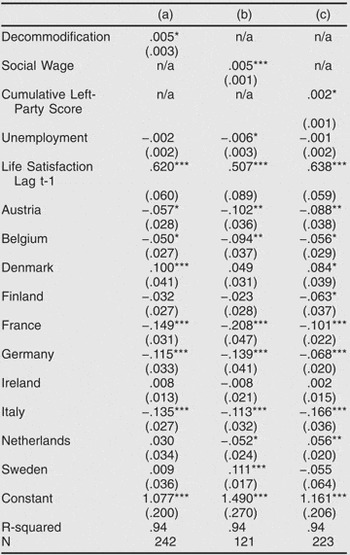
Results are in table 1. As is apparent, each of the three political variables is significant and correctly signed. The implication is obviously that national levels of satisfaction vary directly with the level of decommodification, the social wage, and left-dominance of government.Footnote 52
The welfare state and life satisfaction, European Union 1975–2002

Note: Dependent variable is mean life-satisfaction (1–4 scale). Estimation is with panel corrected standard errors with a lagged dependent variable to control for autocorrelation. Entries are regression coefficients (standard errors). The United Kingdom is the reference category for fixed effects.
* —significant at .05 level
** —significant at .01 level
*** —significant at .001 level
Perhaps the most profitable way of interpreting the magnitude of the impact of the political variables on life satisfaction is to compute the expected change in satisfaction when moving between the maximum and minimum observed values of the former variables.Footnote 53 Doing so indicates a predicted difference of over three-quarters of a standard deviation in satisfaction for decommodification, one-and-a-quarter standard deviations for the social wage, and sixth-tenths of a standard deviation for left party dominance. Clearly, then, the degree of market independence a society provides has a substantive as well as statistically significant effect on the degree to which individuals tend, on average, to find their lives satisfying.Footnote 54
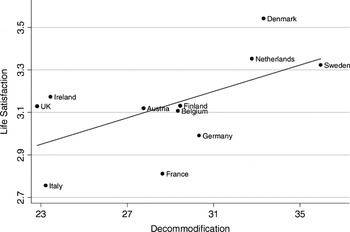
While the multivariate models described above are the best way to appraise the relationships between the welfare state variables and SWB, we can also document the basic patterns through the more intuitive method by illustrating the simple bivariate relationships (using the mean values over time for the welfare state measures and SWB), as provided in figures 1, 2, and 3. The patterns are by no means entirely neat (reflecting the fact that there are indeed other determinants of satisfaction beyond the welfare state) but they do illustrate nicely the basic relationships in question.
Life satisfaction and decommodification

Life satisfaction and the social wage

Life satisfaction and party government

The Industrial Democracies
The results above can be substantiated using an entirely different data collection covering a wider sample of nations by turning to the several waves of the World Values Survey. Our dependent variable is again the national mean of life satisfaction, from the standard question: “All things considered, how satisfied or dissatisfied are you with your life now?” Higher values, of course, suggest greater satisfaction. We compute national values using all waves of the WVS from 1981 to 2000. The number of observations varies by country but averages 3.1.
The principal independent variables are as before: decommodification, the social wage, and left party control of government. The sample now includes the same eleven West European countries, plus the United States, Canada, Australia, New Zealand, Norway, Switzerland, and Japan. Given the small number of time points per country, neither panel-corrected standard errors nor dummy variables are appropriate; instead we rely on a GLS random-effects model to account for the pooled structure of the data.Footnote 55 Given the absence of country dummies, we include the three control variables commonly used in cross-national studies:Footnote 56 a measure of the “individualism” of national cultures,Footnote 57 GDP per capita,Footnote 58 and unemployment.Footnote 59
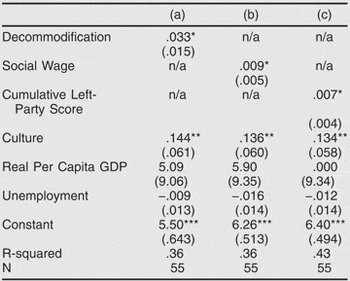
Results are in table 2. As is apparent, theoretical expectations are once again confirmed: the coefficient of each of the variables of interest is significant and of the correct sign.Footnote 60 Interpreting the magnitude of the coefficients (using the same method as earlier) actually suggests a slightly greater overall impact of the political factors on satisfaction: moving across the range of the independent variables in each case suggests a change of more than one full standard deviation in satisfaction.
The welfare state and life satisfaction, industrial democracies 1981–2000

Note: Dependent variable is mean life satisfaction (1–10 scale). Estimation is with a GLS random-effects model. Entries are regression coefficients (standard errors).
* —significant at .05 level
** —significant at .01 level
*** —significant at .001 level
In sum, the data analysis clearly and unequivocally confirms the hypothesis that the welfare state contributes to human well-being. Simply stated, the less people are forced “to behave as commodities in order to survive,” the greater their satisfaction with life tends to be.Footnote 61
Discussion
Albert Einstein posed the question “Why Socialism?” (Reference Einstein1949). The answer he provided was that socialism provided the best method available to “structure society in order to make human life as satisfying as possible.” Much of Einstein's reasoning followed the conventional class-analytical critique of capitalism as a means of production, which we have briefly touched upon above: “workers” (in the most expansive sense, as Einstein puts it, of “those who do not share in the ownership of the means of production”) become prisoners—commodities—within the system of production, such that their lives are characterized by insecurity. To the extent that the welfare state is the emblematic institution of the modern socialist (or, at least, social democratic) enterprise, the evidence presented here would seem to vindicate Einstein's judgment. Whatever else we might say about the welfare state, it does indeed seem to make important contributions to the project of making “human life as satisfying as possible.” We thus echo Einstein by concluding that socialism (at least as represented by its social democratic incarnation) provides what is perhaps our best hope for improving the human condition, in so far as we agree that making “life as satisfying as possible” is the appropriate standard of evaluation.Footnote 62
This is not the most hopeful conclusion to draw given current ideological trends. The welfare state appears to be everywhere in retreat. Across Europe, from Sweden to Germany to the U.K., commitment to the idea of social security in general, and to the idea of “decommodification” in particular, has eroded. In the United States, where the welfare state never coalesced into anything beyond its most minimal and anemic form, these pressures are more keenly felt than ever. More generally the neo-liberal agenda of unfettered markets, privatization, “flexible” labor laws, and lower social spending appears to be advancing nearly unopposed everywhere from Scandinavia to “communist” China, leaving the world to face an ideological hegemony (“the Washington consensus”) unknown since capitalism's inception. If the contentions advanced in this article carry any validity at all, it takes no great insight to deduce the implications for the human condition.
Can we find any other basis for a more sanguine view of the future of human happiness? One possibility is that offered by Robert Lane who, like Robert Putnam, stresses not so much the structure of the economy but rather human connections—supportive and nurturing relationships—as the key to satisfying lives.Footnote 63 Einstein again provides a convenient starting point for considering this approach. He observes, familiarly, that humans have two primary “drives.” One is “private” or “egoistical”; it encourages one to “to protect his own existence” and “to satisfy his personal desires.” The other is “social”; it suggests seeking “to gain the recognition and affection of [one's] fellow human beings, to share in their pleasures, to comfort them in their sorrows.” Both are always present and necessary, of course, but it is “their specific combination [that] determines the extent to which an individual can achieve an inner equilibrium” in which he or she lives life to its fullest. The “relative strength” of these two drives in most persons is in turn determined “by the structure of society” in which they live. Some institutional arrangements push one or other of the drives to dominate in an unhealthy way over the other. Thus, the extent to which people find the correct “inner equilibrium” necessary for a good life is greatly influenced “by the types of organizations that predominate in society.”
Here we come to what Einstein sees as the central problem with capitalism: whatever its many commendable aspects, as an institution it encourages the individual to see society not “as a positive asset, as an organic tie, as a protective force, but rather as a threat to his natural rights … such that the egoistical drives … are constantly being accentuated, while his social drives, which are by nature weaker, progressively deteriorate.” This, then, is Einstein's view of “the real source of evil” in contemporary society: market economies tend to make individuals “prisoners of their own egotism,” so that “they feel insecure, lonely and deprived of the naïve, simple, and unsophisticated enjoyment of life.”
This is precisely Lane's point: what makes people happy is ultimately freedom from the “loneliness” that he sees as responsible for the decline in happiness in capitalist societies. Similarly, Einstein's conclusion would please Putnam and the other proponents of social capital: “Man can find meaning in life … only through devoting himself to society.” By this he means simply an emphasis on the “social drive” so as to build connections and relationships of trust and reciprocity with others, in order to escape being “a prisoner of egotism.”
The circle closes itself when we consider Einstein's suggested cure. Given that the problems he addresses stem from the structural conditions of the market system, the only solution is to replace that system—or, at a minimum, to supplement it with other countervailing institutions that limit its potential for converting human beings into commodities. As we have seen, this is precisely the goal of the social democratic project. We thus return again to the conclusion that the welfare state is an agent of human well-being.