Introduction
Over the past 15 years, the European processing industry has gradually increased the availability of poultry meat in a large variety of processed ready-meals, following market trends from North America (Magdeleine et al., 2008). This shift towards further-processed products has underscored the necessity for higher standards in poultry meat quality in order to improve sensory characteristics and functional properties (Fletcher, Reference FLETCHER2002). The poultry production chain includes a sequence of interrelated phases and the resulting quality of the meat is associated to post-mortem modifications which take place during conversion of muscle to meat. These modifications are strictly related to events occurring during the pre-slaughter period, slaughtering and processing of poultry (Northcutt, Reference NORTHCUTT2001; Sams, Reference SAMS2001). Due to ever growing standardisation of live production factors, the influence exerted by pre-slaughter and slaughtering phases on final product quality may be greater than those attributable to variation in husbandry practises. An understanding of the major issues contributing to meat quality traits is essential if producers are to generate poultry meat of high quality and uniformity.
This paper is divided in two sections, the first provides an overview of the pre-slaughter phases, while the second one focuses on the steps of poultry slaughtering and its influence on product quality.
Preslaughter factors influencing meat quality
At the end of the growing phase, birds are caught, loaded into cages or coops and transported to a slaughterhouse that may be located either close to or far away from the farm. Many problems may occur during this period that potentially increase mortality rate and carcass downgrades as well as impairing meat quality. Moreover, slaughterhouse efficiency depends on bird uniformity and variations in flock responses to changes in conditions during catching, transport, and lairage conditions can contribute to processing yield losses, reduced product uniformity, and decreased product quality. Figure 1 summarizes the main operations and issues concerning pre-slaughter period.
Influence of pre-slaughter factors on product quality.

feed withdrawal
Before birds are caught and crated, feed is removed to allow time for the evacuation of intestinal contents. This reduces the incidence of faecal contamination of the carcass which may occur during slaughtering. Fasting has to be referred to the total length of time birds are without feed before processing including the time the birds are in the farm without feed, as well as the time birds are in transport and in the lairage area at the slaughterhouse. Thus, attaining optimal feed withdrawal requires cooperation and communication between live production and processing personnel. Length of fasting is important because it affects carcass yield (live weight losses), carcass contamination and product safety (pathogenic and spoilage bacteria) and quality (ultimate muscle pH).
The recommended length of time without feed for birds before slaughtering is between 8 and 12 hours, as this allows the majority of the flock to evacuate remaining faecal matter, and minimises any negative effects on body weight and carcass (Bilgili, Reference BILGILI2002; Northcutt et al., Reference NORTHCUTT, BUHR, BERRANG and FLETCHER2003; Warriss et al., Reference WARRISS, WILKINS, BROWN, PHILLIPS and ALLEN V.2004). Incorrect applications of feed withdrawal programmes, which do not allow the minimum recommended feed withdrawal periods of 8 hours, results in an incomplete clearance of the gastrointestinal tract, thus increasing the probability of carcass contamination and cross-contamination during commercial automated evisceration (Bilgili, Reference BILGILI2002; Northcutt et al., Reference NORTHCUTT, BUHR, BERRANG and FLETCHER2003; Petracci et al., Reference PETRACCI, BIANCHI and CAVANI2005). Birds lose 0.18% of body weight per hour during the withdrawal period, to a maximum of 0.42% (Northcutt, Reference NORTHCUTT2001; Nijdam et al., Reference NIJDAM, DELEZIE, LAMBOOIJ, NABUURS, DECUYPERE and STEGEMAN2005a). In the first 4-6 hours, weight loss in birds is mainly due to gastric emptying, so carcass yield is not negatively influenced. After 6 hours, there are losses in moisture and nutrients from body tissues, which can affect carcass yield (Warriss et al., Reference WARRISS, WILKINS and and KNOWLES1999).
catching and crating
Careful bird handling, to reduce trauma, has been reported as crucial factor in reducing mortality and carcass defects (haemorrhages, bruises and broken bones) (Warriss et al., Reference WARRISS, BEVIS, BROWN and EDWARDS1992; Barbut, Reference BARBUT2002; Nijdam et al., Reference NIJDAM, ARENS, LAMBOOIJ, DECUYPERE and STEGEMAN2004). The areas of the broiler most frequently bruised are the breast, wings, and legs. It has been estimated that 90-95% of the bruises found on carcass broilers occurs during the 12 hours prior to processing (Northcutt, Reference NORTHCUTT2001). Manual catching of broilers is usually by the legs, and operatives may carry up to five birds, each held by one leg, in each hand. The potential for trauma is therefore considerable. There is variation between the proficiency of different catching teams implying that training of operators and financial incentive programs would decrease trauma (Nijdam et al., Reference NIJDAM, ARENS, LAMBOOIJ, DECUYPERE and STEGEMAN2004). Mechanical catching systems for broilers have the potential to reduce trauma and mortality. The machines most commonly used in Europe are of the sweeper-type with a vertical three-rotor pick-up head with soft rubber fingers. However, contradictory results have been found when comparing the results on dead-on-arrival (DOA) birds and injuries prevalence as well as meat quality of birds harvested by manual versus machine catching (Nijdam et al., Reference NIJDAM, DELEZIE, LAMBOOIJ, NABUURS, DECUYPERE and STEGEMAN2005b; Schilling et al., Reference SCHILLING, RADHAKRISHNAN, THAXTON, CHRISTENSEN, THAXTON and JACKSON2008).
transport
The birds may be exposed to a variety of potential stressor during transit, including the thermal demands of transport microenvironment, acceleration, vibration, motion, impacts, fasting, withdrawal of water, social disruption and noise (Mitchell and Kettlewell, Reference MITCHELL and KETTLEWELL1998).
Environmental conditions during transport of poultry have been shown to be the main factors affecting live shrink and process yield (Petracci et al., Reference PETRACCI, FLETCHER and NORTHCUTT2001), mainly because birds respond to the increased temperature by increasing panting which alters water intake and body moisture loss profiles (Warriss et al., Reference WARRISS, WILKINS and and KNOWLES1999). Transport of broilers leads to an average mortality of about 0.3-0.4% and mortality rate increases with the length of the journey (Petracci et al., Reference PETRACCI, BIANCHI and CAVANI2005). In an extensive Italian survey, Petracci et al. (Reference PETRACCI, BIANCHI, CAVANI, GASPARI and LAVAZZA2006) observed pre-slaughter mortality of 0.35 and 0.38% in broilers and turkeys respectively. These figures are higher compared to those reported by Warriss et al. (2005), who indicated DOA bird prevalence of 0.126% in UK. Nijdam et al. (Reference NIJDAM, ARENS, LAMBOOIJ, DECUYPERE and STEGEMAN2004) considered 1,907 Dutch and German broiler flocks slaughtered in 2000-2001 at a single processing plant, and found 0.46% DOA. Petracci et al. (Reference PETRACCI, BIANCHI, CAVANI, GASPARI and LAVAZZA2006) determined that the season significantly affected DOA, with pre-slaughter mortality in summer being dramatically higher in broilers (+43%) and turkeys (+59%). In Mediterranean countries, the average air temperature and RH exceed 25°C and 70%, respectively, and during the summer months these environmental conditions during the ante-mortem period can induce heat stress and, subsequently, increase the DOA. Northern European countries have very different environmental conditions. Warriss et al. (2005) found that, in the UK, DOA rates only increased when temperature was higher than 23°C.
The influence of transportation in connection with feed withdrawal on poultry meat quality has been extensively studied. Glycogen reserves can be depleted by prolonged feed withdrawal and the stress of transportation. It has been suggested that glycogen concentration in the liver falls rapidly between 6 and 12 h of fasting (Warriss et al., Reference WARRISS, KESTIN, BROWN and BELVIS1988). The consumption of glycogen reserves determines an increase in muscle pH, leading to a lower degree of protein denaturation with higher water holding capacity and a darker meat colour. Although these effects are not all detrimental to quality, they may contribute to a higher variability in quality. Allen et al. (Reference ALLEN, RUSSELL and FLETCHER1997) reported that darker broiler breast meat with higher pH values was susceptible to faster microbiological spoilage than paler breast meat with lower pH. Delezie et al. (Reference DELEZIE, SWENNEN, BUYSE and DECUYPERE2007) determined the importance of stocking density in transport crates, the effects of which often overwhelmed feed withdrawal and transport.
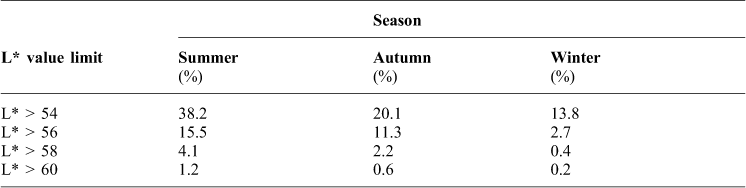
Environmental conditions during transport and holding of the birds affect processing yield and meat quality (McKee and Sams, Reference MCKEE and SAMS1997; Petracci et al., Reference PETRACCI, FLETCHER and NORTHCUTT2001; Bianchi et al., Reference BIANCHI, CAPOZZI, CREMONINI, LAGHI, PETRACCI, PLACUCCI and CAVANI2004; Bianchi et al., Reference BIANCHI, PETRACCI and CAVANI2006a). Among the environmental factors which can determine the PSE-like condition in poultry, heat stress during the end of the growing phase or during the pre-slaughter period seems to play the major role (Petracci et al., Reference PETRACCI, BIANCHI and CAVANI2009). During the summer months, high ante-mortem temperatures affect the post-mortem metabolism of muscle and subsequent meat quality via adrenal or other physiological responses or simply due to fatigue (Warriss et al., Reference WARRISS, WILKINS and and KNOWLES1999; Sandercock et al., Reference SANDERCOCK, HUNTER, MITCHELL and HOCKING2006). Petracci et al. (Reference PETRACCI, BIANCHI, BETTI and CAVANI2004) evaluated seasonal effects on the incidence of PSE meat in broilers. They showed that the PSE breast meat occurrences were 15.5 and 2.7% in summer and winter, respectively, by applying a light measure (L*) cut-off value of 56 (Table 1). Recently Wang et al. (Reference WANG, PAN and PENG2009) found that pre-slaughter exposure to heat reduced the oxidative stability of broiler breast muscle protein, decreasing its functional properties.
lairage
At the arrival at abattoir, crates are unloaded to the lorry and kept in a secure area prior to slaughtering. The majority of abattoirs are provided with a closed area equipped with forced ventilation and water-misting sprays as a control strategy for adverse environmental conditions. In a few cases, this area is outside and is equipped with a roof to protect the birds against sunlight and rain. It has been observed that holding birds at different temperatures can influence some meat quality properties. There are reports of lower pH from birds kept at elevated temperatures compared to broilers held in cooler conditions (Holm and Fletcher, Reference HOLM and FLETCHER1997; Petracci et al., Reference PETRACCI, FLETCHER and NORTHCUTT2001). McKee and Sams (Reference MCKEE and SAMS1997) observed that turkeys subjected to elevated temperatures prior to slaughter exhibited more PSE meat characteristics. Moreover, Warriss et al. (Reference WARRISS, WILKINS and and KNOWLES1999) indicated that holding broilers for more than 1 hour prior to slaughter resulted in higher breast pH due to effects of glycogen muscle depletion.
Comparison of the incidence of pale breast meat under different L* value limits during summer, autumn and winter (modified from Petracci et al., Reference PETRACCI, BIANCHI, BETTI and CAVANI2004).

Slaughtering factors influencing meat quality
Nowadays processing is a highly coordinated system of mechanised operations that kill the birds, remove the inedible portions of the carcasses, and package/preserve the edible portions of the carcass for distribution to the consumer (Sams, Reference SAMS2001). Figure 2 summarizes the main operations and issues concerning slaughtering process.
Influence of slaughtering factors on product quality.

hanging, stunning and killing
Stunning before slaughter is a statutory requirement in the EU to induce unconsciousness and insensibility (inability to perceive stimuli) in animals, so that slaughter can be performed without fear, anxiety, pain, suffering and distress on the part of the bird. The most widely used stunning system of poultry is electrical stunning. However, under certain conditions, electrical stunning can result in carcass and meat defects like broken keels and wings, engorged wing veins, red wing tips and broken capillaries in the breast muscle, mainly due to muscle super-contractions, and subsequent haemorrhaging in muscle tissue caused by rupture of blood vessels and damage to muscle fibres (Northcutt et al., Reference NORTHCUTT, BUHR and YOUNG1998; Fletcher, Reference FLETCHER1999; Savenije et al., Reference SAVENIJE, SCHREURS, WINKELMAN-GOEDHART, GERRITZEN, KORF and LAMBOOIJ2002). The animal welfare issues and product quality problems due to the use of high current electrical stunning in Europe have promoted the development of alternatives, such as gas stunning. Gas stunning has a high potential for humane stunning or stun-to-kill, it requires sophisticated and expensive technical equipment and has the main advantage of moderate handling stress of the birds. During gas stunning, the birds are exposed to gases which may induce either anaesthesia (carbon dioxide) or anoxia (argon and nitrogen) (Sams, Reference SAMS2001). One of the main advantage of gas stunning is represented by the fact that, in some automated systems, birds can remain in transport crates from the time they are loaded at the farm until they are stunned, reducing both animal distress and subsequent carcass defects (broken bones, haemorrhages, etc.) associated with unloading live birds from crates and hanging them to the shackle line by their feet (Barbut, Reference BARBUT2002). Besides haemorrhages and the other carcass defects, comparisons between electrical and gas stunning systems have outlined the existence of differences in muscle metabolism in initial post-mortem periods, as well as final meat quality traits (Raj, Reference RAJ1999 and 2004). However, contradictory results have been reported, especially when different stunning conditions were compared. When argon is used as stunning gas, the induced anoxia has been reported to accelerate rigor mortis development due to a rapid decrease in pH caused by anoxic convulsions (wing flapping) during death. This increased the post-mortem utilisation of ATP by the muscles and allowed boning of the fillets at earlier post-mortem times without impairing meat tenderness (Raj and Nute, Reference RAJ and NUTE1995; Sams and Dzuik, Reference SAMS and DZUIK1999). Other researchers reported reduced carcass damage with gas stunning, but did not show less breast meat ageing requirements before boning (Hirschler and Sams, Reference HIRSCHLER and SAMS1993). Bianchi et al. (Reference BIANCHI, PETRACCI and CAVANI2006b), when comparing electrical stunning with gas stunning in turkeys, found a lower incidence of engorged wing veins and a tendency for less breast cuts with blood spots in animals stunned by gas system. Moreover, when the boning was conducted at 6 h post-mortem (commercial boning time), gas stunning resulted in lower shear values of cooked breast meat. In a subsequent study with broiler chickens, Bianchi et al. (Reference BIANCHI, PETRACCI and CAVANI2008) confirmed the lower incidence of breast meat defects obtained with gas stunning over electrical stunning. Recently Battula et al. (Reference BATTULA, SCHILLING M.W., Y., BEHRENDS, WILLIAMS and SCHMIDT2008) proposed the use of low-pressure gas stunning (597 to 632 mm Hg) and found only minimal meat product differences compared to electrically stunned broilers. However there are still some animal welfare concerns associated with gas stunning in poultry.
After stunning, the birds are hung by their feet on the slaughtering line, and are killed by cutting the jugular veins and carotid arteries on one or both sides of the neck. Once the neck has been cut, the birds are allowed to bleed for 2-3 minutes. During this period the bird loses most of its blood, which eventually causes brain failure and death. Insufficient blood loss due to bad neck cutting can cause residual blood, which engorges blood vessels, and the absence of muscular contraction favouring the emptying of blood vessels. This can produce carcasses with visible engorged veins and dark meat (Raj, Reference RAJ2004).
scalding, plucking and evisceration
The scalding procedure is used to open the feather follicles to facilitate the removal of feathers. Carcasses are passed through one or more scalding tanks filled with hot water at temperatures regulated depending on the final product required. For the fresh market, scald temperatures of between 50 and 52°C (‘soft’ or ‘semi-scald’) are used, whereas for older birds and frozen meat products a ‘hard’ scald at 56 to 63°C can be employed. Soft-scalding conditions do not cause appreciable damage to the outer skin layers, the stratum corneum or cuticle. Because it maintains the yellow-pigmented layer of the skin intact, soft scalding is the preferred method for producing fresh poultry with yellow skin. Such skin colour is highly desired in some parts of the world as it is viewed as an indicator of ‘corn-fed’ or healthy birds (Sams, Reference SAMS2001). Other options include spray or steam scalding and combined scalding and plucking, during which hot water sprays are employed. However, spray scalding may have an adverse effect on carcass appearance, since steam causes damage to the outer cuticle of the skin, which makes it unsuitable for the chilled-product market (Barbut, Reference BARBUT2002).
The de-feathering process involves a series of high speed rotation of multiple metal discs bearing rubber ‘fingers’. While rotating rapidly, the fingers rub against the carcass and abrasion pulls out the loosened feathers. By combining a series of these rotating dusters of fingers, each directed at a different region of the carcass, the whole carcass is plucked. Plucking machines with fingers adjusted too close to the bird may cause skin tears in the thigh and breast regions and broken wing, leg, and rib bones. Machines that are too distant may not adequately remove the feathers. This phase is also critical for bacterial cross-contamination of carcasses originating from the contact of skin and the tools or the machines used for de-feathering (Mead, Reference MEAD2004).
Evisceration is the removal of viscera by using a series of interconnected machines. Reducing faecal material at slaughter is an important practice which reduces contamination during processing which can occur either because of leakage of the contents of the intestinal tract onto the carcass, or through spillage resulting from ruptures of the gastrointestinal tract and viscera during evisceration. Incidence of faecal contamination, assumed to be primary pathway for pathogenic contamination of carcasses, can be used as an indicator of process-control during slaughter (Russell, Reference RUSSELL2001; Mead, Reference MEAD2004). Poultry carcasses are often trimmed during evisceration to remove damaged areas of the carcasses. Castañeda et al. (Reference CASTAÑEDA, HIRSCHLER and SAMS2005) found that trimming carcasses by wing or breast fillets removal can result in decreased meat tenderness.
chilling
After evisceration, carcasses are submitted to chilling. The primary objective of chilling is the reduction of microbial growth to a level that maximises both food safety and shelf-life. Rapid chilling of carcasses serves to increase the firmness of the muscle and stiffness of the skeleton to facilitate portioning and deboning. The most common method in Europe is air chilling, while water chilling is the almost exclusively the method adopted in the US. These methods have a very different effect on product yield and quality (Sams, Reference SAMS2001).
Air-chilled poultry carcasses usually exhibit a slight weight loss during chilling, while water-chilled carcasses gain weight up to 12%. The advantages of air chilling are:
• no moisture pickup
• a drier final product that does not show exudation (drip loss) when packed in trays.
To enhance cooling and prevent over-drying the skin, the product can be sprayed with water, which absorbs heat as it evaporates. Contradictory results were found when evaluating microbial quality (Mead, Reference MEAD2004). Recently Berrang et al. (Reference BERRANG, MEINERSMANN, SMITH and ZHUANG2008) found that both methods were effective in lowering carcass temperature, and neither chilling method seemed to select for specific species, sub-types, or antimicrobial-resistant bacteria.
The increase in moisture caused by water-chilling affects carcass appearance by modifying skin colour. Huezo et al. (Reference HUEZO, SMITH, NORTHCUTT and FLETCHER2007) found that the skin of air-chilled carcasses appeared ‘dried out’ during cooling, and became more translucent when compared with the water-chilled carcasses. As a result, the appearance of the skin of air-chilled carcasses was darker than water-chilled carcasses, because underlying muscle was visible through the skin. Carroll and Alvarado (2008) found that air chilling may improve colour, marination yield, tenderness, and increase shelf-life of retail-packaged broiler breast fillets. On the contrary, Zhuang et al. (Reference ZHUANG, SAVAGE, SMITH and BERRANG2009) stated that sensory flavour and texture quality are not influenced by chilling method if homogeneous deboning time is considered.
processing
Once the birds have been converted into carcasses and chilled to the required temperature, they can be packaged and marketed whole or be converted into portioned or boneless meat. The market shift towards further processed products has pushed processors towards boneless breast meat for not only quality and uniformity, but also for efficiency (Sams, Reference SAMS2002). If the carcass is cut up into parts, or if the breast meat is removed from the carcass prior to the completion of rigor mortis, the muscles will be unimpeded by normal skeletal constraints, the muscle fibres will contract and shorten, and the resulting meat will be less tender. It has been argued that a minimum of 4-6 h ageing is required to allow the breast muscles sufficient time to complete rigor development and to allow subsequent removal from the carcasses without excessive toughening (Fletcher, Reference FLETCHER2002). Because carcasses usually complete water immersion chilling at about 1.5 h post-mortem or air chilling by 2-3 h post-mortem, the carcasses need to wait an additional 2.5-4.5 h in refrigerated storage before deboning (Sams, Reference SAMS2002).
Clearly ageing is an expensive process with the majority of the costs being associated the loss in meat yield and energy, so extensive research has been carried out to develop slaughter methods which allow for acceleration of post-mortem rigor mortis, allowing cut up and deboning as soon after slaughter as possible (Fletcher, Reference FLETCHER2002; Sams, Reference SAMS2002). A promising method is electrical stimulation of the carcass immediately after death. The application of electrical stimulation can reduce the need for ageing carcasses before deboning by accelerating the energy depletion involved in rigor mortis development to decrease the shortening-related toughness of early deboning. Some electrical stimulation systems have the additional effect of inducing physical disruption in the muscle, reducing muscle integrity (Sams, Reference SAMS2002).
Conclusions
In the present paper it has been discussed how poultry product quality is affected during ante-mortem and slaughtering phases under commercial conditions. Major sources of concern during the pre-slaughter period include the methods of catching and crating birds, environmental conditions in transit and long journeys. Amongst the slaughtering factors, stunning and chilling conditions as well as early deboning can exert the most important effect on carcass and meat quality. In the future it is likely that further development of carcass and meat quality on-line evaluations will be employed to provide feedback on the slaughter line to optimise meat quality and uniformity.