INTRODUCTION: INFOTRACK
InfoTrack opened its UK office in July 2015 and in just over 3 years, has grown to a business servicing nearly 1,300 firms across the UK. In those three years, InfoTrack has won a total of 10 industry awards including Best Technology, Best Service Provider, Best Innovation, Best Search Provider and Supplier of the Year to name but a few. When I joined the executive team in 2016, I was already aware of the InfoTrack name from my days working in Australia and I knew them to be a key supplier to many firms there. Indeed, InfoTrack work with 70% of the market in Australia today. Knowing about the ability of InfoTrack to really deliver exciting new products and with my own vision to deliver services to law firms that would enable them to find accurate company information, faster, joining them was a simple choice.
We have a unique approach to the market which blends the use of technology with a level of service and experience that supports clients. Indeed, there are plenty of examples whereby clients have asked for specific products and very quickly, we are able to respond, build and release. In several cases, products have been conceptualised, built and released within the space of a week. Within this article, I will provide the different attributes that we consider in developing InfoTrack and how, by paying attention to market needs, they allowed us to quickly forge ahead and deliver multiple benefits to our client base.
TECHNOLOGY IN LAW FIRMS
Having attended numerous law conferences, I always find there is someone who will suggest that technology used by solicitors is outdated – but in my opinion, that is not necessarily the case. A better way of looking at it is to ask whether law firms are using the right technology, because it is technology that can be pivotal to how you service your clients, how you can add value to your business and create a point of difference.
It is my opinion that, unfortunately, the legal market has been let down by false dawns and unfulfilled promises by tech providers, and this has led to law firms continuing to do what they have always done, rather than asking themselves what's best for them, their staff and their clients. The technology that exists for law firms has become disparate and tends to work in isolation, meaning that law firms are having to visit multiple websites to conduct their tasks rather than through a central hub - the CMS. How is it then possible to believe any advertising that states ‘We'll make you more efficient and more profitable’. Those working in law firms then have a mindset of thinking everyone is the same.
For me, law firms need to remain open-minded, curious and garner an education around the market. That's not easy. So, what is our view of the market and what should we be considering?
WE ARE EVER MORE DEMANDING
In many client facing industries and professions, the landscape is constantly changing, with consumer attitudes toward technology and services advancing rapidly. It's already visible within the motor industry for example. It's a rainy Sunday afternoon at home, and you are thinking about buying a car. If it is a new car, we are more likely to go direct to a manufacturer's website and configure a vehicle to our own specification to get an idea of what it will be like first. Manufacturers are good at giving a breakdown of costs very early in the purchase, to tempt you into buying from them. To do that, they also incorporate insurance, finance and road tax into that price, so although you are dealing with DVLA, insurance and finance companies, you are doing it all through one place rather than visiting multiple places. It's even possible to live chat for immediate answers to questions. Today, we no longer must enter the building to make an enquiry and establish a price. That's what we have become accustomed to in terms of immediacy of service and that's also the way we as consumers, work ourselves.
Whilst we may not want to be compared with car manufacturers, there is no denying that they have developed an effective approach. From being able to provide transparency through price at the early stages using technology, they can appeal to their customers faster and give them the information they need to make decisions throughout the process, all from a single place.
At the recent London LPM conference, a question was asked as to whether technology should be focused for Generation X rather than the millennials. The reality is that technology is being adopted and used by people of all ages, both in their personal and professional lives. That's because it's developed into being incredibly intuitive and easy for people to use. Look around you and you'll see people of all ages using technology already. Think about what apps you are using on your smart devices right now.
Are you using Uber, or a bank account app via your mobile? Do you have an Amazon Echo or a Google Home in your house? Such is our demand for immediate responses, these assistants are now making it easier to ask a question and receive an immediate response. That's responding to a need to be more efficient than keying in a question to Google. Our behaviour has been influenced by this type of technology – the kind that is responding to a need - a more efficient way of finding information.
The shift continues to be driven by businesses (start-ups and established) implementing technology that offers a smarter way of conducting tasks and that in turn encourages people down this route, no matter what their age is.
Peter Carr of Fisher Jones Greenwood (FJG) was on the aforementioned panel, and he discussed their recently implemented chatbot - a form of artificial intelligence that enables the client to ask specific questions of that firm, in order to make a decision. Although this is not currently commonplace, I believe this approach to be correct, as FJG demonstrate how they really are catering for the consumers of the now and an understanding of how they behave with technology. Ultimately, whether the time is now or in the future, they will be ready and able to deliver on their client needs which is immediacy, because with the likes of Amazon's Alexa and Google Home, we are now interacting in a very different way, and we are becoming accustomed to having immediate responses and to conversing with something that isn't actually human.
THE MEANING OF ‘SERVICE’ CONTINUES TO EVOLVE
Working in what is essentially a service-based industry, we should question and delve into the meaning of ‘service’. Ultimately, recent research tells me it no longer means simply giving your clients a phone call and an update, the word service has naturally evolved to incorporate technology. Service now means, ‘are you talking to me in the right way?’, ‘are you communicating with me using the method I prefer?’ and even ‘are you operating at a time convenient to me?’. Servicing new business doesn't have to be tricky if you have the right technology in place but remember that it all starts with that all important first impression. The word ‘service’ suddenly starts to morph into ‘experience’. According to the Customer 2020 Report, by 2020, customer experience will overtake price and product as the key brand differentiator.
So, think for a moment on how your firm quotes for new business. How long does it take from a phone call, to sending it out? If you are unable to quote on the phone or with immediacy, you may have lost them to another firm who can conduct the same task within a minute or two, who can provide the information over the phone, or electronically via their website. Recent InfoTrack research demonstrates that 39%Footnote 1 of consumers purchasing law firm services now look to instruct on the first quote. Interestingly this has decreased from 50%1 some years ago because people now often request multiple quotes. It stands to reason that if they can't get that quote from their couch on a Saturday evening via one firm's website, they simply move onto one that can generate the information they need immediately, and that provides them with the ability to hit instruct at a click of the mouse. This principle applies to all businesses today in that experience is everything.
We agree that you can no longer apply just a level of service. Instead, we need an experience from beginning to end, whether that's just a click and buy experience or when an ongoing service is required. Essentially, the word service has evolved, and we now expect an experience over a service – it is what customers are now demanding.
NO REPLACEMENT FOR EXPERTISE
With all these technological advancements, I believe that technology alone cannot replace expertise. But what is expertise? Will AI take our roles? Whilst it is crucial to continue to adopt technology, we still need to ensure that the information used to inform decisions, or choice, is accurate and up-to-date. Using the likes of Companies House Service (Beta) is no guarantee of being complete and, as such, it quickly becomes inaccurate. It may appear ‘free’ but often there's a reason there's no charge and this impacts the risk to your law firm and, in the longer term, the reputation that has taken years to build.
The rapid development of technology such as Google has led us to expect everything to be freely available and accurate, but the reality is that we do not use Google like that. Whether I'm searching for a film, builder, a car or simple information, I'll start at Google and delve into the first result. However, I'll then cross reference it with information from other sources as well – for a film, I'd use Rotten Tomatoes, IMDB and others, for example. That helps me build a fuller, informed picture, and I'm able to make an informed decision.
PUTTING VALUE INTO YOUR FIRM
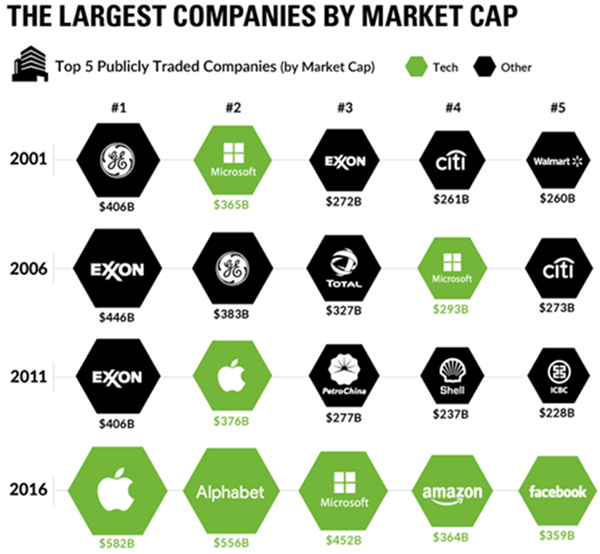
The value of technology cannot be understated within a law firm. Not only does it allow you to deliver on the needs of clients, the implementation of technology means you apply real value to your business. In 2006, the biggest businesses in the world by market cap were generally oil giants such as Exxon and Total. By 2016, however, this same chart is occupied by technology companies, including Alphabet, Facebook, Apple and MicrosoftFootnote 2 (see figure 1). Similarly, in April 2017, Ford, the largest manufacturer of vehicles in the world, was knocked off its perch of market value by Tesla.Footnote 3 The importance here is to understand that by placing technology at the heart of a business is now where the value is seen. Indeed, you can view Ford as an automotive brand, trying to become a technology business, whereas Tesla are very much a technology brand with an automotive business. The value is in the technology. That's no longer lost on Ford with their Global CEO, at the time, admitting that simply building vehicles is no longer going to win them back market value.Footnote 4
The world's largest companies are now technology businesses.

Although law firms can build their own technology, this naturally comes with high maintenance costs, a continuous investment of funds and the employment of specific departments to maintain and build integrations. There is also a risk that a lack of expertise in dealing with certain data sources, government APIs and the like could place the firm further behind the curve, having to learn lessons that the legal tech providers learned back when they were entering the legal tech arena. Thankfully, there are several legal tech providers now incorporating solid third-party integrations, particularly in the case management area, so your firm doesn't have to. Also, at this lower price point, firms of any size can have access to the same powerful integrations that can help deliver the best possible experience for users and service to clients, whether it is procuring information or creating seamless workflows.
MANAGING CHANGE
There are barriers to change within any organisation, change is huge and is resisted by staff, management, and there is always a reason to say no, or an excuse to avoid it. The reality is, clients and consumers are changing, and firms need to move with the times. When implementing change, it is important to bring the staff on that journey and ensure you sell them the benefits in terms of their time, so they can buy-in to it.
Employees need to have a balance in their lives, if you can sell the benefits of saving time through the benefits of great technology, you can also help them understand how simple it can be. Demonstrate the positive points most relevant to them, the simplicity and ‘smartness’ of the technology, and employees are much more likely to want to come on that journey with you. Choose your suppliers carefully, select those who will be able to offer you that future technology that allows you to change the game, that allows you to win new business, and allows you to deliver different aspects of what I have talked about throughout this article.
BEING DIFFERENT IS POSITIVE
To see what impact adoption of technology can have on a business, law firm or otherwise, we can reflect on the stories illustrated by Kodak, Blockbuster and many others who failed to adopt future thinking technology at pivotal times, refusing to change. Around the world, there are around 11,000 start-ups created every hour,4 of which, many are beginning to offer legal services. These are the businesses that will be building and competing with law firms in a very short space of time, and firms need to be prepared. There is an immediate opportunity for law firms to start thinking about how technology can be utilised to give them a real edge.
Using the right technology not only gives you efficiency, it gives you a differentiation that stands you apart from the rest. That's important because the InfoTrack research suggests that people struggle to see the difference between solicitors, which when coupled with the inability to get an immediate response, leads them to shop around. However, if you've got an ability to quote immediately, to send contracts and information out via a portal, to have documents signed electronically, to provide a streamlined and seamless online service, it really will stand you apart from your competition. Using the right technology empowers you, whether it's AI or simply easier, more enjoyable technology that performs multiple tasks and reduces the amount of rekeying.
I believe businesses can today be categorised into three buckets – irrelevant, momentary and relevant. Those who are ‘irrelevant’ do not observe, do not listen and do not react – think Toys R Us and Blockbuster. ‘Momentary’ businesses follow trends and react to behaviour – think about taxi services nowadays. However, those who are ‘relevant’ engage and inspire, adapt and pro-actively shape experiences. Being different relies on remaining ‘relevant’.
Steve Jobs alluded to the notion that if clients are asking for technology you are possibly already too late. We, as customers, never ask any businesses for change or for specific technologies – that would be too easy – but we absolutely will always find and gravitate towards a better solution. For example, we know postage is a costly overhead for law firms, yet it is still used as a method of sending documents but ask yourself, do your clients expect to receive them in the post or do they expect to digitally sign them? Using digital signatures will start to place law firms in the ‘relevant’ bracket.
At InfoTrack, we realise the need for law firms to operate in the relevant bucket and we are now seeing a shift where clients are finding InfoTrack themselves.
INFOTRACK GIVES YOU THE TOOLS TO BE DISRUPTIVE
InfoTrack is a disruptor and by being a disruptor, we remain relevant. However, to remain relevant, we constantly look for insights by listening and observing and develop to the market needs. Only then can we challenge the norm and help law firms evolve in keeping with the market.
Our approach has been successful, and we are now an established supplier to law firms across the UK. Our ability to integrate with registries in the UK and across the world means that law firms are now not only saving time logging in to different sites, they are obtaining results that are accurate and delivered fast in a pay as you go format. Through our technology we are providing law firms with a fuller picture and by pulling data from multiple sources into one single place. This is evidenced across our three main areas of business; UK company information, international company information and UK conveyancing services.
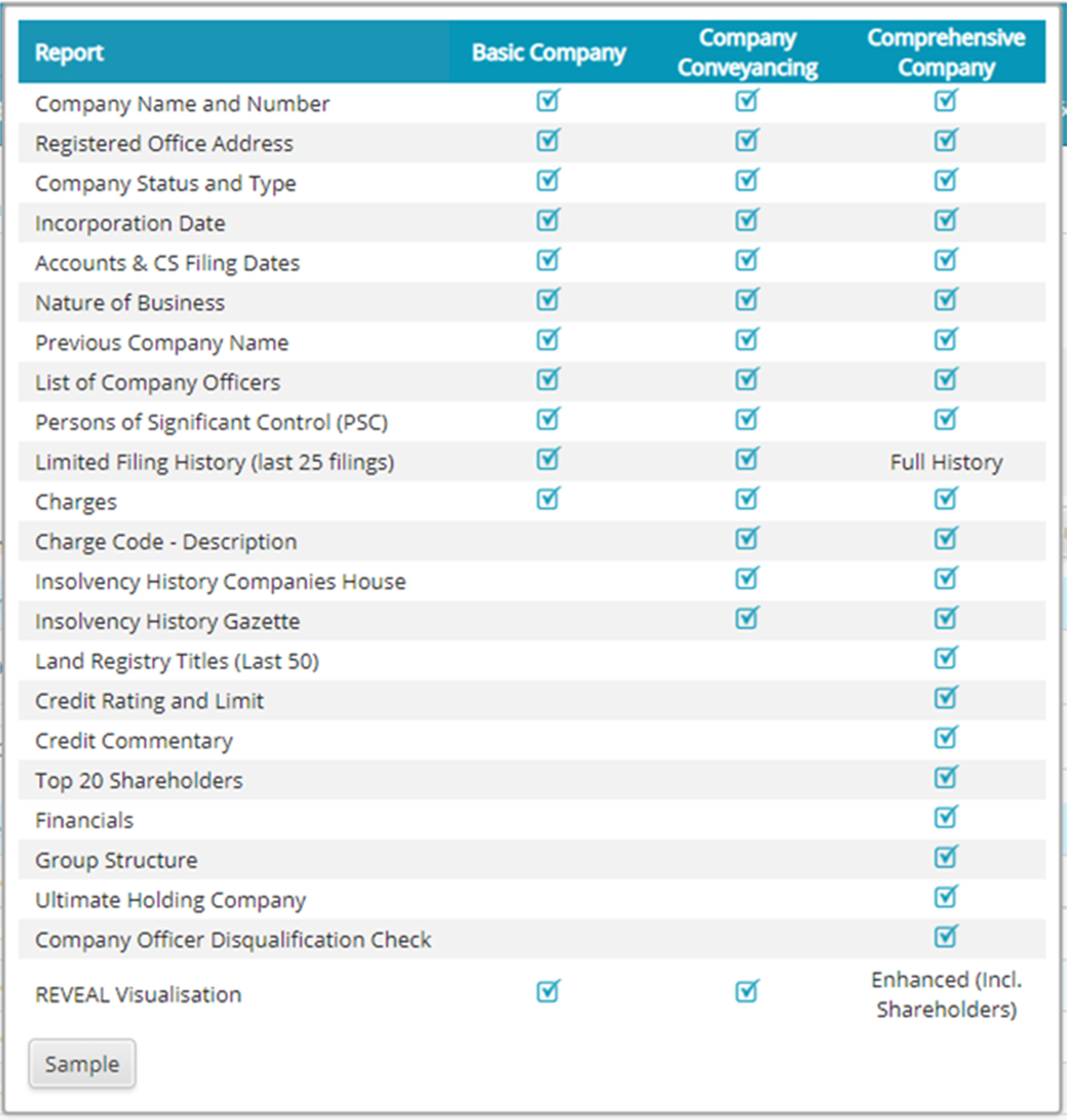
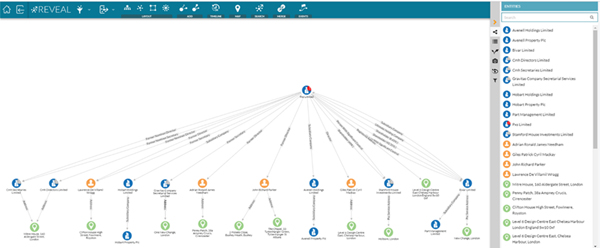
In the case of our ‘UK Comprehensive Company Report’ (see figure 2) we uniquely access and cross reference; Companies House Direct, Companies House Service (Beta), the Land Registry, Disqualified Directors Database, CH Dissolved Companies Database, Creditsafe, Dow Jones and the Gazette. Despite having to access 8 separate live repositories, the report is compiled within just 90 seconds and is available to order 24/7. In addition, we also visualise the company structure using our ‘REVEAL’ capability (figure 3). This all helps to create that great experience from beginning to end and to make our clients more relevant whilst saving them time and money and mitigating risk.
An InfoTrack ‘UK Comprehensive Company Report’ provides a full picture of the history and current state of any company.

Data visualisation is making it easy for clients to spot trends faster as with InfoTrack's ‘REVEAL’ capability.

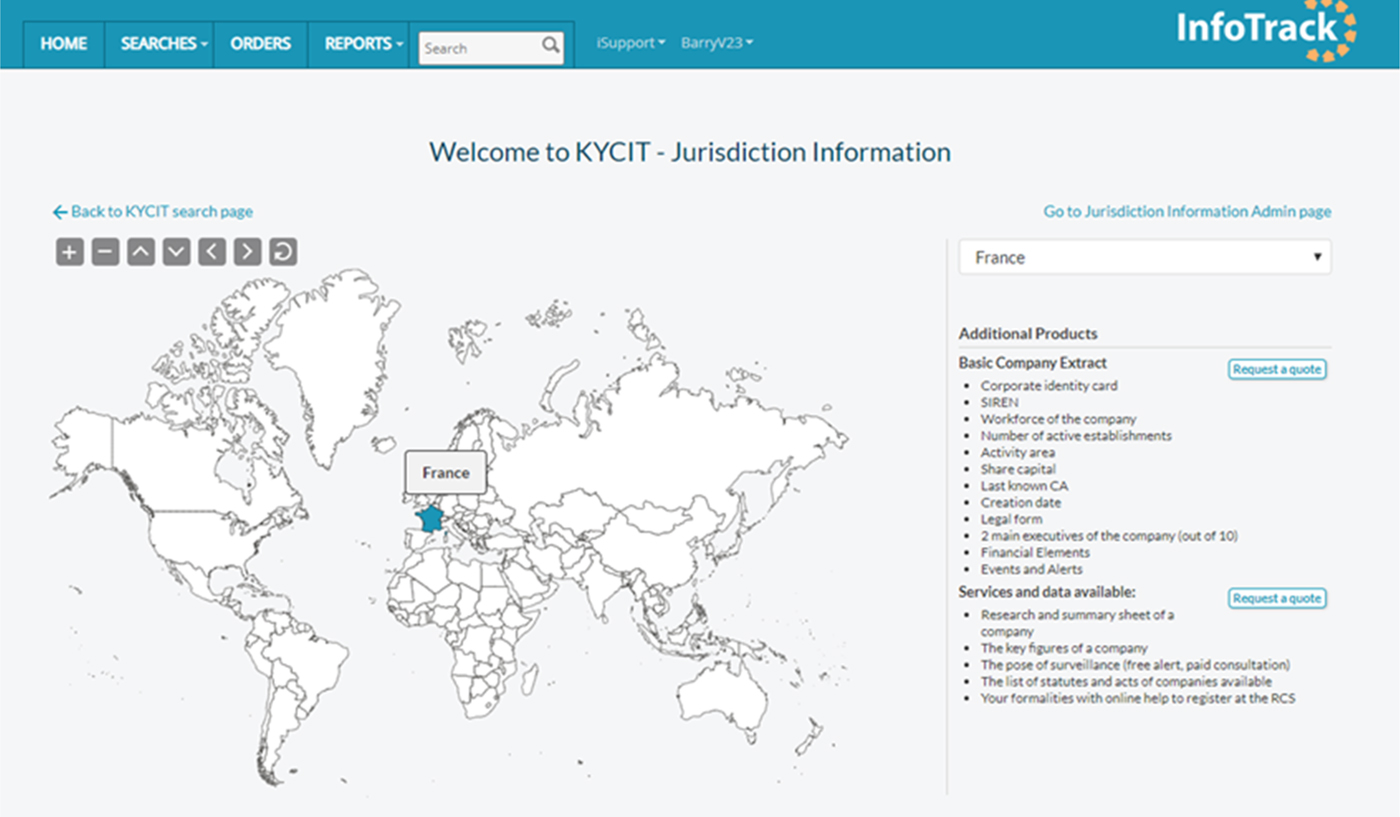
International Company Information is available through the InfoTrack KYCIT portal, and this allows clients immediate access to a range of partner company reports such as BvD Orbis, Dunn & Bradstreet, Creditsafe and Dow Jones, as well as providing access to our International Company Researchers both here and in Australia, who in turn have access to over 200 jurisdictions around the world. Clients are therefore able to lookup company names to ascertain what reports or documents are available, use our researchers or use the jurisdictional map to find out the filing requirements and possible reports available from that area (figure 4).
Interactive map to make it easy to find whether information is accessible.

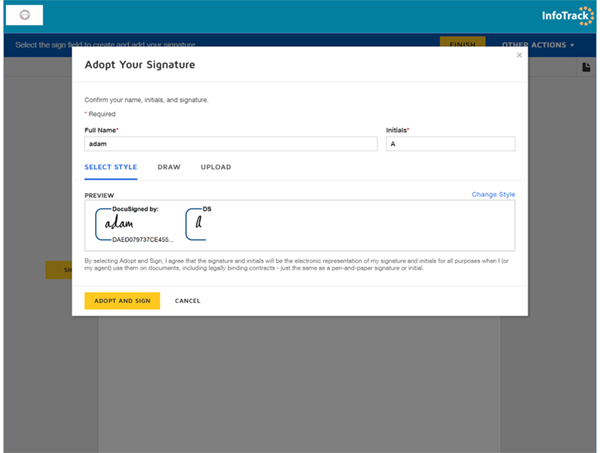
In response to growing expectations in the conveyancing process and the appetite for information in real-time, InfoTrack have developed the ability for clients to send their own care letters, client questionnaires (including TA6, TA7 and TA10) and other documentation to clients without needing to scan, print or post. Including electronic signatures, it's proving to be a very innovative approach to how clients, and their own clients, now expect and want to do business (figure 5). The benefits are more than just a unique positioning however as it is this thinking that enables firms to improve time savings and create cost efficiencies, for all parties involved in a transaction.
Electronic signatures deliver an improved experience and create cost efficiencies.

In the immediate future, law firms require disruptive tools that will serve to position themselves differently whilst ensuring the overheads are minimised. InfoTrack have devised those tools that enable law firms to be disruptive and profitable, without removing the ability for them to continue to provide their expertise.
We will continue to be disruptive through innovation whilst, at the same time, focusing on what law firms themselves require which, in my opinion, is to remain relevant now and in the future. Both InfoTrack and I can help you.