INTRODUCTION
Interspecific interactions and their role in structuring helminth communities in freshwater fish are currently a topical issue (Bush & Holmes, 1986; Stock & Holmes, 1987, 1988; Rohde, 1979, 1991, 1998; Kennedy & Guégan, 1996; Kennedy & Hartvigsen, 2000; Poulin, this volume). There is evidence from mammalian hosts that interspecific interactions may involve immune responses (Holland, 1984, 1987; see also Behnke et al. and Cox, this volume) in one way or another, but there is little evidence that these are of importance in fish hosts. Evidence for interspecific interactions between helminths in fish is seldom direct. Interactions have been reported for monogeneans on gills and generally are deduced from observations on the decline of one species in the presence of another (Kennedy & DiCave, 1998) or from a niche shift or resource partitioning between species within a habitat (Buchmann, 1988). In the view of some workers, notably Rohde (1979, 1991, 1998), they are of infrequent occurrence and little or no ecological significance as niche restriction can be explained in other ways.
Inter-specific interactions between species in fish intestines have often been deduced from evidence of niche shifts by one species in the presence of another (Chappell, 1969; Halvorsen & Macdonald, 1972; Grey & Hayunga, 1980) or, more rarely, from the decline of one species in the presence of another (Kennedy, 1992) or the exclusion of one species by another (Kennedy & Hartvigsen, 2000). Direct, experimental evidence for interspecific interactions is difficult to obtain and hence very scarce, the studies of Bates & Kennedy (1990, 1991) being a rare exception. Most of the known examples involve an acanthocephalan and/or a cestode and in no case has the resource for which the species compete been identified with certainty, nor is the mechanism of the competition understood. It is frequently suggested that there is direct competition for nutrients or for intestinal space which, in turn, may provide access to nutrients. It is generally accepted that interspecific competition is not common, partly because resource partitioning in space is common and will serve to avoid it (Holmes, 1973) and partly because co-existence of potential competitors is possible if both species show overdispersed distributions throughout their host populations (Dobson, 1985).
Examples of competition from other sites within a fish are very scarce indeed but one such involving metacercarial stages of three species of diplostomatid digeneans in the eyes of perch, Perca fluviatilis, has been reported from a small lake, Slapton Ley, in Devon. The earliest study of the parasites of fish in this lake reported only Diplostomum spathaceum, although it was recognized that some individuals were found in the lens and others in the humour of the eye (Canning et al. 1973). A later study by Kennedy (1975) recognized the discrete identity of the individuals from the humour as belonging to the congeneric species D. gasterostei. This same paper also reported the appearance of metacercariae of Tylodelphys clavata in the humour of eyes of perch in October 1973, coincident with, and believed to be causally related to, the commencement of breeding by the Great Crested Grebe, Podiceps cristatus, in the lake. The population biology of D. gasterostei and T. clavata in perch in the lake was studied by Kennedy & Burrough (1977), who reported that the abundance of T. clavata increased rapidly whilst that of D. gasterostei remained relatively steady. A second species of Tylodelphys, T. podicipina, first appeared in the lake in 1976 and the metacercariae of this species also showed a preference for the humour of perch eyes (Kennedy, 1981a). As the abundance of this species increased, it became clear that that of D. gasterostei was simultaneously declining (Kennedy, 1981b). Two processes were believed to be involved in this decline: a decrease in the proportion of fish harbouring heavy infections of D. gasterostei which was significantly negatively correlated with the increase in population abundance of T. clavata in the eyes of perch and a dramatic decline in the rate of recruitment of D. gasterostei into young perch in 1978 and 1979, which coincided with the increase in infrapopulation density of T. podicipina in perch. It was thus suggested that the two species of Tylodelphys were interacting negatively with D. gasterostei, to the detriment of this latter species.
It was not possible to test this hypothesis directly or experimentally for a number of reasons. Nevertheless, interspecific competition was accepted as the most plausible explanation by Dobson (1985) who cited this as an example of exploitation competition. Meanwhile, the long-term monitoring of the helminth populations in perch, begun in 1973, was continued and a further paper on T. podicipina only appeared (Kennedy, 1987). In the winter of 1984/85 the lake froze over, winterkill caused a massive crash in the populations of perch, roach, Rutilus rutilus, and rudd, Scardinius erythrophthalmus, and their parasites, and hardly any fish were caught until 1990 (Kennedy, 1996; Kennedy, Wyatt & Starr, 1994). This provided an excellent opportunity to test the conclusions reached on the basis of the earlier pre- 1985 studies, i.e. it represented a natural experiment. The recovery of the parasite populations was therefore monitored very closely up to the present (Kennedy, 1998).
The result is a 29 year data set, comprising samples taken over 15 years before the crash, intermittently during the crash and over a period of 10 years since the crash. The changes in population levels of the three species in the eyes of perch up to 1979 have already been published (Kennedy & Burrough, 1977; Kennedy, 1981a, b, 1987), but are also summarized here for clarity and to provide a comprehensive account. Changes in the population levels in the years immediately preceding the crash, and during and after the crash are the subject of this present paper, which also focuses on the decline in population size of D. gasterostei over the whole 29 year period. Additional data on the site of the three species within the humour of the eyes of perch are also presented. The overall aim is to test the hypothesis that interspecific competition occurs between the two species of Tylodelphys and D. gasterostei by examining the changes in the abundance of the three species from 1980 onwards and comparing these with the population changes before the crash with a view to determining if the same patterns are repeated over the period of recolonization.
MATERIALS AND METHODS
The study locality, Slapton Ley, Devon (NGR SX825440) is a small, shallow, eutrophic, freshwater coastal lake. Brief descriptions of the catchment and basins are given by Burt & Heathwaite (1996) and Johnes & Wilson (1996). A recent history of the fishery is given by Kennedy et al. (1994) and Kennedy (1996). The parasites all occurred as natural infections in the eyes of perch. The definitive host of T. clavata and T. podicipina is believed to be Podiceps cristatus: that of D. gasterostei is unknown. The first intermediate host of T. clavata and T. podicipina is Physa fontinalis, whereas that of D. gasterostei is Lymnaea pereger. Samples were taken at least once every year, but the frequency was variable depending upon personnel availability and funding. In some years samples were taken every month and in others only once or twice a year, but every effort was made to obtain a sample in October or the nearest month to this at the conclusion of the annual recruitment period. Wherever possible, a minimum of 30 fish was examined but variation in numbers and year class abundance between samples was extensive and it was never possible to obtain consistent or replicable samples. Fish were caught in gill nets or seine nets or by electric fishing as appropriate and were generally killed and deep frozen prior to examination. Fish required for a study of parasite site location were returned to the laboratory alive, and the eyes were frozen immediately after they were killed. All fish were weighed and measured and the majority were aged. Eyes were removed, opened from the site of entry of the optic nerve and searched, and all parasites removed, identified and counted. No significant difference in abundance between left and right eyes was ever found and so data were combined for each fish. Eyes required for a study of site selection were sectioned. All raw data sets will be deposited in the archives of the Slapton Ley Field Centre, operated by the Field Studies Council.
All terminology is used in accordance with the definitions of Bush et al. (1997). Data are presented in several ways, including abundance and prevalence levels of a species throughout the entire life span of a year class (cohort) of a fish (the year class is always the year of birth), and for fish of each year class at ages 0+ and 1+. All such data are presented for samples taken in October or the nearest month to it to avoid problems of seasonality and ensure that the recruitment period for the year had concluded (Kennedy, 1981a, b). This paper focuses on overall trends in parasite infrapopulation sizes and these are generally evident despite heterogeneity in sample composition and overdispersion. Other patterns are nested within the data set, but they are not dealt with here. Details of infrapopulation levels pre-1980 can be found in Kennedy (1981a, b).
RESULTS
Seasonality
From 1973 to 1984, i.e. before the perch population crash, all three species showed a seasonal pattern of recruitment into perch. Both T. clavata and D. gasterostei infected fish of all sizes primarily in late summer with a second and minor infection period in spring. The life span of T. clavata is short, around 1 year only, and large numbers die over winter. Recruitment levels are higher each year of a fish's life and so the infrapopulation level increases over the life span of a fish whilst showing an autumn rise and winter decline. By contrast, D. gasterostei is long lived and although fish can be infected every year so that abundance rises over three or four years, it then declines in the oldest fish. Recruitment rates varied from year to year, but were consistently lower than those of T. clavata (Kennedy, 1981b). In complete contrast, T. podicipina can only infect young of the year perch in June and so fish are infected in one year of their life only. The parasites are long lived and infrapopulation densities decline throughout the life span of the host (Kennedy, 1987). These basic seasonal patterns in recruitment and mortality were also evident after the perch population crash.
The decline in D. gasterostei infrapopulations
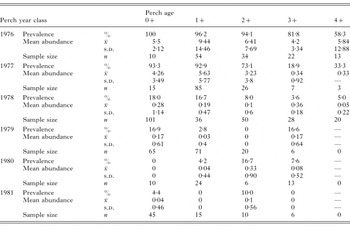
The decline in infrapopulation levels of D. gasterostei was noted as early as 1975 (Kennedy & Burrough, 1977), when it was also reported that large numbers of T. clavata and D. gasterostei were seldom found in the same individual perch. The decline in recruitment of D. gasterostei was first noted in the 1978 and 1979 year classes (Kennedy, 1981b). Infrapopulation levels throughout the life-span of each year class of perch for the year classes 1976–1981 inclusive are shown in Table 1. For the year classes of 1976 and 1977, infection parameters of prevalence and abundance peaked in 0+ (prevalence) or 1+ (abundance) and declined thereafter, although the lower levels in older fish may also reflect the small sample sizes. Prevalence reached 100% in 0+ fish of the 1976 cohort and 93% in 0+ fish of the 1977 cohort, and abundance levels never fell below 3 (maximum 9.4) for fish up to 2+.

However, maximum prevalence in 0+ fish of the 1978 year class was only 18% and prevalence fell to 4.4% in the 1981 year class (Table 1). Abundance levels in 0+ fish over the same period were also low and declined, from 0.28 to 0.04. Declines in prevalence throughout the life of each year class indicated that mortality exceeded recruitment, even though maximum abundance was often observed in older fish (3+ in the 1978 year class and 2+ in the 1980 and 1981 year classes). Over the period 1978–1981 abundance never exceeded 1 or variance 1.29, whereas between 1973 and 1977 abundance never fell below 3 (maximum 19.4) in fish up to 2+, and variance frequently exceeded 100 (maximum 466). Clearly the declines in numbers of heavily infected fish and in recruitment rate noted for 1978 and 1979 continued through into the 1980 and 1981 year classes. Abundance never again reached the earlier levels, and in a year such as 1979 abundance in fish of that year class did not exceed 0.17 whereas abundance in fish of earlier year classes attained levels of up to 4.2 (3+ fish of the 1976 year class). Nevertheless, fish of all ages and year classes continued to harbour infections of D. gasterostei.
Population levels of all three species from 1980 until the crash
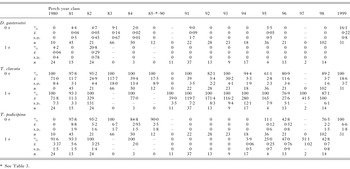
Levels of prevalence and abundance of D. gasterostei remained at this new low in the 1982, 1983 and 1984 year classes (Table 2). The two species of Tylodelphys maintained normal levels and seasonal patterns. Prevalence of T. clavata remained at or close to 100% in both 0+ and 1+ fish, whilst abundance varied between good (1980, 1983) and poor (1981, 1985) recruitment years and was almost always higher in 1+ fish. The characteristic pattern of population biology and levels exhibited by T. podicipina in the 1970s was also unchanged. Prevalence approached or reached 100% in 0+ fish of all year classes, whilst abundance remained at similar levels and was always highest in the 0+ fish. Prevalence declined only slightly in 1+ fish but abundance fell more sharply confirming that fish were infected on one occasion only.

Thus, in the year classes from 1978 up to and including that of 1985 the population levels of T. clavata and T. podicipina remained more or less constant, whereas D. gasterostei remained at levels far lower than those reported pre-1978.
Population levels of all three species during the crash
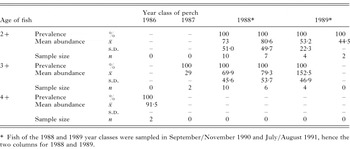
The crash in the populations of perch, roach and rudd in the lake first became apparent in spring of 1985. Perch and parasite levels were normal in the last samples taken in 1984, but when sampling was resumed in 1985 no fish of any species were caught. Sampling was continued and intensified over the summer of 1985, but despite strenuous efforts only 12 perch, all 0+, were caught in the whole year (Table 2). The absence of D. gasterostei probably reflected the small sample size and low prevalence of the species at that time, as both T. clavata and T. podicipina were still present in the lake and infected 0+ fish of the 1985 year class. After 1985 and up to and including 1989 very few fish were caught and those very irregularly (Table 3). Samples were not in any way representative of year classes or fish ages, and any conclusions about parasite levels over this period must of necessity be very tentative. Nevertheless, the fact remains that the only species found throughout this period was T. clavata: neither T. podicipina nor D. gasterostei were recorded in any sample. It is unlikely that their absence is simply a reflection of the small sample sizes and their irregular nature as 17 fish of the 1988 year class were caught in 1990 and 16 in 1991 but again only T. clavata was found in this larger sample of 33 fish. It would instead seem more likely that populations of T. podicipina and D. gasterostei had fallen below levels of detection or below the threshold levels at which transmission was possible and so had become locally extinct.

Population levels of all three species after the crash
Recovery began in 1990, with the capture of 2+ fish of the 1988 year class, and in 1991 more fish of this year class and some of the 1989 and 1990 year classes were also caught (Tables 2 and 3). There can be no doubt that T. clavata survived in the lake throughout the period of the crash and continued to infect fish of each year class. In 1991 it was found in 0+ perch, at levels of prevalence (100%) and abundance (39) comparable to those recorded before the crash (Table 2). Prevalence levels thereafter fluctuated between 100% and 61% in 0+ fish, and abundance between 30 and 2. In 1+ fish, prevalence was 100% in all years except 1996 and abundance varied from 280 to 27: the values of these parameters and their fluctuations were all within the ranges recorded for the pre-crash period (Table 2). By contrast, T. podicipina did not re-appear until 1995, and then in 1+ fish of the 1994 year class. Its population levels increased only slowly and pre-crash levels in 0+ perch of 100% prevalence and 6.6 abundance were not attained until the 1999 year class: 6 years later. The recovery of D. gasterostei was very erratic: it was first recorded in 1991 but thereafter in some year classes only and only in 0+ perch (Table 2). Only in 1999, 8 years later, did it approach pre-crash (1978 and 1979) levels of 16.1% prevalence and 0.22 abundance.
Site selection by the three species
Although all three species are generally described as living in the humour of the eye, as opposed to species such as D. spathaceum which inhabits the lens, they are in fact far more precise in their site selection than this. All three species show a preference for the suspensory ligaments (Table 4). Approximately 95% of the metacercariae of T. clavata are found in the suspensory ligaments of young perch (Table 4) and this proportion increases to 99% with fish age. By contrast, only 55% of T. podicipina are found in the suspensory ligaments of young fish and this proportion declines to around 5% in older fish as metacercariae disperse and move into the humour. Few data are available on D. gasterostei as this species was very uncommon at the time of this study in 1981, but such data as exist indicate that this species also prefers the suspensory ligaments. It can therefore be tentatively concluded that all three species have the same site preference.

DISCUSSION
The original hypothesis of the decline in D. gasterostei being due to negative interspecific interactions with both T. clavata and T. podicipina was based on: (1) Coincidences of timing such that (a) the decline in the proportion of perch with heavy infections of D. gasterostei coincided with increasing population levels of T. clavata after 1973, and (b) the dramatic decrease in the recruitment rate of D. gasterostei into young perch of the 1978 and 1979 year classes coincided with the appearance and population expansion of T. podicipina (Kennedy, 1981a, b, 1987). (2) A significant negative correlation between the decline in the proportion of perch carrying heavy infections of D. gasterostei (i.e. the % perch with 10 or more individuals) and the increase in maximum mean intensity of T. clavata (Kennedy, 1981b), such that heavy infections of D. gasterostei were seldom or never found in the same individual perch harbouring heavy infections of T. clavata (Kennedy & Burrough, 1977). There was no significant association (2×2 contingency test) between the presence and absence of the two species due to the very low number of fish harbouring neither parasite or D. gasterostei only.
The hypothesis was thus based on indirect evidence only, i.e. on field data on population changes. The hypothesis was supported by Dobson's (1985) independent analysis of the data as an example of exploitation competition, as he noted that the comparison between empirical data and his mathematical simulation was fairly striking.
The problem with many hypotheses of negative interspecific interactions is the difficulty of testing them. Hypotheses based on field data tend to be erected on the basis of observations on the decline in population levels of one species in the presence of another, as documented here, or on niche shifts (Chappell, 1969; Grey & Hayunga, 1980), or on exclusive distributions (Kennedy, Bates & Brown, 1989; Kennedy & Hartvigsen, 2000). All these observations are strongly suggestive of interspecific interactions, but confirmation needs to come from elsewhere and ideally from experiments. As Dobson (1985) has stated ‘a variety of other biological and environmental factors contribute to the observed patterns of population behaviour'. Where it is possible to undertake experimental infections of fish with one or more species at different intensities, it can be shown that a change in abundance or niche shift by one species in the presence of another or even the exclusion of one species may be due to interspecific competition (Bates & Kennedy, 1990), but even then it may be difficult or impossible to determine whether the competition was for a nutrient resource or a more favourable site. In the present case of the metacercariae in the eyes of perch it was never possible to test the hypothesis of interspecific competition experimentally in a laboratory. Because T. podicipina infects 0+ perch within a very short period after their birth (Kennedy, 1981a, 1987), it would have been necessary to obtain uninfected perch from the field and then maintain them in the laboratory for three or four months until cercariae of D. gasterostei and T. clavata were available for infection. This was not practicable, the more so as in the pre-crash period the identity of the first intermediate hosts of all three species was not known. The alternative approach of keeping the life cycle of all three species going in the laboratory was also impracticable in view of the problems of maintaining the bird hosts. Clearly, some other approach was required to provide confirmation of the hypothesis and/or to test it.
Routine monitoring of the perch and parasite populations up to 1984 confirmed that there had been no significant changes in the prevalences and abundances of any of the three species since 1979. The two species of Tylodelphys remained at their normal high levels, whilst D. gasterostei remained at its low post 1978 level and if anything declined even further. These observations served to extend the data set and confirm earlier observations e.g. that D. gasterostei rarely occurred in perch that harboured high numbers of either or both of the other two species. Further statistical analyses of the situation were not possible in view of the very low numbers of D. gasterostei and the absence of fish with no infections of either Tylodelphys species. The first intermediate host of each of the three species was identified, but unfortunately snail densities were never monitored. The numbers of P. cristatus increased and remained high until 1984/5 (Elphick, 1996) and both intermediate and definitive hosts appeared still to be available up to 1985. No obvious changes in any biological or environmental factors were identified that could provide an alternative or more satisfactory explanation than interspecific competition for the decline in D. gasterostei.
The investigation into the site location of the three species within the eye of perch provided some further support for the hypothesis of competition. The three species were found in the humour, in contrast to D. spathaceum which always occurred in the lens, and all three appeared to prefer the same site i.e. the suspensory ligaments. This is most evident in young fish. However, as fish aged and intensities of T. clavata increased, T. podicipina moved out of the ligaments and into the humour, whereas T. clavata remained in this former site. This could be interpreted as a niche shift, just as the spatial separation of the two species of Diplostomum could be considered an example of resource partitioning. Whatever the interpretation, there appears to be the potential for competition for the suspensory ligaments between the three species and for the humour between D. gasterostei and T. podicipina. There appears to be no opportunity for resource partitioning in space or time for D. gasterostei. Wherever it attempts to locate in the eye, it will encounter one of the other three species. It can survive when alone in fish of any age, but in young fish it is likely to encounter high levels of T. podicipina and in older fish high levels of T. clavata. It has no refuge from the other two species, and such a situation is compatible with the competition hypothesis.
The matter might have rested there, with the hypothesis of interspecific competition still being preferred and indeed supported by new evidence but untested, were it not for the fish population crash over the winter of 1984/1985. The lake had become increasingly eutrophic throughout the 1970s and early 1980s, and in the very cold winter of 1984/1985 it froze over for a long period. This provided ideal conditions for winterkill (Kennedy et al. 1994; Kennedy, 1996), and perch, roach and rudd populations all crashed to virtually undetectable and unsampleable levels. It was never clear whether fish remained in the lake itself at densities too low for representative sampling, or whether they survived in a refuge close to the inflow of the main river where they could not be sampled. Over this period the numbers of P. cristatus declined (Elphick, 1996) presumably because of the decline in the numbers of fish. Recovery in the fish populations was slow: the recovery of rudd started in 1989 and that of roach and perch in 1990 (Kennedy, 1996). The grebes did not reach their pre-crash levels until 1990–1992 (Elphick, 1996). The virtual disappearance of roach and rudd and their parasites followed by their subsequent recovery were monitored very closely as they constituted a natural experiment for testing hypotheses erected from a study of their pre-crash populations (Kennedy et al. 1994; Kennedy, 1996). The crash in the perch population and the recovery and re-colonization by parasites provided a similar opportunity for testing the hypothesis of interspecific competition between the three species of eye flukes.
Both D. gasterostei and T. podicipina, together with other parasites of perch, (Kennedy, 1998) disappeared over the period of the fish crash. The most likely explanation is that transmission of each species became at best difficult and at worst impossible at such low densities of both perch and grebes. These two species were most vulnerable to any decline in perch numbers, since D. gasterostei densities were already very low before the crash and T. podicipina can only infect a single age group of perch, the 0+.
Densities of all fish-eating birds, including grebes, declined during the crash period (Elphick, 1996) and it seems most probable that T. podicipina, and possibly also D. gasterostei, became temporarily locally extinct and re-colonized with the grebes. By 1991 the numbers of birds and perch were back to pre-crash levels. Tylodelphys clavata had remained in the lake and continued to transmit at pre-1985 rates throughout the period of the crash, and this almost certainly reflects the higher reproductive potential and recruitment rate of this species compared to the other two (Kennedy, 1981b). It appears that D. spathaceum also survived in the lake during the crash (Kennedy, 1998), and this suggests that the densities of the snail intermediate hosts did not decline significantly over the crash period.
In 1991, soon after the crash, D. gasterostei was present in the lake, snail, fish and bird hosts all appeared to have returned to pre-crash densities and a major competitor, T. podicipina, was absent and had not yet re-colonized. Why then, in the absence of T. podicipina, did D. gasterostei not increase in density to at least 1976 and 1977 levels as might have been predicted on the competition hypothesis? The most plausible explanation relates to the continued persistence of T. clavata at pre-crash levels over the whole period. This is the only species whose population densities have been shown statistically and significantly to be inversely correlated with those of D. gasterostei. It was evident (Kennedy & Burrough, 1977) that these two species could co-exist in the eyes of young fish, in which levels of T. clavata were lowest. It would therefore seem to be very significant that after 1990, D. gasterostei was only ever found in 0+ fish and typically in individual hosts in which levels of T. clavata were exceptionally low. Both species have the same preferred site in the eye and T. clavata appears able to retain occupation of it in the presence of either of the other species. If this interpretation is correct, it would suggest that T. clavata has a greater impact on D. gasterostei than does T. podicipina. This latter species has a much lower reproductive potential than its congener and is much slower to colonize, or re-colonize, a locality (Kennedy, 1981a, b; 1987).
Thus, the results of this natural experiment do confirm the results of the earlier study. These three species exhibit the same site preference within the eye and T. clavata appears able to retain its position there at the expense of the other two species. Why they prefer this particular site is unknown, but it is unlikely to be related to immune responses in any way. Dobson (1985) described the interaction as exploitation competition, but it is impossible at this point to identify what is being exploited and indeed the situation appears more akin to interference competition in many ways. The ability of T. clavata to emerge as the most successful competitor is entirely commensurate with its higher reproductive potential and so colonization ability (Kennedy, 1993, 1994). Persistence of all three species in perch is possible if all three species are overdispersed in distribution throughout the perch population (Dobson, 1985), and this has indeed been shown to be the case (Kennedy & Burrough, 1977; Kennedy, 1987). Thus the situation in respect of the eye flukes is comparable to that of other species of fish helminth identified as possible competitors. The extended data set and the recolonization of perch by the three species of eyefluke in Slapton Ley constituted a natural experiment that confirmed that negative interaction is the most parsimonius hypothesis that can be erected to explain the decline of D. gasterostei in the lake.
Over the period of 29 years too many people have helped in this study to be able to list them all individually. Nevertheless, I must single out P. C. and J. Shears and the Wardens and staff at the Slapton Ley Field Centre and thank them for their continual support. Financial support has been provided at various times by the NERC, SERC, Whitley Wildlife Conservation Trust and the Exeter University Research Fund. Thanks are also due to E. Lamb for permission to use unpublished data, and to everyone else who has assisted but has not been named.