





Impact statement
This paper proposes and exemplifies the potential of using relational approaches in design education, to develop artefacts as integrated product-service-systems, that create material cultures that support resilient more-than-human futures. The aim is to contribute to the field of Biodesign with critical perspectives that are situated, acknowledging power relations and interspecies cohabitation by pursuing what can be life-affirming. This paper aims at engaging in dialogue about these issues with input from the Biodesign community.
Introduction
In the beginning of the module “Introduction to Design Ecoliteracy,” one of the modules taught to new students at the Master’s Programme Design Ecologies – an education operating within the expanded field of industrial design or product design – we often ask the question: “Who in this group has studied ecology before?” We explain that this doesn’t need to imply studies at a higher level, but simply having “studied” that subject sometime during their lives. In the few years that the master’s programme has been running (starting August 2022), only once has a student had previous studies. This is relevant to this paper since the pedagogy that we are pursuing aims at educating through a relational approach. What is common is that students have had biology as a subject in school, a subject that has shaped their understanding of living beings. Biology, as the science that studies living organisms, has in primary school educated students in simplified and basic evolutionary theory, mostly focusing on functional aspects; how organisms are built (anatomy) and how their parts work (physiology). Yet, beings do not exist in isolation, they are interdependent (Sharma Reference Sharma2015), “beings do not preexist their relatings” (Haraway Reference Haraway2003, 6). This is where our basic question to our students starts to take dimension. Ecology studies how living things affect each other and their surroundings. Interdependence is not about independent things interacting with each other, as in discrete separate things that precede a relation, but about the becoming of things by mutual constitution (Sharma Reference Sharma2015, 2). In this way, interdependence, as the mutual constitution of things, helps us frame our understanding of the relations that enable a given design proposal and how the proposal may enable or disable further relations in turn. This relational approachFootnote 1 allows us to pay attention to the places where the things that we design come from, where they are used and where they are discarded. In this way, we move away from a paradigm in which designers conceive artefacts in abstraction. For example, when someone designs something in a location, say Stockholm, Sweden, creating a digital file that is sent to a manufacturer in Zhen Zhen, China, to be shipped to Europe via Rotterdam, Holland to be distributed and sold in Stockholm where it was designed, a product that after usage may end up as waste in Agbogbloshie, Ghana. At the end of this typical global logistics pattern, none of the places were acknowledged, only the economic aspects that generate profit for someone at each stage of the production process. This creates a backgrounding and a disconnect (Plumwood Reference Plumwood2002) that has devastating ecological implications, a practice that damages the natural systems, the web of life (Capra and Luisi Reference Capra and Luisi2014), on which we depend upon.
Towards designs that are life-affirming
At Design Ecologies we define something as being sustainable if it enables further life. In this way, the programme moves away from the negative logic of the currently predominant paradigm of thinking sustainability as “reduce, reuse, recycle”Footnote 2 and seeks to consider localities and relations to other-than-human beings in the design of products, services and systems. To pursue the positive drive of affirming the living, students are encouraged to depart from six ecoliteracy principles that they need to relate to and develop within the context of their individual work. The six ecoliteracy principles that we use follow the five principles in Goleman et al. (Reference Goleman, Bennett and Barlow2012),Footnote 3 with the addition of a sixth one, “Understanding that at stake in all the principles are power/political implications.” This last one encourages a critical attitude, awareness of the omnipresent asymmetries and conflicts on multiple levels, in terms of class, gender, ethnicities and among species. The principles are:
-
1. Developing empathy for all forms of life;
-
2. Embracing sustainability as a community practice (understanding that organisms do not exist in isolation);
-
3. Making the invisible visible (effects of human behaviour on other people and the environment);
-
4. Anticipating unintended consequences (precautionary principles);
-
5. Understanding how nature sustains life (learn strategies that are applicable to designing human endeavours);
-
6. Understanding that at stake in all the principles are power/political implications (class, gender, ethnicity, species…).
For each principle, we give the students a basic example stating that “Design can…” and introducing references and sources for systems thinking, circular economy, biomimicry, resilience, regenerative practices and more. Yet, part of the pedagogy of the programme is not to prescribe universal responses or “solutions” (Larusso Reference Larusso2023; Obrenovic and Stolterman Reference Obrenovic and Stolteman2018), but to demand from the student to make sense of the principles through the situated lens of the project that the student is working with.
To both adopt and actively practice the principles of ecoliteracy and to drive development aimed at transforming the role of the designer is challenging. What does it mean to embrace empathy for all forms of life, when we, in this human-centred world, where design is mainly done by humans for humans, and thus ignorant of or disconnected from the very existence of many species and the consequences for ecosystems in our daily lives? How can ecoliteracy principles underpin design practices in ways that support the development of the design profession in dialogue with industries, institutions and communities?
At the beginning of the programme, in a module called “Explorations,” we ask students to develop and explore parallel iterations of the artefacts that they are designing. Departing from a technocentric perspective and an ecocentric perspective the students are asked to reflect on the implications of designing by exploring different kinds of technologies in comparison to working with ecological processes and living organisms. This to understand alternative industrial and biological cycles and how their designs enact material flows that demand energy, affect places, industries, species, involve norms and more.
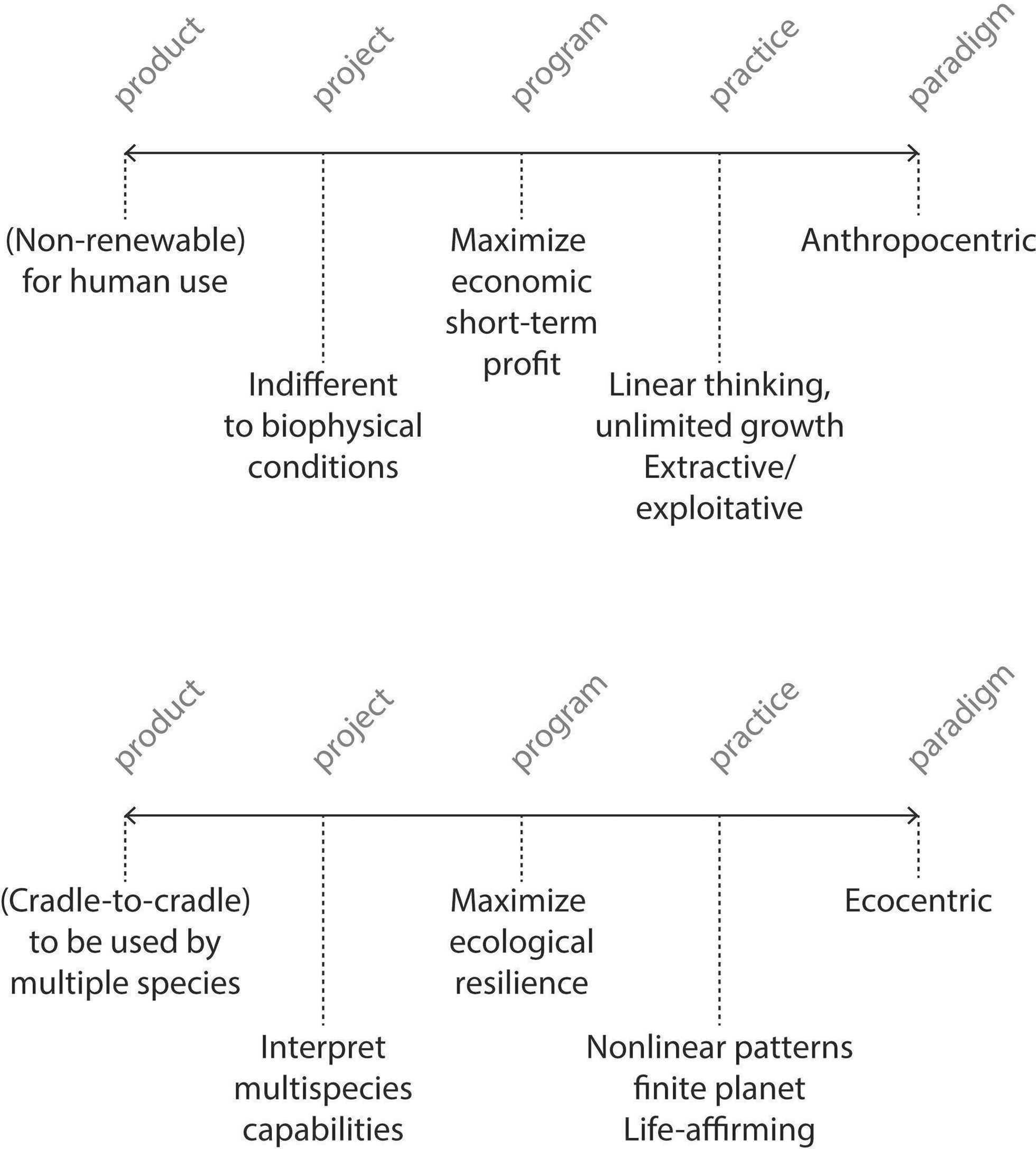
Part of what we strive to make explicit is the need for a practice that is based on a different paradigm than the currently dominant one, that is, a shift from an anthropocentric paradigm to an ecocentric one, where humans participate to the fullest extent in the fabric of the biosphere. Following Redström (Reference Redström2017), we describe this shift using a diagram that articulates design, ranging from product to paradigm (Figure 1). Comparing these two paradigms, we want to illustrate how we move away from the illusion of unlimited growth and resources to a practice that acknowledges planetary boundaries (Biggs et al. Reference Biggs, Schlüter and Schoon2015), from a programme that maximizes economic growth to one that strives to maximize ecological resilience, from projects that do not consider biophysical conditions to projects that recognize the need to cohabit our environment together with multiple species, from products that are non-renewable and for human use only, to products that participate in circular economies (industrial and biological cycles) that are not only conceived in relation to humans, but in relation to other-than-humans, as well.
From an anthropocentric to an ecocentric paradigm for product design (from Ávila Reference Ávila2022, 102).

The pedagogy of the Master’s Programme Design Ecologies strives to enable this paradigm shift in the practice of design, educating practitioners to operate as designers that can enable alternative, more resilient and less anthropocentric material cultures.Footnote 4 In this sense, it works with “biodesign,” by engaging in a design practice that promotes empathy for all forms of life and the understanding of natural systems and processes. We understand biodesign by emphasising the bios, the original Greek word that designates life, as a design practice that strives to be life affirming. Yet, following this reasoning, we prefer not to qualify the word design with the word “bio.” Rather we choose to call the programme Design Ecologies, to critically examine how and to what extent a design affirms or participates in the life of others, and which others. This critical attitude helps us as colleagues and students, to remain aware of the political implications of intervening through design. The intention is to enact a pedagogy that stays attentive to the agency of designed things and emphasizes precautionary actions, a pedagogy that promotes accountability when designing artefacts conceived in a relational way, things that will affect places and those that encounter them, human or other.
Life-affirming material cultures
At the programme we encourage students to create artefacts that form a material culture, conceived in relational ways, as things that can become appropriate responses (rather than “solutions”) to the challenges of cohabitation with other-than-humans, in a given place at a given time, for specific people, using specific technologies. In this way, the responses that these artefacts are, materialize an effort to make things participate in the biosphere, to become “terrestrial” (Latour Reference Latour2018), a metaphor to think all environments, not only the terrestrial, but aerial and aquatic too, that which is “planetary” (Tironi Reference Tironi, Tironi, Chilet, Ureta Marín and Hermansen2023), to affect and render sensible relations to beings and places that are otherwise abstracted, backgrounded (Plumwood Reference Plumwood2002). Artefacts that operate within a politics of the sensible (Rancière Reference Rancière2010; Ávila and Ernstson Reference Ávila, Ernstson, Ernstson and Sörlin2019), agential things that trigger responses that promote relations with some others, that engage us in noticing, or not, aspects of the worlds we collectively enact (Escobar et al. Reference Escobar, Osterweil and Sharma2024).
Within a material culture that strives to be life-affirming, the effort is to “enliven” (Weber Reference Weber2019). One of the tasks of designers is to understand the consequences of using one material instead of another one or even excluding material alternatives. To operate within planetary capacities (Raworth Reference Raworth2017), we not only need to decouple our everyday lives from unnecessary material consumption, but as designers, in dialogue and collaboration with material experts, challenge the extractive industries that design often relies upon, by developing material cultures where energy and material metabolic flows close industrial and biological cycles.
The production, use and discard of materials are central parts of our role in ecosystems. Biobased materials and their possibility for regenerative life (Karana et al. Reference Karana, Barati and Giaccardi2020), combined with steel, aluminium and other metals that, if used correctly and in ways that allow recycling and/or assimilation to local biological or industrial cycles, can be sustainable choices.Footnote 5 The decision on which material to choose in each situation is coupled to infrastructures of production, local availability and recyclability. The energy needed for harvesting and manufacturing, the service life of the product and the material are also crucial, minimizing the extraction of raw materials and finding new possible sources, like side- or waste streams of industrial production systems for upgrading (Allwood and Cullen Reference Allwood and Cullen2012).
In this context, we encourage our students to look for new material alternatives and collaborate with companies and researchers at the forefront of material innovation and recycling/re-use/regeneration. In different projects, we collaborate with (among others) material scientists and researchers, whose point of departure is the material itself. But where are the novel materials most relevant? Where can they have an impact and create meaningful experiences? This is an opportunity for designers to explore, experiment and contribute with their particular competencies. Sometimes the material and its properties have an obvious fit with the topics and themes our students are exploring; at other times, the process is reversed and there is a material driven design (MDD) (Karana et al. Reference Karana, Barati, Rognoli and Zeeuw van der Laan2015) that allows a topic to be framed and explored from the boundaries of the technological and material constraints. The context and use follow the material, and the process to explore this, is an entry point less common to many design practitioners. Practicing material-driven design, students are encouraged to learn about and familiarize themselves with new materials to tinker with them, to work and experiment with them and understand what manufacturing processes might be used to put them into use. Considering material alternatives, students speculate upon the potential of a material to change consumer behaviour, focusing on the interplay between the consumer and the material of the artefact. For example, biobased materials can display their origin, making perceived attributes and impacts of extraction become important. Collaborations with perception psychologists and material scientists have led to materials that trigger intuitive associations to high-quality, to “nature,” to short or long-lasting duration, etc. (Lindberg et al. Reference Lindberg, Hartzén, Wodke and Lindström2013). New materials, such as bio-based materials with properties that allow them to be used in the same way as the fossil-based materials that they could replace without changing production processes; identical products that work in an identical way in production, will not change our behaviour. Materials with new property combinations might help us to modify behaviour and stimulate new ways of thinking and acting. (Pinkse and Bohnsack Reference Pinkse and Bohnsack2021).
Collaborations
Collaboration, with external actors in the field, as well as internally with the competencies available at the school and within each class, is a central and active part of the programme’s relational pedagogical approach. The projects, framed by the programme, as well as the student-driven initiatives, often start with a matter of concern -a theme or topic that relates to contemporary or future challenges. Together with external partners, experts and communities, we strive to learn collectively and develop design proposals that invite, disrupt and engage with alternative ways of living and relating to the world.
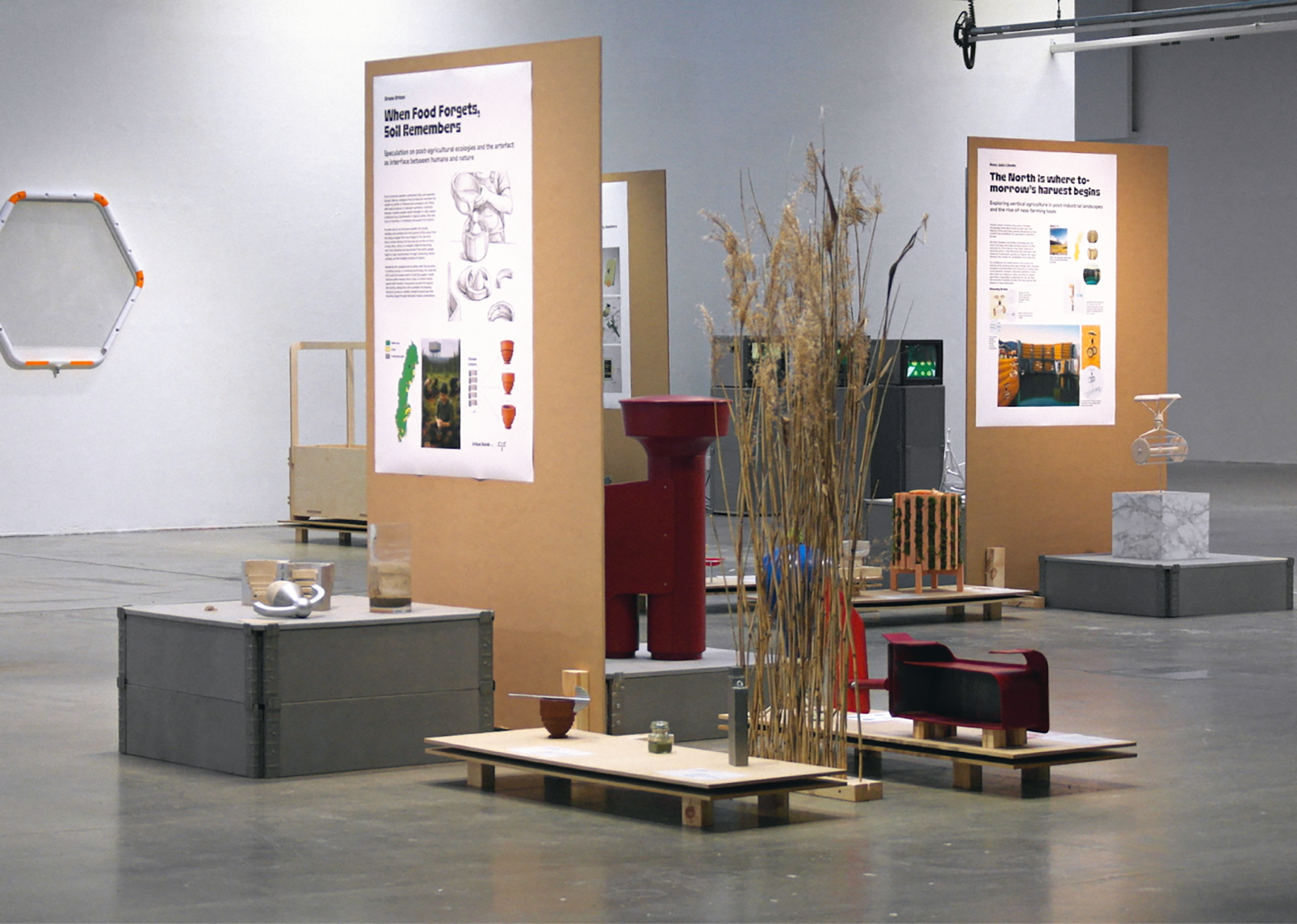
Throughout the courses, Design Ecologies students work in relation to, and together with one, or more actors in their design projects. In the first term the main collaborators are decided by the teaching team, often connected to ongoing research projects focussing on exploring future systemic changes through the design of artefacts as integrated parts in product-service-systems. For example, in the fall term of 2025 first year students explored, within the framework of the Vinnova -funded project ‘Future-proof food security for health and well-being’ , how future climate change could affect our food supply and access to food and developed prototypes for future climate-adapted agricultural value chains. Departing from signals and trends as indicators of possible future social, technological, environmental and cultural developments and changes, the students, in consultation with researchers at SLU , Stockholm Resilience Centre and Axfoundation among others, developed scenarios that speculated on futures where a 3 degree increase in the global average temperature, or more, becomes a reality. As a response to these futures, students imagined, developed and materialized future agricultural value chains and explored how these could be manifested in designed artefacts (integrated product-service-systems) for Sweden in the year 2060. The teaching was carried out together with Samhällsnytta , a subsidiary of Karlstad University and the above mentioned research project; a collaboration with the Swedish Board of Agriculture , the Swedish National Food Agency , the Swedish Agency for Economic and Regional Development , the Swedish Environmental Protection Agency , the Swedish Veterinary and Food Agency and farmers in the Swedish regions of Skåne, Värmland and Jämtland. In mid-December 2025 the students’ work was used as the point of departure for discussions about the future of agriculture during the Swedish Board of Agriculture’s annual strategy day for its employees at the Elmia trade fair in Jönköping, Sweden and resulted in the travelling exhibition Agricultural Futures – Prototypes for future climate-adapted agricultural value chains (Figure 2). This way of working, in collaboration with relevant actors and stakeholders, aims at informing the projects but also at making possible outreach, impact and dissemination of the outcomes of student work. In this way, students train to become more independent and able to position their work in relation to a relevant context in dialogue with experts that they can continue collaborating with after their graduation.
Agricultural futures – prototypes for future climate-adapted agricultural value chains. design projects by first year students of the master’s programme design ecologies exhibited at Konstfack February 2026.

Design ecologies student projects
In the traditional role of the designer, the process often begins by examining a problem, need or specific challenge and in response developing some kind of “solution,” often considered universal, as proposals to “solve” an issue anywhere. In contemporary design education, where critical perspectives are key, and when our societies are facing complex challenges, or so called “wicked problems” (Rittel and Webber Reference Rittel and Webber1973), there are no “solutions” that would be universally appropriate responses. Therefore, departing from the places where we use, produce or discard the things we design (rather than backgrounding places and the living beings that enact them), openness to re-formulating what the challenge actually might be and what is at stake, becomes an important practice. What might seem like the most obvious response to a problem can sometimes actively hinder what is life-affirming at other temporal or spatial scales.
To exemplify and discuss the potential of the life-affirming design pedagogies developed and practiced in the Master’s Programme since its start 2022, and its ambition to, from the perspectives of Ecoliteracy, question the environmental consequences of conventional design of everyday artefacts, we have chosen two final degree projects from 2025. These projects demonstrate student approaches and interpretations of the above principles and how they have been materialised in the design of product-service-systems with the potential of having an effect on a systemic level.
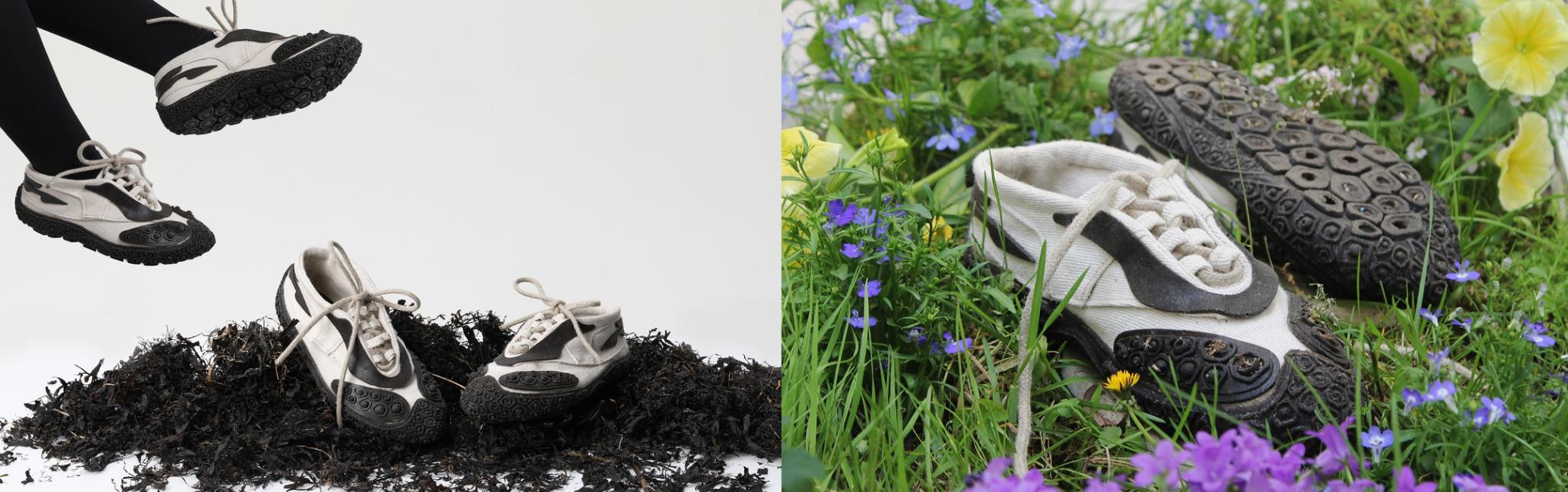
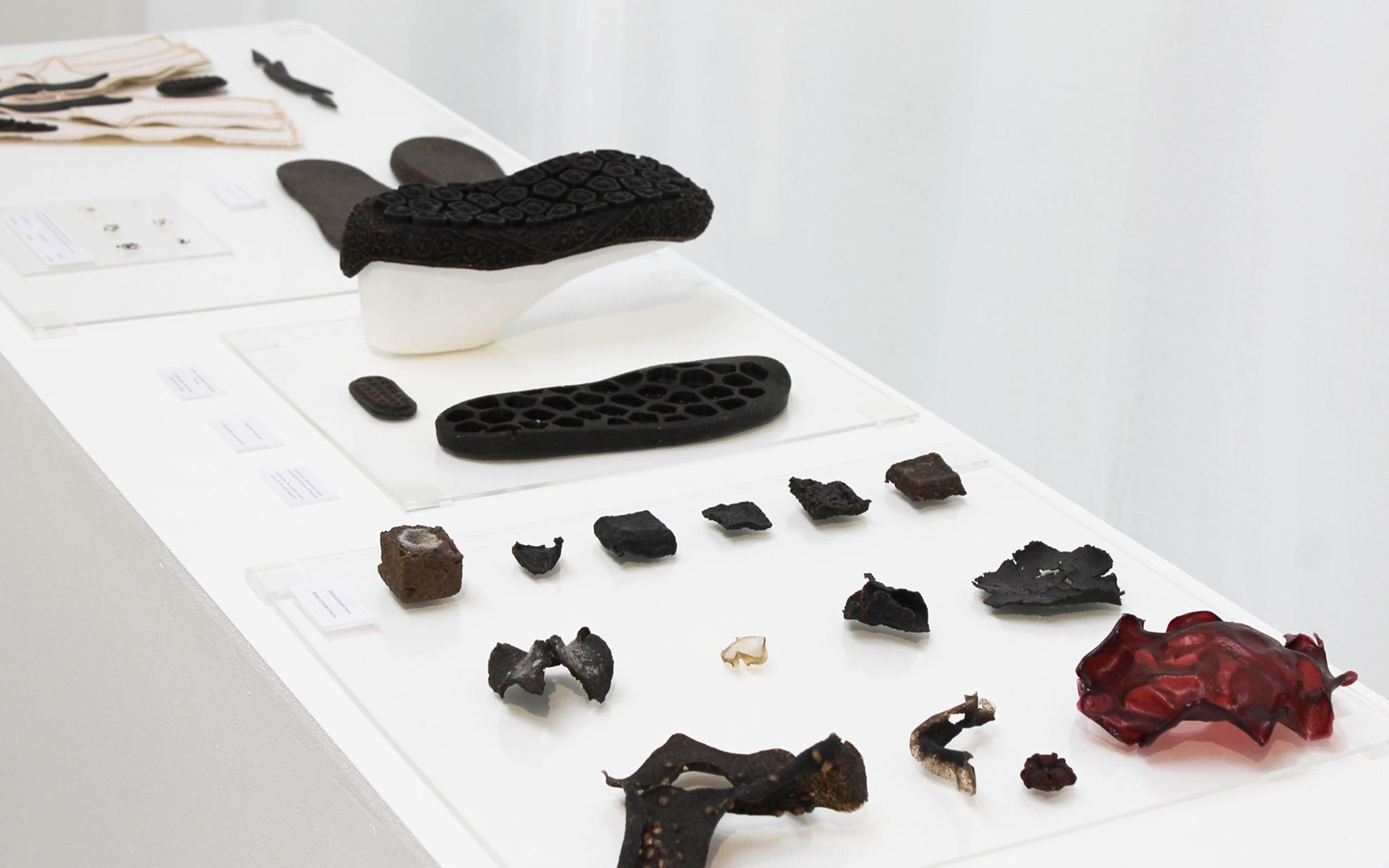
Evelina Lavergren’s degree project “Biological Footprint (Figures 3–5), explores the often-overlooked environmental impact of footwear, particularly in terms of microplastic pollution and recycling challenges. Understanding how synthetic materials like plastic and rubber contribute to marine pollution Evelina investigated the potential of using seaweed from the beaches of Gotland, a Swedish island in the Baltic Sea, as a biomaterial for the production of footwear, to avoid toxic fossil-based materials from accumulating in and harming sea life and entering the human food chain, posing health risks.
Biological footprint. Shoes made of seaweed and hemp. The sole, containing seeds, follows the natural curve of the foot and is a bit thicker in the heel and foot pad, making it comfortable for many hours of wear, providing shock absorption. All parts are sewed together with hemp thread – no glue needed – making them fully biodegradable.

Biomaterial explorations. Created during the first stage of the project, with the aim to develop the shoe soles.

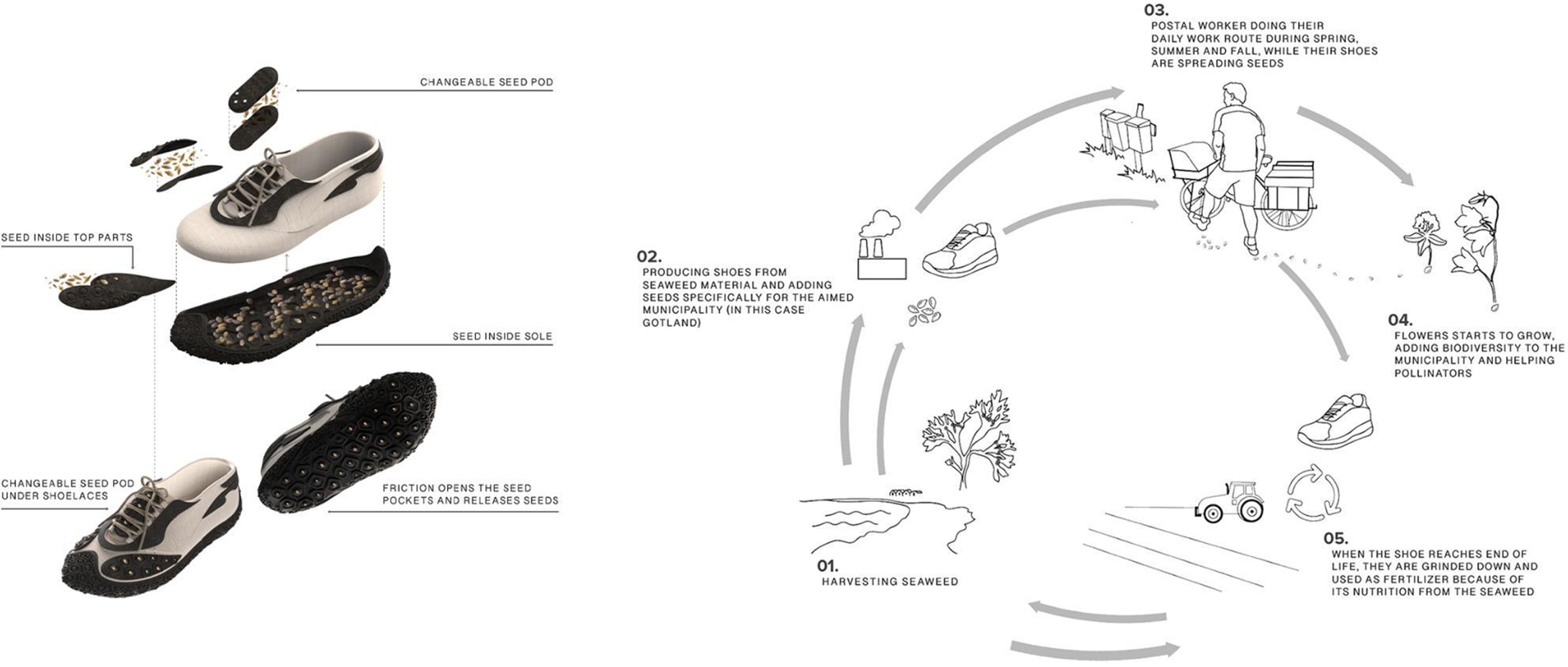
Left: shoe components. The shoe has three seed layers: inside the sole, in front of the shoe and a changeable seed pod. The changeable seed pod is placed behind the shoelaces and can be changed if the municipality wishes that some species should be added to a specific area. Right: Product user scenario and life cycle.

By using seaweed, which helps absorb excess nutrients in the overfertilized Baltic Sea, Evelina designed shoes for postal delivery workers, who frequently move through urban and rural areas. Considering the lifecycle of the shoes in relation to the routines and use of shoes for postal workers, she designed footwear that will help spread native seeds and provide nutrients, supporting local conservation efforts and enhancing the region’s biodiversity. The footwear is made of Gotlandic seaweed and locally produced hemp, a biomaterial that helps regulate temperature and moisture and is well suited to farm on the island’s peatlands. Instead of disseminating synthetic microplastics as they wear off, they disseminate nutrients that were once causing eutrophication in the Baltic Sea. The components of the shoes include parts with encapsulated seeds that are released as the shoes wear off with use.
The project is connected to initiatives aimed at im-proving biodiversity and ecological restoration, such as the Gotland County Administrative Board’s LOVA (cleaning the Baltic Sea) and LONA (municipal nature conservation). By focusing on the target group of postal delivery workers, who work in urban and rural landscapes daily, the project aims to design footwear that supports these regional initiatives by dispersing native seeds and providing nutrients to the soil, promoting local biodiversity and contributing to restoring the Baltic Sea.
Sebastian Fältström’s degree project “Macro Fibre” (Figures 6–8), explores the untapped potential of Swedish wool as a natural solution for cleaning small boat harbours from contaminants across the entire water column. During Sebastian’s previous education as a firefighter, he observed how various petroleum-based materials are produced to be used for absorbing oil spills during cleanup, a very contradictory operation. After use, these materials are incinerated, contributing to environmental pollution. This realization sparked his interest in finding a more sustainable alternative. He began researching Swedish wool fibres, particularly those that are least utilized in the textile industry (Svensk texel 2025) to understand why they are considered undesirable and how their properties could be repurposed. His focus has been on increasing the value of these fibres by exploring their potential as absorbents for oil and heavy metals. With the ability to absorb oil up to 30 times its own weight, wool presents an exciting biodegradable alternative to the synthetic materials commonly used in water sanitation today.
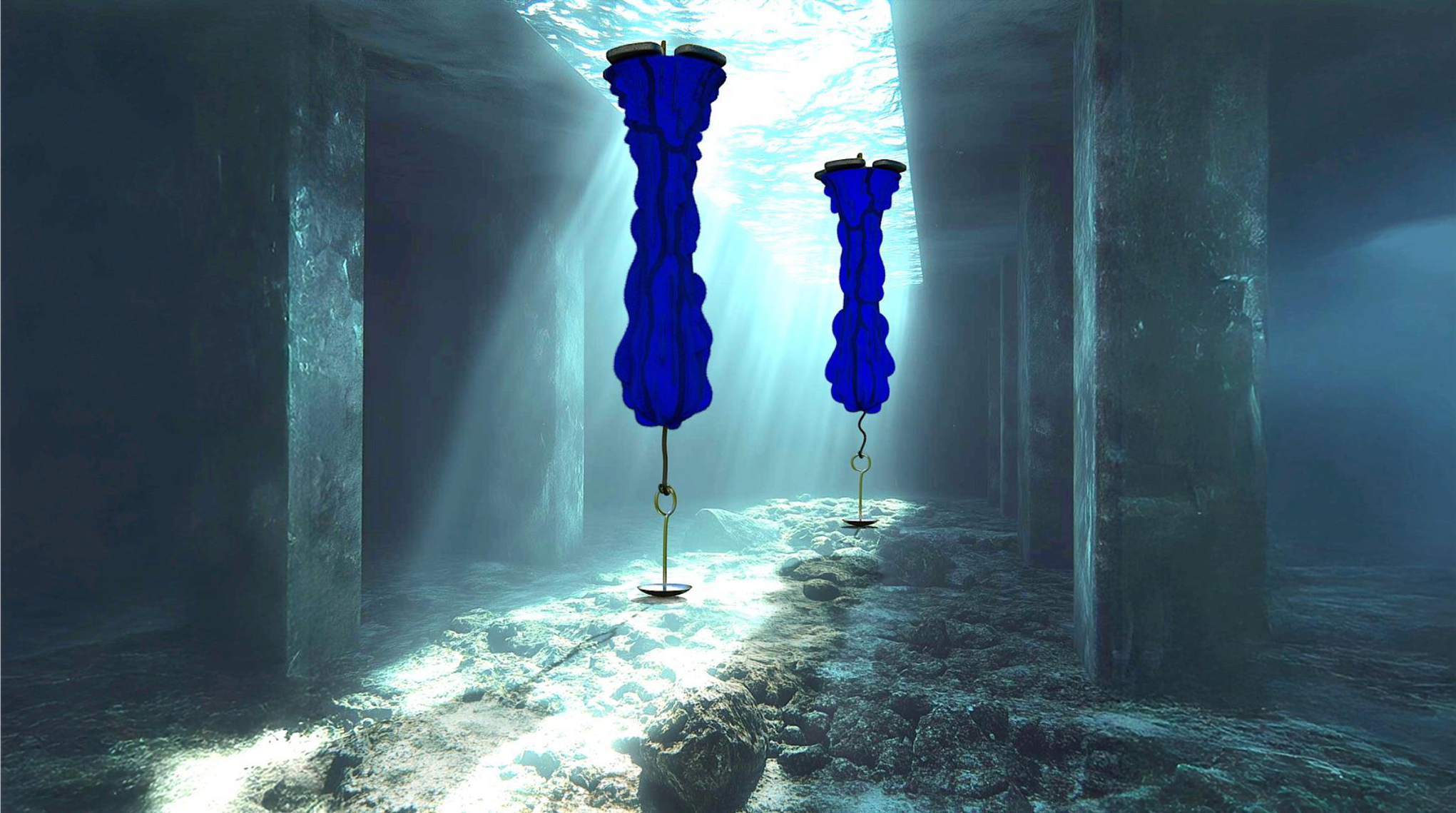
Underwater view of macro fibres installed in a harbour environment. The fibres are deployed during the low season, when oil density increases and pollutants are more likely to sink below the surface. The dimensions can be adjusted according to water depth; the units shown are designed for the typical depth of small boat harbours.

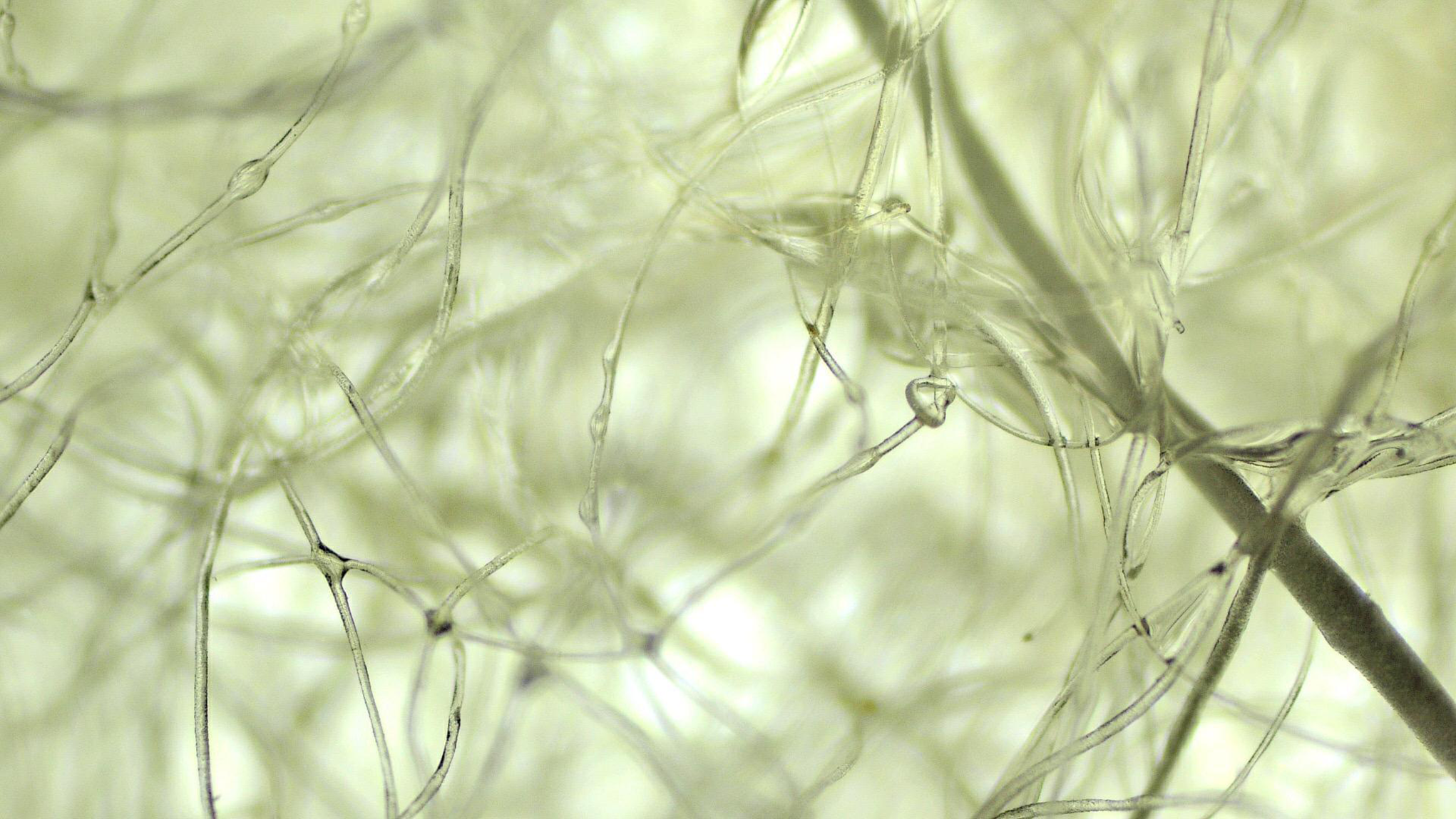
Laboratory work at the Swedish School of textiles in Borås, Sweden. Image showing wool absorbing petroleum-based oil enlarged 10.000 times.

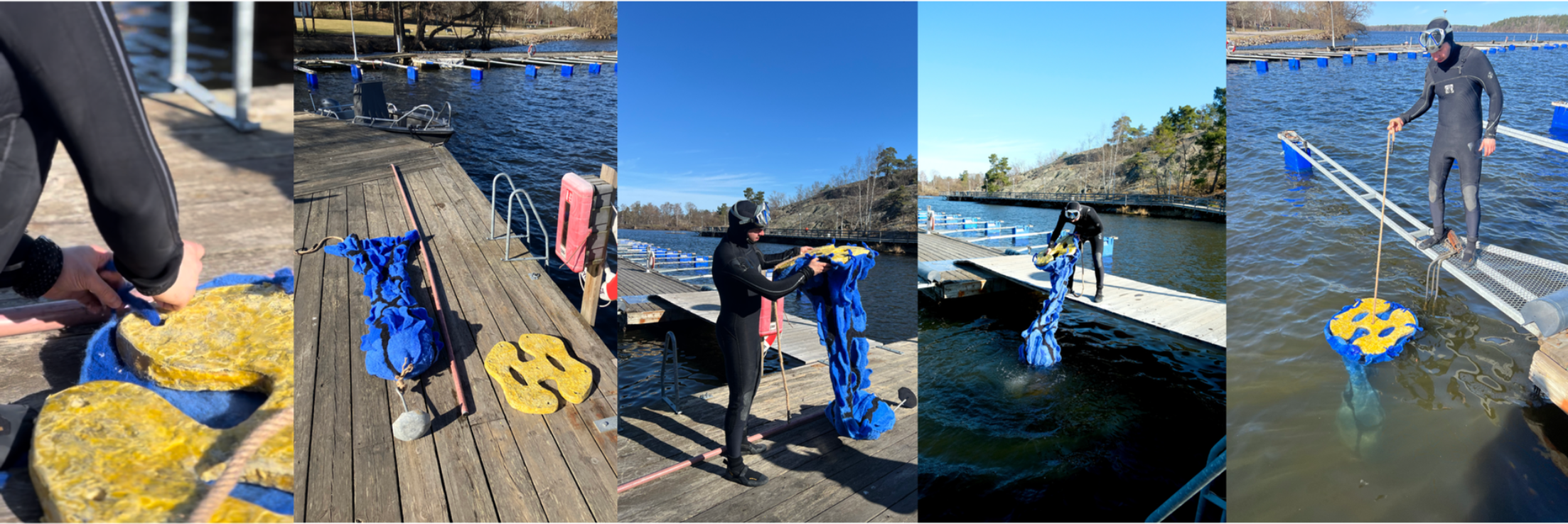
In situ testing. Prototype submerged in a small boat harbour in Stockholm.

By collaborating with specialists in wool processing and absorption, the project led to the development of “Macro Fibres”: a designed product made from repurposed wool, primarily sourced from the Swedish meat industry. Sebastian collaborated with Ullkontoret , Sweden’s only large-scale wool washing facility.
Through a collaboration with the Swedish School of Textiles in Borås, Sweden, Sebastian used industrial sample tools and oils which enabled him to take his project into an evidence-based thesis. After observing how different wool varieties absorbed the added oil, it was possible to confirm his earlier propositions. The final design incorporated a colour scheme from a non-toxic Swedish nudibranch – a shell less sea slug – which mimics toxicity to deter predators. This inspiration from visual warning signs from a living creature enhances the design, making “Macro Fibres” both functional and visually eye-catching.
“Macro Fibres” are passive sanitizers used during low seasons in small boat harbours. After use they are collected and sent for cleansing using baths with microbes that break down the absorbed petroleum-based oil (Riksdagen 2025), after which process the product can be reused. The result is a playful, yet serious, investigation into how local, sustainable resources can contribute to cleaner waters and more circular design practices.
Discussion
Within the expanded scope of industrial- or product design, the described degree projects critically examine situated interdependencies, ecological processes and materialities, striving to embody the ecoliteracy principles that framed their conception. In Evelina’s case it is about finding ways to through the design and life cycle of shoes, make visible our dependency on life in the ocean while enabling conditions for further life on land. In Sebastian’s case it is about valuing material flows that otherwise are considered waste and anticipating unintended consequences of using petroleum-based materials for cleaning pollution. Central in the work of both are the material explorations using local biomaterials to enable/support a material culture that participates in and depends upon local ecosystems. Evelina’s project departs from ecological processes; seaweed filtering the water from the Baltic Sea capturing Phosphorus and Nitrogen compounds from the runoffs of adjacent agricultural fields. During the user-phase of the shoe these nutrients spread on land together with local plant seeds, thereby helping to restore the native flora on Gotland, avoiding petroleum-based toxicities. The project confronts us with many issues, among them, with the challenges of producing artefacts within the boundaries and the carrying capacities of the ecosystem; how many shoes may be manufactured per year? With behavioural attitudes, do the users that disperse seeds change their relation to the places where they work? Years of use and observation of the impact of these biomaterials will lead to the development of the product (product–service–system) and eventually to the phasing out of the system of production if the remedial character of the production process is successful. Sebastian’s project departs from the material properties of wool, the manufacturing and cleaning processes for their capacity of absorbing oil; the starting material is a low-grade wool from the food production, the primary production process is mechanical felting or needling and the regeneration of the product after first use is carried out by microorganisms removing the absorbed oil to activate the “Macro Fibres” for the next season. Among the many issues that this project confronts us with are; how will it be perceived and received by different organisms in the ecosystem? Will it attract organisms to grow on it, affecting its capacity for oil absorption or affecting the life of other beings? To what extent will it have to be developed to adapt to and fit specific conditions depending on the native species of the local biotopes where it is to be introduced? Do these artefacts need to have different sizes and patterns, depending not only on oil-absortion parameters but on the species that live in the polluted boat harbours? Further in situ tests and research have to be carried out to understand how it will work in the complex systems of specific local conditions, as well as organising an efficient infrastructure and logistics for the circular process of production, deployment, cleaning and re-use of the artefacts.
Conclusion
Fundamental to the pedagogies of the master programme Design Ecologies is the integration of critical theory for an ecocentric paradigm to conceive the design of products, services and systems. Key aspects in this are promoting design’s role in ecological processes, nurturing a design mindset that cares for multiple forms of life and acknowledges humans’ interdependency with other species. Since the start of the programme, we have understood that this expanded relational approach to (bio)design and the pursuit of articulating an ecocentric design paradigm, framed and supported by ecoliteracy principles, opens for a wide range of design practices and proposals with potential to become life-affirming. We believe that the critical character of the programme can contribute to the field of Biodesign by generating situated responses that acknowledge and pursue not only the biological aspects of design and the necessary circular, and regenerative material flows that must be developed to sustain social practices within planetary boundaries, but also issues of power, addressing tensions of cohabitation and the ethical responsibilities of intervening in complex ecological systems. Striving to enact life-affirming capacities by means of designed artefacts and through collaborations with relevant human and non-human actors, the challenge is to educate future designers that can contribute to re-imagining, exploring and materializing the potential for interspecies cohabitation. In this way, we work with “biodesign,” by engaging in a design practice that promotes empathy for all forms of life, emphasising the bios that designates life. Yet, by not qualifying the word design with the word “bio,” we aim at not taking for granted that the outcomes may be conducive to life and expect every project to critically examine how and to what extent a design proposition may affirm the life of others.
Data availability statement
Data availability is not applicable to this article as no new data were created or analysed in this study.
Acknowledgements
Many others have, directly or indirectly, been part of the discussions that led to the development and implementation of the original curriculum for Design Ecologies since it started in 2022. We would like to thank all previous and current teachers, students and guests that in multiple ways have contributed to the development of the programme.
Author contributions
Conceptualization: Martín Ávila; Jenny Althoff; Carl-Johan Vesterlund; Mikael Lindström. Methodology: Martín Ávila; Jenny Althoff; Carl-Johan Vesterlund; Mikael Lindström. Supervision: Martín Ávila; Jenny Althoff; Carl-Johan Vesterlund; Mikael Lindström. Writing– Original draft and editing: Martín Ávila; Jenny Althoff; Carl-Johan Vesterlund; Mikael Lindström. All authors approved the final submitted draft.
Financial support
This work received no specific grant from any funding agency, commercial or not-for-profit sectors.
Competing interests
The authors have no conflicts of interest to declare for this publication.
Ethical standards
Ethical approval and consent are not relevant to this article type.

 Open access

