INTRODUCTION
Within the literature on political representation, it has been frequently argued that women are more likely to prioritize particular policy areas once elected to parliament (see, e.g., Philips Reference Philips1995; Thomas Reference Thomas1994). Furthermore, it has also been shown that women and men do not always share the same policy priorities (e.g., MacDonald and O'Brien Reference MacDonald and O'Brien2011; Thomas Reference Thomas1994). The question of how constituents are represented by their representatives is one of the big questions in political science, particularly since the publication of the seminal work on representation by Hannah F. Pitkin (Reference Pitkin1967). Empirically, the issue has also received a great deal of attention, particularly with regard to the congruence between voters and representatives (e.g., Powell Reference Powell2004). Over the last two to three decades, the topic of differences in representation on the basis of gender has garnered increased interest across numerous cases and has also witnessed further theoretical development (e.g., Dahlerup Reference Drude2006; Heath, Schwindt-Bayer, and Taylor-Robinson Reference Heath, Schwindt-Bayer and Taylor-Robinson2005; Kittilson Reference Kittilson2006; Norris and Lovenduski Reference Norris and Lovenduski1995; Philips Reference Philips1995; Schwindt-Bayer and Mishler Reference Schwindt-Bayer and Mishler2005; Stegmaier, Tosun, and Vlachová Reference Stegmaier, Tosun and Vlachová2014; Thomas Reference Thomas1994).
Interestingly, for an issue of this magnitude the evidence supporting the relationships almost exclusively hails from the post-1970s, as also lamented by Beckwith (Reference Beckwith2007, 32). This is due in part to the argument that studying women's representation is a contextual approach, i.e., women's interests are connected to how societies are currently constituted (Wängnerud Reference Wängnerud2009, 53–54), making the topic more likely to concentrate on studies at the current point in time. In this article we argue that while keeping the context in mind is indeed important, it is also worthwhile to take a study on this particular issue retrospectively. In examining whether women legislators pursue a particular representative function, we argue that we should focus on their behavior close to the time point when they were granted the right to become political representatives and to analyze their behavior within the context of that time period. This approach has primarily been the terrain of historians, although in recent years an increasing number of studies in political science has also sought to test theories on historical data (e.g., Aleman and Saiegh Reference Aleman and Saiegh2012; Berman Reference Berman1997; Debus and Hansen Reference Debus and Hansen2010; Hansen and Debus Reference Hansen and Debus2012; Lehmann Reference Lehmann2010; Schonhardt-Bailey Reference Schonhardt-Bailey2003). It also follows part of the suggestion by Beckwith (Reference Beckwith2007) on creating longitudinal studies to examine what happens when the number of female representatives grows over time. While such an approach would be the ideal, we also argue that there is value in studying the early years of women's representation in a political system.
The case of Weimar Germany lends itself particularly well to the study of women in parliaments, for it allows us to investigate women's representation just after enfranchisement. In Germany women gained the right to vote in 1918 after the end of World War I and thus had parliamentary representation in the Weimar Republic before its demise and the takeover by the National Socialists. While there was no point where the share of female MPs exceeded 10% during this period, both pre- and post-World War I women's organizations in bourgeois and Socialist parties played an important role in German society by emphasizing issues on welfare, child care, alcoholism, and prostitution (see, e.g., Ellenbrand Reference Ellenbrand1999; Mergel Reference Mergel2005, 44). Moreover, as we will show in this article, in at least one instance, the clear decision by a minority of the female MPs resulted in a policy reversal to the detriment of women, suggesting a clear case of female MPs being split between primarily representing women's interests over their party and toeing the party line. Previous research has found that while there is generally little difference between men and women in terms of policy attitudes, there are differences when women's interest issues are at stake: female representatives must then decide between representing their party or their gender (see, e.g., Lovenduski and Norris Reference Lovenduski and Norris2003; Norris and Lovenduski Reference Norris and Lovenduski1995).
We use a dataset consisting of all roll call votes in the Weimar Republic (see Debus and Hansen Reference Debus and Hansen2010; Hansen and Debus Reference Hansen and Debus2012) to study the voting behavior of legislators in the early years of the Weimar period. We examine the extent to which there are significant gender differences, both in general terms, but also on specific policy areas. We extend this analysis by looking at one recorded vote directly linked to women's interests in the Weimar years; this approach was also used by Cowell-Meyers and Langbein (Reference Cowell-Meyers and Langbein2009) in their study of U.S. state legislatures. Our findings suggest that from the onset of gaining representation, female MPs specifically represented women's interests in the parliament. While the data are far from perfect in terms of analyzing intraparty debates that did not result in divergent roll call behavior, we nevertheless find support for the idea that gendered representation is something that appears across contexts and that women, to a larger degree than men, are willing to go against their party when it comes to issues directly related to women. We structure our article with short discussions of social group representation in parliament and women and politics in the Weimar Republic, moving on to briefly introduce the data and methodology used. The results are followed by a concluding discussion.
SOCIAL GROUP REPRESENTATION IN PARLIAMENTS
The classic representational ideals can be summarized as either representing the individual, the group, or the society as a whole (see also Diaz Reference Diaz2005, 15). The purely individual representation view disregards the particularities of the representative but allows, for instance, for the possibility that the representative can represent an abstract ideal, i.e., an ideology. In modern politics, it is perhaps a rather naïve view that it is possible to act as a group representative without taking social background or gender into account. Indeed, Philips (Reference Philips1995) is squarely of the opposite view in her theory of the politics of presence, which argues that female politicians are better equipped to represent the interests of women. Here, the concept of social group representation is useful.
Young (Reference Young2000) views social groups as the social relations held by members of the group with other members of society, and special rights should be given to these groups if they are underrepresented, for instance, in terms of quotas (see also Dahlerup Reference Drude2006). For Young (Reference Young2000), social groups are not just based on gender, but could also be based on race, class, and so forth. This question speaks also to the more general-interest view of representation, whose proponents, such as Kymlicka (Reference Kymlicka1996) and also Philips (Reference Philips1995), argue that the mirror representation ideal should be avoided and that only social groups with experienced systematic discrimination should be given specific rights on a temporary basis.
There is little doubt that the systematic underrepresentation of women in politics has occurred and remains the reality. For our study we are not directly concerned with the descriptive representation part that addresses, for example, the number of women actually in parliament, but more with how the women elected represent women or, rather, whether their representative behavior is different from that of men. However, any study in this area would benefit from also looking at substantive representation, i.e., how the number of women elected affects the representation of women's interests (see also Diaz Reference Diaz2005, 14; Wängnerud Reference Wängnerud2009, 59). It has furthermore been argued that there is an interplay between both parties and various interest groups and between the societal structures in increasing the number of women elected, thereby influencing the substantive representation for women (Wängnerud Reference Wängnerud2009, 52).
Whom to represent and how to do it are some of the questions at the core of the discussion on women's representation. This was acutely felt by a female MP for the Catholic Centre Party when she was elected in 1919: “What shall I represent? The interests of my party or my sex?” (Deutsch Reference Deutsch1920, 6). Koonz (Reference Koonz1976) argued that the solution was for the women to abstain from votes dealing with women's interests. As we will show later, this approach was not necessarily followed when it came to specific roll-call votes dealing with women's issues.
WOMEN, POLITICAL PARTIES, AND POLITICS IN THE WEIMAR REPUBLIC
The Weimar Constitution of 1919 proclaimed equality among the sexes. It was assumed that the equal political and civil rights would enable women to take an active role in the governing and development of the republic, although German women had not primarily focused on women's suffrage at the top of the agenda, instead focusing their energies on exacting social, cultural, and economic change (Koonz Reference Koonz1976, 665). In terms of numerical representation, these hopes were soon dashed: at no point in time during the short lifespan of the Weimar Republic did the share of female legislators exceed 10% (Koonz Reference Koonz1976; see also Mergel Reference Mergel2005, 104–5).Footnote 1 Most of the women elected were actually part of either the Social Democrats (SPD) or the liberal German Democratic Party (DDP) (see Mergel Reference Mergel2005, 43–45). This is not surprising, as the bourgeois feminist movement was relatively strong in Weimar Germany (see Harvey Reference Harvey1995, Reference Harvey2000, Reference Harvey2004); the Social Democratic women's movement, on the other hand, was much weaker yet still present (see Eifert Reference Eifert1997).Footnote 2 At the same time, both the right-wing and left-wing women's movement shared the same cross-pressure when it came to the role of women, i.e., reconciling formal equality with the primacy of motherhood (Eley and Grossmann Reference Eley and Grossmann1997, 68). In her study of the Social Democratic women's movement, Eifert (Reference Eifert1997) further showed that a large number of female legislators during the Weimar years were women who had played significant roles in the women's movements prior World War I. A similar pattern was discovered by Harvey (Reference Harvey1995) in her study of bourgeois women's movements.
Studies on voting behavior show that gender was a major issue neither in terms of choice of party nor for the patterns of the German party system after 1918 (see, e.g., Falter Reference Falter1991). Despite the fact that the number of voters increased drastically due to female suffrage between 1912 (the last election for the Reichstag in the Wilhelminian Empire) and 1919/1920 when the elections for the national assembly and the first Reichstag of the Weimar Republic were held, neither party strength nor ideological camps significantly changed. Falter (Reference Falter1991, 139–54) showed that—in contrast to the explanations of the 1920s and 1930s—women did not vote for radical parties like the Communist Party (KPD) or the National Socialists (NSDAP) in the elections for the Weimar Reichstag between 1924 and 1933. Instead, female voters tended to support religious or conservative parties and were markedly underrepresented among KPD and NSDAP voters. This finding demonstrates that other factors might structure voting behavior, party competition, and legislative decision making of political actors in Weimar Germany. One theoretical account that helps us to explain the persistence of the German party system since the late 19th century refers to cleavage theory (Lipset and Rokkan Reference Lipset, Rokkan, Lipset and Rokkan1967; see also Hansen and Debus Reference Hansen and Debus2012, 711–13). According to this theoretical concept, German society can generally be described as having two distinct societal cleavages: the state vs. the Catholic Church and workers vs. capital. The former was prominent in the cultural battles of the 1870s and 1880s during the infancy of the German state and was the primary driver in the formation of the party representing German Roman Catholics: the Centre Party. The latter cleavage led to the formation of the Social Democratic Party and, much later, the Communist Party.
Scholars usually describe the German party system until 1933 as having been grouped around four or five so-called “milieus” (Lepsius Reference Lepsius and Lepsius1993; Peukert Reference Peukert1987). It is possible to distinguish between two categories of milieus: the individually oriented vs. the organizational (Pyta Reference Pyta and Ritter1997, 208–13). Within the person-centered milieu we find two liberal parties: the more right-wing German People's Party (DVP) and the more left-wing Democratic Party (DDP).Footnote 3 These two parties are usually seen to represent urban and bourgeois groups. Also a person-centered party, but much more focused on the agrarian-rural groups, was the national-conservative DNVP, which sought to restore the monarchy and autocracy.
Strong organizations and less focus on personality characterized the Socialist and Catholic milieus. Founded on the network of labor unions and the Roman Catholic Church, respectively, the late 19th century saw the formation and increased success of the Social Democratic Party (SPD) and the Centre Party (Z). The Social Democrats witnessed a split in 1917 when the Independent Social Democrats (USPD) broke apart, with one group joining the newly established Communists (KPD) in 1920 and most of the remaining group returning to the SPD in 1922 and 1923. In comparison to the other parties, the Centre Party did not compete for votes in Bavaria, where it was linked to the Bavarian People's Party (BVP), a party that did not share the positive view of the republic held by most of the legislators from the Centre Party.
These considerations imply that legislative party discipline was high across all parties represented in the Reichstag, in particular in the case of the parties originating from the organizational milieus (see also Debus and Hansen Reference Debus and Hansen2010; Hansen and Debus Reference Hansen and Debus2012). We would therefore expect the following:
H1: Regardless of the policy area a parliamentary vote belongs to, MPs of the Weimar Reichstag would follow the party line in almost all recorded votes—here all votes from 1920 until 1924—in particular if they were members of a parliamentary party group that represented a party from the “organizational milieus”, i.e., SPD, KPD, and the Catholic Centre Party.Footnote 4
This perspective, however, ignores the fact that MPs might be influenced by factors other than party politics when voting in parliament. As Carey (Reference Carey2009) put it, MPs may face several principals when acting in parliament. Such agents can be, for instance, the preferences of the voters and/or party supporters in the constituency that the MP represents or the geographical area the respective MP comes from. Whether an MP attaches more weight to the position of his or her party or to interests of the constituency (s)he represents largely depends on the type of the electoral system (e.g., Bowler Reference Bowler2010; Bräuninger, Brunner, and Däubler Reference Bräuninger, Brunner and Däubler2012; Carey and Shugart Reference Carey and Shugart1995; Hug and Martin Reference Hug and Martin2012; Shugart, Valdini, and Suominen Reference Shugart, Valdini and Suominen2005; Sieberer Reference Sieberer2010). Research analyzing the decisions of individual MPs has also shown that pressure from constituency and party are not the only factors that shape parliamentarians' legislative behavior. In addition, the personal background of MPs matters. In his motivational conception of MPs' preferences, Searing (Reference Searing1994) argues that the preferences of MPs consist not exclusively of career goals but are also influenced by so-called “emotional incentives” (Searing Reference Searing1994, 19).
While Searing's work focuses on explaining differing patterns of MPs' behavior, i.e., the parliamentary roles played by MPs, Burden (Reference Burden2007) refers to the personal characteristics of members of the U.S. Congress to explain their legislative behavior. He argues that the personal backgrounds of MPs, like ethnicity or gender, and their experience are important in the formation of parliamentarians' policy preferences, which influence and structure legislative behavior.Footnote 5 The focus on personal characteristics, especially gender, is supported by the organizational environment of the political parties in the Weimar Republic. Most of the major parties in Weimar Germany had special women's interest organizations, which were—in the case of the national-conservative parties like the DNVP—also rooted in the Protestant Church and already existed prior to women's suffrage in 1919. While the female MPs from the liberal parties cooperated with female representatives from the Social Democrats and Socialists in case of general questions on the equal treatment of women, female MPs from the DDP and DVP often worked together with their fellow female colleagues from the conservative DNVP on conflictual societal questions that addressed family or moral issues (e.g., Schüler Reference Schüler2008; Willing Reference Willing and Hardtwig2005). To test these considerations empirically, we need to move away from a more general level—as in the case of our first hypothesis—to a more particular level so that we can examine only those votes where women's interest were—directly or indirectly—at stake.
H2: Despite the generally high degree of legislative party discipline in the Weimar Reichstag, female MPs were more likely to deviate from the party line when women's interests were at stake.
This hypothesis necessitates a brief discussion of what was seen as women's interests during the Weimar years. While it might be tempting to use modern-day definitions of women's interests, it would be incorrect, as those issues that currently constitute women's interests are the progeny of the battles fought by previous generations of women. Therefore, to correctly identify what both male and female politicians of the Weimar Republic defined as women's interests, we must look further back in time. Pore (Reference Pore1981) lists a number of such issues, which include discrimination against women, access to birth control, abortion reform, marriage and divorce reform, and general protection of women. Alongside the historical studies we find the two works by Regine Deutsch (Reference Deutsch1920; Reference Deutsch1923), who, as a woman and a politician, had direct access to the women elected to the Weimar Parliaments. Deutsch argues that—in addition to the areas mentioned by Pore (Reference Pore1981)—labor market rights for women, free access to all professions for women, social help for families as well as the limitation of sexually transmitted diseases and women's rights are also of particular interests to women. The latter policy area—i.e., STDs as an example of women's rights—is of key interest for the present study since it touches the virtue of women, an issue that was emphasized by Christian, Jewish, and conservative women interest groups in particular, but also by women interest groups attached to the Social Democrats or to the liberal parties (Ellenbrand Reference Ellenbrand1999, 41–43).
The law against sexually transmitted diseases was a primary component of the legislative agenda from 1920 until 1927. Despite its frequent occurrence on the legislative agenda, proposals relating to the law rarely made it to roll call votes, which is similar to many of the other women's issues defined by female politicians in the Weimar Republic. One recorded vote on the topic was held in June 1923 concerning the content of a law proposal on reforming the regulation of sexually transmitted diseases. While the original proposal explicitly prohibited people to consult persons other than approbated doctors for medication, a group of male and female MPs from the Catholic Centre Party, both liberal parties, and the national-conservative DNVP introduced an amendment to the proposed law that, had it received a parliamentary majority, would have resulted in a softened version of the law. The amendment would have allowed persons (primarily women) to contact persons other than doctors in the case of emergency. This amendment would have helped the situation of people in rural areas as well as people who feared contacting doctors, since doctors had to officially report the diagnosis of a sexually transmitted disease to the authorities. This amendment would have also had a significant impact on—mostly female—sex workers, the position of women within society—since their virtuousness, which was a highly important issue in particular for women during that time period, would have been significantly damaged if they were infected by STDs (Ellenbrand Reference Ellenbrand1999, 72–81)—and would have impacted the personal rights of these persons in discussions with the police. The latter aspects were the reason why also liberal and SPD MPs were in favor of a more permissive policy on STDs and, thus, of the amendment (see Schüler Reference Schüler2008; Willing Reference Willing and Hardtwig2005). Because the vote on this amendment is the legislative proposal on women's issues where the MPs' voting behavior was recorded, we use this case in order to test whether personal characteristics of MPs, such as their gender, had an effect on legislative behavior.
DATA AND METHODOLOGY
Using roll-call votes for the analysis of parliamentary behavior is not novel; for studies of the United States Congress, this approach has been the norm for at least the last 20 years (see also Poole and Rosenthal Reference Poole and Rosenthal1997). Studies of roll-call votes in the Weimar Republic have also recently been undertaken by Debus and Hansen (Reference Debus and Hansen2010), Hansen and Debus (Reference Hansen and Debus2012), and Lehmann (Reference Lehmann2010). While there are benefits of using roll-call votes, how they are requested and how representative they are warrants a short discussion of how and when roll calls can be implemented (see also Saalfeld Reference Saalfeld and Döring1995).
In the Weimar parliaments, a roll-call vote could be called following §105 of the Standing Order of the parliament when at least 50 attending members requested such a vote (Markmann Reference Markmann1955, 22). Because the number of MPs increased from 459 in the first legislative period (from 1920 to 1924) to 577 in 1930 (reaching 608 in July 1932), it is assumed to have been easier for MPs to get the required support for calling a recorded vote: while in 1920 almost 11% of the Reichstag members had to ask for a roll-call vote, the share of required MPs decreased significantly over time. Moreover, in a few cases, §106 of the Standing Order of the Reichstag prohibited recorded votes. Roll-call votes were not allowed for certain procedural aspects, such as on matters pertaining to the number of members in a committee or the length, agenda, and postponement of a parliamentary session. Thus, the Standing Order of the Reichstag was but a minor obstacle to hindering requests for a recorded vote. For the analysis, we made use of a dataset that not only contains all roll-call votes from 1920 to 1933, but also the personal characteristics and political functions like positions within the government of all Reichstag MPs (see Debus and Hansen Reference Debus and Hansen2010; Hansen and Debus Reference Hansen and Debus2012).Footnote 6
While the roll-call votes are not the entire population of votes cast in the Weimar parliaments, they are the subset of votes where a sufficient number of MPs found a given topic of debate to be salient enough to request a vote by roll call. Given the nature of our hypotheses, we use the Rice index (Rice Reference Rice1925) as a measure of agreement between the MPs in a party. The index ranges between 0 and 1, with 1 indicating no disagreement between the MPs in a party. In the first part of our analysis we focus on testing our first hypothesis, which is based on all recorded votes from the first legislative period of the Reichstag (1920 to 1924). We test our second hypothesis by examining the vote in June 1923 on the permissive amendment on the law proposal dealing with sexually transmitted diseases. The first legislative period from 1920 until 1924 is of interest not only because it was in this when the roll-call vote on the STD issue took place, but also due to the fact that the time period marked the onset of the Weimar parliaments. The tumultuous period after the Armistice and the Treaty of Versailles and the ensuing chaos and instability that overtook Germany is, to some extent, an indicator that the country yearned for stability. At the same time, this period is the first in which women were elected and served as parliamentary representatives. We have previously argued that scholarship interested in female legislators often ignores the origins of their tenure and instead tends to focus only on more recent times, as also discussed by Beckwith (Reference Beckwith2007). Analyzing the voting behavior of female MPs and comparing them with their male counterparts in the infancy of a political system allows us to explore the impact of gender at a time point when political socialization was expected to be less developed among women than for men (see also Searing Reference Searing1994).
RESULTS
The analysis proceeds in two stages. First we explore the overall mean cohesion scores of the parties divided by gender and policy area, both descriptively and in a multivariate setting. Second, we explore the vote in June 1923 terms of cohesion and bivariate analysis, moving on to a multivariate analysis. In this last step we can also control for a number of factors that are generally used in the theoretically based analysis of legislative voting (see, e.g., Hix, Noury, and Roland Reference Hix, Noury and Roland2006).
Our first hypothesis dealt with the MPs' party membership and the cohesion scores. It was argued that a generally high level of cohesiveness would be expected, although much more explicit among the parties belonging to the “organizational milieus”, i.e., Social Democrats, Catholics, and Communists. In Table 1 we show the mean party cohesion scores for all recorded votes that took place in the first legislative period of the Reichstag from 1920 until 1924. The results support the first hypothesis: Parties generally have a high level of cohesion; and all parties except the DDP have a score over 0.9. The parties in the organizational milieus are, for the most part, more cohesive than the other parties, with the exception of the Catholic Centre Party (Z) and the Bavarian Peoples Party (BVP). One reason for this finding might be that the religious component and the close connection to the Roman-Catholic Church held both parties together (Lösche Reference Lösche1994, 79). In social structural terms, the parties—in particular the Centre Party—consisted of all social groups, such as blue- and white-collar workers, civil servants, and the self-employed, which can have diverging preferences for economic, financial, or welfare policies. Unsurprisingly, the Communist KPD has perfect party cohesion, i.e., no communist MP strayed from the party line. The Social Democrats also have a near perfect score with 0.997, suggesting only a few votes or a few MPs went against the party.
Mean party cohesion scores (Rice index) of votes 1920–24 by party

Note: Own calculations.
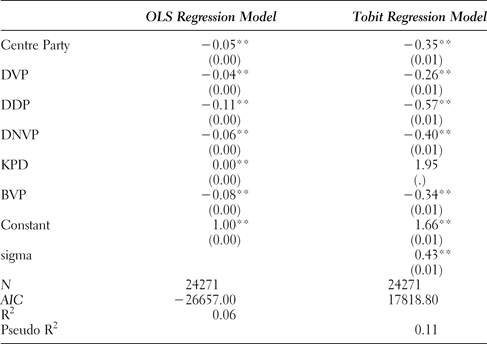
While the descriptive analysis presents one view on the hypothesized relationship, it is necessary to introduce a multivariate analysis to fully explore the extent to which MPs from parties with a basis in the organizational milieus toe the party line more than MPs from nonmilieu parties. The multivariate results, which are based on a Tobit model since our dependent variable—the Rice index scores—varies only between 0 and 1, corroborates the descriptive parts (see Table 2 below): all other major party groups are less cohesive than SPD as an example of a party belonging to the organizational milieu.Footnote 7 The exception here was the Communist Party (KPD), which—given its perfect party cohesiveness—cannot become more cohesive.
Party-specific determinants of party cohesion scores (Rice index) for all parliamentary votes in the time period 1920–24

Notes: Estimates from an OLS (left) and Tobit model (right; lower limit is set to “0”; upper limit is set to “1”); standard errors (clustered by MP) in parentheses. The dependent variable reflects the Rice index score for each parliamentary party and legislative vote; reference group are SPD MPs; +p < 0.10, *p < 0.05, **p < 0.01.
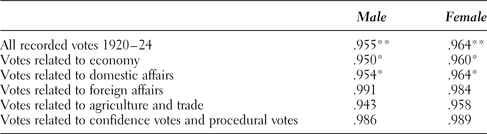
Given that there are some differences between the parties and that our first hypothesis is confirmed, we can now move on to explaining why these differences between and within the parties exist. The first part of this analysis can be found in Table 3 where the Rice scores are divided by gender and policy area to compare whether there is a difference between men and women in terms of how cohesive they are and the extent to which this is based on specific policy areas.
Mean party cohesion scores (Rice index) of votes 1920–24 distributed by gender and by policy area
Note: Own calculations. Differences in means (t-test) between male and female MPs are significant at 5% level (*) and 1% level (**).
Generally, women are more cohesive than men, scoring around 1% higher on the Rice index. The differences in means of the Rice index scores between male and female MPs are statistically significant according to a t-test. This is the case across most policy areas that we can control for, although for few areas men are more cohesive than women in the Weimar Reichstag from 1920 until 1924. The difference between male and female MPs on foreign policy is—likewise to votes related to agriculture and trade as well as to procedural rules—not statistically significant on conventional levels. This is not surprising, given that we know from more recent research on gender and representation that foreign policy is often assumed to be a “hard” policy area where women are less likely to be involved (e.g., Bäck, Debus, and Müller Reference Bäck, Debus and Müller2014). This difference, albeit limited, would also indicate that this type of explanation also held true in the early days of the Weimar Republic.
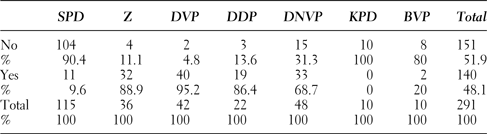
This finding suggests that it is useful to move from the general party-level to the specific MP-level and to examine whether women vote differently than men on specific issues. Establishing a particular policy as specifically male is hard. Conscription would be one such element, yet as this was abolished as part of the Treaty of Versailles, there were no votes on this issue in parliament. However, as we mentioned above, there was at least one policy up for deliberation that was of particular interest to women. The proposal we examine here prohibited people from seeking medical attention for STDs from anyone except approbated doctors. The amendment proposed would have allowed people to contact persons other than doctors in emergency situations. This was especially important for rural areas where there were very few doctors, and, of those doctors, they were generally known to those seeking care. Moreover, doctors were required to report cases of sexually transmitted diseases to the authorities, so that the virtuousness and thus the position of male and, in particular, female persons in society in general and in their personal surrounding in particular would have been damaged or even destroyed (Ellenbrand Reference Ellenbrand1999, 3–5). Had the proposal passed, it would have been a progressive step forward for the rights of women and their position within society in the first half of the 20th century. The only recorded vote on this issue was on this particular amendment, and the proposal failed. The distribution of votes between the parties can be found in Table 4 between men and women in Table 5.
Results of the recorded vote on the permissive amendment on the law proposal dealing with sexually transmitted diseases by selected parliamentary party groups
Note: Own calculations.
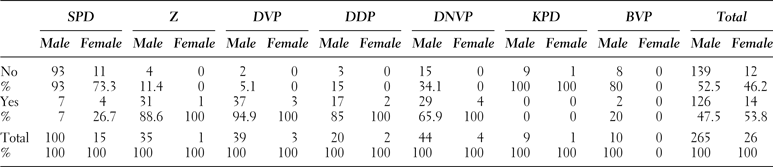
Results of the recorded vote on the permissive amendment on the law proposal dealing with STDs by selected parliamentary party groups and gender
Note: Own calculations.
The parties were split in terms of their attitudes toward the amendment. Only the KPD voted as a unitary actor, whereas all other parties saw splits of varying magnitude, with the conservative DNVP split 70% to 30% in favor of the amendment. While the differences within the parties could be due to multiple reasons, for our argument, however, one particular factor is of primary interests, namely gender.
The proposed amendment failed by 12 votes, the same number of women who voted against the amendment, 11 of which were Social Democrats and one Communist. Whereas only the women of the Social Democratic Party were split on the issues, all women from the traditional bourgeois parties voted in favor of the progressive amendment. Thus, although the group of women looks divided when taking the total into account, i.e., 14 for and 12 against, this must be qualified, as the main body of opposition was a part of the Social Democratic women. This suggests that in order to fully understand the factors influencing the voting decision, we should move beyond the bivariate analysis to a multivariate design where possible confounding factors can be controlled for. This approach is presented in Table 6.
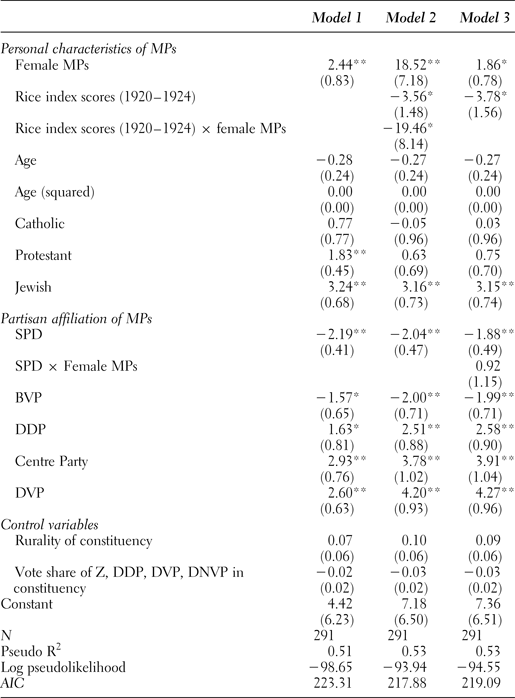
Determinants of voting for the permissive amendment on the law proposal dealing with sexually transmitted diseases
Notes: Members from the DNVP are the reference category. Standard errors (clustered by constituency) in parentheses; +p < 0.10, *p < 0.05, **p < 0.01
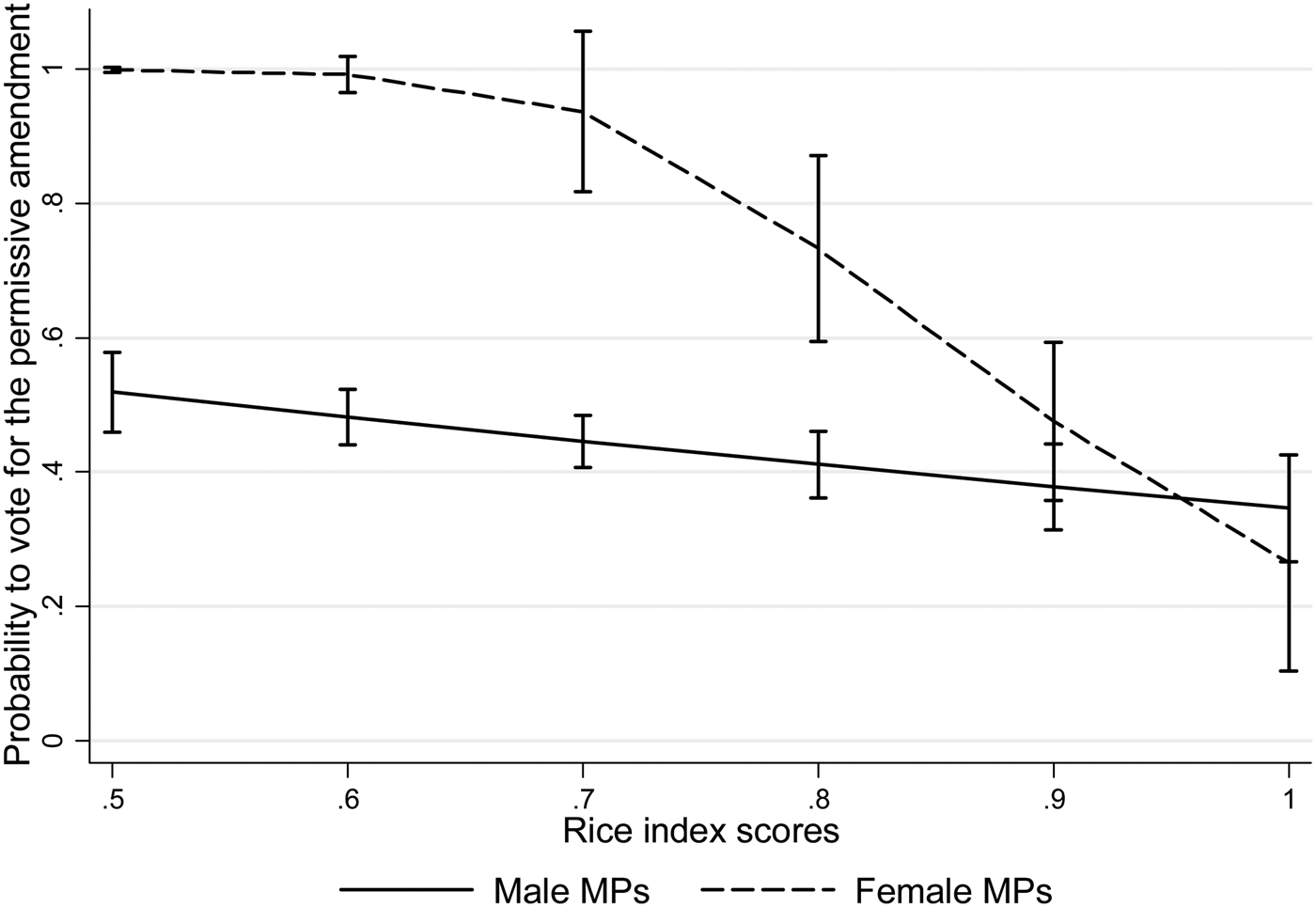
The multivariate logistic regression analysis corroborates the patterns discussed previously. Overall, women are—even when controlling for other personal characteristics of MPs like age or religious affiliation—significantly more likely to vote in favor of the amendment than men. In substantive terms, the chances that male MPs voted for the amendment was at 46% while the probability that female MPs voted for the amendment is at 70%, according to estimates on the basis of Model 1. When comparing this finding to the interaction between cohesiveness and gender, which is introduced in Model 2, we see that women vote significantly more in line with their party than men—which makes the decision by so many women to deviate from their party line in this particular vote even more fascinating (see also Figure 1).
Effect of party cohesion on the probability to vote for the permissive amendment on STD by gender.
Model 3 introduces an interaction term between gender and membership in the SPD parliamentary party. In contrast to the results from the second model presented in Table 6, we find no evidence that female SPD MPs were significantly more likely to vote for the permissive bill.
We also find that Jewish MPs were much more in favor than nondenominational, Roman Catholic, or Protestant MPs. This is somewhat surprising against the background of our finding that it is among the bourgeois parties where the support for the amendment was strongest. The explanation for this finding—in addition to the generally stronger liberal and progressive orientation within the Jewish community in Germany, which was mirrored in the activities of Jewish politicians within liberal or socialist parties (see, e.g., Liepach Reference Liepach1996, 30–43)—can be traced back to the profession and general position on sexual medicine of one Jewish MP. While Ludwig Haas, a Jewish MP from the DDP, abstained from the vote, the two remaining Jewish MPs in the legislative period from 1920 to 1924, Julius Moses and Hugo Heimann, both members of the SPD—were split on the vote; Moses voted in favor, and Heimann against. While Heimann was the chair of the important budget committee and thus had to support the party position to vote against the amendment because of his position within the parliamentary party leadership, Julius Moses was a doctor and supported sex education and the promotion of sexual hygiene throughout his parliamentary career in the Weimar Republic. One of the arguments given in favor of the amendment was that it would help the rural areas where doctors were scarce and people have to travel far distances to receive professional medical help.Footnote 8 However, this does not translate into a significant relationship when we control for the rurality of the electoral district: members from such districts are no more or less likely to vote in favor of the amendment.Footnote 9 We also control for the sum of the vote shares of the Centre Party, the DDP, the DVP, and the DNVP in our analysis since MPs from these parties initiated the amendment on the STD issue. The higher the combined share of these parties is in the respective constituencies, the more likely it is that MPs representing these constituencies will follow their fellow MPs in supporting the amendment, as it should strengthen their position within their own party and the chances to get reelected (e.g., Strøm and Müller Reference Strøm, Müller, Strøm and Müller1999). The effect of this variable, however, is neither significant nor does it have a positive direction. Nevertheless, there is a strong impact of MPs' party affiliation: compared to MPs from the DNVP, which serve as the reference group in the regression analysis, MPs from the Centre Party, the DDP, and the DVP are significantly more likely to vote for the permissive amendment, while MPs who belong to the SPD and the Bavarian Peoples Party are significantly less likely to vote in favor of the amendment. This suggests that the main drivers of the amendment were party political, although the split among women for the Social Democrats was the main reason the amendment failed.
We can move beyond mere speculation when it comes to understanding why a large part of the SPD women voted against the amendment. There is good reason to believe that the party attempted to keep everyone in line due to a desire for the government to fail. The government at the time, led by Chancellor Cuno, was a motley coalition between various independents, Conservatives, and Centrists. The coalition had only been in power for a short period of time, taking over a coalition in which the Social Democrats had taken part. Indeed, when the Cuno government fell in August 1923, the Social Democrats once again joined a coalition with the Centre Party and both liberal parties. The 11 social democratic women were in all likelihood following the party dictate, while the four women who voted for the amendment took a risk by putting the interests of their gender above those of the party. However, three of the four female SPD MPs who voted in favor of the amendment got reelected,Footnote 10 indicating that deviating from the party line on an issue that can be labeled as “moral” or “ethical” was less problematic for the party leadership.
CONCLUSION
In this article, we discussed the impact of gender on legislative decision making in a political system where women had just recently gained the right to vote and to occupy political offices. By focusing on the first years of the Weimar Republic and the legislative process in the German parliament, we selected one recorded vote on an amendment that would have—had it been enacted—increased the rights of persons seeking medical treatment for STDs (women in particular) in terms of their treatment by the state. On the basis of a dataset containing information on the voting behavior of all MPs of the Weimar Reichstag and their personal characteristics during 1920 to 1924, we could show that female MPs did not always follow the party position when the interests of women were at stake. The analysis of a recorded vote on an amendment that would have given more leeway to persons seeking medical care for sexually transmitted diseases has shown that female MPs were split on the issue. Those MPs from liberal, religious, and conservative parties, and a handful of social democrats, voted for the proposal so that the concerned persons, which were mostly women, had more leeway to treat their diseases, which, in addition, increased their chances not to lose their position within society because of “lost virtuousness.” The majority of social democratic women and the sole female communist MP voted against the amendment.
Our analysis reveals that gender was—at least in this particular legislative roll-call vote—a decisive factor in explaining the individual behavior of MPs in the Weimar Republic, despite the general high degree of party unity in the parliament of the first German republic. We thus can conclude that interests of MPs originating from the personal characteristics played a role in newly created democracies with strong and dominant political parties. We can also conclude that, especially on the left end of the political spectrum, the question of whether to represent one's gender or one's party led to a split, whereas the liberal, conservative, and religious side was not split. It is, however, not possible to fully establish whether this was due to women's interests overlapping with the particular proposal; it does seem to be likely, as the women from these parties were united.
These findings have implications for further studies. Since the treatment of social diseases was also discussed in other European countries during that time period (since the numbers of STDs increased dramatically during and after the First World War), it would be interesting to study whether female MPs after women's suffrage displayed similar behavior in other political systems like the United States or the United Kingdom where party discipline was—and still is, due to the electoral system—generally lower. Were female MPs more active in the legislative process, e.g., by giving speeches or by introducing law proposals, when the interests of women were—directly or indirectly—on the agenda? Were female MPs significantly less active in the first years or decades after women's suffrage, and are there differences between political contexts and institutional structures of political systems? These topics would not only be of interest for scholars interested in the specific countries, but would also help us to establish the full extent to which gendered representation has evolved across time and institutions, thereby addressing some of the issues discussed by Beckwith (Reference Beckwith2007) as missing from the study of gender and representation. To answer these questions, a broader perspective is required that includes quantitative research on “historical” parliaments from the time period after women were allowed to enter the political arena.