



1 Introduction
In the study of dynamical systems, entropy is one of the fundamental invariant quantities that is widely used to characterize the complexity of a dynamical system, and the measure theoretic entropy measures the average amount of information and complexity in a system. For a differentiable dynamical system on a compact finite dimensional manifold, there are several well-known results that involve the measure theoretic entropy, such as Ruelle’s inequality, Pesin’s entropy formula and the fact that positivity of the measure theoretic entropy implies the existence of hyperbolic periodic orbits and horseshoes. It is a natural question whether these results in finite dimensional systems hold in infinite dimensional systems.
The Oseledets multiplicative ergodic theorem (MET for short) plays a key role in the theory of differentiable dynamical systems. Ruelle [Reference Ruelle20] proved the MET for operator cocycles on Hilbert spaces. Thieullen [Reference Thieullen21] proved it for continuous operator cocycles on Banach spaces. For random dynamical systems, Lian and Lü [Reference Lian and Lu14] proved it for strongly measurable operator cocycles on separable Banach spaces; Varzaneh and Riedel [Reference Varzaneh and Riedel22] proved the multiplicative ergodic theorem for a strongly measurable semi-invertible operator on fields of Banach spaces, and constructed the stable and unstable manifolds theorem; and Li and Shu [Reference Li and Shu11] proved Ruelle’s inequality of random dynamical systems in Banach spaces.
For
 $C^2$
Fréchet differentiable mappings of Banach spaces, Blumenthal and Young [Reference Blumenthal and Young3] recently studied the relation between entropy and volume growth for a natural notion of volume defined on finite dimensional subspaces, and characterized SRB measures as exactly those measures for which entropy is equal to the volume growth on unstable manifolds. This extended a significant result in [Reference Ledrappier and Young10] for diffeomorphisms of finite dimensional Riemannian manifolds. See [Reference Lian, Liu and Lu13] for the existence of SRB measures for a
 $C^2$
partially hyperbolic map on a Hilbert space. Another important result in finite dimensional smooth ergodic theory is Katok’s landmark approximation result that positive measure theoretic entropy implies the existence of hyperbolic periodic orbits and horseshoes [Reference Katok8]. Lian and Young [Reference Lian and Young16] generalized Katok’s theorem to Fréchet differentiable maps on a Hilbert space with injective, compact derivative and admitting a compact invariant set on which the invariant measure is supported, and later to a similar setting for a
 $C^2$
smooth semiflow on Hilbert spaces [Reference Lian and Young17]. Later, Lian and Ma [Reference Lian and Ma15] extended this result to maps in a separable Banach space. These previous research studies were driven by the study of dissipative parabolic differential equations having global attractors, for instance, two-dimensional (2D) Navier–Stokes equations and other reaction diffusion equations.
If
 $f,g$
are two commuting
 $C^{2}$
diffeomorphisms on a smooth compact manifold, Hu [Reference Hu7] proved the sub-additivity of measure theoretic entropies, that is,
 $h_{\mu }(f\circ g)\leq h_{\mu }(f)+h_{\mu }(g)$
with respect to any
 $(f,g)$
-invariant measure
 $\mu $
(see §2 for the definition). This result does not remain true for measure preserving transformations in general, see an example in the end of [Reference Hu7], where the author constructed two commuting measure preserving transformations
 $f,g$
of a compact manifold M satisfying that
 $h_{\mu }(f)=h_{\mu }(g)=0$
and
 $h_{\mu }(fg)>0$
with respect to a measure
 $\mu $
. The main aim of this paper is to generalize the above result to
 $C^{2}$
Fréchet differentiable mappings of Banach spaces. Namely, let
 $f,g$
be two commuting
 $C^{2}$
Fréchet differentiable maps on a Banach space
 $\mathcal B$
. We will show that
 $h_{\mu }(f\circ g)\leq h_{\mu }(f)+h_{\mu }(g)$
with respect to an
 $(f,g)$
-ergodic measure
 $\mu $
under some suitable conditions.
Although one may use some existing techniques to deal with the lack of local compactness of the phase space, there are some new questions that should be addressed in our case of the infinite dimensional Banach spaces. The first one is caused by the non-invertibility of the maps f and g. The maps may not be onto and may have arbitrarily strong contraction in some directions. Even if the map
 $f^{-1}$
can be defined in some invariant subset, one cannot expect it to have nice regular properties. The second is that the Lyapunov metric does depend on points, so one has difficulties in estimating the norm of vectors since there is no inner product.
This paper is organized as follows. In §2, we give some preliminary results and the statements of the main results. In §§3 and 4, we recall the multiplicative ergodic theorem for commuting transformations and establish the Lyapunov norms in our case. In §5, we give the details of the sub-additivity of entropies. In §§6 and 7, we provide some properties of unstable manifolds and give a condition of the equality of the entropies in §7.
2 Preliminaries and statements
Throughout this paper, let
 $\mathcal {B}$
denote an (infinite dimensional) separable Banach space with norm
 $|\cdot |$
and let
 $A\subset \mathcal {B}$
be a compact subset. Consider two maps
 $f:\mathcal {B} \rightarrow \mathcal {B}$
and
 $g:\mathcal {B} \rightarrow \mathcal {B}$
, and denote by
 $fg$
the composition
 $f\circ g$
for simplicity. Assume the following properties are satisfied.
-
(H1)
-
(i)
 $fg=g f$
, both
$ f $
and
$ g $
are
$C^2$
Fréchet differentiable and injective;
-
(ii) denote by
$Df_x$
and
$Dg_x$
the derivatives of f and g at the point
$x\in \mathcal {B}$
, which are also injective.
-
-
(H2)
-
(i)
$ f(A)=A $
and
$ g(A)=A $
; -
(ii) the set A has finite (upper) box-counting dimension.
-
-
(H3) Assume that
Here,
$$ \begin{align*} l_{\alpha}(f)=\lim_{n\rightarrow \infty}\frac{1}{n} \log \sup_{x\in A} |Df^{n}_x|_{\alpha}<0 \text{,} \quad l_{\alpha}(g)=\lim_{n\rightarrow \infty}\frac{1}{n} \log \sup_{x\in A} |Dg^{n}_x|_{\alpha}<0. \end{align*} $$
$|T|_{\alpha }$
is the Kuratowski measure of non-compactness for a linear operator
$ T $
(see definition below).


Definition 2.1. The Kuratowski measure of non-compactness for a linear operator
 $ T : \mathcal {B}\rightarrow \mathcal {B}$
is defined as
 $$ \begin{align*}|T|_{\alpha}=\inf_{r>0}\{r:T(B) \ \text{can be covered by a finite number of balls with radius}\ r \},\end{align*} $$
where B is the unit ball in
 $ \mathcal {B} $
.
Let
 $h=f \ \text {or} \ g$
, since
 $|T_1 T_2|_{\alpha }\leq |T_1|_{\alpha } \cdot |T_2|_{\alpha }$
for any linear operators
 $T_1,T_2$
on
 $\mathcal {B}$
(e.g. see [Reference Lian and Lu14, §2]). We have that
 $$ \begin{align*}\sup_{x\in A} |Dh^{n+k}_x|_{\alpha}\leq \sup_{x\in A} |Dh^{n}_x|_{\alpha} \cdot \sup_{x\in A} |Dh^{k}_x|_{\alpha}.\end{align*} $$
Hence, all the limits in condition (H3) exist.
Remark 2.2. Conditions (H1) and assumption (i) of (H2) are natural properties guaranteeing the existence of Lyapunov exponents in the Oseledets multiplicative ergodic theorem on a Banach space (see [Reference Thieullen21]). Condition (H3) is discussed in §4, it implies that the tangent space can be decomposed into the unstable, centre and stable subspaces with respect to the transformation. Assumption (ii) of condition (H2) is naturally satisfied when
 $Df_x$
(or
 $Dg_x$
) is the sum of a compact operator and a contraction for each
 $x\in A$
(see [Reference Mañé18]), and it will be used in §§5.3 and 7.2.2.
For every measurable transformation
 $h:\mathcal {B} \rightarrow \mathcal {B}$
, let
 $\mathcal {M}(h,A)$
denote the set of all h-invariant Borel probability measures supported on A, and put
 $\mathcal {M}(f,g,A):=\mathcal {M}(f,A) \cap \mathcal {M}(g,A)$
. It is proved in [Reference Hu7] that the set
 $\mathcal {M}(f,g,A)$
is non-empty. A measure
 $\mu \in \mathcal {M}(f,g,A)$
is
 $(f,g)$
-ergodic, if for any measurable set B with
 $\mu (f^{-1}(B) \triangle B)=\mu (g^{-1}(B) \triangle B)=0$
, one has
 $\mu (B)=0$
or
 $1$
. Let
 $\mathcal {E}(f,g,A)$
denote the set of all
 $(f,g)$
-ergodic measures. Note that if
 $\mu \in \mathcal {M}(f,g,A)$
is f-ergodic or g-ergodic, then
 $\mu \in \mathcal {E}(f,g,A)$
, and the inverse is not true in general.
We recall some basic properties of the sets
 $\mathcal {M}(f,g,A)$
and
 $\mathcal {E}(f,g,A)$
, and refer the reader to [Reference Hu7, §1] for more details.
Proposition 2.3. If T and S are commuting continuous maps on a compact metric space X, then we have the following.
-
(1)
-
(i) T and S have common invariant measures, that is,
$\mathcal {M}(T,S,X)\neq \varnothing $
; -
(ii) the set
$\mathcal {M}(T,S,X)$
is convex; -
(iii)
$\mathcal {M}(TS,S,X)=\mathcal {M}(T,S,X)$
.
-
-
(2)
-
(i)
$\mathcal {E}(T,S,X)$
is the set of all extreme point of
$\mathcal {M}(T,S,X)$
; -
(ii) for every
$\mu \in \mathcal {M}(T,S,X)$
, there exists a unique Borel probability measure
$\pi $
on
$\mathcal {E}(T,S,X)$
such that
$$ \begin{align*}\mu=\int_{\mathcal{E}(T,S,X)} v_e\, d\pi(v_e);\end{align*} $$
-
(iii)
$\mathcal {E}(TS,S,X)=\mathcal {E}(T,S,X)$
; -
(iv) if
$\mu \in \mathcal {E}(T,S,X)$
, then for any measurable function
$\psi $
on X with
$\psi (f(x))\leq \psi (x)$
and
$\psi (g(x))\leq \psi (x)$
, one has that
$\psi $
is a constant for
$\mu $
-almost every (a.e.) x.
-















Let
 $h=f,g$
or
 $fg$
. Denote by
 $h_\mu (h)$
the measure theoretic entropy of h with respect to
 $\mu $
(see [Reference Walters23, Ch. 4] for details). The assumption (i) of condition (H1) implies that
 $h|_{A}$
is invertible and
 $h_\mu (h)=h_\mu (h|_{A})$
for every
 $\mu \in \mathcal {M}(f,g,A)$
.
Definition 2.4. A sub-bundle V is finite dimensional
 $Dh$
-invariant with respect to a measure
 $\mu \in \mathcal {M}(f,g,A)$
if it satisfies the following properties:
-
(1)
$x\mapsto V(x)$
is measurable and
$\dim V(x)$
is finite for
$\mu $
-a.e. x; -
(2)
$Dh_x V(x)=V(h(x))$
for
$\mu $
-a.e x,




where
 $h=f$
or g.
Given
 $\mu \in \mathcal {M}(f,g,A)$
, assume that the following condition is satisfied:
-
(H4) for every finite dimensional sub-bundle V which is both
$Df$
-invariant and
$Dg$
-invariant with respect to the measure
$\mu \in \mathcal {M}(f,g,A)$
, then either or both
$$ \begin{align*}\int \log^{+}|(Df_x|_{V(x)})^{-1}|\,d\mu(x)<\infty \quad \text{and} \quad \int\log^{+}|(Dg_x|_{V(x)})^{-1}|\,d\mu(x)<\infty\end{align*} $$
$\log ^{+}|(Df|_{V})^{-1}|$
and
$\log ^{+}|(Dg|_{V})^{-1}|$
are not integrable with respect to
$\mu $
.







Remark 2.5. The above condition is satisfied for every
 $\mu \in \mathcal {M}(f,g,A)$
if f and g are
 $C^2$
diffeomorphisms on some neighbourhood of A. It is used in the proof of Corollary 3.14 in §3, and is only used in the proof of part (e) of Theorem 3.16.
Under the previous assumptions, we have the following theorem.
Theorem A. Let
 $\mathcal {B}$
be a separable Banach space with norm
 $|\cdot |$
. Given a compact subset
 $A\subset \mathcal {B}$
and a measure
 $\mu \in \mathcal {E}(f,g,A)$
, if
 $f,g:\mathcal {B} \rightarrow \mathcal {B}$
satisfy conditions (H1)–(H4), then we have that
 $$ \begin{align*} h_\mu(f g)\leq h_{\mu}(f)+h_{\mu}(g).\end{align*} $$
When does the inequality in the above theorem become an equality? To answer this question, we introduce some notation first. Let
 $\mathcal {B}_x:=\{x\}+\mathcal {B}$
denote the tangent space of
 $\mathcal {B}$
at
 $x\in \mathcal {B}$
and choose
 $\unicode{x3bb} _{\alpha }\in \mathbb {R}$
such that

Let
 $h=f$
or g. Given
 $\mu \in \mathcal {E}(f,g,A)$
, denote by
 $\unicode{x3bb} _1(x,h)>\unicode{x3bb} _2(x,h)>\cdots >\unicode{x3bb} _{r(x,h)} (x,h)>\unicode{x3bb} _{\alpha }$
the distinct Lyapunov exponents of
 $(h,\mu )$
which are bigger than
 $\unicode{x3bb} _{\alpha }$
for
 $\mu $
-a.e. x. Define respectively the unstable, centre and stable subspace of
 $\mathcal {B}_x$
by

and

See Theorem 3.2 for a detailed description of the above notation. For any
 $\delta>0$
, denote by
 $w^{u}_{\delta }(x,h)$
the local unstable manifold of h at the point x (see §6 for the precise definition).
Theorem B. Let
 $\mathcal {B}$
be a separable Banach space with norm
 $|\cdot |$
. Given a compact subset
 $A\subset \mathcal {B}$
and a measure
 $\mu \in \mathcal {E}(f,g,A)$
, assume that
 $f,g:\mathcal {B} \rightarrow \mathcal {B}$
satisfy conditions (H1)–(H4) and
 $E^{u}(x,f)=E^{u}(x,g)$
for
 $\mu $
-a.e. x. Then, there exists a number
 $\hat {\delta }>0$
such that
 $$ \begin{align*}w^{u}_{\delta}(x,f)=w^{u}_{\delta}(x,g)\quad \mu\text{-a.e.} \, x \end{align*} $$
for every
 $0<\delta <\hat {\delta }$
. Moreover, if
 $E^{c}(x,f)=\{0\}$
and
 $E^{c}(x,g)=\{0\}$
for
 $\mu $
-a.e. x, then
 $$ \begin{align*}h_\mu(fg)=h_{\mu}(f)+h_{\mu}(g).\end{align*} $$
3 MET for commuting transformations
In this section, we will construct an Oseledets splitting of the tangent space
 $\mathcal {B}_x$
such that the Lyapunov exponents of
 $Df,Dg$
and
 $D(fg)$
are well defined on the finite dimensional subspace, and can also be controlled on the finite co-dimensional subspace.
Definition 3.1. Let X be a compact metric space and
 $\mu $
a Borel probability measure on X, and let Z be a metric space. We say that a map
 $\Psi :X\rightarrow Z$
is
 $\mu $
-continuous if there is an increasing sequence
 $\{K_{n}\}_{n\in \mathbb {N}}$
of compact subsets of X, such that
 $\mu (\bigcup _{n}K_n)=1$
and
 $\Psi |_{K_n}$
is continuous for each n.
Given
 $f,g,\mathcal {B},A$
satisfying conditions (H1)–(H3) and
 $\mu \in \mathcal {E}(f,g,A)$
, put
 $h=f$
or g. By the sub-additive ergodic theorem, the following limit exists for
 $\mu $
-a.e. x:
 $$ \begin{align*}l_{\alpha}(x,h):=\lim_{n\rightarrow \infty}\frac{1}{n} \log |Dh^{n}_x|_{\alpha}.\end{align*} $$
It follows from condition (H3) immediately that
 $l_{\alpha }(x,h)\leq l_{\alpha }(h)<\unicode{x3bb} _{\alpha }$
(recall the choice of
 $\unicode{x3bb} _{\alpha }$
in equation (2.1)). We first recall the classical MET for derivative cocycles on a Banach space, see [Reference Thieullen21] for more details.
Theorem 3.2. Let
 $\mathcal {B},h,A,\unicode{x3bb} _{\alpha }$
and
 $\mu $
be as above. Then, there exists a both f-invariant and g-invariant Borel subset
 $\Gamma $
with
 $\mu (\Gamma )=1$
such that for every
 $x\in \Gamma $
, there are
 $r(x,h)$
numbers

and a unique splitting
 $$ \begin{align*} \mathcal{B}_x=E_1(x,h) \oplus \cdots \oplus E_{r(x,h)}(x,h) \oplus E_{\alpha}(x,h)\end{align*} $$
with the following properties:
-
(a) for
$i=1,\ldots ,r(x,h)$
,
$ \dim E_{i}(x,h)=m_i(x,h)$
is finite and
$Dh_x E_{i}(x,h)=E_{i}(h(x),h)$
, for every
$v\in E_{i}(x,h)\setminus \{0\}$
, we have -
(b)
$E_{\alpha }(x,h)$
is closed and finite co-dimensional, satisfies that
$Dh_x E_{\alpha }(x,h)$
$\subset E_{\alpha }(h(x),h)$
and -
(c) the map
$x\mapsto E_{i}(x,h)$
(
$\ i=1,\ldots ,r(x,h)$
,
$\alpha $
) is
$\mu $
-continuous; -
(d) let
$\pi _{i}(x,h)$
(
$i=1,\ldots ,r(x,h)$
,
$\alpha $
) denote the projection of
$\mathcal {B}_x $
onto
$ E_{i}(x,h) $
via the splitting, so we have
$$ \begin{align*}\lim_{n\rightarrow \pm\infty} \frac{1}{n}\log |\pi_{i}(h^{n}(x),h)|=0.\end{align*} $$








Remark 3.3. If
 $\mu $
is h-ergodic, it is well known that
 $r(x,h)$
,
 $\unicode{x3bb} _i(x,h)$
and
 $m_i(x,h)$
(
 $i=1,\ldots ,r(x,h)$
) are constant
 $\mu $
-almost everywhere. In §2, we stressed that
 $\mu \in \mathcal {E}(f,g,A)$
does not imply
 $\mu $
is f-ergodic or g-ergodic. However, we will show that all of these functions are constants
 $\mu $
-almost everywhere if
 $\mu $
is only
 $(f,g)$
-ergodic.
Remark 3.4. Note that for every metric space Z,
 $\mu $
-continuous is equivalent with Borel measurability (see [Reference Kupka and Prikry9, Theorem 4.1]).
For a given measurable positive function
 $\psi $
and a measure
 $\mu $
, we call
 $\psi $
the (
 $\mu $
-)temperate with respect to h, if
 $$ \begin{align*}\lim_{n\rightarrow \pm \infty} \frac{1}{n}\log \psi\circ h^n=0 \quad \mu\text{-almost everywhere}\end{align*} $$
and we say
 $\psi $
is
 $\varepsilon $
-slowly with respect to h, if
 $$ \begin{align*}\psi(h^{\pm}x)\leq e^{\varepsilon}\psi(x)\quad \mu\text{-almost everywhere}, \end{align*} $$
where
 $\varepsilon>0$
and
 $h=f$
or g.
The following lemmas are useful in the proof of our main results, see [Reference Walters24, Lemmas 8 and 9] for the first result and in [Reference Blumenthal and Young3, Lemma 5.4] for the second result.
Lemma 3.5. Let
 $T: X\to X $
be an invertible measure preserving transformation of a probability space
 $(X,\mu )$
and let
 $\psi :X\rightarrow \mathbb {R}$
be a measurable function. Assume that either
 $(\psi \circ T-\psi )^{+}$
or
 $(\psi \circ T-\psi )^{-}$
is integrable, then
 $$ \begin{align*}\lim_{n\rightarrow \pm \infty} \frac{1}{n} \psi\circ T^n(x)=0 \quad \mu\text{-a.e.} \ x\in X.\end{align*} $$
Lemma 3.6. Let
 $T: X\to X $
be an invertible measure preserving transformation of a probability space
 $(X,\mu )$
, and let
 $\psi :X\rightarrow \mathbb {R}$
be a measurable and temperate function. Then, for every
 $\varepsilon>0$
, there exists a measurable function
 ${\psi }':X\rightarrow [1,\infty )$
such that
 ${\psi }'(x)\geq \psi (x)$
and
 ${\psi }'(T^{\pm }x)\leq e^{\varepsilon }{\psi }'(x)$
for
 $\mu $
-a.e.
 $x\in X$
.
3.1 Invariant splitting
We first prove that the Oseledets splitting of f is also
 $Dg$
-invariant, and so it is both
 $Df$
-invariant and
 $Dg$
-invariant. Let
 $ m(x,f)=m_1(x,f)+\cdots +m_{r(x,f)}(x,f)$
and
 $$ \begin{align*}E(x,f)=E_1(x,f) \oplus \cdots \oplus E_{r(x,f)}(x,f).\end{align*} $$
Lemma 3.7. For every
 $x\in \Gamma $
and
 $v\in E(x,f)\setminus \{0\}$
, let
 $$ \begin{align*}\unicode{x3bb}(x,v,f)=\lim_{n\rightarrow \infty}\frac{1}{n} \log|Df^n_xv|\end{align*} $$
if the limit exists. Then, we have
 $\unicode{x3bb} (g(x),Dg_xv,f)=\unicode{x3bb} (x,v,f)$
.
Proof. Let
 $C_0=\max \{\sup _{x\in A}|Df_x|,\sup _{x\in A}|Dg_x|\}<\infty $
and put
 $$ \begin{align*}m(x,g,E):=m(Dg_x|_{E(x,f)})=\inf_{v\in E(x,f)\setminus\{0\}}\dfrac{|Dg_x v|}{|v|},\end{align*} $$
then one has that
 $m(x,g,E)>0$
for every
 $x\in \Gamma $
, since
 $Dg_x$
is injective and
 $E(x,f)$
is finite dimensional.
We claim that for
 $\mu $
-a.e.
 $x\in \Gamma $
,
 $$ \begin{align} \lim_{n\rightarrow \pm \infty} \frac{1}{n} \log m(f^{n}(x),g,E)=0. \end{align} $$
We proceed to prove the lemma by assuming that the claim is true. By definition, we have
 $m(x,g,E)|v|\leq |Dg_x v| \leq C_0|v|$
for every
 $x\in \Gamma $
and
 $v\in E(x,f)$
, which together with the community of
 $f,g$
yields that
 $$ \begin{align*} m(f^{n}(x),g,E)|Df^n_x v| \leq |Dg_{f^{n}(x)} Df^n_x v|=|Df^n_{g(x)}Dg_x v|\leq C_0 |Df^n_x v|. \end{align*} $$
It follows from the claim immediately that
 $\unicode{x3bb} (g(x),Dg_xv,f)=\unicode{x3bb} (x,v,f)$
for
 $\mu $
-a.e.
 $x\in \Gamma $
.
To finish the proof of the lemma, it suffices to prove the above claim.
Proof of the claim
Let
 $\Gamma (m)=\{x\in \Gamma : m(x,f)=m\}$
, then
 $\Gamma =\bigcup _{m\in \mathbb {N}} \Gamma (m)$
and
 $\Gamma (m)$
is f-invariant for every
 $m\in \mathbb {N}$
. Take a positive integer
 $m\in \mathbb {N}$
with
 $\mu (\Gamma (m))>0$
and let
 $\mu _m$
be the normalized measure of
 $\mu $
restricted on
 $\Gamma (m)$
. Hence,
 $\mu _m$
is an f-invariant probability measure supported on
 $\Gamma (m)$
. Note that
 $$ \begin{align*}Dg_{f(x)}|_{E(f(x),f)}=Df_{g(x)} \circ Dg_{x} \circ (Df_x |_{E(x,f)})^{-1},\end{align*} $$
it is easy to show that
 $m(f(x),g,E)\leq |Df_{g(x)}|\cdot m(x,g,E) \cdot |(Df_x |_{E(x,f)})^{-1}|$
. Consequently, one can show that
 $$ \begin{align} (\log m(f(x),g,E)-\log m(x,g,E))^{+}\leq \log C_0 + \log^{+} |(Df_x |_{E(x,f)})^{-1}|. \end{align} $$
To complete the proof of the lemma, it suffices to show that (3.1) holds for
 $\mu $
-a.e.
 $x\in \Gamma (m)$
. By Lemma 3.5 and equation (3.2), it suffices to show that
 $$ \begin{align} \int \log^{+} |(Df_x |_{E(x,f)})^{-1}|\,d\mu_m(x)<\infty. \end{align} $$
For every
 $x\in \Gamma (m) $
and every
 $v\in E(x,f)$
with
 $|v|=1$
, by [Reference Blumenthal and Young3, Lemma 3.11], we have that
 $$ \begin{align} \det(Df_x |_{E(x,f)}) \leq m^{m/2} |Df_x |_{E(x,f)} |^{m-1} |Df_x v|, \end{align} $$
where one can see [Reference Blumenthal and Young3, §3.2] for the definition of the determinant of a linear operator on Banach spaces. This, together with the fact
 $ |Df_x |_{E(x,f)} |\leq C_0$
, yields that
 $$ \begin{align*}|(Df_x |_{E(x,f)})^{-1}|\leq C_m \cdot (\det(Df_x |_{E(x,f)}))^{-1},\end{align*} $$
where
 $C_m=m^{m/2} \cdot C_0^{m-1}$
.
Put
 $\phi (x)=\log \det (Df_x |_{E(x,f)})$
. To show equation (3.3), it suffices to prove that
 $ \phi \in L^{1}(\mu _m)$
. Since
 $\det (Df_x |_{E(x,f)})\leq m^{m/2} C^{m}_0$
by equation (3.4), one has
 $\phi ^{+}\in L^1(\mu _m)$
. It remains to show that
 $\phi ^{-}\in L^1(\mu _m)$
. By Birkhoff’s ergodic theorem, there exists a measurable function
 $\hat {\phi }:\Gamma _m\rightarrow [-\infty ,\infty )$
with
 $\hat {\phi }^{+}\in L^1(\mu _m)$
such that
 $$ \begin{align*} \hat{\phi}(x)=\lim_{n\rightarrow \infty} \frac{1}{n}\sum_{k=0}^{n-1} \phi(f^i(x))=\lim_{n\rightarrow \infty} \frac{1}{n}\sum_{k=0}^{n-1} \phi(f^{-i}(x))\end{align*} $$
for
 $\mu _m$
-a.e.
 $x\in \Gamma (m)$
. Note that
 $$ \begin{align*} \hat{\phi}(x)&=\lim_{n\rightarrow \infty} \frac{1}{n}\sum_{k=0}^{n-1} \phi(f^{-i}(x))\\ &=\lim_{n\rightarrow \infty} \frac{1}{n} \sum_{k=0}^{n-1}\log \det(Df_{f^{-i}(x)} |_{E(f^{-i}(x),f)})\\ &=\lim_{n\rightarrow \infty} \frac{1}{n} \log \det(Df^n_{f^{-n}(x)}|_{E(f^{-n}(x),f)})\\ &=\lim_{n\rightarrow \infty} -\frac{1}{n} \log \det(Df^{-n}_{x}|_{E(x,f)}) \end{align*} $$
and, by [Reference Blumenthal and Young3, Lemma 3.11], one can choose
 $\{v_1,\ldots ,v_m \}$
to be a unit basis for
 $E(x,f)$
such that
 $$ \begin{align*}\det(Df^{-n}_{x}|_{E(x,f)})\leq m^{m/2} \prod_{i=1}^{m}|Df^{-n}_{x} v_i|.\end{align*} $$
By Theorem 3.2(a), we have that

Then, we have that
 $\int \hat {\phi }(x) dx>-\infty $
. Note that
 $\int \hat {\phi }(x)\,dx= \int \phi (x)\,dx$
. Hence, we have
 $\phi (x) \in L^1(\mu _m).$
This completes the proof of this lemma.
Actually, the following result is proved in the proof of the above claim.
Lemma 3.8. Given a finite dimensional
 $Dh$
-invariant sub-bundle V (here h is f or g), if there exists a number
 $\unicode{x3bb}>-\infty $
such that for
 $\mu $
-a.e. x,
 $$ \begin{align*}\lim_{n\rightarrow \pm \infty} \frac{1}{n} \log |Dh^{n}_{x} v|\geq \unicode{x3bb}\end{align*} $$
for any
 $v\in V(x)\setminus \{0\}$
. Then, we have
 $\int \log ^{+} |(Dh_x|_{V(x)})^{-1}|\,d\mu <\infty $
.
Lemma 3.9. For
 $\mu $
-a.e.
 $x\in \Gamma $
, we have that
 $$ \begin{align*}Dg_x E_{j}(x,f)=E_{j}(g(x),f)\ \ j=1,\ldots,r(x,f),\end{align*} $$
and the functions
 $r(\cdot ,f),\ \unicode{x3bb} _{j}(\cdot ,f)$
and
 $m_j(\cdot ,f)$
(
 $j=1,\ldots ,r(\cdot ,f)$
) are constants
 $\mu $
-almost everywhere.
Proof. By Lemma 3.7, for
 $\mu $
-a.e.
 $x\in \Gamma $
and every
 $u\in E(x,f)\setminus \{0\}$
, we have that

This implies that
 $Dg_x u \notin E_{\alpha }(g(x),f)$
, that is,
 $E_{\alpha }(g(x),f)\cap Dg_x E(x,f)=\{0\}$
. Hence, one has that
 $$ \begin{align*}m(x,f)\leq \text{co}\dim E_{\alpha}(g(x),f)=m(g(x),f)\end{align*} $$
for
 $\mu $
-a.e.
 $x\in \Gamma $
. Since
 $\mu $
is
 $(f,g)$
-ergodic and
 $m(x,f)=m(f(x),f)$
, by Proposition 2.3, we have that
 $m(\cdot ,f)$
is a constant
 $\mu $
-almost everywhere.
Take a point x with
 $m(x,f)=m(g(x),f)$
, one can show that
 $\unicode{x3bb} _{j}(x,f)\le \unicode{x3bb} _{j}(g(x),f)$
by Lemma 3.7 and
 $m_j(x,f)\le m_{j}(g(x),f)$
by the injectivity of
 $Dg_x$
for
 $j=1,\ldots ,r(x,f)$
. Consequently, one has that
 $r(x,f)\le r(g(x),f)$
since we have already obtained
 $r(x,f)$
number of exponents at point
 $g(x)$
. Note that
 $r(\cdot ,f),\ \unicode{x3bb} _{j}(\cdot ,f)$
and
 $m_j(\cdot ,f)$
are also f-invariant functions, so it follows from the
 $(f,g)$
-ergodity that they are constants for
 $\mu $
-a.e. x.
Since
 $E_{\alpha }(g(x),f)\cap Dg_x E(x,f)=\{0\}$
and
 $Dg_x$
is injective for
 $\mu $
-a.e. x, one may consider a splitting of the tangent space at point x as follows:
 $$ \begin{align*} \mathcal{B}_x=\bigoplus_{i=1}^{r}Dg_{g^{-1}x}E_i(g^{-1}(x),f)\oplus E_{\alpha}(g(x),f). \end{align*} $$
It satisfies Theorem 3.2. By the unique existence of Oseledets splitting, we have that
 $Dg_x E_{j}(x,f)=E_{j}(g(x),f)$
for
 $j=1,\ldots ,r(x,f)$
and
 $Dg_x E_{\alpha }(x,f)\subset E_{\alpha }(g(x),f)$
for
 $\mu $
-a.e. x.
One can prove in a similar fashion that
 $Df_x E_{j}(x,g)=E_{j}(f(x),g)$
and the functions
 $r(\cdot ,g)$
,
 $\unicode{x3bb} _{j}(\cdot ,g)$
and
 $m_j(\cdot ,g)$
,
 $j=1,\ldots ,r(\cdot ,g)$
are constants
 $\mu $
-almost everywhere. Thus, for
 $h=f$
or g, we write
 $r(x,h)=r(h)$
and
 $\unicode{x3bb} _{j}(x,h)=\unicode{x3bb} _{j}(h),\ m_j(x,h)=m_j(h)$
(
 $j=1,\ldots ,r(h)$
) for
 $\mu $
-a.e. x.
3.2 Construction of a new splitting
In this section, we will construct a desired splitting of the tangent space
 $\mathcal {B}_x$
for the purpose of proving our main result. We first introduce a concept to simplify our description. Given a finite dimensional both
 $Df$
-invariant and
 $Dg$
-invariant sub-bundle V, and letting
 $h=f,g$
or
 $f g$
, we call the number
 $\unicode{x3bb} (h)\in \mathbb {R}$
the Lyapunov exponent of
 $Dh$
on sub-bundle V if
 $$ \begin{align*}\lim_{n\rightarrow \pm \infty} \frac{1}{n}\log |Dh^{n}_x v|=\unicode{x3bb}(h)\quad \mu\text{-a.e.}\, x\end{align*} $$
for every
 $v\in V(x)\setminus \{0\}$
.
Lemma 3.10. Given a finite dimensional both
 $Df$
-invariant and
 $Dg$
-invariant sub-bundle V, if there exist two numbers
 $\unicode{x3bb} (f)\in \mathbb {R}$
and
 $\unicode{x3bb} (g)\in \mathbb {R}$
such that for
 $\mu $
-a.e. x,
 $$ \begin{align*}\lim_{n\rightarrow \pm \infty} \frac{1}{n}\log |Df^{n}_x v|=\unicode{x3bb}(f) \quad \text{and} \quad \lim_{n\rightarrow \pm \infty} \frac{1}{n}\log |Dg^{n}_x v|=\unicode{x3bb}(g) \end{align*} $$
for every
 $v\in V(x)\setminus \{0\}$
, then, for every
 $s,t\in \mathbb {Z}$
and
 $\mu $
-a.e. x, we have that
 $$ \begin{align*}\lim_{n\rightarrow \pm \infty} \frac{1}{n}\log |D(f^sg^t)^{n}_x v|=s\unicode{x3bb}(f)+t\unicode{x3bb}(g)\quad \text{ for all } v\in V(x)\setminus \{0\}. \end{align*} $$
Proof. Note that
 $f,g$
are
 $C^2$
maps, so by the assumption and Lemma 3.8, we have that
 $$ \begin{align*}\log^{+} |(Df|_{V})^{\pm}|\in L^{1}(\mu) \ \text{and} \ \log^{+} |(Dg|_{V})^{\pm}|\in L^{1}(\mu).\end{align*} $$
This implies that
 $\log ^{+} |Df^sg^t|_{V}|\in L^{1}(\mu )$
for every
 $s,t\in \mathbb {Z}$
. For every
 $s,t\in \mathbb {Z}$
, consider the finite dimensional
 $D(f^sg^t)$
-invariant sub-bundle V and apply the multiplicative ergodic theorem for the cocycle
 $\{D(f^sg^t)^{n}\}_{n\ge 0}$
, which is defined on A with respect to
 $f^sg^t$
, for
 $\mu $
-a.e.
 $x\in \Gamma $
, the following limit:
 $$ \begin{align*}\unicode{x3bb}(x,v,f^sg^t)=\lim_{n\rightarrow \pm \infty}\frac{1}{n}\log |D(f^sg^t)^n_x v|\end{align*} $$
exists for every
 $v\in V(x)\setminus \{0\}$
.
For every
 $\varepsilon>0$
, let
 $$ \begin{align*}A_{\varepsilon}=\{x\in \Gamma: \unicode{x3bb}(x,v,f^sg^t)-s\unicode{x3bb}(f)-t\unicode{x3bb}(g)>4\varepsilon \ \text{for some} \ v\in V(x)\}.\end{align*} $$
Assume that
 $\mu (A_{\varepsilon })>0$
. For every
 $\ell \in \mathbb {N}$
, let
 $$ \begin{align*} {A}^{\prime}_{\varepsilon,\ell}=\{&x\in A_{\varepsilon}: \text{ there exists } \ u_x \in V(x) \ \text{such that}\ |D(f^sg^t)^n_x u_x|\\&\geq \ell^{-1} e^{n(\unicode{x3bb}(x,u_x,f^sg^t)-\varepsilon)}|u_x| \text{ for all } \ n\geq 1 \} \end{align*} $$
and
 $$ \begin{align*} {A}^{\prime\prime}_{\varepsilon,\ell}=\{x\in A_{\varepsilon}: \ |Dg^{tn}_x u|\leq \ell e^{n(t\unicode{x3bb}(g)+\varepsilon)}|u| \text{ for all } u \in V(x), \text{ for all } n\geq 1 \}. \end{align*} $$
Since
 $\mu (A_{\varepsilon })>0$
, one may choose
 $\ell $
large enough such that
 $\mu ({A}^{\prime }_{\varepsilon ,\ell }\cap {A}^{\prime \prime }_{\varepsilon ,\ell })>0$
. For every
 $x\in {A}^{\prime }_{\varepsilon ,\ell }\cap {A}^{\prime \prime }_{\varepsilon ,\ell }$
, applying Poincaré’s recurrence theorem with respect to
 $f^s$
, there exists
 $n>2({\log \ell }/{\varepsilon })$
such that
 $f^{sn} x\in {A}^{\prime }_{\varepsilon ,\ell }\cap {A}^{\prime \prime }_{\varepsilon ,\ell }$
and
 $$ \begin{align*}|Df^{sn}_x u|\leq |u|\cdot e^{n(s\unicode{x3bb}(f)+\varepsilon)}\end{align*} $$
for every
 $u\in V(x)$
. Hence, for every
 $0\neq u\in V(x)$
, we have that
 $$ \begin{align*} |D(f^sg^t)^n_x u|&=|Dg^{tn}_{f^{sn}(x)}Df^{sn}_x u|\\ &\leq \ell e^{n(t\unicode{x3bb}(g)+s\unicode{x3bb}(f)+2\varepsilon)}|u|\\ &\leq \ell e^{-n\varepsilon} e^{n(\unicode{x3bb}(x,u,f^sg^t)-\varepsilon)}|u|\\ &< \ell^{-1} e^{n(\unicode{x3bb}(x,u,f^sg^t)-\varepsilon)}|u|, \end{align*} $$
which contradicts with the fact
 $x\in {A}^{\prime }_{\varepsilon ,\ell }$
. Hence, we have
 $\mu (A_{\varepsilon })=0$
for every
 $\varepsilon> 0$
. In a similar fashion, one can show that the following set:
 $$ \begin{align*}B_{\varepsilon}=\{x\in \Gamma: \unicode{x3bb}(x,v,f^sg^t)-s\unicode{x3bb}(f)-t\unicode{x3bb}(g)<4\varepsilon \ \text{for some} \ v\in V(x)\}\end{align*} $$
satisfies that
 $\mu (B_{\varepsilon })=0$
for every
 $\varepsilon> 0$
. By the arbitrariness of
 $\varepsilon> 0$
, we have that
 $$ \begin{align} \lim_{n\rightarrow \pm \infty}\frac{1}{n}\log |D(f^sg^t)^n_x v|=s\unicode{x3bb}(f)+t\unicode{x3bb}(g)\quad \mu\text{-a.e.}\, x \end{align} $$
for every
 $0\neq v\in V(x)$
.
Fix
 $i\in \{1,\ldots ,r(f)\}$
, note that
 $$ \begin{align*}Dg_x E_{i}(x,f)=E_{i}(g(x),f) \text{,} \hspace{7pt} \log^{+} |Dg_x|_{E_{i}(x,f)}|\in L^1(\mu)\hspace{7pt} \text{and}\hspace{7pt} \dim E_{i}(x,f)=m_i(f) .\end{align*} $$
Restrict on the finite dimensional
 $Dg$
-invariant sub-bundle
 $E_{i}(\cdot ,f)$
and apply the multiplicative ergodic theorem for the cocycle
 $\{Dg^{n}\}_{n\ge 0}$
, which is defined on A with respect to g. For
 $\mu $
-a.e.
 $x\in \Gamma $
, there exist
 $j_i$
numbers

and a unique splitting of the subspace
 $E_{i}(x,f)$
,
 $$ \begin{align} E_{i}(x,f)=E_{i,1}(x) \oplus \cdots \oplus E_{i,j_i}(x), \end{align} $$
such that the following properties hold:
-
(a) for each
$j=1,\ldots ,j_i$
, one has that
$\dim E_{i,j}(x)=m^{E}_{i,j}\leq m_i(f)$
,
$Dg_x E_{i,j}(x)=E_{i,j}(g(x))$
and
$Df_x E_{i,j}(x)=E_{i,j}(f(x))$
by using a similar argument as in Lemma 3.9. Moreover, for every
$v\in E_{i,j}(x)\setminus \{0\}$
, we have that and the second limit also holds for
$n\rightarrow -\infty $
if
$\unicode{x3bb} _{i,j}(g)>-\infty $
;
-
(b) the map
$x\mapsto E_{i,j}(x)$
(
$j=1,\ldots ,j_i$
) is
$\mu $
-continuous.








Remark 3.11.
-
(1) There is a natural splitting of
$E_{i}(x,f)$
, where
$$ \begin{align*}E_{i}(x,f)=E_{i,1}(x) \oplus \cdots \oplus E_{i,r(g)}(x) \oplus E_{i,\alpha}(x),\end{align*} $$
$E_{i,j}(x)=E_{i}(x,f)\cap E_{j}(x,g)$
and
$E_{i,\alpha }(x)=E_{i}(x,f)\cap E_{\alpha }(x,g)$
. However, one can only show that the Lyapunov exponents of
$D(fg)$
on the finite dimensional sub-bundle
$E_{i,\alpha }$
are upper bounded by
$\unicode{x3bb} _{\alpha }+\unicode{x3bb} _i(f)$
, which may be larger than
$0$
. This implies that
$E_{i,\alpha }$
may not belong to any subspace which is unstable, centre or stable with respect to
$D(fg)$
. We would like to point out that the above method of constructing the desired splitting is slightly different to [Reference Li and Zhu12].
-
(2) If
$\log ^{+} |(Dg_x|_{E_{i}(x,f)})^{-1}|\in L^1(\mu )$
, then the Lyapunov exponent
$\unicode{x3bb} _{i,j_i}(g)$
is finite.





Note that the Lyapunov exponents of
 $Df,Dg$
on the sub-bundle
 $E_{i,j}$
are
 $\unicode{x3bb} _{i}(f)$
and
 $\unicode{x3bb} _{i,j}(g)$
respectively. It follows from Lemma 3.10 that the Lyapunov exponent of
 $D(fg)$
on
 $E_{i,j}$
is
 $\unicode{x3bb} _{i}(f)+\unicode{x3bb} _{i,j}(g)$
.
For
 $x\in \Gamma $
, let
 $$ \begin{align*}E_{\alpha,j}(x):=E_{\alpha}(x,f)\cap E_{j}(x,g) \quad \text{for } j=1,\ldots,r(g),\end{align*} $$
and
 $E_{\alpha }(x):=E_{\alpha }(x,f)\cap E_{\alpha }(x,g)$
. Recall that

Therefore, using the same arguments as in the proof of Lemma 3.10, one can show that

Given the sub-bundle
 $E_{\alpha ,j}$
, the Lyapunov exponent of
 $Dg$
on it is
 $\unicode{x3bb} _j(g)$
for
 $j=1,\ldots ,r(g)$
. To get the Lyapunov exponents of
 $Df$
and
 $D(fg)$
on it, applying the multiplicative ergodic theorem for cocycle
 $\{Df^n|_{E_{\alpha ,j}}\}_{n\ge 0}$
, which is defined on A with respect to f and satisfied that
 $\log ^{+}|Df |_{E_{\alpha ,j}}|\in L^1(\mu )$
, for
 $\mu $
-a.e.
 $x\in \Gamma $
, there exist
 $i_j$
numbers

and a unique splitting of the subspace
 $E_{\alpha , i}(x,f)$
,
 $$ \begin{align} E_{\alpha,i}(x,f)=G_{1,j}(x) \oplus \cdots \oplus G_{i_j,j}(x), \end{align} $$
such that the following properties hold:
-
(a) for each
$i=1,\ldots ,i_j$
, one has that
$\dim G_{i,j}(x)=m^{G}_{i,j}\leq m_j(g)$
,
$Df_x G_{i,j}(x)=G_{i,j}(f(x))$
and
$Dg_x G_{i,j}(x)=G_{i,j}(g(x))$
by using a similar argument as in Lemma 3.9. Moreover, for every
$v\in G_{i,j}(x) \setminus \{0\}$
, we have that where the first limit also holds for
$n\rightarrow -\infty $
if
$\unicode{x3bb} _{i,j}(f)>-\infty $
;
-
(b) the map
$x\mapsto G_{i,j}(x)$
(
$i=1,\ldots ,i_j$
) is
$\mu $
-continuous.









Together with equations (3.6) and (3.8), for
 $\mu $
-a.e. x, we get a both
 $Df$
-invariant and
 $Dg$
-invariant splitting of
 $\mathcal {B}_x$
:
 $$ \begin{align*}\mathcal{B}_x=\bigg(\bigoplus_{i=1}^{r(f)} \bigoplus_{j=1}^{j_i} E_{i,j}(x)\bigg) \oplus\bigg(\bigoplus_{j=1}^{r(g)} \bigoplus_{i=1}^{i_j} G_{i,j}(x)\bigg) \oplus E_{\alpha}(x)\end{align*} $$
such that the following properties hold:
-
(i) for each
$i=1,\ldots ,r(f)$
,
$j=1,\ldots ,j_i$
, the Lyapunov exponents of
$Df,Dg$
and
$D(fg)$
on the sub-bundle
$E_{i,j}$
are
$\unicode{x3bb} _{i}(f)$
,
$\unicode{x3bb} _{i,j}(g)$
and
$\unicode{x3bb} _{i}(f)+\unicode{x3bb} _{i,j}(g)$
, respectively (
$\unicode{x3bb} _{i,j_i}(g)$
may be
$-\infty $
); -
(ii) for each
$j=1,\ldots ,r(g)$
,
$i=1,\ldots ,i_j$
, the Lyapunov exponents of
$Df,Dg$
and
$D(fg)$
on the sub-bundle
$G_{i,j}$
are
$\unicode{x3bb} _{i,j}(f)$
,
$\unicode{x3bb} _{j}(g)$
and
$\unicode{x3bb} _{i,j}(f)+\unicode{x3bb} _{j}(g)$
, respectively (
$\unicode{x3bb} _{i_j,j}(f)$
may be
$-\infty $
); -
(iii)
${\limsup _{n\rightarrow \infty }({1}/{n})\log |D(f^sg^t)^n_x|_{E_{\alpha }(x)}|\leq (s+t)\unicode{x3bb} _{\alpha }}$
for every
$s,t\in \mathbb {N}$
.




3.3 Norms of projections
In this section, we shall show that the norms of projections are temperate.
Lemma 3.12. Let
 $\mathcal {B}_x=V(x)\bigoplus U(x)$
be a measurable splitting of the tangent space
 $\mathcal {B}_x$
for every
 $x\in \Gamma $
and let
 $\pi _{V}(x)$
be the projection of
 $\mathcal {B}_x $
onto
 $ V(x) $
via the splitting. Suppose that V is a finite dimensional
 $Dh$
-invariant sub-bundle and
 $Dh_x U(x)\subset U(h(x))$
for every
 $x\in \Gamma $
and
 $\log |(Dh|_{V})^{-1}|\in L^1(\mu )$
. Then, we have that
 $$ \begin{align*}\lim_{n\rightarrow \pm\infty} \frac{1}{n}\log |\pi_{V}(h^{n}(x))|=0 \quad \mu\text{-a.e.}\, x,\end{align*} $$
where
 $h=f$
or g.
Proof. Let
 $h=f$
or g. Since
 $Dh_x V(x)=V(h(x))$
and
 $Dh_x$
is injective for every x, we have that
 $$ \begin{align*}Dh_x \circ (\pi_{V}(x)) v= (\pi_{V}(hx)) \circ Dh_x v\end{align*} $$
for every
 $v\in \mathcal {B}_x$
. Hence, we have that
 $|\pi _{V}(x)|\leq |(Dh_x|_{V(x)})^{-1}| \cdot |\pi _{V}(h(x))| \cdot |Dh_x|$
. Consequently, one has that
 $$ \begin{align*}\log |\pi_{V}(x)|-\log|\pi_{V}(h(x))|\leq \log |(Dh_x|_{V(x)})^{-1}|+ \log C_0,\end{align*} $$
where
 $C_0=\max \{\sup _{x\in A}|Df_x|,\sup _{x\in A}|Dg_x|\}\hspace{-1pt}<\hspace{-1pt}\infty $
. Since
 $\log ^{+}|(Dh_{x}|_{V(x)})^{-1}|\hspace{-1pt}\in\hspace{-1pt} L^1(\mu )$
, we have that
 $(\log |\pi _{V}(x)|-\log |\pi _{V}(h(x))|)^{+}\in L^1(\mu )$
. It follows from Lemma 3.5 that
 $$ \begin{align*} \lim_{n\rightarrow \pm\infty} \frac{1}{n}\log |\pi_{V}(h^{n}(x))|=0 \quad \mu\text{-a.e.}\,x.\\[-40pt] \end{align*} $$
Let
 $\pi _{i,j}^{E}(x)$
,
 $\pi _{i,j}^{G}(x)$
and
 $\pi _{\alpha }(x)$
denote the projections of
 $\mathcal {B}_x$
onto
 $E_{i,j}(x)$
,
 $G_{i,j}(x)$
and
 $E_{\alpha }(x)$
, respectively, we have the following result.
Corollary 3.13. For every
 $i=1,\ldots ,r(f)$
,
 $j=1,\ldots ,j_i$
with
 $\unicode{x3bb} _{i,j}(g)>-\infty $
and every
 $j=1,\ldots ,r(g)$
,
 $i=1,\ldots ,i_j$
with
 $\unicode{x3bb} _{i,j}(f)>-\infty $
, we have that
 $$ \begin{align*} \lim_{n\rightarrow \pm\infty} \frac{1}{n}\log |\pi_{i,j}^{E}(h^{n}(x))|=0 \quad \text{and} \quad \lim_{n\rightarrow \pm\infty} \frac{1}{n}\log |\pi_{i,j}^{G}(h^{n}(x))|=0 \quad \mu\text{-a.e.}\, x,\end{align*} $$
where
 $h=f$
or g.
Proof. For every
 $i\in \{1,\ldots ,r(f)\}$
,
 $j\in \{1,\ldots ,j_i\}$
and every
 $v\in E_{i,j}(x)\setminus \{0\}$
, we have that

and
 $\unicode{x3bb} _{i}(f)>\unicode{x3bb} _{\alpha }$
,
 $\unicode{x3bb} _{i,j}(g)>-\infty $
by the assumptions. By Lemma 3.8, one has that
 $$ \begin{align*}\log|(Df|E_{i,j})^{-1}|\in L^1(\mu) \quad \text{and} \quad \log|(Dg|E_{i,j})^{-1}|\in L^1(\mu).\end{align*} $$
It follows form Lemma 3.12 that the norm of projection
 $\pi _{i,j}^{E}$
is (
 $\mu $
-)temperate with respect to f and g, respectively. In a similar fashion, one can show that the norm of projection
 $\pi _{i,j}^{G}$
is (
 $\mu $
-)temperate with respect to f and g, respectively.
Furthermore, if
 $\mu $
satisfies condition (H4), then the norm of
 $\pi _{\alpha }(x)$
is also temperate. This condition is also used in the two cases: (1)
 $i=1,\ldots ,r(f)$
and
 $j= j_i$
; (2)
 $j=1,\ldots ,r(g)$
and
 $i=i_j$
.
Corollary 3.14. If
 $\mu $
satisfies condition (H4), then the exponent
 $\unicode{x3bb} _{i,j}(f)$
is finite for every
 $i=1,\ldots ,r(f)$
and
 $j=1,\ldots , j_i$
, and the exponent
 $\unicode{x3bb} _{i,j}(g)$
is finite for every
 $j=1,\ldots ,r(g)$
and
 $i=1,\ldots , i_j$
. Moreover, all the norms of the projections
 $\pi _{i,j}^{E}(x)$
,
 $\pi _{i,j}^{G}(x)$
and
 $\pi _{\alpha }(x)$
are (
 $\mu $
-)temperate with respect to f and g, respectively.
Proof. Note that the Lyapunov exponent of the cocycle
 $\{Df_x^n\}_{n\ge 0}$
on the sub-bundle
 $E_i(x,f)$
is
 $\unicode{x3bb} _i(f)$
, and the Lyapunov exponent of the cocycle
 $\{Dg_x^n\}_{n\ge 0}$
on the sub-bundle
 $E_{\alpha ,j}(x)$
is
 $\unicode{x3bb} _j(g)$
, so both
 $\unicode{x3bb} _i(f)$
and
 $\unicode{x3bb} _j(g)$
are finite. By Lemma 3.8, we have that
 $$ \begin{align*} \int \log^{+}|(Df_x|E_i(x,f))^{-1}|\,d\mu<\infty \quad \text{and} \quad \int \log^{+}|(Dg_x|E_{\alpha,j}(x))^{-1}| \,d\mu<\infty\end{align*} $$
for every
 $1\leq i \leq r(f),1\leq j \leq r(g)$
. Consequently, by condition (H4), we have that
 $$ \begin{align*} \int \log^{+}|(Dg_x|E_i(x,f))^{-1}|\,d\mu<\infty \quad \text{and} \quad \int \log^{+}|(Df_x|E_{\alpha,j}(x))^{-1}|\,d\mu<\infty\end{align*} $$
for every
 $1\leq i \leq r(f),1\leq j \leq r(g)$
. The integrability of
 $\log ^{+}|(Dg_x|E_i(x,f))^{-1}|$
implies that
 $\unicode{x3bb} _{i,j}(g)>-\infty $
for every
 $i=1,\ldots ,r(f)$
and
 $j=1,\ldots , j_i$
. Similarly, the integrability of
 $ \log ^{+}|(Df_x|E_{\alpha ,j}(x))^{-1}|$
yields that
 $\unicode{x3bb} _{i,j}(f)>-\infty $
for every
 $j=1,\ldots ,r(g)$
and
 $i=1,\ldots , i_j$
.
Hence, by Corollary 3.13, the norms of the projections
 $\pi _{i,j}^{E}(x)$
and
 $\pi _{i,j}^{G}(x)$
are (
 $\mu $
-)temperate with respect to f and g, respectively. Finally, the fact
 $$ \begin{align*}\mathrm{Id}_x=\sum_{i=1}^{r(f)}\sum_{j=1}^{j_i}\pi_{i,j}^{E}(x)+\sum_{j=1}^{r(g)}\sum_{i=1}^{i_j}\pi_{i,j}^{G}(x) +\pi_{\alpha}(x)\end{align*} $$
yields that the norm of the projection
 $\pi _{\alpha }(x)$
is (
 $\mu $
-)temperate with respect to f and g, respectively.
Remark 3.15. In general, there are two ways to prove that the norm of the projection operator of some subspace is temperate. The first one is that which we use to prove the above lemma, which is suitable for the case where the Lyapunov exponents on it are bounded. We refer the reader to [Reference Dragičević and Froyland5, Lemma 1], [Reference González-Tokman and Quas6, Lemma 2.11] and [Reference Backes and Dragičević1, Proposition 3.7] for the second one, where the condition is that the exponential growth rate of vectors in the subspace is not equal to the exponential growth rate of vectors in the complement of the subspace.
3.4 MET for
$Df$
and
$Dg$


Without loss of generality, assume that
 $\Gamma $
is both f-invariant and g-invariant, and all of the previous statements hold for every
 $x\in \Gamma $
. Otherwise, we may remove a zero measure subset of
 $\Gamma $
to achieve this goal. Then, the MET for commuting transformations on Banach spaces can be stated as follows.
Theorem 3.16. Given a separable Banach space
 $\mathcal {B}$
with norm
 $|\cdot |$
. Let
 $A,f,g$
satisfy conditions (H1)–(H3) and let
 $\mu \in \mathcal {E}(f,g,A)$
. Then, there exist an f-invariant and g-invariant Borel subset
 $\Gamma $
with
 $\mu (\Gamma )=1$
, and numbers

such that for every
 $1\leq i \leq r(f),1\leq j \leq r(f)$
, there exist numbers

so that for every
 $x\in \Gamma $
, we have a splitting of
 $\mathcal {B}_x$
:
 $$ \begin{align*}\mathcal{B}_x=\bigg(\bigoplus_{i=1}^{r(f)} \bigoplus_{j=1}^{j_i} E_{i,j}(x)\bigg) \oplus\bigg(\bigoplus_{j=1}^{r(g)} \bigoplus_{i=1}^{i_j} G_{i,j}(x)\bigg) \oplus E_{\alpha}(x)\end{align*} $$
with the following properties.
-
(a) For every
$1\leq i \leq r(f)$
and
$1\leq j\leq j_i$
,
$\dim E_{i,j}(x)=m^E_{i,j}<\infty $
and for every
$s,t\in \mathbb {Z}$
,
$D(f^sg^t)_x E_{i,j}(x)=E_{i,j}(f^sg^t(x))$
. If
$\unicode{x3bb} _{i,j}(g)>-\infty $
, then for every
$v\in E_{i,j}(x)\setminus \{0\}$
, we have that -
(b) For every
$1\leq j \leq r(g)$
and
$1\leq i\leq i_j$
,
$\dim G_{i,j}(x)=m^G_{i,j}<\infty $
and for every
$s,t\in \mathbb {Z}$
,
$D(f^sg^t)_x G_{i,j}(x)=G_{i,j}(f^sg^t(x))$
. If
$\unicode{x3bb} _{i,j}(f)>-\infty $
, then for every
$v\in G_{i,j}(x)\setminus \{0\}$
, we have that -
(c) The subspace
$E_{\alpha }(x)$
is closed and finite co-dimensional, and satisfies that
$D(f^sg^t)_x E_{\alpha }(x)\subset E_{\alpha }(f^sg^t(x))$
for every
$s,t\in \mathbb {N}$
and -
(d) The maps
$x\mapsto E_{i,j}(x),x\mapsto G_{i,j}(x)$
and
$x\mapsto E_{\alpha }(x)$
are
$\mu $
-continuous. -
(e) Additionally, if
$\mu $
satisfies condition (H4), then for every pair
$(i,j)$
, the Lyapunov exponents
$\unicode{x3bb} _{i,j}(f),\unicode{x3bb} _{i,j}(g)$
are finite. Let
$\pi ^E_{i,j}(x),\pi ^G_{i,j}(x)$
and
$\pi _{\alpha }(x)$
denote the projection of
$\mathcal {B}_x $
onto
$E_{i,j}(x)$
,
$G_{i,j}(x)$
and
$E_{\alpha }(x)$
via the splitting, respectively, then the norm of each of those projection operators is (
$\mu $
-)temperate.





4 Lyapunov norms
Let
 $f,g,A$
and
 $\mu $
be as in Theorem A, we will construct a new norm
 $|\cdot |_x$
in the tangent spaces
 $\mathcal {B}_x$
in this section, which is called the Lyapunov norm.
By Theorem 3.16, there exists a both f-invariant and g-invariant Borel subset
 $\Gamma \subset A$
with
 $\mu (\Gamma )=1$
and a splitting of
 $\mathcal {B}_x$
:
 $$ \begin{align} \mathcal{B}_x=\bigg(\bigoplus_{i=1}^{r(f)} \bigoplus_{j=1}^{j_i} E_{i,j}(x)\bigg) \oplus\bigg(\bigoplus_{j=1}^{r(g)} \bigoplus_{i=1}^{i_j} G_{i,j}(x)\bigg) \oplus E_{\alpha}(x). \end{align} $$
For simplifying the notation, we rewrite the splitting equation (4.1) as
 $$ \begin{align*}\mathcal{B}_x=\bigoplus_{\kappa\in {\mathcal I}} V_{\kappa}(x)\oplus E_{\alpha}(x), \end{align*} $$
where
 ${\mathcal I}$
is some finite index set with
 $\{V_{\kappa }\}_{\kappa \in {\mathcal I}}=\{E_{i,j}\}_{(i,j)}\cup \{G_{i,j}\}_{(i,j)}$
.
For
 $h=f,g$
or
 $fg$
and every
 $\kappa \in {\mathcal I}$
, let
 $\unicode{x3bb} ^{\kappa }(h)$
denote the Lyapunov exponent of
 $Dh$
on the sub-bundle
 $V_{\kappa }$
. Given
 $x\in \Gamma $
, put
 $$ \begin{align*} E^{u}(x,h)&=\oplus\{V_{\kappa}(x):\unicode{x3bb}^{\kappa}(h)>0\},\\ E^{c}(x,h)&=\oplus\{V_{\kappa}(x):\unicode{x3bb}^{\kappa}(h)=0\},\\ E^{s}(x,h)&=(\oplus\{V_{\kappa}(x): \unicode{x3bb}^{\kappa}(h)<0\}) \oplus E_{\alpha}(x). \end{align*} $$
Then, we have that
 $\mathcal {B}_x=E^{u}(x,h) \bigoplus E^{c}(x,h) \bigoplus E^{s}(x,h)$
and each subspace
 $E^{\tau }(x,h)$
 $(\tau =u,c,s)$
is the direct sum of some subspaces in the splitting equation (4.1). Let
 $$ \begin{align*} \unicode{x3bb}^{+}(h)= \min_{\kappa\in {\mathcal I}} \{\unicode{x3bb}^{\kappa}(h): \unicode{x3bb}^{\kappa}(h)>0\} \end{align*} $$
and

where
 $\unicode{x3bb} _{\alpha }(f)=\unicode{x3bb} _{\alpha }(g)=(\unicode{x3bb} _{\alpha }(fg))/2=\unicode{x3bb} _{\alpha }.$
Let
 $K_0$
be the cardinality of the set
 ${\mathcal I}\bigcup \{\alpha \}$
and fix a small number
 $\varepsilon $
such that
 $$ \begin{align} 0<\varepsilon<\frac{1}{10K_0}\min\{-\unicode{x3bb}^{-}(h),\unicode{x3bb}^{+}(h):h\in\{f,g,f g\}\}. \end{align} $$
For
 $x\in \Gamma $
, let
 $$ \begin{align*}|v|_{x}=\sum_{n,k\in \mathbb{Z}}\dfrac{|D(f^ng^k)_x v|}{e^{n\unicode{x3bb}^{\kappa}(f)+k\unicode{x3bb}^{\kappa}(g)+(|n|+|k|)\varepsilon}}\end{align*} $$
if
 $v\in V_{\kappa }(x)$
for some
 $\kappa \in {\mathcal I}$
, and let

if
 $v\in E_{\alpha }(x)$
.
Definition 4.1. Fix
 $\varepsilon>0$
as above and define a set of point dependent norms
 $\{|\cdot |_{x}\}_{x\in \Gamma }$
as follows:
 $$ \begin{align*} |v|_{x}:=\max\{\max_{\kappa\in{\mathcal I}}\{|v_{\kappa}|_x\},|v_{\alpha}|_x\}, \end{align*} $$
where
 $v=\sum _{\kappa \in {\mathcal I}}v_{\kappa }+v_{\alpha }\in \mathcal {B}_x$
with
 $v_{\kappa }\in V_{\kappa }(x)$
for every
 $\kappa \in {\mathcal I}$
and
 $v_{\alpha }\in E_{\alpha }(x)$
.
To see the definition of the above norm
 $|\cdot |_{x}$
is well defined, it suffices to show that
 $|v|_{x}<\infty $
for every
 $v\in V_{i}(x)$
and every
 $i\in {\mathcal I}$
and
 $i=\alpha $
. Fix
 $\kappa \in {\mathcal I}$
and
 $v\in V_{\kappa }(x)$
. We will show that
 $|v|_x<\infty $
. The case of
 $i=\alpha $
can be shown in a similar fashion. We first assume that
 $|n|\geq |k|\geq 0$
and
 $n\cdot k\geq 0$
. Let
 $\ell \in \mathbb {N}$
be large enough so that
 $$ \begin{align*}\sup_{x\in A}|Df_x|\leq e^{\unicode{x3bb}^{\kappa}(f) +\ell\cdot({\varepsilon}/{4})} \, \text{and}\, \sup_{y\in A}|Df_y|\leq e^{\unicode{x3bb}^{\kappa}(g) +\ell\cdot({\varepsilon}/{4})}.\end{align*} $$
Note that for every
 $0\leq t \leq \ell $
, the following limit:
 $$ \begin{align*}\lim_{s\rightarrow \pm \infty}\frac{1}{s} \log|D(f^\ell g^t)^s_xu|=\ell\unicode{x3bb}^{\kappa}(f) +t\unicode{x3bb}^{\kappa}(g) \end{align*} $$
is uniformly for
 $u\in V_{\kappa }(x)$
with
 $|u|=1$
. Therefore, there exists
 $s_0>\ell $
such that for every
 $|s|>s_0$
, one has that
 $$ \begin{align*} |D(f^\ell g^t)^s_xu| \leq |u| \cdot e^{s(\ell\unicode{x3bb}^{\kappa}(f) +t\unicode{x3bb}^{\kappa}(g)) +|s|{\varepsilon}/{4}}\end{align*} $$
for every
 $0\leq t\leq \ell $
and every
 $u\in V_{\kappa }(x)$
. Let
 $N_\ell =s_0 \cdot \ell $
. For every
 $|n|>N_\ell $
, write
 $n=s\ell +p$
with
 $s\in \mathbb {Z}$
and
 $0\leq p \leq \ell $
, and write
 $k=st+q$
with
 $0\leq q \leq |s|$
. Since
 $|n|\geq |k|\geq 0$
and
 $n\cdot k\geq 0$
, one has
 $0\leq t \leq \ell $
. Therefore, for every
 $|n|>N_\ell $
, we have that
 $$ \begin{align*} \begin{aligned} |D(f^ng^k)_x u|&=|Df^p\circ Dg^q\circ D(f^\ell g^t)^s_xu| \\ &\leq |u|e^{n\unicode{x3bb}^{\kappa}(f) +k\unicode{x3bb}^{\kappa}(g) +(p\ell+q\ell+|s|)\cdot({\varepsilon}/{4}) }\\ &\leq |u|e^{n\unicode{x3bb}^{\kappa}(f) +k\unicode{x3bb}^{\kappa}(g) +(|n|+|k|)\cdot({\varepsilon}/{2})}. \end{aligned} \end{align*} $$
For
 $|n|\geq |k|\geq 0$
and
 $nk<0$
, the above inequality can also be proven for
 $|n|>N_\ell $
by some modification of the choice of
 $t,s\in \mathbb {Z}$
and
 $p,q,N_\ell>0$
. If
 $|k|\geq |n|$
, one can prove in a similar fashion that there exists a sufficiently large
 $K_\ell $
so that the above inequality holds for
 $|k|>K_\ell $
. Therefore, we have that
 $$ \begin{align*}|D(f^ng^k)_x u|\leq |u|e^{n\unicode{x3bb}^{\kappa}(f) +k\unicode{x3bb}^{\kappa}(g) +(|n|+|k|)\cdot({\varepsilon}/{2})}\end{align*} $$
for every
 $(n,k)\in \mathbb {Z}^2$
with
 $|n|>N_\ell $
and
 $|k|>K_\ell $
. Hence, we have
 $$ \begin{align*}\sum_{n,k\in \mathbb{Z}}\dfrac{|D(f^ng^k)_xu|/|u|}{e^{n\unicode{x3bb}^{\kappa}(f) +k\unicode{x3bb}^{\kappa}(g) +(|n|+|k|)\varepsilon}}<\infty.\end{align*} $$
This yields that the norm
 $|u|_x$
is well defined.
To estimate the difference of these new norms and the original ones, put
 $$ \begin{align*} C_{\kappa}(x)=\sup_{n,k\in \mathbb{Z}}\dfrac{\sup_{v\in V_{\kappa}(x),|v|=1}|D(f^ng^k)_x v|}{e^{n\unicode{x3bb}^{\kappa}(f)+k\unicode{x3bb}^{\kappa}(g)+(|n|+|k|)\cdot({\varepsilon}/{2})}} \end{align*} $$
if
 $\kappa \in {\mathcal I}$
, and

Let
 $C(x)=\max \{\!\max _{\kappa \in {\mathcal I}}\{C_{\kappa }(x),\pi _{\kappa }(x)\},C_{\alpha }(x),\pi _{\alpha }(x)\}$
, where
 $\pi _{\kappa }(x)$
is the projection of
 $\mathcal {B}_x $
onto
 $V_{\kappa }(x)$
via the splitting. Note that all of these functions on
 $\Gamma $
are Borel measurable and finite-valued. One can show the function
 $C(x)$
satisfies the following property by using part (e) of Theorem 3.16 and Lemma 3.5.
Lemma 4.2. Let the function
 $C(x)$
be given as above, then
 $$ \begin{align} \lim_{n\rightarrow \pm \infty} \frac{1}{n} \log C(h^n(x))=0 \end{align} $$
for
 $\mu $
-a.e.
 $x\in \Gamma $
, where
 $h=f,g$
or
 $fg$
.
Using the similar arguments in [Reference Blumenthal and Young3, Lemma 5.1], we have the following result.
Lemma 4.3. The following properties hold for all
 $x\in \Gamma $
:
-
(1) for every
$v\in V_{\kappa }(x),\kappa \in {\mathcal I}$
, and every
$w\in E_{\alpha }(x)$
, we have that and
$$ \begin{align*} e^{-(|n|+|k|){\varepsilon}/{2}}|v|_{x} \leq \frac{|D(f^ng^k)_x v|_{f^ng^k(x)}}{ e^{n\unicode{x3bb}^{\kappa}(f)+k\unicode{x3bb}^{\kappa}(g)}} \leq e^{(|n|+|k|){\varepsilon}/{2}}|v|_{x} \quad \text{for all } n,k\in\mathbb{Z} \end{align*} $$
-
(2) the norms
$|\cdot |_{x}$
and
$|\cdot |$
satisfy that
$$ \begin{align*}\frac{1}{K_0}|\cdot|\leq |\cdot|_{x} \leq \bigg(\frac{6C(x)}{1-e^{-{\varepsilon}/{2}}}\bigg)^2 |\cdot|,\end{align*} $$



where
 $K_0$
is the cardinality of the index set
 ${\mathcal I}\bigcup \{\alpha \}$
.
Consequently, we have the following result by considering
 $n=1,k=0$
or
 $n=0,k=1$
or
 $n=1,k=1$
.
Corollary 4.4. For
 $h=f,g$
or
 $fg$
, the following properties hold for all
 $x\in \Gamma $
:
 $$ \begin{align} e^{\unicode{x3bb}^{+}(h)-\varepsilon}|u|_{x} &\leq |Dh_x u|_{h(x)}; \end{align} $$
 $$ \begin{align} e^{-\varepsilon}|v|_{x} \leq |Dh_x v|_{h(x)} \leq e^{\varepsilon}|v|_{x}; \end{align} $$
 $$ \begin{align} &|Dh_x w|_{h(x)} \leq e^{\unicode{x3bb}^{-}(h)+\varepsilon}|w|_{x}, \end{align} $$
where
 $u\in E^{u}(x,h)$
,
 $v\in E^{c}(x,h)$
and
 $w\in E^{s}(x,h)$
.
Denote by
 $\exp _x:\mathcal {B}_x\rightarrow \mathcal {B}$
the exponential map defined by
 $v\mapsto v+x$
. Define the connecting maps
 $\widetilde {h}_x:\mathcal {B}_x \rightarrow \mathcal {B}_{h(x)}$
by
 $ \widetilde {h}_x:=\exp ^{-1}_{h(x)}\circ h \circ \exp _x$
and let
 ${\widetilde {h}^{n}_x=\widetilde {h}_{h^{n-1}x}\circ \cdots \circ \widetilde {h}_x}$
, where
 $h=f,g$
or
 $fg$
. Note that
 $(D\widetilde {h}_x)_{0}=Dh_x$
. Since
 $f,g$
are
 $C^2$
transformations and A is compact, there exist
 $M_0>0$
and
 $\gamma _0>0$
such that
 $$ \begin{align} \max\{|D^2f_x|,|D^2g_x|,|D^2(fg)_x|\}<M_0 \end{align} $$
for every
 $x\in \mathcal {B}$
with
 $\operatorname {dist}(x,A)<\gamma _0$
.
For
 $h=f$
or g, by Lemma 4.2 and [Reference Hu7, Lemma 3.1], for each
 $\delta>0$
, there exists a measurable function
 $K_{\delta }:\Gamma \rightarrow [1,\infty )$
so that
 $$ \begin{align} K_{\delta}(h^{\pm}(x))\leq e^{\delta}K_{\delta}(x) \quad \text{and} \quad K_{\delta}(x)\geq \bigg(\frac{6C(x)}{1-e^{-{\varepsilon}/{2}}}\bigg)^2. \end{align} $$
Let
 $K(x):=K_{\frac {\varepsilon }{2}}(x)$
. By Lemma 4.3, we have
 $$ \begin{align} \frac{1}{K_0}|\cdot|\leq |\cdot|_{x} \leq K(x) |\cdot|. \end{align} $$
Let
 $\widetilde {B}_x(r):=\{v\in \mathcal {B}_x:|v|_x\leq r\}$
. We have the following result.
Lemma 4.5. Let the function
 $\ell :\Gamma \rightarrow [1,\infty )$
be given by
 $\ell (x)=M_0K^2_0e^{\varepsilon }K(x)$
and
 $h=f, g$
or
 $fg$
. For every
 $0<\delta <\gamma _0$
and every
 $x\in \Gamma $
, the map
 $\widetilde {h}_x: \widetilde {B}_x(\delta \ell (x)^{-1}) \rightarrow \widetilde {B}_{h(x)}$
satisfies the following properties:
-
(1)
$\operatorname {Lip}(\widetilde {h}_x-(D\widetilde {h}_x)_{0})\leq \delta $
; -
(2) the map
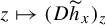
$z\mapsto (D\widetilde {h}_x)_{z}$
satisfies
$\operatorname {Lip} (D\widetilde {h}_x)\leq \ell (x).$


Proof. For every
 $y,z\in \widetilde {B}_x(\delta \ell (x)^{-1})$
, since
 $$ \begin{align*} |(D\widetilde{h}_x)_{z}-(D\widetilde{h}_x)_{y}|&= \sup_{v\neq 0} \dfrac{|(D\widetilde{h}_x)_{z}v-(D\widetilde{h}_x)_{y}v|_{h(x)}}{|v|_{x}}\\ &\leq K(h(x))K_0 |Dh_{\exp_{x} y}-Dh_{\exp_{x} z}|\\ &\leq e^{\varepsilon}K_0M_0 K(x)|z-y|\\ &\leq e^{\varepsilon}K^2_0M_0 K(x)|z-y|_{x}\\ &\leq \ell(x)|z-y|_{x}, \end{align*} $$
this proves the second statement. To prove the first statement, note that
 $$ \begin{align*} \operatorname{Lip}(\widetilde{h}_x-(D\widetilde{h}_x)_{0}) &\leq \sup_{y\in \widetilde{B}_x(\delta \ell(x)^{-1})}|(D(\widetilde{h}_x-(D\widetilde{h}_x)_{0})_{y}|\\ &= \sup_{y\in \widetilde{B}_x(\delta \ell(x)^{-1})}|(D\widetilde{h}_x)_{y}-(D\widetilde{h}_x)_{0}|\\ &\leq \operatorname{Lip}(D\widetilde{h}_x)\cdot|y-0|_{x} \\ &\leq \ell(x)\cdot\delta \ell(x)^{-1}\\ &= \delta, \end{align*} $$
where the second statement is used in the fourth inequality. This completes the proof.
Remark 4.6. By the definition of
 $\ell (x)$
, for
 $h=f,g$
or
 $fg$
, we have
 $$ \begin{align*}\ell(x)\geq K(x) \ \text{and} \ \ell(h^{\pm}(x))\leq e^{\varepsilon}\ell(x),\end{align*} $$
where
 $\varepsilon $
is fixed as in equation (4.2). It follows from equation (4.9) that
 $$ \begin{align} \frac{1}{K_0}|\cdot|\leq |\cdot|_{x} \leq \ell(x) |\cdot|. \end{align} $$
Choose
 $\delta _1<\gamma _0$
small enough such that for every
 $0<\delta \leq \delta _1$
, one has
 $$ \begin{align} e^{\varepsilon}+\delta<e^{2\varepsilon}<e^{4\varepsilon}-\delta \ \text{and} \ e^{-\varepsilon}-\delta>e^{-2\varepsilon}>e^{-4\varepsilon}+\delta. \end{align} $$
Fix
 $\unicode{x3bb}>\log (e^{2\max \{\unicode{x3bb} _1(f),\unicode{x3bb} _1(g)\}+\varepsilon }+\delta _1)$
. For
 $h=f,g$
or
 $fg$
, one can show that

for every
 $u\in \widetilde {B}_x(\delta _1\ell (x)^{-1})$
. In particular, one has that
 $$ \begin{align} \widetilde{h}_x(\widetilde{B}_{x}(e^{-\unicode{x3bb}-\varepsilon}\delta_1 \ell(x)^{-1}))\subset \widetilde{B}_{h(x)}(\delta_1 \ell(h(x))^{-1}) \end{align} $$
for every
 $x\in \Gamma $
.
Corollary 4.7. For
 $h=f,g$
or
 $fg$
and
 $x\in \Gamma $
, let
 $\pi _{x,h}^{\tau }$
denote the projection operator of
 $\mathcal {B}_x$
onto
 $E^{\tau }(x,h)$
via the splitting
 $\mathcal {B}_x=E^{u}(x,h) \bigoplus E^{c}(x,h) \bigoplus E^{s}(x,h)$
, where
 $\tau =u,c,s$
. For every
 $u,v\in \widetilde {B}_x(\delta _1 \ell (x)^{-1})$
with
 $|u-v|_{x}=|\pi _{x,h}^{u}(u-v)|_{x}$
, then we have that
 $$ \begin{align*}|\widetilde{h}_x u-\widetilde{h}_x v|_{h(x)}=|\pi_{h(x),h}^{u}(\widetilde{h}_x u-\widetilde{h}_x v)|_{h(x)}.\end{align*} $$
Proof. By definition of the norm
 $|\cdot |_{x}$
, it suffices to show that
 $$ \begin{align*}|\pi_{h(x),h}^{u}(\widetilde{h}_x u-\widetilde{h}_x v)|_{h(x)}\geq |\pi_{h(x),h}^{cs}(\widetilde{h}_x u-\widetilde{h}_x v)|_{h(x)},\end{align*} $$
where
 $\pi _{x,h}^{cs}=\pi _{x,h}^{c}+\pi _{x,h}^{s}.$
Since
 $\unicode{x3bb} ^{+}(h)\geq 5\varepsilon $
, by the choice of
 $\varepsilon>0$
(see equation (4.2)), we have that
 $$ \begin{align*} &|\pi_{h(x),h}^{u}(\widetilde{h}_x u-\widetilde{h}_x v)|_{h(x)}\\ &\quad\geq |\pi_{h(x),h}^{u}((D\widetilde{h}_x)_{0}(u-v))|_{h(x)}-|\pi_{h(x),h}^{u}((\widetilde{h}_x-(D\widetilde{h}_x)_{0})u-(\widetilde{h}_x-(D\widetilde{h}_x)_{0})v)|_{h(x)}\\ &\quad\geq|(D\widetilde{h}_x)_{0}(\pi_{x,h}^{u}(u-v))|_{h(x)}-|(\widetilde{h}_x-(D\widetilde{h}_x)_{0})u-(\widetilde{h}_x-(D\widetilde{h}_x)_{0})v|_{h(x)}\\ &\quad\geq e^{\unicode{x3bb}^{+}(h)-\varepsilon}|\pi_{x,h}^{u}(u-v)|_{x}-\delta_1|u-v|_{x} \\ &\quad\geq (e^{4\varepsilon}-\delta_1)|u-v|_{x}, \end{align*} $$
where equation (4.4) and Lemma 4.5 are used in the third inequality. Similarly, we have that
 $$ \begin{align*} &|\pi_{h(x),h}^{cs}(\widetilde{h}_x u-\widetilde{h}_x v)|_{h(x)}\\ &\quad \leq |\pi_{h(x),h}^{cs}((D\widetilde{h}_x)_{0}(u-v))|_{h(x)}+|\pi_{h(x),h}^{cs}((\widetilde{h}_x-(D\widetilde{h}_x)_{0})u-(\widetilde{h}_x-(D\widetilde{h}_x)_{0})v)|_{h(x)}\\ &\quad\leq |(D\widetilde{h}_x)_{0}(\pi_{x,h}^{cs}(u-v))|_{h(x)}+|(\widetilde{h}_x-(D\widetilde{h}_x)_{0})u-(\widetilde{h}_x-(D\widetilde{h}_x)_{0})v|_{h(x)}\\ &\quad\leq e^{\varepsilon}|\pi_{x,h}^{cs}(u-v)|_{x}+\delta_1|u-v|_{x} \\ &\quad\leq (e^{\varepsilon}+\delta_1)|u-v|_{x}. \end{align*} $$
The choice of
 $\delta _1$
(see equation (4.11)) implies that
 $e^{\varepsilon }+\delta _1< e^{2\varepsilon }< e^{4\varepsilon }-\delta _1$
. This yields that
 $$ \begin{align*}|\widetilde{h}_x u-\widetilde{h}_x v|_{h(x)}=|\pi_{h(x),h}^{u}(\widetilde{h}_x u-\widetilde{h}_x v)|_{h(x)}.\\[-34pt]\end{align*} $$
Corollary 4.8. For
 $h=f,g$
or
 $fg$
, let
 $x\in \Gamma $
,
 $n\in \mathbb {Z}$
and
 $u,v\in \mathcal {B}_x$
with
 $\widetilde {h}^{k}_x(u),\widetilde {h}^{k}_x(v)\in \widetilde {B}_{h^{k}(x)}(\delta _1 \ell (x)^{-1})$
for
 $k=0,1,\ldots ,n$
:
-
(1) if
$|u-v|_{x}=|\pi _{x,h}^{u}(u-v)|_x$
, then for
$$ \begin{align*} |\widetilde{h}^{k}_xu-\widetilde{h}^{k}_xv|_{h^{k}(x)}&=|\pi_{h^{k}(x),h}^{u}(\widetilde{h}^{k}_xu-\widetilde{h}^{k}_xv)|_{h^{k}(x)}\\ &\geq (e^{4\varepsilon}-\delta_1)^{k}|u-v|_{x}\\ &\geq e^{2k\varepsilon}|u-v|_{x} \end{align*} $$
$k=0,1,\ldots ,n$
;
-
(2) if
$|\widetilde {h}^{n}_xu-\widetilde {h}^{n}_xv|_{h^{n}(x)}=|\pi _{h^{n}(x),h}^{cs}(\widetilde {h}^{n}_xu-\widetilde {h}^{n}_xv)|_x$
, then for
$$ \begin{align*}|\widetilde{h}^{k}_xu-\widetilde{h}^{k}_xv|_{h^{k}(x)}=|\pi_{h^{k}(x),h}^{cs}(\widetilde{h}^{k}_xu-\widetilde{h}^{k}_xv)|_{h^{k}(x)}\leq e^{2k\varepsilon}|u-v|_{x}\end{align*} $$
$k=0,1,\ldots ,n$
.





Proof. It follows from Corollary 4.4, Lemma 4.5, Corollary 4.7 and the choice of
 $\varepsilon , \ \delta _1$
(see equations (4.2) and (4.11)).
Remark 4.9. Corollary 4.7 remains true if we replace
 $\pi _{\cdot ,h}^{u}, \pi _{\cdot ,h}^{cs}$
by
 $\pi _{\cdot ,h}^{uc}, \pi _{\cdot ,h}^{s}$
, respectively, where
 $\pi _{\cdot ,h}^{uc}=\pi _{\cdot ,h}^{u}+\pi _{\cdot ,h}^{c}$
. In this case, the inequalities (1) and (2) in Corollary 4.8 become
 $$ \begin{align*} |\widetilde{h}^{k}_xu-\widetilde{h}^{k}_xv|_{h^{k}(x)}=|\pi_{h^{k}(x),h}^{uc}(\widetilde{h}^{k}_xu-\widetilde{h}^{k}_xv)|_{h^{k}(x)}\geq e^{-2k\varepsilon}|u-v|_{x} \end{align*} $$
and
 $$ \begin{align*} |\widetilde{h}^{k}_xu-\widetilde{h}^{k}_xv|_{h^{k}(x)}&=|\pi_{h^{k}(x),h}^{s}(\widetilde{h}^{k}_xu-\widetilde{h}^{k}_xv)|_{h^{k}(x)}\leq (e^{-4\varepsilon}+\delta_1)^k |u-v|_{x}\\ &\leq e^{-2k\varepsilon} |u-v|_{x}, \end{align*} $$
respectively.
5 Sub-additivity of measure-theoretic entropies
In this section, we will give the detailed proof of Theorem A. Let
 $f,g,A$
and
 $\mu $
be as in Theorem A.
5.1 Local entropy
Suppose T and S are commuting continuous maps on a compact metric space X. Let
 $ B(x,\delta ) $
be a closed ball in X centred at x and of radius
 $\delta $
. We call the set
 $$ \begin{align*}B_n(x,\delta,T)=\bigcap_{k=0}^{n}T^{-k}B(T^kx,\delta)\end{align*} $$
to be an
 $(n,\delta ,T) $
-ball. Let
 $\mu $
be a T-invariant measure on X, by the Brin–Katok entropy formula [Reference Brin and Katok4], the following limit:
 $$ \begin{align*} h_{\mu}(x,T):&=\lim_{\delta\rightarrow 0}\limsup_{n\rightarrow \infty} -\frac{1}{n} \log \mu(B_n(x,\delta,T))\\ &=\lim_{\delta\rightarrow 0}\liminf_{n\rightarrow \infty} -\frac{1}{n} \log \mu(B_n(x,\delta,T)) \end{align*} $$
is well defined for
 $\mu $
-a.e.
 $x\in X$
, and the quantity
 $h_{\mu }(x,T)$
is called the local entropy of T at point x. Moreover, the function
 $h_{\mu }(x,T)$
is T-invariant, integrable and satisfies that
 $\int h_{\mu }(x,T) d\mu (x)=h_{\mu }(T)$
.
Lemma 5.1. [Reference Hu7, Lemma 6.1]
Let T and S be two commuting continuous homeomorphisms on a compact metric space X and
 $\mu \in \mathcal {M}(T,S,X)$
. Then, the function
 $h_{\mu }(x,T)$
is both T-invariant and S-invariant. Consequently, if
 $\mu $
is
 $(T,S)$
-ergodic, then
 $h_{\mu }(x,T)=h_{\mu }(T)$
for
 $\mu $
-a.e.
 $x\in X$
.
Let
 $\rho :X \rightarrow [0,\infty )$
be a measurable function. Define an
 $(n,\rho ,T)$
-ball at x by
 $$ \begin{align*}B_n(x,\rho,T)=\bigcap_{k=0}^{n}T^{-k}B(T^kx,\rho(T^kx)).\end{align*} $$
The following result is an extension of the Brin–Katok entropy formula.
Proposition 5.2. [Reference Hu7, Proposition 6.4]
Let
 $\{\rho _{\delta }:\delta>0\}$
be a family of measurable functions on X satisfying:
-
(1)
$0<\rho _{\delta }(x)\leq \delta $
for every x and
$\rho _{\delta }$
monotonically decreases as
$\delta \rightarrow 0;$
-
(2)
$\int \log \rho _{\delta } d\mu <\infty $
for every
$\delta>0$
.



Then,
 $$ \begin{align*}h_{\mu}(x,T)=\lim_{\delta\rightarrow 0}\limsup_{n\rightarrow \infty} -\frac{1}{n} \log \mu(B_n(x,\rho_{\delta},T))\quad \mu\text{-a.e.}\, x.\end{align*} $$
For
 $r\in (0,1)$
and
 $\delta>0$
, denote by
 $N_n(\delta ,r,T)$
the minimal number of
 $(n,\delta ,T) $
-balls covering a set of
 $\mu $
-measure more than
 $1-r$
. Assume that
 $\mu $
is T-ergodic, by the Katok entropy formula (see [Reference Katok8, Theorem 1.1]), we have that
 $$ \begin{align*}h_{\mu}(T)=\lim_{\delta\rightarrow 0}\limsup_{n\rightarrow \infty} \frac{1}{n} \log N_n(\delta,r,T).\end{align*} $$
In fact, the assumption
 $\mu $
is T-ergodic is not necessary. By Lemma 5.1, the following lemma can be proven easily.
Lemma 5.3. [Reference Hu7, Proposition 6.3]
If T and S are commuting continuous maps on a compact metric space X,
 $\mu $
is
 $(T,S)$
-ergodic. Then, for every
 $r\in (0,1)$
, we have that
 $$ \begin{align*}h_{\mu}(T)=\lim_{\delta\rightarrow 0}\limsup_{n\rightarrow \infty} \frac{1}{n} \log N_n(\delta,r,T).\end{align*} $$
Remark 5.4. Since
 $\mu \in \mathcal {E}(T,S,X)$
is equivalent to
 $\mu \in \mathcal {E}(TS,T,X)$
(see Proposition 2.3(2)), for every
 $r\in (0,1)$
, we have that
 $$ \begin{align*}h_{\mu}(TS)=\lim_{\delta\rightarrow 0}\limsup_{n\rightarrow \infty} \frac{1}{n} \log N_n(\delta,r,TS).\end{align*} $$
5.2 Relations between Bowen balls
Let
 $\widetilde {h}_{x}, \widetilde {B}_{x}(r),\delta _1,\varepsilon $
and
 $\ell (x)$
be the same as in §4.
In the following, we will prove some useful lemmas; they have their counterparts in finite dimensional systems which are proved in [Reference Hu7, §7]. For the case of finite dimensional systems, Hu [Reference Hu7] considered two commuting
 $C^{2}$
diffeomorphisms
 $f,g$
on a compact Riemannian manifold, so that a version of Lemma 4.5 and all the corollaries are also valid for
 $\widetilde {f}^{-1}, \widetilde {g}^{-1}$
. In our case, although
 $f^{-1}$
is well defined and continuous on the set A, it may not be defined outside A and may not be differentiable even in A. So we need some new methods to prove the following lemmas, which is slightly different from those in [Reference Hu7].
Lemma 5.5. Let
 $\delta>0$
be a small number and
 $x\in \Gamma $
. For
 $h=f,g$
or
 $fg$
, let
 $u\in \mathcal {B}_x$
with
 $\widetilde {h}^{k}_x(u)\in \widetilde {B}_{h^{k}_x(u)}(\delta _1 \ell (x)^{-1})$
for every
 $k=0,1,\ldots ,n$
:
-
(1) if
$u\in \widetilde {B}_x(\delta e^{-2n\varepsilon })$
and
$\widetilde {h}^{n}_x(u)\in \widetilde {B}_{h^n(x)}(\delta )$
, then
$$ \begin{align*}\widetilde{h}^{k}_x(u)\in \widetilde{B}_{h^k(x)}(\delta e^{-2(n-k)\varepsilon}) \quad \text{for all } \ k=0,1,\ldots,n;\end{align*} $$
-
(2) if
$u\in \widetilde {B}_x(\delta )$
and
$\widetilde {h}^{n}_x(u)\in \widetilde {B}_{h^n(x)}(\delta e^{-2n\varepsilon })$
, then
$$ \begin{align*}\widetilde{h}^{k}_x(u)\in \widetilde{B}_{h^k(x)}(\delta e^{-2k\varepsilon}) \quad \text{for all } \ k=0,1,\ldots,n.\end{align*} $$





Proof. For simplicity, we write
 $\pi ^{\tau }_{h^{k}(x),h}$
,
 $|\cdot |_{h^{k}(x)}$
as
 $\pi ^{\tau }_{k}$
,
 $|\cdot |_{k}$
, respectively.
Note that
 $$ \begin{align*}|\widetilde{h}^{k}_x(u)|_{k}=\max\{|\pi_{k}^{u}\widetilde{h}^{k}_x(u)|_{k}, |\pi_{k}^{cs}\widetilde{h}^{k}_x(u)|_{k}\}.\end{align*} $$
If
 $ |\widetilde {h}^{k}_x(u)|_{k}=|\pi _{k}^{u}\widetilde {h}^{k}_x(u)|_{k}$
. By part (1) of Corollary 4.8, we have that
 $$ \begin{align*} \delta\geq|\widetilde{h}^{n}_x(u)|_{n}\geq e^{2(n-k)\varepsilon} |\widetilde{h}^{k}_x(u)|_{k}.\end{align*} $$
Thus,
 $|\widetilde {h}^{k}_x(u)|_{k}\leq \delta e^{-2(n-k)\varepsilon }$
. If
 $|\widetilde {h}^{k}_x(u)|_{k}=|\pi _{k}^{cs}\widetilde {h}^{k}_x(u)|_{k}$
, by part (2) of Corollary 4.8, we have that
 $$ \begin{align*}|\widetilde{h}^{k}_x(u)|_{h^k(x)}\leq e^{2k\varepsilon}|u|_{x} \leq \delta e^{-2(n-k)\varepsilon}.\end{align*} $$
This proves the first statement.
To prove the second statement, note that
 $$ \begin{align*}|\widetilde{h}^{k}_x(u)|_{h^k(x)}=\max\{|\pi_{k}^{uc}\widetilde{h}^{k}_x(u)|_{k},|\pi_{k}^{s}\widetilde{h}^{k}_x(u)|_{k}\}.\end{align*} $$
If
 $|\widetilde {h}^{k}_x(u)|_{k}=|\pi _{k}^{uc}\widetilde {h}^{k}_x(u)|_{k}$
. By part (1) of Corollary 4.8 and Remark 4.9, we have that
 $$ \begin{align*} \delta e^{-2n\varepsilon} \geq|\widetilde{h}^{n}_x(u)|_{n}\geq e^{-2(n-k)\varepsilon} |\widetilde{h}^{k}_x(u)|_{k}.\end{align*} $$
Thus,
 $|\widetilde {h}^{k}_x(u)|_{k}\leq \delta e^{-2k\varepsilon }$
. If
 $|\widetilde {h}^{k}_x(u)|_{k}=|\pi _{k}^{s}\widetilde {h}^{k}_x(u)|_{k}$
, by part (2) of Corollary 4.8 and Remark 4.9, we have that
 $$ \begin{align*}|\widetilde{h}^{k}_x(u)|_{k}\leq e^{-2k\varepsilon}|u|_{x} \leq \delta e^{-2k\varepsilon}.\end{align*} $$
This completes the proof of the lemma.
Let
 $\Gamma _\ell :=\{x\in \Gamma :\ell (x)\leq \ell \}$
, and choose a sufficiently large
 $\ell $
such that
 $\mu (\Gamma _\ell )>0$
. Let
 $h=f$
or g. For every
 $x\in \Gamma _\ell $
, let
 $\tau _{h}(x)$
be the smallest positive integer n such that
 $h^n(x)\in \Gamma _\ell $
. By the Poincaré recurrence theorem, we have that
 $\tau _{h}(x)<\infty $
for
 $\mu $
-a.e.
 $x\in \Gamma _\ell $
and we extend
 $\tau _{h}(x)$
to A by letting
 $\tau _{h}(x)=0$
if
 $x\notin \Gamma _{\ell }$
. For each
 $\delta>0$
, define a function
 $\rho _{\delta ,h}:A \rightarrow (0,\infty )$
as follows:
 $$ \begin{align*}\rho_{\delta,h}(x)=\min\{\delta,\delta_1 \ell^{-2}e^{-(\unicode{x3bb}+\varepsilon)\tau_{h}(x)}\},\end{align*} $$
see equation (4.12) for the choice of
 $\unicode{x3bb} $
. Note that
 $\log \rho _{\delta ,h}$
is integrable since
 $\int \tau _{h}(x)\,d \mu =(\mu (\Gamma _\ell ))^{-1}$
, and the family of functions
 $\{\rho _{\delta ,h}:\delta>0\}$
satisfies the conditions of Proposition 5.2. Recall that
 $B(x,r)=\{y\in \mathcal {B}:|x-y|\leq r\}$
and
 $$ \begin{align*}B_n(x,\rho_{\delta,h},h)=\bigcap_{k=0}^{n}h^{-k} B(h^{k}(x),\rho_{\delta,h}(h^kx)).\end{align*} $$
Lemma 5.6. Let
 $h=f$
or g,
 $0<\delta <\delta _1\ell ^{-2}$
,
 $x\in \Gamma _\ell \cap h^{-n}\Gamma _\ell $
and
 $n\in \mathbb {N}$
. For each
 $k=0,1\ldots ,n$
, the following properties hold:
-
(1)
$ \widetilde {h}^{k}_x(\exp ^{-1}_x (B_n(x,\rho _{\delta ,h},h)\cap B(x,\delta e^{-2n\varepsilon }))) \subset \widetilde {B}_{h^k(x)}(\delta \ell e^{-2(n-k)\varepsilon });$
-
(2)
$ \widetilde {h}^{k}_x(\exp ^{-1}_x (B_n(x,\rho _{\delta ,h},h)\cap h^{-n}(B(h^n(x),\delta e^{-2n\varepsilon })))) \subset \widetilde {B}_{h^k(x)}(\delta \ell e^{-2k\varepsilon }).$


Proof. For simplicity, denote
 $|\cdot |_{h^{k}(x)}$
by
 $|\cdot |_{k}$
. For each
 $y\in B_n(x,\rho _{\delta ,h},h)$
, let
 $u=\exp ^{-1}_x y$
. For every
 $k\in \{0,1\ldots ,n\}$
with
 $h^k(x)\in \Gamma _\ell $
, we have that
 $$ \begin{align*}|\widetilde{h}^{k}_x(u)|_{k}\leq \ell(h^k(x))|\widetilde{h}^{k}_x(u)|\leq \ell|h^k(x)-h^k(y)| \leq \ell\delta \leq \ell^{-1}\delta_1\leq \delta_1\ell(h^k(x))^{-1}.\end{align*} $$
If
 $h^k(x)\notin \Gamma _\ell $
, denote by
 $n_k<k$
the biggest non-negative integer such that
 $h^{n_k}(x)\in \Gamma _\ell $
, then
 $\tau _{h}(h^{n_k}(x))>k-n_k$
. We have
 $$ \begin{align*}|\widetilde{h}^{n_k}_x(u)|_{n_k}\leq \ell|h^{n_k}(x)-h^{n_k}(y)|\leq \ell^{-1}\delta_1 e^{-(\unicode{x3bb}+\varepsilon)\tau_{h}(h^{n_k}(x))} \leq \ell^{-1}\delta_1 e^{-(\unicode{x3bb}+\varepsilon)(k-n_k)}.\end{align*} $$
By equation (4.12), we have that
 $$ \begin{align*} |\widetilde{h}^{k}_x(u)|_{k}\leq e^{\unicode{x3bb}(k-n_k)}|\widetilde{h}^{n_k}_x(u)|_{n_k}\leq \ell^{-1}e^{-(k-n_k)\varepsilon}\delta_1\leq \delta_1\ell(h^k(x))^{-1}\end{align*} $$
since
 $\ell (h^{n_k}(x))=\ell $
. Therefore, we have that
 $$ \begin{align*}|\widetilde{h}^{k}_x(u)|_{k}\leq \delta_1\ell(h^k(x))^{-1}\end{align*} $$
for every
 $k=0,1\ldots ,n$
. Moreover, if
 $y\in B(x,\delta e^{-2n\varepsilon })$
, then
 $|u|_{x}\leq \ell (x)|u|\leq \ell \delta e^{-2n\varepsilon }$
. Similarly,
 $h^n(y)\in B(h^n(x),\delta e^{-2n\varepsilon })$
implies
 $|\widetilde {h}^{n}_x(u)|_{n}\leq \ell \delta e^{-2n\varepsilon }$
. Statements (1) and (2) follow immediately from Lemma 5.5.
Lemma 5.7. For every
 $0<\delta <\delta _1\ell ^{-2} e^{-\unicode{x3bb} -\varepsilon }$
and
 $x \in \Gamma _\ell \cap f^{-n}\Gamma _\ell \cap (fg)^{-n} \Gamma _\ell $
, let
 $$ \begin{align*} \Delta:=&B_n(x,\rho_{\delta,f},f)\cap B(x,\delta e^{-2n\varepsilon}) \\ &\cap f^{-n}(B_n(f^n(x),\rho_{\delta,g},g) ) \cap (fg)^{-n}(B((fg)^n(x), \delta e^{-2n\varepsilon})). \end{align*} $$
Then, we have that
 $\Delta \subset B_n(x,\delta \ell K_0,fg)$
, where
 $ K_0 $
is the constant as in Lemma 4.3.
Proof. For each
 $y\in \Delta $
, let
 $u=\exp ^{-1}_x y$
. Since
 $x\in \Gamma _\ell \cap f^{-n}\Gamma _\ell $
and
 $y\in B_n(x,\rho _{\delta ,f},f)\cap B(x,\delta e^{-2n\varepsilon })$
, by part (1) of Lemma 5.6, we have that
 $$ \begin{align} \widetilde{f}^{n-k}_{x}u\in \widetilde{B}_{f^{n-k}(x)}(\delta \ell e^{-2k\varepsilon}) \end{align} $$
for every
 $0\leq k\leq n$
. Similarly, since
 $f^n(x)\in \Gamma _\ell \cap g^{-n}\Gamma _\ell $
and
 $f^{n}(y)\in B_n(f^n(x), \rho _{\delta ,g},g) ) \cap g^{-n}(B((fg)^n(x), \delta e^{-2n\varepsilon }))$
, by part (2) of Lemma 5.6, we have that
 $$ \begin{align} \widetilde{(fg)}^{k}_{f^{n-k}(x)}\circ \widetilde{f}^{n-k}_{x}u\in \widetilde{B}_{f^ng^k(x)}(\delta \ell e^{-2k\varepsilon}) \end{align} $$
for every
 $0\leq k\leq n$
.
For each
 $0\leq k\leq n$
, we claim that
 $$ \begin{align} \widetilde{(fg)}^{i}_{f^{n-k}(x)}\circ \widetilde{f}^{n-k}_{x}u \in \widetilde{B}_{(fg)^i(f^{n-k}(x))}(\delta \ell e^{-2\max \{i,k-i\}\varepsilon}) \ \text{for} \, i=0,1,\ldots, k. \end{align} $$
We will show the above claim by induction. For
 $k=0$
, the claim follows from equation (5.1). Suppose that the claim is true for
 $k-1$
, that is,
 $$ \begin{align*}\widetilde{(fg)}^{i-1}_{f^{n-k+1}(x)}\circ \widetilde{f}^{n-k+1}_{x}u \in \widetilde{B}_{(fg)^{i-1}(f^{n-k+1}(x))}(\delta \ell e^{-2\max \{i-1,k-i\}\varepsilon})\end{align*} $$
for every
 $1\leq i \leq k$
. Note that
 $$ \begin{align*} (\widetilde{g}\circ\widetilde{(fg)}^{i-1})_{f^{n-k+1}x}\circ \widetilde{f}^{n-k+1}_{x} u = \widetilde{(fg)}^{i}_{f^{n-k}(x)}\circ \widetilde{f}^{n-k}_{x}u. \end{align*} $$
By equation (4.12) and the induction assumption, for every
 $1\leq i \leq k$
, we have that
 $$ \begin{align*} |\widetilde{(fg)}^{i}\circ \widetilde{f}^{n-k}_{x}u|_{(fg)^{i}(f^{n-k}(x))} &\leq e^\unicode{x3bb}|\widetilde{(fg)}^{i-1}_{f^{n-k+1}x}\circ \widetilde{f}^{n-k+1}_{x}u|_{(fg)^{i-1}(f^{n-k+1}(x))}\\ &\leq e^\unicode{x3bb} \cdot \delta \ell e^{-2\max \{i-1,k-i\}\varepsilon}\\ &\leq \delta_1 \ell^{-1}e^{-k\varepsilon}. \end{align*} $$
By the definition of the function
 $\ell (x)$
, we have that
 $$ \begin{align*}\ell((fg)^{i}(f^{n-k}(x)))=\ell(f^{-(k-i)}g^{i}f^n(x))\leq \ell(f^n(x))e^{(k-i)\varepsilon+i\varepsilon}\leq \ell e^{k\varepsilon} \end{align*} $$
since
 $f^n(x)\in \Gamma _\ell $
. Therefore, we have that
 $$ \begin{align*}\widetilde{(fg)}^{i}\circ \widetilde{f}^{n-k}_{x}u \in \widetilde{B}_{(fg)^if^{n-k}(x)}(\delta_1 \ell((fg)^{i}f^{n-k}(x))^{-1}) \quad \text{ for all } i=1,2,\ldots, k.\end{align*} $$
Applying Lemma 5.5 to vector
 $\widetilde {f}^{n-k}_{x}u$
and map
 $\widetilde {fg}$
with equations (5.1) and (5.2), we have that
 $$ \begin{align*}\widetilde{(fg)}^{i}_{f^{n-k}(x)}\circ \widetilde{f}^{n-k}_{x}u \in \widetilde{B}_{(fg)^i(f^{n-k}(x))}(\delta \ell e^{-2\max \{k,k-i\}\varepsilon})\quad \text{ for all } i=0,1,\ldots, k.\end{align*} $$
This completes the proof of the claim.
By the claim, for every
 $0 \leq i \leq n$
, we have that
 $$ \begin{align*}|\widetilde{(fg)}^{i}_x u|_{(fg)^i(x)}\leq \delta \ell e^{-2\max \{i,n-i\}\varepsilon}\leq \delta \ell.\end{align*} $$
Since
 $ \widetilde {(fg)}^{i}_x u=(fg)^i(y)-(fg)^i(x)$
, it follows from equation (4.10) that
 $$ \begin{align*} |(fg)^i(x)-(fg)^i(y)|=|\widetilde{(fg)}^{i}_x u|\leq K_0 |\widetilde{(fg)}^{i}_x u|_{(fg)^i(x)} \leq \delta \ell K_0 \end{align*} $$
for every
 $0 \leq i \leq n$
. Hence,
 $y\in B_n(x,\delta \ell K_0,fg).$
This completes the proof of the lemma.
5.3 Proof of Theorem A
Let
 $N(r)$
denote the minimal number of balls of radius r covering A. By assumption (ii) of condition (H2), there exist numbers
 $D_0>0$
and
 $\delta _2>0$
, such that for every
 $0<r<\delta _2$
, we have that
 $$ \begin{align} N(r)\leq r^{-D_0}. \end{align} $$
Proof of Theorem A
Take
 $r\in (0,1)$
. Fix
 $\ell>1$
such that
 $\mu (\Gamma _\ell )>1-r/5$
. Let
 $\rho _{\delta ,f}$
and
 $\rho _{\delta ,g}$
be two families of functions as in §5.2.
For
 $h=f$
or g,
 $n\in \mathbb {N}$
and sufficiently small number
 $\varepsilon>0$
and
 $\delta>0$
, let
 $$ \begin{align*}A^{h}_{n,\delta,\varepsilon}=\{x\in \Gamma:\mu(B_k(x,\rho_{\delta,h},h))\geq e^{-k(h_{\mu}(h)+\varepsilon)} \text{ for all } k\geq n\}.\end{align*} $$
It follows from Proposition 5.2 that
 $$ \begin{align*}h_{\mu}(h)\geq \limsup_{n\rightarrow \infty} -\frac{1}{n} \log \mu(B_n(x,\rho_{\delta,h},h)) \quad \mu\text{-almost everywhere}.\end{align*} $$
Thus, for every
 $\delta>0$
, we have
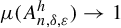 $\mu (A^{h}_{n,\delta ,\varepsilon })\rightarrow 1$
as
 $n\rightarrow \infty $
. Choose
 $n_h(\delta )>0$
, such that
 $\mu (A^{h}_{n,\delta ,\varepsilon })>1-r/5$
for every
 $n>n_h(\delta )$
.
By the definition of
 $A^{h}_{n,\delta ,\varepsilon }$
, there are at most
 $e^{n(h_{\mu }(h)+\varepsilon )}$
disjoint
 $(n,\rho _{\delta ,h},h)$
-balls centred at points in
 $A^{h}_{n,\delta ,\varepsilon }$
. So the same number of
 $(n,2\rho _{\delta ,h},h)$
-balls centred at points in
 $A^{h}_{n,\delta ,\varepsilon }$
can cover
 $A^{h}_{n,\delta ,\varepsilon }$
. That is, there exists a set
 $S_h\subset A^{h}_{n,\delta ,\varepsilon }$
with
 $|S_h|\leq e^{n(h_{\mu }(h)+\varepsilon )}$
such that
 $$ \begin{align*}A^{h}_{n,\delta,\varepsilon} \subset \bigcup_{x\in S_h}B_n(x,2\rho_{\delta,h},h),\end{align*} $$
where
 $|S|$
denotes the cardinality of the set S.
Take
 $0<\delta <\min \{\tfrac 14\delta _1\ell ^{-2} e^{-\unicode{x3bb} -\varepsilon } ,\delta _2\}$
. By equation (5.4), there exists a set
 $S_0\subset A$
with
 $|S_0|=N(2\delta e^{-2n\varepsilon })\leq (2\delta e^{-2n\varepsilon })^{-D_0}$
such that
 $$ \begin{align*}A\subset \bigcup_{x\in S_0}B(x,2\delta e^{-2n\varepsilon}).\end{align*} $$
For each
 $n>\max \{n_f(\delta ),n_g(\delta )\}$
, let
 $$ \begin{align*}A_n=A^{f}_{n,\delta,\varepsilon}\cup f^{-n} A^{g}_{n,\delta,\varepsilon} \cap \Gamma_\ell \cap f^{-n}\Gamma_\ell \cap (fg)^{-n} \Gamma_\ell.\end{align*} $$
Obviously,
 $\mu (A_n)\geq 1-r$
. For every
 $x_f\in S_f, x_g\in S_g,{x}'\in S_0$
and
 ${x}"\in S_0$
, if the intersection
 $$ \begin{align*} &A_n\cap B_n(x_f,2\rho_{\delta,f},f)\cap B({x}',2\delta e^{-2n\varepsilon}) \\ &\quad\cap f^{-n}(B_n(x_g,2\rho_{\delta,g},g) ) \cap (fg)^{-n}(B({x}", 2\delta e^{-2n\varepsilon})) \end{align*} $$
is not empty, then for each x in it, the intersection is contained in the set
 $$ \begin{align*} &B_n(x,4\rho_{\delta,f},f)\cap B(x,4\delta e^{-2n\varepsilon}) \\ &\quad\cap f^{-n}(B_n(f^n(x),4\rho_{\delta,g},g) ) \cap (fg)^{-n}(B((fg)^n(x), 4\delta e^{-2n\varepsilon})). \end{align*} $$
By Lemma 5.7, the above set is contained in
 $B_n(x,4\delta \ell K_0,fg)$
. There are at most
 $|S_f|\cdot |S_g|\cdot |S_0|^2 $
different such intersections. Note that
 $\mu (A_n)>1-r$
. These intersections cover
 $A_n$
and each one is contained in an
 $(n,4\delta \ell K_0,fg)$
-ball. Thus, we have that
 $$ \begin{align*} N_n(4\delta \ell K_0,r,fg)&\leq |S_f|\cdot|S_g|\cdot|S_0|^2\\ &\leq e^{n(h_{\mu}(f)+h_{\mu}(g)+2\varepsilon)}\cdot (2\delta e^{-2n\varepsilon})^{-2D_0}\\ &\leq (2\delta)^{-2D_0}\cdot e^{n(h_{\mu}(f)+h_{\mu}(g)+(4D_0+2)\varepsilon)}. \end{align*} $$
Therefore, by Lemma 5.3,
 $$ \begin{align*}h_{\mu}(fg)\leq h_{\mu}(f)+h_{\mu}(g)+(4D_0+2)\varepsilon.\end{align*} $$
Since
 $\varepsilon $
is arbitrary, one has that
 $$ \begin{align*} h_{\mu}(fg)\leq h_{\mu}(f)+h_{\mu}(g).\end{align*} $$
This completes the proof of Theorem A.
6 Local unstable manifold
This section is a continuation of §4, and the notation
 $\widetilde {h}_{x}, \widetilde {B}_{x}(r),\delta _1,\varepsilon $
and
 $\ell (x)$
are the same as in §4. We will recall the unstable manifold theorem in [Reference Blumenthal and Young3] and give an equivalent characterization of the local unstable manifolds.
Notice that
 $E^{u}(x,f)$
or
 $E^{u}(x,g)$
is equal to
 $\{0\}$
if and only if
 $(f, \mu )$
or
 $(g, \mu )$
has no positive Lyapunov exponents. In this case, Theorem B follows from Ruelle’s inequality [Reference Li and Shu11] immediately. In the rest of the paper, we assume that
 $(f, \mu )$
and
 $(g, \mu )$
have positive Lyapunov exponents.
For
 $h=f,g$
,
 $\tau =u,c,s$
and
 $r>0$
, we write
 $\widetilde {B}^{\tau }_{x}(r,h)=\{v\in E^{\tau }(x,h):|v|_{x}\leq r\}$
and
 $\widetilde {B}^{cs}_{x}(r,h)=\widetilde {B}^{c}_{x}(r,h)+\widetilde {B}^{s}_{x}(r,h)$
. Hence,
 $\widetilde {B}_{x}(r)=\widetilde {B}^{u}_{x}(r,h)+\widetilde {B}^{cs}_{x}(r,h)$
.
The unstable (stable) manifold theory is well known for finite dimensional systems. See [Reference Blumenthal and Young3, Theorem 6.1] for this theorem of maps on a Banach space that we will recall below. See also [Reference Lian and Ma15, Reference Lian and Young16] for the detailed proofs of this theorem for maps on Hilbert space and maps on Banach space, respectively.
Theorem 6.1. For
 $h=f$
or g, there exists
 ${\delta }^{\prime }_1\in (0,\delta _1)$
such that for every
 $0<\delta <{\delta }^{\prime }_1$
, there exists a unique family of continuous maps
 $ \{\sigma ^{h}_{x}:\widetilde {B}^{u}_{x}(\delta \ell (x)^{-1},h)\rightarrow \widetilde {B}^{cs}_{x}(\delta \ell (x)^{-1},h) \}_{x\in \Gamma }$
so that
 $$ \begin{align*}\sigma^{h}_{x}(0)=0 \quad \text{and} \quad \widetilde{h}_x(\operatorname{graph}(\sigma^{h}_{x}))\supset \operatorname{graph}(\sigma^{h}_{h(x)}). \end{align*} $$
Moreover, the family
 $\{\sigma ^{h}_{x}\}_{x\in \Gamma }$
has the following additional properties with respect to the norm
 $|\cdot |_{x}$
:
-
(1)
$ \sigma ^{h}_{x} $
is
$C^{1+\operatorname {Lip}}$
Fréchet differentiable, with
$(D\sigma ^{h}_{x})_0=0$
; -
(2)
$ \operatorname {Lip}\sigma ^{h}_{x}\leq 1/10$
and
$\operatorname {Lip}(D\sigma ^{h}_{x})\leq C\ell (x)$
, where
$ C> 0 $
is independent of
$ x $
; -
(3) if
$\widetilde {h}_x(u_i+\sigma ^{h}_{x}(u_i))\in \widetilde {B}_{hx}(\delta \ell (hx)^{-1}) $
for
$u_i\in \widetilde {B}^{u}_{x}(\delta \ell (x)^{-1},h)$
$(i=1,2)$
, then
$$ \begin{align*} &|\widetilde{h}_x(u_1+\sigma^{h}_{x}(u_1))-\widetilde{h}_x(u_2+\sigma^{h}_{x}(u_2)) |_{hx}\\ &\quad\geq (e^{\unicode{x3bb}^{+}(h)-\varepsilon}-\delta)|u_1+\sigma^{h}_{x}(u_1)-u_2-\sigma^{h}_{x}(u_2)|_{x}. \end{align*} $$


For
 $h=f$
or g, let
 $W_{\delta }^{u}(x,h)=\operatorname {graph}(\sigma ^{h}_{x})$
and define the local unstable manifold at x with respect to h by
 $$ \begin{align*}w_{\delta}^{u}(x,h)=\exp_x W_{\delta}^{u}(x,h).\end{align*} $$
The global unstable manifold at x with respect to h is defined as
 $$ \begin{align*}w^{u}(x,h)=\bigcup_{n\geq 0}h^{n} w_{\delta,x}^{u}(h^{-n}(x),h),\end{align*} $$
which is an immersed submanifold in
 $\mathcal {B}$
.
Remark 6.2. Let
 $x\in \Gamma $
and
 $0<\delta <\delta _1'$
, one may not have
 $w_{\delta }^{u}(x,h)\subset A$
. However, by Theorem 6.1, one has
 $W_{\delta }^{u}(x,h)\subset \widetilde {h}^n_{h^{-n}x} W_{\delta }^{u}(h^{-n}x,h)$
for each
 $n>0$
. Consequently, one has
 $w_{\delta }^{u}(x,h)\subset h^n w_{\delta }^{u}(h^{-n}x,h)$
for each
 $n>0$
. Hence, for every
 $y\in w_{\delta }^{u}(x,h)$
, there exists a unique
 $y_n\in w_{\delta }^{u}(h^{-n}x,h)$
such that
 $h^n(y_n)=y$
.
Notice that the next lemma is different to [Reference Blumenthal and Young3, Lemma 6.3]; here, we do not assume that the centre subspaces are trivial.
Lemma 6.3. For
 $h=f$
or g and every
 $0<\delta <{\delta }^{\prime }_1$
, for every
 $x\in \Gamma $
, we have that
 $$ \begin{align*} w_{\delta}^{u}(x,h)=\exp_{x}\{&v\in \widetilde{B}_{x}(\delta \ell(x)^{-1}): \ \text{ for all } n \in \mathbb{N}, \text{ there exists } v_n \in \widetilde{B}_{h^{-n}x}(\delta_1 \ell(h^{-n}x)^{-1}) \\ &\text{such that } \widetilde{h}^{n}_{h^{-n}x}v_n=v \ \text{and } |\pi_{h^{-n}(x),h}^{u} v_n|_{h^{-n}(x)}=|v_n|_{h^{-n}(x)}\}, \end{align*} $$
where
 $\pi _{x,h}^{u}$
is the same as in Corollary 4.7. Moreover, if
 $E^{c}(x,h)=\{0\}$
, one has
 $$ \begin{align*} w_{\delta}^{u}(x,h)=\exp_{x}\{&v\in \widetilde{B}_{x}(\delta \ell(x)^{-1}): \ \text{ for all } n \in \mathbb{N}, \text{ there exists } v_n \in \widetilde{B}_{h^{-n}x}(\delta_1 \ell(h^{-n}x)^{-1}) \\ & \text{such that }\widetilde{h}^{n}_{h^{-n}x}v_n=v\}. \end{align*} $$
Proof. To simplify the notation, for
 $\tau =u,cs$
, write
 $\pi ^{\tau }_{h^{-k}x,h}$
,
 $|\cdot |_{h^{-k}x}$
as
 $\pi ^{\tau }_{-k}$
,
 $|\cdot |_{-k}$
, respectively, and let
 $$ \begin{align*} R:=\exp_{x}\{&v\in \widetilde{B}_{x}(\delta \ell(x)^{-1}): \ \text{ for all } n \in \mathbb{N}, \text{ there exists } v_n \in \widetilde{B}_{h^{-n}x}(\delta_1 \ell(h^{-n}x)^{-1}) \ \\ &\text{such that }\widetilde{h}^{n}_{h^{-n}x}v_n=v \ \text{and } |\pi_{h^{-n}(x),h}^{u} v_n|_{h^{-n}(x)}=|v_n|_{h^{-n}(x)}\}. \end{align*} $$
For each
 $y\in w_{\delta }^{u}(x,h)$
, let
 $v=\exp ^{-1}_x y\in W_{\delta }^{u}(x,h)$
. By Theorem 6.1, for every
 $n\geq 0$
, there exists a
 $v_n\in W_{\delta ,h^{-n}x}^{u}(h^{-n}x,h)$
such that
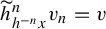 $\widetilde {h}^{n}_{h^{-n}x}v_n=v$
. Moreover, one can show that
 $|\pi _{-n}^{u} v_n|_{-n}=|v_n|_{-n}$
since
 $\operatorname {Lip}\sigma ^{h}_{h^{-n}x}\leq 1/10$
. Thus,
 $y\in R$
.
However, take
 $v\in \widetilde {B}_{x}(\delta \ell (x)^{-1})$
, assume that there exist
 $\{v_n\}_{n\geq 0}$
such that
 $$ \begin{align*}v_n \in \widetilde{B}_{h^{-n}x}(\delta_1 \ell(h^{-n}x)^{-1}), \quad \widetilde{h}^{n}_{h^{-n}x}v_n=v \quad \text{and} \quad |\pi_{-n}^{u} v_n|_{-n}=|v_n|_{-n}. \end{align*} $$
If
 $v\notin W_{\delta }^{u}(x,h)$
, then there exists
 $u\in W_{\delta }^{u}(x,h)$
such that
 $\pi ^{u}_{x,h}v=\pi ^{u}_{x,h}u$
but
 $\pi ^{cs}_{x,h}v\neq \pi ^{cs}_{x,h}u$
. For each
 $n>0$
, let
 $u_n=(\widetilde {h}^{n}_{h^{-n}x})^{-1}u \in W^{u}_{\delta }(h^{-n}x, h).$
Note that
 $$ \begin{align*} 1\geq \dfrac{|\pi_{-n}^{cs} v_n|_{-n}}{|\pi_{-n}^{u} v_n|_{-n}}\geq \dfrac{|\pi_{-n}^{cs} (v_n-u_n)|_{-n}- |u_n|_{-n}}{|v_n|_{-n}}, \end{align*} $$
 $|u-v|_{x}=|\pi ^{cs}_{x,h}(u-v)|_{x}$
,
 $|\pi _{-n}^{u} v_n|_{-n}=|v_n|_{-n}$
and
 $|\pi _{-n}^{u} u_n|_{-n}=|u_n|_{-n}$
. By part (2) of Corollary 4.8, we have that
 $$ \begin{align*} |u-v|_x \leq e^{2n\varepsilon} |\pi_{-n}^{cs} (v_n-u_n)|_{-n}=e^{2n\varepsilon} |v_n-u_n|_{-n}. \end{align*} $$
Similarly, by part (1) of Corollary 4.8,
 $$ \begin{align*} |v|_{x}\geq (e^{4\varepsilon}-\delta_1)^n | v_n|_{-n} \quad \text{and} \quad |u|_{x}\geq (e^{4\varepsilon}-\delta_1)^n | u_n|_{-n}. \end{align*} $$
The above observation yields that
 $$ \begin{align*} 1&\geq \dfrac{e^{-2n\varepsilon}|u-v|_x-(e^{4\varepsilon}-\delta_1)^{-n}|u|_{x}}{(e^{4\varepsilon}-\delta_1)^{-n}|v|_{x}}\\&\geq \bigg(\dfrac{e^{4\varepsilon}-\delta_1}{e^{2\varepsilon}}\bigg)^{n} \dfrac{|u-v|_x}{|v|_{x}}-\frac{|u|_{x}}{|v|_{x}}. \end{align*} $$
Recall the choice of
 $\delta _1$
in equation (4.11). The right-hand side in the above inequality tends to
 $\infty $
as
 $n\rightarrow \infty $
. This contradiction yields that
 $v\in W_{\delta }^{u}(x,h)$
. Hence, we have that
 $\exp _x v\in w_{\delta }^{u}(x,h).$
To finish the proof, we assume
 $E^{c}(x,h)=\{0\}$
. By Remark 4.9, one has
 $$ \begin{align*}|u-v|_{x}\leq e^{-2n\varepsilon} |u_n-v_n|_{-n}.\end{align*} $$
Since
 $|v_n|_{-n}\leq \delta _1 \ell (h^{-n}x)^{-1}$
and
 $|u_n|_{-n}\leq \delta _1 \ell (h^{-n}x)^{-1}$
, we have
 $$ \begin{align*}|v_n-u_n|_{-n}\leq 2\delta_1 \ell(h^{-n}x)^{-1}.\end{align*} $$
Thus, one has that
 $$ \begin{align*}\frac{1}{n}\log e^{2n\varepsilon}|u-v|_x\leq \frac{1}{n}\log (2\delta_1 \ell(h^{-n}x)^{-1}).\end{align*} $$
Letting
 $n\rightarrow \infty $
, we have that
 $$ \begin{align*}2\varepsilon<\limsup_{n\rightarrow \infty} \frac{1}{n}\log \ell(h^{-n}x)^{-1}\leq\limsup_{n\rightarrow \infty} \frac{1}{n}\log (e^{n\varepsilon}\ell(x)^{-1})=\varepsilon.\end{align*} $$
This contradiction implies that
 $v\in W^{u}_{\delta }(x,h)$
. This completes the proof of the lemma.
7 Proof of Theorem B
In this section, the main aim is to give conditions under which the inequality in Theorem A becomes an equality. We first show that the local unstable manifolds of the two commuting maps are equal under some suitable conditions. Moreover, if the centre subspaces of the two commuting maps are trivial, the equality of the metric entropies is established.
7.1 Proof of the first statement
This section will prove the first statement of Theorem B, that is, if
 $E^{u}(x,f)=E^{u}(x,g)$
for
 $\mu $
-a.e. x, then
 $w_{\delta }^{u}(x,f)=w_{\delta }^{u}(x,g)$
for
 $\mu $
-a.e. x provided that
 $\delta $
is sufficiently small. Without loss of generality, assume that
 $E^{u}(x,f)=E^{u}(x,g)$
for every
 $x\in \Gamma $
. By equation (4.1), one also has that
 $E^{cs}(x,f)=E^{cs}(x,g)$
for every
 $x\in \Gamma $
.
Recall the following well-known result about graph transformations. Let
 $0<\delta <{\delta }^{\prime }_1$
,
 $x\in \Gamma $
and
 $$ \begin{align*}\mathcal{W}(x,h)=\bigg\{\sigma:\widetilde{B}^{u}_{x}(\delta \ell(x)^{-1},h)\rightarrow \widetilde{B}^{cs}_{x}(\delta \ell(x)^{-1},h) \, | \, \sigma(0)=0, \ \operatorname{Lip} \sigma \leq \frac{1}{10}\bigg\},\end{align*} $$
where
 $h=f$
or g. For
 $\sigma \in \mathcal {W}(x,h)$
, define a map
 $\Psi _{x,h}(\sigma ): \widetilde {B}^{u}_{hx}(\delta \ell (hx)^{-1},h)\rightarrow \widetilde {B}^{cs}_{hx}(\delta \ell (hx)^{-1},h)$
with the following property:
 $$ \begin{align*}\widetilde{h}_{x}(\operatorname{graph}(\sigma))\supset \operatorname{graph}(\Psi_{x,h}(\sigma)).\end{align*} $$
The map
 $\Psi _{x,h}(\sigma )$
is called the graph transform of
 $\sigma $
with respect to h, and it is well defined in the following sense.
Lemma 7.1. [Reference Blumenthal and Young3, Lemma 6.2]
Let
 $h=f$
or g and
 $x\in \Gamma $
, then the following properties hold:
-
(1) for every
$\sigma \in \mathcal {W}(x,h)$
,
$\Psi _{x,h}(\sigma )$
exists and belongs to
$\mathcal {W}(hx,h)$
; -
(2) there exists a constant
$c\in (0,1)$
such that where


Recall the choice of
 $\unicode{x3bb} $
in equation (4.12) and
 ${\delta }^{\prime }_1$
in Theorem 6.1, we have the following result.
Lemma 7.2. Let
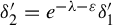 ${\delta }^{\prime }_2=e^{-\unicode{x3bb} -\varepsilon }{\delta }^{\prime }_1$
. If
 $E^{u}(x,f)=E^{u}(x,g)$
for every
 $x\in \Gamma $
, then for every
 $0<\delta <{\delta }^{\prime }_2$
, we have that
 $$ \begin{align*}\widetilde{f}_x(W_{\delta}^{u}(x,g))\supset W_{\delta}^{u}(fx,g), \ \widetilde{g}_x(W_{\delta}^{u}(x,f))\supset W_{\delta}^{u}(gx,f) \quad \text{ for all }\, x\in \Gamma.\end{align*} $$
Proof. Fix
 $x\in \Gamma $
. Since
 $E^{u}(x,f)=E^{u}(x,g)$
, we have that
 $E^{cs}(x,f)=E^{cs}(x,g)$
by equation (4.1). Hence, if there is no confusion caused, we will simply write
 $E^{\tau }(x,h)$
as
 $E^{\tau }(x)$
for
 $\tau =u,cs$
and
 $h=f,g$
. This also implies that
 $\mathcal {W}(x,f)=\mathcal {W}(x,g)$
, and we denote the common set by
 $\mathcal {W}(x)$
.
In the following, we shall show that
 $\widetilde {f}_x(W_{\delta }^{u}(x,g))\supset W_{\delta }^{u}(fx,g) $
, the other one can be proven in a similar fashion.
Given
 $\sigma _{x}^{g}\in \mathcal {W}(x)$
with
 $\operatorname {graph}(\sigma _{x}^{g})=W_{\delta }^{u}(x,g)$
as in Theorem 6.1, by Lemma 7.1, there exists
 $\tilde {\sigma }_{fx}\in \mathcal {W}(fx)$
such that
 $$ \begin{align} \widetilde{f}_x W_{\delta}^{u}(x,g)\supset \operatorname{graph}(\tilde{\sigma}_{fx}). \end{align} $$
It suffices to prove that
 $\tilde {\sigma }_{fx}=\sigma ^{g}_{fx}$
. For every
 $v \in \tilde {B}^{u}_{fx}(\delta \ell (fx)^{-1})$
, let
 $u:=v+\tilde {\sigma }_{fx} v\in \operatorname {graph}(\tilde {\sigma }_{fx}).$
By equation (7.1), there exists
 ${u}_0' \in W_{\delta }^{u}(x,g)$
such that
 $\widetilde {f}_x ({u}^{\prime }_0)=u$
. Since
 ${u}^{\prime }_0 \in W_{\delta }^{u}(x,g)$
, there exists
 ${u}^{\prime }_n\in W_{\delta }^{u}(g^{-n}x,g)$
such that
 $\widetilde {g}^n_{g^{-n}x} ({u}^{\prime }_n)={u}^{\prime }_0$
and
 $|\pi _{g^{-n}(x),f}^{u} {u}^{\prime }_n|_{g^{-n}(x)}=|{u}^{\prime }_n|_{g^{-n}(x)}$
for every
 $n\geq 0$
. Let
 $u_{n}=\widetilde {f}_{g^{-n}x} {u}^{\prime }_n$
, since
 ${u}^{\prime }_n\in \tilde {B}_{g^{-n}x}(\delta \ell (g^{-n}x)^{-1})$
. By equation (4.13) and part (1) of Corollary 4.8, we have that
 $$ \begin{align*}u_{n}\in \tilde{B}_{g^{-n}(fx)}(\delta_1 \ell(g^{-n}fx)^{-1}),\quad |\pi_{g^{-n}(fx),f}^{u} u_n|_{g^{-n}(fx)}=|u_n|_{g^{-n}(fx)}.\end{align*} $$
By construction of
 $u_n$
, we have that
 $\widetilde {g}^n_{g^{-n}(fx)} u_n=u$
for every
 $n\geq 1$
. It follows from Lemma 6.3 that
 $u\in W_{\delta }^{u}(fx,g).$
This yields that
 $\tilde {\sigma }_{fx}= \sigma ^{g}_{fx}$
. This completes the proof of the lemma.
Now we will prove the first statement of Theorem B. We write it as the following theorem.
Theorem 7.3. Suppose
 $E^{u}(x,f)=E^{u}(x,g)$
for every
 $x\in \Gamma $
. For every
 $0<\delta <{\delta }^{\prime }_2$
(
 $ {\delta }^{\prime }_2 $
is the same as in Lemma 7.2), we have that
 $w^{u}_{\delta }(x,f)=w^{u}_{\delta }(x,g)$
for every
 $x\in \Gamma $
.
Proof. Given
 $x\in \Gamma $
and
 $u\in W^{u}_{\delta }(x,f)$
, it follows from Lemma 7.2 that
 $$ \begin{align*}\widetilde{g}^{n}_{g^{-n}x}(W_{\delta}^{u}(g^{-n}x,f))\supset W_{\delta}^{u}(x,f)\ \ \text{ for all } \, n\geq 0. \end{align*} $$
Thus, there exists
 $u_n\in W^{u}_{\delta }(g^{-n}x,f)$
such that
 $\widetilde {g}^{n}_{g^{-n}x} u_n=u$
for every
 $n\geq 0$
. Since
 $u_n\in W^{u}_{\delta }(g^{-n}x,f)\subset \tilde {B}_{g^{-n}x}(\delta \ell (g^{-n}x)^{-1})$
and
 $E^{u}(g^{-n}x,f)=E^{u}(g^{-n}x,g)$
, we have that
 $$ \begin{align*}|\pi_{g^{-n}(x),f}^{u} u_n|_{g^{-n}x}=|\pi_{g^{-n}(x),g}^{u} u_n|_{g^{-n}x}=|u_n|_{g^{-n}x}.\end{align*} $$
It follows from Lemma 6.3 that
 $u\in W^{u}_{\delta }(x,g).$
Thus, we have
 $W^{u}_{\delta }(x,f) \subset W^{u}_{\delta }(x,g).$
Similarly, one can show that
 $W^{u}_{\delta }(x,g) \subset W^{u}_{\delta }(x,f).$
Therefore,
 $W^{u}_{\delta }(x,g)= W^{u}_{\delta }(x,f)$
. So we conclude that
 $ w^{u}_{\delta }(x,f)=w^{u}_{\delta }(x,g) $
for every
 $x\in \Gamma $
.
7.2 Proof of the second statement
In this section, we will show the equality of the measure theoretic entropies under the additional condition that the centre subspaces of f and g are trivial.
7.2.1 Unstable stacks
In this part, we assume that
 $E^{u}(x,f)=E^{u}(x,g)$
for every
 $x\in \Gamma $
. As before, we will simply write
 $E^{\tau }(x,h)$
as
 $E^{\tau }(x)$
for
 $\tau =u,cs$
and
 $h=f,g$
if there is no confusion caused. By Theorem 7.3, we have
 $\sigma ^f_{x}|_{\widetilde {B}_x^{u}(r\ell (x)^{-1})}=\sigma ^g_{x}|_{\widetilde {B}_x^{u}(r\ell (x)^{-1})}$
for small
 $r>0$
. Therefore,
 $w_r^{u}(x,f)=w_r^{u}(x,g)$
and we will simply write this notation as
 $w_r^{u}(x)$
and
 $\sigma _{x}$
, respectively.
To introduce some results on the regularity of the unstable manifolds, we will introduce some notation as follows. For
 $\tau =u,cs$
, let
 $B_x^{\tau }(r)=\{v\in E^{\tau }(x):|v|\leq ~r\}$
. Denote by
 $(C(B_{x}^{u}(\delta \ell _0^{-3}),E^{cs}(x)),||\cdot ||)$
the space of all continuous functions from
 $B_{x}^{u}(\delta \ell _0^{-3})$
to
 $E^{cs}(x)$
with the
 $C^0$
super norm
 $||\cdot ||$
.
Since
 $x\mapsto E^{\tau }(x)$
is
 $\mu $
-continuous, by Definition 3.1, there exists a sequence of increasing compact subsets
 $\{K_n\}$
so that
 $\mu (\bigcup _n K_n)=1$
and the map
 $x\mapsto E^{\tau }(x)$
is continuous on
 $K_n$
for every
 $n\ge 1$
. Recall that
 $\Gamma _{\ell }=\{x\in \Gamma : \ell (x)\leq \ell \}$
, where
 $\ell (x)$
is defined in Lemma 4.5, and the constants
 $ {\delta }^{\prime }_2 $
and
 $K_0$
are given in Lemmas 7.2 and 4.3, respectively.
Theorem 7.4. [Reference Blumenthal and Young3, Lemma 6.5]
Fix
 $\ell _0$
and
 $n_0>1$
so that
 $\mu (\Gamma _{\ell _0}\cap K_{n_0})>0$
and take
 $x_0\in \Gamma _{\ell _0}\cap K_{n_0}.$
For
 $r>0$
and
 $x\in \Gamma ,$
let
 $$ \begin{align*}U(x,r):=\Gamma_{\ell_0}\cap K_{n_0}\cap B(x,r).\end{align*} $$
Then, there exists
 $0<\delta _3<{\delta }^{\prime }_2$
such that for every
 $0<\delta \leq \delta _3$
, the following properties hold for sufficiently small
 $r_0>0$
:
-
(1) for every
$y\in U(x_0,r_0)$
, there exists a continuous function
$\sigma _{x_0}^{y}: \operatorname {Dom}(y) \rightarrow E^{cs}(x_0)$
such that where
$$ \begin{align*}\exp_{x_0}\operatorname{graph}(\sigma_{x_0}^{y})= \exp_{y}\operatorname{graph}(\sigma_{y}|_{B^{u}_{y}(2\delta \ell_{0}^{-3})}),\end{align*} $$
$\operatorname {Dom}(y) \supset B_{x_0}^u(\delta \ell _0^{-3})$
is a subset of
$E^{u}(x_0)$
;
-
(2) the mapping
$\Theta :U(x_0,r_0)\rightarrow C(B_{x_0}^{u}(\delta \ell _0^{-3}),E^{cs}(x_0))$
defined by
$\Theta (y)= \sigma _{x_0}^{y}|_{B_{x_0}^{u}(\delta \ell _0^{-3})}$
is continuous.




Let
 $x_0,U(x_0,r_0)$
and
 $\Theta $
be given as above, and let
 $\bar {U}\subset U(x_0,r_0)$
be a compact subset. The following set
 $$ \begin{align*}\mathcal{S}=\bigcup_{y\in \bar{U}} \exp_{x_0}(\operatorname{graph} \Theta(y)),\end{align*} $$
is called a stack of local unstable manifolds and the set
 $\exp _{x_0}(\operatorname {graph} \Theta (y))$
is called the unstable leaf. We refer the reader to [Reference Blumenthal and Young3, §§ 6.2 and 7.2] for more details about the unstable stack.
7.2.2 Construction of the partition
In this section, we will construct a measurable partition
 $\eta $
of a full
 $\mu $
-measure set such that
 $h_\mu (h,\eta )=h_\mu (h)$
for
 $h=f$
or g. See [Reference Rohlin19] for the detailed description of the quantity
 $h_\mu (h,\eta )$
.
We first recall some notation. For a measurable partition
 $\eta $
, let
 $\eta (x)$
denote the element of
 $\eta $
containing
 $ x $
. For two measurable partitions
 $\eta _1$
and
 $\eta _2$
, we say
 $\eta _2$
is a refinement of
 $\eta _1$
if
 $\eta _1(x)\supset \eta _2(x)$
for
 $\mu $
-a.e. x, and denote it by
 $\eta _1\leq \eta _2 $
. Let further
 $\eta _1 \vee \eta _2=\{A\cap B:A\in \eta _1, B\in \eta _2\}$
and
 $h^{-1} \eta _1=\{h^{-1}(A):A\in \eta _1\}$
, where
 $h=f$
or g. A measurable partition
 $\eta $
is called h-decreasing if
 $\eta \leq h^{-1} \eta $
, and
 $\eta $
is called
 $(f,g)$
-decreasing if
 $\eta $
are both f-decreasing and g-decreasing.
Fix
 $0<\delta < \delta _3$
. Let
 $$ \begin{align*}\mathcal{S}=\bigcup_{y\in \bar{U}} \exp_{x_0}(\operatorname{graph} \Theta(y)|_{\delta \ell_0^{-3}}),\end{align*} $$
where
 $x_0\in \Gamma $
is a fixed point so that
 $\mu (\mathcal {S})>0$
. Denote by
 $\widetilde {\mathcal {S}}$
the set
 $\bigcup _{n,k\geq 0}f^ng^k \mathcal {S}$
, then
 $\mu (\widetilde {\mathcal {S}})=1$
since
 $\mu $
is
 $(f,g)$
-ergodic.
Note that the distinct unstable leaves in
 $\mathcal {S}$
do not intersect with each other. Let
 $\xi $
be the measurable partition of
 $\mathcal {S}$
into unstable leaves (see [Reference Blumenthal and Young3, Lemma 6.7]). For
 $n,k\geq 0$
, let
 $\xi _{n,k}=\{f^{n}g^k(W):W\in \xi \}\cup (\widetilde {\mathcal {S}}-f^ng^k(\mathcal {S}))$
be a measurable partition of
 $\widetilde {\mathcal {S}}$
. Finally, consider the measurable partition of
 $\widetilde {\mathcal {S}}$
as follows:
 $$ \begin{align*}\eta=\bigvee_{n,k\geq0}\xi_{n,k}.\end{align*} $$
By the construction of
 $\eta $
, one can show that
 $y\in \eta (x)$
if and only if
 $$ \begin{align} \left\{ \begin{array}{@{}l@{\quad}l@{\ }l} f^{-n}g^{-k}y \in \xi(f^{-n}g^{-k}x) &\text{if}& f^{-n}g^{-k}(x)\in \mathcal{S}; \\[3pt] y\notin f^{n}g^{k}(\mathcal{S}) &\text{if}& f^{-n}g^{-k}(x)\notin \mathcal{S} \end{array} \right. \end{align} $$
for every
 $n,k\geq 0$
. Hence, we have
 $\eta $
is
 $(f,g)$
-decreasing. As in [Reference Hu7, Proposition 8.1], by choosing small
 $\delta>0$
appropriately, one can make the partition
 $\eta $
subordinate to the unstable foliation
 $W^{u}$
(see [Reference Blumenthal and Young3, Definition 7.2]).
7.2.3 Proof of the second statement
In this section, we will first show that
 $h_\mu (f)=h_\mu (f,\eta )$
and
 $h_\mu (g)=h_\mu (g,\eta )$
with respect to the partition constructed in the previous section. By a standard argument, the second statement of Theorem B follows immediately.
Lemma 7.5. Suppose that
 $E^{c}(x,f)=E^{c}(x,g)=\{0\}$
for every
 $x\in \Gamma $
. Let
 $\eta $
be a partition constructed as above. Then,
 $$ \begin{align*}h_{\mu}(f,\eta)=h_{\mu}(f), \quad h_{\mu}(g,\eta)=h_{\mu}(g).\end{align*} $$
Proof. We only prove that
 $h_{\mu }(f,\eta )=h_{\mu }(f)$
, and
 $h_{\mu }(g,\eta )=h_{\mu }(g)$
can be proven in a similar fashion.
Let
 $\mu =\int \mu _{e} d \hat {\mu }(e)$
be the ergodic decomposition of
 $\mu $
with respect to f. It suffices to show that
 $h_{\mu _e}(f)=h_{\mu _e}(f,\eta )$
for
 $\hat {\mu }$
-a.e. e.
Since
 $\mu (\widetilde {\mathcal {S}})=1$
, for
 $\hat {\mu }$
-a.e. e, one has
 $$ \begin{align*}\mu_{e}(\widetilde{\mathcal{S}})=\mu_{e}\bigg(\bigcup_{n,k\geq0} f^{n}g^{k}\mathcal{S}\bigg)=1.\end{align*} $$
For each
 $\mu _{e}$
with
 $\mu _{e}(\widetilde {\mathcal {S}})=1$
, since
 $\mu _{e}$
is f-ergodic, we can take
 $k_e\in \mathbb {N}$
such that
 $\mu _{e}(g^{k_e}\bigcup _{n\geq 0}f^{n}\mathcal {S})=1$
. Denote by
 $\eta _{e}:=\bigvee _{n\geq 0}\xi _{n,k_e}$
and
 $\mathcal {S}_e:=g^{k_e}\bigcup _{n\geq 0}f^{n}\mathcal {S}$
. By Poincaré’s recurrence theorem, one can show that
 $\vee _{n \geq 0} f^{-n}\eta _{e}$
is a partition of
 $\mathcal {S}_e$
into points
 $\mu _e$
-modulo
 $0$
. Using the same argument in the proof of [Reference Blumenthal and Young2, Lemma 7.15], one can show that
 $h_{\mu _e}(f)=h_{\mu _e}(f,\eta _{e})$
.
We now prove
 $h_{\mu _e}(f,\eta )=h_{\mu _e}(f,\eta _{e})$
. Note that
 $\eta \geq \eta _{e}$
,
 $\eta _{e}$
is f-decreasing,
 $\eta (x)\subset w^u(x)$
and the diameter of
 $(f^{-n} \eta _e)(x)$
tends to
 $0$
as
 $n\rightarrow +\infty $
. By the same argument in the proof of [Reference Zang25, Lemma 2.11] (also in [Reference Ledrappier and Young10, Lemma 3.1.2]), we have
 $$ \begin{align*}h_{\mu_{e}}(f,\eta)=h_{\mu_{e}}(f,\eta\vee \eta_{e})=h_{\mu_{e}}(f,\eta_{e}).\end{align*} $$
Therefore, we have
 $h_{\mu _e}(f,\eta )=h_{\mu _e}(f,\eta _{e})$
. This completes the proof.
Finally, we will prove the second statement of Theorem B. We write it as the following theorem.
Theorem 7.6. Let
 $\mathcal {B}$
be a separable Banach space with norm
 $|\cdot |$
and
 $A\subset \mathcal {B}$
a compact subset. Assume that
 $f,g:\mathcal {B} \rightarrow \mathcal {B}$
satisfy conditions (H1)–(H3),
 $\mu \in \mathcal {E}(f,g,A)$
satisfies condition (H4),
 $E^{u}(x,f)=E^{u}(x,g)$
and
 $E^{c}(x,f)=\{0\}=E^{c}(x,g)$
for
 $\mu $
-a.e. x. Then, we have that
 $$ \begin{align*}h_{\mu}(f)+h_{\mu}(g)=h_{\mu}(fg).\end{align*} $$
Proof. Let
 $\eta $
be the partition constructed in §7.2.2, then (recall that
 $\eta $
is
 $ (f,g) $
-decreasing) we have that
 $$ \begin{align*} h_{\mu}(fg)&\geq h_{\mu}(fg,\eta)\\ &= H_{\mu}(f^{-1}g^{-1}\eta|\eta)\\ &=H_{\mu}(f^{-1}g^{-1}\eta \vee g^{-1}\eta |\eta)\\ &=H_{\mu}(g^{-1}\eta |\eta)+H_{\mu}(f^{-1}g^{-1}\eta | g^{-1}\eta)\\ &=h_{\mu}(g,\eta)+h_{\mu}(f,\eta)\\ &=h_{\mu}(f)+h_{\mu}(g). \end{align*} $$
By Theorem A, we have that
 $ h_{\mu }(f)+h_{\mu }(g)=h_{\mu }(fg).$
Acknowledgements
This work is partially supported by National Key R&D Program of China (2022YFA1005802) and NSFC (12271386).


