Introduction
Disaster preparedness-focused health care coalitions (HCCs) are collaborations among hospitals, public health departments, emergency management and response agencies, and other health care entities that seek to prepare for, and respond to, mass-casualty and catastrophic events in their community.Reference Courtney, Toner and Waldhorn 1 Through pre-event planning, coalitions emphasize a proactive rather than a reactionary approach to sustainable preparedness practices, which results in more effective resource sharing, surge capacity, and interagency communication, and a better-trained workforce.Reference Courtney, Toner and Waldhorn 1 Because preparedness activities are done collectively, redundant activities are decreasedReference Carrier, Yee, Cross and Samuel 2 and local capacity is strengthened at the community level.Reference Hanfling 3 The implementation and success of HCCs is important to national resilience, as these partnerships have increased community capacity to respond to health care systems disasters.Reference Toner, Waldhorn and Franco 4
Due to their collaborative structures, HCCs serve as logical access points for the collective training of a wide variety of health professionals. Because HCCs are at varying stages of development; have different funding levels, sources, and requirements; are subject to different state and local laws; and experience different hazards, workforce training is likely to differ from coalition to coalition. For example, the University of Florida Community-based Disaster Coalition (Gainsville, Florida USA) found that a centralized, state-wide training of county-level coalitions was well received, but also found that, despite the fact that all involved coalitions were in the same state, there was still further need for education and training that was tailored to fit the developmental stages and unique needs of the individual coalition.Reference Frahm, Gardner, Brown, Rogoff and Troutman 5 Furthermore, a wide range of activities fall within the scope of improving emergency preparedness, so metrics to evaluate the effectiveness of preparedness activities and workforce development are difficult to develop.Reference Pines, Pilkington and Seabury 6 Previous coalition-based research studies have focused on topics such as: developing surge capacity,Reference Hick, Hanfling and Burstein 7 pediatric mass care,Reference Burkle, Williams and Kissoon 8 improving hospital capacity to prevent infectious disease outbreaks,Reference Toner and Adalja 9 and implementing quality improvement tools to facilitate learning and information exchanges.Reference Stoto, Cox, Higdon, Dunnell and Goldman 10 While education and training are identified as areas for future research and development, there are few specifics regarding education and training needs and requirements for HCCs in these studies.
However, interdisciplinary workforce training in disaster health has been identified as a priority in national policy and is referred to in the National Health Security Strategy, 11 Homeland Security Presidential Directive-21, 12 the Pandemic All Hazards Preparedness Act, 13 and the National Response Framework. 14 The academic literature furthermore supports efforts to integrate competency-based learning in disaster health into the health professions, and numerous competency sets have been developed to aid in this endeavor.Reference Walsh, Altman, King and Straus-Riggs 15 To date, no universal standard of competency exists for all-hazards health care system preparedness. Thus, little is known about the nature of education and training being delivered through HCCs and if opportunities exist to further augment workforce capabilities through more specific and targeted education and training interventions.
This mixed-methods study aimed to address this research gap by learning from the experiences of leaders of well-established HCCs to understand current education and training methods and to identify opportunities for improved delivery of disaster-health principles to the health professions. Additional information about the more general contribution of HCCs to improving community resilience can be found in a companion publication by the authors.Reference Walsh, Craddock, Strauss-Riggs, Schor and Gulley 16
Methods
Identification of Subjects
The source population of HCCs was limited to those whose primary mission was to foster and promote health care system preparedness for disasters, and did not include coalitions that may address preparedness but whose mission is broader in scope. A purposive sampling strategy was used to preferentially target well-developed and active HCCs, as they would assumedly be positioned better to share comprehensive histories with the research team due to lengthier institutional knowledge. The study sample size was limited to the leadership of nine HCCs, as pursuant to the requirements set forth by the Paperwork Reduction Act. 17
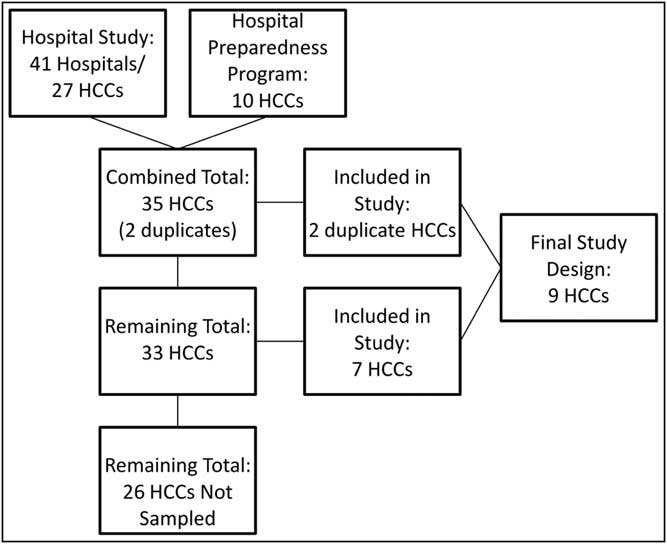
Figure 1 illustrates the 3-stage methodology that was used to identify well-established, preparedness-focused HCCs using the best available data. First, data were extracted from a hospital-based coalition studyReference Rambhia, Waldhorn, Selck, Mehta, Franco and Toner 18 that scored coalition member hospitals on 14 possible characteristics that indicated various attributes of preparedness. To establish a high benchmark for inclusion, hospitals with a score of either 13 or 14 were considered for inclusion in this study. In this manner, a total of 41 hospitals were identified. Each of the 41 hospitals were then linked to their respective coalitions. Coalitions without an online presence or accessible contact information were then excluded, resulting in 27 eligible HCCs from this data source.
Study Sample Selection Methodology. Abbreviation: HCC, health care coalition.

Second, data provided by the Office of the Assistant Secretary for Preparedness and Response (ASPR; Washington DC, USA) were then used to identify “mature” coalitions from among those funded by the Hospital Preparedness Program (HPP). A subset of questions from an existing program evaluation survey was adapted to create search parameters focused on coalition longevity, capacity for education and training, and overall coalition performance. Using these search criteria, a total of 10 HCCs were identified from among the HPP grantees.
The two lists were reconciled, yielding a combined total of 35 unique health care preparedness coalitions. Two coalitions were identified in both datasets and were therefore included as interview sites for this study. The remaining seven coalitions were chosen from among the 33 remaining coalitions using convenience sampling, though efforts were made to select coalitions from urban, suburban, and rural locations, as well as from different parts of the country.
The final study design included nine coalitions, located in the states of California, Colorado, Massachusetts, Michigan, Minnesota, Kansas, Kentucky, Texas, and Washington (USA). Due to confidentiality agreements under the Institutional Review Board approval, individual HCCs will not be named, and they will instead be identified by the state in which they exist.
Survey Instrument and Data Collection
A semi-structured interview guide was used to conduct face-to-face interviews with the coalition leadership in each of the nine HCCs. Institutional Review Board approval was obtained from the Uniformed Services University of the Health Sciences Office of Research (Rockville, Maryland USA), under protocol #381802-5. Informed consent was discussed, and permission to be audio recorded was obtained.
Major topical areas covered in the interview guide included: required education and training by HCCs; perceived disaster-health education and training needs; education and training challenges; and opportunities for additional disaster-health education and training. Questions regarding hospital and public health preparedness capabilities were derived from HPP and Public Health Emergency Preparedness Program grant materials, and input on the questionnaire was sought and obtained from the ASPR National Health Care Preparedness Programs. The remaining questions on education and training needs, performance evaluations, and delivery models were derived from previous research.Reference Walsh, Altman, King and Straus-Riggs 15 , Reference Walsh, Subbarao and Gebbie 19 , Reference Schor and Altman 20 The final survey was also pilot tested with a local HCC leader who was not a respondent in this study. The topics described here are a subset of the complete survey instrument, and data regarding findings that go beyond the scope of education and training in HCCs are reported elsewhere by the authors.Reference Walsh, Craddock, Strauss-Riggs, Schor and Gulley 16
Data Analysis
The audio recordings were transcribed by an online transcription service, and transcripts were analyzed qualitatively using QSR NVivo 10 qualitative analysis software (QSR International Pty Ltd; Doncaster, Victoria, Australia). Three research personnel independently coded each interview, and a standard of 80% intercoder agreementReference Miles and Huberman 21 was followed. The methodology for thematic analysis was influenced by grounded theory, but because interviews were conducted with predetermined questions, predetermined theme areas were covered in every interview.Reference Phillips 22 A structured approach to coding was utilizedReference Phillips 22 and a list of codes was determined prior to the analysis. Codes were then analyzed by hand to uncover and establish themes and trends from among the research sites. Both anticipated and emergent themes were considered, and findings are presented here according to the guidelines for communicating descriptive, qualitative analyses.Reference Knafl and Howard 23
Results
Characteristics of the Sampled Coalitions
The HCCs were based in a variety of home organizations. Three were based in hospitals, two were based in public health departments, and the remaining coalitions were in an emergency management department, a fire department, and one independent, non-profit organization. The coalitions’ regions encompassed anywhere from one to 18 counties, and population densities of the region covered by the coalition varied greatly (six to 3,806 people/mi2). Four coalitions were classified as rural (fewer than 100 people/mi2), two were suburban (100-1,000 people/mi2), and three were urban (more than 1,000 people/mi2, or total population size greater than 5 million people). Coalition leadership was approximately 44.4% female and 55.5% male. Educational and professional backgrounds of the leaders most often included either emergency management or nursing.
Coalitions as Venues for Health Care Workforce Development
Health care coalitions provide a constructive, organized forum for employees and executives of previously disconnected health systems to share information, learn, plan, and train together.Reference Toner, Waldhorn and Franco 4 The majority of respondents indicated that prior to the establishment of the coalition, there was no unified, system-level view of the capability and capacity of regional health care systems to respond to, and recover from, disasters, a sentiment supported in previous studies of preparedness coalitions.Reference Hanfling 3 , Reference Toner, Waldhorn and Franco 4 , Reference Rambhia, Waldhorn, Selck, Mehta, Franco and Toner 18 Also supported by previous research, bringing together leaders of diverse organizations to learn and train together has improved individual knowledge and situational awareness, understanding of community-level gaps and needs, and interoperability of agency plans.Reference Hanfling 3 , Reference Barbera, Yeatts and Macintyre 24
If you go to basics, the real advantage of the coalition is… bringing partners together to the table to learn and work together. And without the coalitions, we still wouldn't have that.
[The advantages are summed up] all in one word, “interoperability,” because it covers everything. We're trained together. We all work together. We have the same tools.
Many of the surveyed coalition leaders viewed themselves as “conveners” to bring community partners together for trainings and exercises. In doing so, HCC leaders are able to leverage the knowledge and talents of a wide variety of health professionals, which enables a better understanding of job roles and expectations in a disaster.
As a general rule, health care facilities didn't understand, especially the smaller ones, what their roles and responsibilities were prior [to] and during [a disaster], and how they tie in with emergency management and what emergency management's role is. Now they do.
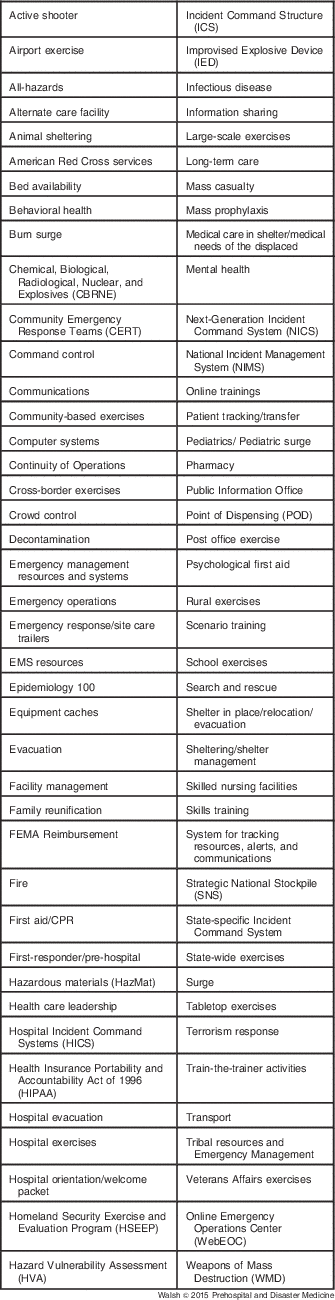
Coalition leaders also considered themselves educators who are faced with the task of developing a competent and capable coalition workforce, comprised of many different health professions at varying levels of preparedness training, and with very different roles in a disaster. To this effect, all coalitions offer numerous education and training opportunities in any given year, ranging from complex and technical training to general, “core” concepts (Table 1). They furthermore facilitate the sharing of information about trainings hosted elsewhere (ie, at member facilities, online, or in nearby regions).
Trainings Offered by Health Care Coalitions Interviewed

[Coalition members] are not only getting products that we have developed as a region, but things that they can share amongst themselves. The hospitals have been doing [preparedness activities] for the last 12 years, so nursing homes [can] send an email out and say, “Do you have a policy on this?” And they'll get three policies. The communication that I've seen in the last two years is really rewarding for them.
Delivery of Education and Training Opportunities
Education and training opportunities are also delivered in many ways, depending on the needs and resources of the coalition. Some utilize free online Federal Emergency Management Agency (FEMA; Washington DC, USA) resources, others host conferences, and all conduct drills and exercises. Coalitions identified in-person meetings, conferences, seminars, and workshops as valuable education and training opportunities, but online meetings were also lauded as a successful way of bringing together geographically distant partners. Additional training delivery formats included: conference calls, formal courses offered by government or universities, pairing exercises with trainings and/or knowledge assessments, tabletop exercises, and train-the-trainer style activities.
Training Requirements
With the exception of a number of exercises required for accreditation or funding, most education and training opportunities are offered to coalition members as non-mandatory opportunities for learning. Just one of the interviewed coalitions required a “basic training” course for all coalition members and new employees, although others voiced it as a need, a sentiment supported in the literature.Reference Barebera and Macintyre 25
We found with [employee] turnover that we need to go back to the basics [for every new employee]. Here's Emergency Management 101. Here's what your role is. Here's how we can help you with this. Here's what ASPR is, here's what the grant means to you and aligns with the Joint Commission.
You know, I think the biggest thing we need, because the hospitals are under stress, I think we're kind of going “back to the future” where we're looking at what are the core things we have to do. Not the “like to have,” not the “nice to have,” but “what do we really have to do?” We are refocusing on those core capabilities.
Just one coalition attempted to maintain Incident Command Structure (ICS) and National Incident Management System (NIMS) training for a defined fraction of health care system leadership and employees. However, while most coalitions encouraged the completion of ICS and NIMS courses, this training usually was not required of the general coalition health care workforce and was completed by very few individuals. This finding supports previous research on essential health care workforce training levels, which indicate that hospital personnel lack critical disaster-preparedness and response training; even among job roles deemed “essential” in hospital-oriented disaster response, training levels were not consistent among job roles nor among hospitals.Reference Reilly and Markenson 26
Sustainability of education is a concern that we have, so that leadership staff and 12 or 14 percent [of employees] should have training [in ICS and NIMS]… [We need to] make sure that new leaders and managers that are coming in, they're trained and know how to utilize the resources that are there.
Identification of Training Needs
Coalition leaders identified education and training needs in a variety of ways. Most commonly, training gaps were found through direct feedback from coalition members or through hospital- or regionally-based hazard vulnerability analyses (HVAs). The process of conducting an HVA not only identifies the vulnerabilities inherent in that system, but secondarily helps define content needs for training based on these vulnerabilities. Interestingly, many of the coalitions surveyed identified their training needs via HVA, and then tied the associated training activities back to the capabilities identified by their grant requirements, rather than the other way around. This comes in contrast to their past practice, which was to derive the majority of training and exercise planning based solely on the grant deliverables.
So what we do is, we have the training and exercise planning workshop and we look at our HVA. I'm remembering back when I first started doing this, and it seems more today that our HVA is driving our training and exercise planning, but really in the past it would have been the grant deliverables. The grant told us what we needed to exercise, and so that's what we would exercise.
Many coalition leaders also developed a long-term strategic plan which helped to identify not only the needs, but also a process for addressing them. Additionally, exercises and real-world events were cited frequently as opportunities to identify vulnerabilities. This, too, has been supported in the literature.Reference Hanfling 3 , Reference Ginter, Rucks and Duncan 27
Identified Training Topics
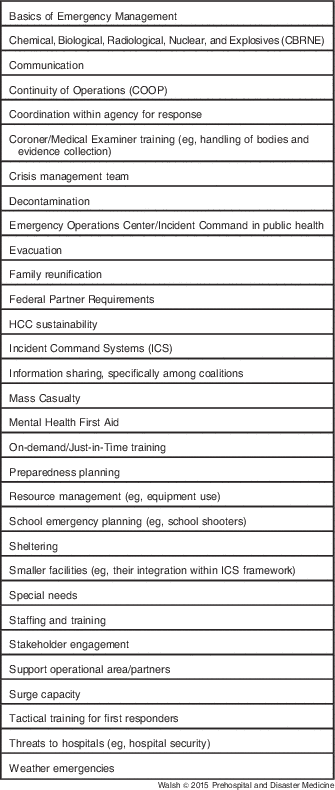
When asked what training topics they thought their members needed most, more than 30 unique training topics were identified (Table 2). Of those, the most frequently cited were: stakeholder engagement; economic sustainability of the coalition; communication; coroner and mortuary services; exercise design; mass-casualty incidents; and chemical, biological, radiological, nuclear, and explosives (CBRNE). Though the coalition leaders did not make this distinction, some needs were specifically relevant to HCC leaders and the leaders of HCC-member institutions, while others were more relevant to general HCC membership.
Training Needs Identified by Health Care Coalitions Interviewed

Those most relevant to HCC leaders and leaders of HCC-member institutions included: stakeholder engagement; economic sustainability; and exercise design. Within the topic of stakeholder engagement, how to better support the coalition's operational area and partners, clarifying the HCC's roles and responsibilities during disaster response, and balancing the needs of diverse coalition partners (ie, finding education and training topics relevant to all) were prioritized as areas for improvement. Stakeholder engagement across state lines was also a topic that coalitions needed guidance on, a challenge that has been noted in the literature.Reference Ginter, Rucks and Duncan 27
Training needs that were more relevant for the general HCC workforce tended to include more specific operational skills (eg, communication; coroner and mortuary services; mass-casualty incidents; and CBRNE).
Education and Training Challenges
Educating and training staff, coalition partners, and volunteers were identified as significant challenges for HCCs. Barriers to education and training were related most often to a lack of time, little-to-no staff devoted to training, and difficulty in getting coalition members to prioritize training opportunities amidst their already plentiful workloads. This finding is supported elsewhere, as a recent survey of patient care providers found that 20% of them ranked time constraints as the primary barrier to emergency-preparedness training, and 76% suggested training should be limited to less than one day per year.Reference Scott, Crumpler, Tolley, Jones and Wahlquist 28 Barbera et alReference Barbera, Yeatts and Macintyre 24 have suggested that personnel training and exercises to maintain coalition capabilities should be designed in a way that is not overly burdensome to coalition members.
Continuing education and staff development in disaster-preparedness programs are known needs in health care.Reference Rose and Larrimore 29 , Reference Maddox 30 Because training in disaster health is not required by most employers and payers such as Centers for Medicare and Medicaid Services (CMS; Baltimore, Maryland USA), and disasters can be seen as low-probability events, it was not often prioritized over other commitments. As a result, attendance at HCC-provided educational opportunities was often low.
We don't live in a region that has a lot of disasters or even medium-sized events. So trying to convince our hospitals and our hospital administration, given all of the other burdens that they have… it's hard to get them to prioritize this.
All the hospitals are understaffed in emergency management. So all of the people that we work with as our partners within a facility are usually wearing about ten hats. It can be a barrier to making progress when those people aren't available to commit their time to our program, to emergency management.
Health care coalition leaders found it difficult to find training that met the needs of all partners. Multiple respondents noted that in moving from solely hospital-based to the inclusion of non-hospital-based partners, it was necessary now to provide additional non-hospital-related training opportunities.
Ten years ago, when we were a hospital planning committee specific to hospitals, we were working on hospital-specific things. The farther you go out in building a coalition and the more partners you bring in, the more difficult it is to make it relevant to each partner to give them a role and a purpose at the table.
Others noted that education and training were not reaching the people that needed it most, namely those in positions of executive leadership and decision making who had little-to-no preparedness training. Indeed, little is known about the motivation for emergency preparedness among hospital and health care executives.Reference Barbera, Yeatts and Macintyre 24
What we are finding is a gap [in knowledge and experience regarding disasters] in the leaders above [department managers, supervisors, and directors]. We are talking the execs or board members of a certain health care entity.
The FEMA-ICS training is 8 hours of…painful. I mean, it's a wonderful training, but my bosses look at me and say that's what we pay YOU to do, so there's a gap. Is there someone out there in the world that can make it palatable for someone who is organizing a multi-million dollar corporation?
Rural coalitions had the additional burden of tailoring training and exercises to be more relevant for their regions and health care systems.
We don't have any targets of national significance…There's no way that I can talk about 200 firefighters and ten trucks and all these paid people because it's not going to happen. Similarly, at the hospital, if I talk about a Level 1 trauma center, it just doesn't exist up here.
While exercises are critical for building and maintaining skills and relationships,Reference Peleg and Kellermann 31 it is often difficult to design exercises that are true-to-life. This can be due to multiple reasons, including resource constraints and lack of active engagement of participants. In addition, some grant requirements often have specific criteria for exercise design, which may make it difficult for HCCs to tailor exercises to specific vulnerabilities and needs identified in their community.
We have to artificialize so much that it really becomes an exercise in communication and sharing information across systems, which is great. But that's a problem sometimes [when trying to identify vulnerabilities].
Furthermore, differently defined jurisdictional boundaries of HCCs and public health and health care regions can make it difficult to integrate all partners involved, and ultimately, can diminish the realism of exercises.
What we struggle with is not having an alignment of our public health regions. It makes the regional exercise a little more difficult. Because all of the rest of the regions are aligned. [Emergency Medical Services] aligns, security aligns, our trauma region aligns with the hospital region, but public health has six regions.
I think the other thing we've done the last few years really started to focus on coordinating trainings and exercises with [neighboring state]. And obviously we … struggle around how to deal with grants and that type of thing. But we're really trying to figure out how to cross the [state] border in a unified manner during an incident because we're 20 miles apart, and the health care system doesn't care about that line.
With little staff time available to focus on education and training, coalitions are struggling to identify or develop impactful training opportunities. Many suggested that an online resource repository would fill this need.
I know this isn't the first full-scale exercise to have happened. So who's doing this, already? Where's our little toolkit in a box? Wouldn't it be great to see what other people have done, and then you can just go and pick one and mold it to make it work for you?
So it would just be nice to have a variety of resources available since we've got [coalitions] across the whole country, right? It seems like we should have a way to share resources with each other. Or have someone who takes those resources and boils them down into some best practices so you don't have 500 exercises on there, but you have a few.
Promising Practices
Coalitions are actively seeking and devising solutions to their more salient challenges. Currently, coalition-led education and training opportunities enable the professional development of individuals, including volunteers and retirees, who would not otherwise have funding or resources to attend such events. Some coalitions offer financial reimbursement to their organizational members to conduct site-specific education and training depending on their audience's professional needs. Health care coalitions are also finding creative ways to promote low- or reduced-cost education and training opportunities among their members, and many share opportunities for free, self-guided education.
We've also got videos that we've put on our website, that if they don't want someone to come out face-to-face and do it, they can pull a video up and they can do a training in their Emergency Room at a staff meeting. We do the same thing for the patient-tracking system that we have in place.
Coalitions are also aligning drills and exercises with other local entities required to conduct training for accreditation, standards, or funding (eg, post offices, airports, and military bases). These combined exercises maximize community benefit while reducing and sharing costs.
Well, since we have a limited amount of dollars, we try to get the biggest bang for our buck when it comes to exercises. We're going to invite as many of the partners to the table as possible, so we work with public health that doesn't have a lot of access to training hours or exercise hours… and we'll go to the hospitals with [The Joint Commission] telling them that they have to do an exercise, and we'll look at the hazard vulnerability assessment for the hospital… [and] we'll talk to the [Emergency Medical Services and the] firefighters and … come up with a scenario that will allow all of them to come in and exercise some of their skills and capabilities.
Our airport has an exercise every year. But with that, we're there. And because we have a [Office of Veteran's Affaris] facility, we're rolling that in as part of our community exercise, so the [Office of Veteran's Affaris]'s upcoming national-level exercise will actually expand itself the next day into our community health care exercise.
Discussion
The health care professions are at the frontlines of response and recovery for any major event, and are therefore an integral component of every community's emergency response system. However, the individual- and organizational-level training needs in HCCs are many and varied, so there is likely no one-size-fits-all approach to educating and training the interdisciplinary health workforce. In the coalition context, offering effective education and training opportunities can be a challenge, not due to a lack of educational content or availability of subject matter expertise, but rather to a lack of time and human resources to design and deliver these opportunities. Because disaster-health training is typically not required by employers, nor is it included in the general curricula of most health professional schools, the topic is often not prioritized for learning. Furthermore, state and federal grant support for health care preparedness principles waxes and wanes, giving the impression that disaster preparedness is a “hot topic” rather than an ongoing systems-level need. Ultimately, a system is needed that better enables the ongoing integration of disaster-preparedness education and training into the health care professions and facilitates the sharing of knowledge and expertise among HCCs across the country. Continuing to invest in human capital is essential for developing national-preparedness capabilities. 32
Health care coalitions alone cannot solve all the systemic challenges that underlie a potentially underprepared health care workforce,Reference Markenson, DiMaggio and Redlener 33 , Reference Garrett, Park and Redlener 34 but they have made a positive impact on the capacity of local health care communities to respond to disasters. 35 Health care coalition leaders have a significant responsibility, and despite the many challenges they face, many have managed to effectively communicate the value of preparedness to their stakeholders. By expanding the preparedness network to include non-health-focused partners, the most mature coalitions have provided unique learning opportunities for the coalition while expanding access to resources and sharing the cost burden.
As coalitions continue to develop, they actively seek opportunities for more sustainable practices and are eager to partner with local, state, and federal representatives to move toward a stronger system framework. Such efforts could be supported better at the federal and state levels by allowing enough flexibility in grant requirements to hire staff that focuses specifically on human-capital development. Just one of the coalitions in this study had any staff devoted completely to workforce education, and nearly all voiced the need for such support. There is also a need to develop easy-to-use learning outcomes assessments, so that coalitions may better measure and communicate to stakeholders the overall impact of training initiatives and the true benefit of investing in our human capital. Furthermore, a structured forum for information and resource sharing among coalitions would go a long way toward reducing redundancy and sharing solutions to common problems. It could also serve as a repository for already-developed learning tools and products, reducing the need for individual coalitions to continuously develop and tailor learning opportunities to different audiences.
To achieve these goals would require substantial stakeholder engagement and the support of many different agencies. The most proximal level of support is that of executives within the agencies themselves, and more research is needed to understand how to better motivate these individuals to support and participate in preparedness training.Reference Barbera, Yeatts and Macintyre 24 At the level of the national government, the recently proposed CMS rule 36 is a promising step toward advancing the level of knowledge and awareness among health care professionals, as it specifically defines workforce-preparedness training as a requirement for reimbursement for a wide variety of health care facilities.Reference Markenson, DiMaggio and Redlener 33 Requiring certain types of training within the HCC structure, in addition to within individual facilities, could support further a systems approach to training the workforce and raising the priority of such training among professionals.
Limitations
Due to the small sample size in this study, these findings may not be generalizable to all preparedness-focused coalitions. Additionally, mature coalitions were sampled purposively, such that the viewpoint and experience of more nascent coalitions are not represented. Furthermore, due to the small sample size and because the HCC structure, funding requirements, and specific regional and demographic characteristics are unique and varied, the design of this study precludes robust cross-coalition comparisons within the sample.
Also, in conducting the interviews, it was noted that the interpretation of the term “education and training” varied among respondents. While some respondents included a wide variety of modes of information sharing in their description of education and training within the HCCs, others focused heavily on interactive and kinesthetic activities such as large-scale exercises and tabletops. Future research may do well to establish a common definition for what constitutes “education and training” and to include a standard, quantitative component of data collection.
Conclusions
Preparedness-focused HCCs are logical forums for the education and training of a diverse subset of health care professionals, and they have already improved the capability of health care systems across the United States to respond to disasters. Despite their many advances, this research also indicates additional opportunity within HCCs to educate and train the health care workforce to provide disaster-cycle services. Such improvements in practice could be expedited with the increased support of numerous stakeholders, including health care executives, federal, state, and local governments, health professional schools, and partners outside the health care sector. Continuing to invest in human capital is essential for developing national-preparedness capabilities.