Mastitis is a term used to describe any inflammatory reaction in the parenchymal tissue of the mammary gland, and according to the signs it divided into clinical and subclinical forms (Radostits et al. Reference Radostits, Gay, Hinchcliff and Constable2007). In terms of livestock production, mastitis is considered a public health disease that is usually associated with suppressed milk production, altered milk quality, increased veterinary and labour costs, and increased culling rate (Sargeant et al. Reference Sargeant, Scott, Leslie, Ireland and Bashiri1998; Guliye et al. Reference Guliye, Van Creveld and Yagil2002; Saleh & Faye, Reference Saleh and Faye2011; Muhammad et al. Reference Muhammad, Alkali and Kalla2012). Consequently, heavy economic and biological losses are inevitable unless early and efficient methods of detection are used. In fact, several researchers have reported that effective mastitis control programmes covering the early diagnosis are more prominent and efficient than the treatment (Erskine et al. Reference Erskine, Wagner and DeGraves2003; Holanda et al. Reference Holanda, Madalena, Holanda, Miranda and Souza2005; Polat et al. Reference Polat, Colak, Cengiz, Yanmaz, Oral, Bastan, Kaya and Hayirli2010).
Dairy dromedary camels have developed udders suitable for machine milking (Ayadi et al. Reference Ayadi, Aljumaah, Musaad, Samara, Abdelrahman, Alshaikh, Saleh and Faye2013). Their daily milk yield ranges from 6–18 l/head (Wernery et al. Reference Wernery, Juhasz and Nagy2004; Ayadi et al. Reference Ayadi, Hammadi, Khorchani, Barmat, Atigui and Caja2009; Aljumaah et al. Reference Aljumaah, Almutairi, Ayadi, Alshaikh, Aljumaah and Hussein2011). Numerous cases of clinical and subclinical mastitis have previously been reported in dairy camels (Abdurahman et al. Reference Abdurahman, Bornstein, Osman, Abdi and Zakrisson1991; Guliye et al. Reference Guliye, Van Creveld and Yagil2002; Aljumaah et al. Reference Aljumaah, Almutairi, Ayadi, Alshaikh, Aljumaah and Hussein2011; Muhammad et al. Reference Muhammad, Alkali and Kalla2012; Al-Juboori et al. Reference Al-Juboori, Kamat and Sindhu2013). The clinical form of mastitis is easily diagnosed, while the subclinical form requires indirect means of diagnosis. Our search in the literature illustrated that several biomarkers and tests had already been used for detecting subclinical mastitis in dairy camels. Broadly, the biomarkers involve measurement of milk somatic cell counts (SCC) (Abdurahman et al. Reference Abdurahman, Ageb, Abbas and Astron1995; Abdurahman, Reference Abdurahman1996; Aljumaah et al. Reference Aljumaah, Almutairi, Ayadi, Alshaikh, Aljumaah and Hussein2011), N-acetyl-β-d-glucosaminidase (Abdurahman, Reference Abdurahman1995; Guliye et al. Reference Guliye, Van Creveld and Yagil2002), pH (Aljumaah et al. Reference Aljumaah, Almutairi, Ayadi, Alshaikh, Aljumaah and Hussein2011) as well as serum albumin concentration (Abdurahman, Reference Abdurahman1995); while the tests include California mastitis test (CMT), electrical conductivity (EC), as well as bacterial culture and isolation (Saber et al. Reference Saber, Mohammed and Ahmed2010; Aljumaah et al. Reference Aljumaah, Almutairi, Ayadi, Alshaikh, Aljumaah and Hussein2011; Saleh et al. Reference Saleh, Al-Ramadhan and Faye2013; Wanjohi et al. Reference Wanjohi, Gitao and Bebora2013). However, their basal levels and physiological variations in dairy camels are still not yet adequately established (Saleh & Faye, Reference Saleh and Faye2011). Besides, as in dairy cows, these tests may not be suitable for field practice owing to their subjectivity (Sen et al. Reference Sen, Kabir and Rahman1996) and variable predictive ability (Bansal et al. Reference Bansal, Hamann, Grabowski and Singh2005; Polat et al. Reference Polat, Colak, Cengiz, Yanmaz, Oral, Bastan, Kaya and Hayirli2010), suggesting a need for extensive studies for clarification.
Infrared thermography (IRT) is a sophisticated non-contact non-invasive technique that works on visualising the surface temperature with high accuracy by generating pictorial images (thermograms) using a state-of-the-art device (thermal camera) based on the amount of surface emitted infrared radiations generated according to the Stefan-Boltzmann law. This technology has been employed successfully in veterinary diagnosis of several cases of infection (Cockcroft et al. Reference Cockcroft, Henson and Parker2000; Eddy et al. Reference Eddy, Van Hoogmoed and Snyder2001; Schaefer et al. Reference Schaefer, Cook, Tessaro, Deregt, Desroches, Dubeski, Tong and Godson2004, Reference Schaefer, Cook, Bench, Chabot, Colyn, Liu, Okine, Stewart and Webster2012). Furthermore, it has previously been used to determine the udder surface temperature in dairy cows (Kunc et al. Reference Kunc, Knizkova and Koubkova1999; Scott et al. Reference Scott, Schaefer, Tong and Lacasse2000; Colak et al. Reference Colak, Polat, Okumus, Kaya, Yanmaz and Hayirli2008; Polat et al. Reference Polat, Colak, Cengiz, Yanmaz, Oral, Bastan, Kaya and Hayirli2010), dairy ewes (Stelletta et al. Reference Stelletta, Murgia, Caria, Gianesella, Pazzona and Morgante2007; Mala et al. Reference Mala, Knizkova, Kunc and Knizek2009; Castro-Costa et al. Reference Castro-Costa, Caja, Salam, Rovai and Aguillo2013) and dairy goats (Caruolo et al. Reference Caruolo, Jarman and Dickey1990), as well as having been utilised to assess changes of body surface temperature in dairy camels (Abdoun et al. Reference Abdoun, Samara, Okab and Al-Haidary2012; Aljumaah et al. Reference Aljumaah, Samara and Ayadi2012; Ayadi et al. Reference Ayadi, Samara, Al-Haidary, Aljumaah, Alshaikh and Caja2012; Samara et al. Reference Samara, Ayadi, Al-Haidary and Aljumaah2013). However, to our knowledge, studies on its diagnostic reliability in detecting subclinical mastitis in camels are lacking. Thus, the present study was designed to examine the feasibility of utilising IRT compared with other indicators for early detection of subclinical mastitis in two breeds of dairy dromedary camels managed under intensive conditions in Saudi Arabia. We hypothesised (1) that udders with subclinical mastitis can be distinguished using the diagnostic merits of IRT, and (2) that interrelationships exist among UST and other routine indicators of subclinical mastitis in dairy camels.
Materials and methods
Camels and their management
Sixty-five lactating dromedary camels of two native breeds (27 Majaheim and 38 Maghatier) averaging 111±23 d in milk (DIM) and yielding 9·1±1·1 kg/d of milk (mean±sd) were screened for subclinical mastitis. These camels were obtained from a private farm (Al-Watania corporation, Al-Jouf district, Saudi Arabia) possessing a single-tunnel milking parlour equipped with low-pipeline milking stalls and recording jars (Alfa-Laval, Riyadh, Saudi Arabia). Camels were milked twice daily (5·00 and 17·00). The daily ration for each animal consisted of alfalfa hay and 2·0 kg of a concentrate mixture distributed in two daily portions, while water was available ad libitum.
Measurements
All procedures described in this study were approved by the Faculty Research Ethics Committee at the King Saud University. Ambient temperature (Ta) and relative humidity (RH) were recorded continuously at 15-min intervals using two data loggers (Hobo Pro, Model H08-032-08, Onset, Cape Cod MA, USA) placed inside the milking parlour at a height of approximately 2 m from the ground, and placed away from direct sources of heat, sunlight and water. Special data logging software (BoxCar Pro 4, Onset) was used for programming the loggers and thereafter for data retrieving.
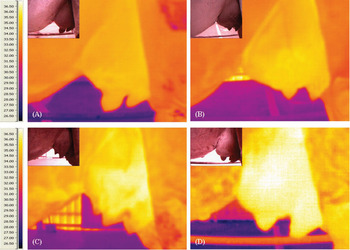
Before 2 d of screening for subclinical mastitis, all camels were subjected to clinical examinations as well as testing blood and milk samples in order to identify any cases of clinical mastitis or systemic infections. Any camel with problems other than subclinical mastitis was treated and excluded from the study. On the measurement day and immediately before the morning milking, all camels were allowed at first to rest inside the milking parlour for 30 min to minimise any interference of the climatic conditions. After resting, left side thermograms of the udder (front and rear quarters) were obtained in duplicate using a portable forward-looking and automatically calibrated infrared camera (VisIR Camera, Thermoteknix Systems, Cambridge, UK) placed perpendicular and at approximately 50 cm away from udders. This camera is equipped with 25° lens, 1·3 M pixel visible camera, and LCD touch screen, as well possessing a 7·5–13 μm spectral range and a precision of ±0·1 °C. Several parameters (the emissivity of the animal, the surrounding temperature, and the distance between the animal and the camera) were supplied to the camera in order to obtain correct values of UST by compensating for the effects of different radiation sources. After capturing, thermograms were stored inside a 250-MB internal memory, readout and analysed using a special thermograms analysis programme (TherMonitor®, Thermoteknix Systems ltd, Cambridge, UK). A total of 118 quarters were analysed. The mean temperature in a defined area was used to quantify the UST for each quarter. Figure 1 shows an illustration of udder thermograms according to CMT score.
Illustrations of udder infrared thermograms according to California mastitis test (CMT) score in dairy dromedary camels. (A): CMT score=0 or negative; (B): CMT score=+1; (C): CMT score=+2; and (D): CMT score=+3. The original images of each thermogram are presented in the upper left corner. A rainbow colour scheme was chosen for all thermograms.

Immediately after obtaining the thermograms, milk samples (100 ml) were collected manually from the front and rear left quarters in sterilised bottles after discarding the first milk jets (about 10 ml). Within 24 h of collection, milk samples were processed for CMT (Bovi-Vet, Kruuse, Germany), SCC (Fossomatic™ Minor, Foss, DK-3400 Hillerod, Denmark), EC (Direct-ION, Dover, Kent, UK) and pH (Hanna instruments®, Smithfield RI, USA) by trained technicians. Quarters with negative or trace CMT score (0) were considered healthy quarters, while those with positive CMT scores (+1, +2, or +3) were considered subclinical mastitic quarters (Radostits et al. Reference Radostits, Gay, Hinchcliff and Constable2007).
Statistical analysis
Data were analysed using the statistical analysis system (SAS Inst., Inc., Cary NC, USA). The PROC MEANS procedure was used to obtain the descriptive statistics of UST by the CMT score. Differences in UST, SCC, EC, and pH by the CMT score (0, +1, +2, and +3) and quarter position (front or rear) were determined using the PROC MIXED procedure. Mean differences were elaborated by the PDIFF option. Interrelationships among mastitis indicators were attained using the PROC CORR and REG procedures. Additionally, the receiver operating characteristics (ROC) curves for UST were performed to compare the sensitivity, specificity, positive likelihood ratio, negative likelihood ratio, positive predictive value and negative predictive value for detecting subclinical mastitis in dairy camels as attained by CMT score and SCC using the SigmaPlot software (SigmaPlot v12.0, Systat Software Inc., San Jose CA, USA). The probability value, which denotes statistical significance, was declared at P<0·05.
Results
Overall means of Ta and RH recorded during the present study inside the milking parlour were 27·7±0·4 °C (16–41 °C) and 31±0·9% (9–64%), respectively. Daily milk yield observed herein (9·1±1·1 kg/d, in average) is within the normal range reported in the literature for dairy camels (Wernery et al. Reference Wernery, Juhasz and Nagy2004; Ayadi et al. Reference Ayadi, Hammadi, Khorchani, Barmat, Atigui and Caja2009, Reference Ayadi, Aljumaah, Musaad, Samara, Abdelrahman, Alshaikh, Saleh and Faye2013; Hammadi et al. Reference Hammadi, Atigui, Ayadi, Barmat, Belgacem, Khaldi and Khorchani2010). This may, collectively, be taken to indicate that camels used in the study were under normal environmental conditions.
The descriptive analysis of UST according to the CMT score is presented in Table 1. The obtained results showed that no differences (P>0·05) were observed in the measured UST as influenced by breed or udder quarter position. Results also revealed that UST was normally distributed, and increased as the CMT score increased (Table 1). The overall mean of UST was 36·06±0·07 °C ranging from 33·90 to 37·70 °C. Subclinical mastitic udders had an average UST of 1·42 °C greater than healthy udders (Table 1).
Descriptive analysis of udder surface temperature (UST) measured using an infrared thermal scanning technique in dairy camels

† CMT, California Mastitis Test; n, number of udder quarters tested
Table 2 shows the changes of UST, SCC, EC and pH according to CMT score. Overall means of UST and SCC were the only measures that exhibited clear differences (P<0·05) as CMT score increased (Table 2). Accordingly, strong positive correlations were obtained between CMT score and UST (r=0·77; P<0·001) and SCC (r=0·86; P<0·001), while a weak positive relationship was observed between CMT score and EC (r=0·26; P<0·01) and a weak negative relationship between CMT score and pH (r=−0·10; P<0·01). In addition, UST and SCC were found to be highly correlated (r=0·75; P<0·001).
Overall means and standard errors of udder surface temperature (UST) as well as milk somatic cell count (SCC), electrical conductivity (EC) and pH according to the California mastitis test (CMT) score in dairy camels

† n, number of udder quarters tested
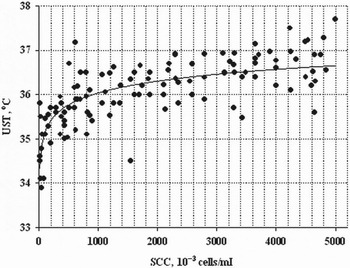
Because UST and SCC were the only parameters that exhibited differences as CMT score increased, a regression analysis was used to determine the relationship between these variables and CMT score. Results revealed that UST increased linearly as CMT score increased [UST (°C)=34·86+0·66×CMT score; R 2=0·65; P<0·001], while SCC increased exponentially as CMT score increased [SCC (×103 cells/ml)=355·05×exp(0·88×CMT score); R 2=0·81; P<0·0001]. However, the relationship between SCC and CMT score was found to be linear after the natural log-transformation of SCC [Log SCC=2·23+0·49×CMT score; R 2=0·81; P<0·0001]. Meanwhile, the relationship between UST and SCC was fitted best to a logarithmic equation [UST, °C=33·39+0·88×Log (SCC,×103 cells/ml), R 2=0·61, P<0·001, Fig. 2].
The best fitted relationship between udder surface temperature (UST) and somatic cell count (SCC) in dairy camels [UST, °C=33·39+0·89×Log (SCC, ×103 cells/ml), R 2=0·61, P<0·001, n=118].

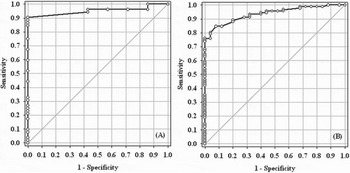
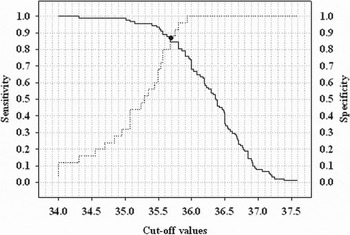
The reliability of IRT in detecting subclinical mastitis was further compared with CMT and SCC using ROC curves. The cut-off value, sensitivity, specificity, positive likelihood ratio, negative likelihood ratio, positive predictive value, negative predictive value, and area under the ROC curve for UST were 35·15 °C, 0·90 (0·83–0·95), 0·98 (0·76–1·00), not determined, 0·10, 0·99, 0·91 and 0·95, respectively, when subclinical mastitis was defined according to CMT score (negative CMT score being healthy vs. those with positive CMT scores (+1, +2, or +3) being subclinical mastitic quarters) (Fig. 3A). On the other hand, the cut-off value for SCC was found to be 432×103 cells/ml according to CMT score. Using this threshold to categorise udders as healthy (SCC⩽432×103 cells/ml) or mastitic (SCC>432×103 cells/ml), the cut-off value, sensitivity, specificity, positive likelihood ratio, negative likelihood ratio, positive predictive value, negative predictive value, and area under the ROC curve for UST were 35·70 °C, 0·89 (0·81–0·95), 0·96 (0·80–1·00), 10·60, 0·17, 0·92, 0·86 and 0·94, respectively (Figs. 3B and 4).
The sensitivity and specificity of the udder surface temperature (UST) when udders were categorised according to California Mastitis Test (CMT) score (negative CMT score being healthy, n=14 vs. those with positive CMT scores (+1, +2, or +3) being mastitic quarters, n=104) in (A), and when categorised according to somatic cell count (SCC) (SCC⩽432×103 cells/ml being healthy, n=25 vs. those with SCC>432×103 cells/ml being mastitic, n=93) in (B). The cut-off value and area under the ROC curve for UST were 35·15 °C and 0·95, respectively, according to CMT score, and were 35·70 °C and 0·94, respectively, according to SCC.

The sensitivity and specificity vs. cut-off values for udder surface temperature (UST) when quarters were categorised according to somatic cell count (SCC) as healthy (SCC⩽432 000 cells/ml, n=25) vs. subclinical mastitic (SCC>432 000 cells/ml, n=93). The intersection (black centre dot) indicate the UST cut-off value (=35·70 °C).

Discussion
Mastitis control programmes covering early diagnosis are crucial for effective reduction of the massive economic and biological losses associated with mastitis in dairy ruminants (Erskine et al. Reference Erskine, Wagner and DeGraves2003; Holanda et al. Reference Holanda, Madalena, Holanda, Miranda and Souza2005). Therefore, several indicators were proposed for detecting subclinical mastitis in dairy ruminants, but none of these routine indicators is perfect and fully accurate. The surface thermal condition of any organ reflects the underlying metabolism, which in turn is influenced by fluctuations in the amount and rate of blood supply (Berry et al. Reference Berry, Kennedy, Scott, Kyle and Schaefer2003; McCafferty et al. Reference McCafferty, Gilbert, Paterson, Pomeroy, Thompson, Currie and Ancel2011). Organ hyperthermia and redness, due to the acceleration of blood flow, are considered as major early signs of any inflammation (Cheville, Reference Cheville and Cheville1999). This suggests that determination of udder surface temperature using IRT may have considerable merit in the early examination of mammary gland health status. In fact, this technology has previously been used for mastitis detection in several dairy ruminants (Caruolo et al. Reference Caruolo, Jarman and Dickey1990; Kunc et al. Reference Kunc, Knizkova and Koubkova1999; Scott et al. Reference Scott, Schaefer, Tong and Lacasse2000; Stelletta et al. Reference Stelletta, Murgia, Caria, Gianesella, Pazzona and Morgante2007; Colak et al. Reference Colak, Polat, Okumus, Kaya, Yanmaz and Hayirli2008; Mala et al. Reference Mala, Knizkova, Kunc and Knizek2009; Polat et al. Reference Polat, Colak, Cengiz, Yanmaz, Oral, Bastan, Kaya and Hayirli2010; Castro-Costa et al. Reference Castro-Costa, Caja, Salam, Rovai and Aguillo2013). However, to our knowledge, this is the first study on using IRT for early detection of subclinical mastitis in dairy camels. In the present study, CMT score was used to define subclinical mastitis and the feasibility of IRT to detect subclinical mastitis was compared with other indicators.
According to CMT score, our results indicated that subclinical mastitic quarters had higher UST than healthy quarters. Similar findings were obtained in dairy cows (Colak et al. Reference Colak, Polat, Okumus, Kaya, Yanmaz and Hayirli2008; Polat et al. Reference Polat, Colak, Cengiz, Yanmaz, Oral, Bastan, Kaya and Hayirli2010). Inflammation of the udder with mastitis ideally results in an increase in the surface temperature of the affected area within the first 24 h of infection (Sargeant et al. Reference Sargeant, Scott, Leslie, Ireland and Bashiri1998). In fact, several authors showed, using IRT, that infusion of lipopolysaccharide (endotoxin) into the mammary gland, to induce an inflammatory response similar to mastitis, resulted in an increase of 1·5–2·0 °C in the udder surface temperature within 24 h of infusion (Scott et al. Reference Scott, Schaefer, Tong and Lacasse2000; Willard et al. Reference Willard, Dray, Farrar, McGee, Bowers, Chromiak and Jones2007; Hovinen et al. Reference Hovinen, Siivonen, Taponen, Hanninen, Pastell, Aisla and Pyorala2008). Therefore, determination of UST using IRT may have a considerable diagnostic merit in the dairy camel.
To confirm, the ability of IRT in detecting subclinical mastitis was then compared with some indicators frequently applied in screening dairy camels for subclinical mastitis. Numerous studies reported that milk SCC, EC, and pH are all considered good indicators for detecting subclinical mastitis in dairy camels (Guliye et al. Reference Guliye, Van Creveld and Yagil2002; Hammadi et al. Reference Hammadi, Atigui, Ayadi, Barmat, Belgacem, Khaldi and Khorchani2010; Saleh & Faye, Reference Saleh and Faye2011; Aljumaah et al. Reference Aljumaah, Almutairi, Ayadi, Alshaikh, Aljumaah and Hussein2011; Saleh et al. Reference Saleh, Al-Ramadhan and Faye2013; Wanjohi et al. Reference Wanjohi, Gitao and Bebora2013). The present data revealed that UST and SCC were the only measures that exhibited clear elevations as CMT score increased. In agreement, udders with a CMT score of +1 or more were reported to have higher UST and SCC than healthy quarters in dairy cows (Scott et al. Reference Scott, Schaefer, Tong and Lacasse2000; Redetzky et al. Reference Redetzky, Hamann, Grabowski and Klein2005). This may therefore explain the positive correlations obtained in the present study between UST, SCC and CMT score. Notably, these findings accord with previous reports in other ruminants (Brito et al. Reference Brito, Caldeira, Verneque and Brito1997; Roesch et al. Reference Roesch, Doherr, Scharen, Schallibaum and Blum2007; Colak et al. Reference Colak, Polat, Okumus, Kaya, Yanmaz and Hayirli2008; Polat et al. Reference Polat, Colak, Cengiz, Yanmaz, Oral, Bastan, Kaya and Hayirli2010). Therefore, this represents substantial evidence that combining these measures may be a useful tool for subclinical mastitis screening in dairy camels.
This deduction was actually confirmed by further analysis for interrelationships and ROC curves. Our results revealed that the coefficient of determination (R 2) between UST and CMT as well as between UST and SCC were relatively high. Moreover, using CMT score and the obtained SCC threshold (SCC=432 000 cells/ml) to categorise udders as healthy or mastitic, UST was proven to distinguish mastitic udders with high feasibility; thereby, indicating that IRT can be used compared with CMT and SCC for early detection of subclinical mastitis in lactating dairy camels. Interestingly, according to Al-Ani & Al-Shareefi (Reference Al-Ani and Al-Shareefi1997), milk samples from camels with SCC⩽400 000 cells/ml were considered healthy while those with SCC>400 000 cells/ml were considered mastitic. Moreover, Scott et al. (Reference Scott, Schaefer, Tong and Lacasse2000) found that mastitis in dairy cows could be detected from udder temperature differences, measured by IRT, earlier than from SCC. This implies that UST, as an indirect measure, is a sensitive screening measure for detecting subclinical mastitis in dairy camels.
However, further studies should determine the sensitivity, specificity, and positive and negative predictive values of IRT in detection of subclinical mastitis in dairy camels combined as well with microbiological evaluation. Despite the fact that intramammary infection upon microbiological culturing is associated with increased SCC and CMT score, the true health status of any udder relies essentially on the presence of microbial pathogens (Younan et al. Reference Younan, Ali, Bornstein and Mueller2001; Wahba et al. Reference Wahba, Ali and El-Hafeez2005; Saleh et al. Reference Saleh, Al-Ramadhan and Faye2013). In dairy cows, several authors report that the sensitivity and specificity to detect positive intramammary infection is 46–84 and 82–98%, respectively, for CMT score, and 61–83 and 58–84%, respectively, for SCC (Djabri et al. Reference Djabri, Bareille, Poutrel, Beaudeau, Ducelliez and Seegers2002; Wahba et al. Reference Wahba, Ali and El-Hafeez2005; Polat et al. Reference Polat, Colak, Cengiz, Yanmaz, Oral, Bastan, Kaya and Hayirli2010). Furthermore, controlled environmental conditions are also required when using IRT (McCafferty et al. Reference McCafferty, Gilbert, Paterson, Pomeroy, Thompson, Currie and Ancel2011). Therefore, these factors must be taken into account when investigating the feasibility of utilising IRT for detection of subclinical mastitis in dairy camels.
In conclusion, this is the first study on the feasibility of using IRT for early detection of subclinical mastitis in dairy camels. Despite being expensive and lacking specificity regarding the aetiology, the obtained results clearly showed that IRT, as an indirect non-invasive screening measure, was highly feasible for distinguishing mastitic udders in lactating dairy camels, thereby suggesting a possibility for early detection of subclinical mastitis, which is crucial to treat mastitis early and efficiently. Making camel milk safer for human consumption and contributing towards a respective control measures by reducing the incidence of clinical mastitis and culling rate are all considerable advantages of using IRT for early detection of subclinical mastitis in dairy camels.
The authors extend their appreciation to the Deanship of Scientific Research at King Saud University for funding the work through the research group project No. RGP-VPP-042.