Introduction
Tuta absoluta (Lepidoptera: Gelechiidae) is an emerging pest on tomato in different countries causing up to 100% crop loss (Desneux et al., Reference Desneux, Wajnberg, Kris, Burgio, Arpaia, Narváez-Vasquez, González-Cabrera, Catalán Ruescas, Tabone, Frandon, Pizzol, Poncet, Cabello and Urbaneja2010; Sridhar et al., Reference Sridhar, Chakravarthy, Asokan, Vinesh, Rebijith and Vennila2014). Total reliance on insecticides for its management results in resistance development apart from residues (Rakha et al., Reference Rakha, Zekeya, Sevgan, Musembi, Ramasamy and Hanson2017). Wild relatives of tomato are known for insect resistance source (Oliveira et al., Reference Oliveira, de Silva, Leite, Jham and Picanco2009) and generally associated with the presence of different trichome types and densities (Tissier, Reference Tissier2012). Glandular trichomes (GT) synthesize and store secondary metabolites (Schilmiller et al., Reference Schilmiller, Shi, Kim, Charbonnaeu, Holmes, Jones and Last2010; McDowell et al., Reference McDowell, Kapteyn, Schmidt, Li, Kang, Descour and Gang2011). The diversity of trichome types and chemical composition among tomato species respond differently against herbivore attack in conferring resistance (Rakha et al., Reference Rakha, Zekeya, Sevgan, Musembi, Ramasamy and Hanson2017) to T. absoluta. The objective of this study is to assess cultivated and wild tomato genotypes for resistance to T. absoluta and identification of mechanism involved.
Experimental
Tomato genotypes and choice bioassay
Twenty-one tomato genotypes (11 wild and 10 cultivated) were screened against T. absoluta (Table 1) in a greenhouse at the Indian Institute of Horticultural Research, Bengaluru, India, during 2017–18. The methodology followed was as given by Maluf et al. (Reference Maluf, Barbosa and Santa1997) and Rakha et al. (Reference Rakha, Zekeya, Sevgan, Musembi, Ramasamy and Hanson2017). Five plants each from 20 plants raised per genotype were screened against T. absoluta and were correlated with trichome types.
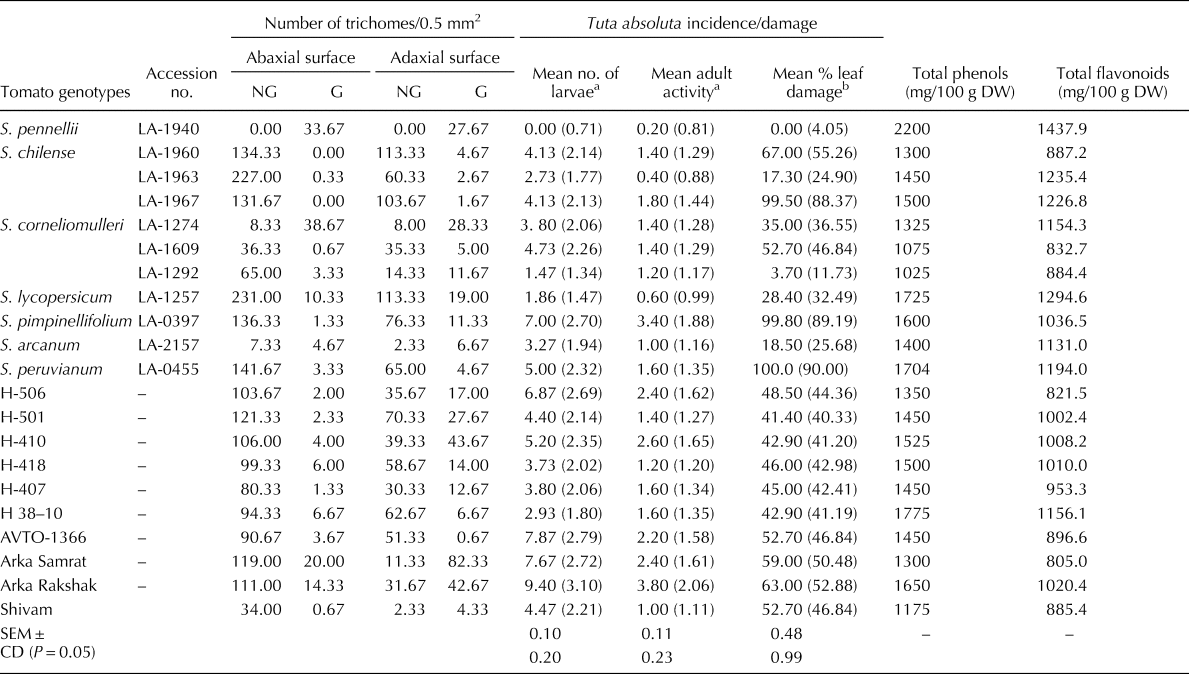
Trichomes, biochemical parameters and incidence of T. absoluta on different tomato genotypes (choice bioassay)

G, glandular; NG, non-glandular.
a Values in parenthesis are square root (x + 0.5) transformed.
b Values in parenthesis are arcsine (x + 0.5) transformed.
No-choice bioassay
The genotypes with mean damage of <40% under choice bioassay were further evaluated under controlled conditions in growth chambers (26 °C temperature and 70% relative humidity). Life stage duration of T. absoluta was assessed based on Rakha et al. (Reference Rakha, Zekeya, Sevgan, Musembi, Ramasamy and Hanson2017). Ten first instar larvae of T. absoluta were released on tomato leaves in petri plates in triplicate. Statistical analysis was done using analysis of variance and means were compared by duncan's multiple range test (DMRT).
Trichome and biochemical assays
Different trichomes, GT and NGT, were assessed per 0.5 mm2 on abaxial and adaxial leaf surfaces in tomato genotypes using a scanning electron microscope (model: TM 3030 Plus, Hitachi Co., Japan). Trichome types were classified according to Luckwill (Reference Luckwill1943).
Estimation of total phenolic content in the samples was determined according to Folin–Ciocalteu's method (Singleton and Rossi, Reference Singleton and Rossi1965) with minor modifications using gallic acid (GA) as standard. Total flavonoid content was determined according to Bao et al. (Reference Bao, Cai, Sun, Wang and Corke2005).
Principal component analysis was used to know the extent of variation among the tested tomato genotypes. Data was processed using the StatistiXL software (ver. 1.8).
Results
Choice assay
Mean T. absoluta larval incidence ranged 0–9.40/plant among tested genotypes. Wild genotype LA-1940 (Solanum pennellii) was completely free from T. absoluta damage. Among the cultivated genotypes, ‘Arka Rakshak’ had highest larval incidence (9.40/plant) and adult activity (3.80/plant). Minimum adult activity (0.20 adults/plant) was observed in LA-1940 (Table 1).
Trichome types and density
S. lycopersicum (LA-1257) showed highest NGT on both abaxial and adaxial surfaces (231.00 and 113.33 trichomes, respectively). S. corneliomulleri (LA-1274) had highest abaxial (38.67) and adaxial (28.33) GTs. However, in cultivated genotypes, highest GTs were on adaxial leaf surface of ‘Arka Samrat’ (82.33), H-410 (43.67) and ‘Arka Rakshak’ (42.67 trichomes) (Table 1).
NGT also varied among the genotypes studied. Type III was dominant in LA-1257 with 193.33 on abaxial surface and LA-1963 with 147.67 trichomes, whereas type V was dominant in LA-1963 with 79.33 and 40 trichomes on abaxial and adaxial surfaces, respectively. Similarly, more type V trichomes were in LA-1292 and LA-1257. Among GTs, types I and IV were dominant in LA-1274 and LA-1940, whereas type VI was dominant in LA-1292 and LA-1257.
The number of GT (type I, IV, VII) showed negative correlation in different genotypes of tomato with reference to larval number/plant (r = −0.47, −0.47 and −0.09), percent damage (r = −0.32, −0.34 and −0.23) and adult activity (r = −0.29, −0.31 and −0.15) and type IV showed significant role in conferring resistance.
Principal component analysis (PCA) analysis
PCA biplot parameters indicated percent larval mortality, larval duration, pupal duration and decrease in adult emergence are directly correlated. Trichomes, except for abaxial glandular, to certain extent, were negatively correlated with these characters. Genotypes LA-1274 and LA-1940 were closely associated with high content of total phenols, flavonoids and abaxial GTs. It appears that total phenols and flavonoid contents alone in leaf are not significantly related to percent decrease in adult emergence. The presence of specific compounds like tomatine etc. may be responsible for the observed values, which needs further confirmation.
No-choice feeding assay
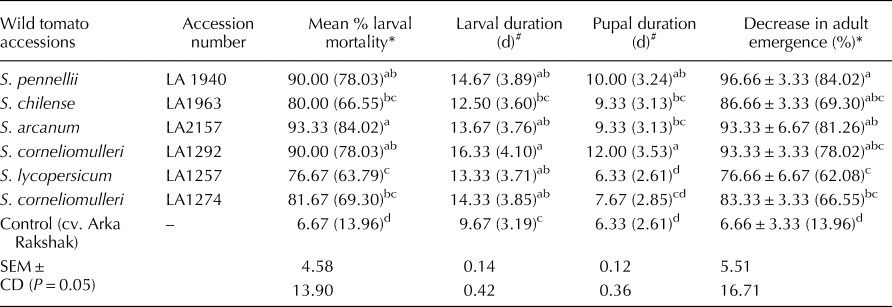
Significant larval mortality of T. absoluta was observed in wild genotypes compared to cultivated lines and ranged from 93.33% (LA-2157) to 76.67% (LA-1257) in wild accessions and 6.67% in control. Highest larval and pupal duration were recorded in LA-1292 and LA-1940 in comparison with ‘Arka Rakshak’ (control). Least adult emergence (3.33%) was observed in LA-1940 (Table 2).
T. absoluta life stage parameters on tomato wild genotypes and cultivated check under no choice bioassay

Means ± SE (n = 3).
In a column, figures with same alphabets are statistically at par with each other.
*Figures in parentheses are arcsine transformed values.
#Figures in parentheses are square root transformed values.
Discussion
Glandular and non-GTs play important role in host plant resistance by affecting the performance of herbivores (Bitew, Reference Bitew2018). In the current study some of the genotypes with less NGT (LA-1940, LA-1274 and LA-2157) and GT (LA-1963 and LA-1292) were more resistant to T. absoluta. However, some of the genotypes showed susceptibility to T. absoluta even with more GT/NGT indicating governance of resistance was through factors other than trichome type, density and their combination, which is in line with observations of Bitew (Reference Bitew2018). Higher Zingiberene (Azevedo et al., Reference Azevedo, Faria, Maluf, Oliveira and Freitas2003), 2-tridecanone (Maluf et al., Reference Maluf, Barbosa and Santa1997) were identified as major factors responsible for T. absoluta resistance in tomato.
The genotypes LA-1940, LA-1963, LA-2157 and LA-1292 are useful for resistance breeding against T. absoluta. LA-1940 showed tolerance both in choice and no choice bioassays with higher total flavonoids, phenols, type IV trichomes and resulted in minimum T. absoluta adult emergence (Table 1). LA-1963, though have higher NGT, have higher phenols and flavonoids. Environmental factors affect the development of GTs and compounds associated with insect resistance (Wilkens et al., Reference Wilkens, Shea, Halbreich and Stamp1996; Kang et al., Reference Kang, Shi, Jones, Marks and Howe2010; Rakha et al., Reference Rakha, Zekeya, Sevgan, Musembi, Ramasamy and Hanson2017).
The results suggest that LA-1940 (S. pennellii) can be a potential source of resistance to T. absoluta in future tomato breeding programmes. There is a need to study the genetic basis of resistance and compatibility/closeness of wild tomato genotypes with cultivated lines.
Supplementary material
The supplementary material for this article can be found at https://doi.org/10.1017/S147926211800062X
Acknowledgements
The authors are thankful to the Director, ICAR-Indian Institute of Horticultural Research, Bengaluru, India for providing necessary facilities for conducting the studies.