


Introduction
It is estimated that 567,715 individuals in the United States are homeless, and 84,000 of these individuals experience chronic health and psychiatric conditions, costing American taxpayers approximately $35,578 per individual experiencing homelessness each year (National Alliance to End Homelessness, 2015; National Alliance to End Homelessness, 2020). According to a recent study, the current lifetime and one-year prevalence of homelessness in the United States are 4.2% and 1.5%, respectively, and these statistics have been increasing (Greenberg and Rosenheck, Reference Greenberg and Rosenheck2010; Tsai, Reference Tsai2018). Additionally, the homeless population’s life expectancy is 17.5 years shorter than that of the general population (Romaszko et al., Reference Romaszko, Cymes, Dragańska, Kuchta and Glińska-Lewczuk2017), and 93.3% of individuals experiencing homelessness experience mental health issues (Hodgson et al., Reference Hodgson, Shelton and van den Bree2015). The vast disparity in the prevalence of depression between individuals experiencing homelessness and housed individuals (Fichter and Quadflieg, Reference Fichter and Quadflieg2001) suggests that mood disorders such as depression may be uniquely experienced within this population.
Mental health and treatment experiences
Homeless experiences
Previous research has identified several discrepancies in the mental health and general experiences individuals experiencing homelessness have compared with the general population. Mothers experiencing homelessness experience more distress than housed mothers, and their children experience more stressors, have fewer friendships, and spend less time with friends than children who do not experience homelessness (Buckner et al., Reference Buckner, Bassuk, Weinreb and Brooks1999; Masten et al., Reference Masten, Miliotis, Graham-Bermann, Ramirez and Neemann1993). Homelessness is associated with psychological trauma, social disaffiliation, learned helplessness, and high rates of mental illnesses such as mood disorders (Fichter and Quadflieg, Reference Fichter and Quadflieg2001; Goodman et al., Reference Goodman, Saxe and Harvey1991; Hodgson et al., Reference Hodgson, Shelton and van den Bree2015; Yim et al., Reference Yim, Leung, Chan, Lam and Lim2015). These discrepancies do not appear to be a simple result of socioeconomic status, as mothers experiencing homelessness have a greater proportion of psychological disorders and less access to care than housed mothers with low socio-economic statuses (Buckner et al., Reference Buckner, Bassuk and Zima1993; Masten et al., Reference Masten, Miliotis, Graham-Bermann, Ramirez and Neemann1993). According to North and Smith (Reference North and Smith1993), men and women have distinct experiences, with men being more likely to have histories of homelessness, legal difficulties/incarceration, and higher rates of psychiatric disorders, and women being more likely to have experienced past sexual abuse and depression.
Homelessness as an intersectional identity
One’s identity as an individual experiencing homelessness often exists among other identities, and this intersectionality lends itself to immensely varied experiences among the homeless population. In a discussion of the barriers to access that Native Americans experiencing homelessness often experience, participants reported that transportation, telephone accessibility, and the general culture of the mental health field interfere with their pursuit of mental health care, whereas clinicians cited lesser access to care, discrimination, and mistrust as probable barriers to access for the population (Wille et al., Reference Wille, Kemp, Greenfield and Walls2017). Additionally, Black individuals experiencing homelessness are perceived as more dangerous and more necessary to create social distance from than White individuals experiencing homelessness and people of colour report experiencing greater racial stigma (Markowitz and Syverson, Reference Markowitz and Syverson2019; Weisz and Quinn, Reference Weisz and Quinn2018). Finally, men experiencing homelessness are perceived as more dangerous than their female counterparts, and women experiencing homelessness face more stigma, worse physical health, and increased psychological distress/mental illness (Markowitz and Syverson, Reference Markowitz and Syverson2019).
Barriers to access and adequacy of services
Koegel and colleagues (1999) reported that only about three-fifths of their sample of ‘seriously mentally ill’ individuals experiencing homelessness had ever received mental health care and that only about one-fifth of their sample had received services in the last two months, which is likely related to past negative experiences with help-seeking and high rates of experienced stereotypes (Chaturvedi, Reference Chaturvedi2016; Weng and Clark, Reference Weng and Clark2018). Additionally, several studies have suggested that the severe lack of effective interventions available for this population must be addressed through reform in the way the field addresses homelessness (Salize et al., Reference Salize, Horst, Dillmann-Lange, Killmann, Stern, Wolf, Henn and Rössler2001; Youn et al., Reference Youn, Sauer-Zavala, Patrick, Ahles, Silvan, Greig, Marques and Shtasel2019). For example, many homelessness programs are designed to combat the problem by only providing shelter as opposed to psychological interventions (Coleman, Reference Coleman2017). Maslow’s hierarchy of needs is often cited as a description of what human beings need to survive and thrive, categorizing physiological needs (e.g. shelter) as foundational compared with other needs (e.g. psychological needs; Maslow and Lewis, Reference Maslow and Lewis1987). However, research suggests that providers should consider including therapy services to improve both quality of life and subjective well-being (Coleman, Reference Coleman2017). With this, research has found that treating mental health symptoms such as depression effectively predicts individuals’ length of stay in shelters and engagement in education and job programs, which suggests that simply addressing housing needs does not address the complex needs of this population (Bogard et al., Reference Bogard, Trillo, Schwartz and Gerstel2001). Positive steps towards helping this population include more access to health centres offering behavioural interventions, case management, and transportation services in their provided services (Jones et al., Reference Jones, Zur and Rosenbaum2017).
Why evaluate depression interventions for the homeless population?
Among the highest reported prevalence for all psychological disorders, Kessler and colleagues (2005) reported a lifetime prevalence of 16.6% for major depressive disorder for the general population. When delving into the prevalence rate of depression in the homeless population, statistics become less reliable, and studies tend to report vastly varied rates, with one study reporting that rates of depression range from 4% to 81% (Fazel et al., Reference Fazel, Khosla, Doll and Geddes2008). With this, it has been reported that individuals who are ‘adequately employed’ have histories of lower depression scores (Dooley et al., Reference Dooley, Prause and Ham-Rowbottom2000). Similarly, higher depression scores are related to missed medical appointments for men experiencing homelessness infected with the human immunodeficiency virus (HIV; Weiser et al., Reference Weiser, Riley, Ragland, Hammer, Clark and Bangsberg2006). Finally, researchers have found that depression symptoms tend to precede the onset of homelessness, and treating depression improves substance use outcomes and engagement with shelter services and educational/vocational programs, which suggests that treating depression may increase the possibility of positive outcomes for this population (Bogard et al., Reference Bogard, Trillo, Schwartz and Gerstel2001; Substance Abuse and Mental Health Services Administration, 2013; Quello et al., Reference Quello, Brady and Sonne2005).
Cognitive behavioural therapy for depression
There has been a plethora of empirical evidence that has established the effectiveness of CBT as a therapeutic intervention for depression in the general population, with an early study finding significantly lower depression scores post-intervention when using a CBT intervention compared with a waitlist control (Taylor and Marshall, Reference Taylor and Marshall1977). More recently, Watts and colleagues (2015) conducted a meta-analysis with a total of 48 studies in which CBT was favoured as the more effective treatment for depression, resulting in a medium effect size.
Cognitive behavioural therapy for depression in individuals experiencing homelessness
Previous systematic reviews and meta-analyses worked to consolidate the literature base to identify trends and evaluate an overall effect size. One systematic review by Noh (Reference Noh2018) cited three randomized control trials, finding that CBT did not significantly reduce depression in runaway youth (Hyun et al., Reference Hyun, Chung and Lee2005; McCay et al., Reference McCay, Carter, Aiello, Quesnel, Langley, Hwang, Beanlands, Cooper, Howes, Johansson, MacLaurin, Hughes and Karabanow2015; Slesnick et al., Reference Slesnick, Prestopnik, Meyers and Glassman2007). A second systematic review by Altena and colleagues (2010) cited two studies that utilized a CBT-based community reinforcement approach (CRA) and one that utilized broad-term CBT with youth experiencing homelessness, finding that both interventions resulted in decreased depression scores compared with control (Slesnick et al., Reference Slesnick, Prestopnik, Meyers and Glassman2007; Slesnick et al., Reference Slesnick, Kang, Bonomi and Prestopnik2008). Finally, a meta-analysis by Hyun and colleagues (Reference Hyun, Bae and Noh2020) with a total sample of 238 participants included two CBT studies and found no significant difference between CBT and control conditions (Garland et al., Reference Garland, Roberts-Lewis, Tronnier, Graves and Kelley2016; Himle et al., Reference Himle, Bybee, Steinberger, Laviolette, Weaver, Vlnka, Golenberg, Levine, Heimberg and O’Donnell2014). These reviews/meta-analyses were all underpowered and utilized specific sub-populations within the homeless population which may affect generalizability.
Why cognitive behavioural therapy over other treatments for depression?
CBT was chosen as the therapy of focus for this specific population for several reasons, including its brief nature and the possible cost-effectiveness of the therapy. In reference to the brief nature of behavioural therapy, CBT may be considered over other possible therapeutic interventions, because it has a reputation as a brief form of psychotherapy and, as such, would be preferable to a therapy that takes several months or years to show improvement (Center for Substance Abuse Treatment, 1999). Within the general population, one study (Scott and Freeman, Reference Scott and Freeman1992) found that CBT was actually cost-ineffective when compared with primary care, and another study (Byford and Bower, Reference Byford and Bower2002) found cost-effectiveness in the short term but not the long term. Additionally, a 1997 analysis of the cost-effectiveness of CBT found that using the selective serotonin reuptake inhibitor (SSRI) fluoxetine is 33% more expensive than CBT and that a dual treatment of both fluoxetine and CBT is 23% more expensive than CBT alone (Antonuccio et al., Reference Antonuccio, Thomas and Danton1997).
The current study
To summarize, the primary objective of the current study was to use meta-analysis to determine the strength of the effect of CBT on depression in individuals experiencing homelessness. In a review of the literature, only one under-powered meta-analysis had been conducted with these variables, suggesting a gap in the literature base. Based on trends within the homeless population and the effect size that the variables of interest produce in the general population (Castaños-Cervantes, Reference Castaños-Cervantes2019; Himle et al., Reference Himle, Bybee, Steinberger, Laviolette, Weaver, Vlnka, Golenberg, Levine, Heimberg and O’Donnell2014; Hyun et al., Reference Hyun, Chung and Lee2005; McCay et al., Reference McCay, Carter, Aiello, Quesnel, Langley, Hwang, Beanlands, Cooper, Howes, Johansson, MacLaurin, Hughes and Karabanow2015; Shein-Szydlo et al., Reference Shein-Szydlo, Sukhodolsky, Kon, Tejeda, Ramirez and Ruchkin2016; Slesnick et al., Reference Slesnick, Prestopnik, Meyers and Glassman2007; Watts et al., Reference Watts, Turnell, Kladnitski, Newby and Andrews2015), a negative, medium effect size was hypothesized. A secondary objective was to determine whether heterogeneity existed among effect sizes and conduct a meta-regression/meta-ANOVA analysis to determine which variables moderate the overall effect, as the previous meta-analysis conducted with these variables did not include meta-regression/meta-ANOVA analyses to determine how treatment effects may be enhanced.
Method
Article selection
All included articles are cited within the article, and subsequent analyses were conducted only using the articles meeting the inclusion criteria.
Sampling procedure
Literature search
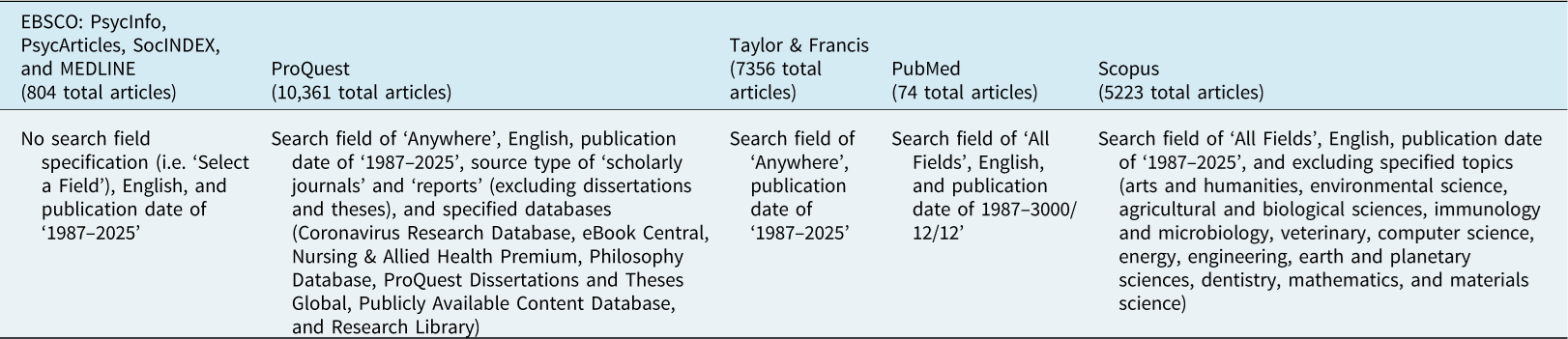
This meta-analysis included articles utilizing CBT to treat depression among individuals experiencing homelessness that were published from 1987 (the year in which the DSM-III-R was published) to August 2025. The search was originally conducted in 2022 and was updated systematically in August 2025. The literature searches were completed using the EBSCO (PsycInfo, PsycArticles, SocINDEX, and MEDLINE), ProQuest, Taylor & Francis, PubMed, and Scopus databases. The following search terms were used to run the literature search: ‘(depression or depressed or depressive) AND (homeless OR homelessness OR houseless OR street-involved) AND (cbt OR cognitive behavioral therapy OR cognitive behavioural therapy OR cognitive behavior therapy OR cognitive behaviour therapy OR cognitive behavioral treatment OR cognitive behavioural treatment OR cognitive behavior treatment OR cognitive behaviour treatment OR cognitive behavior OR cognitive behaviour)’. Of note, dissertations and theses were not included in the articles sourced from databases. Some filters were used for each search to limit the number of extraneous articles included in each output. These filters are outlined below in Table 1.
Database search term specifications

Table 1. Long description
A table comparing the number of articles from different databases using specific search fields and publication dates. The table has 2 rows and 5 columns. The columns are labeled EBSCO, ProQuest, Taylor & Francis, PubMed, and Scopus. The row labels are No search field specification and Search field of Anywhere. The values in the table are as follows: Row 1: EBSCO, 804 total articles; ProQuest, 10361 total articles; Taylor & Francis, 7356 total articles; PubMed, 74 total articles; Scopus, 5223 total articles. Row 2: EBSCO, Search field of Anywhere; ProQuest, Search field of Anywhere; Taylor & Francis, Search field of Anywhere; PubMed, Search field of All Fields; Scopus, Search field of All Fields.
Inclusion/exclusion criteria
Studies were included if they were published in English, included participants that were homeless at the time of intervention (either living in shelters or living outdoors), and utilized an experimental design. Included studies utilized depression as a dependent variable and a CBT intervention as an independent variable, either comparing depression scores pre- and post-intervention or comparing depression scores across control groups or interventions. Additionally, participant depression was measured with a validated measure, and all reported statistics were valid and capable of being consolidated into effect sizes. Finally, considering the vast changes in the diagnostic criteria for depressive disorders within the first three iterations of the DSM, all included articles were published after the publication of the DSM-III-R in 1987 (American Psychiatric Association, 1987).
Literature sort and statistical coding
The study followed the Preferred Reporting Items for Systematic Reviews and Meta-Analyses (PRISMA) recommendations for screening articles to be included in systematic reviews and meta-analyses (Page et al., Reference Page, McKenzie, Bossuyt, Boutron, Hoffmann, Mulrow, Shamseer, Tetzlaff, Akl, Brennan, Chou, Glanville, Grimshaw, Hróbjartsson, Lalu, Li, Loder, Mayo-Wilson and Moher2021). These guidelines are outlined in Figure 1.
PRISMA guidelines.

The initial search yielded 23,818 articles, and 703 duplicate articles were removed. All articles were sorted by the first author. The titles and abstracts of 23,115 articles were screened and resulted in 50 studies requiring further examination. Of these 50 studies, 41 were removed due to their not including all of the variables of interest or not using experimental methodologies (six of which were other systematic reviews/meta-analyses). This yielded a total of nine articles to be included in the study. The six systematic reviews/meta-analyses were reviewed and identified two additional articles (Guo et al., Reference Guo, Slesnick and Feng2014; McCay et al., Reference McCay, Carter, Aiello, Quesnel, Langley, Hwang, Beanlands, Cooper, Howes, Johansson, MacLaurin, Hughes and Karabanow2015) that met the current study’s inclusion criteria. Therefore, the total number of included articles was 11.
With these studies, using the Scopus database, forward and backward citation searches were conducted with each article by reviewing the cited references by the included articles in addition to those articles that cited each of them. This forward and backward citation search did not yield any additional articles to be included in the analysis. Thus, the final number of studies to be included in the analysis remained at 11.
All coding was conducted by the first author, and no artificial intelligence software was used. Articles were sorted into specific folders, with the first sort excluding articles based upon titles, the second sort doing so based upon abstracts, and the third based upon further analysis of each downloaded article. Of note, some articles included interventions that were not defined as CBT-based interventions. Upon identification of these articles, each of these interventions were researched individually, and it was determined whether they met criteria for a CBT-based therapy (i.e. whether they included both cognitive and behavioural elements and were based upon CBT theory). One article (McCay et al., Reference McCay, Carter, Aiello, Quesnel, Langley, Hwang, Beanlands, Cooper, Howes, Johansson, MacLaurin, Hughes and Karabanow2015) included two depression outcome measures, so two effect sizes were calculated from the reported statistics. Additionally, two studies included several CBT-umbrella therapies compared with a control, so multiple effect sizes were calculated from the reported statistics (Guo et al., Reference Guo, Slesnick and Feng2014; Slesnick and Prestopnik, Reference Slesnick and Prestopnik2009). Overall, a total of 14 effect sizes were calculated from the included 11 articles, with 13 of these effect sizes being calculated via independent group comparisons and one effect size being calculated via a repeated measures comparison due to independent groups statistics not being reported. The equation for a repeated measures comparison requires a correlation coefficient; however, no correlation coefficient was reported. Thus, an arbitrary correlation coefficient of 0.3 was utilized for this analysis based on Park (Reference Park2020)’s suggestions. Risk of bias for each included study was assessed using the Cochrane Risk of Bias (2.0) tool.
Moderating variables
Intervention setting
Individuals experiencing homelessness face barriers to accessing transportation to services, which clinicians can address in a variety of ways (Jones et al., Reference Jones, Zur and Rosenbaum2017; Wille et al., Reference Wille, Kemp, Greenfield and Walls2017). Fernandez and colleagues (2015) found that studies that took place in in-patient settings experienced less drop-out than those conducted in out-patient settings. Considering these effects, it was hypothesized that studies bringing the therapy to clients or providing transportation would result in stronger treatment effects than those that require participants to travel to clinicians without assistance. Intervention setting was coded as a dichotomous variable.
Format of therapy
The included articles utilized CBT interventions that ranged from individual therapy to group and family therapy with some studies including a mixture of each of these types of therapy. According to studies assessing the effectiveness of several methods of treatment delivery, there are no significant differences between individual therapy and group therapy, and not much research has compared family therapy with other forms of therapy (Brown et al., Reference Brown, Sellwood, Beecham, Slade, Andiappan, Landau and Smith2011; Craigie and Nathan, Reference Craigie and Nathan2009). However, it is possible that increased social support positively affects depression and the chronicity of homelessness (Gabrielian et al., Reference Gabrielian, Young, Greenberg and Bromley2018; Green et al., Reference Green, Tucker, Golinelli and Wenzel2013; La Gory et al., Reference La Gory, Ritchey and Mullis1990). With this, it was hypothesized that there would be significant differences between the different treatment delivery methodologies, such that the group-based, family-based, and mixed interventions would result in greater reductions in symptoms compared with the individual-based interventions. Format of therapy was coded categorically.
Number of intervention sessions
The CBT interventions included in this study varied greatly on how many sessions were included in the overall treatment. Cuijpers and colleagues (2014) found a significant relationship between the number of treatment sessions included in interventions and the overall effect size reported, where more treatment sessions (including more sessions offered per week) resulted in a larger effect. Another study found that increasing the number of sessions included in treatment reduced treatment drop-out (Fernandez et al., Reference Fernandez, Salem, Swift and Ramtahal2015). Based on these findings, it was hypothesized that the number of sessions included in treatment would moderate the overall treatment effect on participant depression scores such that more treatment sessions would result in a larger effect. Number of intervention sessions was coded continuously.
Participant age
One of the primary goals of this study was to generalize to a variety of age groups, as previous meta-analyses were age restricted. CBT has been found to be an effective treatment modality to treat depression (Jayasekara et al., Reference Jayasekara, Procter, Harrison, Skelton, Hampel, Draper and Deuter2015; Oud et al., Reference Oud, de Winter, Vermeulen-Smit, Bodden, Nauta, Stone, van den Heuvel, Taher, de Graaf, Kendall, Engels and Stikkelbroek2019). However, in one meta-analytic study, general psychotherapy services were found to have smaller effect sizes in children and adolescents compared with adults (Cuijpers et al., Reference Cuijpers, Karyotaki, Eckshtain, Ng, Corteselli, Noma and Weisz2020). Therefore, it was hypothesized that studies with participants under the age of 18 would yield smaller effect sizes than those with participants over the age of 18. Because some studies did not report the mean age of samples, this variable was measured by categorizing the ages of participants included in each study. As such, Participant age was coded categorically as opposed to continuously.
Publication year
Considering how diagnostic criteria for several depression diagnoses have changed over time and adjustment to what interventions are included under the CBT umbrella, the year of publication may affect the overall effects reported by each study. Thus, it was hypothesized that studies published more recently would yield significantly different effect sizes than those published several years ago, although no specific direction of this effect was hypothesized. Publication year was coded continuously.
Type of control
Although studies use different types of experimental controls to determine the efficacy of a treatment, the type of control that the intervention group is being compared with can affect the overall effect size (Bakker et al., Reference Bakker, Cai, English, Kaiser, Mesa and Van Dooren2019). In depression research in particular, it has been determined that waitlist control and no treatment comparison groups yield larger effect sizes (Michopoulos et al., Reference Michopoulos, Furukawa, Noma, Kishimoto, Onishi, Ostinelli, Ciharova, Miguel, Karyotaki and Cuijpers2021). Because of this, it was hypothesized that studies that utilized a waitlist control comparison group would result in larger effect sizes than those that compared the treatment intervention with TAU or other interventions. Type of control was coded categorically.
Gender (proportion female)
In reference to Gender (proportion female), many of the included studies contained samples that differed greatly based on gender, resulting in the question of whether participant gender may affect treatment effects. Several studies suggest that a participant’s gender does not affect treatment outcomes, both in reference to general psychotherapy and psychotherapy for individuals with depression (Parker et al., Reference Parker, Blanch and Crawford2011; Staczan et al., Reference Staczan, Schmuecker, Koehler, Berglar, Crameri, von Wyl, Koemeda-Lutz, Schulthess and Tschuschke2017). However, with individuals experiencing homelessness, it has been found that female participants experience greater post-treatment reductions in depression than male participants (Slesnick et al., Reference Slesnick, Guo and Feng2013; Slesnick et al., Reference Slesnick, Feng, Guo, Brakenhoff, Carmona, Murnan, Cash and McRee2016). Therefore, it was hypothesized that those studies with higher proportions of female participants would result in significantly larger effect sizes. Gender (proportion female) was coded continuously.
CBT subtype
As discussed previously, several types of therapy fall under the CBT umbrella. As such, a question as to whether any specific CBT-based therapy is more effective than others was considered. Because of the understanding that CBT-umbrella therapies are theoretically similar (i.e. including all of the same requisite components such as psychoeducation, behavioural activation, cognitive restructuring, and a focus on emotions) and findings showing that umbrella therapies such as general CBT and dialectical behavioral therapy (DBT) produce similar effect sizes in their treatment of depression in the general population, it was hypothesized that there would be no significant differences between the included CBT-umbrella therapies (Mor and Haran, Reference Mor and Haran2009; Sahranavard and Miri, Reference Sahranavard and Miri2018). CBT subtype was coded categorically.
Number of participants
Due to the varying sample sizes, the question of whether sample size would affect the strength of the effect sizes is considered. Because of the inclusion of sample size in the calculation for effect size, it has been found that smaller sample sizes yield significantly larger effect sizes than larger samples (Bakker et al., Reference Bakker, Cai, English, Kaiser, Mesa and Van Dooren2019; Cheung and Slavin, Reference Cheung and Slavin2016). Based on this knowledge, it was hypothesized that studies with smaller total sample sizes would result in larger effect sizes. Number of participants was coded continuously.
Statistical data analysis
To address the research question, effect sizes were calculated using the Hedges’ g statistic (Hedges’ g = (M 1 – M 2)/SD pooled; Hedges and Olkin, Reference Hedges and Olkin2014) and data from each article were converted to this statistic. The Cochrane Risk of Bais tool was used to assess the risk of bias of each included study, with each study being assessed separately according to the various criteria included in the tool. Hedges’ g was used as opposed to Cohen’s d, because Hedges’ g utilizes a pooled and weighted standard deviation to account for small sample sizes which was of necessity for the current study (Hedges and Olkin, Reference Hedges and Olkin2014). Cohen’s recommendations of interpreting an effect size were used, with 0.2, 0.5, and 0.8 to be small, medium, and large effects, respectively (Cohen, Reference Cohen2013). A random effects model was used to pool the effect sizes due to the included studies being independent from one another and, therefore, not equivalent to support the goal of generalizing results to a larger proportion of the population. Publication bias was assessed through the use of funnel plots (using Duval and Tweedie’s (Reference Duval and Tweedie2000) trim-and-fill analysis to account for asymmetry), Egger’s regression, and two fail-safe N analyses (Rosenthal’s fail-safe N and Orwin’s fail-safe N) to assess for the presence of publication bias (Duval and Tweedie, Reference Duval and Tweedie2000; Egger et al., Reference Egger, Smith, Schneider and Minder1997; Orwin, Reference Orwin1983; Rosenthal, Reference Rosenthal1979).
Finally, a homogeneity analysis was conducted, in which the variability of the overall effect was determined. To determine homogeneity, an I 2 analysis (I 2 = 100%×(Q − df)/Q) was conducted to determine if the data included in the meta-analysis were consistent, with a significant I 2 statistic suggesting that a significant amount of variation exists within the overall effect, suggesting that a meta-regression/meta-ANOVA can be conducted (Higgins et al., Reference Higgins, Thompson, Deeks and Altman2003). An I 2 analysis was conducted in addition to Cochran’s Q analysis due to the Q statistic’s lack of efficacy in detecting homogeneity in meta-analyses with lower power (Higgins et al., Reference Higgins, Thompson, Deeks and Altman2003). However, inclusion of at least 10 studies is typically recommended for meta-regression (Higgins et al., Reference Higgins, Thomas, Chandler, Cumpston, Li, Page and Welch2019). All analyses were conducted using the R software for meta-analysis (R Core Team, 2020).
Results
Studies included
Several studies were identified and included in the meta-analysis. The first of the included studies evaluated a manualized CBT intervention for youth experiencing homelessness in Mexico City, finding that those participants in the intervention condition had significantly lower Beck Depression Inventory (BDI) depression scores than those in the waitlist control condition (Shein-Szydlo et al., 2016). In another study conducted by Hyun and colleagues (Reference Hyun, Chung and Lee2005), male runaway youth in South Korea were assigned to either a control condition or CBT condition, and only those in the treatment condition had a significant decrease in BDI depression scores. Additionally, another study evaluated a 12-week, manualized DBT intervention on Canadian youth experiencing homelessness and found significant differences between the pre- and post-intervention BDI depression scores for the DBT group but not for the waitlist control group (McCay et al., Reference McCay, Carter, Aiello, Quesnel, Langley, Hwang, Beanlands, Cooper, Howes, Johansson, MacLaurin, Hughes and Karabanow2015).
Furthermore, in a study involving adolescent girls experiencing homelessness in Mexico City, an 8-week CBT intervention was evaluated in comparison with a control TAU group, finding that the CBT intervention was significantly more effective (Castaños-Cervantes, Reference Castaños-Cervantes2019). Additionally, cited by two of the three previously discussed systematic reviews/meta-analyses (i.e. Altena et al., Reference Altena, Brilleslijper-Kater and Wolf2010; Noh, Reference Noh2018), another study compared the CBT-based CRA intervention with TAU for youth experiencing homelessness and found that youth of all ages assigned to the CRA intervention experienced a significant decrease in their symptoms of depression, but that TAU only yielded significant results in younger participants (Slesnick et al., Reference Slesnick, Prestopnik, Meyers and Glassman2007). In another study conducted by the same primary author, CBT was compared with TAU, finding that the CBT-based intervention resulted in significant reductions in depression scores (Slesnick and Prestopnik, Reference Slesnick and Prestopnik2005). Finally, in a third study conducted by the same authors, two different CBT-based therapies (ecologically based family therapy and functional family therapy) were compared with TAU, with TAU yielding lower post-treatment depression scores than both CBT interventions (Slesnick and Prestopnik, Reference Slesnick and Prestopnik2009).
While the previously cited studies compared CBT interventions with TAU or no treatment, the following studies compared CBT and non-CBT interventions. Himle and colleagues (2014) found that a CBT plus vocational therapy intervention outperformed a vocational services-only intervention for reducing depressive symptoms. Additionally, Slesnick and colleagues (2015) found significantly reduced depressive symptoms across all conditions, including the control condition of case management. In another study, two CBT-based interventions and a control intervention of motivational enhancement therapy all yielded similar positive results (Guo et al., Reference Guo, Slesnick and Feng2014). Finally, Garland and colleagues (Reference Garland, Roberts-Lewis, Tronnier, Graves and Kelley2016) found that a 10-week, manualized CBT intervention yielded similar results when compared with TAU and a mindfulness intervention.
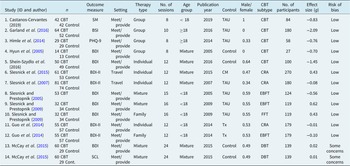
In summary, of the 11 studies reported, CBT was evaluated as a superior intervention to other control interventions or waitlist control conditions in seven studies, equivalent to control conditions in three studies, and worse than control in one study. See Table 2 for a summary of all included studies.
Effect sizes and moderating variables across studies

Table 2. Long description
A table summarizing studies on the effectiveness of CBT interventions across various settings and age groups. The table has 14 rows and 12 columns. Column headers are Study (ID and author), n, Outcome measure, Setting, Therapy type, No. of sessions, Age group, Publication year, Male/female, CBT subtype, No. of participants, Effect size (g), and Risk of bias. Row 1: Study (ID and author), Castanos-Cervantes (2019); n, 42 CBT, 42 Control; Outcome measure, SM; Setting, Meet/provide; Therapy type, Group; No. of sessions, 8; Age group, < 18; Publication year, 2019; Male/female, TAU; CBT subtype, 1; No. of participants, 84; Effect size (g), -0.83; Risk of bias, Low. Row 2: Study (ID and author), Garland et al. (2016); n, 64 CBT, 52 Control; Outcome measure, BSI; Setting, Meet/provide; Therapy type, Group; No. of sessions, 10; Age group, ≥18; Publication year, 2016; Male/female, TAU; CBT subtype, 0; No. of participants, 180; Effect size (g), -2.09; Risk of bias, Low. Row 3: Study (ID and author), Himle et al. (2014); n, 29 CBT, 29 Control; Outcome measure, PHQ-9; Setting, Meet/provide; Therapy type, Group; No. of sessions, 8; Age group, ≥18; Publication year, 2014; Male/female, TAU; CBT subtype, 0.33; No. of participants, 58; Effect size (g), -0.76; Risk of bias, Low. Row 4: Study (ID and author), Hyun et al. (2005); n, 14 CBT, 13 Control; Outcome measure, BDI; Setting, Meet/provide; Therapy type, Group; No. of sessions, 8; Age group, Mixture; Publication year, 2005; Male/female, Control; CBT subtype, 0; No. of participants, 27; Effect size (g), -0.70; Risk of bias, Low. Row 5: Study (ID and author), Shein-Szyldo et al. (2016); n, 50 CBT, 49 Control; Outcome measure, BDI; Setting, Meet/provide; Therapy type, Individual; No. of sessions, 12; Age group, Mixture; Publication year, 2016; Male/female, Control; CBT subtype, 0.64; No. of participants, 100; Effect size (g), -1.45; Risk of bias, Low. Row 6: Study (ID and author), Slesnick et al. (2015); n, 61 CBT, 53 Control; Outcome measure, BDI-II; Setting, Travel; Therapy type, Individual; No. of sessions, 12; Age group, Mixture; Publication year, 2015; Male/female, CM; CBT subtype, 0.47; No. of participants, 270; Effect size (g), 0.43; Risk of bias, Low. Row 7: Study (ID and author), Slesnick et al. (2007); n, 81 CBT, 74 Control; Outcome measure, BDI-II; Setting, Travel; Therapy type, Individual; No. of sessions, 12; Age group, Mixture; Publication year, 2007; Male/female, TAU; CBT subtype, 0.34; No. of participants, 180; Effect size (g), -0.08; Risk of bias, Low. Row 8: Study (ID and author), Slesnick and Prestopnik (2005); n, 53 CBT, BDI; Setting, Meet/provide; Therapy type, Mixture; No. of sessions, 15; Age group, <18; Publication year, 2005; Male/female, TAU; CBT subtype, 0.59; No. of participants, 124; Effect size (g), -0.56; Risk of bias, Low. Row 9: Study (ID and author), Slesnick and Prestopnik (2009); n, 32 CBT, 34 Control; Outcome measure, BDI; Setting, Meet/provide; Therapy type, Mixture; No. of sessions, 16; Age group, <18; Publication year, 2009; Male/female, TAU; CBT subtype, 0.55; No. of participants, 119; Effect size (g), 0.62; Risk of bias, Low. Row 10: Study (ID and author), Slesnick and Prestopnik (2009); n, 32 CBT, 34 Control; Outcome measure, BDI; Setting, Meet/provide; Therapy type, Family; No. of sessions, 16; Age group, <18; Publication year, 2009; Male/female, TAU; CBT subtype, 0.55; No. of participants, 119; Effect size (g), 0.43; Risk of bias, Low. Row 11: Study (ID and author), Guo et al. (2014); n, 55 CBT, 57 Control; Outcome measure, BDI-II; Setting, Meet/provide; Therapy type, Individual; No. of sessions, 12; Age group, <18; Publication year, 2014; Male/female, Tx; CBT subtype, 0.53; No. of participants, 179; Effect size (g), -0.01; Risk of bias, Low. Row 12: Study (ID and author), Guo et al. (2014); n, 55 CBT, 57 Control; Outcome measure, BDI-II; Setting, Meet/provide; Therapy type, Family; No. of sessions, 12; Age group, <18; Publication year, 2014; Male/female, Tx; CBT subtype, 0.53; No. of participants, 179; Effect size (g), -0.10; Risk of bias, Low. Row 13: Study (ID and author), McCay et al. (2015); n, 60 CBT, 29 Control; Outcome measure, BDI; Setting, Meet/provide; Therapy type, Mixture; No. of sessions, 24; Age group, Mixture; Publication year, 2015; Male/female, Control; CBT subtype, 0.49; No. of participants, 139; Effect size (g), 0.02; Risk of bias, Some. Row 14: Study (ID and author), McCay et al. (2015); n, 60 CBT, 29 Control; Outcome measure, SCL; Setting, Meet/provide; Therapy type, Mixture; No. of sessions, 24; Age group, Mixture; Publication year, 2015; Male/female, Control; CBT subtype, 0.49; No. of participants, 139; Effect size (g), 0.01; Risk of bias, Some.
Three studies (Slesnick and Prestopnik, Reference Slesnick and Prestopnik2009; Guo et al., Reference Guo, Slesnick and Feng2014; and McCay et al., Reference McCay, Carter, Aiello, Quesnel, Langley, Hwang, Beanlands, Cooper, Howes, Johansson, MacLaurin, Hughes and Karabanow2015) had two effect sizes pulled and are each listed twice; BDI denotes Beck Depression Inventory (Beck et al., Reference Beck, Ward, Mendelson, Mock and Erbauch1961; Beck et al., Reference Beck, Steer and Brown1996); SCL denotes the Symptom Checklist (Derogatis et al., Reference Derogatis, Lipman and Covi1973); PHQ-9 denotes the Patient Health Questionnaire-9 (Kroenke et al., Reference Kroenke, Spitzer and Williams1999); CBT denotes cognitive behavioural therapy; Tx denotes a comparison with a different therapy; TAU denotes treatment as usual; CM demotes case management; CRA denotes community reinforcement approach; EBFT denotes ecologically based family therapy; FFT denotes functional family therapy; DBT denotes dialectical behavioural therapy; SM denotes self-made measure; each of these articles is presented with an asterisk (*) in the References section.
Meta-analysis
The treatment effect size for CBT’s treatment of depression in individuals experiencing homelessness with 14 effect sizes is g = −0.36, p = .079 with a 95% confidence interval of [−0.75, 0.04] (see Table 3). The result supports that the negative and small effect of CBT interventions in treating depression in individuals experiencing homelessness is not statistically significant. According to the Q-statistic and the I 2 statistic, the total variance (Q = 144.43) is significantly (p < .0001) larger than the sampling variance (d.f. = 13) and the proportion of between-variance out of total variance is 91.88%, suggesting that there is significant heterogeneity among effect sizes. See Fig. 2 for a visual representation of each study’s effect size. Those studies with negative reported effect sizes yielded reductions in depression scores, and those with positive effect sizes yielded increases in depression scores.
Pooled effect size (random effects model)

Table 3. Long description
A table summarizing the effect size of CBT treatments for depression in homeless individuals. The table has 2 rows and 8 columns. Column headers are Estimate, SE, z-value, p-value, 95% CI-L, 95% CI-U, Q-statistic (d.f.), and I2. Row 1: Estimate, -0.356; SE, 0.203; z-value, -1.758; p-value, 0.079; 95% CI-L, -0.753; 95% CI-U, 0.041; Q-statistic (d.f.), 144.433 (13); I2, 91.88%.
SE, standard error; 95% CI-L, lower end of 95% confidence interval; 95% CI-U, upper end of 95% confidence interval.
Forest plot.

Meta-regression/meta-ANOVA analyses
Intervention setting
The pooled effect size for meeting participants, providing transportation, or providing transportation compensation is −0.45 (SE = 0.23, p < .05), whereas the pooled effect size for traveling to therapy is 0.17 (SE = 0.25, p = .507). The difference between the two types of intervention settings is statistically significant (Qb = 16.87, p < .05), which suggests that meeting participants, providing transportation, or providing transportation compensation is significantly more effective than requiring that participants travel to therapy (see Table 4).
Meta ANOVA results

Table 4. Long description
A table with 14 rows and 7 columns comparing different intervention settings, formats of therapy, participant age groups, types of control, and CBT subtypes. The columns are labeled Estimate, SE, p-value, Q-statistic, T^2, and n. The table provides data on the effectiveness of various intervention settings and therapies, including estimates, standard errors, p-values, Q-statistics, T^2 values, and sample sizes. Notable trends include significant p-values for certain intervention settings and therapy formats, indicating their effectiveness. The table also includes data on participant age groups, types of control, and specific CBT subtypes, with varying estimates and p-values.
Standard error is abbreviated as SE; n denotes the number of effect sizes included; TAU denotes treatment as usual; CBT denotes cognitive behavioural therapy; CRA denotes community reinforcement approach; EBFT denotes ecologically based family therapy; FFT denotes functional family therapy; DBT denotes dialectical behavioral therapy.
Format of therapy
The pooled effect size for individual therapy is −0.27 (SE = 0.40, p = .504), the pooled effect size for group therapy is −1.12 (SE = 0.34, p < .01), the pooled effect size for family therapy is 0.14 (SE = 0.27, p = .600), and the pooled effect size for a mixture of therapies is 0.002 (SE = 0.24, p = .992). The difference between the four types of therapy is statistically significant (Qb = 60.29, p < .05), which suggests that group therapy is significantly more effective than individual therapy, family therapy, and a mixture of therapies (see Table 4).
Participant age group
The pooled effect size for participants under 18 years is −0.09 (SE = 0.22, p = .691), the pooled effect size for participants over 18 years is −1.43 (SE = 0.66, p < .05), and the pooled effect size for participants of mixed ages is −0.28 (SE = 0.28, p = .321). The difference between the three age groups is statistically significant (Qb = 100.12, p < .05), which suggests that the intervention was significantly more effective for individuals over the age of 18 (see Table 4).
Type of control
The pooled effect size for TAU is −0.47 (SE = 0.34, p = .174), the pooled effect size for control/waitlist control is −0.52 (SE = 0.36, p = .150), the pooled effect size for case management control is 0.43 (SE = 0.19, p < .05), and the pooled effect size for another therapy control is −0.06 (SE = 0.13, p = .667). The difference between the four types of control is statistically significant (Qb = 24.35, p < .05), which suggests that case management control comparisons result in smaller treatment effects than TAU, control/waitlist control, and another format of therapy (see Table 4).
CBT subtype
The pooled effect size for CBT is −1.19 (SE = 0.27, p < .0001), the pooled effect size for DBT is 0.02 (SE = 0.16, p = .924), the pooled effect size for CRA is 0.11 (SE = 0.16, p = .499), the pooled effect size for EBFT is −0.03 (SE = 0.34, p = .921), and the pooled effect size for FFT is 0.43 (SE = 0.25, p = .081). The difference between the five types of therapy is statistically significant (Qb = 102.15, p < .05), which suggests that CBT is significantly more effective than DBT, CRA, EBFT, and FFT (see Table 4).
Other moderator analyses
The effect sizes for the following moderating variables were not significant: number of intervention sessions, publication year, gender (proportion female), and number of participants.
Publication bias
According to the results of the forest plot ordered by sampling variance (see Fig. 3), the effect sizes that have smaller weights tend to be larger than the effect sizes that have larger weights; however, this is inconsistent. To check for publication bias, a funnel plot analysis, trim and fill analysis, fail-safe N analysis, and Egger’s regression analysis was conducted.
Forest plot ordered by weights.

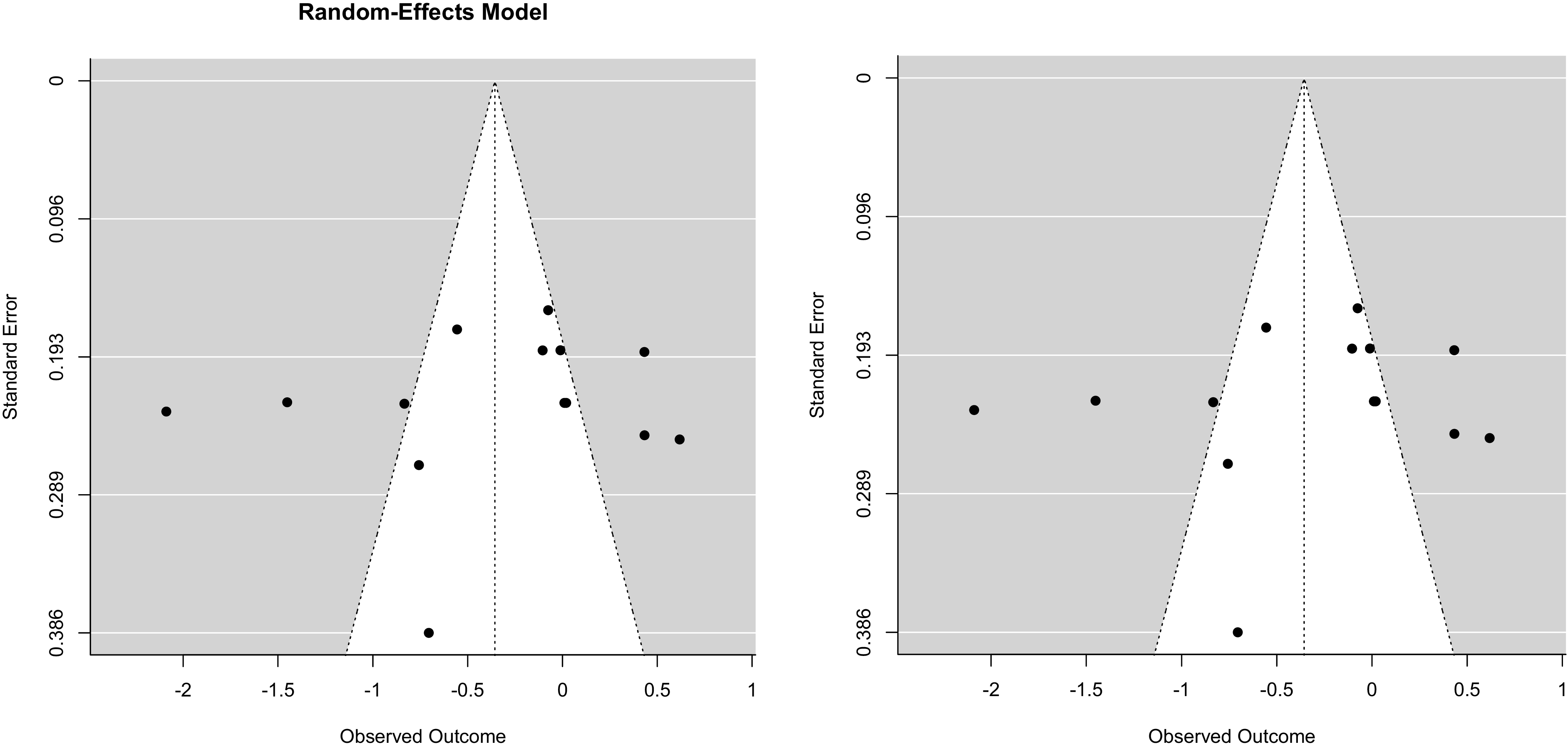
Referencing Fig. 4, the funnel plot indicates that no effect sizes are missing. Also, the trim-and-fill analysis shows that no effect sizes need to be imputed to make the funnel plot symmetrical.
Funnel plots with both unadjusted mean effect size (left) and adjusted mean effect size (right).

Additionally, Rosenthal’s fail-safe N (which was calculated with a target effect size of 0) was 157, and Orwin’s fail-safe N (which was calculated with a target effect size of 0.2) was 12. The cut-off for both fail-safe N analyses is 80 (5×14 + 10). With this, Rosenthal’s fail-safe N indicates there is little possibility of publication bias and Orwin’s fail-safe N indicates there is some possibility of publication bias. The use of 0 versus 0.2 being used as a target effect size for each fail-safe N analysis may explain the difference in the calculated metrics. Finally, the Egger’s regression analysis shows that the coefficient of sampling error (b = −2.49, SE = 3.90, p = .535) is not significant, suggesting that there is no presence of publication bias.
Discussion
The study aimed to determine the size of the treatment effect of CBT-based interventions in the treatment of depression in individuals experiencing homelessness. The meta-analysis consolidated a total of 14 effect sizes from 11 studies and found a small, statistically non-significant effect size (g = −0.36), which does not support the initial hypothesis. Although no significant results were found for the overall effect size, 10 of the included studies had significant within-group changes, suggesting that CBT was effective in reducing depressive symptoms in individuals experiencing homelessness (i.e. Castaños-Cervantes, Reference Castaños-Cervantes2019; Garland et al., Reference Garland, Roberts-Lewis, Tronnier, Graves and Kelley2016; Guo et al., Reference Guo, Slesnick and Feng2014; Himle et al., Reference Himle, Bybee, Steinberger, Laviolette, Weaver, Vlnka, Golenberg, Levine, Heimberg and O’Donnell2014; Hyun et al., Reference Hyun, Chung and Lee2005; McCay et al., Reference McCay, Carter, Aiello, Quesnel, Langley, Hwang, Beanlands, Cooper, Howes, Johansson, MacLaurin, Hughes and Karabanow2015; Shein-Szydlo et al., 2016; Slesnick et al., Reference Slesnick, Guo, Brakenhoff and Bantchevska2015; Slesnick and Prestopnik, Reference Slesnick and Prestopnik2005; Slesnick et al., Reference Slesnick, Prestopnik, Meyers and Glassman2007). This was the case even for two studies that yielded positive independent groups effect sizes, suggesting that the intervention was less effective than the control (McCay et al., Reference McCay, Carter, Aiello, Quesnel, Langley, Hwang, Beanlands, Cooper, Howes, Johansson, MacLaurin, Hughes and Karabanow2015; Slesnick et al., Reference Slesnick, Guo, Brakenhoff and Bantchevska2015). This further corroborates the necessity for subgroup analyses conducted via meta-regression/meta-ANOVA to further understand how the high degree of heterogeneity between studies may have affected the overall pooled effect.
When comparing this non-significant result of the current study to other meta-analyses of CBT in its treatment of depression in the general population, there is a vast discrepancy. That is, those studies conducted in the general population yield significant, large effect sizes when comparing the CBT interventions with controls (Cuijpers et al., Reference Cuijpers, Berking, Andersson, Quigley, Kleiboer and Dobson2013; Li et al., Reference Li, Zhang, Su, Liu, Gong, Peng and Jiang2018; Watts et al., Reference Watts, Turnell, Kladnitski, Newby and Andrews2015). These analyses often included substantially more studies and participants. The study’s results better align with Hyun and colleagues’ Reference Hyun, Bae and Noh2020 findings, in which the authors reported non-significant, small effect sizes for both depression and anxiety (Hyun et al., Reference Hyun, Bae and Noh2020). It is unclear if this discrepancy is related to statistical power, moderating variables, or other factors, and more research is suggested to better understand the discrepancy between this study’s findings and that of previous literature.
A further limitation of the current study is related to the high degree of heterogeneity that existed among effect sizes, suggesting that the initial non-significant finding may be more complex than it appears. In an attempt to better understand this heterogeneity, meta-regression/meta-ANOVA analyses were completed to identify potential variables that could explain this degree of heterogeneity. Of particular importance is the variable of CBT subtype, in which various CBT-umbrella therapies were compared, and a general CBT intervention was found to be the only effective treatment. This suggests that the assumption that CBT-umbrella therapies are the same may be flawed and that general CBT is a superior therapy for depression in homeless populations. For example, although the overall pooled effect size (g = −0.36) is not significant, the effect size becomes significant (g = −1.192) when analyzing the effect size for traditional CBT alone. No other CBT subtype resulted in similar effect sizes (see Table 4). While statistical power may play a role in this effect as the traditional CBT subtype included five studies, it is noted that the only other CBT-umbrella therapy approaching significance (i.e. FFT) was only evaluated in one study. As such, it is recommended that future studies continue to examine if CBT-umbrella therapies are fundamentally similar to each other when pooling effects.
In addition to these results, the study found that the following moderating variables yielded statistically significant results: intervention setting (favouring meeting participants or providing transportation), format of therapy (favouring group therapy), participant age group (favouring clients 18 years of age and older), type of control (favouring case management control groups), and CBT subtype (favouring traditional CBT, as was discussed previously). These results assert that although the overall pooled effect size was not statistically significant, the reported effect sizes become statistically significant when various study characteristics are adjusted. In reference to the intervention setting, format of therapy, participant age group, and type of control moderating variables, results aligned well with the hypotheses and the literature upon which they were made.
The current study’s results can inform both our theoretical understanding of CBT’s treatment of depression in individuals experiencing homelessness and our clinical understanding of how to best accommodate this population. Such significant moderators as the type of control group being used suggest that those studies that compare treatments with case management control conditions can expect to find smaller treatment effects, which aligns with the previous research that asserts that non-waitlist control comparisons yield larger effects than do other controls (Michopoulos et al., Reference Michopoulos, Furukawa, Noma, Kishimoto, Onishi, Ostinelli, Ciharova, Miguel, Karyotaki and Cuijpers2021). Additionally, the presence of several non-significant moderators related to methodology suggest that a study’s chosen methods may not necessarily affect the overall effect.
In reference to the clinical implications of these findings, such significant moderators as intervention setting, format of therapy, participant age group, and CBT subtype can all inform clinicians of the ways in which they can enhance CBT’s effectiveness in treating depression in individuals experiencing homelessness. For example, understanding that meeting participants or providing transportation to services may increase treatment effects can make clearer the importance of transportation and access to services within this population. With this information, more programs can be created with the ultimate goal of not only providing services to this population but also providing the necessary transportation services to make therapy more accessible.
In addition to the clinical and theoretical implications that the significant moderating variables result in, even those variables that did not provide significant results (e.g. number of intervention sessions, publication year, gender, and number of participants) provide further understanding of the effect of CBT on depression in homeless populations. For example, understanding that the number of sessions provided does not significantly correlate to stronger treatment effects further supports the short-term effectiveness of CBT for this population, making these interventions even more accessible and cost-effective. Additionally, understanding that the relationship between gender and effectiveness of treatment suggests that CBT may be an appropriate intervention across gender. Finally, significant methodological moderators such as publication year and number of participants suggest that although our understanding and treatment of depression has changed over the years, CBT has remained an effective treatment over time and that the sample sizes offered by many studies are sufficient to understand treatment effects. It is possible that subsequent meta-analyses/meta-regressions may help to determine whether sample size/statistical power impacts results for this population due to the inclusion of further studies.
Limitations
The present study displayed various strengths and limitations related to the methodology. An initial limitation was the study’s reliance on previous studies’ methodological decisions, which was especially relevant when identifying moderating variables. Because of this, future studies may consider including more demographic variables in their analyses, so that these studies can establish a better understanding of the generalizability of results and potential demographic variables that may modify treatment effects. Additionally, future studies should work to assess for and report the presence of co-morbidities that may exist in addition to depressive disorders, as these disorders may affect treatment effects. Another example of the current study’s reliance on previous studies’ methodological decisions can be found in the necessity of utilizing independent groups versus repeated measures analyses depending upon what statistics were reported in each study. This ultimately resulted in one study being analyzed using a repeated measures statistic and required an arbitrary correlation coefficient for the effect size analysis due to there being no reported coefficient in the published article. As was mentioned previously, several studies with significant within-groups changes did not yield significant between-groups differences, suggesting that repeated measures analyses may have yielded different, possibly significant, results (Castaños-Cervantes, Reference Castaños-Cervantes2019; Garland et al., Reference Garland, Roberts-Lewis, Tronnier, Graves and Kelley2016; Guo et al., Reference Guo, Slesnick and Feng2014; Himle et al., Reference Himle, Bybee, Steinberger, Laviolette, Weaver, Vlnka, Golenberg, Levine, Heimberg and O’Donnell2014; Hyun et al., Reference Hyun, Chung and Lee2005; McCay et al., Reference McCay, Carter, Aiello, Quesnel, Langley, Hwang, Beanlands, Cooper, Howes, Johansson, MacLaurin, Hughes and Karabanow2015; Shein-Szydlo et al., Reference Shein-Szydlo, Sukhodolsky, Kon, Tejeda, Ramirez and Ruchkin2016; Slesnick et al., Reference Slesnick, Prestopnik, Meyers and Glassman2007; Slesnick et al., Reference Slesnick, Guo, Brakenhoff and Bantchevska2015; Slesnick and Prestopnik, Reference Slesnick and Prestopnik2005). It is also important to note that several studies utilized an older version of the BDI instead of the more recently updated BDI-II (Hyun et al., Reference Hyun, Chung and Lee2005; Shein-Szydlo et al., Reference Shein-Szydlo, Sukhodolsky, Kon, Tejeda, Ramirez and Ruchkin2016; Slesnick and Prestopnik, Reference Slesnick and Prestopnik2005; Slesnick and Prestopnik, Reference Slesnick and Prestopnik2009). Finally, several of the moderator analyses utilized unbalanced groups, which may have resulted in low power and therefore biased statistical findings. Examples of these moderators include CBT subtype, Intervention setting, and Participant age group. Additionally, although the current study included more than 10 studies, the large number of variables included in the meta-regression/meta-ANOVA analyses resulted in some analyses consisting of few articles, which resulted in under-powered statistics for regression analyses. In choosing to further analyze these effects via meta-regression/meta-ANOVA, the lack of power can become compounded, further confounding the results of the subgroup analyses. This could suggest that non-significant results are not truly non-significant and that future studies may choose to address this concern by individually analyzing each study included in the meta-analysis or utilizing statistical power as an inclusion/exclusion criterion. It is possible that more rigorous searching procedures (such as procedures that adopt artificial intelligence and do not rely on hand-coding articles) would identify more studies and reduce the potential for human error. These methodological changes may result in more opportunity for meta-regression analyses that are not under-powered, which may function as a limitation of the current study.
Regarding the strengths of this study, this is the first meta-analysis that incorporated meta-regression/meta-ANOVA analysis to focus solely on CBT interventions in the treatment of depression in individuals experiencing homelessness. The inclusion of 11 studies (14 effect sizes) allows for increased generalizability of findings and an increased understanding of the treatment effect of CBT. In reference to the increased generalizability, the included studies utilized diverse samples across age group, gender, nationality, and race/ethnicity (Castaños-Cervantes, Reference Castaños-Cervantes2019; Garland et al., Reference Garland, Roberts-Lewis, Tronnier, Graves and Kelley2016; Guo et al., Reference Guo, Slesnick and Feng2014; Himle et al., Reference Himle, Bybee, Steinberger, Laviolette, Weaver, Vlnka, Golenberg, Levine, Heimberg and O’Donnell2014; Hyun et al., Reference Hyun, Chung and Lee2005; McCay et al., Reference McCay, Carter, Aiello, Quesnel, Langley, Hwang, Beanlands, Cooper, Howes, Johansson, MacLaurin, Hughes and Karabanow2015; Shein-Szydlo et al., Reference Shein-Szydlo, Sukhodolsky, Kon, Tejeda, Ramirez and Ruchkin2016; Slesnick et al., Reference Slesnick, Prestopnik, Meyers and Glassman2007; Slesnick et al., Reference Slesnick, Guo, Brakenhoff and Bantchevska2015; Slesnick and Prestopnik, Reference Slesnick and Prestopnik2005; Slesnick and Prestopnik, Reference Slesnick and Prestopnik2009). Although this increases generalizability, it can make interpretation of results difficult, as this disparity could result in confounding variables. The inclusion of meta-regression/meta-ANOVA methodology assisted with determining which variables moderate the treatment effect of CBT in treating depression in individuals experiencing homelessness. Because of this, the study can make suggestions for what future research can be conducted when working with these particular variables and how interventions should be catered to better meet the needs of this population. Finally, although several limitations in conducting the study existed, uncovering these limitations can help to uncover important gaps that exist in the current literature base.
Conclusions
Overall, although the current study did not find a statistically significant effect size, significant moderator analyses found that when clinicians and researchers help clients get to therapy, provide options for group therapy as opposed to other formats of therapy, focus on clients over the age of 18, and focus on broad-term CBT as opposed to CBT-umbrella therapies, and use specific comparison groups, CBT may be an effective treatment for depression in individuals experiencing homelessness. This suggests that the mental health needs of the homeless population are more nuanced than can be addressed by merely providing them with access to evidence-based treatments. As such, this population may require adjustments to be made to how therapy is delivered to experience improved benefits.
Key practice points
-
(1) Cognitive behavioural therapy needs to be adjusted to meet the specific needs of homeless populations for it to be effective.
-
(2) Cognitive behavioural therapists should consider using group interventions as opposed to individual- and family-oriented interventions.
-
(3) Cognitive behavioural therapy may be more effective for adults as opposed to those under the age of 18. Thus, whether cognitive behavioural approaches should be adjusted to meet the needs of children and adolescents, or other approaches may be considered.
Data availability statement
All data were extracted from published, peer-reviewed articles. The data supporting the findings of this study are available within the article. Raw data and coding/statistical outputs are available from the corresponding author upon request.
Acknowledgements
Ryan Sharma, PsyD, ABPP contributed to the original doctoral dissertation on which this manuscript was based.
Author contributions
Maia Godliman: Conceptualization (lead), Formal analysis (lead), Methodology (lead), Writing - original draft (lead); Stephanie Tarle: Conceptualization (supporting), Investigation (supporting), Methodology (supporting), Writing - original draft (supporting), Writing - review & editing (supporting); SunYoung Park: Formal analysis (supporting), Methodology (supporting), Supervision (supporting).
Financial support
This research received no specific grant from any funding agency, commercial, or not-for-profit sectors.
Competing interests
The authors declare none.
Ethical standards
This research conformed to all ethical requirements for research as outlined by the Declaration of Helsinki and did not directly include human subjects.





 Open access


Comments
No Comments have been published for this article.