Introduction
Parasitic nematodes (phylum Nematoda) comprise a highly diverse assemblage with an equally wide and remarkable range of life cycles and transmission strategies (Anderson, Reference Anderson2000; Blaxter & Koutsovoulos, Reference Blaxter and Koutsovoulos2015; Morand et al., Reference Morand, Nadler, Skorping, Krasnov, Littlewood and Morand2015). Despite the high profile of nematodes as macroparasites of veterinary and medical importance (Farrar et al., Reference Farrar, Hotez, Junghanss, Kang, Lalloo and White2013; Taylor et al., Reference Taylor, Coop and Wall2016), our current knowledge on the biology and transmission of the vast majority of nematodes remains sparse. Filarial nematodes of the family Onchocercidae (Filarioidea) are particularly notable for their specialized transmission, free from the food chain and mediated by haematophagous arthropod vectors – for example, tick, mite, lice, flea, mosquitos and flies (Anderson, Reference Anderson2000). While the biology of some species is well known, there is little information on the majority of onchocercids.
The onchocercid genus Oswaldofilaria currently includes 15 species parasitic in lizards and crocodiles (Pereira et al., Reference Pereira, Souza Lima and Bain2010; Bursey et al., Reference Bursey, Goldberg and Grismer2015). The life cycles of five species have been investigated experimentally, suggesting that the principal vectors are culicid mosquitoes (Diptera: Cullicidae) (Makerras, Reference Makerras1953; Prod'hon & Bain, Reference Prod'hon and Bain1972; Bain & Chabaud, Reference Bain and Chabaud1975). However, knowledge of their biology and transmission in nature remains unclear.
During a parasitological study of the lizard Tropidurus torquatus, in a rocky outcrop area of Minas Gerais, Brazil, specimens of the onchocercid nematode Oswaldofilaria chabaudi and of the chigger mite Eutrombicula alfreddugesi were found co-occurring in these lizards. Further examination of the mites revealed the presence of larval nematodes in them. These larvae are described here, and the biological significance of this finding is discussed.
Materials and methods
During a parasitological study of the lizard T. torquatus, carried out from 2005 to 2007 in a rocky outcrop (21°48′27.5″S, 43°35′31.7″W) of the State of Minas Gerais, Brazil, a high abundance of infestation by mites was observed. The lizards were also infected by the filarial nematode O. chabaudi. To investigate a potential connection between mite infestations and nematode infections, 30 adult host lizards (15 males and 15 females) infested by mites were brought back alive to the laboratory, where the ectoparasites were removed under a stereomicroscope, using a fine needle. The lizards were subsequently euthanized with sodium pentobarbital and analysed for the presence of O. chabaudi (see Pereira et al., Reference Pereira, Souza Lima and Bain2010 for methodological details). Mite and nematode specimens were cleared and mounted in lactophenol, studied using a light microscope and identified using the taxonomic literature (Wharton & Fuller, Reference Wharton and Fuller1952; Brennan & Goff, Reference Brennan and Goff1977; Anderson et al., Reference Anderson, Chabaud and Willmott2009; Pereira et al., Reference Pereira, Souza Lima and Bain2010). To search for nematode larvae in mites, groups of up to 15 mites were soaked in a generous drop of lactophenol, placed on a glass slide and gently squashed with the help of a coverslip. Each group of mites consisted of specimens found infesting the same host individual (lizard). Nematode larvae were measured and photographed using an Olympus BX51 light microscope, with drawing tube and UC 30 (Olympus Inc., Tokyo, Japan) digital camera attachments. The Spearman rank correlation was used to verify the association between host size and number of mites, and between the number of microfilariae (by preparation of 15 mites) and the number of adults of O. chabaudi per lizard host (Zar, Reference Zar2014).
Results and discussion
Larger lizards (snout-vent length (SVL) = 81.4 ± 12.3 mm) were purposely chosen because a positive correlation between host body size of and intensity of infection by O. chabaudi is expected (see Pereira et al., Reference Pereira, Sousa and Souza Lima2012); this maximizes the probability that the mite and the nematode will co-occur. Likewise, the number of mites tends to increase with the body size of lizards due the wider body surfaces available to infestation (Rocha et al., Reference Rocha, Cunha-Barros, Menezes, Vrcibradic, Kiefer, Fontes, Van Sluys, Galdino and Maia-Carneiro2020). The present results confirmed this premise, in which SVL was positively and strongly correlated with mite intensity of infestation (P < 0.001; r s = 0.82), similar to previous findings (Carvalho et al., Reference Carvalho, Araújo and Silva2006; Rocha et al., Reference Rocha, Cunha-Barros, Menezes, Fontes, Vrcibradic and Van Sluys2008, Reference Rocha, Cunha-Barros, Menezes, Vrcibradic, Kiefer, Fontes, Van Sluys, Galdino and Maia-Carneiro2020).
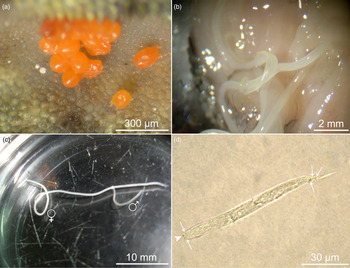
Mites were all in hexapod larval stages (known as chigger), found in specialized structures of the lizard's tegument (mite pockets) (fig. 1a). In T. torquatus these structures are shallow folds on the side of the neck filled with granules. Groin and axilla folds may also house mites, though not as frequently as in the neck folds. Mites were identified as E. alfreddugesi based mainly on the bifurcate palpal claws and a more or less rectangular scutum with 22 dorsal setae (Wharton & Fuller, Reference Wharton and Fuller1952; Brennan & Goff, Reference Brennan and Goff1977). Despite the low host specificity exhibited by E. alfreddugesi, the lizard T. torquatus is one of its more common hosts. This host–parasite association has been widely reported in Brazil in which the mite shows medium to high infestation rates (see Carvalho et al., Reference Carvalho, Araújo and Silva2006; Rocha et al., Reference Rocha, Cunha-Barros, Menezes, Fontes, Vrcibradic and Van Sluys2008, Reference Rocha, Cunha-Barros, Menezes, Vrcibradic, Kiefer, Fontes, Van Sluys, Galdino and Maia-Carneiro2020). The biological relationship between T. torquatus and E. alfreddugesi suggests that it is old, since lizards developed skin folds (mite pockets) that favour the aggregation of this ectoparasite (Frost et al., Reference Frost, Rodrigues, Grant and Titus2001). Moreover, there is no report of congeneric mites infesting T. torquatus in Brazil (see Jacinavicius et al., Reference Jacinavicius, Bassini-Silva, Mendoza-Roldan, Pepato, Ochoa, Welbourn and Barros-Battesti2018). The mean intensity of infestation was 18.7 ± 23.5, corroborating previous reports (see Carvalho et al., Reference Carvalho, Araújo and Silva2006).
Parasites of the lizard Tropidurus torquatus from the present study: (a) larval specimens of Eutrombicula alfreddugesi infesting the right neck mite pocket; (b) adult specimens of Oswaldofilaria chabaudi parasitizing the musculature of the right hind leg of the lizard; (c) male and female of O. chabaudi copulating; (d) microfilaria found in E. alfreddugesi (arrowhead indicates cephalic hook; arrows indicate cephalic and posterior nuclei).

Of the 30 (15 males and 15 females) lizards infested by mites, 12 (40%) were infected with O. chabaudi, showing a mean intensity of infection of 2.9 ± 3.4 (1–6 worms/host). The nematodes were identified based on the diagnostic features reported by Pereira et al. (Reference Pereira, Souza Lima and Bain2010); the lizard and the sampling locality of this study are also the type host and locality of O. chabaudi, respectively. The nematodes were mostly found on or within the muscular fibres of the hind legs, but also infected the musculature at the base of tail. In one lizard we found a male and a female copulating in the musculature of the left hind leg (fig. 1b, c). In this same host there was another couple of adult nematodes in the right hind leg. Nematodes commonly occurred in couples or in groups of one male along with two to three females, sharing the same site of infection.
Microfilariae were only present in the preparations of mites from lizards that were simultaneously infested by E. alfreddugesi and infected with adults of O. chabaudi (fig. 1d), with a mean of 23.9 ± 9.1 (17–50) microfilariae in groups of 15 squashed mites. This indicates that the infection rates of microfilariae in these mites are not negligible. However, in these co-occurrences there was no correlation between the number of microfilariae by groups of 15 mites and adults of O. chabaudi per lizard (P = 0.07). Microfilariae from mites were 80–97 μm long and 8–9 μm wide (n = 25), unsheathed, with a W-shaped cephalic hook, two anterior nuclei, three posterior nuclei, anucleated at the caudal extremity, with a conical and pointed tail; the most posterior nucleus was about 15 μm from posterior end (fig. 1d). Microfilariae from mites were morphologically and morphometrically similar to those extracted from the uteri of four females. Microfilariae extracted from female uteri were 79–95 μm long and 8–9 wide μm (n = 25), some were inside a fragile sheath and others were unsheathed. All microfilariae found in the present study were very similar to those described and illustrated by Pereira et al. (Reference Pereira, Souza Lima and Bain2010) in the original description of O. chabaudi. Based on the morphological and morphometric similarity between the microfilariae found in mites and those extracted from the uteri of O. chabaudi females, and the co-occurrence of both parasites (mite and nematode) in the same individual host, we might consider the microfilariae from these different sources to be the same species, but these larvae remain to be molecularly characterized to unequivocally confirm their identification as O. chabaudi. The fact that microfilariae from mites were unsheathed was expected, since the fragile sheath is easily lost during the transmission from lizard to mite. Therefore, this is the first report of microfilarial infections in the mite E. alfreddugesi in nature.
The transmission of microfilariae to E. alfreddugesi was clear. However, the key question here is: is this also possible evidence of a lifecycle pathway? Based on the biology of the mite, we argue that it is not. The life cycle of E. alfreddugesi includes only one larval stage, which is also the only parasitic form; the mite larvae use their mouthparts to cause lesions and feed on host tegument serous tissues for several days before detaching and moulting to an octopod nymph and later to adult (Taylor et al., Reference Taylor, Coop and Wall2016). Therefore, microfilariae acquired by mites during the long days of feeding will face a dead end in their life cycle, since there is no evidence that larval mites can transfer between hosts. Moreover, we found no evidence of microfilarial development in mites; all worms from mites were the same as those from the uteri of O. chabaudi females, which may indicate that E. alfreddugesi is not suitable for the development of these microfilariae. Nevertheless, based on the feeding habits and behaviour of these mites, we can now establish that the microfilariae found are the skin-inhabiting form, which is one of the two typical forms (skin and blood-inhabiting) found in Onchocercidae (Anderson, Reference Anderson2000) and likely also true for O. chabaudi.
Based on previous experimental studies (Makerras, Reference Makerras1953; Prod'hon & Bain, Reference Prod'hon and Bain1972; Bain & Chabaud, Reference Bain and Chabaud1975), it is possible that the hosts able transmitting O. chabaudi in this ecosystem are culicid mosquitoes. Another question that arises is whether the microfilarial infection is pathogenic for the larval mites, since the microfilariae measure about one-third of the mite's length, which may be a problem in heavily infected individuals. Answers to these questions will emerge as our investigations continue.
Even though our knowledge on the symbiotic relationship of trombiculids and filarioid nematodes is limited, the polyphagous nature of trombiculid mites, similar to blood-sucking insects (Shatrov & Kudryashova, Reference Shatrov, Kudryashova, Morand, Krasnov and Poulin2006), makes these arthropods ideal vectors of infectious diseases – for example, chigger-borne rickettsial diseases. The presence of chigger mites and microfilariae can cause haematological and immunological changes and favour secondary infections in T. torquatus (Hernandes-Córdoba & Braga, Reference Hernandes-Córdoba and Braga2019). Therefore, clarifying the consequences of co-infections is crucial to better understanding the physiological consequences for hosts. Thus, the call for more mite research (see Weitzel et al., Reference Weitzel, Makepeace, Elliott, Chaisiri, Richards and Newton2020) is reinforced here, which ultimately may shed more light on the potential role of chiggers as vectors of filarioids.
Acknowledgement
The authors thank Anindo Choudhury (St Norbert College, USA) for helpful suggestions that much improved the quality of the text.
Financial support
This work was partially funded by CAPES (postdoctoral scholarship to P.V.A., grant number 88887.508591/2020-00).
Conflicts of interest
None.
Ethical standards
All procedures involving animal manipulation were strictly in accordance with the rules and principles adopted by the Brazilian College of Animal Experiments (COBEA) and approved by the Comitê de Ética na Experimentação Animal da Pró-Reitoria de Pesquisa/UFJF (Ethics Committee on Animal Experimentation of the Dean's Office for Research/UFJF Protocol number 010/2005-CEA) and under IBAMA license (Process 02015.010,660/05-88 license number 261/05-NUFAS/MG).