Introduction
Attention problems are a common behavioral difficulty in the very preterm (<32 weeks’ gestation) populations (Aarnoudse-Moens, Weisglas-Kuperus, van Goudoever, & Oosterlaan, Reference Aarnoudse-Moens, Weisglas-Kuperus, van Goudoever and Oosterlaan2009; Bhutta, Cleves, Casey, Cradock, & Anand, Reference Bhutta, Cleves, Casey, Cradock and Anand2002; Botting, Powls, Cooke, & Marlow, Reference Botting, Powls, Cooke and Marlow1997; Breslau & Chilcoat, Reference Breslau and Chilcoat2000), and are a major concern for parents and teachers of these children. The rate of Attention Deficit/Hyperactivity Disorder (ADHD) is also greater in very preterm children than in the general population, with research suggesting rates of ADHD being 3 to 6 times higher compared with full-term controls (Botting et al., Reference Botting, Powls, Cooke and Marlow1997; Johnson et al., Reference Johnson, Hollis, Kochhar, Hennessy, Wolke and Marlow2010; Mick, Biederman, Prince, Fischer, & Faraone, Reference Mick, Biederman, Prince, Fischer and Faraone2002; Treyvaud et al., Reference Treyvaud, Ure, Doyle, Lee, Rogers, Kidokoro and Anderson2013).
Research within the cognitive neurosciences suggests attention is mediated by distinct but interrelated neural networks, which support several attention domains (Fan, McCandliss, Sommer, Raz, & Posner, Reference Fan, McCandliss, Sommer, Raz and Posner2002; Mirsky, Anthony, Duncan, Ahearn, & Kellam, Reference Mirsky, Anthony, Duncan, Ahearn and Kellam1991; Posner & Petersen, Reference Posner and Petersen1990). Prominent work by Mirsky (Reference Mirsky1989, Mirsky et al., Reference Mirsky, Anthony, Duncan, Ahearn and Kellam1991; Mirsky & Duncan, Reference Mirsky and Duncan2001) and Posner and colleagues (Posner & Gilbert, Reference Posner and Gilbert1999; Posner & Petersen, Reference Posner and Petersen1990; Posner & Rothbart, Reference Posner and Rothbart1998; Posner, Sheese, Odludas, & Tang, Reference Posner, Sheese, Odludas and Tang2006) have greatly influenced the understanding of attentional systems. While these attention domains have various labels across theoretical models, they refer to neural networks associated with the ability to select, sustain, shift, and divide the focus of attention. Selective attention refers to the ability to focus on specific information from the environment while ignoring irrelevant information. Parietal areas, superior temporal cortex, and subcortical areas (pulvinar of the thalamus, superior colliculus, corpus striatum) are thought to mediate selective attention (Mirsky et al., Reference Mirsky, Anthony, Duncan, Ahearn and Kellam1991; Posner et al., Reference Posner, Sheese, Odludas and Tang2006; Raz, Reference Raz2004; Raz & Buhle, Reference Raz and Buhle2006). The ability to maintain attention for prolonged periods of time is referred to as sustained attention or vigilance and is mediated by thalamic and fronto-parietal structures and the brain stem (Fan, McCandliss, Fossella, Flombaum, & Posner, Reference Fan, McCandliss, Fossella, Flombaum and Posner2005; Mirsky et al., Reference Mirsky, Anthony, Duncan, Ahearn and Kellam1991; Sarter, Givens, & Bruno, Reference Sarter, Givens and Bruno2001; Sturm & Willmes, Reference Sturm and Willmes2001). Shifting and divided attention are sometimes collectively referred to as executive attention processes (Posner & Digirolamo, Reference Posner and Digirolamo1998). These involve the ability to move the focus of attention to distinct tasks (shifting attention) and the ability to multitask (divided attention). The anterior cingulate and prefrontal areas are thought to mediate this aspect of attention (Fan et al., Reference Fan, McCandliss, Fossella, Flombaum and Posner2005; Mirsky et al., Reference Mirsky, Anthony, Duncan, Ahearn and Kellam1991).
Focal brain injury that compromises neural networks underpinning attention may give rise to a selective profile of attentional difficulties, dependent on the neuropathology (Fernandez-Duque & Posner, Reference Fernandez-Duque and Posner2001) and the disruption to the neural network underpinning attentional processes. In young children, when these functional systems are maturing, research suggests less specific neural activation patterns, compared to adults (Konrad et al., Reference Konrad, Neufang, Thiel, Specht, Hanisch, Fan and Fink2005). However there is evidence of the separability of attention networks in children (Rueda et al., Reference Rueda, Fan, McCandliss, Halparin, Gruber, Pappert Lercari and Posner2004) with most development occurring during early to middle childhood in most domains (Anderson, Reference Anderson2008).
Studies of attention in the very preterm population have tended to focus on specific attention domains. The severity of deficits appears greatest in the selective attention domain, particularly in children aged between 5 and 9 years (Dupin, Laurent, Stauder, & Saliba, Reference Dupin, Laurent, Stauder and Saliba2000; Foreman, Fielder, Minshell, Hurrion, & Sergienko, Reference Foreman, Fielder, Minshell, Hurrion and Sergienko1997; Pizzo et al., Reference Pizzo, Urben, van der Linden, Borradori-Tolsa, Freschi, Forcada-Guex and Barisnikov2010; Ross, Lipper, & Auld, Reference Ross, Lipper and Auld1991; Shum, Neulinger, O'Callaghan, & Mohay, Reference Shum, Neulinger, O'Callaghan and Mohay2008); although difficulties of selective attention in preadolescent and adolescent samples have also been reported (Elgen, Lundervold, & Sommerfelt, Reference Elgen, Lundervold and Sommerfelt2004). Impaired sustained attention has been reported in very preterm children from 6 to 11 years of age (Elgen et al., Reference Elgen, Lundervold and Sommerfelt2004; Katz, Dubowitz, Henderson, & Jongmans, Reference Katz, Dubowitz, Henderson and Jongmans1996; Short et al., Reference Short, Klein, Lewis, Fulton, Eisengart, Kercsmar and Singer2003), although other studies report no differences compared with term controls (Bayless & Stevenson, Reference Bayless and Stevenson2007; Breslau, Chilcoat, DelDotto, Andreski, & Brown, Reference Breslau, Chilcoat, DelDotto, Andreski and Brown1996; Grunau, Whitfield, & Fay, Reference Grunau, Whitfield and Fay2004; Kulseng et al., Reference Kulseng, Jennekens-Schinkel, Naess, Romundstad, Indredavik, Vik and Brubakk2006). In terms of executive attention, shifting attention deficits in very preterm children have been reported from early childhood (Aarnoudse-Moens, Smidts, Oosterlaan, Duivenvoorden, & Weisglas-Kuperus, Reference Aarnoudse-Moens, Smidts, Oosterlaan, Duivenvoorden and Weisglas-Kuperus2009; Bayless & Stevenson, Reference Bayless and Stevenson2007; Pizzo et al., Reference Pizzo, Urben, van der Linden, Borradori-Tolsa, Freschi, Forcada-Guex and Barisnikov2010) and into adolescence (Kulseng et al., Reference Kulseng, Jennekens-Schinkel, Naess, Romundstad, Indredavik, Vik and Brubakk2006; Taylor, Minich, Bangert, Filipek, & Hack, Reference Taylor, Minich, Bangert, Filipek and Hack2004), but, again, findings are inconsistent (Elgen et al., Reference Elgen, Lundervold and Sommerfelt2004; Mellier & Fessard, Reference Mellier and Fessard1998; Shum et al., Reference Shum, Neulinger, O'Callaghan and Mohay2008) not only due to differences between studies (e.g., cohorts born in different years) or limitations in the study design (i.e., small samples), but also due to differences in the measures used across studies. While divided attention has not been extensively evaluated in the very preterm population, there is some evidence for deficits in school-aged children (Anderson et al., Reference Anderson, De Luca, Hutchinson, Spencer-Smith, Roberts and Doyle2011) and young adults (Nosarti et al., Reference Nosarti, Giouroukou, Micali, Rifkin, Morris and Murray2007). A recent study investigating attention more broadly found greater rates of impairment across all attentional domains at 8 years of age in a large, representative cohort of children born extremely preterm (EP; <28 weeks) or extremely low birth weight (ELBW; <1000 g) compared with term-born controls (Anderson et al., Reference Anderson, De Luca, Hutchinson, Spencer-Smith, Roberts and Doyle2011).
While the above studies provide a basic understanding of the attentional difficulties observed in this population, most research to date has involved the use of small or selective samples, and has been narrow in focus, assessing only one or two aspects of attention. Also, although behavioral difficulties related to attention are commonly reported in the literature (Aarnoudse-Moens, Weisglas-Kuperus, et al., Reference Aarnoudse-Moens, Weisglas-Kuperus, van Goudoever and Oosterlaan2009; Bhutta et al., Reference Bhutta, Cleves, Casey, Cradock and Anand2002; Botting et al., Reference Botting, Powls, Cooke and Marlow1997; Breslau & Chilcoat, Reference Breslau and Chilcoat2000), few studies have evaluated both cognitive and behavioral aspects of attention concurrently. Furthermore, most studies report on cohorts born before the 1990s and the introduction of surfactant as standard care, when survival rates of the highest risk children, such as those born EP/ELBW, were low (Doyle & the Victorian Collaborative Study Group, Reference Doyle2004). Finally, as the majority of studies describe early to middle childhood outcomes, it is still not clear if attention difficulties persist into adolescence. This cannot be inferred given the protracted development of some attention skills through childhood and adolescence (Anderson, Anderson, Northam, & Taylor, Reference Anderson, Anderson, Northam and Taylor2000; Huizinga, Dolan, & van der Molen, Reference Huizinga, Dolan and van der Molen2006; Leon-Carrion, Garcia-Orza, & Perez-Santamaria, Reference Leon-Carrion, Garcia-Orza and Perez-Santamaria2004). It is possible that early impairments may represent a delay in skill acquisition, rather than a permanent deficit, with catch-up to normal levels at later ages.
The present study was designed to address these issues by evaluating a large geographical cohort of adolescents born EP or ELBW, and compare their performance with a normal birth weight control group. The aim was to explore the incidence, nature, and extent of attention difficulties, including the behavioral manifestations of attention problems (disinhibition/hyperactivity, behavioral inflexibility). A secondary aim was to evaluate the neonatal risk factors associated with attention difficulties in the EP/ELBW group. It was hypothesized that the EP/ELBW group would exhibit more attention difficulties across all domains compared with controls, and that medical risk factors in the neonatal period would be predictive of attention difficulties.
Method
Participants
Between January 1991 and December 1992, there were 298 consecutive survivors born either EP (<28 weeks’ gestational age) or ELBW (<1000 g) infants in Victoria, Australia. At a mean age of 17.0 years (standard deviation [SD] = 1.5), 76.5% (228) of the EP/ELBW cohort completed a neuropsychological assessment (38 refused, 15 were lost to follow-up, 3 lived in other states or countries, 14 other reasons).
The control group comprised 262 survivors from 265 who were randomly selected and recruited in the newborn period and matched with the EP/ELBW infants by date of birth, sex, mother's country of birth, and health insurance status. At 17.4 (SD = 1.6) years, 63.4% (166) of the control group completed a neuropsychological assessment (54 refused, 21 were lost to follow-up, 5 lived in other states or countries, 1 died, 15 other reasons).
Procedure
Participants had been previously evaluated at ages 2 (The Victorian Infant Collaborative Study Group, 1997), 5 (Doyle & the Victorian Collaborative Study Group, Reference Doyle2001), and 8 (Anderson, Doyle, & the Victorian Collaborative Study Group, Reference Anderson and Doyle2003; Anderson, Doyle, & the Victorian Collaborative Study Group, Reference Anderson and Doyle2004). Parents provided written informed consent to participate in this follow-up study, as did the adolescents themselves, if they were able. The study was approved by the Human Research Ethics Committees of the Royal Women's Hospital, Mercy Hospital for Women, Monash Medical Centre, and the Royal Children's Hospital, and completed in accordance with the guidelines of the Helsinki Declaration. Participants were assessed by a trained examiner who was blind to group membership.
Outcome Measures
Cognitive Attention Measures
Selective attention
The Telephone Search task of the Test of Everyday Attention (Robertson, Ward, Ridgeway, & Smith-Nimmo, Reference Robertson, Ward, Ridgeway and Smith-Nimmo1994) was used as a measure of selective attention. In this task, participants were required to search a simulated A3 size telephone directory for pairs of shapes that looked the same (i.e., two squares, two stars, two circles, or two crosses). Shapes were presented next to a supposed telephone number and were interspersed among a series of distractor stimuli (i.e., pairs of shapes that looked different). Participants were encouraged to identify the target shapes that looked the same both accurately and quickly. The number of targets detected (maximum = 20) and the time taken to complete the task were recorded. The Elevator with Distraction task, also from the Test of Everyday Attention, was used as a second measure of selective attention. In this task, participants were prompted to imagine that they were in an elevator in which the visual floor indicator was not working. Participants were asked to work out on which floor they were located by counting a series of specific tones while ignoring the presence of a distractor tone. The number of correct trials (maximum = 7) was recorded.
Sustained attention
The Test of Variables of Attention (TOVA) (Leark, Greenberg, Kindschi, Dupuy, & Hughes, Reference Leark, Greenberg, Kindschi, Dupuy and Hughes2007) is a continuous performance task (CPT) and was used as a measure of sustained attention. It is a long monotonous task in which participants were required to press a button as soon as they see a target presented on a computer screen and refrain from responding when non-targets are presented. The target was displayed for 100 ms and the interstimulus interval was of 2000 ms. The total duration of the test was 21 min and 36 s. The task commenced with a low frequency rate of target presentation for the first 10 min and 48 s (ratio of 3.5:1 non-targets for every target; target presented in 22.5% of the trials) and continued with a high frequency rate of target presentation for the remainder of the test (ratio 3.5:1 targets for every non-target; target presented in 77.5% of the trials). Outcomes in this study were: response time (average time between target presentation and response) for correct responses, response time variability (standard deviation of reaction time for correct responses), number of omission errors (targets not responded to), and number of commission errors (responses to non-targets). Age standard scores were analyzed for these variables, which were evaluated for the entire task as well as the 1st, 2nd, 3rd, and 4th quarters of the task.
Shifting attention
The Contingency Naming Test (CNT) (Anderson et al., Reference Anderson, Anderson, Northam and Taylor2000; Taylor, Albo, Phebus, Sachs, & Bierl, Reference Taylor, Albo, Phebus, Sachs and Bierl1987) measures inhibition and shifting. Participants were shown a page of colored shapes (circle, triangle, square), each of which is embedded with a smaller shape (circle, triangle, square), and instructed to respond by naming either the color or shape of each figure as fast and accurately as possible according to different rules. In the first two trials, the participants were required to name the color (trial 1) or outer shape (trial 2) for each figure. Trials 3 and 4, which require flexible shifting, were the trials of interest in this study. In trial 3, participants were required to name the color of each figure if the inner and the outer shapes were the same, and name the outer shape of each figure when the shapes were different. For trial 4, participants were required to follow the instructions for trial 3 except some of the figures had a backward pointing arrow at the top of the figure in which case participants had to reverse the rule (name the color if the inner and outer shapes were different and name the outside shape if the inner and outer shapes were the same). An efficiency score, which represents a ratio of the time taken to complete the task and the number of errors, was the variable of interest. This variable was calculated for trials 3 and 4 separately.
Divided attention
The Telephone Search while counting task on the Test of Everyday Attention was used as a measure of divided attention. Participants were required to listen to and count a series of tones while completing the Telephone Search task (where they were required to select and circle specific targets). Participants were instructed to identify the same double symbols as before in a different stimulus sheet as quickly and accurately as possible while at the same time counting a series of tones presented in an audio recording. The participants were required to report the number of tones counted in a given series as soon as they heard a voice ask “how many?”. A divided attention score was calculated by multiplying the proportion of correct targets found by the proportion of correct series of tones counted times 10, with a score of 10 signifying a perfect score.
Behavioral Attention
Conners’ ADHD/DSM IV Scales (CADS) (Conners, Reference Conners1997)
The CADS is based on ADHD diagnostic criteria from the Diagnostic and Statistical Manual of Mental Disorders Fourth edition (DSM-IV) and evaluates the presence of inattentive or hyperactive behaviors which are characteristic of ADHD. Parent (CADS-P) and self-report (CADS-A) forms were administered. The CADS-P consists of 26 items and the CADS-A of 30 items, and both provide 3 age-standardized scales (inattentive behaviors, hyperactive behaviors, DSM-IV ADHD index) each with a mean (M) of 50 and SD of 10.
Behavior Rating Inventory of Executive Function, BRIEF (Gioia, Isquith, Guy, & Kenworthy, Reference Gioia, Isquith, Guy and Kenworthy2000)
The BRIEF was designed to evaluate behaviors related to executive functioning and in this study was used to evaluate specific behaviors that relate to executive attention skills such as the “shift” and “inhibit” scales. Parent and self-report versions of the BRIEF were completed. Difficulties in executive attention may manifest as problems with behavioral inhibition and shifting as important skills in self-regulating behavior (Fernandez-Duque, Baird, & Posner, Reference Fernandez-Duque, Baird and Posner2000; Hasher, Reference Hasher2007; Rothbart, Ellis, Rueda, & Posner, Reference Rothbart, Ellis, Rueda and Posner2003). The “shift” scale includes 8 items in the parent report and 10 items in the self-report version, and evaluates the ability to flexibly move from a given activity or aspect of a problem to another as demanded by a situation (e.g., “Tries the same approach to a problem over and over even if it does not work”). The “inhibit” scale includes 10 items in the parent report and 13 items in the self-report version, and evaluates the ability to show self-control in a variety of situations (e.g., “Gets out of seat at the wrong time”). T scores were recorded for each of these scales (M = 50; SD = 10).
General Intellectual Ability
The Vocabulary and Block design measures were used in a two-subtest version of the Wechsler Abbreviated Scale of Intelligence (WASI) (The Psychological Corporation, 1999) to estimate general intellectual ability (IQ).
Neonatal Risk Factors
Data on neonatal risk factors were collected during the primary hospitalization. In this study, we focused on neonatal risk factors considered to reflect major complications of extreme prematurity and thought to be associated with long-term outcome including bronchopulmonary dysplasia (oxygen requirement at 36 weeks in an infant with respiratory distress), postnatal corticosteroids, grade 3 or 4 intraventricular hemorrhage or cystic periventricular leukomalacia diagnosed by serial cranial ultrasound during the neonatal period, and birth weight Z score (i.e., 0 = expected birth weight for gestational age and gender; positive values are birth weights above expectations for gestational age and gender; negative values are birth weights below expectation for gestational age and gender) (Cole, Freeman, & Preece, Reference Cole, Freeman and Preece1998).
Sociodemographic Variables
Duration of education of the primary caregiver and language(s) spoken at home were recorded at adolescence.
Data Analyses
For normally distributed continuous data, two-sided independent samples t tests were performed to compare outcomes between the EP/ELBW and control groups. Secondary analyzes were performed using analysis of covariance, including age, maternal education, and gender as covariates for both age standardized outcomes and outcomes with no age standardization. It was not considered appropriate to include IQ as a covariate given that attention and IQ constructs overlap (Dennis et al., Reference Dennis, Francis, Cirino, Schachar, Barnes and Fletcher2009), however analyses were repeated excluding children with an IQ<70 (n = 12) and those with cerebral palsy (n = 21). The Mann-Whitney U test was used to assess between group differences for outcomes that were not normally distributed. Scores equal to or less than -1.5 SD from the control group mean in at least one variable on an attention test or questionnaire were considered to represent a clinically significant difficulty in the attention domain represented by that test.
The proportions of adolescents with clinical difficulties was compared between the groups for each cognitive domain using logistic regression, where group (EP/ELBW or control) was entered as the predictor variable, and age, education of the primary caregiver, and gender were entered as covariates.
Within the EP/ELBW group the neonatal risk variables for scores in the cognitive domains that were different between the EP/ELBW and control groups (i.e., selective, shifting, and divided attention) were determined by linear regression, with education of the primary caregiver, age, and gender entered as covariates.
Age was corrected for prematurity to avoid bias in cognitive scores (Rickards, Kitchen, Doyle, & Kelly, Reference Rickards, Kitchen, Doyle and Kelly1989) and to remain consistent with our previous assessments of this cohort (Anderson, Doyle, & the Victorian Collaborative Study Group, Reference Anderson and Doyle2003, Reference Anderson and Doyle2004; Doyle & the Victorian Collaborative Study Group, Reference Doyle2001).
Given the multiple comparisons, the results were interpreted by considering overall patterns and magnitudes of differences, rather than by focusing on individual p-values.
Results
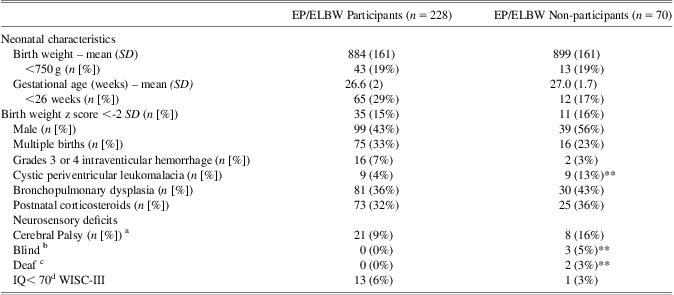
The neonatal characteristics, neurosensory deficits, and social risk characteristics of the participating and non-participating EP/ELBW adolescents are presented in Table 1. The proportions of children with cystic periventricular leukomalacia, blindness, and deafness were higher in the non-participating EP/ELBW adolescents compared with the participating EP/ELBW adolescents, otherwise there were no group differences. In the control group, participants and non-participants differed in the proportion of males (control participants = 40%; control non-participants = 62%, χ2 (1, N = 262) = 10.8; p = .001) and IQ at age 8 (control participants, M = 106.0; SD = 14.0; control non-participants, M = 101.5; SD = 14.0; t(218) = −2.1; p = .04), which was measured with the Wechsler Intelligence Scale for Children-Third Edition (WISC-III) (Wechsler, Reference Wechsler1991).
Neonatal characteristics and neurosensory deficits at 8 years for the EP/ELBW participants and the EP/ELBW non-participants

*p < .05, **p < .01, ***p < .001.
aCerebral Palsy at 8 years of age.
bVisual acuity worse then 6/60 in the better eye at 8 years of age.
cProfound hearing loss at 8 years of age.
dWechsler Intelligence Scale for Children-Third Edition assessed at 8 years of age.
The EP/ELBW and control groups had a similar percentage of males (43% and 40%, respectively, χ2(1, N = 394) = 0.4; p = .54). The EP/ELBW group was slightly younger than the control group at the time of assessment (M = 17.0; SD = 1.5; M = 17.4; SD = 1.6, respectively; mean difference, −0.3; 95% confidence interval [CI], −0.7 to −0.1, t(392) = 2.3; p = .024). The proportion of adolescents whose primary caregiver had less than 12 years of secondary schooling was greater in the EP/ELBW group (EP/ELBW = 50%; control = 27%; χ2(1, N = 335) = 17.7; p < .001), but the rate of adolescents where no English was spoken at home was similar between the groups (EP/ELBW = 2%; control = 3%; χ2 (1, N = 337) = 0.7; p = .40). As in previous follow-ups of this cohort, mean IQ was lower in the EP/ELBW group (EP/ELBW mean = 95.3 (SD 16.3), control = mean 106.4 (SD 13.7), mean difference, −11.1; 95% CI, −14.1 to -8.1, t (372.4) = −7.3; p < .001). Similar results were found with the WISC III at 8 years of age (M = 95.7; SD = 16.6 and M = 106.4; SD = 14.0, respectively; t (380) = −6.44; p < .001).
Cognitive Attention Measures
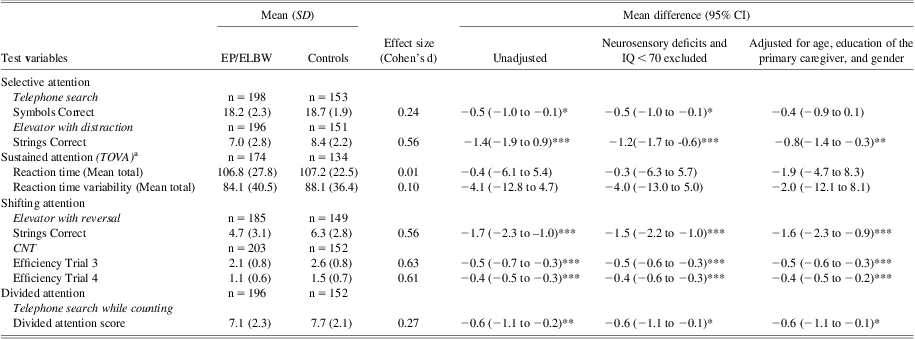
The EP/ELBW group performed more poorly than the control group in all measures of selective, shifting, and divided attention (see Table 2). With one exception, differences remained after excluding participants with neurosensory deficit at age 8 and those with an IQ below 70, and also after adjusting for education of the primary caregiver, age, and gender at testing. The EP/ELBW and control groups performed similarly for all measures of sustained attention (Table 2), including the number of omission (EP/ELBW Median = 0, 0, 0.8, 0.8; Control Median = 0, 0, 0, 0.8 for trials 1 to 4, respectively; p > .05 for all analyses) and commission errors (EP/ELBW Median 1,0,7,8; Control Median = 1, 0, 6, 7 for trials 1 to 4, respectively; p > .05 for all analyses).
Cognitive attention domains contrasted between EP/ELBW and control groups
*p < .05, **p < .01, ***p < .001.
TOVA = Test Of Variables of Attention; CNT = Contingency Naming Test. a Standard Score.
After covarying for education of the primary caregiver, age, and gender over a third of adolescents in the EP/ELBW group recorded scores in the clinically impaired range for the selective and shifting attention domains, representing significantly higher proportions than for the control group (Table 3). Proportionately more EP/ELBW adolescents fell within the clinically impaired range for divided attention, but not for sustained attention.
Proportion of adolescents in the EP/ELBW and control groups scoring in the clinical range (<−1.5 SD from the control mean) on cognitive attention measures and logistic regression comparing the proportions between groups, adjusting for education of the primary caregiver, age, and gender

Neonatal Risk Factors as Predictors of Cognitive Attention within the EP/ELBW Group
The regression analysis of neonatal risk factors revealed only one significant risk factor for one shifting attention subtest (CNT efficiency trial 3): grade 3/4 intraventricular hemorrhage, B = −0.8, 95% CI, −1.3 to −0.2, p = .005. This variable explained 8.2% of the variance in outcome. No neonatal risk factors were associated with any of the other attention domains (data not shown).
Behavioral Attention Skills (Table 4)
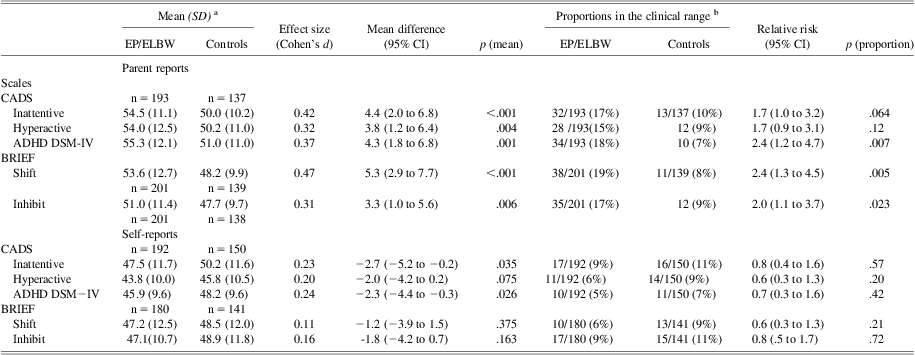
Parents of the EP/ELBW adolescents reported higher scores on average (i.e., more problem behaviors) than parents of controls for all CADS and BRIEF variables. These differences remained significant after adjusting for education of the primary caregiver (CADS Inattentive, mean difference, 4.4; 95% CI, 1.9 to 6.9; CADS Hyperactive, mean difference, 3.3; 95% CI, 0.6 to 6.1; CADS ADHD DSM-IV, mean difference, 4.4; 95% CI, 1.7 to 7.1; BRIEF Shift, mean difference, 4.6; 95% CI, 2.0 to 7.3; BRIEF Inhibit, mean difference, 3.0; 95% CI, 0.5 to 5.5). According to parental report, more EP/ELBW adolescents were within the clinical range compared with the controls and these differences reached significance for the CADS ADHD DSM-IV scale, and the BRIEF shift and inhibition scales (Table 4)
T scores and proportion of adolescents scoring in the clinical range for the parent and self-report CADS and BRIEF questionnaires for the EP/ELBW and the control groups
CI = Confidence Interval; CADS = Conners’ ADHD/DSM IV Scales; BRIEF = Behavior Rating Inventory of Executive Function; EP/ELBW = Extremely Preterm/Extremely Low Birth Weight.
aHigher scores indicate more problem behavior. Clinical range defined as 1.5 SD or over the control group mean.
In terms of self-report, mean scores on the CADS and BRIEF tended to be lower than those reported by parents, suggesting that the EP/ELBW adolescents are reporting fewer behavioral problems than their parents. Of interest, the EP/ELBW adolescents self-reported lower levels of inattention and ADHD symptoms than the controls, and there was little difference in the proportions scoring in the clinical range in the EP/ELBW and control groups.
Discussion
In the present study, we found generalized attention problems in a regional cohort of EP/ELBW adolescents born in the 1990s when compared with a matched control group. The proportion of EP/ELBW adolescents with clinically significant attention impairments was elevated, particularly in selective and shifting attention domains, where there were 2.5 times more adolescents with an impairment than in the control group. In general, neonatal risk factors were poor predictors of attention outcomes within the EP/ELBW group. The EP/ELBW adolescents were reported by their parents to have more ADHD symptoms and greater problems with shifting and inhibiting behaviors compared with normal birth weight peers, although the adolescents themselves did not report these problems.
While these findings support previous reports of a generalized attention deficit in the very preterm population (Anderson et al., Reference Anderson, De Luca, Hutchinson, Spencer-Smith, Roberts and Doyle2011), little evidence of a difference in sustained attention was identified in this late adolescent cohort, as has been the case in other reports (Bayless & Stevenson, Reference Bayless and Stevenson2007; Breslau et al., Reference Breslau, Chilcoat, DelDotto, Andreski and Brown1996; Grunau et al., Reference Grunau, Whitfield and Fay2004; Kulseng et al., Reference Kulseng, Jennekens-Schinkel, Naess, Romundstad, Indredavik, Vik and Brubakk2006). It is possible that sustained attention difficulties are more prevalent at younger ages in preterm children (Elgen et al., Reference Elgen, Lundervold and Sommerfelt2004; Katz et al., Reference Katz, Dubowitz, Henderson and Jongmans1996; Short et al., Reference Short, Klein, Lewis, Fulton, Eisengart, Kercsmar and Singer2003). For example, two other studies (Grunau et al., Reference Grunau, Whitfield and Fay2004; Kulseng et al., Reference Kulseng, Jennekens-Schinkel, Naess, Romundstad, Indredavik, Vik and Brubakk2006) have reported similar performance on CPT tasks in adolescents born very preterm or ELBW. Of interest, in both of these studies, parents reported attention difficulties despite the absence of difficulties on sustained attention tasks. However, continuous performance tasks vary in regards to the interval rate between stimulus, the rate of target presentation, the length of the task, and the parameters used and their calculation. It has been suggested that findings frequently vary as a consequence of differing CPT tasks, (Ballard, Reference Ballard2001). In the present study, a CPT task with a greater rate of task presentation or faster interstimulus intervals, may have been more sensitive at detecting possible subtle difficulties in sustain attention in this group and it is still possible that the pronounced development in sustained attention that normally occurs around age 5 years of age (Betts, McKay, Maruff, & Anderson, Reference Betts, McKay, Maruff and Anderson2006; Lin, Hsiao, & Chen, Reference Lin, Hsiao and Chen1999; McKay, Halperin, Schwartz, & Sharma, Reference McKay, Halperin, Schwartz and Sharma1994; Rebok et al., Reference Rebok, Smith, Pascualvaca, Mirsky, Anthony and Kellam1997) is delayed in very preterm children, with catch-up occurring at later ages.
Consistent with the findings from the neuropsychological assessment, parents of EP/ELBW adolescents reported greater attention and inhibition problems compared with parents of the control group. Thus, one could speculate that the neuropsychological impairments we have described have functional significance, affecting their behavior in home, school and other settings. Of interest, when we evaluated this cohort at 8 (Anderson et al., Reference Anderson and Doyle2004), parents reported more shifting difficulties but similar levels of inhibition compared with controls. Increased risk-taking behaviors and disinhibition generally occur during adolescence in the normal population (Hooper, Luciana, Conklin, & Yarger, Reference Hooper, Luciana, Conklin and Yarger2004; Luna & Sweeney, Reference Luna and Sweeney2004; Steinberg, Reference Steinberg2005), although this is not always reported in very preterm populations (Saigal, Pinelli, Hoult, Kim, & Boyle, Reference Saigal, Pinelli, Hoult, Kim and Boyle2003).
The EP/ELBW adolescents had a different perception of their functioning to their parents, and tended to score themselves more favorably. Similar findings have been reported in previous studies of very preterm adolescents (Gardner et al., Reference Gardner, Johnson, Yudkin, Bowler, Hockley and Mutch2004; Indredavik, Vik, Heyerdahl, Romundstad, & Brubakk, Reference Indredavik, Vik, Heyerdahl, Romundstad and Brubakk2005). Discrepancies between parental and self-reports are common in the adolescent research literature across multiple domains of functioning (e.g., quality of life, mental health, cognition). Various explanations for this have been proposed, including parental over-estimation of their child's problems, lack of self-insight, the adolescent's adjustment to or compensation for possibly longstanding difficulties, or denial of problems by the adolescent (De Los Reyes & Kazdin, Reference De Los Reyes and Kazdin2005; Kolko & Kazdin, Reference Kolko and Kazdin1993; Russell, Hudson, Long, & Phipps, Reference Russell, Hudson, Long and Phipps2006; White-Koning et al., Reference White-Koning, Arnaud, Dickinson, Thyen, Beckung, Fauconnier and Colver2007). These factors are not mutually exclusive.
Neonatal risk factors were found to be poor predictors of attention performance, despite the strong association between these risk factors and other cognitive outcomes (e.g, Ligam et al., Reference Ligam, Haynes, Folkerth, Liu, Yang, Volpe and Kinney2009; Majnemer et al., Reference Majnemer, Riley, Shevell, Birnbaum, Greenstone and Coates2000; Short et al., Reference Short, Klein, Lewis, Fulton, Eisengart, Kercsmar and Singer2003; Shum et al., Reference Shum, Neulinger, O'Callaghan and Mohay2008; Yeh et al., Reference Yeh, Lin, Lin, Huang, Hsieh, Lin and Tsai2004). In this study, brain pathology in the newborn period was determined using cranial ultrasound, which is not as sensitive as magnetic resonance imaging in detecting diffuse white matter injury, which is the most prevalent form of brain injury in prematurity (Inder, Wells, Mogridge, Spencer, & Volpe, Reference Inder, Wells, Mogridge, Spencer and Volpe2003). The attention problems in very preterm children may be related to diffuse white matter pathology that compromises the interconnectivity of attention networks. This could include disruption to corticothalamic projection fibers that have being involved in selective attention (e.g., Frith & Friston, Reference Frith and Friston1996; Salmi, Rinne, Degerman, Salonen, & Alho, Reference Salmi, Rinne, Degerman, Salonen and Alho2007) and disruption to non-motor frontostriatal circuits implicated in executive attention processes (Fan et al., Reference Fan, McCandliss, Fossella, Flombaum and Posner2005). Indeed, research suggests these areas may be compromised in very preterm populations (Nagy et al., Reference Nagy, Westerberg, Skare, Andersson, Lilja, Flodmark and Klingberg2003; Skranes et al., Reference Skranes, Vangberg, Kulseng, Indredavik, Evensen, Martinussen and Brubakk2007, Reference Skranes, Lohaugen, Martinussen, Indredavik, Dale, Haraldseth and Brubakk2009).
While our attention measures are validated and established tools, it should be acknowledged that they are multi-dimensional and dependent on other cognitive skills in addition to attention, such as working memory. In this study, we were unable to parcellate the influence of working memory, and it is possible that poorer performance of the EP/ELBW group on some of our tasks, especially the shifting and divided attention tasks, is at least partly due to reduced working memory capacity. In comparison to our previous follow-ups of this cohort (Anderson et al., Reference Anderson and Doyle2003, Reference Anderson and Doyle2004; Doyle & the Victorian Collaborative Study Group, Reference Doyle2001), the attrition rate in this study was relatively high, which is common in follow-up studies of preterm populations conducted in late adolescence. Nevertheless, the broad assessment of attention in a contemporary cohort of EP/ELBW adolescents was a major strength.
In conclusion, EP/ELBW adolescents continue to exhibit attention problems, with a larger proportion of these adolescents experiencing clinically significant impairments compared with their normal birthweight peers, particularly in selective and shifting attention. It is likely that these attention difficulties have affected the development of other cognitive skills and the acquisition of new knowledge. As very preterm adolescents move into adulthood, it is likely that these attention difficulties will continue to make an impact in terms of daily functioning and vocational performance. It is, therefore, important to monitor this at-risk population throughout childhood to enable specific interventions to be applied at the appropriate age. Future research in preterm populations should evaluate the association between multiple areas of attention dysfunction and neuropathology by using advanced neuroimaging techniques.
Acknowledgments
The information in this manuscript and the manuscript itself has never been published either electronically or in print. The authors certify there are no potential conflicts of interest. This work is published on behalf of members of the Victorian Infant Study Group, who were involved in data collection at the various study sites.
Convenor; Lex W Doyle, MD, FRACP.1,2,3,4 Collaborators (in alphabetical order): Peter J. Anderson, PhD,4 Catherine Callanan, RN,1 Elizabeth Carse, FRACP,6 Margaret P. Charlton, M Ed Psych,6 Jeanie Cheong, MD, FRACP,1,4 Noni Davis, FRACP,1 Cinzia R. De Luca, BSc, PhD,1,2 Julianne Duff, FRACP,1 Marie Hayes, RN,6 Esther Hutchinson, BSc (Hons),1 Elaine Kelly, MA,1,5 Marion McDonald, RN,1 Gillian Opie, FRACP,5 Gehan Roberts, MPH, PhD, FRACP,1,3,4,7 Colin Robertson, MD, FRACP,7 Andrew Watkins, FRACP,5 Amanda Williamson,5 Stephen Wood, PhD,8 Heather Woods, RN.5
From: the 1Premature Infant Follow-up Program at the Royal Women's Hospital, the Departments of 2Obstetrics and Gynaecology, and 3Paediatrics at The University of Melbourne, 4Murdoch Childrens Research Institute, 5Mercy Hospital for Women, 6Monash Medical Centre, and the 7Royal Children's Hospital, Melbourne, Australia, and 8School of Psychology, the University of Birmingham, United Kingdom. This manuscript was financed by Project Grant #491246 from the NHMRC, of which the following were successful applicants: Lex Doyle, Peter Anderson, Stephen Wood, Colin Robertson, Sarah Hope, Doug Hacking, Jeanie Cheong.