INTRODUCTION
With the disintegration of Yugoslavia, Bosnian-Herzegovinan society changed in several ways. The society went through a democratization process in the course of which the previous one-party system was replaced by democratic pluralism. At the same time, Bosnian-Herzegovinan political life became strongly ethnicized. The nationalist parties, which mobilize the electorate primarily on the basis of ethnic competition, have, since the collapse of Socialist Yugoslavia, dominated the political life in the country (Bieber Reference Bieber2006). Furthermore, Bosnian-Herzegovinan society has gone through a process of de-secularization and revival of religion as an important political factor in society (for a discussion of Yugoslav and post-Yugoslav dynamics from 1980 to 2001, see Ramet (Reference Ramet2002)).
This article focuses on the nexus of religiosity, ethnicity, and support for democracy in Bosnia-Herzegovina. Relations between the Church and the State and between religious and democratic values are of interest in themselves (Ramet Reference Ramet, Ramet and Treadgold1995a; Zrinšćak Reference Zrinšćak2008), but they have an additional aspect in Bosnia-Herzegovina, where political life is strongly ethnicized, and where religious affiliation coincides with ethnic membership. Although it is broadly acknowledged that religious leaders, institutions, and communities have played and still play an important role in local politics in the Balkans generally including in Bosnia-Herzegovina (see Ramet (Reference Ramet2002), 118–125, 254–259), little attention has been paid to the issue of how religiosity and democratic values may be correlated among the Bosnian population. Therefore, we have examined data for Bosnia-Herzegovina from the latest available (third) wave of World Values Survey. The data were collected in December 2001 and the sample consists of 1,200 respondents. We use linear regression models as our main analytic tool.
Three main research questions are explored: (1) Does religiosity have an influence on Bosnians’ support for democracy? (2) Can we find some differences in religiosity, and in support for democracy among the chief nationality groups in the country, when controlled for a wide range of individual characteristics such as age, education level, place of residence, and gender? (3) Do some groups exhibit lower support for democracy than others, and if this is the case: can the indicated difference be explained with religiosity?
With regard to these questions, differences in the level of religiosity among Muslim Bosniaks, Orthodox Serbs, and Catholic Croats are scrutinized. Furthermore, the religious views among Bosnians are analyzed and linked to respondents’ support for democracy.Footnote 1
The article may be associated with literature that focuses on links and interplays between religiosity and developments in the building or consolidation of democracy in Eastern Europe (such as Karpov (Reference Karpov1999); and Norris and Inglehart (Reference Norris and Inglehart2004)). Additionally, since one ethnic group in our study is Islamic (the Bosniaks), the article contributes to a debate regarding the relations between Islam and democracy (Huntington Reference Huntington, Ramet and Treadgold1995; Tessler Reference Tessler2002; Norris and Inglehart Reference Norris and Inglehart2004).
Based on the aforementioned studies, our hypothesis is that the lack of support for the separation of the religious from the political sphere is a major source of lack of support for democracy in the Bosnian context, quite apart from peoples’ ethnic and religious affiliations.
The article consists of four interrelated sections. In the first section, relevant previous research is presented. In sections two and three, we outline and discuss the dependent and independent variables that will be used in our exploration of the interconnections between religiosity and support for democracy. Finally, in the concluding section, we summarize and relate our major findings to general debates on the links between religion and politics.
THE RELIGIOUS INSTITUTIONS AND POLITICS OF INTOLERANCE
There is a relatively large literature focusing on the role of religion in democratic developments of post-communist societies. Within this literature, we may identify at least two different lines of investigation. The first one includes the studies that analyze the influence of religious institutions on political developments in Eastern Europe, including the ex-Yugoslav republics (e.g., Ramet (Reference Ramet, Byrnes and Katzenstein2006a)). The other part of the literature contains survey-based studies that focus on relationship between religiosity and popular support for democracy (e.g., Karpov (Reference Karpov1999); Norris and Inglehart (Reference Norris and Inglehart2004); Zrinšćak (Reference Zrinšćak, Ramet and Matić2007)). Although this article belongs to the part of the literature that focuses on links between people's religiosity and support for democracy, it is nevertheless relevant to discuss the broader contextual frame including the role of religion and religious institutions and political leaders on politics of Eastern Europe and Balkans. In considering our interpretation of the results of our analysis, the role that religion and religious institutions have played in post-communist societies in general should be kept in mind, as should the process of the disintegration of Yugoslavia in particular.
Religious institutions have played diverse roles in the democratic transition of diverse East European countries (Philpott and Shah Reference Philpott, Shah, Byrnes and Katzenstein2006).Footnote 2 While the Church played an important role in the process of democratization of Poland and Lithuania, religious institutions have played different roles in Bosnia-Herzegovina and other Yugoslav successor states: specifically, they were important agents in processes of ethnicization and religious denomination was used as a marker of difference between groups that otherwise were (and are) divided by blurred ethnic boundaries. As language, physical appearance, and cultural values cannot be effectively used in maintaining ethnic boundaries in the Bosnian-Herzegovinan context, religion and religious markers are used to define ethnic belonging. However, not only did religion serve as a passive marker of difference, but religious institutions also played an active role in process of ethnicization of politics.Footnote 3 With clearly defined ethno-religious boundaries, it became easier to mobilize the electorate on the base of ethnic competition, and that in turn strengthened the nationalist parties.
On the one hand, it would be wrong to argue that religious institutions bore the primary responsibility for the war and for the current developments in Bosnia. Large numbers of studies emphasize social, economic, and political factors that underlay the ethnic conflicts in the former Yugoslavia (Pace Reference Pace2009; Ramet Reference Ramet2004; Reference Ramet2006b, chapters 9–13). On the other hand, Perica argues that, in the early 1990s, the major religious institutions were directly involved in the politics of intolerance, and directly or indirectly supported political leaders with clear autocratic characteristics, while ordinary clergy were more active in reinforcing the nationalist tendencies than in trying to advocate for liberal democracy (Perica Reference Perica, Byrnes and Katzenstein2006). Ramet, by contrast, stresses the diversity of views within each confession and notes both initiatives for reconciliation and the involvement in supporting the war effort of their respective sides and in blessing the banners of their respective forces. Ramet notes, in particular, the protest by Catholic Archbishop Franjo Kuharić of Zagreb against the killing of Serb civilians, looting, and torching of Serbian property in connection with Operation Storm in August 1995 (Ramet Reference Ramet2002, 255-256, 259; Ramet Reference Ramet, Byrnes and Katzenstein2006a, 438, 464). In the post-war period, the religious institutions in Bosnia-Herzegovina have shown a lack of interest to engage in the process of reconciliation and inter-religious dialogue with the aim of developing a tolerant multi-religious Bosnian-Herzegovinan society and a community based on religious plurality. One of the most recent studies on this topic was carried out by Janine N. Clark, who suggests that clergy in Bosnia-Herzegovina have even been impeding the reconciliation process through the misuse of religious symbols, lack of cooperation with clergy of other faiths, and denial of their own group's war crimes (Clark Reference Clark2010). Clark concludes that the absence of cooperation with other religious communities and the absence of a self-critical evaluation of the war in Bosnia-Herzegovina are obstructing the process of reconciliation.
But can we find any cases where leaders of religious communities in Bosnia-Herzegovina have come together? One example of that is the Inter-Religious Council (IRC), which the religious leaders of the Islamic, Christian Orthodox, Catholic, and Jewish communities in Bosnia–Herzegovina established in 1997. Among other things, the Council signed a “Statement of Shared Moral Values,” produced a “Glossary of Basic Religious Concepts,” and drafted a new law on freedom of religion and the legal status of religious communities in Bosnia-Herzegovina (Clark Reference Clark2010, 686).
Although the aforementioned actions may be important on a symbolic level, the Council has been criticized for being ineffective and unable to agree on any concrete actions regarding the reconciliation process (Clark Reference Clark2010, 677). This does not mean that there are no cases where the leaders of the three religious communities have been able to agree. For example, in 2009, the IRC made an exceptional, unified stand regarding a law adopted in Bosnia's House of Representatives, but it was unfortunately not with regard to reconciliation or the democratic development of the country. On the contrary, the religious leaders unified in protest of a proposed law that was intended to achieve one of the fundamental principles in a democracy, viz., the social equality of the all citizens regardless of their gender identity or sexual orientation. The draft law was nonetheless adopted in Bosnia's House of Representatives (Latal Reference Latal2009).
PEOPLE'S RELIGIOSITY AND ATTITUDES TOWARD “RELIGION IN POLITICS”
It is evident that the religious leaders in Bosnia-Herzegovina have continued to be involved in the political life of the country in the post-war period.Footnote 4 There are several examples of such interference such as the support of Reisu-ul-ulema Mustafa Cerić for Haris Silajdžić (leader of Party for Bosnia-Herzegovina) and Cerić's criticism of Sulejman Tihić (leader of Party of Democratic Action).Footnote 5 The support of the Serb Orthodox bishop from eastern Republika Srpska (RS), Vasilije Kačevenda, for Milorad Dodik (currently president of the RS) and the close connections of Ratko Perić, Catholic Bishop of Mostar, with the Croatian Democratic Union in Western Herzegovina are further examples (Harbin Reference Harbin2002).Footnote 6 The important question for this article is whether people in Bosnia-Herzegovina approve of the involvement of leading figures in their religious organizations in the political life of the country. We may argue that, in social contexts where religious institutions support democracy, the people who strongly identify with these institutions will also be more supportive of democracy. However, in the Bosnian-Herzegovinan context, where religion and religious institutions are often involved in politics and may even undermine the development of a tolerant and democratic Bosnian-Herzegovinan society, it is relevant to ask whether people's religiosity and identification with religious institutions will have a negative effect on their support for democracy.
Several smaller studies implemented by local non-governmental organizations and journalists show that people in Bosnia actually disapprove of the involvement of the religious communities in the political life of the country (Karabegović Reference Karabegović2010, 2; Rakela Reference Rakela2009, 1–3). However, there are hardly any larger survey-based studies that focus on the associations between people's religiosity and their support for democracy in Bosnia. The closest is the work done by Antonio Dragun (Reference Dragun2006) based on a survey among Croats in the Federation of Bosnia and Herzegovina. Dragun identified correlations between religiosity and support for democracy and several other variables. In the words of the author,
“…acceptance of coexistence is negatively correlated with ethnocentricity, national identity, religiosity and authoritarian attitudes, while it is positively correlated with assessments of [the] importance of democracy in the country, with personal education level, and [with] the size of the resident place” (Dragun Reference Dragun2006, 180).Footnote 7
Dragun's study indicates that religiosity has a negative influence on support for democracy in the Bosnian context. The author uses several variables in his analyses, including questions related both to individual religiosity and to associations between religion and politics, but he did not find it relevant to explore the effects of different religiosity-related indicators on support for democracy. We argue, however, that it is necessary to distinguish among different forms of religious views when one analyses support for democracy. On the one hand, there are indicators such as frequency of church attendance, views about the “importance of God in one's life,” beliefs in religious dogmas, etc. that are basically measuring the importance of religion in an individual's personal life. On the other hand, there are indicators of individuals’ preferences regarding the involvement of religious leaders and institutions in the political life of the society, and these indicators are measuring individuals’ preferences regarding the separation of the religious from the political sphere in social life. It is, of course, a fact that individuals who score high on measures of the importance of religion in their personal lives tend to have positive views about the intrusion of religion into politics, but it is not always so. For example, one might argue that an individual may be religious, but nevertheless support the separation of the religious from the political sphere of life. In our analysis, we shall therefore distinguish between respondents’ preferences regarding the involvement of religion in politics (we shall label these preferences “religion in politics”), and their views about importance of religion in their personal life (we shall refer to these views simply as “religiosity”).
At the macro level, the weakness of democracy in countries struggling to establish democratic institutions is sometimes explained as being partly a result of those countries’ failure to disentangle religion from politics (Lipset Reference Lipset1994, 5–7). If we apply this reasoning at the individual level, we might expect individuals preferring strong ties between religious institutions and politics to be less supportive of a liberal democracy. On the other hand, aspects of individual religiosity that are not directly related to politics, such as the importance of God in one's life, do not necessarily have an effect on attitudes related to democracy. This assumption is in line with the findings of Vyacheslav Karpov, who analyzed data from the Polish General Social Survey. Karpov concluded that only certain kinds of religiosity have an impact on democratic values. His findings suggest that religious affiliation, commitment, and participation have only weak indirect effects on democratic values while individuals’ preferences regarding relations between religion and politics have a clear negative impact on democratic values (Karpov Reference Karpov1999, 387, 400–401).
For this article it is relevant to ask: Do certain kinds of religiosity have a negative impact on Bosnians’ support for democracy? In other words: can Karpov's findings from Poland be applied to the Bosnian case? The next question of relevance for the Bosnian case is: Do some religious communities in Bosnia tend to be less supportive of democracy than others?
Huntington argued that Western Christianity (especially Protestantism) fosters a culture that includes more positive attitudes toward representative democracy, than does Islam (Huntington Reference Huntington, Ramet and Treadgold1995, 71–92, 72–73, 86–88.). However, we choose not to rely on Huntington since it seems that his thesis finds little empirical support in international comparative surveys. For example, Norris and Inglehart could not find any significant difference in the support for democracy between Christian and Islamic countries. Regarding democracy, the authors concluded that publics in the West and Muslim societies “show surprisingly similar attitudes concerning democracy” (Norris and Inglehart Reference Norris and Inglehart2004, 134).Footnote 8
If we should find that Bosnian Muslims are not the least supportive of democracy of the three ethnic groups in Bosnia-Herzegovina, which other group might then exhibit the lowest support for democracy? We find studies that document anti-western sentiments among Serbs (Perica Reference Perica, Byrnes and Katzenstein2006). Several researchers also have documented how Serbian religious leaders have involved themselves in the field of politics, often championing nationalist causes (Perica Reference Perica, Byrnes and Katzenstein2006, 180–186, 197–198; Ramet Reference Ramet2002, 254–258; Vukomanović Reference Vukomanović2008, 238). According to Norris and Inglehart, who made extensive cross-national comparisons in Eastern Europe based on large samples from the World Values Survey, East European Orthodox societies showed very low support for democratic ideals (Norris and Inglehart Reference Norris and Inglehart2004, 148) As we will see, our study indicates that Orthodox Serbs exhibit the least support for democracy, but can this lack of support be explained by their Orthodox religion and religiosity? Norris and Ingelhart suggest that the low support for democracy in the countries dominated by the Orthodox population in Eastern Europe should be seen, in the first place, as “a residual hangover from the Cold War era” and as a result of the problems people experienced in the post-communist period (Norris and Inglehart Reference Norris and Inglehart2004, 148). Norris and Inglehart also add that the lower levels of support for democracy in the countries dominated by the Orthodox population may be explained by people's evaluation of “the poor performance of electoral democracy” in these states (Norris and Inglehart Reference Norris and Inglehart2004, 148). However, if the poor performance of democracy in multi-ethnic Bosnia has certain negative effects on the Bosnian population's support for democracy we may expect, if we only follow Norris and Inglehart's argument, that such responses would be equally distributed among all ethnic and religious groups in Bosnia.
With a focus on the Bosnian context, in the next pages of this article, we will further explore several of these questions. To summarize: we believe that certain types of religiosity among the Bosnian population will correlate with support for democracy. Based on the fact that Bosnian Muslims, Serbs, and Croats have had some similar traditions and culture, as well as a shared political history, we also argue that they display roughly similar levels of religiosity and support for democracy. These three groups were included in the same empires, countries and federal republics for a very long time (for details, see Bieber (Reference Bieber2006); Hoare (Reference Hoare2007); Malcolm (Reference Malcolm1994)),Footnote 9 and there are arguably small cultural differences among the three ethnic/religious groups.Footnote 10
Confirming the findings of the studies that we have summarized in this short overview, our analysis will show that in Bosnia religiosity also has a negative influence on support for democracy. We also found approximately similar levels of religiosity and support for democracy among all three groups. We believe that such differences in support for democracy as there may be among the three ethnic/religious groups can to a large extent be explained by other individual traits (such as educational level, age, sex, and place of residence), and not differences in religiosity or religious faith. However, since Bosnia-Herzegovina is a multi-confessional society consisting mainly of Muslim Bosniaks, Orthodox Serbs, and Catholic Croats, with a recent history of civil war among these groups, we could not avoid including in our brief overview Huntington's arguments on differences in democratic values in Christian and Islamic societies. Among other things, Huntington argued that Islam nurtured a political culture not supportive to democracy (Huntington Reference Huntington, Ramet and Treadgold1995, 71–92, 72–73, 86–88.). On the contrary, we allow the possibility that Bosniaks in Bosnia actually may be more supportive of civic-oriented society and democratic representation than either Bosnian Serbs or Bosnian Croats, if not for other reasons than due to the fact that they are the largest group and may achieve dominance through democratic representation.Footnote 11 Although this hypothesis is beyond the scope of this article, it will be (briefly) discussed in the last section of this article.
DATA AND VARIABLES
The latest available (third) wave of the World Values Survey includes 1,200 respondents in Bosnia-Herzegovina. Face-to-face interviews of respondents were conducted by professional interviewers under supervision of World Values Survey stuff members. The survey was conducted in 2001, but the value data from the survey are still useful for explorations of relations between religiosity and support for democracy.Footnote 12 The sample consists of 800 persons in the Federation BiH and 400 in the Republika Srpska, and the ethnic distribution of the sample roughly corresponds to the ethnic composition of the country's population at the time of the last census (conducted in 1991, before the war). Around 33% of the respondents from the sample were Serbs, 49% were Bosniaks and about 15% were Croats.
Several questions in the World Values Survey may be used in an exploration of the hypotheses presented above. We shall call the scale measuring positive attitudes toward democracy Support for democracy. The variable is constructed on the basis of three questions from the survey, asking respondents to express their degree of agreement with the following statements: (1) “In democracy, the economic system runs badly”; (2) “Democracies are indecisive and have too much quibbling”; and (3) “Democracies aren't good at maintaining order.” For all three of these statements, the coding of answers was varying from 1 = “Agree strongly” to 4 = “Disagree strongly.” The values of the variables representing the questions were summed, producing a scale that has values varying from 1 to 10, where low values indicate negative views toward democracy.Footnote 13
Regarding measures of individual religiosity, we shall build upon operationalizations used by Strabac and Listhaug (Reference Strabac and Listhaug2008), and introduce a distinction between religiosity measures that are directly related to associations between religion and politics and religiosity measures that are not.Footnote 14 Based on this “political vs. non-political” distinction between measures of religiosity, we introduce two composite measures of individuals’ religious views and involvements.Footnote 15 The first composite measure we simply call Religiosity, and this measure consists of variables that are not directly related to associations between religion and politics, such as frequency of church attendance or beliefs in religious dogmas. The second composite measure is called Religion in politics, and this variable gauges respondents’ preferences regarding relations between the religious and the political spheres.
With regard to coding of these two composite measures, Religiosity is based on measures of respondents’ religious participation, values and beliefs.Footnote 16 Religious participation is measured by variable Frequency of attendance. The variable is based on a survey question: “Apart from weddings, funerals and christenings, about how often do you attend religious services these days?” (1 = “Never, practically never” to 8 = “More than once a week”). Religious values are measured by Importance of God variable. The variable is based on a question from the survey: “How important is God in your life?” (1 = “not at all important” to 10 = “very important”). Religious beliefs are measured by Religious dogma variable. This variable is a five-item scale based on questions whether or not the respondent believes in the following: “God,” “life after death,” “hell,” “heaven,” and “sin.” Answer categories are: “yes” (coded 2), “do not know” (coded 1), and “no” (coded 0). We summed the score for each item to create the Religious dogma scale, where a high value indicates a strong belief in the religious dogmas mentioned.Footnote 17 Afterwards, all three variables (Frequency of attendance, Importance of God and Religious dogma) were standardized, and summed to create the additive index that we call Religiosity.
Our second religiosity-related variable, which measures individuals’ preferences regarding associations between religion and politics, is called Religion in politics. This variable is coded with a point of departure in four questions from the survey, asking respondents to express their degree of agreement with the following statements: (1) “Politicians who do not believe in God are unfit for public office”; (2) “Religious leaders should not influence how people vote in elections”; (3) “It would be better for Bosnia and Herzegovina if more people with strong religious beliefs held public office”; (4) “Religious leaders should not influence government decisions.” Originally, all of the four questions had answer categories coded so as to vary from 1 = “Agree strongly” to 5 = “Strongly disagree,” but we reverse-coded answer alternatives to questions (1) and (3), so that also for these questions the answer alternatives with high values indicate support for involvement of the religious sphere into the political one. Thereafter, we coded Religion in politics as an unweighted average of the four mentioned items. Thus, high values of Religion in politics indicate high support for interference of religion in politics.Footnote 18
In addition to variables measuring individual religiosity, we also coded dummy-variables representing respondents’ ethnic belonging as well as socio-demographic control variables representing respondents’ gender, age, level of education, and degree of urbanity of their place of residence. Ethnicity is represented by dummy-variables Croat and Bosniak, with Serbs serving as the reference category in regression models. Twenty-nine individuals (2.4% of the sample) who did not declare themselves as Bosniaks/Muslims, Croats, or Serbs were removed from the regression analyses. Education is a variable measuring respondents’ highest achieved level of education. The variable has four values: 0 = “No formal education or incomplete primary education”; 1 = “Completed primary education”; 2 = “Secondary education”; 3 = “Tertiary education.” Respondents’ gender is represented by dummy-variable Male, while their age is represented by a variable Age, measuring respondents’ age in years. Regarding urban vs. rural place of residence of respondents, the size of the place of residence is represented by a set of two dummy-variables: City (coded “1” for places with population of 100,000 or more), and Town (coded “1” for places with population between 2,000 and 100,000). The reference category in regression models are villages (defined as places with population of less than 2,000).
RESULTS: RELIGIOSITY AND SUPPORT FOR DEMOCRACY IN BOSNIA
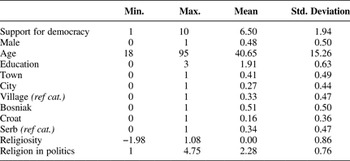
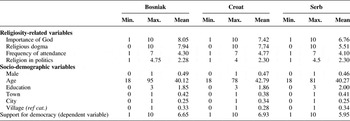
We begin our analysis by looking at simple descriptive statistics. In Table 1 we present descriptive statistics for the variables included in our analyses. Since levels of religiosity among ethnic groups are of considerable interest for this article, a more detailed descriptive statistics for measures of religiosity for Bosniaks, Croats and Serbs are presented in Tables 2 and A1 (online supplemental material).
Descriptive statistics

Descriptive statistics broken down by ethnic group

We can see from Table 1 that the average value of Support for democracy variable is 6.5. The variable is coded so that values higher than 5.5 indicate positive views toward democracy, and it therefore seems that Bosnians on average are positively inclined toward democracy. From the same table we can see that respondents in our sample are on average about 40 years old, and have (on average) fulfilled slightly less than secondary level of education. From dummy-variables representing size of place of residence we see that around 40% of our respondents live in towns, slightly less than 30% live in cities, and slightly more than 30% live in villages.Footnote 19 Regarding ethnicity, we see that about 50% of the respondents declared themselves as Bosniaks, 16% declared themselves as Croats, and 34% as Serbs.
Since values of the Religiosity variable are standardized (as previously explained), we cannot draw any simple conclusions based on any variable's mean value, but we can draw some conclusions based on the mean value of the Religion in politics variable. This variable is coded with values varying from 1 to 5, and with values below 3 indicating preferences for separation of the religious from the political sphere. One can see from Table 1 that the average preferences of Bosnian respondents are actually lower than 3, thus indicating support for the separation of religion and politics.
Since ethnic divisions, unfortunately, play a very prominent role in the current Bosnian political context and since the three main ethnic groups adhere to different religions, we also present detailed descriptive statistics broken down by ethnic groups in Table 2. Instead of little-informative descriptive statistics for the Religiosity variable, in this table, we present more detailed statistics for religiosity-related variables that are used to construct our composite measure Religiosity. The variable Religion in politics is presented in the same manner as in Table 1, since the four items on which the Religion in politics variable is based do not convey much relevant additional information by themselves.Footnote 20
With regard to socio-demographic variables, one can see in Table 2 that there are hardly any differences among the three major ethnic groups. The Serb sample seems to be slightly more highly educated than the other two, and there seems to be a somewhat higher proportion of city-dwellers in the Croat sample, but the general impression is that the socio-demographic differences among samples from the three ethnic groups are small. However, looking at the mean values of religiosity-related variables in Table 2, we see that Serbs score lowest on all three measures of religiosity that are not related to politics, while there is practically no difference among the three ethnic groups with regard to the Religion in politics variable. This means that Serbs seem to be less religious than Croats and Bosniaks, but that Serbs are not stronger supporters of separation of religion from politics than the other two groups are. Regarding the difference between Bosniaks and Croats, we see that Bosniaks score slightly higher on the Importance of God and Religious dogma variables, but that Croats score higher on Frequency of attendance. In other words, Bosniaks, on average, believe more in religious dogmas and put more weight on importance of God while Croats attend religious services more often.Footnote 21
The differences in the mean values of our dependent variable, Support for democracy, are of course of crucial interest and we shall discuss these in more detail. The average values of Support for democracy variable are: 6.93 for Croats, 6.65 for Bosniaks, and 5.95 for Serbs. Recall that higher values of the variable mean stronger support for democracy. As one can see, Croats seem to be exhibiting the highest levels of support for democracy, with Bosniaks exhibiting only slightly lower levels of support. The levels of support for democracy among Serbs seem to be somewhat lower. The differences between Serbs and the other two groups are roughly one point, with the level of support among Serbs being reported lower by one point (on a 1–10 scale) than levels of support among Croats, and about 0.7 point lower than levels of support among Bosniaks. We conducted t-tests to check whether differences in levels of support among the ethnic groups are statistically significant. It turns out that the difference between Croats and Bosniaks is not statistically significant at the conventional 0.05 level of significance, while the differences between Serbs and Croats and again between Serbs and Bosniaks are statistically significant at the same level of significance. This means that the observed differences in levels of support among Croats and Bosniaks might be attributed to coincidences associated with the drawing of the sample we used in analyses, while it is hardly likely that the differences between Serbs and other two groups are due to such coincidences. So, our conclusion here is that our data show that Serbs exhibit lower levels of support for democracy than Croats and Bosniaks, while the latter two groups exhibit roughly equal levels of support.Footnote 22
Recall that we indicated that we would find the largest support for majority rule among the members of the largest ethnic/religious group (Bosniaks) since, due to the size of their ethnically mobilized electorate, they will, through democratic processes, achieve dominance. Therefore, we expected that Muslim Bosniaks, being in the majority actually would be more pro-democratic than the two Christian groups. However, it is evident that the smallest group (Croats) and the largest ethnic group (Bosniaks) are equally supportive of democracy. According to “the dominance assumption,” the Bosniaks should be the most supportive and Croats the least, and while the Serbs would be somewhere in-between, and presumably more like Bosniaks than Croats. Being “protected” by the Dayton Peace Accords and the autonomy of the Republika Srpska, Serbs in Bosnia have, by this argument, less reason to fear the dominance of Bosniak majority than Croats who are the smallest group, and who are together in Federation with the Bosniaks’ majority (which is one of the major arguments why Bosnian Croats advocate the establishment of a third entity).Footnote 23 Since the Serbs are the least supportive of democracy and Muslims and Croats the most, this interpretation can be rejected.
RELIGIOSITY, RELIGION IN POLITICS AND SUPPORT FOR DEMOCRACY
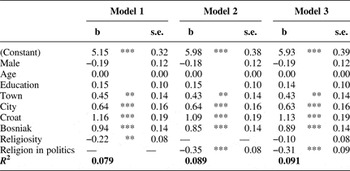
Now we turn our attention to associations between religiosity and support for democracy. The best way to analyze these associations is to use multiple regression models in which, in addition to religiosity, include also other possible determinants of democratic attitudes as control variables.Footnote 24 Since we have two different religiosity-related variables (Religiosity and Religion in politics), we present three different models. In Model 1, we include Religiosity and control variables as independent variables. In Model 2, we include Religion in politics instead of Religiosity and keep control variables unchanged. Finally, in Model 3, we include both our religiosity-related variables simultaneously in the model. All three models are presented in Table 3.
Unstandardized regression coefficients from regression analysis of support for democracy

Note: *p < 0.05; **p < 0.01; ***p < 0.001.
Looking at the effects of socio-demographic variables in Model 1 first, we can see that age, sex, and education do not have any statistically significant influence on support for democracy, but that the size of place of residence clearly has an influence. The reference category is villages and our model therefore predicts that Bosnians living in towns have 0.45 points higher support for democracy than those living in villages. Correspondingly, those living in cities are predicted to have 0.64 points higher support than those living in villages. Thus, a clear pattern emerges from our data — the larger the place of residence, the higher the support for democracy. One should also notice that these results are obtained after we control for rural-urban differences in distributions of age, gender, education, and religiosity. In other words, these observed differences in support for democracy between rural and urban residents are not caused by the former being more religious, elderly, or less educated. Regarding education, a somewhat surprising finding is that more highly educated individuals are not more supportive of democracy than individuals with low levels of education. This is good news, as it shows that support for democracy is not a phenomenon limited to highly-educated elites, but has spread also to the strata of the Bosnian population that have little or no education.
Regarding differences in support for democracy among the three ethnic groups, we can see that they have not diminished after control for socio-demographic characteristics and levels of religiosity; actually they have increased slightly.Footnote 25 We can gain some impression about the size of differences among ethnic groups by comparing them with other relevant differences in our model. For example, the difference in support for democracy between Croats and Serbs is twice as large as the difference between individuals living in villages and those living in large cities. Comparing Bosniaks and Serbs, the difference between them is 1.5 times as large as the village–city difference. Arguably, differences in worldviews between villagers and city-dwellers in Bosnia-Herzegovina tend to be considerable (Allcock Reference Allcock2002), and our data therefore indicate comparatively large differences in support for democracy between Serbs on one side and the two other ethnic groups on the other.
Finally, religiosity-related variables also showed statistically significant effects on support for democracy. We have included our two religiosity-related measures in three different models, and we will comment on each model briefly. In Model 1, Religiosity had a negative effect on support for democracy. This means that our respondents in Bosnia-Herzegovina who attend religious service often consider God to be important in their lives, and believe in religious dogmas tend to be less supportive of democracy than individuals who do not score high on these three criteria. In other words, respondents who score high on common measures of religious participation and belief tend to be less pro-democratic. In Model 2, the statistically significant negative effect of Religion in politics indicates that Bosnians who do not advocate separation of religious and political spheres tend to be less supportive of democracy as a system of political governance. The results from Model 3 demand a slightly more complex explanation: in this model, Religion in politics has a statistically significant effect on support for democracy, while Religiosity does not. This means that, after we control for Religion in politics, Religiosity does not have an influence on support for democracy. The new insight we gain from Model 3 is that religious participation and beliefs do not negatively affect support for democracy of those Bosnian respondents who do not also support the engagement of the religious organization in the political sphere. To put this in less formal language: in a hypothetical world in which religious participation and beliefs (measured by our Religiosity variable) do not correlate with views about separation between religious and political spheres, those individuals who score high on religious separation and beliefs would not be less supportive toward democracy. In the real world, Bosnian citizens who are more religious are also less supportive of a separation between religion and politics, and it is therefore for this reason that we find the negative effect of Religiosity in Model 1.
The models presented in Table 3 assume equal effects of religiosity variables for all three ethnic groups in our sample. However, if we run the models akin to the ones presented in Table 3 with the interaction terms between Religion in politics and ethnicity, it turns out that Religion in politics has negative influence on support for democracy of Bosniaks and Croats, but not of Serbs.Footnote 26
DISCUSION AND CONCLUSIONS
The core assumptions in this article were based on research that has demonstrated a negative relationship between religiosity and support for democracy and studies that have proposed that Bosnians, across ethnic and confessional lines, are very similar (Bieber Reference Bieber2006; Norris and Inglehart Reference Norris and Inglehart2004). Our findings support most, but not all, of our initial suppositions. Regarding the arguments that are supported: religiosity does have a negative influence on support for democracy, but only for Croats and Bosniaks. It is particularly so that Croat and Bosniak individuals who do not support separation of the religious from the political sphere exhibit lower support for democracy.
We may also conclude that the vast majority of Bosnians from all three ethnic groups and confessions are supportive of democracy, and that most individuals in all three groups prefer not to see strong ties between religious institutions and political institutions. However, there are some differences among the groups. We found that Bosnian Croats and Bosniaks are more religious than Bosnian Serbs. We also found unequal support for democracy across ethno-religious lines (also when we controlled for other individual traits such as educational level, age, sex, and place of residence). Nevertheless, our findings contradict Huntington's argument. We can here refer to two facts. First, according to Huntington, Bosnian Muslims should be less supportive of democracy than the rest of the Bosnian (Christian) population. According to our findings, the differences in support for democracy in Bosnia do not reveal a difference between Christians and Muslims. On the contrary, our findings are more in line with the study by Norris and Inglehart that suggested that the Orthodox populations are the least democratically oriented (Norris and Inglehart Reference Norris and Inglehart2004). Our findings are that Serbs in Bosnia-Herzegovina are clearly less supportive of democracy than Croats or Bosniaks, also when controlled for all other background variables. As already noted, the difference in support for democracy between Serbs and the other two ethnic groups is larger than the corresponding difference between the rural and urban populations of Bosnia-Herzegovina. Second, we found that the level of religiosity related to “religiosity in politics” has a strong negative influence on support for democracy of Croats and Bosniaks, but not of Serbs. The Serbs are less religious than Croats and Bosniaks, and they exhibit somewhat lower support for democracy independently of their level of religiosity.Footnote 27 Based on our findings we can conclude that there must be some other factors that influence Serbs’ attitudes toward democracy, and that these are not related to religiosity.
Norris and Inglehart's argument is that “the poor performance of electoral democracy” (Norris and Inglehart Reference Norris and Inglehart2004, 148) may explain lower support for democracy in several Eastern European countries with predominantly Orthodox populations (Norris and Inglehart Reference Norris and Inglehart2004, 154). If we follow Norris and Inglehart's argument we might expect that Bosnian Serbs, Muslims, and Croats should have an equally “realistic evaluation of the actual performance of democracy” (Norris and Inglehart Reference Norris and Inglehart2004, 154) since all three groups live in the same country. Why then do Bosnian Serbs exhibit less support for democracy? One possible explanation is offered by Sabrina Ramet (Reference Ramet2005; Reference Ramet2006b). She argues that the propaganda of the Milošević era was effective in demonizing Bosniaks and Albanians (who were the largest ethnic groups in Bosnia and Kosovo, respectively) and in promoting a collective sense of victimization among Serbs, as well as in convincing Serbs that they were “entitled” to create a so-called “Greater Serbia,” that political attitudes supporting majority rule, i.e., democracy, were suppressed (Ramet Reference Ramet2005, 125–126, 132, 136–137).Footnote 28
Another line of explanation can be provided by taking a point of departure in the literature on the field that refers to the “neo-Slavophile anti-western” sentiments, which emerged among the Serbs after the disintegration of Yugoslavia (Perica Reference Perica, Byrnes and Katzenstein2006, 180–187).Footnote 29 If we compare the Serbs with the Bosniaks and Croats, we may argue that anti-Western sentiments were less emphasized among the two latter groups. Even if anti-Western sentiments and skepticism vis-à-vis Western democracy can be found among Bosniaks, it seems that such sentiments are restricted to smaller group of Wahhabis.Footnote 30 The pro-Western, pro-European sentiments were found even among Croat nationalists who were criticized by the West (Melčić Reference Melčić, Ramet, Clewing and Lukic2008; Sadkovich Reference Sadkovich, Ramet, Clewing and Lukic2008). For example, Croatian president Franjo Tudjman (1922–1999) stressed that the democratic, “West-European Croats” should be distinguished from the other, “non-western oriented” groups in the Balkan region which “belong to the East.”Footnote 31
The Serbs have often displayed great skepticism about Western democracies.Footnote 32 The literature on recent ex-Yugoslav and Serbian history suggests several reasons for this skepticism (Perica Reference Perica, Byrnes and Katzenstein2006, 187). Notions about Western conspiracies against the Serbs and Western countries, which have helped in destroying the Socialist Yugoslavia are commonly heard in the Republika Srpska and Serbia.Footnote 33 Arguably, this skepticism may also be connected to the perception that Western democracies have forced them to remain in the Bosnian state, supported the secession of Kosovo, humiliated them and bombed them in Bosnia, Serbia, and Kosovo.Footnote 34 As Perica has pointed out, such interpretations of recent Serbian history have contributed to foster a “besieged-fortress” mentality and “martyr-nation image” and generated ambivalence toward Western democracies among the Serbs (Perica Reference Perica, Byrnes and Katzenstein2006, 187).
Nevertheless, one should also remember that levels of support for democracy are quite high for all three groups in our analysis, including Serbs. It therefore seems that democracy as a system of governance is accepted by the vast majority of Bosnians, and although the religious communities are involved in political life, the members of all three groups do not support the involvement of religious institutions in politics. However, it remains to be seen if citizens of the country will manage to overcome the current dominance of ethnic issues in political life and to develop stable and well functioning political institutions.Footnote 35 It also remains to be seen which role Bosnia religious leaders, including the IRC, will play in the country's political life. Here we can again refer to Clark (Reference Clark2010) who maintains that religious actors are reinforcing the existence of three versions of truth about the war in Bosnia-Herzegovina that contributes to keeping the Bosniaks, Serbs, and Croats locked in their own sense of victimhood (Clark Reference Clark2010). We agree with Clark that religious leaders should instead be engaged in self-critical evaluation of the war in Bosnia-Herzegovina. Even more importantly, they should be more engaged in the process of reconciliation instead of being often in support of nationalist parties that promote the politics of intolerance.
How can we relate this article to general debates on the relationship between religion and democracy? We want to stress that our findings have at least two implications for debates on the relationship between religion and democracy. First, the findings from the Bosnian case display the tendencies also found in other countries (Karpov Reference Karpov1999; Norris and Inglehart Reference Norris and Inglehart2004). Together with these studies, this article strengthens the argument that religiosity may have a negative influence on support for democracy. Second, our findings from Bosnia are consistent with cross-national studies on links between Islamic attachments and support for democracy.Footnote 36 Together with these studies, the findings from Bosnia contribute to strengthening the argument that Christians and Muslims show similar attitudes concerning democracy.