Introduction
Food products and production processes following environmental, social, quality and safety standards have become increasingly popular among traders, retailers and consumers in industrialized countriesReference Asfaw, Mithöfer and Waibel1–Reference Rigby and Cáceres6. In the past decade, organic certified products have moved from niche to mass markets in industrialized countries; a similar trend is likely to emerge for ethical and fairly traded productsReference Codron, Siriex and Reardon3.
The shift in consumer awareness and demand, including the willingness to pay higher prices for certified and/or high-quality products, has also been noticed by farmer organizations and governments in developing countries, non-governmental organizations (NGOs) and international donorsReference Bolwig, Gibbon and Jones7, Reference Pelupessy and Díaz8. To address the deteriorating terms of trade of agricultural commoditiesReference Kaplinsky9, price volatilityReference Cashin, McDermott and Scott10 and rural poverty, NGOs and policy-makers recommend upgrading agricultural production and entry to high-value marketsReference Bolwig, Gibbon and Jones7, Reference Pelupessy and Díaz8. This is seen as a way to enhance the benefits accruing to producersReference Humphrey and Schmitz11–Reference Riisgaard, Bolwig, Ponte, Du Toit, Halberg and Matose13. Coffee producers and their cooperatives can upgrade by offering products with higher quality or additional environmental or social certification or by processing and exporting the goods themselvesReference Bolwig, Gibbon and Jones7, Reference Kilian, Jones, Pratt and Villalobos14–Reference Willer and Yussefi16. As the food and agricultural commodity value chains have shifted from domestically oriented, state-controlled systems to globally integrated food supply chains with private governance, new forms of vertical coordination have emergedReference Swinnen and Maertens4. Cooperatives can facilitate farmers’ access to these vertically integrated food supply chainsReference Wollni, Lee and Thies17. Each cooperative thereby follows a certain business model: how the cooperative is run, its internal organization and values, as well as services offered such as credit or marketing services.
Farmer organizations, cooperatives and companies are under constant pressure to increase their competitiveness and improve their performanceReference Humphrey and Schmitz11. In the coffee sector, smallholder producers and cooperatives have to defend themselves against low-cost producers in Brazil and Vietnam. The sector is also characterized by frequent over-supply, production shocks and high price volatilityReference Cashin, McDermott and Scott10. Access to high-value (coffee) markets offers potentially great rewards, but there are also considerable challengesReference Kaganzi, Ferris, Barham, Abenakyo, Sanginga and Njuki18.
A typical suggested upgrade for coffee producers is participation in certification schemes such as the organic and/or Fairtrade certification19–Reference Gutierrez21. Both schemes aim to increase the welfare of smallholder producers through improving production and marketing processesReference Kilian, Jones, Pratt and Villalobos14, Reference Linton15, 22, Reference Wills and Osterhaus23. The focus of organic certification is on environmentally friendly production processes, whereas Fairtrade certification focuses on social standards and fair marketing and trading conditions. The details on the standards of organic and Fairtrade certification are widely available in the literatureReference Rigby and Cáceres6, Reference Barrett, Browne, Harris and Cadoret24–Reference Raynolds, Murray and Heller27. Although Fairtrade certification is only available to coffee producers organized in a group or cooperative, organic certification is also issued to individual producers. Organic certification costs can be high and often smallholders can only afford certification when they participate as a group. Several research studies have indicated that organic and Fairtrade certification can improve education, health and infrastructureReference Arnould, Plastina and Ball28, Reference Bacon, Ernesto Mendez, Gomez, Stuart and Flores29, and increase social organization and capacity buildingReference Raynolds, Murray and Taylor30–Reference Taylor, Murray and Raynolds32. However, while some studies identified price premiums for both certifications and economic benefits at the producer level in Latin AmericaReference Raynolds, Murray and Taylor30, Reference Bacon33, Reference Wollni and Zeller34, other research has found few economic benefits for farmersReference Kilian, Jones, Pratt and Villalobos14, Reference Mutersbaugh35–Reference Philpott, Bichier, Rice and Greenberg37.
The existing literature largely addresses the socioeconomic effects of coffee certification on smallholders with a focus on farm, household and community levelsReference Bacon, Ernesto Mendez, Gomez, Stuart and Flores29, Reference Barham, Callenes, Gitter, Lewis and Weber38, Reference Valkila39 but only marginally deals with farmer organizations' business model and upgrading strategies. A separate stream of literature identifies the determinants for successful collective action, group formation, farmer organizations, and resulting advantages and disadvantagesReference Markelova, Meinzen-Dick, Hellin and Dohrn12, Reference Kaganzi, Ferris, Barham, Abenakyo, Sanginga and Njuki18, Reference Hellin, Lundy and Meijer40–Reference Thorp, Stewart and Heyer42 but does not focus specifically on upgrading strategies. The fit of upgrading strategies to the business model of a farmer organization as well as the determinants for the success of upgrading through certification have been neglected by research so far. This may partly account for the contradictory findings regarding economic benefits from certification in the above cited studies. Additionally, most of the cited studies on certification effects have neither randomly sampled cooperatives/farmer organizations nor analyzed several cooperatives or certification standards simultaneously. Arnould et al.Reference Arnould, Plastina and Ball28 worked with randomly sampled cooperatives, but did not analyze their business models. Raynolds et al.Reference Raynolds, Murray and Taylor30 systematically compare seven, non-randomly selected, Fairtrade certified producer cooperatives in Mexico, Guatemala and El Salvador. The authors find that successful Fairtrade participation depends on the political, economic and marketing conditions, the social and ecological resources of producers, and the producer groups' internal organization and external linksReference Raynolds, Murray and Taylor30, yet they did not analyze the latter in depth. As only one certification scheme is targeted and no comparison with cooperatively organized conventional producers was made, the Raynolds et al. study cannot differentiate between the socioeconomic effect of certification and the socioeconomic effect of being organized in a cooperative or producer group.
Raynolds et al.Reference Raynolds, Murray and Taylor30 assume that their above identified characteristics have proven to be historically successful but are likely to be insufficient in the future given the growing competition in Fairtrade markets. In this paper, we focus specifically on the roles of the producer groups, their business models and upgrading strategies in the success of certification schemes. We analyze cooperatives with two certification schemes, organic and Organic-Fairtrade, and compare these to a control group of cooperatively organized conventional coffee smallholders.
The following three research questions are analyzed:
(1) Do the business models and upgrading strategies differ between conventional, organic and Organic-Fairtrade certified cooperatives apart from the certifications?
(2) Are there differences in the strengths, weaknesses, opportunities and threats (SWOT) between conventional, organic and Organic-Fairtrade certified cooperatives?
(3) How are the coffee gross margins linked to the organic and Organic-Fairtrade certification strategy, the cooperative's business model and its other upgrading strategies?
We collected over 100 qualitative in-depth interviews from seven cooperatives in northern Nicaragua representing conventional, organic and Organic-Fairtrade certified smallholder coffee producers. We also conducted a two-stage random sample based household survey with 327 coffee producers of the seven cooperatives.
The article is structured in seven sections. The next section presents the conceptual framework. The third section describes the sampling framework and the analytical methods. In the fourth section, we describe the cooperatives' business models. Section five analyzes the upgrading strategies and the SWOT of the conventional, organic and Organic-Fairtrade certified cooperatives. These results are linked to the coffee gross margins obtained by the cooperative members in the sixth section. The last section contains the conclusions and policy recommendations.
The Conceptual Framework: Business Models and Upgrading Strategies of Coffee Cooperatives
The potential of smallholders to increase their agricultural incomes increasingly depends on their ability to access output marketsReference Markelova, Meinzen-Dick, Hellin and Dohrn12, Reference Hellin, Lundy and Meijer40. Farmer organizations such as cooperatives can play an important role in connecting producers to markets. A market-oriented cooperative is characterized by a group of economically active individuals who engage in a joint undertaking with the objective of deriving benefits for themselves as membersReference Dülfer43, Reference Kramer44. Over the past few decades, cooperatives have increasingly adapted their organizational structures according to market conditions. This has led to a broader range of cooperative structures than beforeReference Kramer44. Each cooperative, such as a company, follows an individual business model and these business models can be seen as ‘stories that explain how enterprises work’ (MagrettaReference Magretta45, p. 87). The business models of cooperatives can be classified according to microeconomic aspects such as the main activity (credit/savings, production, consumption and service), the type of economic functions or services (supply/purchase, marketing, production, financing and administration), the number of functions and services, and the degree of organization (informal or formal)Reference Zerche, Schmale and Blome-Drees46. Service cooperatives offer input supply, processing and marketing of outputs, financing, and also provide technology or support to their members in entering high-value marketsReference Markelova, Meinzen-Dick, Hellin and Dohrn12, Reference Deininger47. Agricultural cooperatives in developing countries tend to offer multiple services.
In Nicaragua, cooperatives have a long history. Agricultural cooperatives were founded in the 1930s. In 1979, 634 cooperatives existed, although only 88 really functionedReference Blandón, Hermógenes, Ruiz Chavéz, Róger Juárez and Duarte Mena48. With the overthrow of the Somoza dictatorship in 1979, the land owned by the Somoza family was expropriated by the new government, the Frente Sandinista de Liberación Nacional (FSLN). FSLN strongly supported cooperatives, especially those with collective production. Somozas's property, around 20% of Nicaragua's farm lands, was first turned into state farms and later, as for other expropriated or purchased farmland, handed over to agricultural cooperatives or individual smallholdersReference FitzGerald49. Members of the cooperatives could inherit, but not sell, the title or part of the land50. The state farms and the agricultural production cooperatives were strongly supported by the government with inputs and creditsReference FitzGerald49, Reference Ruben and Zerman51. Especially in northern Nicaragua, the government also used them as political organizationsReference FitzGerald49. By the end of the 1980s, 2174 cooperatives existed: 1685 agricultural cooperatives, 58 credit and savings cooperatives, and 73 service cooperativesReference Blandón, Hermógenes, Ruiz Chavéz, Róger Juárez and Duarte Mena48.
The ushering in of a new government in the early 1990s, led to a wave of economic liberalization. Agricultural cooperatives were no longer given preferential treatment and it was permitted to hand over collectively owned land to individual cooperative members. In 1989, rural cooperatives occupied approximately 21% of the agricultural land; by 1999 this figure had been reduced to 9%Reference Ruben and Zerman51. Many of the agricultural cooperatives have disappeared since then but some of today's cooperatives still have a history related to the former politically supported cooperativesReference Ruben and Zerman51.
Cooperatives in Nicaragua are currently undergoing structural changes in response to a law passed in 2004 obliging them to register legally and to restructure. This has led to a relatively homogeneous organizational structure within the currently registered cooperatives. However, not all existing cooperatives have finished this registration process, largely because they could not afford to pay for the obligatory training of cooperative members and staff. The hierarchical organization of cooperatives distinguishes first-, second- and third-level cooperatives. The first-level cooperative is the lowest level where individual farmers are members. The organizational components of first-level cooperatives are the general assembly (either members or elected delegates), the supervisory board that controls finances, and the administrative board or steering committee composed of the president, vice president and treasurer. The steering committee is supported by several specialized committees, e.g. for education, credits and marketing. A minimum of five first-level cooperatives can form a second-level cooperative and by doing so secure economies of scale in processing, marketing or exporting of products. Second-level cooperatives can then consolidate to form third-level cooperatives or federations. Many variations of this still exist because the law has not yet been fully implemented. The agricultural cooperatives in Nicaragua today mainly offer multiple services.
Shafer et al.Reference Shafer, Smith and Linder52 define a business model as a description of the underlying logic of a cooperative/company and its strategic choices for creating and capturing value within a value chain. This implies that cooperatives pursue a strategy to create additional value by differentiating themselves from competitorsReference Magretta45. Upgrading strategies are mainly seen as strategies that improve the position of producers or cooperatives in the value chain through shifting to more (economically) rewarding functional positions, for example through the uptake of new activities previously performed by other chain actors or through increasing the added value of production or improving returnsReference Humphrey and Schmitz11, Reference Bolwig, Ponte, Du Toit, Riisgaard and Halberg53–Reference Giuliani, Pietrobelli and Rabellotti55. In a broader definition, upgrading can additionally include a change of activities which leads to reduced exposure to riskReference Riisgaard, Bolwig, Ponte, Du Toit, Halberg and Matose13, Reference Ponte and Ewert56. This broader definition embraces the possibility of downgrading. For small producers and entrepreneurs in developing countries, Riisgaard et al.Reference Riisgaard, Bolwig, Ponte, Du Toit, Halberg and Matose13 identify seven possible upgrading strategies that can be grouped into three types according to (i) the improvement of the product, volume or production process, (ii) the change and/or the adding of functions in the chain, and (iii) the improvement of value chain coordination through horizontal and vertical contracts.
Product improvements can be achieved through increasing quality, complying with certification, such as organic or Fairtrade, or by meeting food safety standards. Improvements of the produced volume can be obtained through increases in yield or area, whereas the production process can be improved through increasing efficiency or reducing negative externalities such as environmental pollution. The change of functions in the chain refers to either (a) functional upgrading, such as taking on new functions such as processing, exporting, roasting or providing services/inputs, or (b) functional downgrading through the abandonment of unprofitable activities and a focus on core activitiesReference Riisgaard, Bolwig, Ponte, Du Toit, Halberg and Matose13. Vertical value chain coordination can refer to improving business ties with buyers through contracts instead of spot market sales. For example, cooperatives may contract directly with coffee roasters. Horizontal coordination can be agreements among producers or cooperatives to cooperate over marketing, services or input provision.
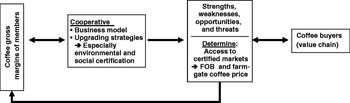
To summarize, the conceptual framework builds on the cooperative, its business model and chosen upgrading strategies (Fig. 1). We use the term business model for the cooperatives based on the above-mentioned definitions, but limit the analysis to organizational structure, size, functions, services and financial characteristics. The classification of upgrading strategies is based on the framework of Riisgaard et al.Reference Riisgaard, Bolwig, Ponte, Du Toit, Halberg and Matose13 A particular focus is on the upgrading strategy of environmental and social certifications such as the organic and Organic-Fairtrade certification. The business model and upgrading strategies together determine the strengths and weaknesses of the cooperative which are internal factors. External factors emerge from the natural and business environment within which the cooperative operates. They constitute opportunities for development as well as threats. The internal and external factors determine the access to certified markets as well as the coffee prices the cooperative obtains in international markets, and thus influence the farm-gate price a cooperative can offer to its members.
The influence of the cooperative's business model and upgrading strategies on members’ coffee income.

Sampling Framework and Methods
The research was conducted in northern Nicaragua, in the departments Madriz and Nueva Segovia, on coffee farms situated between 900 and 1300m above sea level. Through pre-study field visits and key-person interviews, we ensured that the research region was homogeneous in terms of living conditions (such as remoteness, hard and soft infrastructure, market access, housing, etc.), the socioeconomic level of the smallholders, and the on-farm coffee growing characteristics. The coffee quality of all farmers fell into the ‘Strictly High Grown’ (SHG) category. This was also verified ex-post by the household survey. Quantitative household data were collected in 2007. Cooperatives were randomly selected from a self-established list as there was no official list of all the cooperatives in the region. The list of existing cooperatives was compiled during several field visits and key-person interviews. We then classified cooperatives according to their certification into conventional, organic and Organic-Fairtrade certified cooperatives, and randomly selected the cooperatives. The coffee growing cooperative members from the selected cooperatives were the population from which the interviewed households were selected. The household selection was done either using a simple random sampling or a two-stage random sampling, depending on the regional spread of the cooperative. Using a structured questionnaire, 327 cooperative members were surveyed with nearly equal shares of conventional, organic and Organic-Fairtrade producers. The response rate was 100%. The household questionnaire included data on the household demographic characteristics, the dwelling, food consumption, assets, access to financial services, agricultural production with a special focus on coffee production and cost data, marketing channels, coffee prices and certification.
One conventional cooperative dropped out of the study near the end of the data collection period. The conventional cooperatives are called CONV-A (n=37) and CONV-B (n=31); the organic certified cooperatives ORG-B (n=32) and ORG-C (n=76); and the Organic-Fairtrade certified cooperatives OFT-D (n=34), OFT-E (n=36) and OFT-F (n=34). ORG-B is a subgroup of organic coffee producers of the conventional cooperative CONV-B. If not further specified, we use the term ‘certified’ to refer to both the organic and the Organic-Fairtrade certification.
In addition, in 2007 and 2008 qualitative data were collected through 48 key-person interviews with cooperative staff, exporters, roasters and researchers, 33 semi-structured producer interviews, and 21 focus group discussions, with an average of nine participants in each group. The interviews with the cooperative staff examined the cooperative's business model, its upgrading strategies, coffee sales, and its SWOT. All interviewees gave their informed consent prior to the quantitative and qualitative interviews.
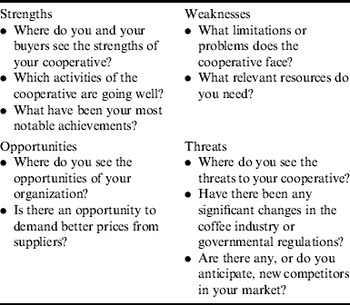
We used a SWOT analysis to identify internal and external factors that affect the cooperatives and their implicit goal of increasing their member's economic welfare. A SWOT analysis helps to provide a quick picture of an organization's current position and its short-term futureReference Fleisher and Bensoussan57. This overview can be used to evaluate the current situation and make strategic decisions about the futureReference Dabbert and Braun58. Being a descriptive model it does not offer explicit strategiesReference Fleisher and Bensoussan57, but provides a transparent overview and reveals important problem areasReference Rauch59. Organic or Organic-Fairtrade certification as an upgrading strategy is compared with the ‘business as usual’ model of conventional cooperatives. The questions listed in Table 1 are the guiding questions used in the interviews with the cooperative staff. In addition key-persons, such as coffee exporters and NGO staff, were also asked these questions to obtain a broader view of the coffee sector in Nicaragua.
Questions regarding cooperatives' SWOT.

In the next step, we link the cooperative business models, SWOT and upgrading strategies with farmers' coffee gross margins. Gross margins are calculated per hectare of coffee. Even certified coffee producers usually sell to various coffee buyers outside their cooperatives. These sales are called ‘off-sales’. We calculate the revenue per hectare by calculating the quantity of coffee sold in a market channel, multiplying this by the farm-gate coffee price obtained in that market channel and then dividing that figure by the coffee area in hectares. The farm-gate coffee price is the final price farmers receive after the cooperative or exporter has deducted their costs for coffee drying, processing, transport, administration, fees and taxes. The costs for the organic and Fairtrade certification are reflected in the farm-gate coffee price. Farm-gate coffee prices were discounted in those cases when the cooperative paid months after the coffee harvest. In addition, we indicate the average price coffee producers received across all marketing channels by dividing the total revenue of a farmer by the total quantity of coffee sold. By deducting the variable production costs from the revenue, we determine the gross margin. The variable production costs include all input costs such as organic or chemical fertilizer, pest, disease and weed treatments (chemical and/or organic), transport costs related to the purchase of inputs and coffee sale, the costs occurred at harvest for, e.g., coffee picking, wet processing, sacks, and the costs for hired labor. For a more detailed description of the calculation, please refer to Beuchelt and ZellerReference Beuchelt and Zeller60. The gross margins of the cooperative members are used to indicate the success of the certification schemes.
The Business Models of the Sampled Cooperatives
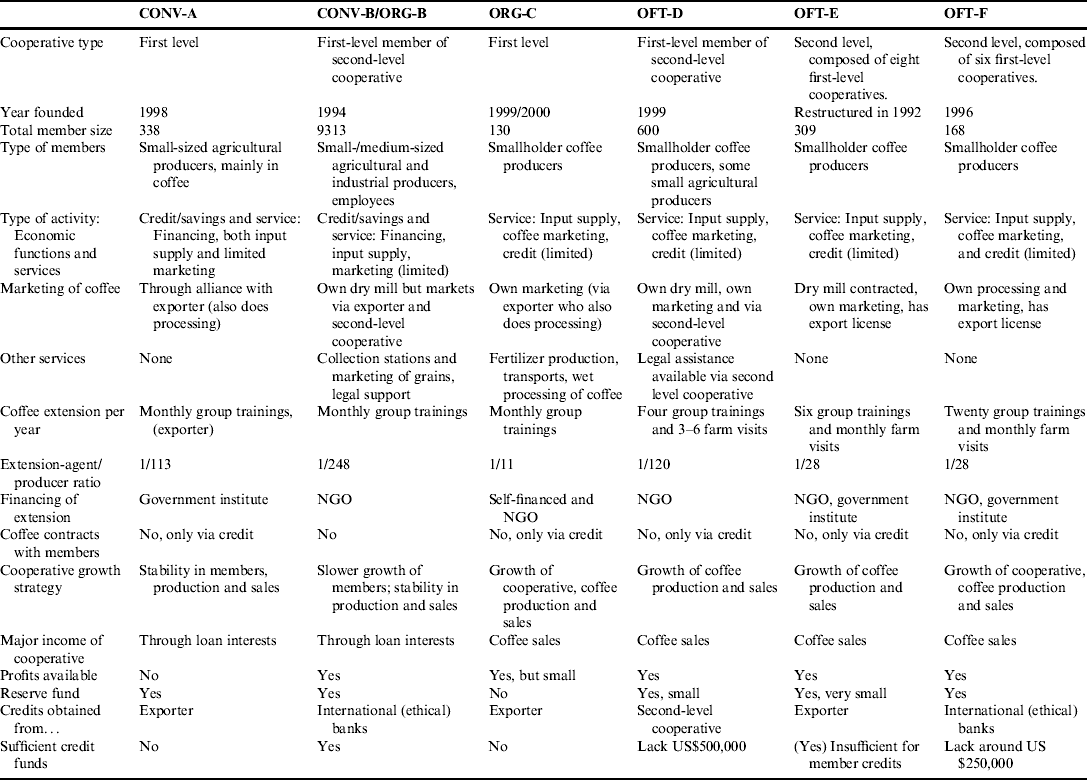
An overview of the cooperatives' business models, their characteristics and services offered is presented in Table 2. The two conventional cooperatives focus on offering financial services such as provision of credit as well as savings accounts. Cooperative CONV-A markets coffee through an alliance with an exporter. Cooperative CONV-B offers many additional services such as supplying inputs and storage, as well as grain and coffee marketing. The certified cooperatives focus mainly on service provision regarding coffee-related services such as extension, processing and marketing of coffee. They market the coffee themselves or via the second-level cooperatives with which they have alliances. Except for the cooperative CONV-A, all other cooperatives offer basic coffee inputs such as fertilizers, insecticides or fungicides, or the needed ingredients for home mixtures. The organic cooperative ORG-C additionally produces and sells high-quality organic fertilizer at cost-recovery prices. For a small fee, the cooperative even transports the fertilizer to the member's plots. Through both services members are able to apply more organic fertilizer than normal which helps to increase their yield levels (see Table 5). The same cooperative also built a central wet processing station in 2006. This was an essential upgrading strategy as many individual members did not own wet processing mills.
Overview of the characteristics and services of conventional, organic and Organic-Fairtrade certified cooperative business models.
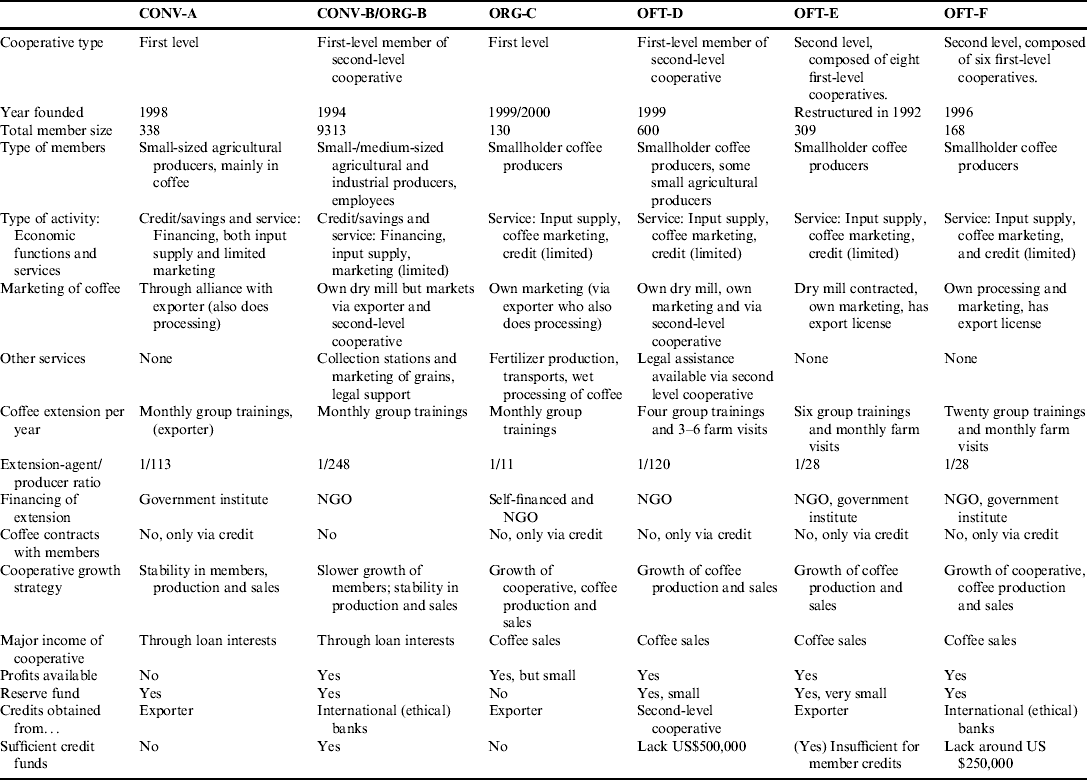
The extension service for coffee producers varies significantly between cooperatives. The least favorable extension agent–producer ratio was offered by cooperative CONV-B/ORG-B for both their conventional and organic members (Table 2). The best extension agent–producer ratio is offered by the two smaller Organic-Fairtrade certified cooperatives that received funding from both an NGO and a governmental institution for their extension service. There is a tendency for certified cooperatives to offer a better extension agent–producer ratio compared with conventional cooperatives. As cooperative ORG-C could not obtain sufficient external funding for an extension agent, the members decided to pay part of it themselves.
Coffee producers do not have contracts regarding coffee delivery or prices with their cooperative. Except in cooperative CONV-B, members are obliged to pay back credits from the cooperative with coffee. Through this tied contract the cooperatives ensure loan repayment and coffee delivery. They can also estimate the minimum coffee quantity delivered to the cooperative which reduces the risk when negotiating with coffee buyers. As the conventional cooperatives have a stronger focus on offering financial services, they are able to provide sufficient credit to their members. The certified cooperatives have to limit their credit offer to their members because the cooperatives lack sufficient funds and face liquidity constraints. The conventional cooperatives finance themselves through loan interest, the certified cooperatives from coffee sales.
The certified cooperatives focus on growth of coffee production and thus coffee sales, with the aim of reducing transaction costs through economies of scale. The two conventional cooperatives focus on stability in production and sales. Cooperative CONV-B experienced strong member growth rates in the past 5 years; in 2003, they had only around 1400 members compared with 9300 in 2008. Apart from having opened many regional branch offices which contributed to their growth, the cooperative also introduced an insurance policy to cover funeral costs for their members, which according to informal statements, attracted many new members.
The cooperatives are not financially autonomous. Apart from cooperative CONV-B, all depend on credit and face limited credit access. Cooperatives often lack appropriate collateral and therefore do not obtain sufficient credit to manage satisfactorily the coffee marketing, investments or the members' credit demand. Cooperatives have no access to state bank credit which could help to reduce their dependency on exporters and international finance institutions. Cooperatives CONV-B/ORG-B and OFT-F obtain credit from international ethically oriented finance institutions such as Oikocredit or Rabobank. In the case of profits, credit access and reserve funds, no major differences can be identified between the conventional and certified cooperatives. Since 2004 cooperatives have been required by law to have a reserve fund to increase their financial stability, but cooperatives have struggled to build up this fund.
The business models of each cooperative differ and no major similarities can be found within each group of cooperatives apart from the certification strategy. When the organic and Organic-Fairtrade certified cooperatives are grouped, they have more aspects in common as a ‘certified’ group than with the conventional cooperatives. The certified cooperatives focus more on coffee-related services, while conventional cooperatives tend to have a stronger focus on financial services which may relate to their history.
Upgrading Strategies and the SWOT of Cooperatives
Analyzing the upgrading strategies and the SWOT of cooperatives, we found that while upgrading strategies are specific to each cooperative, the SWOT of cooperatives can be cooperative specific but some are also shared by all cooperatives. Since the SWOT of each cooperative are also linked to the upgrading strategies chosen, we have divided this section into a discussion of (i) the cooperatives' specific upgrading strategies and SWOT, and (ii) the SWOT which all cooperatives have in common.
Cooperative-specific upgrading strategies and SWOT
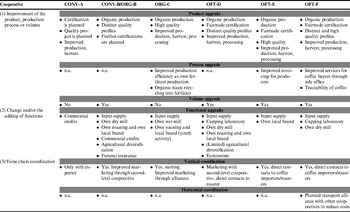
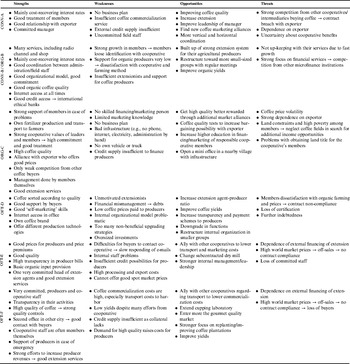
The upgrading strategies and SWOT of each cooperative are described in Tables 3 and 4, respectively. Based on these two tables, we analyze whether the upgrading strategies and individual SWOT are typical for and can, thus, be grouped according to conventional, organic and Organic-Fairtrade certified cooperatives.
Upgrading strategies of conventional, organic and Organic-Fairtrade certified cooperative models.

SWOT of conventional, organic and Organic-Fairtrade certified cooperative business models.

The sampled cooperatives apply several upgrading strategies in order to improve the income of the cooperative and its members (see Table 3). The participating cooperatives concentrate on product, process, volume and functional upgrades, as well as vertical coordination. Product upgrades are similar between all cooperatives; the focus is on certification, distinct quality profiles and improved production, harvesting and processing. Process upgrades such as offering organic fertilizer, improved invoicing and services to coffee buyers or traceability are specific to only one cooperative. When the certified cooperatives are grouped together, they tend to offer more with regard to process upgrade than the conventional cooperatives. Nearly all cooperatives try to increase the coffee volume sold.
The range of functional upgrades is diverse and the number of upgrades in this category varies between the cooperatives. All cooperatives applied at least one functional upgrade, others up to six; yet, as Table 4 shows, with different levels of success. Comparing conventional, organic and Organic-Fairtrade certified cooperatives, no specific differences in upgrading strategies can be identified which go beyond the certification strategy and would allow for generalizations. This can be explained by the tendency of cooperatives to imitate the upgrading strategies of other cooperatives in the region. Also NGOs, including those linked to the government, advocate similar strategies for cooperatives.
The cooperative specific strengths vary between the cooperatives and range from good relationships to buyers and members, transparency, staff commitment to good coffee quality, to additional services offered. In terms of weaknesses we again found a large variance between the cooperatives, starting from the lack of a business plan, lack of sufficient credit access, lack of qualified or committed staff, low levels of extension, bad infrastructure, or implementation of too many upgrading strategies. The interviewed cooperatives plan to invest in increasing upgrading activities even though the potential benefits of this upgrading are not necessarily evaluated ex-ante. For example, upgrading strategies of cooperative OFT-D became a large financial and management burden for the cooperative and present a current weakness that is likely to turn into a threat.
Opportunities exist in finding new marketing alliances, improving coffee quality and yield levels, and increasing extension services and transparency. Other opportunities include more horizontal or vertical coordination for marketing (CONV-A, ORG-C and OFT-F) or respectively to downgrade (OFT-D). The planned change in horizontal value chain coordination of cooperative OFT-F to reduce export-related transport costs through a transport alliance with other cooperatives could be an opportunity for all certified cooperatives if it is well managed and regulated. Threats can range from the strong dependence on one buyer and on external financing of extension, to land constraints and cooperative debts. A threat mentioned especially by the Organic-Fairtrade certified cooperatives is the intense competition from other coffee buyers such as intermediaries, exporters and sometimes even other cooperatives. The usual advantage of non-cooperative buyers in Nicaragua is that they possess sufficient funds to pay producers on the spot and thus cash-desperate members sell their coffee to them.
The certified cooperatives are further threatened by high conventional coffee prices. This is because additional premiums for certified coffees dwindle as conventional coffee prices rise at a faster rate than organic and Fairtrade coffee prices. Since high-quality certified coffee is costly to produce, decreasing profit margins trigger an increase in low-quality coffee off-sales by the cooperative members. As the CEO of cooperative OFT-F puts it ‘It sounds like a paradox, but the biggest threat for us is high world market coffee prices’ (personal communication, April 2008).
Four lessons can be derived. First, apart from the certification strategy, it is difficult to further classify the cooperatives' upgrading strategies and SWOT into typical categories that only apply to conventional or only to organic or Organic-Fairtrade certified cooperatives. Second, successful upgrading strategies of one cooperative are copied by other cooperatives as most upgrading strategies are relatively easy to imitate. This creates competition in what are often very small market niches, such as certified coffees. Due to the limited market size for certified coffees, profit margins decrease as new cooperatives enter certification—even when certification costs decrease. Coffee buyers can exert more bargaining power and pressure on certified coffee prices (cf. conceptual framework). Certified cooperative managers, for example, stated in the interviews that organic premiums were declining, whereas buyers increasingly demand higher quality.
The third lesson is that activities and strategies which are strength for one cooperative can be a weakness or threat to another cooperative. This is the case for the cooperative's internal organization, staff commitment, the extension system and some upgrading strategies. A fourth lesson is that imitating an upgrading strategy is not always successful. This highlights the need for a careful choice of the upgrading strategy according to the cooperative business model.
SWOT common to all sampled cooperatives
Common strengths
The strength of all cooperatives is that coffee production is located at high altitudes with very good coffee quality potential. The region's coffee has won several prizes in highly prestigious international competitions. Generally, all cooperatives indicate a trend in the coffee industry towards higher quality, especially those having certification. Therefore, investing in high quality constitutes an opportunity for coffee growers and cooperatives of that region.
Common weaknesses
All cooperatives strongly depend on external credit supply and do not have enough own funds to run their operations. Not all have sufficient credit access to fully finance their operations or to offer adequate credit to their members. As cooperatives cannot provide enough credit, their members obtain additional credit from other sources, such as microfinance institutions, or from intermediaries who offer a cash advance on coffee delivered later. The coffee delivered to intermediaries is then not available to the cooperative, which reduces its turnover.
The cooperatives are located in an area with a weak rural infrastructure. This raises the cooperative's operation costs, e.g., expenses for an electrical generator, transport problems due to unpaved roads and bad condition, unreliable fixed phone, poor mobile phone and Internet connectivity. None of the cooperatives have completely self-financed extension service and they depend strongly on externally funded extension provision which is often tied to short-duration development projects.
Common threats
A threat for cooperatives is the microclimatic variation. Coffee producers and cooperatives indicated that weather conditions are becoming less predictable, whereas coffee requires a specific rainfall pattern over the year. The microclimatic variations make it difficult for cooperatives to estimate accurately the harvest, hence, threatening compliance with coffee and credit contracts, and increasing transaction costs. A further threat is the possibility of corruption and mismanagement of cooperative funds as members have little control over the decisions taken by the board of executive managers.
Common opportunities
To increase members' control over management and to make the benefits of the cooperative more visible, one possible solution is to develop and implement the concept of a member's promotion plan. The plan with verifiable goals should be provided at the beginning of the business year and evaluated at the annual assembly. Additionally, there could be an annual record of each member's cumulative capital contributions (e.g., the association fee or the percent retained from credits for reserve funds) and some sort of share certificate acknowledging the members' contribution.
Another opportunity is to increase transparency by specifying the deductions on the coffee price, e.g., processing and certifications, in the final bill for the delivered coffee. Credit repayments should be issued on a separate invoice. Although this involves human and financial resources, these documents enhance transparency and could increase members' loyalty and satisfaction. It would also enable members to make more informed decisions about membership, upgrading of production systems, certification and marketing.
Linking Coffee Gross Margins to Cooperative Business Models, Certification and Upgrading Strategies
The average yield levels and gross margins of coffee producers are shown in Table 5. The members of the two conventional cooperatives received on average a similar coffee price across all market channels (2.08–2.12US$/kg). Cooperative CONV-B paid its members with 2.19US$/kg significantly higher maximum coffee prices than the exporter of CONV-A (2.06US$/kg). The yield level is 18% higher in cooperative CONV-B and since production costs per hectare are similar between the two conventional cooperatives, this results in a 90US$/ha higher gross margin for producers in CONV-B compared with CONV-A.
Coffee prices (US$/kg) and gross margins per hectare coffee of conventional, organic and Organic-Fairtrade certified cooperatives.

a Significant difference at P<0.01.
b Significant difference at P<0.05.
Superscript letters indicate a significant difference between two groups marked by the same number. Prices and gross margins statistically compared within a certification status, i.e., between CONV-A and CONV-B, between ORG-B and ORG-C, and between OFT-D, OFT-E and OFT-F. All variables were non-normally distributed. Kruskal–Wallis tests were used to test for statistical differences, followed by pairwise comparisons based on the Mann–Whitney post hoc test adjusted by the Bonferroni correction factor where applicableReference Field61.
Between the two organic-certified cooperatives there is a high variation in yield. The yield per hectare of cooperative ORG-B is nearly half compared with ORG-C (293kg/ha compared with 516kg/ha, respectively). The average coffee prices producers obtained across all market channels are similar between the two cooperatives, but cooperative ORG-C paid significantly higher maximum coffee prices to its members although the absolute difference is only 0.06US$/kg or 2%. Although producers of ORG-C have higher variable production costs, their gross margins are still double that of ORG-B. Some reasons behind the significantly higher yield of cooperative ORG-C's coffee producers are better management of their coffee plantations and good access to organic fertilizer.
The members of the Organic-Fairtrade certified cooperatives have similar yield ranges as cooperatives ORG-B, CONV-A and CONV-B. However, there are differences in yield levels, coffee prices and production costs among the Organic-Fairtrade certified cooperatives. Members of the cooperative OFT-D have only slightly higher average coffee prices as producers in the conventional cooperatives, whereas the other Organic-Fairtrade producers obtain better average prices (10–14% higher). The highest prices paid by the cooperatives are almost similar among all three Organic-Fairtrade cooperatives (2.39–2.47US$/kg). A possible explanation is that members of cooperative OFT-D either had higher off-sales than the other cooperative members or opted more frequently for spot market prices instead of waiting for the final bill several months later.
Yield levels and production costs are relatively similar between cooperative OFT-D and OFT-F, whereas members of cooperative OFT-E have 34–40% higher yields and 22–38% higher production costs. With the higher yields, members of OFT-E have, despite higher production costs, the highest gross margins, earning 62% more than members of cooperative OFT-D. Members of OFT-D obtained the lowest per hectare gross margins of all the cooperatives. Its members also showed dissatisfaction with the organic farming system and their cooperative during the interviews. The low coffee prices and low gross margins in OFT-D reflect management problems, failing upgrading strategies and the weaknesses of the cooperative. Although members in the other Organic-Fairtrade cooperative, OFT-F, received only 40US$/ha more, they were satisfied with the prices, their cooperative and its services. The farmers of OFT-F mentioned low yields, caused by old and low-density planted plots, as their major problem. They aim to improve their plots, but lack credit for long-term investments such as the replanting of coffee.
The highest gross margin of US$904 is obtained by the organic cooperative ORG-C followed by the Organic-Fairtrade certified cooperative OFT-E (US$629). Paradoxically, the two lowest gross margins of US$388 and US$429 are also obtained by Organic-Fairtrade certified cooperatives (OFT-D and OFT-F). Members of conventional cooperatives have gross margins somewhere between those of the certified cooperatives.
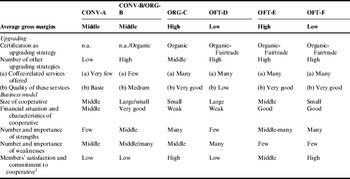
Table 6 ranks the cooperatives according to the gross margins earned by the cooperative members, by the cooperatives' business models, and upgrading strategies. There is no obvious association between the certification strategy of a cooperative and the gross margins producers obtain. Producers in certified cooperatives may have either higher or lower gross margins than producers in conventional cooperatives. Members' satisfaction as well as the net of strengths and weaknesses of a cooperative can be related to the gross margin. The data indicate that OFT-F is an exception. It is a very well-run and organized cooperative, but has very low gross margins for members. The example of the cooperative ORG-C shows that its many weaknesses can be compensated by its strengths and coffee-related services, resulting in high member satisfaction and contributing to good gross margins. The number and importance of strengths and weaknesses as well as the amount of coffee-related services offered to producers seem to affect the gross margins more than certification. Table 6 also shows no clear relationship between the certification strategy of a cooperative and the number of other upgrading strategies, cooperative size and financial characteristics. This qualitative evaluation indicates that the gross margins per hectare depend more on yield levels, the business model of a cooperative, its respective SWOT and upgrading strategies than on certification per se.
Relative ranking of conventional, organic and Organic-Fairtrade certified cooperatives.

1 Only indirectly measured, based on qualitative interviews, informal comments and observations. ORG-C and OFT-F offer many ‘informal services’ such as helping members incapable of paying their debts, providing transport to hospital, granting collateral-free credit in case of severe illness/accident, etc.
Conclusion
In this paper, we analyzed the business models, upgrading strategies and SWOT of coffee cooperatives in northern Nicaragua and linked these to members' coffee gross margins. Since the business models of each cooperative differ, it is not possible to differentiate according to typical characteristics of conventional, organic and Organic-Fairtrade certified cooperatives. Yet, as a group, the certified cooperatives have a stronger focus on coffee-service provision, such as coffee marketing, input supply and extension, than on financial services such as the conventional cooperatives. These differences cannot be generalized beyond the research region due to the sampling framework, but merit further research.
Cooperatives often choose the same upgrading strategies as other cooperatives. Hence, apart from the certification, upgrading strategies are not typical for one group, be it conventional, organic or Organic-Fairtrade certified cooperatives. The cooperatives' SWOT is related to the cooperative's business model and the specific upgrading strategies undertaken. Again, there is not much common ground in each of the three groups of conventional, organic and Organic-Fairtrade certified cooperatives. The lack of clear differences between the groups of cooperatives is noteworthy. It is probably due to the growing popularity of environmental and social certification, as well as the imitation of other upgrading strategies without proper evaluations of their appropriateness to the cooperative in question.
We found no obvious association between a cooperative's certification strategy and the gross margins to its members. The number and importance of strengths and weaknesses, as well as the amount of coffee-related services offered to producers tend to be more related to gross margins than due to organic or Organic-Fairtrade certification per se. Based on a qualitative evaluation, we conclude that the gross margins depend on yield levels, the cooperative's business model (and the services it offers its member), its respective SWOT and its upgrading strategies, of which certification is but one. Coffee certification is not always the solution to increase smallholder coffee incomes but may serve as a buffer in case of extremely low coffee prices. Cooperatives need to identify specific upgrading strategies and market niches which do not overburden the cooperative's management or finances; thus which are in line with the cooperative's business model.
To be a successful upgrading strategy, organic or Organic-Fairtrade certification strongly depends upon the business model of a cooperative, its strengths, weaknesses and other supportive upgrading strategies. Future research needs to be based on quantitative assessments of the impacts of certification schemes on the socioeconomic effects on smallholders. Such assessments should include the institutional context in which farmers operate through explicitly analyzing conventional and certified cooperatives' business models, their upgrading strategies and SWOT. When evaluating only one upgrading strategy such as certification, researchers are likely to miss the real effect if the business models, other upgrading strategies and SWOT are not taken into account and controlled for in the analysis.
The following presents policy recommendations that can address the SWOT common to all cooperatives; the individual SWOT is easier to be addressed by the cooperative management. Policies that aim at increasing smallholder coffee incomes through upgrading should focus, apart from production aspects, on the institutional context of smallholders and their cooperatives. Regarding coffee production, the low yield levels as well as the climatic risks need to be addressed—for example through a successive switch to higher yielding, less climate-susceptible coffee varieties, improved shade management in the coffee plantation or by even diversifying into other agricultural crops. Research needs to identify appropriate coffee varieties and also alternative crops for these higher regions. To ensure extension services in the long run, it is recommended that cooperatives oblige producers to participate in financing the extension service.
Institutional support at the national level is also of great importance. Until 2008, Nicaraguan governmental support to cooperatives, agricultural producers and coffee smallholders was negligible. At the same time, producers from other coffee producing countries such as Colombia, Costa Rica, Brazil or Mexico count on governmental sector strategies and support, not only through credit, extension, subsidies, market support or infrastructure, but also through research and generally higher educational levels. The absence of this support in Nicaragua and the lack of a functioning national coffee institution, make it difficult for Nicaragua's coffee growers to compete internationally. Coffee certification alone cannot improve producers' welfare in the long run because newly certified producers will erode profit margins for all.
Enforced by policies or voluntarily, cooperatives could be more transparent in their invoices and issue a record of each member's cumulative capital contributions or share certificates acknowledging the member's role in the cooperative. Policies could address the liquidity constraints of cooperatives through, for example, a supportive national banking system or an agricultural bank that provides business credits at market interest rates to the cooperatives. Additionally, policies could promote a diversified microfinance sector to serve the cooperatives' members. Microfinance institutions could provide short-term consumption credits to producers during harvest time to reduce their need for spot market sales.
Credit for coffee carries excessive covariate risk with respect to yields, climate, prices and competition. Such risk can be better shouldered by international finance institutions or by broadly diversified, national microfinance and banking institutionsReference Zeller, Schrieder, von Braun and Heidhues62. Such institutions could provide credit to the cooperative's members, whereas the cooperative sells the member's coffee and then first pays the member's credit at the microfinance/banking institution before paying the remaining gains from coffee sales to the credit-using member. As the cooperatives themselves could undertake the screening, monitoring and loan enforcement functions, microfinance institutions could serve them at relatively low transaction costs. By building up more equity capital and their reserve fund, cooperatives can improve their liquidity position and credit worthiness over time. This process should be made transparent so that members are aware that their shares in their cooperative are increasing. The introduction of an obligatory annual external auditing of first-level and second-level cooperatives is recommended to avoid mismanagement and corruption, and to make cooperatives more creditworthy for banks. A coffee institute could then also become responsible for the monitoring of finances or the auditing of cooperatives and could forge links with the national banking system and international banks.
Acknowledgements
Many thanks to Thomas Oberthür, Anna Kiemen, Jon Hellin, Rick Peyser and Don Seville for their invaluable discussions and comments. The funding for field research by the ‘Advisory Service on Agricultural Research for Development (BEAF)’ of the ‘Deutsche Gesellschaft für Internationale Zusammenarbeit (GIZ)’ and the logistic support from the ‘International Center for Tropical Agriculture (CIAT)’ in Colombia and Nicaragua, especially by Axel Schmidt and Evelyn Lopez, is gratefully acknowledged.