1. Background: language-specificity in the construal of events
In recent years, researchers in the field of psycholinguistics have looked at how speakers organize content for linguistic expression when talking about events. The present analysis is carried out in the context of studies that investigate the role of grammaticalized means in guiding spatial representation as well as event representation and whether patterns of event construal are specific to native speakers of certain languages, given the way concepts are encoded (cf. Carroll & von Stutterheim, Reference Carroll and Stutterheim1993; Carroll & von Stutterheim, to appear; Carroll, von Stutterheim & Nüse, Reference Carroll, Stutterheim, Nüse, Habel and Pechmann2004; Slobin, Reference Slobin, Gumperz and Levinson1996 (the Thinking for Speaking hypothesis); von Stutterheim & Nüse, Reference Stutterheim and Nüse2003; von Stutterheim, Nüse & Murcia Serra, Reference Stutterheim, Nüse, Murcia Serra, Hasselgård, Johansson, Fabricius-Hansen and Behrens2002; Talmy Reference Talmy and Rudzka-Ostyn1988).
It was found that concepts that have paved their way into the grammar of a language play a significant role in establishing language-specific preferences in the segmentation, selection and structuring of information for event construal (cf. von Stutterheim & Nüse, Reference Stutterheim and Nüse2003). This process is referred to here as conceptualization, in line with Levelt (Reference Levelt1989). Cross-linguistic comparisons were carried out on the basis of the following question: Are grammaticalized means of expression prominent for speakers of a given language in that they will implement the associated concepts in specific contexts (when talking about events, for example) systematically and frequently? Specifically, are they prominent in the sense that the more grammaticalized, the more automatized access to that concept will be in the process of conceptualization (Carroll et al., Reference Carroll, Stutterheim, Nüse, Habel and Pechmann2004; Schmiedtová, von Stutterheim & Carroll, in press)? For example, when conceptualizing motion events (as shown in a cross-linguistic study using video clips), speakers of English as well as Standard Arabic – languages with a highly grammaticalized progressive/imperfective marker – tend to segment the event into phases (the inceptive, intermediate or terminative phase, e.g., he is walking along the road; he is heading for the train station), depending on the phase that is represented in the video clip, and which, in that sense, is “ongoing” at the time of speech. Motion event descriptions by speakers of German – a language without grammaticalized aspectual markers – show that speakers follow a different pattern and represent events in holistic terms (e.g., er läuft zum Bahnhof ‘he walks to the train station’) (von Stutterheim & Carroll, Reference Stutterheim, Carroll, Byrnes, Weger-Guntharp and Sprang2006). It is hypothesized that systematic differences of this kind (phasal segmentation versus holistic representation of an event) are linked to the role of grammaticalized aspectual concepts.
The relevance of these concepts for event conceptualization is supported by differences in patterns of attention allocation by speakers of English and German, as measured by the tracking of eye movements during the speech planning phase (von Stutterheim & Carroll, Reference Stutterheim, Carroll, Byrnes, Weger-Guntharp and Sprang2006). Eye movements before and while speaking are considered to reflect speech planning processes (see, e.g., Bock & Griffin, Reference Bock, Griffin and Wheeldon2001; Griffin, Reference Griffin, Henderson and Ferreira2004; Levelt, Roelofs & Meyer, Reference Levelt, Roelofs, Meyer and Altmann2002) and it is assumed that eye movements during event conceptualization provide a window on underlying event representations, which are linked to linguistic means (Papafragou, Hulbert & Trueswell, Reference Papafragou, Hulbert and Trueswell2008). The findings show that grammaticalized and frequently used aspectual structures in a language focus the attention of its native speakers to relevant features of events (von Stutterheim & Carroll, Reference Stutterheim, Carroll, Byrnes, Weger-Guntharp and Sprang2006). In the example provided above, speakers of German, who present motion events holistically, tend to also allocate more attention to a possible endpoint of a motion event, although the sections focused in the clip show the intermediate phase of the event (travelling along a road). Speakers of languages that use progressive or imperfective aspectual constructions (e.g., speakers of Russian, Arabic, Spanish, English) tend to focus on the phase shown, and are less likely to look for and mention a possible endpoint. In other words, they do not direct attention to the relevant area (possible endpoint) in the clips to the same extent as the German speakers (von Stutterheim & Carroll, Reference Stutterheim, Carroll, Byrnes, Weger-Guntharp and Sprang2006). Papafragou et al. (Reference Papafragou, Hulbert and Trueswell2008), looking at the manner versus path verb typology (Talmy, Reference Talmy and Shopen1985) and its implications for attention allocation when describing motion events, support the idea that there are early language-specific effects on attention distribution due to cross-linguistic differences given with verb-framed versus satellite-framed languages (cf. Talmy, Reference Talmy and Shopen1985).
As mentioned above, speakers of Dutch and German have comparable means to mark progressive aspect but differ markedly in the extent to which this aspectual perspective is selected, being highly frequent in Dutch, but not in German. The present experimental study investigates factors that lead to the use of progressive aspect by early bilinguals, using video clips showing different types of situations that have been varied on a systematic basis. The focus is placed on event construal, and eye movement is measured both before and while speakers are verbalizing the dynamic live-action video clips. This approach provides a window on the conceptualization processes that take place during the organization and selection of content for expression. The novelty of the current article is the investigation of the role of grammatical concepts in event construal and the interrelation between attention allocation and event construal patterns in bilingual speakers. The next section will look at previous studies on event conceptualization and L2 users/bilinguals.
1.1 Background: event conceptualization by advanced L2 users and early bilinguals
Many studies on L2 users address the question of whether a speaker who has formally acquired the L2 linguistic system also fully acquires the associated conceptualization patterns that are typical for native speakers of the second language, in both verbal and non-verbal tasks. Pavlenko (Reference Pavlenko, De Groot and Kroll2005) and Jarvis and Pavlenko (Reference Jarvis and Pavlenko2008) provide an overview of a number of possible outcomes for L2 and bilingual performance: the co-existence of L1 and L2 conceptualization preferences, L1-based conceptual transfer, the internalization of new conceptual distinctions, the restructuring of conceptual organization, the convergence of L1 and L2 conceptualization preferences, a shift from L1 to L2 conceptualization preferences, or L1 conceptual attrition. The question is which of these possible outcomes apply to event conceptualization preferences and the role of aspect in bilingual speakers, as investigated in the present study, or whether there are other options. The sections below will discuss the outcomes of previous studies looking at event construal in L2 or bilingual speakers.
Several studies looking at the impact of frequently used aspectual notions on event construal (Carroll & Lambert, Reference Carroll, Lambert, Dimroth and Starren2003; van Ierland, Reference Ierland2009; Schmiedtová & Sahonenko, Reference Schmiedtová, Sahonenko, Gommes and Walter2008; von Stutterheim & Carroll, Reference Stutterheim, Carroll, Byrnes, Weger-Guntharp and Sprang2006; von Stutterheim & Lambert, Reference Stutterheim, Lambert and Hendriks2005) show that very advanced L2 users have not fully acquired the subtle but systematic implications of aspectual forms for information organization. Although these speakers have a high level of proficiency, their patterns of event construal follow a specific but not target-like pattern. For example, German as well as French learners of English, when constructing a narrative, mainly use the progressive -ing to stress the duration of a situation, but they do not acquire the global planning principles and the perspective associated with use of the form: L1 English narratives centre around a deictic point of reference and speakers relate to ‘what is now the case’ for each scene when re-narrating a short silent film. L1 German narratives, on the other hand, show a holistic perspective and centre around the notion of temporal shift. The German learners of English use the progressive marker but still re-narrate a large number of bounded events (cf. Carroll & Lambert, Reference Carroll, Lambert, Byrnes, Weger-Guntharp and Sprang2006; von Stutterheim & Lambert, Reference Stutterheim, Lambert and Hendriks2005). The outcome of the above studies can be labelled (partial) L1 based conceptualization transfer, resulting in a “mixed” system with its own (non-target-like) logic.
Studies of other domains show that it is possible for L2 users to fully adapt their conceptual organization to the concepts encoded by the L2 (e.g., Athanasopoulos & Kasai, Reference Athanasopoulos and Kasai2008, looking at grammatical number marking in a non-verbal object categorization task; Pavlenko, Reference Pavlenko2003, for the expression of (lexical) emotion concepts). Another set of studies on L2 users or early bilinguals found that they develop a shared linguistic and conceptual system, combining elements of both languages, which makes the system different from that of native speakers of either language (for work on object classification see: Ameel, Storms, Malt & Sloman, Reference Ameel, Storms, Malt and Sloman2005; Marian & Spivey, Reference Marian and Spivey2003; for syntax: Hartsuiker, Pickering & Veltkamp, Reference Hartsuiker, Pickering and Veltkamp2004, also described in Grosjean, Reference Grosjean1985; Reference Grosjean1998). Findings for early bilinguals on an object naming task (Ameel et al,. Reference Ameel, Storms, Malt and Sloman2005) suggest a lexical system that has a “midway” bias and is applied in both languages of the L2 user or bilingual, i.e., it shows convergence between the L1 and L2 pattern. Ameel, Storms, Malt and van Assche (Reference Ameel, Storms, Malt and van Assche2009) and Ameel et al. (Reference Ameel, Storms, Malt and Sloman2005) claim that for the early bilinguals investigated, the category boundaries of the lexical concepts of both languages have moved closer to one another, causing the semantic boundaries of particular concepts to become more broadly defined (and in a way, simplified), compared to monolinguals of the particular language. It is argued that such a system satisfies individual cognitive demands, in that having one set of concepts that can be applied to both languages is less demanding on the limitations of memory storage (cf. Ameel et al., Reference Ameel, Storms, Malt and van Assche2009; Reference Ameel, Storms, Malt and Sloman2005). The consequences of such a system are that language-specific idiosyncrasies are “dropped” and the system is less determined by such means, when compared to monolinguals (Ameel et al., Reference Ameel, Storms, Malt and van Assche2009). These findings are in line with those of Grosjean, who argues that early bilinguals should be treated as “unique-language speakers”, having language systems that do not always conform to the monolingual standard (Reference Grosjean1985; Reference Grosjean1998).
Schmiedtová and Sahonenko (Reference Schmiedtová, Sahonenko, Gommes and Walter2008) looked at how Russian and Czech learners of German described goal-oriented motion events. First of all, they found that, given differences in the use of aspectual devices in Czech and Russian L1, speakers take different perspectives on motion events – again underlining the perspectiving role of grammatical aspect for event construal. Concerning the learners, the results show that both groups used L1-rooted principles when conceptualizing goal-oriented motion events in the target language.
Bylund (Reference Bylund2009) looked at event construal by advanced Spanish learners of Swedish (with a focus on L1 attrition) and he found that the age of acquisition of the L2 may play a role in determining bilinguals’ conceptualization patterns: subjects who had started learning the L2 before the age of twelve showed a divergence from the monolingual Spanish conceptualization preferences when describing motion events in Spanish. Performance in the L2 was not discussed in this study.
Other work on event construal in L2 has mainly investigated the manner/path verb lexicalization typology (e.g., Hohenstein, Eisenberg & Naigles, Reference Hohenstein, Eisenberg and Naigles2006; see Cadierno, Reference Cadierno, Robinson and Ellis2008). Cadierno and Ruiz (Reference Cadierno and Ruiz2006), for example, found that intermediate Danish learners of Spanish showed more traces of L1-specific verb lexicalization patterns in L2 than advanced Danish learners of Spanish, showing how levels of proficiency play a role in the achievement of L2-specific conceptualization preferences.
Generally, we may say that most L2 studies focus on lexicalization patterns and that there is inconclusive evidence in L2 research regarding the acquisition of event conceptualization patterns, i.e., linguistic knowledge that does not rely on the acquisition of formal means only. Proficiency in event conceptualization preferences may be more difficult to gain considering the conceptual complexity of the domains. Factors that aid the achievement of target-like patterns of conceptualization were found to be, e.g., a high level of proficiency (as in Athanasopoulos, Reference Athanasopoulos2006; Cadierno & Ruiz, Reference Cadierno and Ruiz2006) and there is some evidence that the age of acquisition of the L2 may correlate with the ability to achieve native-like preferences (see Boroditsky, Reference Boroditsky2001; Bylund, Reference Bylund2009). The next section will elaborate on the aims of the present study.
2. General aims of the article
The present study investigates the type of speaker that has both a high level of proficiency in the two languages and an early age of acquisition of both languages. This is the early bilingual and/or simultaneous bilingual. The focus is on the selection of an aspectual perspective, coupled with specific verbal aspectual forms, by early Dutch–German bilinguals when construing different types of events in Dutch, in comparison to monolingual Dutch and German speakers. Furthermore, the present study will expand on the relation between use of an aspectual perspective and the allocation of attention (eye-tracking measurements) by looking at this interrelation in early bilinguals. According to the definition used in the present article, early bilinguals are speakers who have acquired two languages in early childhood and have an excellent knowledge of both languages. Their level of proficiency is (at a first glance) native-like and exposure and input in both languages is relatively balanced. Within this group, one can further distinguish simultaneous bilinguals. These are speakers who have started to acquire the two languages during the first three or four years of life and who are usually brought up with the one-person one-language principle, ensuring a remarkable capability to switch between the two language systems (cf. Butler & Hakuta, Reference Butler, Hakuta, Bhatia and Ritchie2004; Meisel, Reference Meisel, Bhatia and Ritchie2004; see also Bialystok, Reference Bialystok1999). For this type of speaker the factors that play a crucial role in the debate on the possibility for speakers to control and use two language and conceptual systems independently of one another are held constant, i.e., age of acquisition and possibilities for achieving a high level of proficiency.
A relevant case arises when a particular conceptual distinction is present and productive in one language of a bilingual, but not in the other. As the studies outlined above indicate, native speakers of the former language may be more likely to attend to the concept in relevant contexts and, when conceptualizing events, these speakers may be more likely to convey the aspects of a dynamic situation that are linked to the specific concept, when compared to speakers of languages that only rarely use specific means to convey the same meaning. If speakers of the other language of the bilingual do not encode the same conceptual distinction, the question is how do early bilingual speakers deal with this difference (also suggested as an area for research in Green, 1998). This is the focus of the present study.
2.1 Research questions and hypotheses
As mentioned above, the focus of the linguistic analyses is on the use of progressive aspectual means when verbalizing events. The bilinguals’ verbalizations in Dutch will be compared to monolingual speakers of Dutch and German. In order to gain insight into conceptualization processes, the eye movements of all participants are measured before and during their verbal descriptions of the events. The aim is to see how bilingual speakers (speaking Dutch) differ from or resemble monolingual Dutch speakers. Dutch represents a challenge for the bilingual learner in the following respect: although use of an aspectual perspective is not obligatory, in any context, the language currently shows specific preferences that are linked to specific situation types with relevant temporal features (see the next section). Although similar forms for expressing an aspectual perspective are available in German, overall use is rare (see below).
With respect to the eye-tracking analyses, it is hypothesized that monolingual speakers of Dutch and German may show differences in the distribution of attention to specific parts of the stimuli, depending on the use of progressive aspect in describing the stimuli. For bilinguals the question arises as to whether they show patterns in representing events in aspectual terms that are similar to, or divergent from, those of monolingual speakers of Dutch. The analysis of the bilinguals’ eye movements will provide insights into the interrelation of the use of specific linguistic means and attention allocation, with the aim of shedding light on bilinguals’ possibilities of achieving target-language-specific conceptualizations.
2.2 The languages at stake – expressing “ongoingness” in Dutch and German
The two West Germanic languages show many similarities: they are both verb-second (V2) languages, with a similar syntax and tense system (see, e.g., König & van der Auwera, Reference König and Auwera van der2002).
Dutch has several constructions that express progressive aspect. One is the periphrastic aan het form (examples 1a, 1b).
- (1)
a. Ik ben aan het pianospelen
“I am at/on the pianoplay – I am playing the piano”
b. Ik ben piano aan het spelen
“I am piano at/on the play – I am playing the piano”
The function and meaning of the aan het construction is to express the ongoingness of an event at a particular time interval (also in Boogaart, Reference Boogaart1999; Booij, Reference Booij, Bergs and Diewald2008). Use of the construction been has shown to be frequent amongst native speakers of Dutch in specific contexts (see in detail Flecken, in press b; von Stutterheim, Carroll & Klein, Reference Stutterheim, Carroll, Klein, Klein and Li2009). Examples (1a, 1b) also show that the syntax concerning the aan het construction is rather flexible (see also Boogaart, Reference Boogaart, Drijkoningen and Kemenade1991; Reference Boogaart1999), while this is not the case for the means available in German (see below). Use of the aan het construction, however, is subject to semantic restrictions. One of the prototypical contexts of use of the aan het construction and the associated perspective is with situations depicting ongoing events, without a change in state (“activities”, cf. Vendler, Reference Vendler1957, e.g. to play tennis, to surf) that occur in the here-and-now, while use with the description of motion events is very rare in monolingual Dutch (see Carroll, Natale & Starren, Reference Carroll, Natale and Starren2008; Flecken, in press b; von Stutterheim, Carroll & Klein, Reference Stutterheim, Carroll, Klein, Klein and Li2009).
Dutch also has other verbal constructions to express the perspective “event is ongoing”. These involve the posture verbs zitten/liggen/staan or the motion verb lopen plus the infinitive (examples 2–5).
(2) Femke zit te werken
“Femke sits to-work – Femke is working”
(3) De baby ligt te slapen
“The baby lies to-sleep – The baby is sleeping”
(4) Caspar staat de muur te schilderen
“Caspar stands the wall to-paint – Caspar is painting the wall”
(5) Marlies loopt te zeuren
“Marlies walks to-nag – Marlies is nagging”
These constructions are used to a much lesser extent than aan het by native speakers of Dutch. Also, to allow for the use of posture verbs it is important for the subject to be in the corresponding physical position.Footnote 1 The posture verb constructions are mainly used in contexts that show agents in the physical posture that corresponds with the posture verb used (for details, see Lemmens, Reference Lemmens2005).
The means in German are formally similar to the Dutch aan het progressive (see 6–7).
(6) Eine junge Frau ist am Lernen
“A young lady is at-the learn – A young lady is learning”
(7) Ein paar Männer sind beim Fussballspielen
“A couple of men are at-the football-play – A couple of men are playing football”
In contrast to Dutch, the prepositions used cover an (‘at/on’) or bei (‘by/at’)Footnote 2 and dabei (there-at/by) one of the “busy”-type progressives (cf. Ebert, Reference Ebert and Dahl2000) (see (8)).
(8) Eine Frau ist dabei ein Papierflugzeug zu falten
“A lady is there-at a paper aeroplane to fold – A lady is folding a paper aeroplane”
Experiments eliciting event descriptions with stimuli that include a variety of situation types (e.g., motion events, events showing a change in state) show that native speakers of German (from different regions) rarely express the concept of ongoingness in general, and also rarely by means of the an or bei construction (see, e.g., von Stutterheim, Carroll & Klein, Reference Stutterheim, Carroll, Klein, Klein and Li2009). Moreover, a higher frequency is typical of a specific German dialect (the “Rheinische Verlaufsform”; for a detailed description see Ebert, Reference Ebert and Dahl2000; Krause, Reference Krause2002) and not of Standard German (also in Booij, Reference Booij, Bergs and Diewald2008).
The relevant question arises as to what the bilingual speakers do when construing events in Dutch: Do they show the same preferences as monolingual speakers when expressing ongoingness when it comes to form and usage patterns or will there be evidence for a specific bilingual-Dutch aspectual system?
3. Method
3.1 Participants
The monolingual speakers of Dutch were nineteen students (average age 20.38 years; age range 18–23 years; 13 female, 6 male) at the Radboud University in Nijmegen, the Netherlands, and the German monolingual speakers were nineteen students at the University of Heidelberg in Germany (average age 24.32; age range 20–35 years; 11 female, 8 male). Monolingual native speaker participants were excluded from the analyses when their answers to questions in a language background questionnaire indicated a long stay in an environment where a language other than Dutch or German is spoken, or when they had advanced L2 knowledge of either Dutch or German.Footnote 3
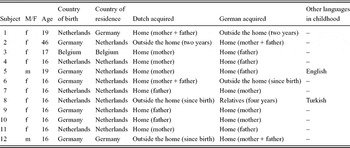
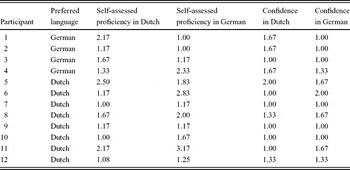
The bilingual participants consisted of twelve secondary school pupils (and 1 teacher). The average age of the pupils was 16.6 years; age range of the majority 16–19 years, plus one 46-year-old; 10 female, 2 male)Footnote 4 and were enrolled in a bilingual German–Dutch education programme. They were given a detailed questionnaire relating to their language background. The questionnaire was inspired by parts of existing questionnaires (Gullberg & Indefrey, Reference Gullberg and Indefrey2003; Li, Sepanski & Zhao et al, Reference Li, Sepanski and Zhao2006; Marian, Blumenfeld & Kaushanskaya, Reference Marian, Blumfeld and Kaushanskaya2007) but fully adapted and extended to the situation of early bilinguals. Appendix 1 gives some information regarding the acquisition of the two languages; Appendix 2 shows self-assessments of their proficiency and confidence in both languages. Proficiency ratings were made on a scale of 1 to 5 (from 1 “excellent” to 5 “poor”) for speaking, understanding, writing, reading, grammar and pronunciation separately. The table gives the ratings calculated as an average of ratings in all six areas.
Most of the participants were in fact simultaneous bilinguals (that is, most of them had been exposed to two languages from birth), but some of the participants had a slightly later onset of acquisition of one of the two languages (all of them, however, before or from the age of four). These speakers are usually also characterized as simultaneous bilinguals (see, e.g., Butler & Hakuta, Reference Butler, Hakuta, Bhatia and Ritchie2004). Nevertheless, to avoid confusion, the whole group was characterized as early bilinguals. The group as a whole had an early age of acquisition of both languages in common and for this reason no differentiation was made within the participant group.Footnote 5
3.2 Experimental procedure
The experiment consisted of the online retelling of a set of sixty-five short video clips, depicting everyday situations. The video clips were dynamic, live recordings, on an average of six seconds in length. In between each video clip a black screen with a white focus point was shown for eight seconds. All participants were told that they would see video clips showing everyday events and they were instructed to tell “what is happening” (in Dutch: Het is uw opgave om te vertellen wat er gebeurt, in German: Es ist Ihre Aufgabe, zu sagen was passiert). All participants were explicitly told to focus on the event only, and not to give a detailed description of what was shown on the screen. They were also told that they could start to speak as soon as they recognized what was happening. The actual experiment took about fifteen minutes. Beforehand, the participant had the chance to practise the task with six training items. The participant's event descriptions were recorded with a microphone throughout the experiment, and the subjects’ eye movements were recorded with eye-tracking equipment during the entire phase in which the video clip was shown. Before the start of the experiment, the cameras were callibrated to adjust them to the subjects’ eyes, which took a few minutes. After the experiment, the monolingual participants were asked to fill out a questionnaire concerning their language background.
The bilingual participants were recruited to take part in the same experimental set-up twice: once while speaking in Dutch and once while performing all experiments in German. To reduce memory effects, the second part of the study, i.e., the experimental procedure done in German, took place four months after the bilingual participants had performed all the tasks in Dutch. The current study will only report on the Dutch experiment.
The bilingual participants first took part in an offline narrative retelling task (a silent film) which functioned as a language mode inducing task (for a discussion of the relevance of language mode, see Grosjean, Reference Grosjean1998) and as a proficiency test (for the results, see Flecken, in press a). After the narrative retelling task, the bilinguals were asked to carry out the event description task described above. The bilinguals were given the exact same stimuli and experimental set-up as the monolingual participants. They then took part in two more experiments, unrelated to the present study. At the end of the experiment session, the bilinguals were asked to fill out a language background questionnaire.
All in all, the total procedure took about 1.5 hours per bilingual participant and they were paid 10 euros for participating.
3.3 Stimuli
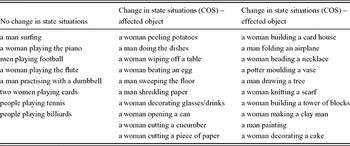
The stimuli consisted of video clips that can be classified into five different situation types (48 critical items in total) and a group of distractor items (see Table 1 and Appendix 3 for a full list of items). The situation type referred to as “no change in state situations” cover situations that do not show a change in state, for example scenes such as two young men surfing, or a person singing. These are events which involve only one temporal interval (1-state events, cf. Klein, Reference Klein1994), and no change in state is entailed. The change in state situations show an active agent who is acting on a specific object. The agent is shown to be in the middle of a process that leads to the creation of a particular object. These events thus show progression to a clear, tangible resultant state in the near future (examples are knitting a scarf, and painting a picture, with the scarf and the painting as the effected objects) (cf. Natale, Reference Natale2009). The other group of change in state situations do not involve the creation, but rather the transformation of an object. Examples of those are peeling potatoes, or wiping a table with a cloth, with the potato and table as affected objects.
Situation types present in the stimulus set.

The third group of change-in-state situations (5 with an effected object, 5 with an affected object) also show a change in state but offer two options for event construal. First, they can be viewed and verbalized as a macro-event (e.g., a lady is typing) (see Bohnemeyer et al., Reference Bohnemeyer, Enfield, Essegbey, Ibarretxe-Antunano, Kita, Lüpke and Ameka2007; Talmy, Reference Talmy2000), or the event can be verbalized with the specific events shown in the video (e.g. a lady is taking a sheet of paper and inserting it into a typewriter). Another video shows a person in the kitchen adding flour to a cake mix. This can be represented in this specific way or in overall terms as someone baking a cake, i.e., as the macro-event (for details, see Carroll & von Stutterheim, to appear).
The motion events involve a person, vehicle or animal moving along a path from point A to point B. These entities are not depicted as reaching the possible goal or endpoint. In other words, the event depicted is a motion event in progress.
All of the above situation types were included in the stimulus set because certain features of the situations depicted in the video clips have proven to be relevant with respect to the marking of the progressive aspect in languages where use of such constructions is frequent yet not fully grammaticalized (see Bouhaous, in preparation; Leclerq, Reference Leclerq2008; Natale, Reference Natale2009). In short, the cross-linguistic findings show that the aspectual means in Italian and French are used most frequently for situations that show progress toward a resultant state, a qualified object (for example knitting a scarf) (Carroll, Natale & Starren, Reference Carroll, Natale and Starren2008; von Stutterheim, Carroll & Klein, Reference Stutterheim, Carroll, Klein, Klein and Li2009).
4. Linguistic analyses
4.1 Results
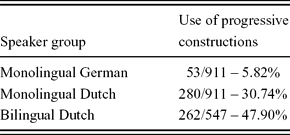
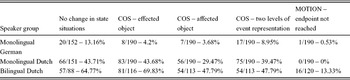
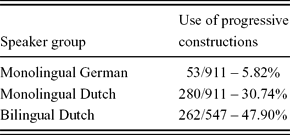
The focus of the linguistic analysis is on the number of events that are marked with progressive aspectual means, that is, the number of events that explicitly entail a perspective of ongoingness. Table 2 shows the total number of progressives used by monolingual speakers of Dutch and German and by the bilinguals speaking Dutch. Table 3 distinguishes between situation types.Footnote 6
Progressive marking (percentage of total number of responses) by Dutch and German monolingual native speakers and bilingual Dutch speakers.
Progressive marking by monolingual Dutch and German speakers and bilinguals speaking Dutch per situation type.

The first analysis focused on the two monolingual speaker groups only. A Mann–Whitney test was conducted to compare the proportion of progressive marking between monolingual Dutch and monolingual German, and the difference was significant (U = 32, p < .001). The standardized residuals of a chi square analysis showed that the Dutch speakers use more progressives than the Germans when describing the situation types labelled “change in state with an effected object” and “no change in state situations” (χ2 (4) = 15.088, p < .001). A within-group comparison to compare aan het marking by monolingual Dutch speakers between all five situation types showed that the motion events were marked with aan het significantly less than the other four situation types (Kruskal–Wallis test: H (4) = 36.98, p < .001).
The second analysis compared the monolingual Dutch speakers with the bilingual Dutch speakers. A Mann–Whitney test showed that the bilinguals (speaking Dutch) used progressive markers with a greater frequency than the monolingual Dutch speakers, across all situation types. Standardized residuals of a chi-square test revealed that specifically for the situation type motion events and the change in state situations with an effected object the bilingual speakers used more progressive markers than the monolingual Dutch speakers (χ2 (4) = 19.562, p < .001).Footnote 7
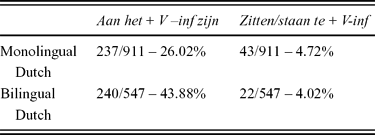
If we first take a closer look at the actual means used by the monolingual Dutch speakers and the bilingual Dutch speakers, we see that in both groups mainly the aan het construction was used, whereas the other progressive constructions (the posture verb constructions zitten/staan te) were hardly used (see Table 4).Footnote 8
Different progressive constructions used – monolingual and bilingual Dutch (percentage of total number of responses).
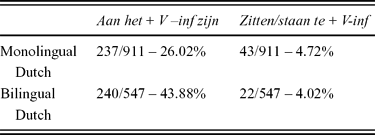
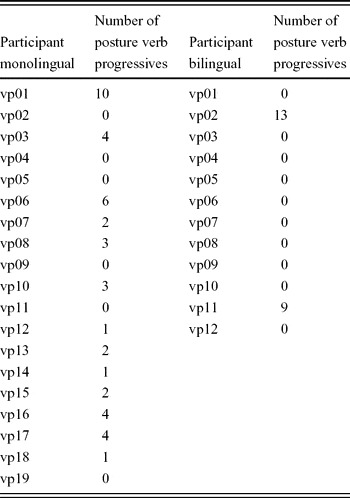
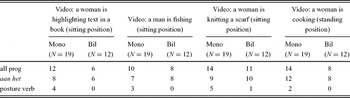
Table 4 shows that the higher frequency of use of progressives by the bilingual speakers can be attributed to an increased use of the aan het construction only. A speaker analysis revealed that the other progressive constructions were used by the bilingual participants in a manner different from the monolingual Dutch speakers: all occurrences of the zitten and staan te progressive constructions in the bilingual data appeared in the verbalizations of only two (out of 12) speakers. One of the bilingual participants actually used these posture verb constructions exclusively (for 13 out of 48 critical video clips), without a single occurrence of the aan het construction. This is rather different from the way in which they were used by the monolingual Dutch speakers (see the distribution of the use of posture verb progressives in Table 5).
Distribution of use of posture verb progressives.

A Mann–Whitney test comparing the frequency of use of the posture verb constructions between the two speaker groups also showed that the monolingual Dutch group used more of these constructions than the bilingual Dutch speakers (U = 67, p < .05).
A qualitative analysis focusing on the posture verb progressive constructions indicated that these constructions were used mainly when the video clip that was being verbalized actually showed an agent in the respective physical position. Video clips of this type attracted a number of the zitten or staan te constructions in the monolingual Dutch data. In the bilingual Dutch data only occassionally one of the two bilingual participants who actually used the posture verb progressives also used one in these contexts (see the examples in Table 6). This shows that with respect to the usage preferences of the posture verb forms the bilinguals differ from the monolinguals. In the bilingual data, there is a clear preference for the aan het construction only, even though the visual input in the video clips would also allow use of the other constructions. In these cases, the monolinguals make use of all options available (see Table 6).
Use of posture verb and aan het progressives in specific video clips.

When taking a closer look at the German data, we see that the number of progressives is low for all situation types (never more than 20 occurrences per situation type). There seems to be a preference to use progressives when expressing situations without a change in state (e.g., Ein Mann ist beim Billiardspielen “A man is at-the billiardsplay – a man is playing billiards”). German speakers use the beim construction mainly: of all the progressives used in this dataset, 50 (out of 53) include the preposition bei, whereas only 2 include an and 1 instance exists of the dabei sein construction.
4.2 Discussion of the linguistic data
Comparing use of an aspectual perspective in the data by monolingual speakers of Dutch and German, it is clear that the expression of ongoingness in Dutch (aan het construction) is frequent. Significantly, Dutch speakers are sensitive to the specific temporal characteristics of situations that attract use of progressive markers in other languages as well (e.g., visual presence of an effected object has a high attractor effect on the progressive (in the same task) in Italian (Natale, Reference Natale2009), Modern Standard Arabic (Bouhaous, in preparation) and French (Leclerq, Reference Leclerq2008; for more evidence on Dutch, see van Ierland, Reference Ierland2009). Motion events represent a special case since this situation type shows the lowest rate of occurrence for this perspective in Dutch (as well as Italian and French). The events shown in the clips focus on the intermediate phase of the trajectory (between source and possible goal) and the stimuli show a possible endpoint which is, however, not reached by the moving object. In Dutch, the results of native speakers’ acceptability judgments (Flecken, in press b) also underline the pattern found in the present data: descriptions of motion events (e.g., gaan “to go somewhere”, rijden “to drive somewhere”) and the aan het form are untypical for speakers of Dutch (see also Carroll, Natale & Starren, Reference Carroll, Natale and Starren2008). This holds throughout all the pilot studies that were conducted for this analysis (Flecken, Reference Flecken2008). For forty subjects (other than those in the current sample), a progressive construction was only used in 1.35% of all utterances relating to a motion event (13 aan het constructions out of a total of 960 utterances). Interestingly, in nearly all these instances the verb used was an activity-like motion verb explicitly expressing not just manner of motion, but also a macro-event such as “being out for a walk” (and not a specific change in place with reference to path of motion or a possible goal (going along x to y). The forms used are, for example, aan het wandelen (“taking a walk”), aan het fietsen (“cycling”) and aan het paardrijden (“horseriding”).Footnote 9
The results for the bilingual speakers show that they also use progressive markers highly frequently. The bilinguals apply the aan het progressive in the contexts that are typical attractor areas of the form for the monolingual Dutch speaker (i.e., the no change in state situations and change in state situations with an effected object). It shows that in these semantic domains there is convergence between the monolinguals’ and bilinguals’ usage preferences for expressing ongoingness. However, there is a significant difference and this applies to the frequency with which an aspectual perspective is expressed by means of the aan het form. The bilinguals’ use of aan het exceeds that of monolingual speakers, in all the situation types tested. This means that we find use of an aspectual perspective also when referring to motion events, the type of situation in which monolingual speakers rarely use an aspectual perspective. Bilingual Dutch examples such as (9) were rarely found in the current monolingual Dutch data, nor in the pilot set (i.e., not found among a sample of in total 59 monolingual Dutch subjects; Flecken, Reference Flecken2008).
- (9)
001 twee mensen
002 die aan het lopen zijn
“two people who are walking”
Another example in which the aan het construction is used in a way that does not compare with monolingual speakers are those occurrences of predicates marked by aan het and also a spatial adjunct expressing an endpoint or goal of the motion (10).
- (10)
001 een man
002 die naar een auto aan het wandelen is
“a man who is taking a walk to a car”
For the bilingual group, restrictions on the use of the aan het progressive are less prominent in the domain of motion events, compared to monolingual speakers.
A relevant factor in this regard is given with the extent to which the aan het construction is used, in comparison to other means such as posture verbs. The findings indicate that the bilingual speakers have a slightly less diversified system in expressing progressive aspect: Dutch monolingual speakers make use of posture verbs when specific properties of the situation allow use of this alternative, i.e., ongoing events in which agents perform actions in a particular physical position (sits to do x; stands to do x). Bilingual speakers use these alternatives to a significantly lower degree and thus show less variety in range of forms used when expressing an aspectual perspective. They are less sensitive to the factors that lead monolingual speakers to use posture verbs.
It would seem that the bilingual speakers have chosen the option when expressing ongoingness that is most frequent in the input, the aan het construction, showing a greater tendency to use the form in constrained contexts, while underusing less frequent alternatives (posture verbs) in contexts in which they do occur in the monolingual data.
In sum, the data show that the bilinguals’ patterns of use of progressive aspect in Dutch are different from the monolingual pattern, but not in a sense which would indicate ungrammatical use of language, or cross-linguistic influence from German. The use of means to express an aspectual perspective can be taken as a manifestation of a bilingual-specific language competence.
5. Eye-tracking data
5.1 Research questions: eye-tracking analysis
Differences in the use of aspectual devices are crucial for event construal in that they are linked to different perspectives on events, which are reflected not only in linguistic performance, but also in attention as measured by eye movements (von Stutterheim & Carroll, Reference Stutterheim, Carroll, Byrnes, Weger-Guntharp and Sprang2006). The Dutch linguistic data show that the concept of ongoingness represents a productive option for perspective-taking in event conceptualization. Dutch speakers’ decisions between a simple (unmarked) form and an aspectual perspective marked with aan het depends on features of the specific type of situation. In German, similar progressive means are used at a very low frequency in all situation types. In this sense, Dutch speakers have an extra option to decide on when conceptualizing events, i.e., taking a perspective of ongoingness explicitly or not. The question with respect to the eye-tracking analysis relates to the extent to which this is reflected in the direction of attention during event conceptualization and how the monolingual and bilingual speakers differ.
The results of the linguistic analyses of the bilingual data show a higher tendency to use an aspectual perspective across all situation types, compared to the monolingual groups. In a comparison of the frequencies of use of progressives for all situation types between the three speaker groups, the difference is largest for the stimuli showing change-in-state situations with an effected object (e.g., knitting a scarf): the bilinguals mark an aspectual perspective for this type of event in 69.83% of all utterances. In monolingual Dutch, the percentage is 43.68%, whereas German speakers select this perspective in no more than 4.20% of the cases. One may thus also expect differences in direction of attention to specific parts of the situation shown in the video clips – to the part in the video clip in which the ongoing process is presented. This is the area that, first of all, is crucial for the selection of verb form. Most importantly, the linguistic findings show that both the monolingual and the bilingual Dutch speakers activate the concept of progressive aspect given the specific temporal properties of the event depicted in the video clip (i.e., the presence of an effected object). The monolingual and especially the bilingual Dutch speakers are thus expected to pay extra attention to relevant features of the stimulus (of the ongoing action) at the level of conceptualization.
The next section presents a comparison of the duration and timing of speakers’ gaze fixations in this area of interest.
5.2 Method
The same participants, apart from two,Footnote 10 as discussed for the linguistic analyses above are included in the analyses of eye movement. The stimuli analyzed are the change in state situations with an effected object (moulding a vase). To be able to analyze differences in attention distribution, two specific areas of interest were defined: the part of the video clip showing the ongoing action and the object (labelled AoI (area of interest) “action”), and, on the other hand, the agent (labelled AoI “agent”), or, to be more precise, the upper part of the body of the person who is shown performing the action (see Figure 1).
Example of a stimulus (video clip) analyzed for eye movement: two areas of interest.

Only those video clips in which these areas show no overlap, i.e., between that of the AoI of the action and the AoI of the agent, were selected for analyses. The following six scenes were selected:
(i) A woman making a pearl necklace
(ii) A woman building a tower of blocks
(iii) A woman decorating a cake with creamFootnote 11
(iv) A woman sitting on a sofa and knitting a colourful scarf
(v) A man folding a paper airplane
(vi) A man drawing a tree with a pencil
Attention was measured on the basis of the duration for fixations within both AoIs (the time they spent looking at the area of interest), or by means of the time (measured in milliseconds from video clip onset) at which a fixation periodFootnote 12 started within both AoIs (start time). Both measures for attention (i.e., duration and start times of fixations within AoI) are calculated per subject over all stimuli. The timing data (the start time of the first fixation period within the AoIs) were aggregated across stimuli per subject. All the subsequent analyses were carried out per speaker group.
5.2.1 Apparatus
Eye movement was recorded by a remote eye-tracking device, with binocular eye-tracking capability, of the type Eyefollower by LC Technologies. Stimuli were shown on a 20-inch wide computer screen, and audio as well as gaze movement were recorded with the software NYAN, designed for our purposes by Interactive Minds in Dresden, Germany. The eye-tracking device had a 120 Hz gaze point sampling rate and it was capable of automatic eye acquisition during the entire experiment.
5.3 Results – eye-tracking data
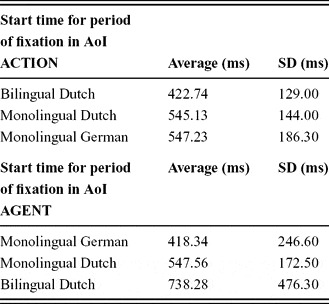
The first analysis focuses on the start time of the first period of fixation within the AoIs. Table 7 shows aggregated start times for the first fixation period within the areas of interest per speaker group in milliseconds.
Average start times of first period of fixation in the two areas of interest.

A repeated measures ANOVA shows that there is a significant interaction between the within-subjects factor area of interest and the between-subjects factor speaker group (F(2,48) = 5.18, p < .05). A paired samples t-test shows that for the bilingual Dutch group, there is a trend to have an earlier start time for the first fixation period within the area of interest of the action, rather than within the agent area (t(10) = −0.234, p = .069). This is not the case for either monolingual speaker group.
A condition (area of interest) x speaker group ANOVA shows a significant effect of the AoI agent (F(2,48) = 4.39, p < .05). Post-hoc tests (LSD) show that German speakers have an earlier start time for the first fixation period within the AoI of the agent than the bilingual Dutch speakers (p < .001). When comparing the start time of the first fixation period (AoI agent) of the bilingual Dutch speakers to the start time of monolingual Dutch speakers, post-hoc tests show a trend (p = .084): the bilingual Dutch speakers tend to look later at the agent than both monolingual groups. There is no difference between the two monolingual groups. This indicates that the bilingual Dutch speakers tend to look at the action earlier than at the agent, when compared to both monolingual groups. The German speakers tend to look earlier at the agent.
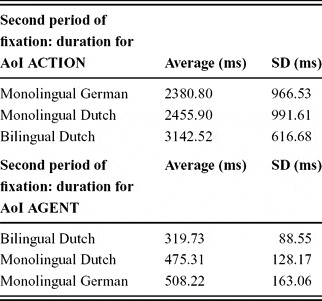
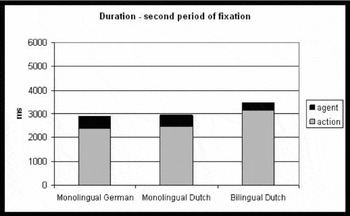
If we compare the total duration of the second fixation period within the two AoIs between groups, we see that there is a trend for differences in the AoI of the action (F(2,48) = 2.73, p = .075), and a highly significant effect of the AoI of the agent (F(2,48) = 7.13, p < .001). Table 8 and Figure 2 show the total duration of the second fixation period for the two AoIs.
Average duration of the second period of fixation in both areas of interest.

Average duration of second period of fixation in both areas of interest.

Post-hoc tests (LSD) show that the bilingual Dutch speakers have a longer second fixation period in the AoI of the action when compared to the German speakers (p < .05), and this is a trend when compared to the monolingual Dutch group (p = .051). There is no difference in fixation time between the two monolingual groups.
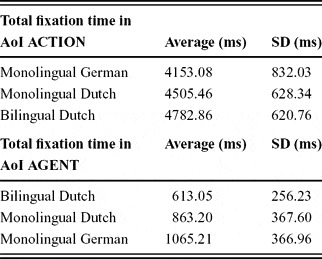
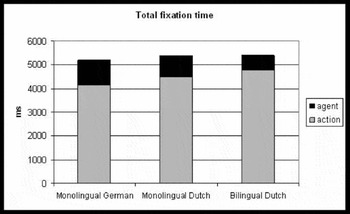
Looking at the total duration of all the fixations within both areas of interest (total fixation time), again differences arise between the two AoIs (repeated measures analysis: F(1,48) = 718.36, p < .001) and the interaction between AoI and the three speaker groups (F(2,48) = 5.00, p < .05) (see Table 9 and Figure 3).
Average total fixation time per speaker group in both areas of interest.

Distribution of total fixation time over the two areas of interest.

The t-tests for paired samples show that, for all language groups, there is a significantly longer fixation time on the action than on the agent (Monolingual German: t(18) = 12.82, p < .001; Monolingual Dutch: t(17) = 18.87, p < .001; bilingual Dutch: t(10) = 18.87, p < .001).
A condition x language ANOVA shows that for the action AoI there is a trend for differences between groups (F(2,48) = 2.95, p = .062), and a significant effect of the agent AoI (F(2,48) = 6.11, p < .05). Post-hoc tests (LSD) show that the German speakers spend less time overall looking in the action AoI, compared to the bilingual Dutch speakers (p < .05). Within the agent AoI we see that the bilingual Dutch group has less fixation time than the German group (p < .001) and the shorter fixation time is a trend when compared to the monolingual Dutch group (p = .061). The monolingual Dutch speakers also show a trend for a shorter fixation time at the agent AoI than the German speakers (p = .080). The distribution of attention is such that all groups look longer at the action than at the agent. A between-group comparison of overall fixation time shows that the monolingual Dutch speakers and the bilinguals look at the agent for a shorter period of time (and at the action for a longer period of time) than the German speakers. The bilingual Dutch speakers again show a trend for looking at the agent for a shorter period of time (and at the action for longer) than the monolingual Dutch speakers.
5.4 Discussion of the eye-tracking data
Overall the analyses of fixation time within the two identified AoIs (although many comparisons showed trends, possibly due to a power problem) indicate that the bilingual Dutch speakers have a long fixation time at the part of the video clip where the action (the creation process) is shown. This is interpreted as showing that the bilingual speakers pay more attention and have more interest in the ongoing process shown in the video clips, rather than the agents that are performing the action. The same holds for the monolingual Dutch speakers, though to a lesser extent.Footnote 13 In both cases, the higher degree of attention to the depicted ongoing process correlates with a high frequency of use of progressive aspectual forms.
These results support the hypothesis that relevant temporal features of the stimuli led monolingual as well as bilingual speakers of Dutch to take an aspectual perspective of ongoingness when conceptualizing the specific events. It is argued that the activation of this perspective is linked to the fact that the language has a productive linguistic form available in expressing this concept, which is not the case in German.
The bilingual speakers, first of all, showed an even higher frequency of selection of an aspectual perspective and it was hypothesized that they would show longer (or earlier) fixation times within the area of interest that shows the ongoing process. This is indeed what the eye-tracking analyses have revealed (although again, one should note that most effects indicated trends).
The results of the eye-tracking analyses thus suggest that the monolingual and bilingual Dutch speakers’ increased degree of attention to the action in progress can be linked to the selection of the aspectual concept “event is ongoing”. Given the specific temporal features of the event shown in the stimulus, the monolingual and bilingual Dutch speakers select the aan het progressive to refer to the event. The increased degree of attention to this part of the stimulus could also reflect the part of the speech planning process which relates to the selection of the verb form (part of the formulation process and not so much conceptualization, in Levelt's (Reference Levelt1989) terms).
All in all, the attention patterns are linked to the speech production results, and they appear to be language-specific (or rather speaker group-specific). The data show that the Dutch–German bilinguals have a unique pattern of scanning the stimulus material for verbalization, which is linked to their unique pattern of use of specific linguistic forms, compared to the monolinguals. Although the present results of the eye-tracking analyses are tentative, the differences, though small, do reveal interesting trends which are in line with the linguistic analyses.
6. General discussion and conclusion
The present study has provided evidence for the interrelation between the selection of specific aspectual categories and specific patterns of event conceptualization, as reflected in the direction of attention during information intake (both for and while speaking). Taking the case of the aan het progressive in Dutch, a high frequency of use of the form by monolingual and bilingual speakers in event construal correlates with a marked direction of attention to the part of the stimulus that shows the event in progress.
The early Dutch–German bilinguals showed a specific preference in the use of an aspectual perspective in Dutch, at the linguistic as well as the conceptualization level. Even though the bilinguals apply the aan het progressive to a high degree in contexts that represent attractor areas for monolingual Dutch speakers, the findings show a less constrained pattern of use of the Dutch aan het progressive at the expense of other options (posture verbs). The bilinguals use this perpective on motion events to a higher degree, as with the other situation types studied, but with motion events they produce event descriptions that are not typical for native speakers (e.g., the combination of progressive aspect (aan het) with an endpoint). These findings indicate that the semantic restrictions on the use of the progressive do not replicate those found for monolingual speakers and are thus bilingual-specific. This in a way resembles the results of Ameel et al. (Reference Ameel, Storms, Malt and van Assche2009; Reference Ameel, Storms, Malt and Sloman2005) who found a comparable pattern for lexical object naming since the bilinguals in their sample had weaker semantic boundaries for specific lexical concepts. Significantly, the bilinguals’ patterns of attention allocation differ compared to both monolingual groups, suggesting that the Dutch–German bilingual, when speaking Dutch, has a bilingual-specific event conceptualization system. This system differs from monolingual Dutch speakers and does not show any sign of cross-linguistic influence from the monolingual German pattern. In this sense, the current study may provide an alternative to the possibilities in conceptualization patterns as outlined by Jarvis and Pavlenko (2008, see 1.1): increased use and extension of a conceptualization pattern (in this case extension of an aspectual perspective to goal-oriented motion events) that departs from the conceptualization preferences found for monolinguals of one of the two languages – that is, the Dutch pattern.
An important question remains: In what way do the early Dutch–German bilingual speakers go about solving tasks of event construal in German? Might we here again find evidence that the bilingual speaker is a very competent but unique language user (cf. Grosjean Reference Grosjean1998), or will we find traces of cross-linguistic influence from the Dutch system? These questions will be the focus of a forthcoming study.
Overview of bilingual participants

Bilinguals' self-assessed proficiency in both languages

Overview of critical stimuli