Introduction
Genetically modified (GM) crops containing the insecticidal proteins from Bt have become an important tool for pest management (Raybould, Reference Raybould2012). However, the widespread cultivation of Bt crops increases the probability that the pests will evolve selectively resistance toward these insecticidal proteins (Wu & Guo, Reference Wu and Guo2005). Cotton bollworm (Helicoverpa armigera) is one of the major pests worldwide (Fitt, Reference Fitt1989; Luttrell et al., Reference Luttrell, Fitt, Ramalho and Sugonyaev1994; Guo, Reference Guo1997). It has been effectively controlled by transgenic cotton that expresses the Bt-toxin Cry1Ac (James, Reference James2007; Tabashnik et al., Reference Tabashnik, Gassmann, Crowder and Carriere2008; Wu et al., Reference Wu, Lu, Feng, Jiang and Zhao2008). The evolution of the resistance by target pests such as H. armigera could reduce the efficacy of Bt cotton (Lu et al., Reference Lu, Wu, Jiang, Guo and Desneux2012; Tabashnik et al., Reference Tabashnik, Wu and Wu2012). Selection for the H. armigera-resistant strains has already been conducted in laboratories in China, Australia and India (Liang et al., Reference Liang, Tan and Guo2000; Akhurst et al., Reference Akhurst, James, Bird and Beard2003; Tabashnik et al., Reference Tabashnik, Carriere, Dennehy, Morin, Sisterson, Roush, Shelton and Zhao2003; Zhang et al., Reference Zhang, Tian, Zhao, Jin, Yang, Liu, Yang, Wu, Wu, Cui, Tabashnik and Wu2012). And in our laboratory several Bt-resistant strains of H. armigera have been developed with their mechanism of resistance investigated (Liang et al., Reference Liang, Tan and Guo2000; Wu et al., Reference Wu, Guo and Gao2002a , Reference Wu, Guo, Lv, Greenplate and Deaton b ; Liu et al., Reference Liu, Li, Gao, Ning and Wu2010). Induction of the Bt-toxin resistance in the H. armigera strains affected reproduction in a variety of ways, including reducing the incidence of successful mating, changing the fitness and decreasing reproducibility as the resistance level increased (Liang et al., Reference Liang, Wu, Yu, Li, Feng and Guo2008; Zhao et al., Reference Zhao, Wu, Liang and Guo2008). However, the mechanism of these phenomena is still unknown.
Vitellogenin is not only the major nutrient of the embryo but also a precursor protein of egg yolk (Hagedorn et al., Reference Hagedorn, Maddison and Tu1998; Sappington & Raikhel, Reference Sappington and Raikhel1998). Recently, genomic and transcript sequences for Vgs from numerous species have been recorded in GenBank, including insects (Li et al., Reference Li, Sadasivam and Ding2003; Ye et al., Reference Ye, Dong, Song, Shi, Chen and Hu2008; Shu et al., Reference Shu, Zhou, Tang, Lu, Zhou and Zhang2009; Tufail & Takeda, Reference Tufail and Takeda2009; Tufail et al., Reference Tufail, Naeemullah, Elmogy, Sharma, Takeda and Nakamura2010) and some copepod species (Hwang et al., Reference Hwang, Lee, Han, Park, Lee, Lee and Lee2010). In most insects, Vgs are synthesized in the fat body, secreted into the hemolymph, then incorporated into the developing oocytes (Tufail & Takeda, Reference Tufail and Takeda2008). Apart from providing nutrition, Vgs also participate in the synthesis of brood food, transport of zinc, longevity, the immune system, etc. (Nakamura et al., Reference Nakamura, Yasuda, Adachi, Sakurai, Ishii and Goto1999; Guidugli et al., Reference Guidugli, Piulachs, Belles, Lourenco and Simoes2005; Amdam et al., Reference Amdam, Norberg, Page, Erber and Scheiner2006; Cervera et al., Reference Cervera, Maymo, Martinez-Pardo and Garcera2006; Corona et al., Reference Corona, Velarde, Remolina, Moran-Laute, Wang, Hughes and Robinson2007; Hwang et al., Reference Hwang, Lee, Han, Park, Lee, Lee and Lee2010; Havukainen et al., Reference Havukainen, Halskau and Amdam2011).
An identification of the correlation between the resistance to the Bt-toxin and reproduction could be valuable for a better understanding of the resistance evolution and determining the mechanisms to manage resistance. In this article, the correlation between the resistance evolution to the Bt-toxin and the reproduction in H. armigera was examined by analyzing the Vg gene expression. Here, we cloned and identified the Vg gene from H. armigera (HaVg) for the first time. Then, the relative mRNA expression levels of HaVg were systematically investigated in different Bt-toxin strains. Our results demonstrate one of the regulation mechanisms in the reproductive cost of the resistance evolution to the Bt-toxin in H. armigera, which is based on an HaVg mRNA expression pattern.
Materials and methods
Insect strains
The cotton bollworm, H. armigera, used in this study was originally collected from the cotton fields in Xinxiang County, Henan Province of China in 1996. The Cry1Ac-susceptible strain (96S) had been reared on an artificial diet without any exposure to chemical insecticides or the Bt-toxin in the laboratory since 1996. Meanwhile, the Cry1Ac-resistant strain (BtR) was derived from 96S using an artificial diet with the Cry1Ac toxin (Liang et al., Reference Liang, Tan and Guo2000). During the selection process, to ensure that the samples had a common genetic background, the BtR strain was crossed with the 96S strain in the 27th, 49th and 87th generations, which would minimize the development of the other differences between the two strains. In this study, the BtR strain had been selected for 135 generations, the Cry1Ac protein concentration in the 135th generation was 550 μg ml−1. Since the 97th generation, the selected strain has been separated into two groups, one group of the progeny was transferred to an artificial diet without the Bt-toxin, till the test it had been kept on a common artificial diet for 38 generations (CK1). A part of the 135th-generation resistant larvae were fed on an artificial diet without the Cry1Ac protein and their offspring also were tested (CK2). All of the groups of insects were reared in the laboratory on an artificial diet at 27±2 °C, 75±10% RH and a photoperiod of L 14 h: D 10 h (Liang et al., Reference Liang, Wu, Yu, Li, Feng and Guo2008), respectively. The female and male adults were placed in cages (30 cm×60 cm×30 cm) for mating and oviposition.
Bioassays and resistance level to Cry1Ac
The susceptibility of the four groups was tested after amending the diet surface overlay bioassays described in Zhang et al. (Reference Zhang, Wei, Zhao, Jin, Yang, Wu, Tabashnik and Wu2011). A definite amount of liquid artificial diet was dispensed into each well of a 24-well plate. After the diet got cooled and solidified, 60 μl of the Na2CO3 buffer solution containing different concentrations of the Cry1Ac protein was applied evenly to the diet surface in each well and allowed to air dry (the suspensions of the Cry1Ac protein were diluted with a 0.05 M, pH 11.4, Na2CO3 buffer solution), then a single first instar larva was placed in each well. For a diagnostic concentration of the Cry1Ac protein, each treatment had three biological replicates, including a blank control only added Na2CO3 liquid. After a treatment of 7 days, the larval mortality was recorded. The lethal concentration of 50% (LC50) was analyzed by probit regression using Polo program (Russell et al., Reference Russell, Robertson and Savin1977). The resistance ratio was calculated as the LC50 for the strain progeny from a cross-division by the LC50 for the susceptible strain (96S).
Tissue sampling and cloning of HaVg gene
Male and female individuals of H. armigera in different groups were separated at the 2nd day after pupation. To determine the expression profiles, female samples at different stages of H. armigera were collected from four different groups’ development. The newly formed pupae (3rd day), the late phase pupae (10th day) and the emerged adults of different strains were collected every day after eclosion. Then, the pupae and the adults were immediately frozen in liquid nitrogen and were stored at −80 °C before RNA isolation.
Different tissues from the female adults, including fat body, ovary, hemolymph, cuticle, head, antenna, gut and malpighian tubule (six individual tissues as a treatment), were collected on the 3rd day after eclosion, and stored as mentioned above.
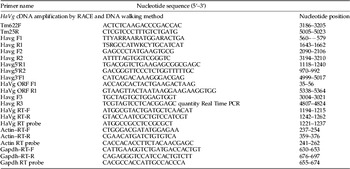
Total RNA was extracted with the Trizol reagent (Invitrogen, Carlsbad, CA, USA), following the manufacturer's recommendation. The SuperScript™ III First-Strand Synthesis System (Invitrogen) was used to synthesize the cDNA. According to the expressed sequence tag (EST) sequence from the suppression subtractive hybridization (SSH) library constructed in our lab (data not shown), the Tm622 F and the Tm25 R primers (table 1) were designed to amplify the partial mRNA sequence of Vg near the 3′ end. Degenerate primers (Havg-F1/Havg-R1 and Havg-F2/Havg-R2 (table 1), respectively) were designed to amplify a fragment of Vg near the 5′ end. The gene-specific primers (Havg-F3 and Havg-R3, respectively (table 1)) were used to study the sex expression of HaVg. PCR reactions were performed for 40 cycles.
Primers used for vitellogenin sequencing.

Rapid amplification of the cDNA ends (RACE) method was performed to amplify the 3′ and the 5′ ends of the Vg genes with a SMARTTM RACE cDNA Amplification Kit (Clontech, Palo Alto, CA, USA) and specific primers (Havg-5′R1/Havg-5′R2 for the 5′end and HaVg3′F1 for the 3′end (table 1), respectively) according to the manufacturer's protocol. PCR reactions were performed for five cycles of 30 s at 94 °C and 3 min at 72 °C; 5 cycles of 30 s at 94 °C, 30 s at 70 °C and 3 min at 72 °C; and 30 cycles of 30 s at 94 °C, 30 s at 68 °C and 3 min at 72 °C, respectively. To ensure that the entire open reading frame (ORF) was amplified, specific primers were designed according to the 5′ and the 3′ untranslated region sequences and were used to amplify the entire ORF sequences (ORF-F1/ORF-R1 (table 1)).
The nucleotide and the deduced amino acid sequences of the HaVg protein were analyzed using the ExPaSy proteomics server website (http://www.expasy.org). The signal peptide position and the transmembrane helices were analyzed using TMHMM v. 2.0 (http://www.cbs.dtu.dk/services/TMHMM-2.0/). Percent identity of the amino acid sequences was calculated using ClustalW (Thompson et al., Reference Thompson, Higgins and Gibson1994). The phylogenetic tree was constructed in MEGA 5.0, using the neighbor-joining method (Tamura et al., Reference Tamura, Peterson, Peterson, Stecher, Nei and Kumar2011).
Tissue and temporal expression patterns in the Bt-toxin susceptible and resistance strains
The relative mRNA expression levels of Vg in the different strains during the various stages of development were analyzed by a quantitative real-time PCR (qRT-PCR). Each qRT-PCR reaction contained the following components: 1 μl of the template cDNA, 2*Premix Ex Taq™ (Takara, Japan), 0.2 μM of each primer and 0.4 μM of the probe. An ABI 7500 Fast Real-time PCR System (Applied Biosystems) was used to run the reactions. qRT-PCR was performed for 40 cycles of 95 °C 15 s and 60 °C 34 s, respectively. The Vg gene expression was normalized with the double reference genes β-actin (Accession no. EU527017) and GAPDH (accession no. JF417983) and the comparative CT method (2−ΔΔCt) (Livak & Schmittgen, Reference Livak and Schmittgen2001) was used to analyze the data. The primers and the fluorescein amidite (FAM) probes are shown in table 1.
Statistical analysis
Statistical analyses were conducted using STATA 9.0. The development of the different stages was analyzed using one-way analysis of variance (ANOVA), and multiple comparisons were conducted using Bonferroni multiple post hoc comparison test. Different Bt-toxin-susceptible and resistant strains were compared using paired Student t-test.
Results
Bioassays test in a different group
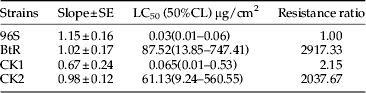
The bioassay data are shown in table 2. Compared with the susceptible strain (96S), the resistance strain (BtR) had a 2917.15-fold resistance to the Cry1Ac protein. The resistance ratios of CK1 and CK2 were 2.15-fold and 2037.67-fold, respectively. The results showed that the resistance of the resistant strain (BtR, which had a higher resistance to Cry1Ac) decreased very rapidly when the selection pressure was removed, the resistance ratio reduced from 2917.15-fold to 2037.67-fold after one generation, and reached to less than 2.15-fold after 38 generations.
Toxicity and resistance ratio against Cry1Ac in the four H. armigera groups.

Resistance ratio: resistance strain LC50/susceptible strain LC50.
Amino acid sequence of HaVg and a comparison with the other insects
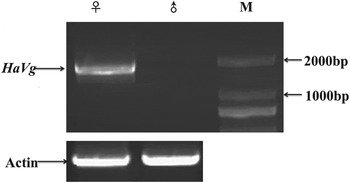
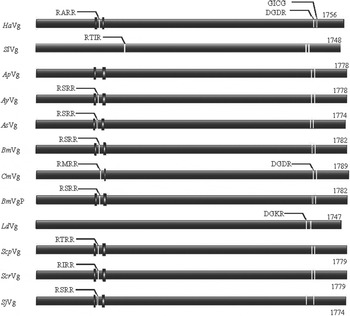
The Vg cDNA is 5704 nt in size containing an ATG start codon (nt 59–61), a TAA stop codon (nt 5327–5329), a putative poly-A addition signal (nt 5442–5446) and a poly-A tail (nt 5678–5704), respectively. HaVg has an ORF 5265 nt encoding for the 1765 amino acid protein with a calculated molecular weight of 197.28 kDa (GenBank accession no. JX504706). It was only expressed in the female moths of H. armigera (fig. 1). SignalP analysis indicated that the first 19 amino acids represented the signal peptides (http://www.cbs.dtu.dk/services/SignalP/). The National Center for Biotechnology Information (NCBI) search predicted the following three conserved domains within the amino-acid sequence of HaVg: the Vg–N domain or the lipoprotein amino-terminal region, the DUF 1943 domain and a Von Willebrand factor type D domain (VWD) (amino acid positions: 54–439, 584–732 and 1364–1537, respectively). In addition, two polyserine regions, an RXXR consensus cleavage site, a GL/ICG motif and cysteine residues, respectively, were identified (fig. 2). The cleavage signal RARR HaVg was anticipated to be between the amino acids 353 and 356. Upon cleavage, two subunits with the predicted MWs 160.882 and 39.988 kD would be produced.
RT-PCR analysis of the sex specific expression of the Helicoverpa armigera Vg. ♀ is the female adult sample, ♂ is the male adult sample and M is the weight maker (2000 bp ladder), respectively.

Alignment of the Vg sequences in Lepidoptera. Alignment of the deducted amino acid sequences from HaVg (Helicoverpa armigera Vg, GenBank accession no. JX504706), SlVg (Spodoptera litura Vg, ABU68426), ApVg (Antheraea pernyi Vg, BAB16412), AyVg (Antheraea yamamai Vg, BAB32640), AsVg (Actias selene Vg, ADB94560), BmVg (Bombyx mandarina Vg, BAE47146), CmVg (Cnaphalocrocis medinalis Vg, AEM75020), BmVgP (Bombyx mori Vg precursor, NP_001037309), LdVg (Lymantria dispar Vg, AAB03336), ScpVg (Samia cynthia pryeri Vg, BAD91196), ScrVg (Samia cynthia ricini Vg, BAB32641) and SjVg (Saturnia japonica Vg, BAD91195). The highly conserved regions are highlighted. The GICG motif, the RXRR cleavage site motif and the DGXR motif are indicated in the sequence. The polyserine tracts are labeled by the black frame.

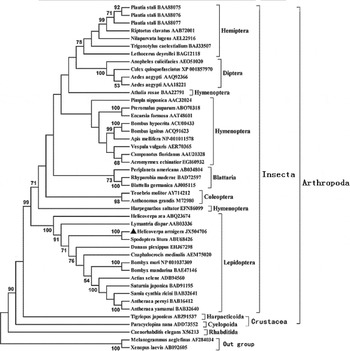
The deduced amino-acid sequence of HaVg was aligned with the corresponding sequences of the other Lepidoptera insects. HaVg had a high similarity (51–72%) to Vgs of the other Lepidoptera insects and was 72% similar to Spodoptera litura (Supplementary Table S1). The alignment showed that the GL/ICG motif, the DGXR motif and the cysteine residues located near the C-terminal were highly conserved among the Lepidoptera insect Vgs (fig. 2). A phylogenetic tree was constructed based on the distances of the amino acid sequences between H. armigera and the other insects. A phylogenetic analysis clustered the H. armigera Vg into the Lepidoptera Vg subfamily (fig. 3).
A molecular phylogenetic (neighbor-joining) tree based on the entire amino acid sequence of Vg for forty insects and five non-insect species.

HaVg mRNA expression in the tissue
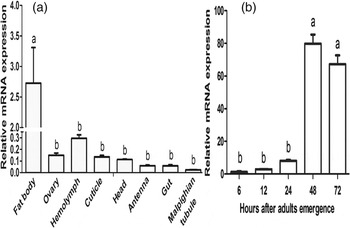
The qRT-PCR was used to probe the tissue- and the stage-specific expressions of the HaVg gene. The relative mRNA expression level of HaVg was extremely high in the fat body compared to other tissues (ANOVA, F=20.13, DF=7, 24, P<0.0001) (fig. 4a). The relative expression of Vg in the fat body was low at 6–24 h after eclosion. The relative mRNA expression levels rose drastically at 48 h after eclosion, and then began to decrease (ANOVA, F=120.59, DF=4, 10, P<0.0001, multicomparison by the Bonferroni test: P<0.0001 between 24 and 48 or 72 h; P=0.074 among 6, 12 and 24 h; P=0.295 between 48 and 72 h) (fig. 4b).
Tissue expression levels of the HaVg mRNA detected by qRT-PCR. (a) Relative expression levels of the HaVg mRNA in different tissues. All of the expression levels of the HaVg mRNA in the tissues were compared with that in the fat body. (b) Relative expression levels of the HaVg mRNA in the female fat body at different stages of development. Take the expression level of the HaVg mRNA at 6 h after emergence as the control group, the levels in the other times were compared with that in the control group. The data represent the mean±SE for at least four repeats normalized relative to the double reference genes transcript level (β-actin and GAPDH). The differences are considered statistically significant at the P<0.05 level.

Temporal pattern of HaVg mRNA expression in different strains
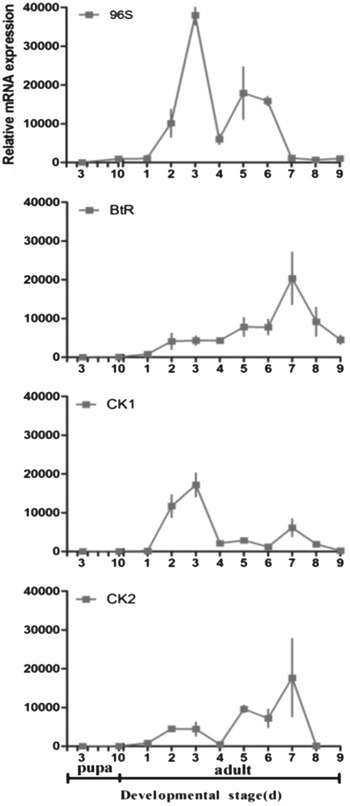
The developmental expression pattern of Vg demonstrated that HaVg was first transcribed in the early pupal stage. The expression level of the Vg gene fluctuated significantly during the developmental stages and had a maximum expression level in the 3rd day female adults in the 96S strain (ANOVA, F=23.45, DF=10, 33, P<0.0001). In the BtR strains, the maximum expression level of Vg was found in the 7-day-old female adults. Meanwhile, the relative expression level was approximately 50% less than that of the 3rd day female adults in the 96S strain (fig. 5). The Vg mRNA expression level of 96S was significantly higher in the late pupal stage, on the 3rd (t-test, P<0.0001) and the 6th (t-test, P=0.0057) day adults than that of the BtR strain. In the later phase of adult development, days 7–9, the relative Vg mRNA expression levels were reversed, and the BtR strain was significantly higher than the 96S strain (t-test, P<0.05) (Supplementary Table S2). Furthermore, the relative expression levels of HaVg, which was the highest in the 3rd day female in the CK1 strain, was significantly higher on the 2nd to the 4th days than the HaVg expression level in the CK2 strain (t-test, P<0.05) (Supplementary Table S2). In the later phase of development, the HaVg expression level was significantly higher in the CK2 strain than in the CK1 strain in the 5th and the 6th day females (t-test, P<0.05) (Supplementary Table S2). Therefore, from the comparison of the Vg mRNA expression levels among the four different strains, the expression level of the Vg mRNA in the CK1 strain was similar to the 96S strain whereas the CK2 strain was similar to the BtR strain (fig. 5).
The quantity real time PCR analysis of the HaVg mRNA expression levels in the whole body of the Helicoverpa armigera females at different developmental stages in the 96S, BtR, CK1 and CK2 strains, respectively. The RNA samples were extracted from the whole bodies of the pupa at different stages after eclosion. The data represents the mean±SE for at least four repeats with β-actin and GAPDH as the double reference normalized genes. A statistical comparison by the Student's t-test in pairs by strain is listed in Supplementary Table S2.

Discussion
The Bt-toxins influence selection in insect fitness and the evolution of the insect resistance which threatened the successful production of transgenic crops (Gonzalez et al., Reference Gonzalez-Cabrera, Escriche, Tabashnik and Ferre2003; Tabashnik et al., Reference Tabashnik, Dennehy and Carriere2005, Reference Tabashnik, Gassmann, Crowder and Carriere2008). Several studies indicate that the fitness costs affect the reproduction of H. armigera (Liang et al., Reference Liang, Wu, Rector and Guo2007; Zhao et al., Reference Zhao, Wu and Guo2007, Reference Zhao, Wu, Liang and Guo2008; Tabashnik et al., Reference Tabashnik, Gassmann, Crowder and Carriere2008). Studies have also shown that reproductive maturation is regulated by the Vg protein (Telfer, Reference Telfer2009). Before entering adulthood, the primary oocytes have already developed within the follicular cell of the ovary, while the synthesis and the uptake of yolk protein (vitellogenesis) remain incomplete in most insects (Sappington & Raikhel, Reference Sappington and Raikhel1998). In the present study, the bioassay showed that the resistance of the resistant strain decreased very rapidly when the selection pressure was removed. The resistance ratio dropped from 2917.33-fold to 2037.67-fold in just one generation. The resistance of CK1 kept a relatively stable low resistance level (2.15-fold) afterwards without selection pressure for 38 generations (table 2). Zou et al. (Reference Zou, Li, Zhang, Wei, Liang and Guo2012) also found that the resistance would be regained quickly by reselection using Cry1Ac, the hatchability and the survival rate of the larvae reduced as the resistance ratio rose.
In recent years, the Vg cDNA sequences of many insects have been cloned to facilitate an examination of the Vg expression levels in different growth periods, tissues and ovary development (Tufail & Takeda, Reference Tufail and Takeda2008). Previous studies have indicated that the insect Vg sequences have common features such as the VWD domain (Baker, Reference Baker1988), the GL/ICG motif and DUF 1943 (Thompson & Banaszak, Reference Thompson and Banaszak2002). Recent studies have reported that the C-terminal region and the VWD domain of Vg are processed and attached to the vitelline coat which participates in fertilization as the binding partner of the sperm proteases (Akasaka et al., Reference Akasaka, Harada and Sawada2010). HaVg shared common motifs with other insects, such as the putative RXXR cleavage cite (RARR), the conserved GL/ICG domain and the DGXR motif (fig. 2), respectively. The conserved polyserine tracts at the N-terminus of most insect Vg sequences are also found in the H. armigera Vg (fig. 2). Some insects do not have this conserved sequence (Hiremath & Lehtoma, Reference Hiremath and Lehtoma1997; Ye et al., Reference Ye, Dong, Song, Shi, Chen and Hu2008; Shu et al., Reference Shu, Zhou, Tang, Lu, Zhou and Zhang2009) or have more than one polyserine tract (Chen et al., Reference Chen, Sappington and Raikhel1997; Koywiwattrakul & Sittipraneed, Reference Koywiwattrakul and Sittipraneed2009). Vitellogenins are complex (200–700 kDa) homologous phosphor proteins that often oligomerize in their native state and have a PI of 6.1–6.4 (Tufail &Takeda, Reference Tufail and Takeda2008). After modification, the Vg monomers of most insects consist of 1–4 subunits, with the larger ones being >180 kDa and the smaller ones being <50 kDa (Pateraki & Stratakis, Reference Pateraki and Stratakis2000; Tufail & Takeda, Reference Tufail and Takeda2008; Provost-Javier et al., Reference Provost-Javier, Chen and Rasgon2010). Through the NCBI conserved domain search, three domains were identified in HaVg. The HaVg gene with an ORF of 5265 nucleotides would encode a protein of 1756 amino acids with a calculated MW of 197.28 kDa and a PI of 8.74. The HaVg transcript was expressed at high levels in the female fat body and found in low traces in the other tissues (fig. 4). This process was investigated during the Vg synthesis (Tufail & Takeda, Reference Tufail and Takeda2009).
The peak expression level of HaVg in the BtR strain was about 4 days later compared to the Bt-toxin-susceptible strain. The mRNA expression level of HaVg was significantly down-regulated on the 3rd day after eclosion in the BtR strain compared with the 96S strain (fig. 5). Furthermore, the 3rd day is the key point for Vg generation. The Vg protein, a main nutritional source stored in the ovary, was detected 1 day after the Vg mRNA first appeared (Shinoda et al., Reference Shinoda, Miura, Taylor and Chinzei1996; Hirai et al., Reference Hirai, Watanabe, Kiyota and Chinzei1998; Tufail et al., Reference Tufail, Lee, Hatakeyama, Oishi and Takeda2000; Piulachs et al., Reference Piulachs, Guidugli, Barchuk, Cruz, Simões and Bellés2003; Ye et al., Reference Ye, Dong, Song, Shi, Chen and Hu2008). Therefore, after the first 3 days, the ovary had stored enough nutrition for the embryo. However, the Vg mRNA expressed maximally on the 3rd day after eclosion in the Cry-1Ac susceptible female adult, while it reached maximally on the 7th day in the Cry-1Ac resistant female adult (fig. 5). The other studies have indicated that the amount of Vg accumulated in the first 3 days was 70% of all of the proteins expressed and this high production was maintained throughout the adult life of Apis mellifera (Guidugli et al., Reference Guidugli, Piulachs, Belles, Lourenco and Simoes2005). Therefore, the result in our study reveals one of the reasons why oviposition in the Bt-toxin-resistant strains was significantly lower and delayed compared to that of the susceptible strains (Liang et al., Reference Liang, Wu, Yu, Li, Feng and Guo2008; Zhao et al., Reference Zhao, Wu, Liang and Guo2008). Considering that the susceptible and the resistant strains were fed different diets and that the resistant strain was screened for 135 generations, it is possible that the down-regulation of the HaVg mRNA expression level is related to the diet. However, this hypothesis was refuted by the expression patterns in the strains of CK1 and CK2. The results indicated that in the CK1 HaVg expressed maximally on the 3rd day after eclosion, which was similar to the susceptible strain, and that the HaVg expression in the CK2 was similar to the BtR strain (fig. 5).
Our study revealed the molecular characterization of Vg in H. armigera for the first time. The expression of the HaVg mRNA in the BtR strain was postponed compared with the 96S strain, which supports the tradeoff hypothesis between the reproductive cost and the Bt-toxin resistance evolution. The down-regulation of the HaVg mRNA level was only partially restored after 38 generations. It can be speculated that removing the Bt pressure may slow the resistance evolution in the field. Vg protein synthesis and egg production were regulated not only by the Vg gene but also by the other hormones and genes (Sappington & Raikhel, Reference Sappington and Raikhel1998). And the Vg protein synthesis, which played a direct role in the insect reproduction, had a positive correlation with the Vg mRNA expression in some insects (Hirai et al., Reference Hirai, Watanabe, Kiyota and Chinzei1998; Ye et al., Reference Ye, Dong, Song, Shi, Chen and Hu2008). To better understand the relationship between Vg and the reproductive cost of the resistance evolution to the Bt-toxin, systematic investigations, including the yolk protein level, fecundity in different strains and the JH regulation mechanisms will be conducted in the future.
The supplementary material for this article can be found at http://www.journals.cambridge.org/BER
Acknowledgement
This work was supported by the National Science and Technology Supported Project (2012BAD19B05).