Implications
Major differences in the muscle composition and physicochemical traits of meat from the French local Basque and the conventional Large White pig breeds were highlighted and associated with higher redness and marbling as well as tenderness, juiciness and flavour of meat from Basque pigs. Pig production systems modified muscle and meat properties. In particular, the extensive conditions influenced the level of stress at slaughter and consequently the physicochemical traits and meat colour, but not eating quality. The present data can be helpful for actors of pork chains involved in differentiation approaches on product quality, such as Protected Designation of Origin.
Introduction
The sensory quality of pork, including appearance, texture and flavour, results from complex interactions between pig genetic background, rearing conditions, pre-slaughter handling and carcass or meat processing. Although many factors influencing pork quality have been identified so far, the muscle properties underlying high eating quality remain unclear. The high quality of meat from local breeds is well-established; however, the biological determinants of this ‘superior’ quality compared with conventional breeds are not clearly identified, apart from generally elevated intramuscular fat (IMF) level (Bonneau and Lebret, Reference Bonneau and Lebret2010; Pugliese and Sirtori, Reference Pugliese and Sirtori2012 for reviews). Moreover, pigs from local breeds are often produced in specific systems with outdoor or extensive conditions that contribute to the overall high acceptability of these systems and of their products by consumers (Bonneau and Lebret, Reference Bonneau and Lebret2010). These local pork chains are often involved in differentiation approaches to reach official quality label registration based on typicality or high eating quality claims, and thus need to objectivize differences in product properties due to their specific breed and production system, as compared with conventional ones. Therefore, an experiment was designed to determine the genetic and environmental effects on pork quality, using two contrasted pig breeds, the conventional Large White and the French local Basque exhibiting high eating quality (Labroue et al., 2000). These pigs were reared in different production systems, which influenced meat quality (Lebret, Reference Lebret2008 for review; Lebret et al., Reference Lebret, Prunier, Bonhomme, Foury, Mormède and Dourmad2011). Pigs from both the breeds were reared in a conventional and in an alternative (indoor bedding and free outdoor access) system. In addition, some Basque pigs were reared in the extensive system of the Basque pork chain – a commercial local chain producing high-quality pork products and involved in a Protected Designation of Origin (European label) approach. The present manuscript describes the influences of breed and production systems within breed on muscle composition, plasma indicators of the level of stress before slaughter and their impacts on the physicochemical meat traits and sensory quality of pork. Effects of breed and production system on animal performance, body composition and adipose tissue traits are published elsewhere (Lebret et al., Reference Lebret, Dourmad, Mourot, Pollet and Gondret2014).
Material and methods
The experiments were conducted following the French guidelines for animal care and use, edited by the French Ministries of High Education and Research and of Agriculture and Fisheries (http://ethique.ipbs.fr/sdv/charteexpeanimale.pdf). All animals were reared and slaughtered in compliance with the national regulations and according to the procedures approved by the French veterinary Services. Our research unit was the holder of a pig experimentation agreement (No. C-35-275-32), and all the technical and scientific staff involved in the experiment had an individual agreement for experimentation on living animals, delivered by the Veterinary Services of the French Ministry of Agriculture.
Animals and experimental design
The experimental design is already presented in detail by Lebret et al. (Reference Lebret, Dourmad, Mourot, Pollet and Gondret2014). In brief, a total of 100 castrated male pigs from the pure local Basque breed (B, n=60) or the selected Large White breed (LW, n=40) were used. The B pigs were obtained from two breeding farms of a French local pork chain producing high eating quality pork products, and the LW pigs were obtained from the INRA experimental farm herd. All the pigs were free of the HAL n and RN- alleles. The 100 pigs were produced in two successive replicates (R1 and R2), each including 30 B and 20 LW pigs. In each replicate, 20 B and 20 LW pigs were reared in two different housing systems at the INRA experimental farm (Saint-Gilles, France), with one pen of 10 pigs per breed and per system. At the average BW of 35 kg, B and LW pigs were chosen to balance BW, growth rate from birth and litter of origin between the groups. They were allocated to either a conventional (C) housing system on slatted floor (1.0 m2/pig) or an alternative (A) housing system with indoor bedding and a free permanent access to an outdoor area on concrete floor (total of 2.4 m2/pig), so that four treatments were considered: LWC, LWA, BC and BA. Moreover, in each replicate, 10 B castrated males, half-littermates of the BC and BA pigs were placed from 35 kg BW onwards in an extensive (E) free-range production system in a farm of the Basque pork chain to constitute the fifth treatment – BE. The BE pigs were reared in a pen of 2.5 ha with a shed (650 m height) together with 30 non-experimental additional pure B pigs.
Expecting differences in growth rate between breeds and production systems (Labroue et al., Reference Labroue, Goumy, Gruand, Mourot, Neelz and Legault2000; Alfonso et al., Reference Alfonso, Mourot, Insausti, Mendizabal and Arana2005; Lebret et al., Reference Lebret, Prunier, Bonhomme, Foury, Mormède and Dourmad2011) and in order to slaughter the pigs from the five treatments at the same time and final BW (around 145 kg), the BE pigs were included in the experiment 5 months, and the BC and BA pigs 3 months, before the LWC and LWA pigs. Pigs produced in the C and A housing systems received the same standard growing (from 35 up to 75 kg BW) and finishing (from 75 kg BW onwards) diets, using a feeding plan based on live weight, as previously described (Lebret et al., Reference Lebret, Dourmad, Mourot, Pollet and Gondret2014). The BE pigs were reared in the E pen from March up to January (R1) or from April to February (R2). In this local specific system, pigs were fed a mixture of natural resources and a commercial diet: they had free access to the resources of the extensive pen comprised of mainly grass, acorns and chestnuts, and they received a standard growing–finishing diet according to the farming practices of the Basque pork chain (between 1.4 and 2.6 kg/day per pig, according to their BW; Lebret et al., Reference Lebret, Dourmad, Mourot, Pollet and Gondret2014). All pigs were weighed regularly during the experimental period and the day before slaughter.
Handling and slaughtering
All the pigs were slaughtered at the average BW of 145±9.2 kg. The BC, BA, LWC and LWA pigs were slaughtered at the experimental slaughterhouse of INRA (Saint-Gilles, France) in four sessions, each one including 8 to 12 pigs, with pigs from the four treatment groups chosen on the basis of their BW. The BE pigs were slaughtered in one session at a commercial slaughterhouse of the Basque pork chain (Saint-Jean-Pied-de-Port, France). The pre-slaughter handling of pigs and slaughtering conditions were standardized as much as possible between the two slaughterhouses. Two days before slaughter, all the pigs were fed 1.5 times their daily feed allowance and were fasted from 20.00 h onwards according to the handling practices of the Basque pork chain. The following day, pigs were removed from their pen, transported to the slaughterhouse without any mixing with pigs from other groups. Transport differed between the two slaughterhouses (winding roads and longer transport duration: 90 min v. 5 min, lorry less adapted for easy loading of animals in E v. A and C systems). During lairage, pigs were housed in separate pens by treatment and had free access to water at both slaughterhouses. The next morning, pigs were slaughtered by electrical stunning (350 V, 4 A) and exsanguination in compliance with the current national regulations applied in slaughterhouses. For each treatment, the average BW and age of pigs at slaughter as well as back fat thickness measured at the carcass mid-line (between 4th and 5th lumbar vertebrae) are presented in Table 1 (Lebret et al., Reference Lebret, Dourmad, Mourot, Pollet and Gondret2014).
Mean (±s.d.) of data of BW, age and back fat thickness at slaughter of pigs according to breed: Basque (B) or Large White (LW) and rearing system: conventional (C), alternative (A) or extensive (E) (Lebret et al., Reference Lebret, Dourmad, Mourot, Pollet and Gondret2014)

At slaughter, blood was collected in EDTA-containing tubes, centrifuged immediately and stored at −20°C. Plasma ACTH (two-site 125I immunoradiometric assay, Nichols Institute Diagnostic, San Juan Capitiano, CA, USA) and cortisol levels (competitive 125I RIA kit, Immunotech, 13276 Marseille, France) were determined as previously described (Lebret et al., Reference Lebret, Meunier-Salaün, Foury, Mormède, Dransfield and Dourmad2006). Plasma concentrations of glucose (Glucose HK, ABX Diagnostics kit, 34187 Montpellier, France) and lactate (Lactate PAP kit, Biomerieux, 69280 Marcy l’Etoile, France) were determined enzymatically using a spectro-photometric analyser (Konelab20, Thermo Scientific, MA, USA). Creatine kinase (CK) and lactate dehydrogenase (LDH) activities (Enzyline CK NAC and Enzyline LDH-optimized kits, respectively, Biomerieux) were assayed using the same spectrophotometric analyser. For the determination of plasma hormones, metabolites and enzyme activities, samples from each replicate were analysed within single assays. The number of skin lesions (⩾2 cm) was determined on each carcass by the same operator throughout the experiment.
Muscle biochemistry and meat quality traits
Thirty minutes after slaughter, on each right-carcass side, around 20 g sample of the Longissimus muscle (LM) was excised at the last rib level, immediately frozen in liquid nitrogen and stored at −80°C before determination of pH at 30 min postmortem (p.m.) (pH1) and glycolytic potential (GP=2×([glycogen]+[glucose]+[glucose-6-phosphate])+[lactate]), as previously described (Lebret et al., Reference Lebret, Prunier, Bonhomme, Foury, Mormède and Dourmad2011). In brief, pH1 was determined after homogenization of 2 g of muscle in 18 ml of 5 mM Na iodoacetate (Ingold Xerolyte electrode, Metrohm pH-meter, Berlin, Germany). Muscle lactate concentrations as well as muscle glucose and glucose-6-phosphate (G-6-P) levels altogether, were determined as described above. Glycogen was determined from the glucose concentration after hydrolysis by amyloglucosidase. For pH1 and GP determinations, samples from one replicate were analysed within single assays.
The following day, on the right-carcass side, a 2.0-cm-thick transverse section of LM (first lumbar vertebra level) was excised, from which a 0.5-cm slice (side of last rib) was taken and its core part (around 10 g) was cut into small pieces and frozen at −80°C before determination of ultimate pH (pHu) as described above. The remaining LM section was bloomed for 1 h 30min at 4 °C under artificial light before determination of colour co-ordinates CIE L*: lightness, a*: redness, b*: yellowness, C*: saturation (chroma) and h°: hue (average values of 3 different determinations) using chromameter Minolta CR 300 (Osaka, Japan) with a D65 illuminant and a 1-cm diameter aperture. Subsequently, LM slices were trimmed of external fat, minced and homogenized. Half of the minced LM was maintained at –20°C under vacuum before determination of IMF proportion from lipid extraction using chloroform–methanol (Lebret et al., Reference Lebret, Heyer, Gondret and Louveau2007). The remaining freshly minced LM samples were freeze-dried. LM water proportion was determined from the weight of minced muscle before and after freeze drying. Subsequently, freeze-dried samples were homogenized and kept at −20°C under vacuum before the determination of CP and total collagen from N and hydroxyproline concentrations, respectively, and thermal solubility of collagen, as described previously (Lebret et al., Reference Lebret, Heyer, Gondret and Louveau2007). The day after slaughter, another LM transverse section (around 1.5 cm thick) consecutive to the previous one (caudal side of the loin) was taken, trimmed of external fat, but not epimysium, weighed (100±10 g) and kept at 4°C in plastic bags in hanging position for the determination of drip loss between 1 and 3 days p.m. (Honikel, Reference Honikel1998).
The day after slaughter, on each left-carcass side, a piece of loin was excised between the 9th and 12th dorsal vertebrae, partially trimmed of external fat and aged for 3 days at 4°C. Subsequently, they were de-boned, and the LM was vacuum-packed and stored at −20°C before meat texture measurements. After thawing, samples were cut into pieces of 8×4 cm parallel to the fibre axis, vacuum-packed and heated in a water bath (70°C, 50 min). After cooling at room temperature, rectangular meat sections of 1 cm2 were sheared perpendicularly to the muscle fibres with a Warner–Bratzler cell fitted on an universal testing machine (Instron France S.A.S., Guyancourt, France), according to the recommendations of Honikel (Reference Honikel1998). Breaking energy and maximal shear force were determined simultaneously on at least 14 sections of each LM sample, and the data were averaged.
Sensory analyses
The day after slaughter, on the right-carcass side of all pigs, a piece of loin was excised between the 4th and 12th dorsal vertebrae, partially trimmed of external fat and kept for ageing at 4°C for 3 subsequent days. Next, they were de-boned and the LM muscle was weighed, vacuum-packed, frozen and stored at −20°C until sensory analyses, performed at the INRA-EASM (Surgères, France). In addition, in two pigs per treatment and replicate, the remaining cranial portion of the left loin (after sampling for shear force measurements, i.e. between the 2nd and 8th dorsal vertebrae) was aged, prepared and stored following the same method for training sessions of the sensory panelists. After slow-thawing for 48 h at 4°C, the LM was weighed to calculate thawing loss, and one slice (caudal part, ~0.5 cm thick) was cut, trimmed of external fat and kept for visual assessment (below). Roasts (~900 g) were weighed, cooked in an oven by dry heat for 10 min at 250°C and then by humid heat at 100°C up to a core temperature of 80°C – that is, a total cooking time of around 55 min – and weighed to calculate cooking loss.
Raw slices were assessed by a panel of 12 members trained (NF ISO 8586) to taste for homogeneity and intensity of red colour and marbling. Mid-portions of 1-cm-thick slices of cooked roasts were presented to the panelists for evaluation of odour, tenderness, juiciness, fibrousness, global flavour and pork flavour. All traits were scored on an unstructured scale from 0 (very low) to 10 (high). For each replicate, after two training sessions, 50 roasts were evaluated over 10 sessions each including five roasts (one per treatment). Samples of raw meat were served simultaneously for appearance evaluation, whereas cooked samples were served one by one following a random distribution between the five treatments. The average of individual panelist scores from each sample was used for the statistical analysis.
Statistical analyses
The SAS software (version 9.4, 2013; SAS Institute, Cary, NC, USA) was used for statistical analyses. For all the analyses, animal was considered as the statistical unit. First, data were submitted to an ANOVA (GLM procedure), including the treatment (five levels) and replicate (two levels) as fixed effects to calculate residues of data. Normality of residues was checked using the Shapiro–Wilk test (P⩾0.05). When necessary, a log transformation was applied to reach a normal distribution of residues of data (plasma glucose, lactate, ACTH and cortisol, LM water, protein, collagen, IMF, lactate, free glucose +G-6-P concentrations, LM drip loss and collagen solubility proportions and breaking energy and shear force). Normality of the residues of transformed data was checked as described above. Homogeneity of variance of raw or transformed data was also checked (Bartlett test: P⩾0.05). Subsequently, contrasts between breeds were determined from ANOVA using only A and C pigs from each breed to balance for production system between breeds. Within each breed, contrasts between rearing systems were also determined to evaluate the effects of A v. C system in the LW breed as well as A v. C and E v. C systems in the B breed. Means were calculated by treatment. As it was not possible to normalize residues of data for plasma CK, skin lesions and pHu and because of the heterogeneity of variance of raw data (Bartlett test: P⩽0.05), a non-parametric method (NPAR1WAY procedure, Kruskal–Wallis test) was used to determine the effects of breed and rearing system within breed. Medians, first and third quartiles were calculated by treatment.
Results and discussion
Muscle chemical composition
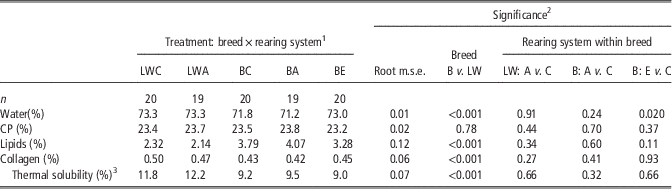
The breed greatly influenced LM chemical composition, with the B pigs exhibiting much higher IMF and lower water, collagen concentration and thermal solubility (P<0.001) than the LW pigs, whereas CP proportion did not differ between breeds (Table 2). The higher IMF proportion of the B pigs (3.93% v. 2.23% for B and LW, P<0.001) was in accordance with their higher body fatness (Lebret et al., Reference Lebret, Dourmad, Mourot, Pollet and Gondret2014). It is also in agreement with the results reported for IMF proportion (Labroue et al., Reference Labroue, Goumy, Gruand, Mourot, Neelz and Legault2000) or marbling density (Alfonso et al., Reference Alfonso, Mourot, Insausti, Mendizabal and Arana2005) in this breed, and confirms the great potential of local pig breeds for IMF deposition (Lebret, Reference Lebret2008; Pugliese and Sirtori, Reference Pugliese and Sirtori2012). In agreement with the present results, lower LM collagen concentrations and higher proportion of non-reducible, thermo-resistant collagen cross-links were found in local Casertana compared with LW pigs at 330 days of age (Maiorano et al., Reference Maiorano, Gambacorta, Tavaniello, D’Andrea, Stefanon and Pilla2013). Altogether, this indicates a lower muscle collagen concentration in local than in conventional breeds, despite a smaller loin eye area (personal data), suggesting a lower ‘dilution rate’ of collagen by muscle fibres in the local breeds, when compared at the same BW and also at the same age. This also reveals the higher thermal stability of IM collagen in the local breeds, independent of the age of animals.
Chemical composition of fresh Longissimus muscle according to breed: Basque (B) or Large White (LW) and rearing system: conventional (C), alternative (A) or extensive (E)

1 Means of treatment groups.
2 P-values of contrasts between breeds (determined using A and C pigs of both breeds, i.e. n=39 LW and n=39 B) or rearing systems within breed, and root m.s.e. (mean square error) obtained from ANOVA on log values for all traits to fit a normal distribution.
3 Thermal solubility of collagen expressed in percentage of total collagen.
No significant influence of A compared with the C system on LM chemical composition was observed within either LW or B pigs, whereas higher IMF proportion was previously found in the LM of synthetic line and Duroc cross-bred pigs reared in the A system, even without variation in back fat thickness between rearing systems (Lebret et al., Reference Lebret, Meunier-Salaün, Foury, Mormède, Dransfield and Dourmad2006 and Reference Lebret, Prunier, Bonhomme, Foury, Mormède and Dourmad2011). Other studies showed higher IMF in pigs reared in ‘enriched’ systems (higher indoor space allowance, straw bedding and/or outdoor access) systems compared with conventional ones, but this was generally associated with fatter carcasses (Lebret, Reference Lebret2008). In contrast, some studies report no effect or decreased IMF and fatness in alternative systems, highlighting the role of nutritional factors on these traits that might overrule the housing effect (Millet et al., Reference Millet, Moons, Van Oeckel and Janssens2005 for review).
Among LM chemical composition traits, the E system led only to higher water proportion in BE than in BC pigs (P=0.020). The difference in IMF proportion between the BE and BC pigs did not reach significance (P=0.11) but was more marked when considering only R1 animals (3.04% v. 3.84%, P<0.05, Lebret et al., Reference Lebret, Dourmad, Mourot, Pollet and Gondret2014). The ‘trend’ for lower IMF in BE compared with BC pigs agrees with their lower back fat thickness (Table 1). The older age of the BE compared with the BC pigs (423 v. 320 days) did not induce a decrease in collagen thermal solubility, as generally reported with increasing age (Bailey and Light, Reference Bailey and Light1989). Our results agree with Mayoral et al. (Reference Mayoral, Dorado, Guillen, Robina, Vivo, Vazquez and Ruiz1999) who showed no variations in insoluble collagen proportion in the LM of Iberian pigs between 350 and 420 days of age, whereas insolubility of collagen increased at older stage.
Animal responses to pre-slaughter handling
An important and often debated issue is whether pigs reared in different rearing systems cope differently with pre-slaughter stress including lorry loading and unloading, transport, lairage in a novel environment at the slaughterhouse and driving to the stunning area. Pre-slaughter stress was assessed through levels of plasma ACTH and cortisol, which is synthesized under the control of ACTH and released into the circulatory system 20 to 30 min after an acute stimulation (Prunier et al., Reference Prunier, Mounier and Hay2005). Global energy metabolism was evaluated by determining plasma glucose and lactate levels, which indicate the balance between mobilization and use of energy primarily for muscle activity and the intensity of anaerobic metabolism, respectively (Lebret et al., Reference Lebret, Meunier-Salaün, Foury, Mormède, Dransfield and Dourmad2006). The physical activity of pigs was assessed through plasma levels of CK and LDH, which are released into the circulatory system after high muscular activity, and fighting behaviour was estimated by the number of skin lesions (Terlouw et al., Reference Terlouw, Arnould, Auperin, Berri, Le Bihan-Duval, Deiss, Lefèvre, Lensink and Mounier2008).
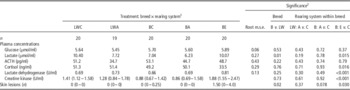
At slaughter, plasma concentration of hormones, enzymes and glucose did not differ between LW and B breeds, whereas plasma lactate levels were lower in B than in LW pigs (P=0.014) (Table 3). No skin lesions were found on the LW carcasses, whereas some B pigs (n=6) exhibited skin lesions (P=0.021). This indicates that responses of pigs to pre-slaughter handling did not differ between B and LW breeds in our C and A experimental conditions. The higher plasma lactate concentrations of the LW pigs indicate higher mobilization of muscle or liver glycogen stores during the pre-slaughtering period, in response to stress (Prunier et al., Reference Prunier, Mounier and Hay2005) or due to higher physical exercise (Fernandez et al., Reference Fernandez, Meunier-Salaün, Ecolan and Mormede1995), although other indicators of stress (e.g. cortisol) or muscular activity (CK and LDH) did not differ between breeds. To our knowledge, influence of genotype on behaviour or physiological responses of pigs to pre-slaughter handling has been studied in selected breeds (e.g. Terlouw et al., Reference Terlouw, Berne and Astruc2009 in LW and Duroc cross-breeds), but scarcely investigated in local breeds.
Plasma components and skin lesions at slaughter according to breed: Basque (B) or Large White (LW) and rearing system: conventional (C), alternative (A) or extensive (E)

1 Means of treatment groups for glucose, lactate, ACTH and cortisol concentrations and lactate dehydrogenase activity. Medians and ‘in brackets’, first and third quartiles per treatment groups for creatine kinase activity and skins lesions.
2 P-values of contrasts between breeds (determined using A and C pigs of both breeds, i.e. n=39 LW and n=40 B) or rearing systems within breed and root m.s.e. (mean square error) obtained from ANOVA on raw data (lactate dehydrogenase) or P-values and root m.s.e. obtained from ANOVA on log values to fit a normal distribution (glucose, lactate, ACTH and cortisol), or P-values of non-parametric (Kruskal–Wallis) tests for breed and rearing system within breed because data could not be normalized after transformation (creatine kinase activity, skin lesions).
Compared with the C system, the A system had no influence on plasma hormones, enzymes and metabolite levels within both LW and B pigs, and on skin lesions in LW pigs. Although of low magnitude, skin lesions tended to be more important in BC than in BA pigs (five pigs, maximum score=12 in BC v. 1 pig, maximum score=5 in BA, P=0.078). Thus, the A system did not modify the behaviour and physiological responses of either LW or B pigs to the pre-slaughtering procedure, which is in accordance with previous results on A v. C system comparisons (Lebret et al., Reference Lebret, Meunier-Salaün, Foury, Mormède, Dransfield and Dourmad2006 and Reference Lebret, Prunier, Bonhomme, Foury, Mormède and Dourmad2011). Other studies also showed no effect of enriched environment (increased space allowance, straw bedding) on physiological stress indicators assessed at the end of the lairage period, although the housing conditions influenced animal activity during transport (Geverink et al., Reference Geverink, De Jong, Lambooij, Blokhuis and Wiegant1999; Klont et al., Reference Klont, Hulsegge, Hoving-Bolink, Gerritzen, Kurt, Winkelman-Goedhart, De Jong and Kranen2001). Conversely, Foury et al. (Reference Foury, Lebret, Chevillon, Vautier, Terlouw and Mormede2011) reported less skin lesions and lower plasma CK at slaughter in pigs housed on sawdust bedding with outdoor access compared with conventional housing; however, in their study, pigs were slaughtered in an industrial slaughterhouse, generating more stressful conditions as demonstrated by the much higher average levels of skin lesions and plasma CK levels compared with the present study. In contrast, the BE pigs exhibited higher plasma lactate (P=0.015), LDH and CK activities (P<0.001) and lower cortisol (P=0.016) concentration than the BC pigs, whereas ACTH and glucose levels were not affected. Besides, score of skin lesions was higher in BE (14 pigs, maximum score=11) than in BC pigs (P=0.03). Thus, pigs reared in the E system fought more (higher number of pigs involved) and had a higher physical (muscular) activity during the pre-slaughtering period than pigs in the C system. This is probably explained by the differences in transport conditions of the BE pigs compared with the other experimental treatments, which were inherent to production systems (Terlouw et al., Reference Terlouw, Arnould, Auperin, Berri, Le Bihan-Duval, Deiss, Lefèvre, Lensink and Mounier2008). Indeed, according to Barton Gade (Reference Barton Gade2008), outdoor rearing per se did not influence the number of carcasses with unacceptable skin damages or plasma CK levels at slaughter. Plasma cortisol was lower for the BE than the BC pigs, suggesting that the environmental conditions at the ‘local’ slaughterhouse were less stressful.
Meat quality indicators
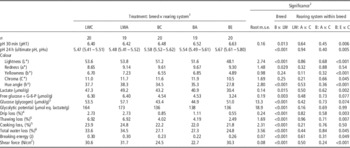
The breed greatly influenced the biochemical and physicochemical meat parameters with almost all the traits being affected (Table 4). Compared with the LW, meat from B pigs had higher pH1 (P=0.013) and pHu values (+0.09 pH unit on average, P<0.001), lower L* and h° (P<0.001), indicating redder meat, although b* and C* values were not affected. B pigs also had lower GP due to lower concentrations of all GP components (P<0.015), reduced total water loss due to lower drip, thawing and cooking losses (P<0.001), as well as lower breaking energy and shear force of cooked meat (P<0.001). These results are consistent with the well-known positive relationships between pH1 and pHu values, redness and mechanical tenderness of pork, whereas lightness and water loss are negatively related to pH1 and pHu as well as GP to pHu (Monin, Reference Monin1988; Warriss, Reference Warriss2000; Klont et al., Reference Klont, Hulsegge, Hoving-Bolink, Gerritzen, Kurt, Winkelman-Goedhart, De Jong and Kranen2001). These breed differences can be interpreted as higher sensory quality of meat from B pigs and confirm the results obtained on the LM of B compared with LW pigs by Alfonso et al. (Reference Alfonso, Mourot, Insausti, Mendizabal and Arana2005) for pH1, pHu, lightness and redness and by Labroue et al. (Reference Labroue, Goumy, Gruand, Mourot, Neelz and Legault2000) for pHu, lightness, redness and water-holding capacity. Accordingly, higher pHu and redness and lower lightness and drip loss were found in the loin from other local breeds compared with the LW pigs (e.g. Labroue et al., Reference Labroue, Goumy, Gruand, Mourot, Neelz and Legault2000 in Gascon and Maiorano et al., Reference Maiorano, Gambacorta, Tavaniello, D’Andrea, Stefanon and Pilla2013 in Casertana pigs).
Biochemical and physicochemical meat quality traits of the Longissimus muscle according to breed: Basque (B) or Large White (LW) and rearing system: conventional (C), alternative (A) or extensive (E)

1 Means of treatment groups for all traits except pHu: medians and ‘in brackets’ first and third quartiles per treatment groups.
2 P-values of contrasts between breeds (determined using A and C pigs of both breeds, i.e. n=39 LW and n=39 B) or rearing systems within breed and root m.s.e. (mean square error) obtained from ANOVA on raw data (pH1, L*, a*, b*, C*, h°, glucose (glycogen), glycolytic potential; thawing, cooking and total water losses), or P-values and root m.s.e. obtained from ANOVA on log values to fit a normal distribution (lactate, free glucose+G-6-P, drip loss, breaking energy, shear force), or P-values of non-parametric (Kruskal–Wallis) tests for breed and rearing system within breed, because data could not be normalized after transformation (pHu).
3 Glucose issued from glycogen hydrolysis.
4 Drip loss between 1 and 3 days p.m.
5 Thawing and cooking losses determined on LM roast prepared for sensory analysis.
6 Sum of drip, thawing and cooking losses as calculated above.
Within both LW and B breeds, the A compared with the C rearing system did not influence any biochemical and physical pork traits. This is consistent with our previous findings regarding loin pH, L* and a*, whereas increased drip loss, b* value and GP to a lesser extent were found in the meat from A compared with C pigs (Lebret et al., Reference Lebret, Meunier-Salaün, Foury, Mormède, Dransfield and Dourmad2006 and Reference Lebret, Prunier, Bonhomme, Foury, Mormède and Dourmad2011). In agreement with the present data, Patton et al. (Reference Patton, Huff-Lonergan, Honeyman, Crouse, Kerr and Lonergan2008) found no effect of deep-bedded semi-outdoor housing compared with standard pig housing on pH1, pHu, colour, drip and cooking losses of pork. Accordingly, Millet et al. (Reference Millet, Moons, Van Oeckel and Janssens2005) concluded that indoor environmental enrichment or outdoor access for pigs had generally no impact on pork pH values. However, the E production system greatly influenced meat quality traits, leading to higher pH1 and pHu (P<0.006) and lower L*, b*, h° (P<0.001) and C* values to a lesser extent (P=0.045) compared with the C system, whereas the a* value was not modified. The BE pigs exhibited lower muscle lactate (P=0.002) and tended (P<0.077) to have lower free glucose but higher glycogen levels than the BC pigs, leading to similar GP values in LM of BE and BC pigs. Meat from BE pigs showed less total water loss due to lower drip and thawing losses (P<0.007), whereas cooking loss was unaffected. Higher shear force (P<0.001) and breaking energy (P=0.045) of cooked meat were found in BE than in BC pigs.
The higher pH1 in the BE pigs is associated with their lower muscle lactate level and may be related to their lower plasma cortisol levels at slaughter. This also suggests a lower contribution of the glycolysis and lactic acid production pathway to energy (ATP) production in the muscle of BE pigs during the minutes after slaughter, with ATP also being produced by the CK and myokinase pathways (Monin, Reference Monin1988). Deeper investigations would be helpful to better characterize the influence of extensive rearing conditions on p.m. muscle physiology and metabolism. In contrast with our findings, the literature generally reports no effect of extensive v. indoor rearing on the pH1 value in local (Labroue et al., Reference Labroue, Goumy, Gruand, Mourot, Neelz and Legault2000 in Basque and Gascon; Pugliese et al., Reference Pugliese, Bozzi, Campodoni, Acciaioli, Franci and Gandini2005 in Cinta Senese pigs) or conventional breeds (Bee et al., Reference Bee, Guex and Herzog2004; Terlouw et al., Reference Terlouw, Berne and Astruc2009). Besides, the higher pre-slaughter physical activity of BE than BC pigs, which requires consumption of muscle energy (glycogen) store, would have probably contributed to their higher pHu values. However, this was not associated with higher GP, indicating that other muscle metabolic properties or its buffering capacity would be involved in pHu determination, in agreement with Scheffler et al. (Reference Scheffler, Scheffler, Kasten, Sosnicki and Gerrard2013). This also suggests that during their rearing period, the BE pigs probably had a higher muscle GP than the BC pigs, as suggested by their tendency for higher level of glucose issued from glycogen hydrolysis at 30 min p.m. Increased muscle glycogen or GP in extensive conditions, especially during the winter season to fulfil high muscle energy requirements has already been reported, but was not accompanied by lower ultimate pH (Bee et al., Reference Bee, Guex and Herzog2004; Terlouw et al., Reference Terlouw, Berne and Astruc2009). Accordingly, Pugliese et al. (Reference Pugliese, Bozzi, Campodoni, Acciaioli, Franci and Gandini2005) found similar loin pHu in Cinta Senese pigs reared outdoors or indoors, whereas Labroue et al. (Reference Labroue, Goumy, Gruand, Mourot, Neelz and Legault2000) showed lower pHu in the LM of Basque and Gascon pigs reared in free-range compared with semi-confined systems.
As mentioned above, the decreased lightness and water loss and increased dark red colour of BE pork agree with their higher pH1 and pHu values, respectively (Monin, Reference Monin1988; Klont et al., Reference Klont, Hulsegge, Hoving-Bolink, Gerritzen, Kurt, Winkelman-Goedhart, De Jong and Kranen2001; Lebret et al., Reference Lebret, Meunier-Salaün, Foury, Mormède, Dransfield and Dourmad2006). The marked effect of the production system on meat colour (h°) could also be partly explained by the older age of the BE pigs, as increased myoglobin content has been found in the muscles of Iberian pigs between 350 and 420 days of age (Mayoral et al., Reference Mayoral, Dorado, Guillen, Robina, Vivo, Vazquez and Ruiz1999). Moreover, the higher level of physical activity of extensively reared pigs that is generally associated with increased muscle oxidative metabolism (Gondret et al., Reference Gondret, Combes, Lefaucheur and Lebret2005 for review) could also partly explain the darker colour of BE pork, in accordance with reports of Millet et al. (Reference Millet, Moons, Van Oeckel and Janssens2005). In agreement with our results, reduced meat lightness and water loss have been observed in outdoor pigs by Pugliese et al. (Reference Pugliese, Bozzi, Campodoni, Acciaioli, Franci and Gandini2005), whereas Bee et al. (Reference Bee, Guex and Herzog2004) reported lower meat lightness but higher drip in outdoor v. indoor pigs. Despite higher pH1 and pHu and lower drip, which have all been positively associated with mechanical tenderness of pork (Huff-Lonergan et al., Reference Huff-Lonergan, Baas, Malek, Dekkers, Prusa and Rotschild2002; Bee et al., Reference Bee, Calderini, Biolley, Guex, Herzog and Lindemann2007), BE pigs had higher meat shear force values than BC pigs. This cannot be ascribed to the amount or solubility of LM collagen, which did not differ between groups, but may be related to the trend (P=0.11) for lower IMF in BE pigs, in agreement with the well-described negative relationship between IMF content and shear force of pork, especially for IMF values above 2.5% (De Vol et al., Reference DeVol, McKeith, Bechtel, Novakofski, Shanks and Carr1988; Lebret, Reference Lebret2009). Higher shear force of meat from BE pigs could also be explained by lower rate of muscle protein turn-over and p.m. proteolysis, resulting from the lower growth rate during the finishing period (110 to 145 kg BW) of the BE compared with BC pigs. Indeed, growth rate has been positively associated with activities of muscle proteolytic enzymes in pigs (Kristensen et al., Reference Kristensen, Therkildsen, Aaslyng, Oksbjerg and Ertbjerg2004). Overall, our results confirm those of Pugliese et al. (Reference Pugliese, Bozzi, Campodoni, Acciaioli, Franci and Gandini2005), who showed higher shear force and IMF and lower drip in meat from Cinta Senese pigs reared outdoors compared with indoors.
Sensory meat quality
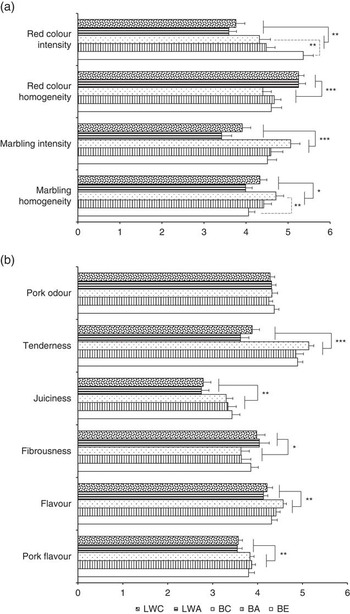
Pig breed had a major influence on pork sensory quality, with all descriptors of appearance, texture and flavour, except odour, being differentially scored between B and LW pigs (Figure 1). Compared with LW pigs, the B pigs exhibited redder and more marbled meat (P<0.01) in agreement with their lower h° value and higher IMF level. Marbling was found to be more homogeneous in B pigs (P<0.001), suggesting a more equilibrated IMF distribution among muscle slices, which would be favourable for acceptability of meat by consumers (Lebret, Reference Lebret2009), whereas red colour was found less homogeneous (P<0.05) in B pigs, which can be explained by their higher redness score. Meat from B pigs was judged to be more tender (P<0.001), juicer (P<0.01) and less fibrous (P<0.05), which is in agreement with breed differences found on instrumental texture measurements. Flavour and specific pork flavour scores were also higher for B than for LW meat (P<0.05), whereas odour did not differ between breeds. The higher eating quality of meat from B pigs is in agreement with breed differences found in almost all pork quality indicators under study that are associated with sensory quality – that is, the higher pH1 and pHu values and IMF concentration and the lower water losses, breaking energy and shear force (De Vol et al., Reference DeVol, McKeith, Bechtel, Novakofski, Shanks and Carr1988; Monin, Reference Monin1988; Huff-Lonergan et al., Reference Huff-Lonergan, Baas, Malek, Dekkers, Prusa and Rotschild2002; Lebret, Reference Lebret2009). Our study confirms the higher scores for redness, marbling, tenderness, juiciness and flavour of meat from B compared with LW pigs found by Labroue et al. (Reference Labroue, Goumy, Gruand, Mourot, Neelz and Legault2000) and Alfonso et al. (Reference Alfonso, Mourot, Insausti, Mendizabal and Arana2005), and are in line with the high eating quality reported in local compared with conventional pig breeds (Labroue et al., Reference Labroue, Goumy, Gruand, Mourot, Neelz and Legault2000 in Gascon v. LW pigs; Bonneau and Lebret, Reference Bonneau and Lebret2010 for review).
Sensory quality traits (means±s.e.) of loin represented on a 0 to 6 scale (but scored from 0: absent to 10: high), according to breed (Large White, LW; Basque, B) and rearing system (conventional, C; alternative, A; extensive, E), n=20 per treatment group. Contrasts between breeds (solid line, determined using A and C pigs of both breeds, i.e. n=40 LW and n=40 B) and contrasts between rearing system within breed (plotted line) were obtained from ANOVA. ***P<0.001, **P<0.01, *P<0.05. (a) Appearance of raw meat. (b) Texture, odour and flavour of cooked meat (roast).

Within both LW and B breeds, the A v. C system did not impact appearance or eating quality traits of pork. Among the B pigs, compared with C, the E system increased the red colour intensity of meat (P<0.01), in agreement with its lower h° value, and decreased marbling homogeneity (P<0.01). The redder colour may have strengthened contrast between the ‘white’ lipid bundles or droplets and the darker muscle fibre bundles, thus increasing heterogeneous appearance of marbling. Despite higher shear force and breaking energy of BE pork, difference in tenderness and fibrousness scores between BE and BC pigs did not reach significance. In contrast with the present data, a slight increase in pork juiciness was found in synthetic line or Duroc cross-breeds produced in the A system (Lebret et al., Reference Lebret, Meunier-Salaün, Foury, Mormède, Dransfield and Dourmad2006 and Reference Lebret, Prunier, Bonhomme, Foury, Mormède and Dourmad2011), although the other sensory traits were not modified. Overall, influence of ‘enriched’ systems on pork sensory quality is often of low magnitude and, when significant, is usually due to the influence of feeding strategy and the level of physical activity, to a lesser extent, on muscle composition and metabolism (Millet et al., Reference Millet, Moons, Van Oeckel and Janssens2005; Lebret, Reference Lebret2008). Impacts of extensive production system on meat sensory quality are even more complex and contrasted between studies, as they result from direct and interactive effects of animal environmental conditions, nutritional strategy, response to pre-slaughter handling, etc., on muscle growth, composition and properties. For example, both increased and decreased pork tenderness have been reported in extensive compared with indoor pig rearing conditions due to opposite effects between studies on muscle IMF level and pHu (Lebret, Reference Lebret2008).
Conclusion
The present study highlights major differences in muscle composition and physicochemical and sensory quality of meat from the local B and the conventional LW breeds. The higher eating quality of meat from B pigs was related to its higher IMF content, lower rate and extent of p.m. pH drop and lower water losses, whereas reactivity of pigs to pre-slaughter handling, which can modify muscle metabolism around slaughter and consequently the meat quality, did not differ between breeds. Compared with the conventional system, the alternative system had limited impacts on muscle composition and meat quality in both B and LW breeds. In contrast, within the B pigs, the extensive system that included both specific rearing and transport conditions influenced many stress-related indicators measured at slaughter as well as physicochemical traits and appearance of meat, but did not modify eating quality. These data regarding the specific impacts of breed and rearing system on pork quality are of interest for actors of pork chains involved in differentiation approaches on product quality such as the Protected Designation of Origin.
Acknowledgements
The authors thank the staff of INRA experimental farm, slaughterhouse and laboratories (URM1348 PEGASE, F-35590 Saint-Gilles, UR370 QuaPA, Theix, F-63122 St-Genès-Champanelle, UE EASM, Le Magneraud, F-17700 Surgères; France) for excellent assistance, as well as the breeders and slaughterhouse staff of the Basque Pork chain involved in this study. The authors gratefully acknowledge the European Community financial participation under the Sixth Framework Programme for Research, Technological Development and Demonstration Activities for the Integrated Project Q-PORKCHAINS FOOD-CT-2007-036245.