Introduction
“Foreign menace” was one of the major threats to the political integrity of the Song 宋 (960–1276) state. In order to enhance internal consolidation, Song foreign policy prioritized the strategy of appeasement with their neighbours, namely the Liao 遼 (907–1125), Xi Xia 西夏 (1038–1227) and Jin 金 (1115–1234) states. However, border insecurity intensified at the end of the eleventh century, partly because of increasing factional struggles at court. This ultimately resulted in the Jurchen invasion which led to the end of the Northern Song dynasty in 1126.Footnote 1 It was during this period that the legend of Lady Cai Wenji 蔡文姬 (177–249) received particular attention. She was abducted by the Southern Xiongnu 南匈奴 into inner Mongolia, where she was forced to become the wife of King Zuoxian 左賢王 and bore him two children. Since her story concludes with the heroine's return to China after living with the Xiongnu for 12 years, Chinese people have long regarded it as symbol of the “superiority” of Chinese civilization over all others.Footnote 2
The handscroll Eighteen Songs of a Nomad Flute 胡茄十八拍, which is kept in The Metropolitan Museum of Art, illustrates this narrative. It is thought to be a faithful Ming 明 (1368–1644) copy of the original Song version, which has four damaged album leaves and is located in the Museum of Fine Arts, Boston. This offers an opportunity to investigate different ethnic identities, material culture and the ideology of political integrity in the Song period.
In 1970s, Wen Fong and Robert Rorex assigned an early Southern Song date to the original handscroll in Boston.Footnote 3 Their conjecture is mainly based on the Southern Song court's signed peace treaty of 1142, which led to the rescue of the emperor's mother from the Jurchens.Footnote 4 As Fong and Rorex point out, while the surviving Boston pictures are without text, the copied scroll kept in The Metropolitan Museum of Art reveals a tracing of calligraphy in the style of Song Gaozong 宋高宗 (r. 1127–1162). They also look into historical evidence which reveals that during the reign of Song Gaozong, the court commissioned a series of narrative scrolls that illustrated episodes from both classical and contemporary contexts in order to fulfil the emperor's political propaganda project of “dynastic revival”.Footnote 5 Peng Huiping 彭慧萍 further points out that the Boston version contains three Jurchen horse breeds. Based on this pictorial evidence, she identifies the depicted ethnic group as Jurchen.Footnote 6
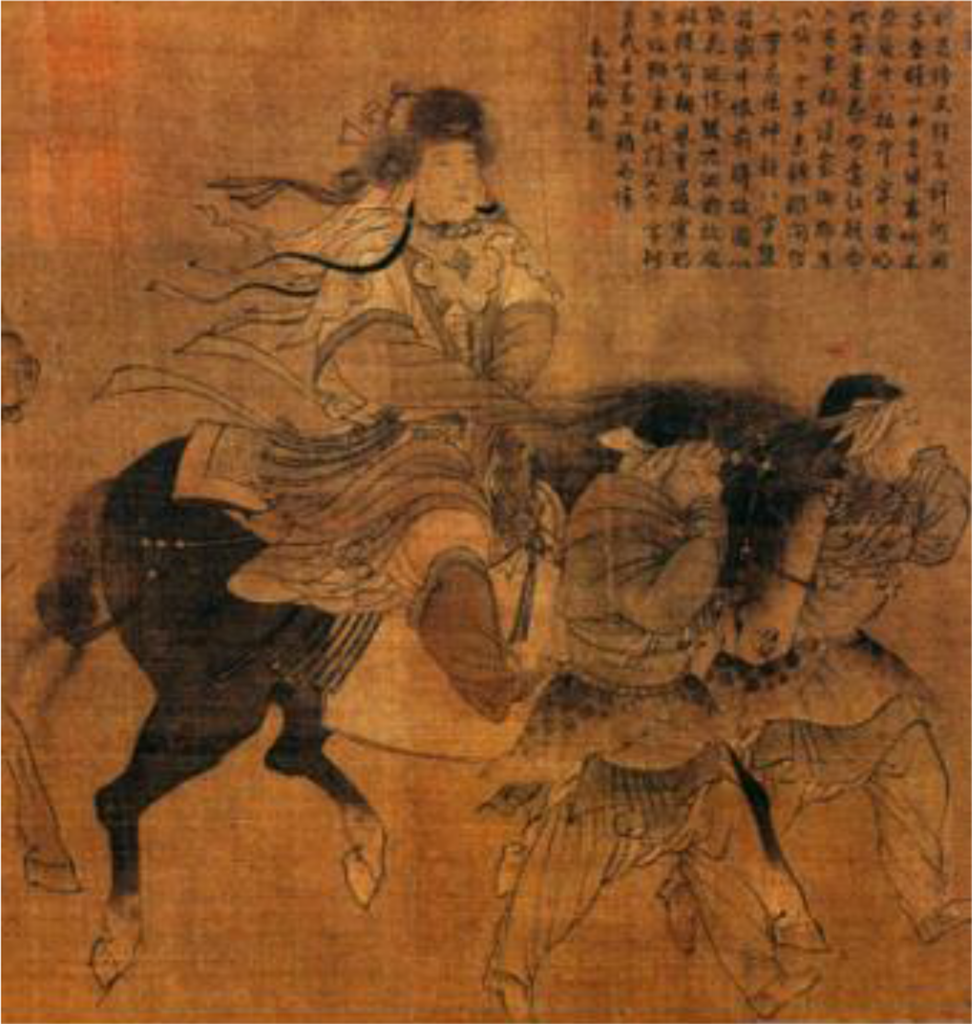
However, the figures in the illustration do not have the appearance recounted in the Jinshi 金史. Jurchens were fond of wearing round fur hats, cloud-shawls and flowing sashes around their waists. For costume decoration, designs with floral patterns mixed with hawks catching geese were preferred for the spring hunting season, while motifs of bears and deer in woods were used during the autumn hunting season.Footnote 7 These elements, which are shown in a thirteenth-century depiction of a Jurchen costume worn by Lady Wenji (Figure 1.1), have been omitted in both the Boston and New York scrolls.
Chang Yu, Lady Wenji Return to China, detail, early thirteenth century. Jilin Provincial Museum, Changchun.

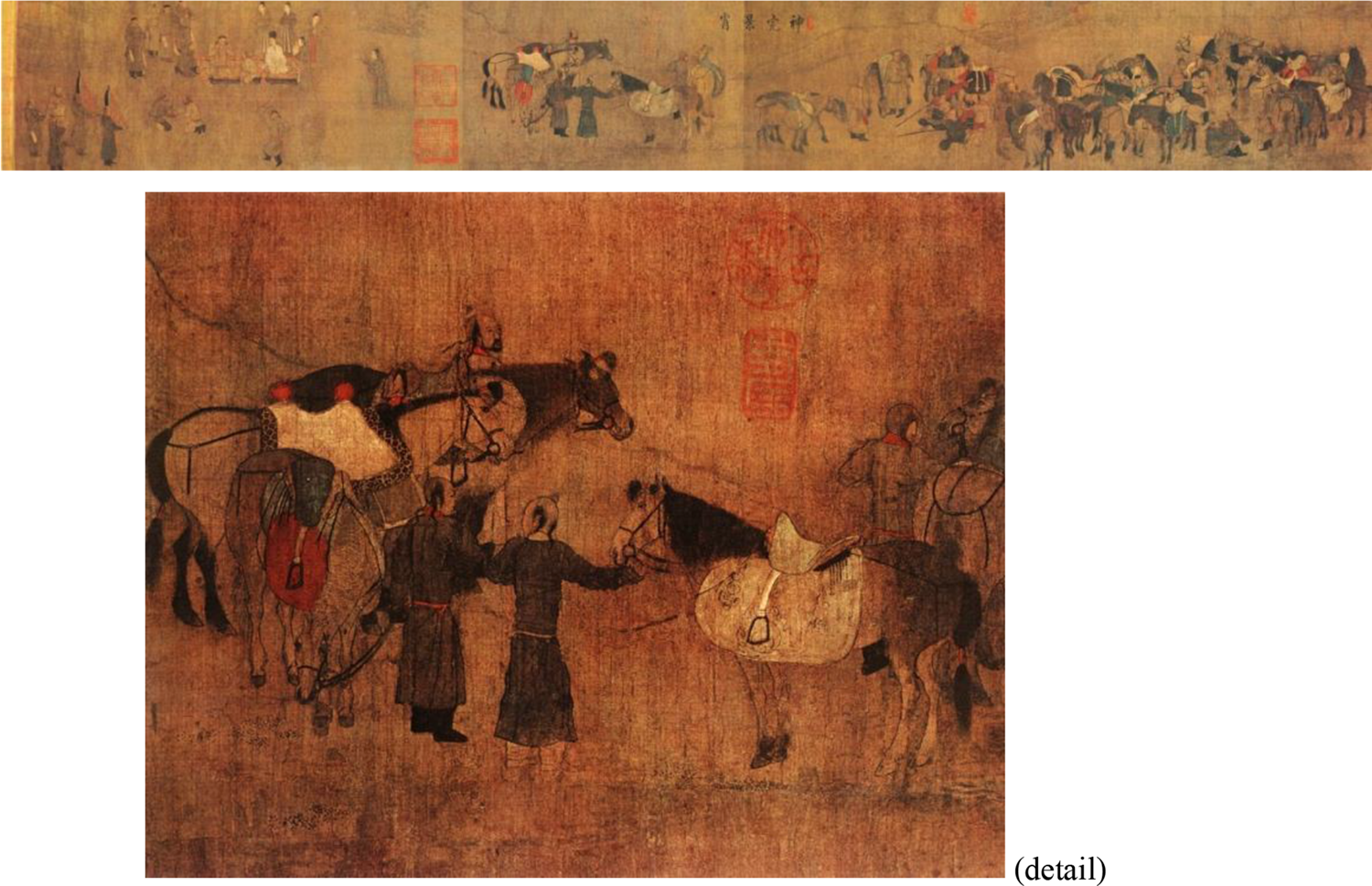
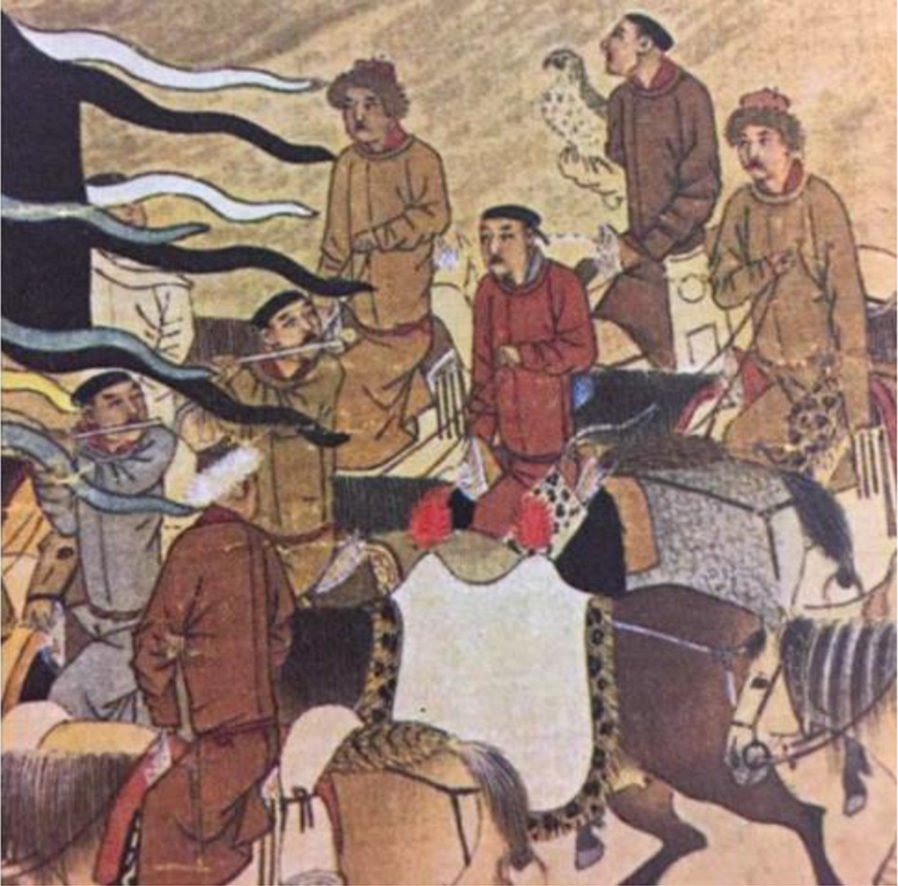
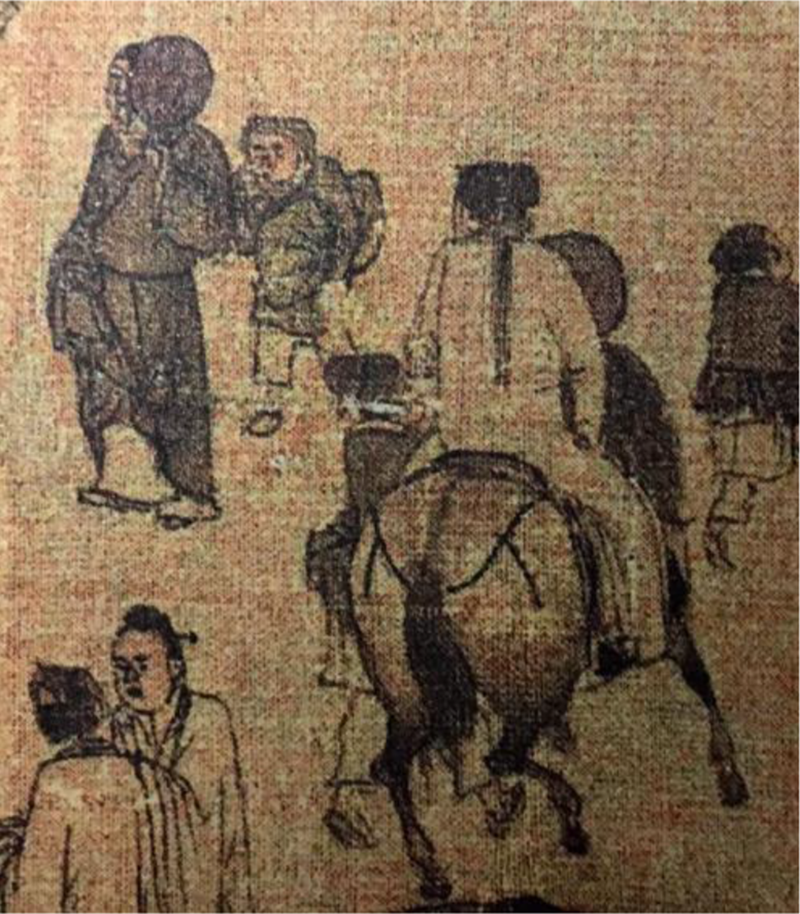
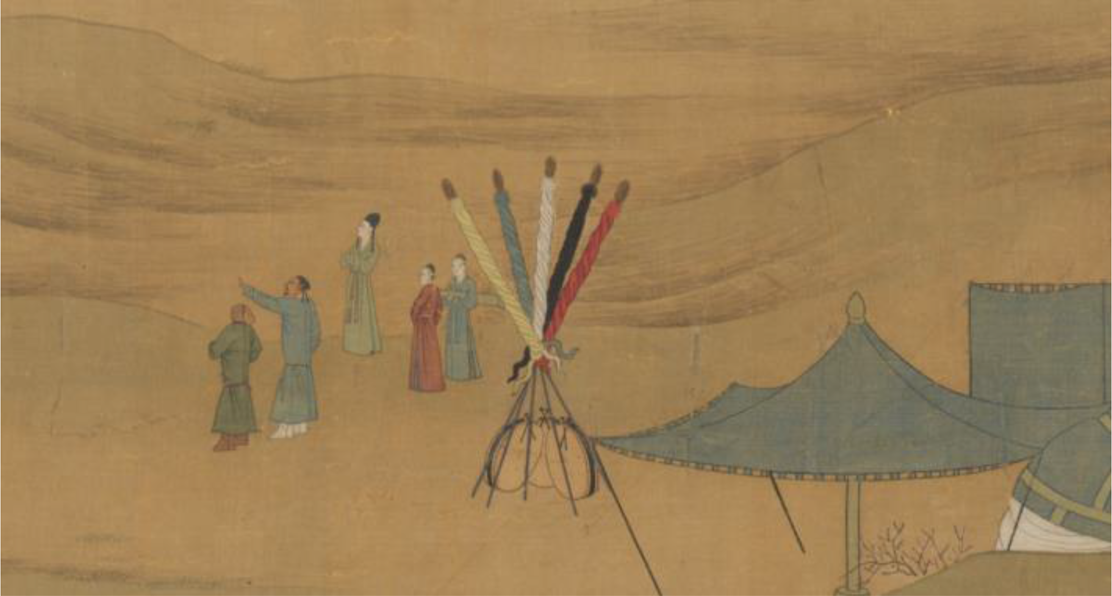
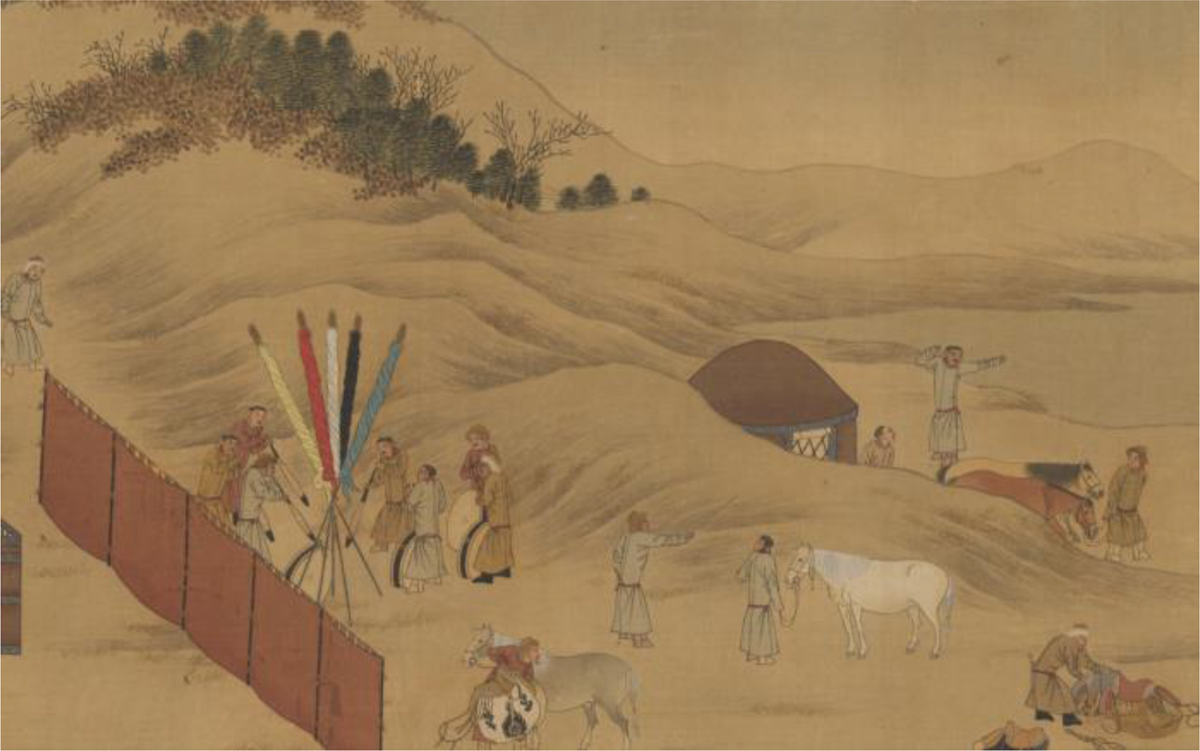
Instead, the nomadic people are shown with moon-shaped faces, shaved heads and long side-fringes and goatees. The majority of the scholars agree that the depicted figures are closest in appearance to the Khitan people. Archaeological evidence found in the murals discovered in Kunlun Banner tomb, dated to 1088, depict the lives and customs of Khitan people.Footnote 8 Rorex also points out that the painters of the scroll might have received training from Xuanhe Painting Academy 宣和畫院 since the illustration follows the tradition of the fanzu 藩族 genre set in the Xuanhe Huapu 宣和畫譜 (Xuanhe Catalogue of Paintings). The catalogue records the Khitan painter Hu Xiang 胡瓖 (fl. ninth century) as one of the specialists of this genre.Footnote 9 Both the Boston and New York scrolls show seemingly identical renderings to Hu Xiang's panoramic handscroll Nomads Resting 卓歇圖 (Figure 1.2). The representation in the handscroll begins with Khitan riders holding their horses and ends with a prepared concert and a feast served to the Khitan master and mistress. The background is sketched with dry ink brushwork and reveals low barren hills. The illustrations of Eighteen Songs seem to follow this tradition, displaying similarities, even to the decorative patterns of animal furs used to make saddles (Figure 1.3).Footnote 10
Hu Xiang, Nomads Resting, and detail, 33 cm x 256 cm, tenth century. Palace Museum, Beijing.

Unidentified artist, detail of the second scene, Eighteen Songs of a Nomad Flute, fourteenth century. Metropolitan Museum of Art, New York.

There are also differing views on the issues of dating and historical intention in the original Boston scroll. Scholars like Robert Rorex argue that Eighteen Songs was done when there were rising nationalistic feelings in the mid-twelfth century after the collapse of the Northern Song. Irene S. Leung, on the other hand, identifies the original Boston scroll as an eleventh-century artwork, most likely done during the regency of the Empress Dowager Xuanren 宣仁 (1085–1093) in the Northern Song period.Footnote 11 However, Leung's unpublished study has long been forgotten. This article adopts a social constructivist approach to reinvestigate the Song-Liao relations that are manifested in the scroll and to re-examine Irene S. Leung's argument. Instead of offering a visual analysis of each of the 18 scenes in succession, it draws attention to the shared cultural practices and connotations of identity in the contrasting depictions of Song urban life and the nomad encampment. It argues that the illustration probably represents the benevolent attitude of the conservative faction towards nomadic tribes in the late Northern Song period, which is also likely to have been associated with the rise of Neo-Confucianism.
Song-Liao relations
Before looking into the scroll in more detail, this article will briefly explore Song-Liao relations, which provide the historical background to the making of the scroll. The Khitans, who originally belonged to the Eastern Xianbei 鮮卑 tribes, lived in present-day southeastern Inner Mongolia and led a pastoral way of life. Making a living from hunting, herding and fishing, they would set up their temporary homes alongside water and grass. They raised sheep, horses, cattle and camels, whose fur they used to make garments and carpets. Following the collapse of the Tang dynasty in 907, the leader of the Khitan tribe, Abaoji 阿保機 (872–926), assumed the title of Kaghan (or Khan 可汗 supreme ruler).Footnote 12 At the time, the office of the polity was set up through a selection of the members of the leading family. As soon as Abaoji was selected to be the khan for the fourth time, he prepared a formal ceremony in the Chinese tradition and assumed the title of “emperor”. From then on, the tribe adopted Yelü 耶律 as a family name, and established the Liao as the name of the dynasty. The succession system was also changed from selective to hereditary.Footnote 13
Prior to the establishment of the Song dynasty in 960, the Liao had adopted Confucian ideology, through which they successfully won recognition in China's central plain. In the meantime, the Khitan state's political stability was achieved by adopting a dual administration. The policy was recorded in the Liaoshi 遼史 as:
以國制治契丹,以漢制待漢人。
Using their native institutions to rule the Khitans, using Han institutions to regulate the Han people.Footnote 14
In the hope of securing a long-lasting peace with the Liao, the Song court adopted a policy of appeasement and promised to pay annual indemnities (large amounts of silk and silver) to the Liao. The Treaty of Chanyuan 澶渊之盟 of 1005 reflected, in part, the success of Khitan foreign policy. Some modern historians have argued that one of the reasons for the final collapse of the Northern Song can be found in this early treaty because the leaders insisted on seeking peace without realizing the potential danger of foreign threats.Footnote 15 One mutually beneficial consequence of this treaty was that the peaceful political environment led to uninterrupted trade and diplomatic relations. Historically, the Liao authority regularly sent tributary missions to the Song court, which included large quantities of agricultural and industrial products. In return, ceramics, lacquers and other utensils used at the Song court were exported to the Liao.Footnote 16 The Songshi records that after the signing of the Treaty of Chanyuan, brocade silk, lacquer wares and books of Chinese classics were allowed to be commercially traded by the Song to the Liao in addition to fragrances, biancaea sappan (sappanwood), rhinos and tea. Official permission was also given for the Song to trade silver coins, camels, sheep and horses with the Liao.Footnote 17 These exchanged items would indirectly influence the lifestyle and cultural practices of both the Khitan and Song people.
Factional struggle on foreign policy
Nevertheless, a group of Song officials had already identified unbalanced ‘gains and losses’ in Song-Liao relations and were determined to reverse the situation. One key reason for this was that the annual payments of silver and silk had become a heavy economic burden on the Song government. Because of consistent political concessions made by the Song, the Liao Empire intervened in Song foreign policy towards other countries. At the end of the eleventh century, the Liao had even persuaded the Song not to invade the Xi Xia, encouraging the Song government to use generous financial terms to mollify them.Footnote 18
Supported by Emperor Shenzong 神宗 (r. 1067–1085), in his new policy issued in the 1070s, Wang Anshi 王安石 (1021–1086) advocated an increase in military expenditure and adopting a more aggressive response towards the Liao.Footnote 19 However, together with other programmes of administrative reforms launched by Wang Anshi, this new policy was opposed by conservative officials, led by Sima Guang 司馬光 (1019–1086). He insisted on the mutually beneficial international system of “balance of power” and thought that the policy of suppression and expansion would unnecessarily increase the economic burden on society.Footnote 20 Furthermore, foreign policy disputes with the Khitans were trigger points that intensified factional conflicts. Ministers from these opposing factional divisions had polarized views of political ideology and moral endowments. Given that both had intended to persuade the emperor to implement a strategic policy instituted by their own faction, moves to expel the opposing factions made coexistence unlikely.Footnote 21
Immediately upon the sudden death of Shenzong 神宗 in 1085, Wang Anshi's new policy lost imperial support, which was reversed during the regency period of Empress Dowager Xuanren, whose son, Emperor Zhezong 哲宗 (r. 1085–1100), was only ten years old when he ascended the throne. During the Yuanyou era (1086–1094), ministers from the conservative faction returned to power. Su Shi 蘇軾 (1037–1101), Su Zhe 蘇轍(1039–1112), Huang Tingjian 黃庭堅 (1045–1105) and other scholar officials who had been demoted to remote places were temporarily allowed to return the capital. However, soon after Zhezong took command of the court, following the death of Empress Dowager Xuanren in 1093, literati officials in conservative factions lost power and were again dispatched to remote provincial posts.Footnote 22
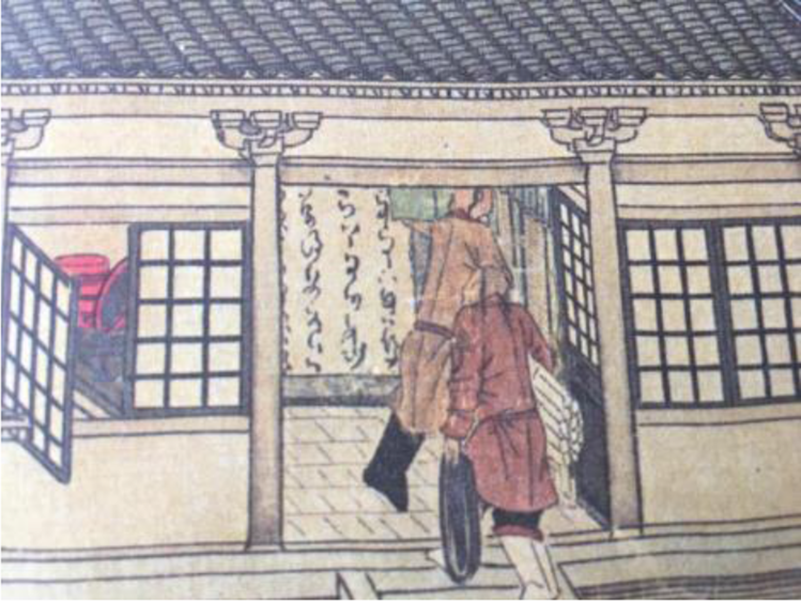
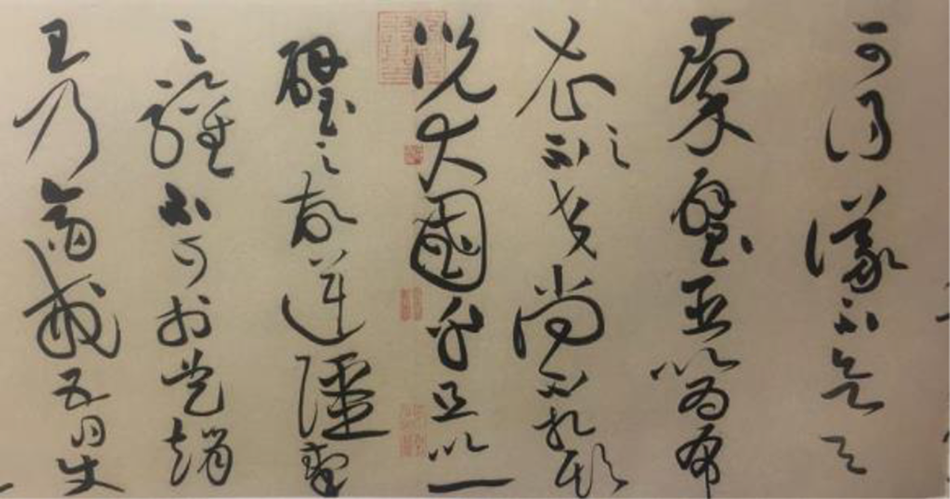
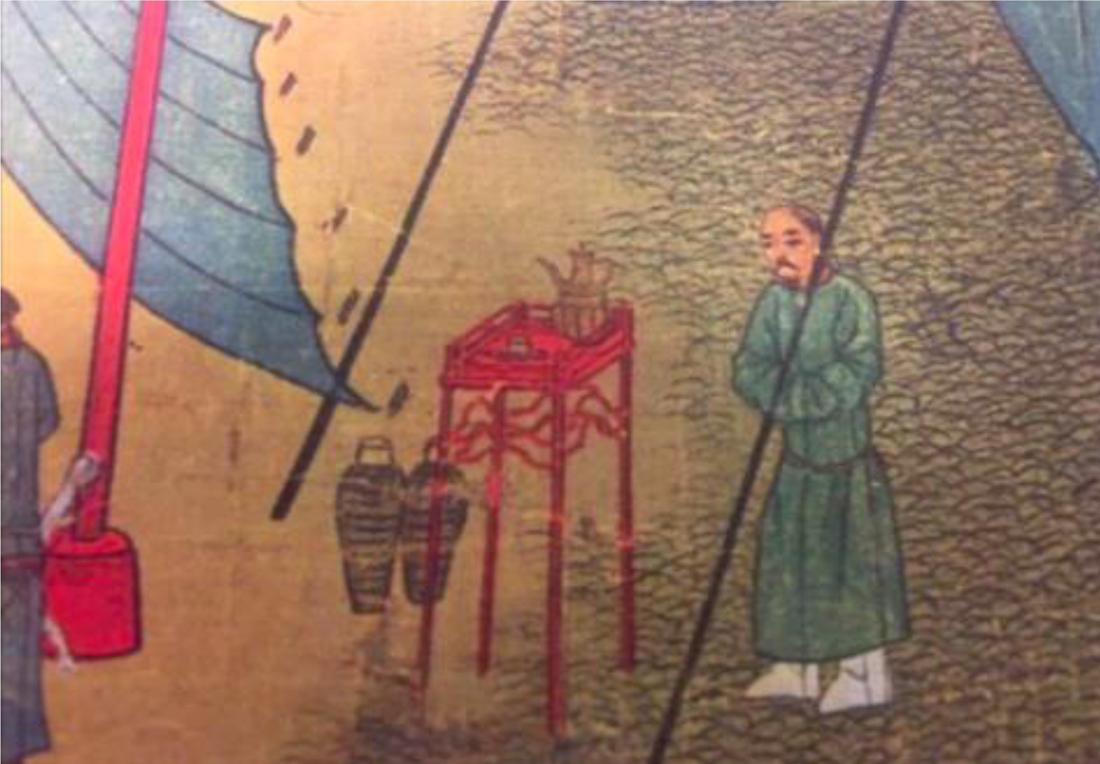
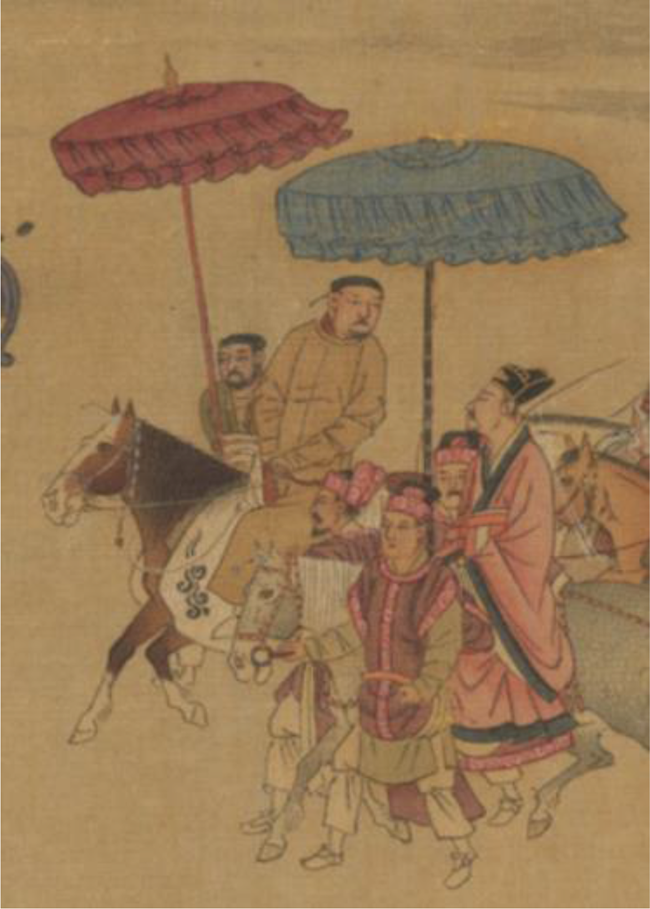
In the final scene (returning home) of the Boston scroll as well as the copied first scene (abduction) of the New York scroll (Figure 1.4a), a calligraphy screen is shown, depicting the pseudo-characters, probably in the style of Huang Tingjian (Figure 1.4b). Yu Hui points out that the screen of cursive calligraphy had been originally and exclusively used by upper-class families. As soon as some of the scholar officials from the conservative faction who made them were denounced, these screens were no longer used by upper-class families and they entered the plebeian market.Footnote 23
Unidentified artist, detail of the first scene of Eighteen Songs of a Nomad Flute, fourteenth century. Metropolitan Museum of Art, New York.

Huang Tingjian, detail of Biographies of Lian po and Lin Xiangru, 1090s, ink on paper. Metropolitan Museum of Art, New York.

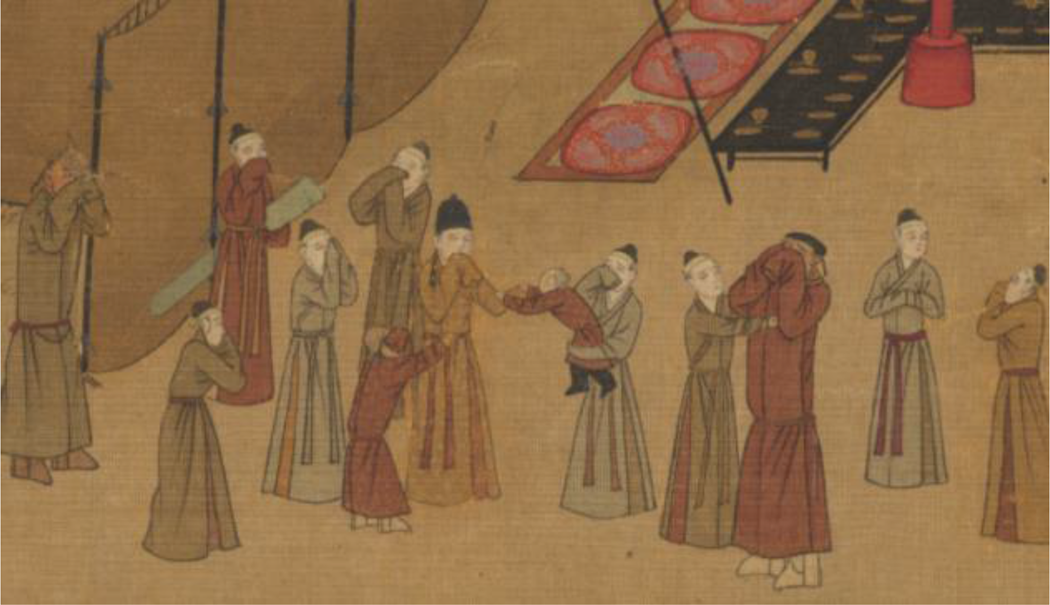
Historical documents have also revealed that after the banishment of members of the conservative factions was proclaimed, other government officials refused to meet followers of Su Shi and Huang Tingjian in public. It became a common social phenomenon for someone to hide their face behind a fan to avoid a straightforward greeting to a member of the denounced faction.Footnote 24 A story was recorded in Henan Shaoshi wenjian houlu 河南邵氏聞見後錄 (Later Records of Mr Shao's Hearsay):
當東坡盛時,李公麟至,為畫家廟像。後東坡南遷,公麟在京師遇蘇氏兩院子弟與途,以扇遮面不一揖,其薄如此!
When Su Shi was favoured by the emperor and celebrated by the court officials, Li Gonglin came and painted the family temple portraits for him. After Su Shi was relegated to the south, Gonglin hid his face behind a fan without making a bow when coming across the followers and students of the Su family. How mean he is!Footnote 25
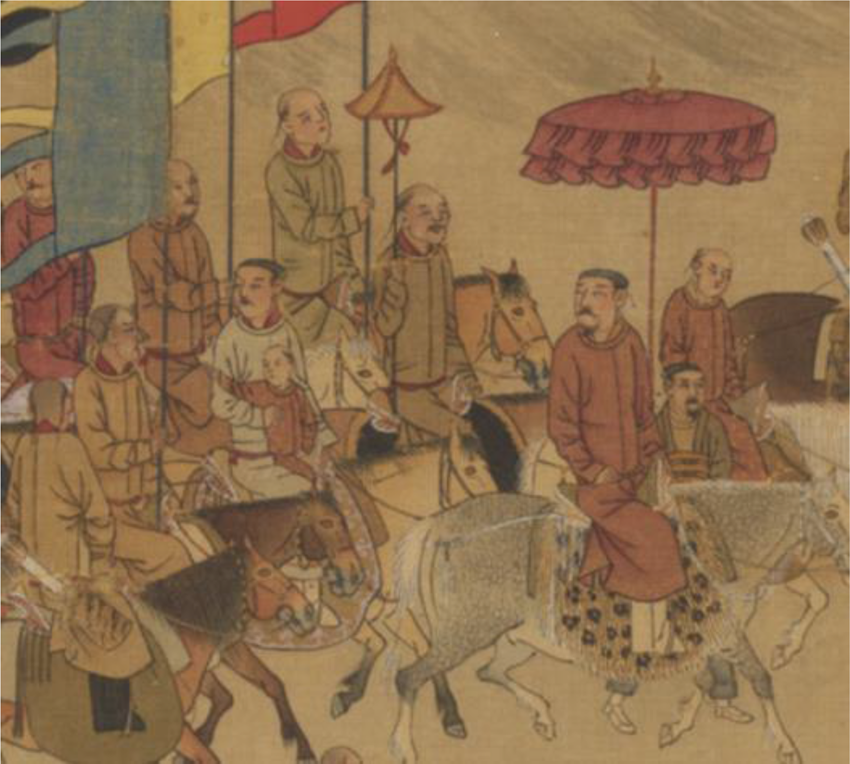
A pictorial depiction of this was included in the Qingming Shanghe Tu 清明上河圖 attributed to Zhang Zeduan 張擇端 (1085?–1145), in which a scholar official is seen to divert his face away from the horse rider (Figure 1.5).
Zhang Zeduan, Qingming Shanghe Tu, detail. Palace Museum, Beijing.

It seems that the original scroll of the Eighteen Songs was unlikely to have been completed during the period when the conservative factions were out of favour with the monarch. Instead, the scroll probably reveals a benevolent political strategy conducted by the conservative faction when they temporarily returned to power, as suggested by Irene S. Leung, in the period of the Yuanyou era 元祐 (1086–1094).Footnote 26
Cultural practices: reality or imagination
The following discussion looks into the cultural practices that are depicted through utensils, decorative motifs and instruments. From a sociological perspective, this constructs an awareness of the separation between Song and non-Song identity and a non-Han identity. According to Manuel Castells, identities are the source of the symbolic “purposes” of social actors’ intended action. The construction of identities not only needs “raw” building materials from history, geography, lineage, biology, religious and political institutions, personal fantasy and collective consensus, it also includes a process of selection which is generally associated with the power struggle that determines the ultimate distinctions between “us” and “the others”.Footnote 27 The abstraction of “identity” permeates our every human act and perception. In turn, cultural practices such as the traditions of playing music, drinking wine and tea, and using specific kinds of utensils are active embodiments that materialize identity, authority and a belief system.Footnote 28
The relationship between objects and humans are front-and-centre, while human experience and identity are inseparably and mutually co-constructed. Pierre Bourdieu notes that objects are not only static “symbols” or “resources” but also a dynamic habitus. World views and socio-political relations are shaped through daily life, which itself is constructed through material surroundings.Footnote 29 Representations of human experience produce meanings that are defined by pre-assumed cultural connotations, related to specific behaviours and motifs.
Ding 鼎-shaped cauldrons
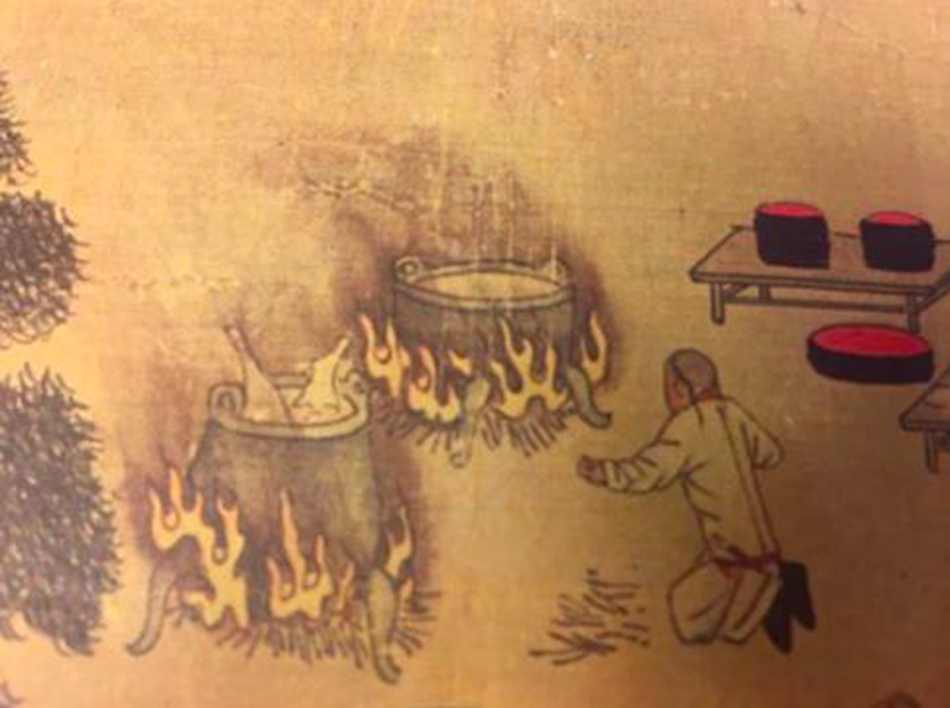
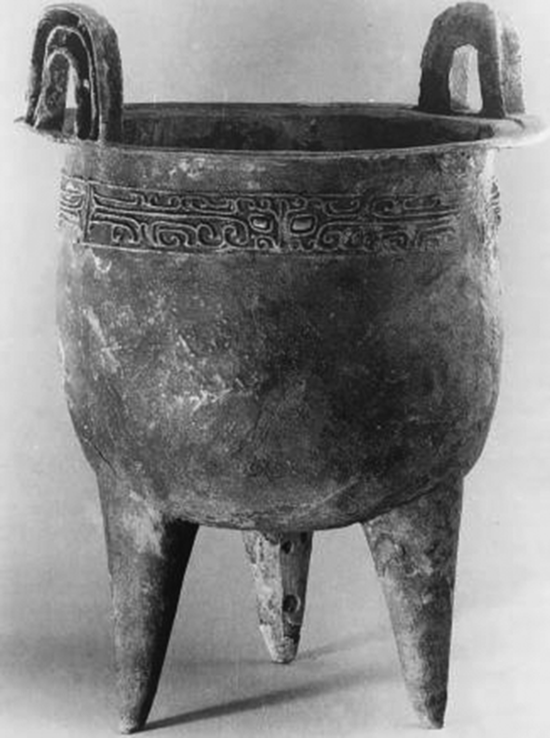
Scenes 5, 10 and 13 of the Eighteen Songs of a Nomad Flute all show two cauldrons in the shape of Ding, being used to cook lamb in the nomad camp (Figure 2.1). Those vessels have a deep, round belly supported by three legs and topped with two handles, which are stylistically similar to Shang 商(1600–1046) bronzes (Figure 2.2).
Unidentified artist, detail of cooking scene in the Eighteen Songs of a Nomad Flute, fourteenth century. Metropolitan Museum of Art, New York.

Ding with animal mask decoration, height 48 cm, early period of Shang dynasty, unearthed at Panlongcheng, Huangpi County, Hubei Province in 1974. Hubei Provincial Museum, Wuhan.

Historical documents reveal that the technique of bronze making was introduced into northeastern Asia during the Han dynasty.Footnote 30 However, it has been debated whether the technique of bronze making originated among the nomad group of West Asia or in the central plains of China.Footnote 31 The Xiongnu in Lady Wenji's time may have encountered Ding, although from the beginning of historical times, most documented Ding were used to contain cooked meat for ritual purposes. There are only a few cases where Ding were used exclusively for cooking, since fire could damage the tin in the bronze legs.Footnote 32 Furthermore, high-fired ceramics and iron vessels had begun to replace secular bronze in Han dynasty households.Footnote 33 In this case, archaeological evidence is still needed to prove the use of Ding as cooking vessels among nomad groups during the Han period. Wen Fong and Robert Rorex point out that the cauldrons depicted were probably made of iron.Footnote 34
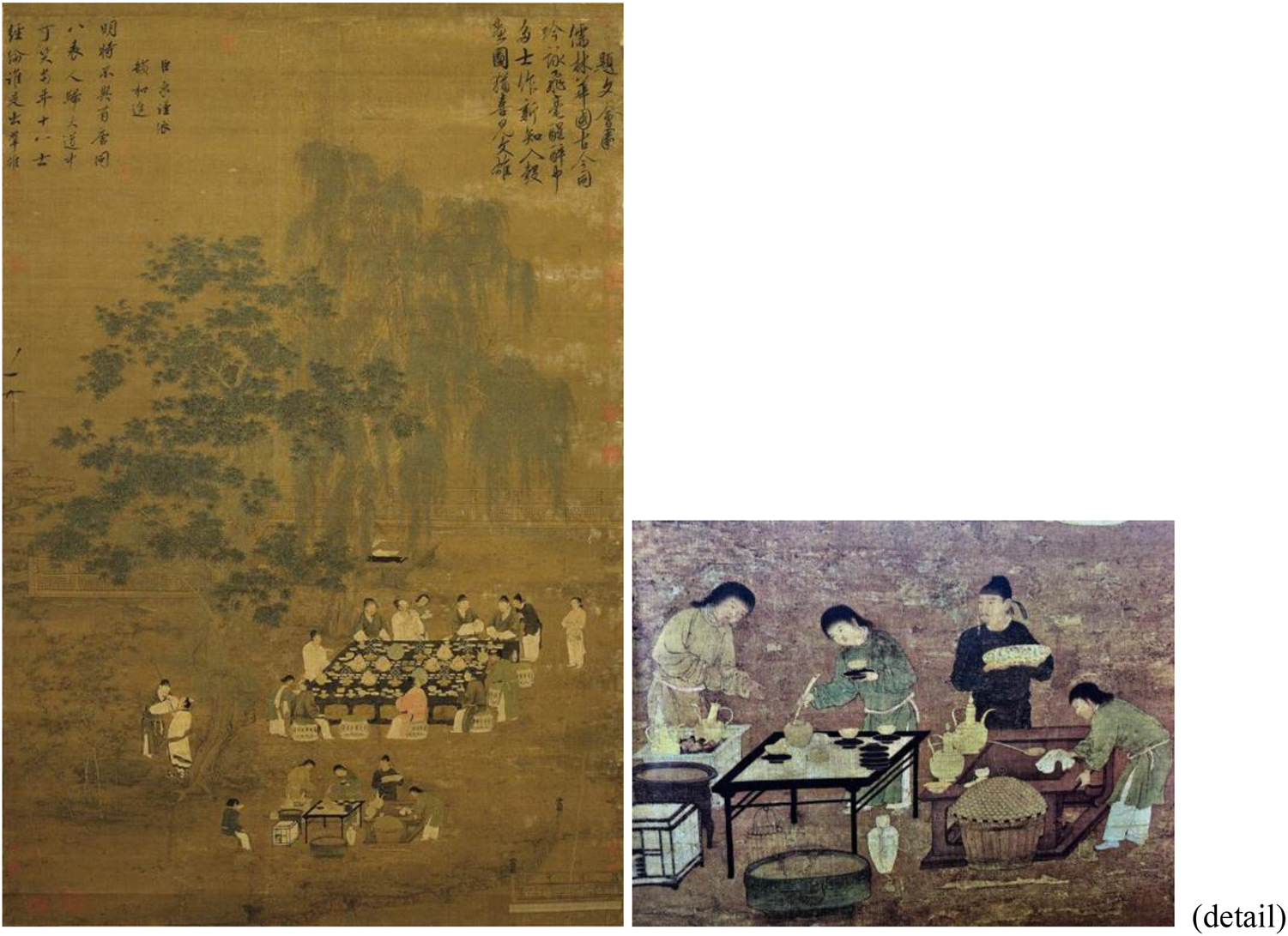
In the Song period in which the painting was actually created, the case was different. The representation of bronze as a food vessel also appears in the painting Literary Gathering (Figure 2.3), which is attributed to Emperor Huizong 徽宗 (r. 1100–1126). The painting is set in a palace garden space. Eight scholar officials are seated around a large banquet table with an elaborate set of cups, bowls and flowers, while servants in the foreground are preparing wine and tea. Just in front of the charcoal burner is a Ding, complete with decorative motifs in a horizontal frieze below the rim. Another bronze in the form of Pan 盤 is placed in front of the four-legged square table.
Literary Gathering, and detail, attributed to Song Huizong, hanging scroll, ink and colour on silk, 184.4 x 123.9 cm. Palace Museum of Taipei.

It is noteworthy that during the Song dynasty, emperors had great enthusiasm for collecting antiquities, among whom Huizong was the most ardent. According to the Treaties on Ritual in Songshi 宋史禮志, Emperor Huizong sent out eunuchs and officials to search for antiquities that had previously been distributed among households of both commoners and scholars officials soon after he ascended the throne in 1107. By 1117, Huizong announced that more than 500 ancient vessels (some of which had been unearthed) had been found and returned to the palace.Footnote 35 Encouraged by the ritual reform project of Huizong's court, large quantities of imitation bronze vessels were then produced. The process of making Song bronze used a lost-wax technique that was completely different to the ancient technique of piece-mould.Footnote 36
Regardless of whether the depicted bronze vessels in the Literary Gathering were ancient originals or newly made pieces in the archaic style, they function as visual documentation of social aesthetic taste at that moment in time. Correspondingly, the depicted Ding-shaped cooking vessels of the nomadic tribe do not escape from the aesthetic standards set by Song court, especially by the court painters, who must have been familiar with the utensils used in palace gatherings.
Wine ewers
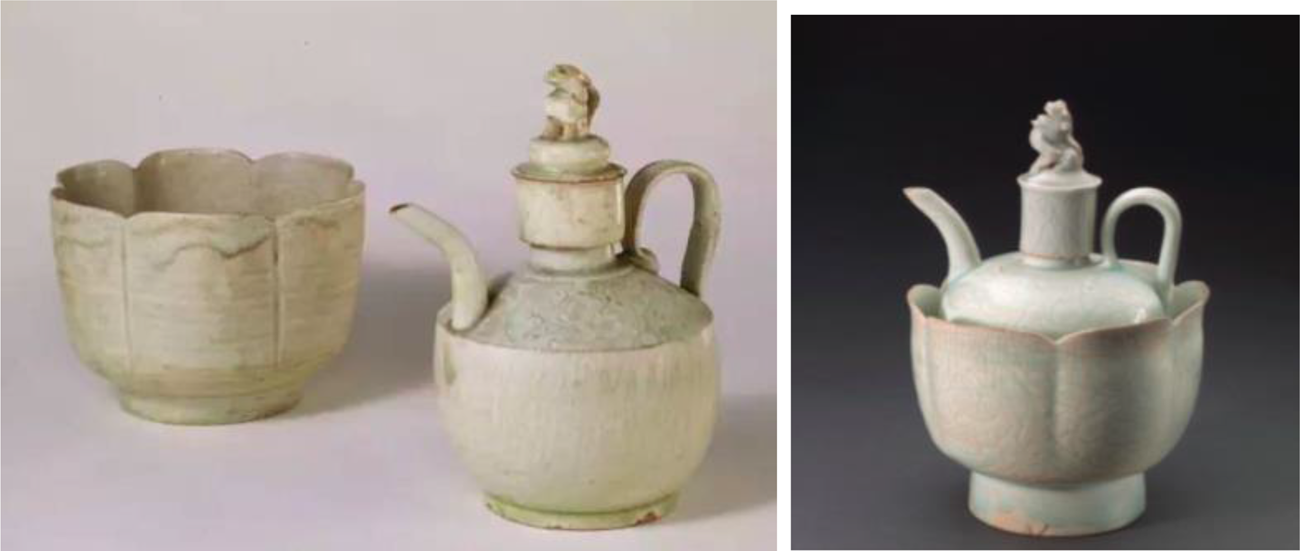
Other characteristic utensils of the Song dynasty that are revealed in the Eighteen Songs (scenes 5 and 7) are the wine ewer and the warming bowl (Figures 2.4 and 2.5). The wine ewer is also included in the Literary Gathering and also Zhang Zeduan's Qingming Shanghe Tu (Figure 2.6). The kind of utensils shown in Figure 2.4 were used predominantly in winter, with the lotus-shaped bowl containing hot water gently enveloping the ewer and warming the wine inside.Footnote 37 After its introduction to the Northern Song, it became very popular among all classes, from the imperial house to scholar officials to commoners.
Wine ewer and warming bowl, Qingbai ware, height 19.1 cm, Southern Song dynasty. Johnson Museum of Art, Cornell.

Unidentified artist, detail of wine ewer in the Eighteen Songs of a Nomad Flute, fourteenth century. Metropolitan Museum of Art, New York.

Zhang Zeduan, Qingming Shanghe Tu, detail. Palace Museum, Beijing.

The far reach of this set of utensils reflects, to some extent, the elegant lifestyles and related popular wine culture of the Song people. According to Dongjing Menghua Lu 東京夢華錄 (The Eastern Capital: A Dream of Splendor), written by Meng Yuanlao 孟元老 (twelfth century):
大抵都人風俗奢侈,度量稍寬,凡酒店中不問何人,止兩人對坐飲酒,亦需用注碗一副,盤盞兩幅,果菜碟各五片,水果碗三五只,既銀近百兩矣。
People who lived in the capital had high maintenance costs. Two customers coming to a wine tavern, whatever their social statuses, would order a set of wine ewer and warming bowl, two sets of table wares, five or more dishes and three to five fruit bowls, at a cost of several hundreds of silver Liang.Footnote 38
The depiction of the wine ewer and warming bowl in the Eighteen Songs probably implies that the lifestyle of the Liao people had been influenced by the ceramic vessels traded from the Song court. Both the Songshi and the Liaoshi record detailed gift exchanges on birthdays, ascensions and the funerals of rulers. For example, Songshi records that in the sixth month of 1022, the Song court sent envoys to the Liao court to present ceramic vessels for tea and wine drinking, carnelian cups, eating vessels and musical instruments decorated with tortoiseshell and gold.Footnote 39 Qidan Guozhi 契丹國志 (Records of Khitan State) also records that 37 gold vessels for tea and wine drinking were sent by the Song court as gifts to celebrate the Khitan emperor's birthday.Footnote 40
A contemporary ceramic specialist notes that a preferred taste for Chinese design found outside the borders of China, achieved through owning such ceramic and gold vessels, can be regarded as an early form of “cultural imperialism”.Footnote 41 In this case, the Liao people are likely to have, either consciously or unconsciously, accepted this specific Chinese cultural norm and assimilated it into the formulation of their own daily habitus. More importantly, it was the painter from the Song court who deliberately created the pictorial representation of “assimilation”, symbolizing the friendly diplomatic relations that existed between the Liao and the Song.
Roof decoration
Across the 18 scenes, the painter was fond of creating a consistent artistic style in the contrasting depiction of the Song urban environment and the nomad encampment, typified by a unification of architectural elements. The Song era witnessed the rise of a specific genre of painting known as boundary painting 界 畫 (jiehua), which means the drawing of boundaries or outlines that are closely associated with the representation of architecture that serves as a means of reproducing order.Footnote 42
The development of jiehua coincided with the imperial commission of the building manual Yingzao Fashi 營造法式, in which government standards were set out to regulate actual construction practices. The manual was developed between the 1070s and the 1100s, finally being completed by Li Jie 李誡 (1035–1110) and published in 1103. The manual is the earliest surviving Chinese treatise on architecture in terms of the use of material, manpower and building methods.Footnote 43
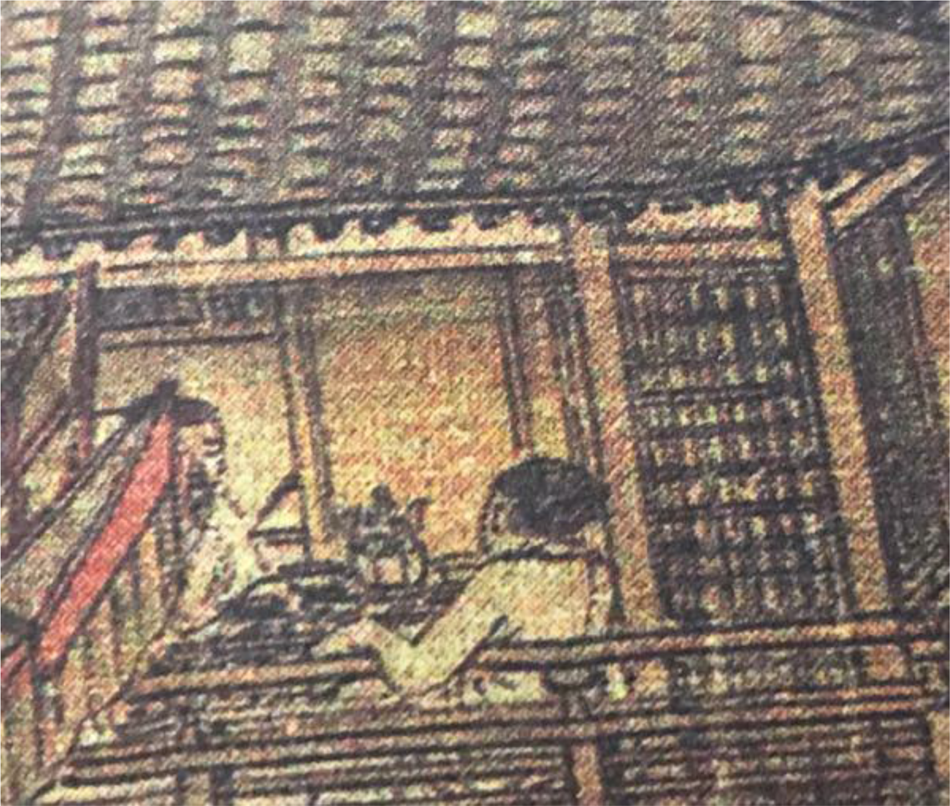
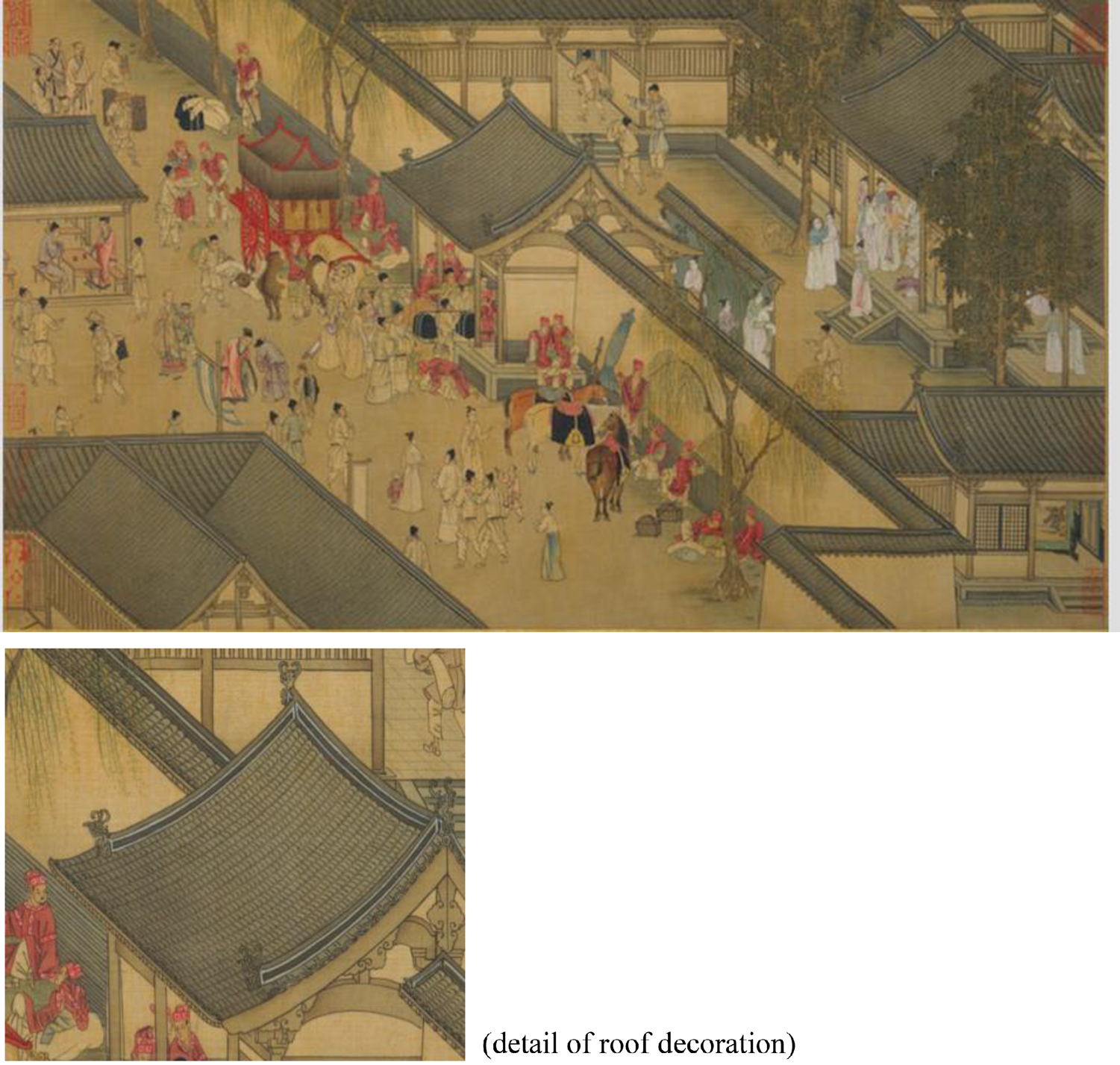
In both the opening and concluding scene of the Eighteen Songs, an open-constructed courtyard mansion with elegantly curved eaves is depicted. From an aerial view, the illustration offers a glimpse of well-planned urban dwellings and city streets (Figure 2.7). In the paintings, architectural details such as decorations, motifs and the links between parts are all carefully considered, not only for an objective representation of the architecture's practical function but also to construct a symbolic meaning of social hierarchy.Footnote 44
Unidentified artist, returning scene in Eighteen Songs of a Nomad Flute, with detail of the roof decoration, fourteenth century. Metropolitan Museum of Art.

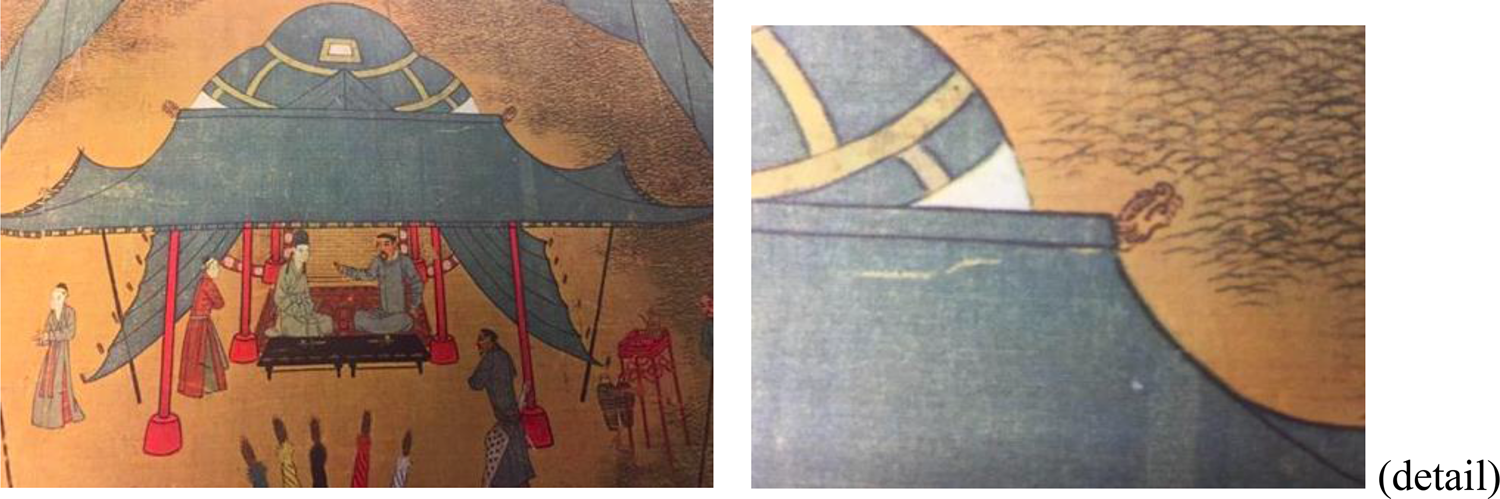
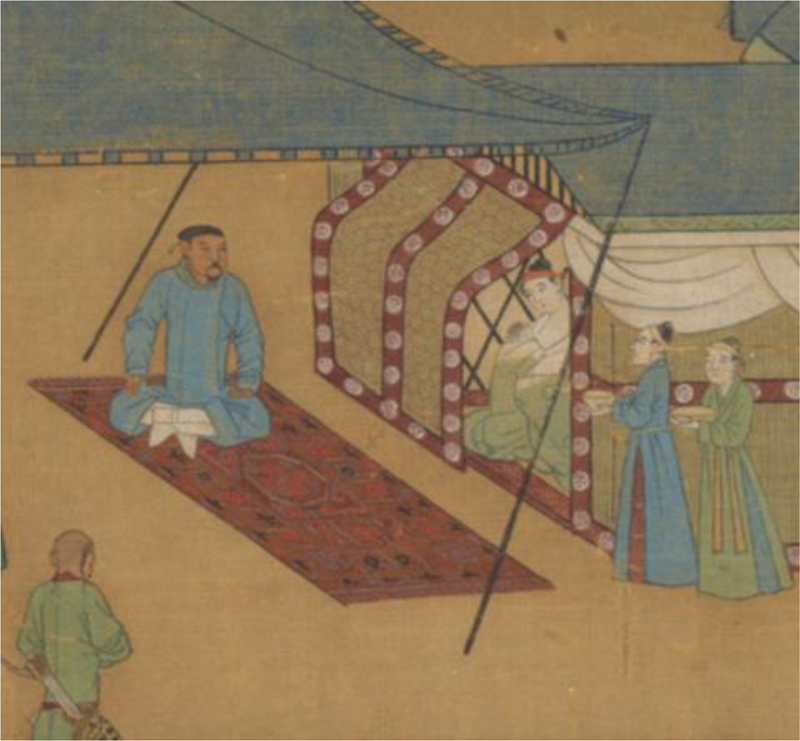
The architectural style pertaining to Lady Wenji's family can be distinguished from the surroundings by the ridge finial, known as wenshou 吻獸. Since the end of the ridge was vulnerable to penetration by both rain and sunshine, the finial originally had a practical function, namely, to offer protection from the elements and minimize damage. The finial depicted in the mansion hall is probably a dragon, 龍吻 referred to in the Yingzao Fashi, whose mouth is clamped around the ridge and whose tail-like body is thrown into the sky.Footnote 45 Correspondingly, in the depiction of the canopy outside the nomads’ yurt (scene 5), a gilded dragon finial, whose head is gazing upwards to the sky 望獸, decorates the end top of the shelter (Figure 2.8).
Unidentified artist, yurt canopy and detail, in the Eighteen Songs of a Nomad Flute, fourteenth century, Metropolitan Museum of Art, New York.

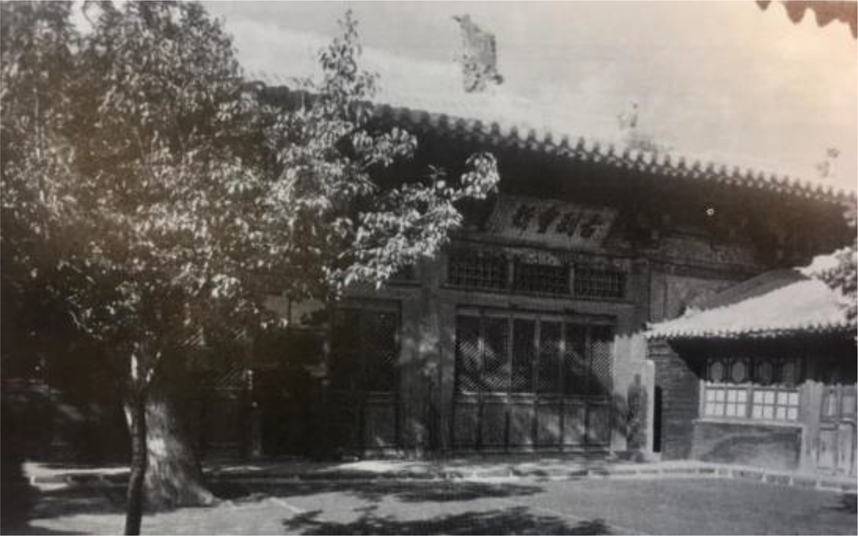
In ancient China, roof decoration was regulated by the court. Its design, including the use of colour and material, signalled the identity of those who occupied the dwelling. From the Tang dynasty to the Yuan, animal ridge figures could only be used by officials and at imperial sites.Footnote 46 This architectural convention was also adopted by the Liao Empire, exemplified by the surviving Sūtra Library of Huayansi 華嚴寺, which was built in Liao's western capital of Datong in Shanxi province (Figure 2.9). The Sutra Library has a hip-gable roof 歇山顶 which is topped with chiwen 鴟吻.Footnote 47 A pictorial depiction of chiwen is also seen on the City Gate of the capital Bianjing in the Qingming Shanghe Tu.
The Sūtra Library of Huayansi Monastery, built in 1038, Datong, Shanxi Province.

The depiction of the nomads’ yurt canopy, which is supported by lacquer pillars (Figure 2.8), is a creation of the painter. It is likely to be mimetic of either the Chinese-inspired Liao architecture or Song urban architecture. In the scroll, the architectural elements depicted in the Song cityscapes and those of the Liao nomadic settings are unified. The Song painter once again tried to diminish the antithetic relationship between Liao and Song in the pictorial representation, by intentionally inserting a Chinese-inspired architectural format into the Liao's original pastoral setting. In this way, an interdependent cultural pattern is visually constructed.
An “affectionate” concert
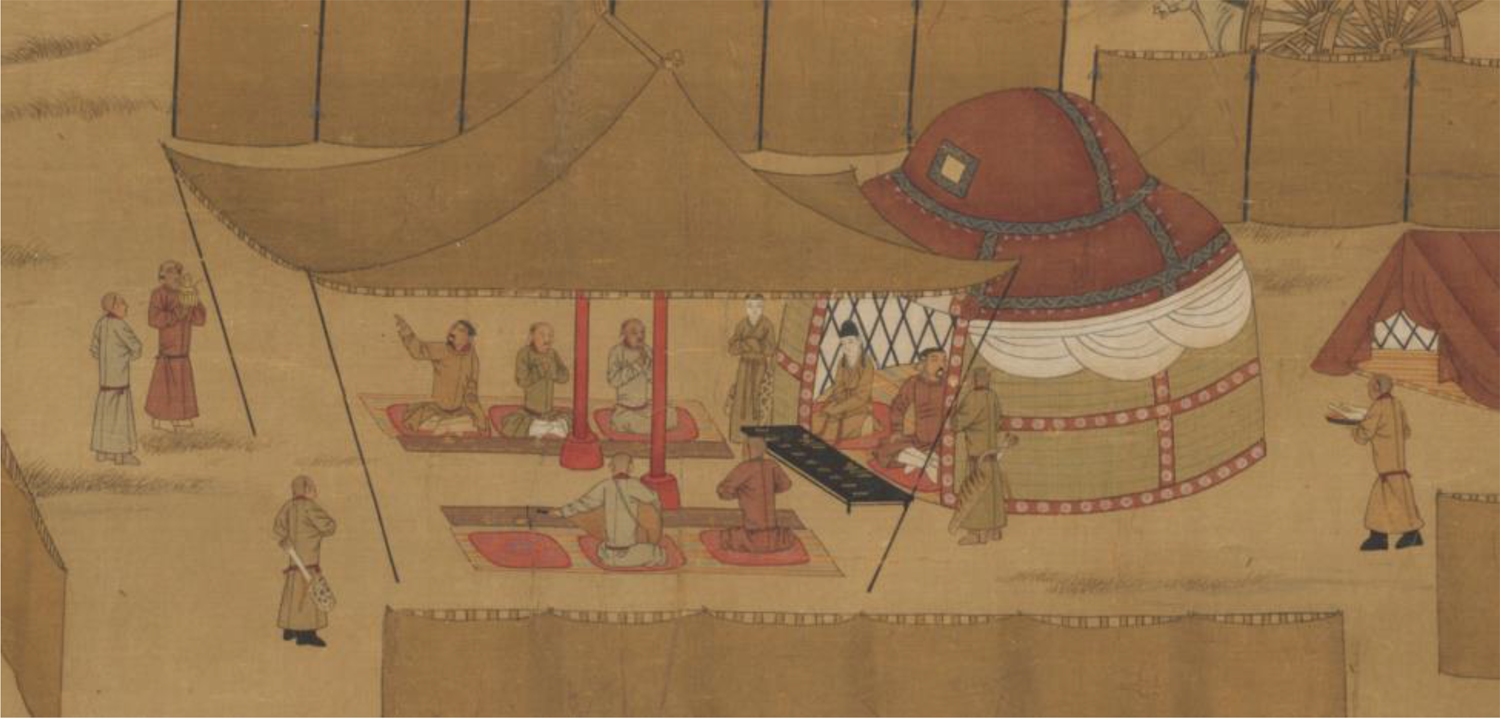
This cultural interdependence between the Liao and Song is further represented by the concert scene in Eighteen Songs (Figure 2.10). From an angled aerial perspective, Lady Wenji is shown kneeling behind the frontal bamboo net of the yurt while her chieftain husband is seated beside her in a cross-legged position in the open central space. Musicians are arranged in two rows, seated directly opposite each other. The one in the middle at the back is playing the pipa (lute) 琵琶. Diagonally across from him, a musician is playing the pili (bamboo pipes) 篳篥. The man with the additional headdress and fingers pointed upwards is most likely the singer.
Unidentified artist, detail of Scene 7 of the Eighteen Songs of a Nomad Flute, fourteenth century. Metropolitan Museum of Art, New York.

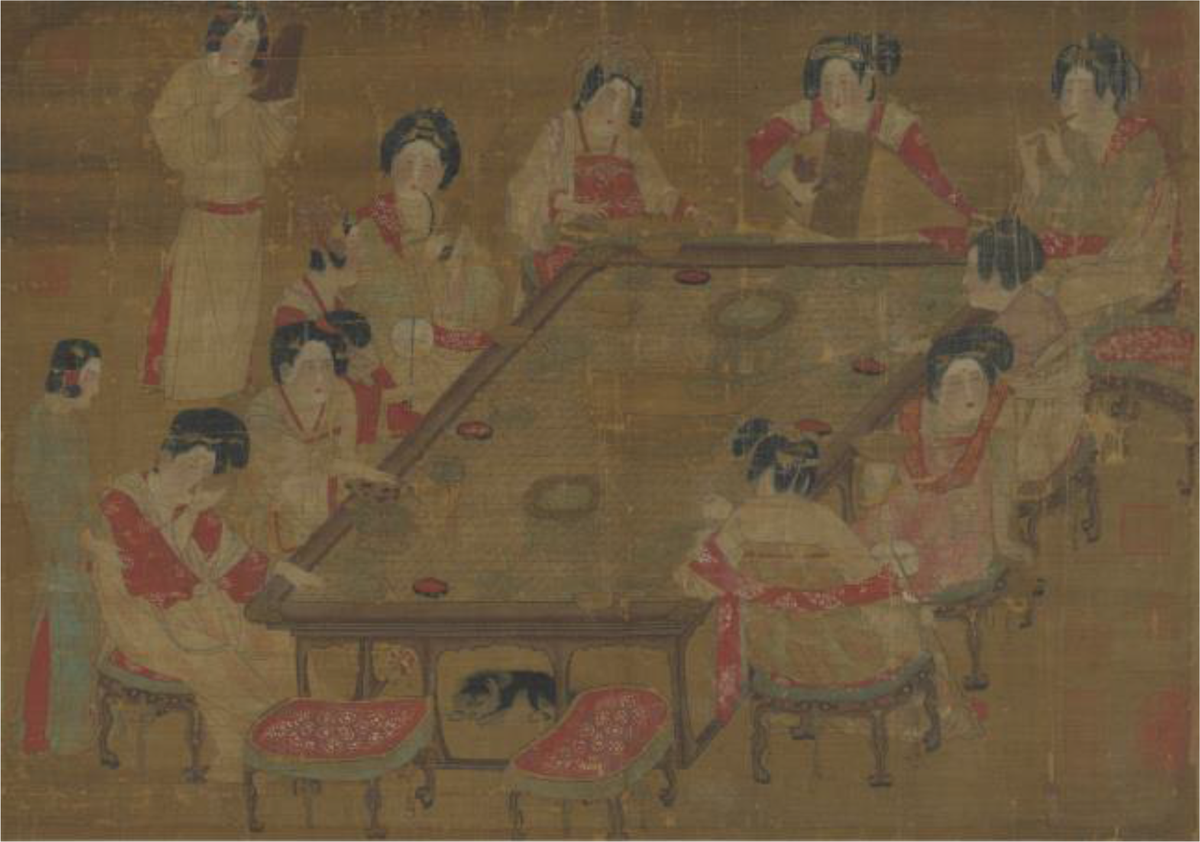
Both pili and pipa make frequent appearances in the depiction of palace concerts dating from the Tang dynasty. The painting, A Palace Concert, which is kept in the National Palace Museum of Taipei, illustrates ten court ladies seated around a rectangular table drinking wine and playing music (Figure 2.11). Four musicians are placed in the upper centre of the composition. The instruments they are holding, from right to left, are the pili, pipa, zither 古琴 and flute 笙.Footnote 48 The origins of the pipa and pili remain an issue of scholarly disagreement. The encyclopedic book of instruments and music by the Tang author Duan An'jie 段安節 records that the pili comes from Kucha (an ancient Buddhist kingdom in the present-day Aksu county of Xinjiang) and is typified by its sorrowful sound.Footnote 49 The earliest literary mention of pipa is in the Eastern Han dynasty dictionary Shiming 釋名(Explanation of Names) in which the author Liu Xi 劉熙 (310?–329) suggests that the instrument was originally played on horseback by nomadic people from north and west Asia.Footnote 50 But whether the pipa was a recent arrival in the Han dynasty or had been around since the Qin dynasty is still unknown. It is generally accepted that the pipa played a significant role in palace entertainment since the period of the Three Kingdoms (184/220–280). A fifth-century document, for example, records that Empress Wende 文德 (r. 222–235) of the state of Cao Wei 曹魏 specialized in playing the pipa.Footnote 51
Anonymous, A Palace Concert, Tang Dynasty (618–907), hanging scroll, ink and colour on silk, 48.7 x 69.5 cm. Palace Museum of Taipei.

In the history of Chinese art, representations of court ladies playing music has always carried poignant psychological intensity. Set in a luxurious palace setting, the languid gathering reveals female isolation and unspoken loneliness. Most of the women are depicted with a slight frown and eyes that are either downcast or which gaze out of the image (Figure 2.11). Direct eye contact between figures is avoided, suggesting that the community of court ladies is probably neither friendly nor harmonious. Their youth and beauty has drawn them into a melancholic and desperate situation, while music and alcohol become shelters, mechanisms for routine escape.Footnote 52
However, the human emotion illustrated in the concert scene of the Eighteen Songs appears different. In the image, although Lady Wenji is also shown with her eyes downcast, she is physically unwell due to homesickness rather than a lack of affection from her husband. The accompanied poem reads:
Despite Lady Wenji lamenting being away from her homeland, she is, in the meantime, represented as a good companion to her barbarian husband, and their mutual affection is displayed as they talk intimately (Figure 2.8), listen to music (Figure 2.10) or look at the stars (Figure 2.12). It is particularly highlighted in scene 10 when they are shown looking after the new-born baby prince (Figure 2.13). Their affection reaches its climax in the farewell scene (Figure 2.14). The unbearable sadness of separation can be felt, as the nomad husband lifts his sleeves to blot his streams of tears, their elder son tugs at the belt of Wenji's garments and the younger son cries loudly to reach Wenji from a nurse. The accompanied poem reads:
My little children, one on either side, are pulling my clothes; They cannot stay with me in the coming years, how shall I miss them!
It is difficult to figure out my emotions between the happiness of returning to home and the sorrow of departing with my barbarian family; I can only abandon my children and go back to my old country.
Once I have crossed thousand miles of mountains and rivers and arrived at the national border again; there will be no approaches for me to get messages of my barbarian family from the back.
With traces of tears crossing my face, I turn toward to the setting sun; All day long I have been reluctant to depart, standing at there looking to the south and looking to the north.
From reading the poem, we know that Wenji hesitates to return to her homeland, the place she has been longing for. Her deep affection for her nomad family clashes with her antipathy towards the nomadic environment she experienced in the beginning. The sentimental emotion continues to appear in scenes 14 and 15, in which the nomad husband seems to be requesting that the envoy take care of Wenji (Figure 2.15) and to be watching the Han procession as the nomad procession turns away (Figure 2.16). The focus of the illustration is not only on the emotional bond between a mother and her children, but also between husband and wife.
Unidentified artist, detail of watching a constellation of stars in the Eighteen Songs of a Nomad Flute, fourteenth century. Metropolitan Museum of Art, New York.

Unidentified artist, detail of the new-born child in the Eighteen Songs of a Nomad Flute, fourteenth century. Metropolitan Museum of Art, New York.

Unidentified artist, detail of the farewell scene in the Eighteen Songs of a Nomad Flute, fourteenth century. Metropolitan Museum of Art, New York.

Unidentified artist, detail of the nomad husband in the Eighteen Songs of a Nomad Flute, fourteenth century. Metropolitan Museum of Art, New York.

Unidentified artist, detail of the return journey in the Eighteen Songs of a Nomad Flute, fourteenth century. Metropolitan Museum of Art, New York.

This pictorial treatment reveals that the painter appears to be imbuing the couple with a paradoxical Confucian image. Within the family, although the father is the ultimate disciplinarian who is omnipotent, it is the mother who functions as the primary force of nurture and supervision. In the process of Chinese genderization, sets of socially recognizable gender norms were constructed. The Biographies of Exemplary Women 列女傳, compiled by the prominent Han Confucian scholar Liu Xiang 劉向 (79–8 bce), creates socially recognizable categories of womanhood.Footnote 53
Throughout the 125 stories, Liu Xiang identified seven desirable virtues. Among them is maternal rectitude 母儀, exemplified by “Teaching the children and helping the husband” 相夫教子 and “educating through a personal living example” 言傳身教, which is placed in the first category.Footnote 54 However, Lady Wenji's return to her homeland means that she has chosen to give up her responsibility to be a good mother and good wife. Lady Wenji's inner feelings were undoubtedly ones of great agony as she found herself torn between loyalty to her homeland and maternal rectitude. The father here is no longer omnipotent as he permits the departure of his beloved wife, almost certainly prompted by Chinese diplomatic pressure. Subtly dealing with the relationship between human emotion and political ideology, the seemingly paradoxical Confucian representation and the narrative of physical separation between Lady Wenji's nomad family and her Han origins depict an deep emotional bond.
Intermingled ideologies
An emphasis on benevolence and genuine emotion was not solely the creation of the painter nor was it the result of temporary political involvement. Specific pictorial language was shaped within wider historical backgrounds, in which Buddhist, Daoist and Confucian ideas intermingled. The following section discusses the combined ideologies represented in the scroll.
After the collapse of the Tang dynasty, the Song period witnessed the secularization of Buddhism. Although the government did not intend to harshly suppress Buddhist institutions or ban their doctrines, transformation did take place. Buddhist temples were adapted into schools or places of scholarly retreat. Meditations and withdrawals that were previously Buddhist in nature were accepted as Confucian practices. The Buddhist primacy of philanthropy was also “Confucianized”, particularly in relation to social issues such as the maintenance of orphanages, support for homeless old people, medical services and famine relief.Footnote 55
Despite an acknowledgement of Buddhism's inferior status, scholar officials and philosophers were willing to have discussions with learned Buddhist monks, whose knowledge of Chinese classical texts and Buddhist sutras were thought to contribute to the general cultural development of the age.Footnote 56 Meanwhile, the Khitan people had insisted on their allegiance to Buddhism since the founding of Liao dynasty, even after the Tang court had denounced Buddhism as a foreign creed in 845 ce. Historical documents reveal that around 10 per cent of the Liao population were either monks or nuns, numbering some 360,000 out of a total population of 3.8 million.Footnote 57 Different to the diminished circumstances of Buddhism in the Song court, the strong Buddhist establishment within Liao society coexisted alongside Confucianism, and had to be adapted into a component of the Khitan ruling methodology.
The decline of Buddhism in the Song dynasty was also caused by the lasting court interests in Daoism. Imperial patronage for Daoist temples was on a lavish scale. Hundreds of Daoist temples were built throughout the reign of Zhenzong 真宗 (r. 997–1022 ce). The development of the vulgarized belief and practice of using “auspicious magic” to control nature reached its climax in the court of Huizong, who was publicly against Buddhist doctrines. The emperor's private devotion thus also helped to revive the Daoist philosophy based on the school created by Laozi and Zhuangzi.Footnote 58 Indeed, a humorous juxtaposition of Buddhism and Daoism is revealed in Eighteen Songs. Wen Fong and Robert Rorex have argued that while the painter gave a Song appearance to most of the details in the paintings, the envoy's hat appears to be a fashion from the Han dynasty. Characterized by two peaks and a jade ornament at the front, it had been adapted into a cap for Taoist priests at the time.Footnote 59 In Lady Wenji's family reunion scene (Figure 2.7), a Buddhist monk is hidden in the crowd, passing by with his attendant.
Within an intermingled religious system, Buddhist doctrines on mind and transcendence, and the Daoist Book of Changes 易經 (Yi Jing) had a strong influence on the development of Neo-Confucianism. This is typified by two schools of thought: the Idealist School of Mind 心學 (Xin Xue) and the Rationalist School of Principle 理學 (Li Xue). These two schools are not antithetical, but rather are complementary approaches applied by Song philosophers to explore the nature of human life and to explain the cosmos.Footnote 60 Cheng Hao 程顥 (1032–1085), one of the founders of Neo-Confucianism, argued that the ultimate reality of the cosmos could be verified by turning the mind inwards to discover principle, nature and reason. He also emphasized that the doctrine of benevolence 仁, typified by justice 義, courtesy 禮, intelligence 智 and credibility 信, was the most prestigious principle of social regulation.Footnote 61
Confucian hierarchy and family cohesion
Corresponding to the affectionate and well-organized nomad family represented in the encampment, prominent Confucian social hierarchy is depicted in Lady Wenji's family reunion scene (Figure 2.7), in which personal conduct was highly regulated by specific social positions. On the left side of the middle ground, one of the stewards from Lady Wenji's family is inviting the chief envoy to the tea house in order to show gratitude, while the servant from the family is waiting outside the tea house with a respectful gesture. Moving forwards, another steward from the family bows to another significant envoy, with the envoy returning the bow, albeit more slightly. On the right side of the family gate, two members from the mission are kneeling at the feet of two highly ranked officials, who are paying attention to how Lady Wenji's belongings are being smoothly carried into the mansion. These two officials are probably the male commanders of Lady Wenji's family. The remainder of the weary men from the mission are resting along the wall, with two of them being served with bread, most likely from either Lady Wenji's family or from the peddler.
Old relatives and friends living far away have come to greet Lady Wenji on her return. A group that might include the scholar officials is represented to the left of the background. Lady Wenji is gazing at the crowd and is followed by an attendant carrying his zither. Most of the female family members are only allowed to celebrate Lady Wenji's arrival inside the courtyard. This corresponds to Lady Wenji's sitting position behind the net of the yurt in the concert scene 5 and re-emphasizes the domestic duty of womanhood.
It seems that “family cohesion” based on Confucian hierarchy was one of the focal points which the painter of Eighteen Songs was willing to advocate in both the depictions of Song urban life and the nomad encampment. This intention was most likely to be conveyed by a social awareness of the mutually dependent relationship between “family” and “society”. The Song elite rewrote books on how families should organize themselves and how the rules of courtesy are differentiated to pay proper deference to family members in varied hierarchies. It was argued that society flourished on the premise of well-functioning families, and in turn that if society declined due to warfare or corruption, then families are inevitably affected badly.Footnote 62 In Sima Guang's Precepts for Family Life(Jiafan 家范), he argues although women were attached to men in a hierarchical family, they could exercise influence on family goals and men's decisions.Footnote 63
Transforming the historical landscape of political integrity
The Daoist philosophy on immortality and the Buddhist doctrine on purifying the spirit to find renewal had considerable influence on the establishment of the visions of political integrity that were initiated by rising Neo-Confucian scholar officials in the Song dynasty. These men gained social status and official rank through the civil service examination. In response to political unrest and career disappointment, they withdrew themselves from court duties into private retreats in the name of “self-cultivation”. Having abandoned themselves to the natural world of mountains and water, these scholar officials gave rise to a genre of monumental landscape painting, which became a metaphor for an ideal, well-regulated state.Footnote 64 This section explores a political interpretation of the landscape paintings in the Eighteen Songs of Nomad Flute.
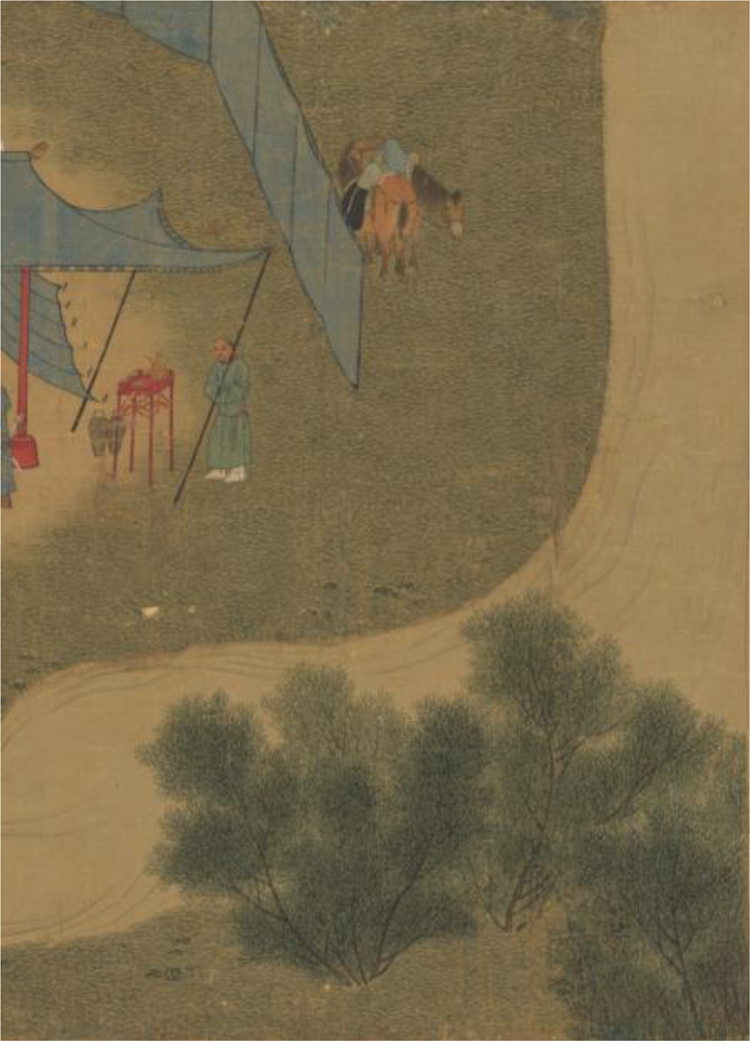
In the scroll, the landscape functions as a background setting to the nomad encampment (Figure 3.1). Robert Rorex and Wen Fong identified that the brushwork of round foliage dots was derived from the tradition established by Fan Kuan 范寬 (950–1032), which later became an iconic technique to represent a chilly nomadic setting in Snowy Landscape (Figure 3.4) by Liang Kai 梁楷 (1140–1210).Footnote 65
Unidentified artist, detail of the nomad encampment in the Eighteen Songs of a Nomad Flute, fourteenth century. Metropolitan Museum of Art, New York.

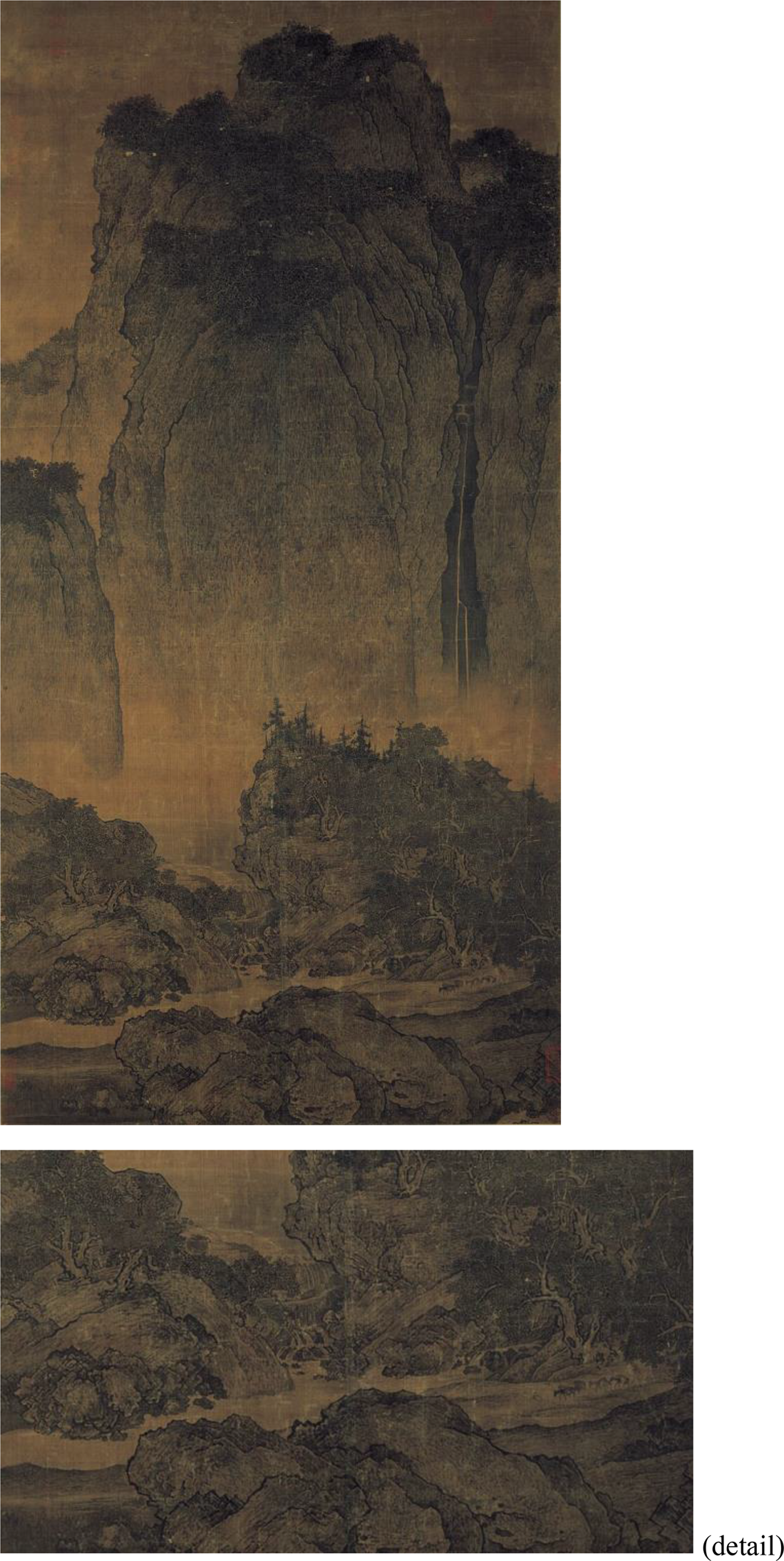
Fan Kuan, Travellers Among Mountains and Streams, and detail, early eleventh century, 206.3 x 103.3 cm. Palace Museum of Taipei

A close investigation of Fan Kuan's surviving work Travellers among Mountains and Streams (Figure 3.2) has found the pointillist technique of cun’ 皴 (fold) and tangled threads of flax,Footnote 66 which are used to depict the roughness of the rock. This is similar to the depiction of the wilderness of the desert in Eighteen Songs. However, the landscape in Eighteen Songs is horizontally arranged, and there is a visual continuity between sections. In Fan Kuan's hanging scroll, however, the solemn grandeur of the monumental mountain arranged vertically dominates the composition. C. Smith has suggested that Fan Kuan's sturdy form, firm brush and singular peak are expressive of his insistence on rationality and strength in a state that was under constant barbarian threat.Footnote 67
Unidentified artist, detail of a stream in Eighteen Songs of a Nomad Flute, fourteenth century. Metropolitan Museum of Art, New York.

In the Travellers among Mountains and Streams, rhythmic infinity is harmoniously echoed by raindrops. A cascade falls from the right middle ground of the painting and culminates in a flowing stream in the foreground. The rushing stream also makes an appearance in scene 5 of Eighteen Songs (Figure 3.3), where the nomad chieftain makes his encampment. It thus points out another metaphor in Fan Kuan's tradition of landscape paintings: the natural cycle, from departure to return.Footnote 68 Nature's unification and wholeness are achieved by an inherently evolved process, rather than being imposed by any external power.Footnote 69 It is further represented by living trees and fallen leaves, and the tiny figurative processions of travellers and horses coming from the right foreground of the composition. The depicted metaphor is perceived to be suggestive of the traditional Chinese concept of “a politically integrated state” which had hitherto normally been achieved through the inevitable process of historical development rather than by physical expansion. Liang Kai's Snowy Landscape (Figure 3.4), made decades after the Jurchen invasion and the collapse of the Northern Song, seems to follow this tradition.
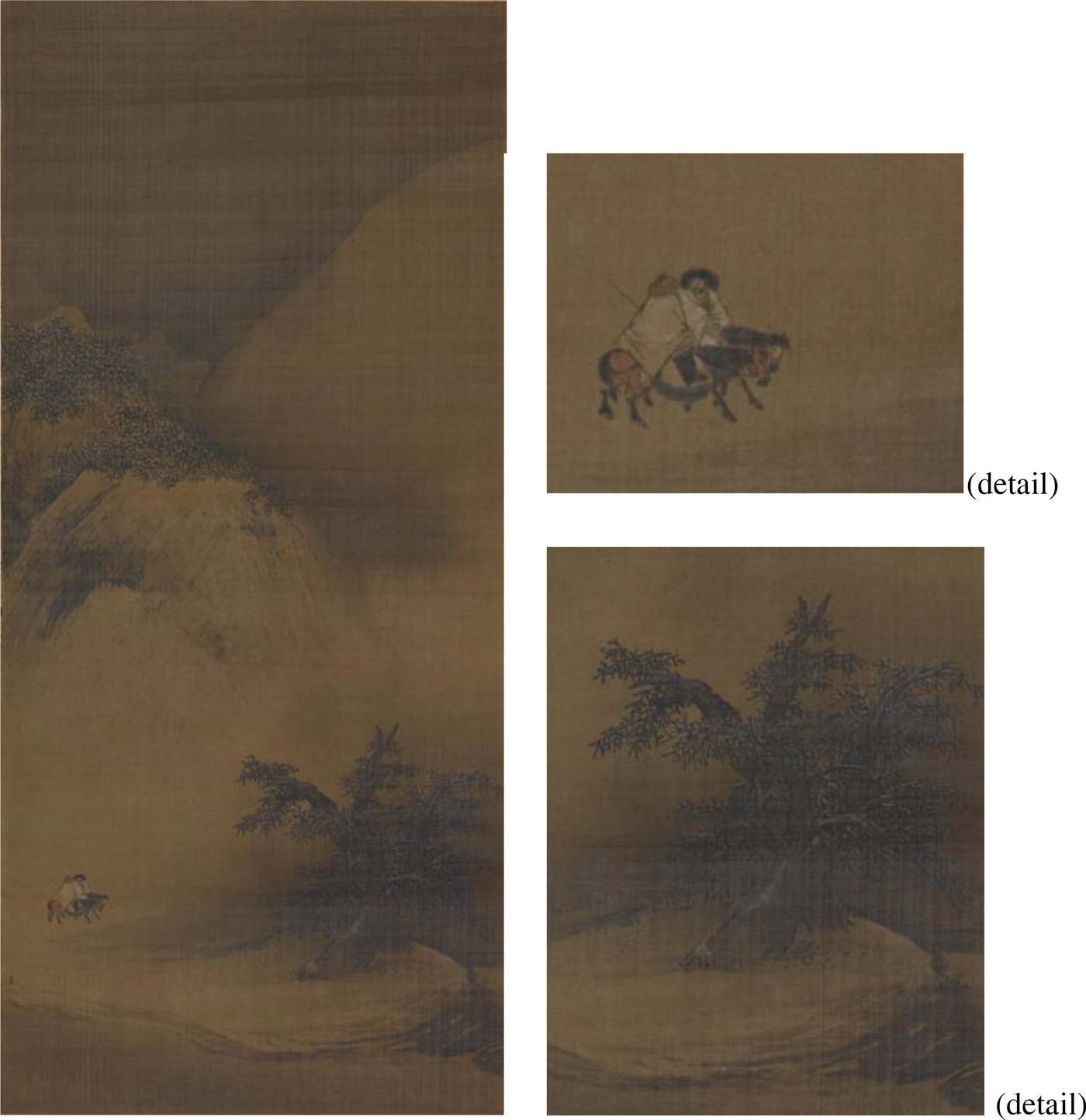
Liang Kai, Snowy Landscape, and detail, thirteenth century, 110.3 x 49.7 cm. Tokyo National Museum.

This painting depicts a snow-threatened mountain scene, skilfully using washes of light ink to render an ethereal coldness. The sky is overcast and the horizon disappears into a vast void. Two tiny figures on horseback, gazing at each other, are approaching the mountain pass. Judging from their whiskers, round fur hats and cloud shawls, they are probably Jurchens. During the early thirteenth century, the time when the painting was created, the Jin dynasty (1115–1234) had witnessed a decline, and had constantly suffered from threatens from the Mongolians, who finally overthrew it in 1234 ce.
To some extent the landscape in Eighteen Songs transforms and simplifies Fan Kuan's traditionally interpreted brushwork of jagged outline strokes and overlapping brush dabs into a modified, more “boneless” format. Instead of creating an atmosphere of tranquillity and solitude, as revealed in Liang Kai's painting, vitality and movement outweigh the overwhelming grandeur. If there is one potentially harsh comment to be made about the Jurchen horse riders as perceived in Snowy Landscape, Eighteen Songs appears to be expressive of a more optimistic view of Song-Liao relations. The craving for a centrally dominated political integrity is not as strong as that revealed by either Fan Kuan or Liang Kai.
Conclusion
The major focus of this article has been to observe the material culture and human activities in the Eighteen Songs of Nomad Flute. Hovering between imagination and reality, the depictions of the nomad encampment are not necessarily faithful to the historical reality of the Xiongnu in the Han dynasty or the Khitans of the Liao dynasty. The nomadic group reveals that it shares a similar habitus with the Song people, exemplified by the use of Ding-shaped cauldrons to cook food, the use of special sets of wine ewers and warming bowls, a concert with pili and pipa and the symbolic roof decorations. This specific pictorial language was created by Song court painters and reveals the benevolent foreign policy conducted by officials from the conservative faction, who returned to power during the Yuanyou era in the late Northern Song and insisted on a peaceful international environment of “balance of power”. In the painting, the nostalgia for homeland is balanced with an affectionate attachment between the nomad husband, the Han wife and their children. The most celebrated ideology in the representation is probably Neo-Confucianism, which highlights the human mind, principles of nature, benevolence and self-cultivation. The Song monumental landscape, initiated by literati officials, was triggered by this philosophical movement and paid extra attention to the idea of a well-structured and politically integrated state. In Eighteen Songs of a Nomad Flute, the traditionally interpreted brushwork tradition was adapted to describe a nomadic setting, in which vitality, movement and even freedom outweigh grandeur and austerity.