Introduction
Entire biological world has survived on the basis of unity, diversity and interdependence among unicellular and multicellular organisms. Millions of species so evolved have inhabited this planet for millions and millions of years. Forests are the products of prolific biological activities. The forest types, their forms and sizes are the cumulative effect of thousands of species corresponding to micro- and macro-organisms interacting with their genetic potentials and environmental factors. Obviously, forests are not merely a jungle of trees housing animals, but are the first rate natural well knitted web comprising herbs, shrubs, climbers and trees for the basic survival of all organisms living in- and out-side of the forest ecosystems (Goswami, Reference Goswami1981). Animals, more so the lower mammals depend on food and shelters under the covers of trees and shrubs. The essential carpet flora enriching the soil is microflora and for mechanical support on ground are the bryophytes and pteridophytes. Lichens, mosses and ferns thrive as terrestrial as well as epiphytic flora thereby offering nutritionally rich and biologically safe forests. Intriguingly, most of these lower groups of plants particularly lichens (Boustie and Grube, Reference Boustie and Grube2005), bryophytes (Harris, Reference Harris2008, Reference Harris2009) and pteridophytes are equally superior grade of medicinal plants. During the 16th–18th centuries the ‘most effective composite group of plants’ in the Traditional Chinese Medicine and folk medicine culture was called as ‘moss’ (Dillenius, 1763: cited from Harris, Reference Harris2008, Reference Harris2009). Botanically these ‘moss’ were a mixture of dried bryophytes (Sphagnum, Rhodobryum giganteum, Polytrichum, etc.), lichens (Cladonia, and others, so called tree moss the lichens growing on the tree), lycophytes (Club moss: Selaginella, Lycopodium), a few dried leaves of small ferns and even angiosperms (often called Spanish moss: Tillandsia usneoides).
There are about 12,000 species of pteridophytes distributed world wide in different ecological niches. Out of these, 10,000 species are ferns and the rest belong to fern-allies. Smith et al. (Reference Smith, Pryer, Schuettpelz, Korall, Schneider and Wolf2006) on the basis of morphological and gene sequencing techniques have considered pteridophytes as paraphyletic assemblage of lycophytes and filicophytes. Pteridophytes, though the second largest group of vascular plants, represent only 5–7% of the total vascular plants, but still have important ecological role particularly in the tropical vegetation (Page, Reference Page and Dyer1979). Pteridophytes used as medicinal plants have been recorded since the time of Theophrastus (ca. 372–287 BC) Charak (ca. 100 AD) and Shushruta (ca. 100 AD) (Puri, Reference Puri1970; Parihar et al., Reference Parihar, Parihar and Bohra2004). Charak and Sushruta the two medical giants of ancient India recommended medicinal values of pteridophytes in ‘samhitas’. Also, Discorides (ca. 50 AD) referred in his ‘de Materia Medica’ (Li, Reference Li2004) to a number of ferns including the bracken fern (Pteridium aquilinum (L) Kuhn) and Dryopteris filix-mas (L) Schott) as having medicinal values.
Most popular ancient Indian herbal medicine was a pteridophyte
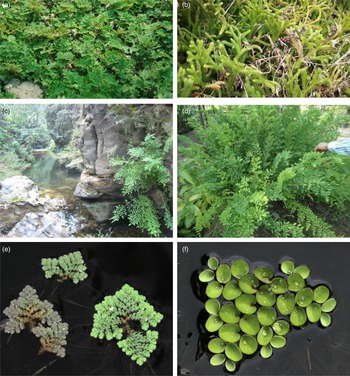
From ancient point of view the traditional Indian drug ‘Sanjeevani’ said to be the life-saving/reviving drug mentioned in ancient religious Indian texts is considered to be a group of lycophyte species mainly Selaginella bryopteris (Fig. 1(a)). On scientific inquiry S. bryopteris has been found to be superior grade of medicinal herb (Antony and Thomas, Reference Antony and Thomas2011). This species initially thought to be occurring in Himalayas is now known to be growing in many places. Whereas, there may be many other species, e.g. Selaginella pulvinata, and other ferns viz. Chelianthes, Actiniopteris, etc. that are restricted to Himalayas (Fraser Jenkins, Reference Fraser-Jenkins2012), but S. bryopteris extracts are found to be far superior in curing wounds. Most of such plants are vegetatively propagated (Renzaglia et al., Reference Renzaglia, Duff, Nickrent and Garbary2000).
Representative pictures of some important pteridophytes : (a) Selaginella bryopteris, commonly called also as ‘sanjeevani’ can be cultivated in the suitable environment in the garden, (b) Lycopodium clavatum, is among the oldest lycophytes being used in the Homeopathic and Unani medicinal practices for centuries, (c) Osmunda regalis, in its natural habitat growing in the rock crevices by the side of the flowing water, (d) but this can also be cultivated when grown under suitable environment (e) freshwater free floating fern Azolla pinnata with rosette of green to reddish brown, (f) Salvinia cucullata often seen in many lakes or ponds.

Pteridophytes as herbal medicine across the globe
Having discovered greater potential of medicinal uses of ferns there has been an increasing trend to explore economic feasibility and medicinal uses of pteridophytes in comparison with the angiosperms (Nayar, Reference Nayar1959; Kumar and Kaushik, Reference Kumar and Kaushik1999; Kumar et al., Reference Kumar, Ramesh and Sequiera2001; Remesh et al., Reference Remesh, Kumar and Manilal2001; Manickam et al., Reference Manickam, Benniamin and Irudayaraj2005; Benjamin and Manickam, Reference Benjamin and Manickam2007). In a recent publication from Botanical Survey of India (Singh, Reference Singh2011), there is an enumeration of 1261 species of pteridophytes occurring in India. Though this figure represents a rich heritage of pteridophytes in India their ethnomedico-botanical uses are not very well known (Dhiman, Reference Dhiman1998) despite the fact that these have been used since the advent of ancient Indian Ayurvedic medicinal culture. Similarly, over more than 5000 years the older civilizations in China, Korea, Japan and also Egypt have used herbal medicines, of which nearly 50% is constituted by lower plants, e.g. species of Lycopodium, Selaginella, Pteridium, Christella (=Thelypteris), Actiniopteris, Angiopteris, Isoetes, Ophioglossum, etc. (Goswami, Reference Goswami2009b). Over the past four decades there has been increased interest in drug discovery from this group of plants. A large number of extraction and microbiological testing studies have been conducted in several laboratories in India, Japan and elsewhere to test the antimicrobial activity of ferns indicating the presence of good amount of substances such as phenolic compounds, glycosides, flavonoids and alkaloids (Sen and Nandi, Reference Sen and Nandi1951; Banerjee and Sen, Reference Banerjee and Sen1980; Guha et al., Reference Guha (Ghosh), Mukhopadhyay, Pal and Gupta2004, Reference Guha (Ghosh), Mukhopadhyay and Gupta2005, Reference Guha (Ghosh), Gupta and Mukhopadhyay2006; Kumari, Reference Kumari2011; Basak et al., Reference Basak, Jha and Adhikari2012; Abraham et al., Reference Abraham, Yadav and Kaushik2015). Phytochemical analyses have been done on a large number of pteridophytes to explore presence of phenolic compounds (Bohm and Tryon, Reference Bohm and Tryon1967; Patric et al., Reference Patric, Manickam, Britto, Gopalakrishnan, Ushioda, Tanimura, Fuchino and Tanaka1995; Singh, Reference Singh1999; Singh et al., Reference Singh, Singh, Khare and Rawat2008a, Reference Singh, Govindarajan, Rawat and Khareb; Shinozaki et al., Reference Shinozaki, Shibuya, Masuda and Ebizuka2008; Shin and Lee, Reference Shin and Lee2010; Lee and Shin, Reference Lee, Shin, Fernández, Kumar and Revilla2011; Bessa Pereira et al., Reference Bessa Pereira, Gomes, Costa-Rodrigues, Almeida Palmas, Vieira, Ferraz, Lopes and Fernandes2012; Anto et al., Reference Anto, Greeshma and Santosh2015). Studies on estimation of primary metabolites, their seasonal quantitative variations and role in ecophysiology have also been undertaken (Rathore and Sharma, Reference Rathore and Sharma1988, Reference Rathore and Sharma1991; Sharma et al., Reference Sharma, Rathore, Harsh and Chawan1995; Hopkins et al., Reference Hopkins, Norman and Huner2001; Guha et al., Reference Guha (Ghosh), Gupta and Mukhopadhyay2006). Lately, genomic studies are gaining wider popularity so as to identify specific DNA sequences responsible for producing hundreds of compounds of medicinal importance (polyphenols, flavonoids, antioxidants, etc.), and prospecting specific fern genera and species with high medicinal potential.
Ethnomedicinal significance
Usage of many fern genera by the tribal people for curing various diseases such as asthma, dyspepsia, bronchitis, phthisis, etc. have long been reported in early literature (Puri and Arora, Reference Puri and Arora1961; Puri, Reference Puri1970; Pandey et al., Reference Pandey, Rasingam and Lakra2009). In India, aborigines (tribal folk) inhabiting Andaman and Nicobar Islands are among the most primitive people said to have settled around 35–60,000 years ago (Mazumdar, Reference Mazumdar1952; Wells, Reference Wells2002). Ethnomedicinal information obtained from these people has led to huge curiosity to initiate scientific inquiry into the usage of pteridophytes. As a follow-up, Dagar and Dagar (Reference Dagar and Dagar1987) detailed out ethnomedicinal uses of 46 species of pteridophytes. On further investigation, Dagar (Reference Dagar1989) had specifically mentioned 10 species that are more particularly used by traditional Vaidyas (local medical practitioners) among Nicobarese. Pandey et al. (Reference Pandey, Rasingam and Lakra2009) have surveyed and had published an exhaustive list of medicinal plants, which included many pteridophytes including epiphytic ferns such as Microsorum punctatum, Nephrolepis biserrata, Phymatosorus scolopendria and several terrestrial species.
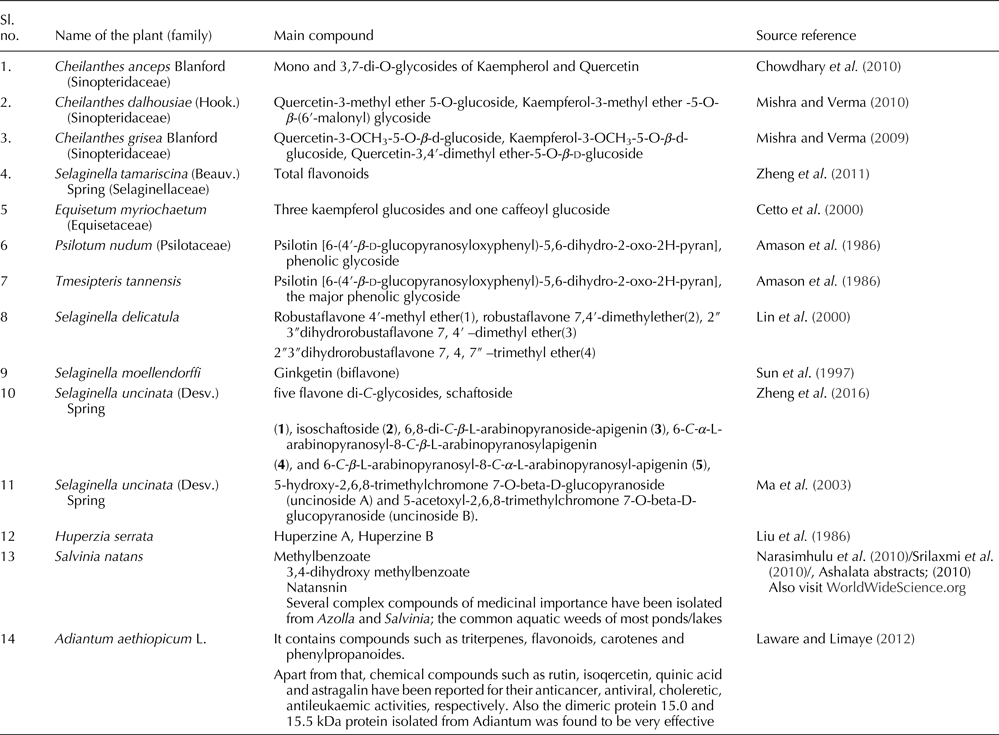
Most ferns are rich source of phytochemicals and have been found to possess a variety of biological activities (Tables 1 and 2) including antioxidant potential. Exhaustive studies conducted on biological potential of ferns suggest that most ferns have huge potential abilities as antioxidants (Lee and Shin, Reference Lee, Shin, Fernández, Kumar and Revilla2011; Sessa and Der, Reference Sessa, Der and Rensing2016). Analytical investigations conducted on antioxidant activities of many ferns particularly of the families Dryopteridaceae, Osmundaceae, Woodsiaceae exhibited powerful antioxidant activities. Among these, the antioxidant activities (DPPH radical and ABTS radical cation scavenging) of frond and rhizome extracts of several genera such as Adiantum, Davallia, Hypolepis, Pteridium, Cytominum, Dryopteris, Polystichum, Dicranopteris, Lycopodium, Osmunda, Ceratopteris, Coniogramme, Polypodium, Pyrrosia, Pteris, Lygodium, Selaginella, Thelypteris, Athyrium, Matteuccia, Onoclea and Woodsia have proved to be of great medicinal relevance. List of such ferns is increasing every year (Sen and Nandi, Reference Sen and Nandi1951; Puri and Arora, Reference Puri and Arora1961; Patric et al., Reference Patric, Manickam, Britto, Gopalakrishnan, Ushioda, Tanimura, Fuchino and Tanaka1995; Lopez et al., Reference Lopez, Hudson and Towers2001; Lee et al., Reference Lee, Choi, Kim, Kim, Chang, Moon, Lee, Oh and Woo2008; Wong et al., Reference Wong, Long, Yang, Wang, Sun, Wang, Shi and Tang2009; Shin and Lee, Reference Shin and Lee2010; Wolf et al., Reference Wolf, Sessa, Marchant, Li, Rothfels, Sigel and Der2015; Sessa and Der, Reference Sessa, Der and Rensing2016; Wani et al., Reference Wani, Shah and Naqshi2016; Srivastava and Paul, Reference Srivastava and Paul2016).
Pteridophytes in medicinal usage

Major pharmaceutically active principles known to be produced in Lycophytes and Fern Genera
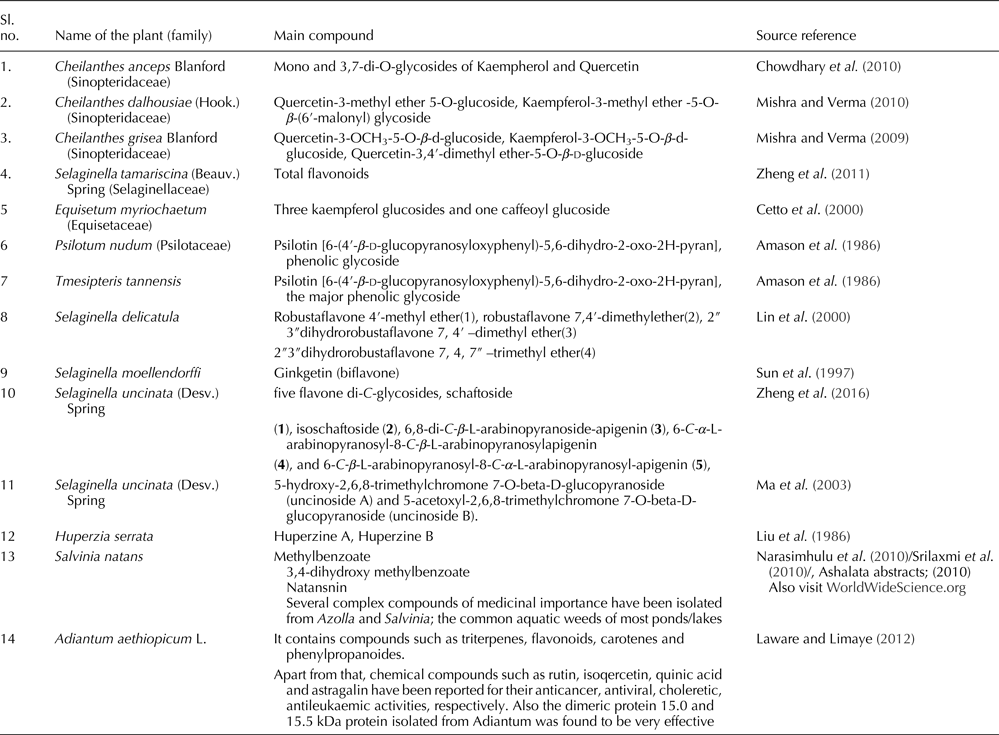
Natural antioxidants are in high demand for application as nutraceuticals, biopharmaceuticals, as well as food additives. This has been established by various population surveys that increased dietary intake of natural phenolic antioxidants, related with decline in cardiovascular problems. In tribal populations of India and elsewhere, edible ferns have been the most preferred staple food as passing through forests were the major part of their routine (Copeland, Reference Copeland1942; Hernandez and Volpata, Reference Hernandez and Volpata2004). It may be underpinned that further systematic studies on realization of antioxidant potential of ferns as natural ingredient may result in the development of health-care products for ageing and chronic disease on account of their high bioactivities.
Evolutionary and ecological importance of ferns
Evolutionary novelty of lycophytes and ferns has been established by modern genomic studies that have enabled to resolve intricate evolutionary relationships among plants and underscored their ecological importance. Comparative genomics have made it clear that lycophytes first diverged from euphyllophytes and these euphyllophytes then diverged into two sister clades monilophytes (comprising of ferns, psilopsids and sphenopsids) and the spermatophytes (seed plants) during the Devonian (about 380 mya). These non flowering plants have had dominated vegetation world until the evolution of angiosperms. Though flowering plants took over larger distribution during late Cretaceous, but the ferns flourished well and continued to be the integral part of each and every part of forests everywhere (Pryer et al., Reference Pryer, Schneider, Smith, Cranl, Wolf, Jeffrey, Hunt and Sipes2001, Reference Pryer, Schuettpelz, Wolf, Schneider, Smith and Cranfill2004; Schneider et al., Reference Schneider, Schuettpelz, Pryer, Cranfill, Magallon and Lupia2004).
As of today, almost in every part of the globe, tropical, subtropical, remote tropical islands and in different habitats or even in deeper rainforests, the ferns play a definitive role to constitute the strong carpet flora and undercover vegetation. Their network of strong roots, which are enormously rich in organic compounds with strong soil binding capacity also serve as the cradle for a large number of smaller mammals, rodents as well as amphibians, invertebrates, even arthropods and insects (Balick et al., Reference Balick, Furth and Cooper- Driver1978; Cooper-Driver, Reference Cooper- Drive1978; Gerson, Reference Gerson1979). Ferns are strong ecologically natural obligations of a rich forest (Goswami, Reference Goswami2009b; Mehltreter et al., Reference Mehltreter, Walker and Sharpe2010). Apart from this natural habitat, several ferns are too hardy, which can colonize and adapt to survive and reproduce in disturbed or barren land with the modest possibility of moisture and drain water. Ferns adapt to xeric environments. These can be frequent colonizers following disturbances such as hurricanes, landslides, fire, floods and even volcanoes (Mehltreter et al., Reference Mehltreter, Walker and Sharpe2010). According to Page (Reference Page and Dyer1979) there are five major environments in which ferns are found; these are tropical mesic, tropical xeric epiphytic, tropical xeric terrestrial, tropical alpine and temperate. Acrosticium aureum grows in salty water; Pteris vittata in particular is often seen growing on the soil near the water drainage pipelines, on walls and even on cement – calcareous waste matter. Most ecologists have referred them to be suitable to be disseminated in barren lands. Since ferns also multiply aggressively by vegetative means, an open area can be better utilized for ferns’ inhabitation before nasty invasive species occupy the space. Even a tree fern Dicksonia antarctica (Arosa et al., Reference Arosa, Ceia, Quintanilla and Ramos2012) becomes invasive in So Miguel Island. Ferns can survive drought and even can be grown in man-made destructions on account of huge modern constructions and cement concrete-residue land mass though, these genera may be different from the original populations.
Enrichment of the flora in nature
Speciation by natural interspecific hybridization is very common among lycophytes and ferns. A large number of species have evolved by natural hybridizations in ferns (Haufler, Reference Haufler, Ranker and Haufler2008; Kato, Reference Kato2009), which are capable of adapting to changing natural climatic conditions. The offspring of natural hybrids are expected to have genotypes combining the alleles of the parental species, and are expected to be genetically diverse. Often we expect that heterozygosity may support better adaptive strategies though not always so. For example, the genus Osmunda (Fig. 1(c)) of the leptosporangiate fern family Osmundaceae has natural hybrids (Kato, Reference Kato2009; Tsutsumi et al., Reference Tsutsumi, Matsumoto, Yatabe-Kakugawa, Hirayama and Kato2011), so also are the genera Ophioglossum, Isoetes (Goswami, Reference Goswami2009a, Reference Goswami2013) and lot many more (see Haufler, Reference Haufler, Ranker and Haufler2008). Hybridization often speeds up speciation process and many such individual segregates do adapt to newer situations. A follow-up study for three decades had revealed that the newly evolved hybrid species, which is practically a segregate of natural hybridization between Isoetes coromandelina and I. sampathkumarini (as is Isoetes pantii) grows on the outer margins of the lake water and can even be collected during winter while both putative parents grow submerged in water and end their rainy season-annual life mostly by the end of October, i.e. onset of winter in India (H.K. Goswami, pers. observ.). Many fern species, e.g. Asplenium platyneuron, Blechnum spicant, Pteris multifida, Lygodium microphyllum, Lygodium japonicum, Dryopteris carthusiana, Sadleria cyatheoides, Osmunda lancea, etc. are generally effective colonizers because of the capability of intra-gametophytic selfing, i.e. by the union of sperm and egg from the same bisexual gametophyte (Tsutsumi et al., Reference Tsutsumi, Matsumoto, Yatabe-Kakugawa, Hirayama and Kato2011). Such species have an advantage in expanding its distribution along various rivers or similar niches. Cultivation of a fern genus Osmunda regalis is a testimony to this. As a natural habitat O. regalis always grows by the side of flowing water (Fig. 1(c)) but lately at Pachmarhi (Central India) the planted O. regalis is growing well in garden plots (Fig. 1(d)) with modest supply of water (H. K. Goswami, pers. observ.). We have planned to attempt to shift and grow representatives of rare and medicinally important flora to a manageable place so that the original pocket in the reserved forest may be at a distance away from undesired anthropogenic disturbances. For example a lycophyte, Lycopodium (Fig. 1(b)) used in Homeopathic medicine is equally cultured in open land area in a designed protected garden. These plants have the tendency to produce many kinds of secondary metabolites in severe conditions (Bohm and Tryon, Reference Bohm and Tryon1967; Chen et al., Reference Chen, Chang, Lin, Wang, Chen, Wu and Wu2007; Ding et al., Reference Ding, Fang, Tai, Yang, Xu, Li and Cao2008; Ganguly et al., Reference Ganguly, Sarkar, Mukherjee, Bhattacharya and Mukhopadhyay2011; Chai et al., Reference Chai, Panirchellvum, Ong and Wong2012; Andrade et al., Reference Andrade, Carolina, Dresch, Rubio, Moreneo and Henriques2014; Dubal and Kale, Reference Dubal and Kale2014 and others; see also, Table 2), which offer enhanced adaptive capabilities and also such secondary metabolites (Table 2, Fig. 2) that can be exploited for medicinal uses.
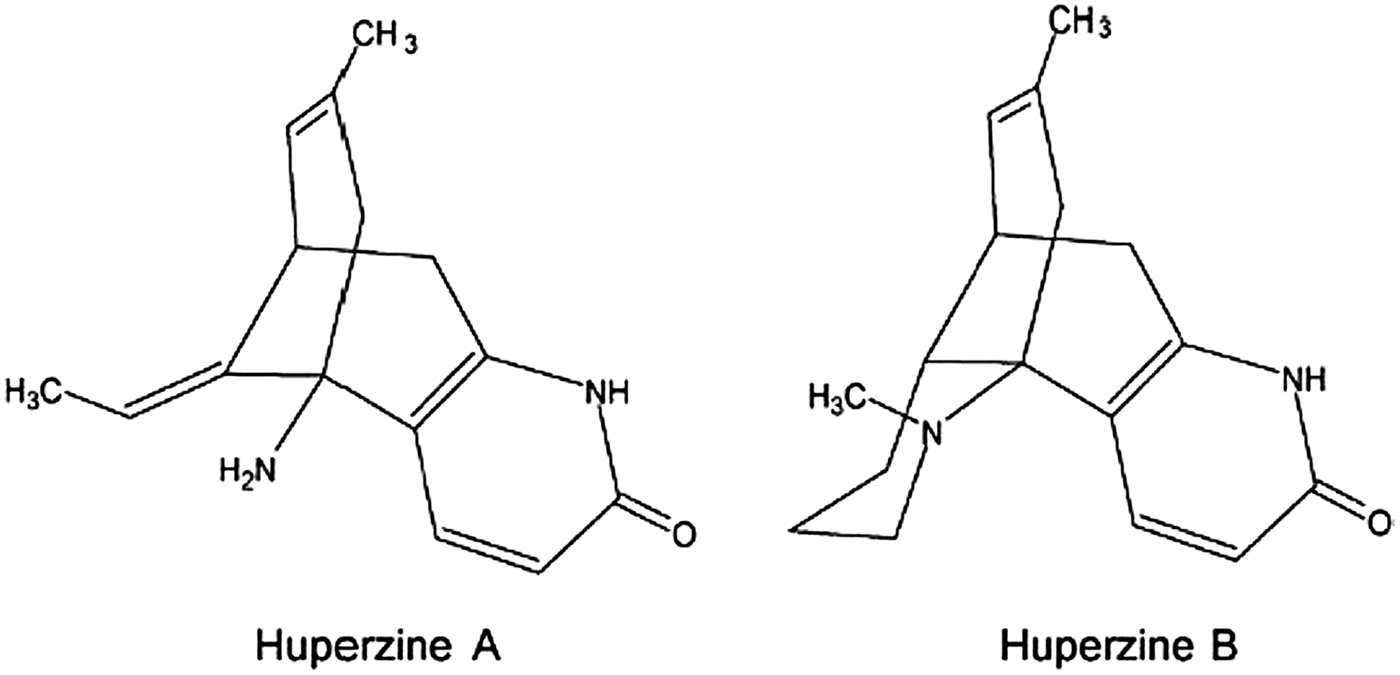
Structural formulae of medicinally important compounds: Huperzin A and -B (Liu et al., Reference Liu, Diaz, Bohlin and Vasange1998).

Phytochemical significance
Since the appearance of Vascular land plants, pteridophytes had acquired several apomorphies such as vascular tissue, lignin and sclerenchyma (Pryer et al., Reference Pryer, Schneider, Smith, Cranl, Wolf, Jeffrey, Hunt and Sipes2001, Reference Pryer, Schuettpelz, Wolf, Schneider, Smith and Cranfill2004) and evolution of biochemical conversion of certain primary metabolites to secondary products in order to realize protection from UV light, parasites, fungi, protozoa and other predators to adapt on land surface and also to defend themselves against biotic or abiotic stress, such as high light intensity, extremely high or low temperature, high salinity, drought and natural enemies. Interestingly, secondary metabolites are promising as the source of new drugs. Three main classes of secondary metabolite, namely terpenoids, alkaloids and phenylpropanoid and allied phenolic compounds that are known to be produced by Lycophytes and ferns have gained attention as the source of new drugs (Caius, Reference Caius1935; Bray and Thorp, Reference Bray, Thorp and Blick1954; Dhar et al., Reference Dhar, Dhar, Dhaman, Mehrotra and Roy1968; Adams, Reference Adams1989; Anishmom and Thomas, Reference Anishmon and Thomas2005; Chen et al., Reference Chen, Chang, Lin, Wang, Chen, Wu and Wu2007; Chowdhary et al., Reference Chowdhary, Verma, Pande and Kumar2010; Ashihara et al., Reference Ashihara, Yin, Katahira, Watanabe, Mimura and Sasamoto2012; Ceyhan et al., Reference Ceyhan, Keskin and Ugur2012; Andrade et al., Reference Andrade, Carolina, Dresch, Rubio, Moreneo and Henriques2014; Augustin and Thomas, Reference Augustin and Thomas2015; Wani et al., Reference Wani, Shah and Naqshi2016). Ferns in particular have gained international recognition and for about two decades a large number of laboratories are busy with extracting various compounds that have value in preparation of life saving drugs. Fern rhizomes have not only become stable refreshment for herbivores, but many rodents are seen feeding on roots and their exudates in the interior forest areas of Bastar (now in Chhatisgarh) and in uphills of Nagaland, India. Chemical components in roots and rhizomes are directly related to adaptive responses of the plant species. For example high sabinene content facilitates adaptation to different climatic and edaphic conditions as observed in an invasive angiosperm species Hyptis suaveolens (fam. Lamiaceae) samples (Noudogbessi et al., Reference Noudogbessi, Pascal, Yehouenou, Adjalian, Nonviho, Akibou Osseni, Wotto, Figueredo, Chalchat and Dominique2013) studied from different places. Similar studies on Ophioglossum (called as Adder's tongue fern) had revealed that higher content of sulphur containing aminoacids (cysteine, ornithine) in roots is directly correlated with excessive vegetative propagation (Fowden, Reference Fowden, Bonner and Varner1965; Goswami and Khandelwal, Reference Goswami and Khandelwal1976; Khandelwal and Goswami, Reference Khandelwal and Goswami1976; Khandelwal et al., Reference Khandelwal, Goswami and Chatterjee1980). There are several studies, which indicate that the presence of specific compound supports some or the other biological function in a species. For example, the amino acid proline is generally associated with drought resistance. Proline acts as osmolyte, giving stress relief to plants (Hopkins et al., Reference Hopkins, Norman and Huner2001). There is also an increase of proline content with age in all the three species of Adiantum (Guha et al., Reference Guha (Ghosh), Gupta and Mukhopadhyay2006). Detection of proline in Ophioglossum corms of different species, (Goswami and Khandelwal, Reference Goswami and Khandelwal1976; Khandelwal and Goswami, Reference Khandelwal and Goswami1976) obviously account for regeneration and reappearance of new Ophioglossum plants after the summer every year in the next rainy season. Higher amount of proline content in rhizome than that of frond has also been reported by Joseph et al. (Reference Joseph, Manickam and Gopalakrishnan2003) in Dryopteridaceae. Adaptive distribution of plants appears to be dependent on specific compounds present and active within the basal organs. Carotenoids are found more in amount in drought resistant ferns. Precisely, if at any place any plant species becomes or behaves as an invasive species the species is bound to have some specific organic components, which are helpful in its prolific reproductive rate. There is a need to explore such chemical constituents in detail and work out their utility for medicinal purposes. In this context, we must recall that a few of the ferns have already reached up to the pharmaceutical development and marketing drugs such as, Huperzine A and Huperzine B (Fig. 2) from Huperzia serrata and Calaguline from Polypodium leucomotos. Further, many such attempts on Selaginella and Lycopodium have also been exploited for producing useful drugs (Liu et al., Reference Liu, Diaz, Bohlin and Vasange1998; Ma et al., Reference Ma, Ma, Feng, Lin, But, Lee and Lee2003; Ho et al., Reference Ho, Teai, Bianchini, Lafont, Raharivelomanana, Fernandez, Kumar and Revilla2011; Zhu et al., Reference Zhu, Tang and Lin2000).
Phytochemical assays
From sporophytic phase (main plant body)
Phytochemical studies have rightfully gained paramount importance for clinical trials for detecting antimicrobial agents. Earlier these were mainly used in chemotaxonomy of pteridophytes (Banerjee and Sen, Reference Banerjee and Sen1980; Gottlieb et al., Reference Gottlieb, Kaplan, Zocher, Kubitzki and Kubitzki1991). Of the 13 species examined by Sen and Nandi (Reference Sen and Nandi1951), 10 species showed antibiotic activity; and the activity was particularly pronounced against the Gram-positive bacteria. Maruzzella (Reference Maruzzella1961) conducted extensive survey of antibiotic activity among the ferns. Thirty-three of the 34 ferns examined by him were found to be fairly active and half of them were active against both Gram-positive and Gram-negative bacteria, including plant pathogens. Mickell (Reference Mickell1959) published a review on the antibiotic activity of vascular plants, which included 26 ferns, of which 17 species were reported to be active as antibiotics. Horvath et al. (Reference Horvath, Alvadarado, Szocs, De Alvarado and Padilla1967) and Creasey (Reference Creasey1969) showed antitumoral activity in Polypodium leucotomos and Cibotium schiedei, respectively. Bhakuni et al. (Reference Bhakuni, Dhar, Dhar, Dhawan and Mehrotra1969) observed anticancerous activity in Dicranopteris linearis and Selaginella plumosa.
The importance of studying secondary metabolites and their active constituents for antimicrobial properties has gained importance gradually as there is a global need to tap new sources of natural drugs to combat the resistant strains of microorganisms. The frond, rhizome and rachis of ferns are covered by glands densely. These epidermal glands (Manickam et al., Reference Manickam, Benniamin and Irudayaraj2005) contain substances such as phenolic compounds, glycosides, flavonoids and alkaloids. These substances are largely responsible for the antimicrobial activity and are being soluble in organic solvents easily extracted in ethanol but less soluble in water (Banerjee and Sen, Reference Banerjee and Sen1980). Depending upon the requirements to obtain medicinally important chemicals, most of the phytochemical studies have been related to antimicrobial assessments from main plant body (sporophytic phase of life cycle; Guha et al., 2003; Parihar et al., Reference Parihar, Parihar and Bohra2004; Sarkar et al., 2011), while gametophytes also yield antimicrobial compounds in axenic cultures (Guha et al., Reference Guha (Ghosh), Mukhopadhyay, Pal and Gupta2004, Reference Guha (Ghosh), Mukhopadhyay and Gupta2005; Ganguly et al., Reference Ganguly, Sarkar, Mukherjee, Bhattacharya and Mukhopadhyay2011).
From gametophyte
Seedless vascular plants bear two phases in their life cycle: Gametophytic and sporophytic. Gametophytic phase of the life cycle is ephemeral and gametophytic tissue is miniature in size. Francisco and Driver (Reference Francisco and Driver1984) attempted to measure the pattern of flavonoid distribution in the gametophytic tissue of Polypodium aureus, Thelypteris patens, T. normalis, Asplenium aethiopicum, Cyrtomium falcatum, Gymnopteris rufa and Pteris straminea. Stable lines of gametophytic tissue of P. aquilinum resistant to Streptomycin were isolated by Breznovits and Sheffield (Reference Breznovits and Sheffield1990). Adiantum capillus-veneris was explored for antimicrobial activity of crude extracts and extracted phenols to compare the antibacterial and antifungal activity of sporophytic and gametophytic plants, whereby it was observed that gametophytic plant parts have higher antimicrobial activity. Also seasonal accumulation of phenol content was measured in different parts of sporophytic plant body. It was maximum in winter season and in the immature pinnules of all the plant parts studied separately (Guha et al., Reference Guha (Ghosh), Mukhopadhyay, Pal and Gupta2004, Reference Guha (Ghosh), Mukhopadhyay and Gupta2005).
Control of pathogens: microbiological assays/antibiotic activities
An important characteristic of plant extracts and their components is their hydrophobicity, which enable them to partition the lipids of the bacterial cell membrane and mitochondria, disturbing the cell structures and rendering them more permeable. The Gram-negative and/or Gram-positive bacteria were found to be susceptible to extracts from various parts of ferns owing to the presence of broad spectrum of antibiotic compounds present in the selected ferns by many workers (Sen and Nandi, Reference Sen and Nandi1951; Bhabbie et al., Reference Bhabbie, Tewari and George1972; Banerjee and Sen, Reference Banerjee and Sen1980; Lopez et al., Reference Lopez, Hudson and Towers2001; Gracelin et al., Reference Gracelin, De Britto and Kumar2012; Anto et al., Reference Anto, Greeshma and Santosh2015). This is considered an eco-friendly, biocontrol traditional method. The methanol extracts of fronds of five ferns, namely Adiantum caudatum, Angiopteris evecta, Pteris confusa, Pteris argyraea and Lygodium microphyllum exhibited antibacterial activity against pathogenic bacteria (Kumar and Kaushik, Reference Kumar and Kaushik1999; Anishmon and Thomas, Reference Anishmon and Thomas2005). Phytochemical analysis of all the extracts revealed that antibacterial activity is due to the presence of alkaloids, flavonoids and phenolic compounds. According to the results of Minimum Inhibitory Concentration (MIC) and Relative Percentage Inhibition (RPI) values, Angiopteris evecta could be used as potential plant for the management of pathogenic bacterium, X. c. pv. c, which is known to cause diseases on many vegetables and cash crops, particularly Centella asiatica. In a recent review, Srivastava and Paul (Reference Srivastava and Paul2016) have presented excellent treatise on rhizospheric microflora, phyllospheric microflora and endophytic microflora of these ferns and opined enormous biotechnological potential.
Not all parts of the same plant contain the same compounds or even if they do, the amount proportionately would be different. Antimicrobial activities of three plant parts such as rhizome, rachis and frond extracts of Cyclosorus interruptus (Willd) H, Gleichenia microphylla R.Br, and Microsorum pteropus (Bl.) Copel, revealed that frond and rhizome extracts of all these three species had higher antimicrobial activity than rachis (Pal, Reference Pal2013). Also lot many experiments have been conducted on isolation and characterization of human pathogenic bacteria and the effect of various fractions of Ceratopteris thalictroides, Christella dentata, Lygodium flexuosum, P. vittata and Salvinia molesta on human pathogenic bacteria under in vitro conditions. The antibacterial activity of C. thalictroides, C. dentata, L. flexuosum, P. vittata, S. molesta are reported against some human pathogenic bacteria such as Escherichia coli, Klebsiella pneumoniae, Bacillus cereus and Staphylococus aureus (Mandal and Mondal, Reference Mandal and Mondal2011; Anto et al., Reference Anto, Greeshma and Santosh2015). Current microbial resistance to antibiotics has become a global concern, as all known classes of natural compounds for antimicrobial therapy are becoming resistant (Boller, Reference Boller1995). We will have to search for such gene reservoirs in fern genomes because fern genomes have survived the rise and fall of huge populations, natural turmoils and geological stresses over millions and millions of years. We are bound to get many unexplored gene complexes within these genomes as ferns and fern allies have survived from Paleozoic times and have adapted with many more various changes of environment than the other primitive vascular plants (Wallace et al., Reference Wallace, Sander and Ferl1991).
As explicitly documented in hundreds of published research papers, ferns possess useful phytochemicals, e.g. flavonoids, steroids, alkaloids, phenols, triterpenoid compounds, varieties of amino acids and fatty acids, etc. (Sen and Nandi, Reference Sen and Nandi1951; Bray and Thorp, Reference Bray, Thorp and Blick1954; Bohm and Tryon, Reference Bohm and Tryon1967; Adams, Reference Adams1989; Patric et al., Reference Patric, Manickam, Britto, Gopalakrishnan, Ushioda, Tanimura, Fuchino and Tanaka1995; Dalli et al., Reference Dalli, Saha and Chakraborty2007; Hirasawa et al., Reference Hirasawa, Matsuya, Shaari, Lajis, Uchiyama, Goda and Morita2012; Morias-Braga, Reference Morais-Braga, Souza, Santos, Andrade, Guedes, Tintino, Sobral-Souza, Costa, Menezes, Saraiva and Coutinho2012a, Reference Morais-Braga, Souza, Santos, Guedes, Andrade, Tintino, Sobral-Souza, Costa, Saraiva and Coutinhob; Pielesz, Reference Pielesz2012). There has been increasing emphasis on obtaining plant derived polyphenolic compounds in preparing modern medicines as these posses anti tumour/cancer (Creasey, Reference Creasey1969; Shon et al., Reference Shon, Nam and Kim2004; Radhika et al., Reference Radhika, Sreejith and Asha2010) and apoptosis inducing properties. Obviously, role of plant derived polyphenols in chemoprevention of cancer is emerging as a challenging area for future medicine. Needless to mention, natural antioxidants and most of their pharmacological properties are considered to be due to their antioxidant potential, which influence physiological functions (Ames et al., Reference Ames, Gold and Willett1995a, Reference Ames, Shigenaga and Hagenb; Singh et al., Reference Singh, Singh, Khare and Rawat2008a, Reference Singh, Govindarajan, Rawat and Khareb; Adamu et al., Reference Adamu, Naidoo and Eloff2012; Zheng et al., Reference Zheng, Zheng, Dai, Wang, Fang, Du, Zhao, Zhang, Wu and Fan2016).
Antifungal and antiviral activities
Apart from antibacterial effects of Adiantum capillus veneris, the antiviral, antifungal and antimicrobial activities of Adiantum latifolium have also been reported. Alcoholic and aqueous extracts of different sporophytic plant parts of three species of Adiantum were tested against the growth of human pathogenic bacteria Salmonella typhi, the causal organism of typhoid fever, by Parihar et al. (Reference Parihar, Parihar and Bohra2004). Maximum response has been noted by the extracts of rhizome of A. lunulatum, which is even higher than the performance of 10% dilution of Tetracyline. Parihar et al. (Reference Parihar, Parihar and Bohra2004) found antifungal activities of Cheilanthes albomarginata and Marsilea minuta against the phytopathogen Aspergillus flavus. Guha et al. (Reference Guha (Ghosh), Mukhopadhyay, Pal and Gupta2004, Reference Guha (Ghosh), Mukhopadhyay and Gupta2005) studied the antibacterial and antifungal activities of crude extracts and extracted phenols from gametophyes and sporophytic plant parts of Adianutm capillus-veneris and Adiantum lunulatum. They found that the gametophytes are more potent or bioactive in combating fungal or bacterial strains than the sporophytes. Ganguly et al. (Reference Ganguly, Sarkar, Mukherjee, Bhattacharya and Mukhopadhyay2011) noted that the crude extract of an epiphyte Arthromeris himalayensis (a member of Polypodiaceae) is more responsive than the extracted phenols to control Gram (+ve) bacteria than the Gram (−ve) bacteria. Probably, the Gram (+ve) bacteria are more susceptible than Gram (−ve) bacteria due to their structural pattern of cell wall membrane. Sarkar et al. (2011) noted antifungal effects of crude extracts and extracted phenols from different sporophytic plant parts of Ampelopteris prolifera, C. dentata and Pronephrium nudatum against Aspergillus niger. Christella dentata is found to have the most effective antifungal property among these three thelypteroid ferns. Sterile leaf parts of all these members contained higher amounts of phenolic substances. There are a large number of studies on antifungal, antiviral and antibacterial activities of fern extracts (Lopez et al., Reference Lopez, Hudson and Towers2001; Ma et al., Reference Ma, Ma, Feng, Lin, But, Lee and Lee2003; Lee et al., Reference Lee, Choi, Kim, Kim, Chang, Moon, Lee, Oh and Woo2008; Tiwary and Ganguly, Reference Tiwary and Ganguly2016).
Pharmaceutical products – recent progress
A brief account about the production of marketable medicinal products obtainable from Pteridophytes is outlined below
Huperzine (Fig. 2): Since Tang dynasty, China extract of plant H. serrata was used and prescribed as Quing Ceng ta in Chinese Traditional medicine. The drug was prescribed for a number of ailments such as contusion, strains, swellings, schizophrenia, myasthemia gravis and now organophosphate poisoning (Ma et al., Reference Ma, Ma, Feng, Lin, But, Lee and Lee2003, Reference Ma, Tan, Zhu, Gang and Xiao2007). Later on Hup A was isolated from Quing Ceng ta (H. serrata) by Chinese scientist Liu et al. (Reference Liu, Diaz, Bohlin and Vasange1998), and established this for its anticholinesterase activity to treat Alzheimer's disease. Since 1996, it was marketed as Shuangyiping tablet (Zhu et al., Reference Zhu, Tang and Lin1999, Reference Zhu, Tang and Lin2000).
Calaguline: Calaguline isolated from leaves of Polypodium has medicinal applications arthritis, psoriasis, atopic dermatitis. Calaguline can block NF-κβ activation so it has the potential of blocking proliferation, inflammation, promotion and metastasis. Structural elucidation has revealed that calaguline contains a new glycoside (Kaempferol 3-O-β-xylopyranosyl (1–2)-β-d arabinopyranoside), two known flavonoid glycosides, rutin and kaempferol 3-O-α-arabinopyranoside (Gombau et al., Reference Gombau, Garcia, Lahoz, Fabre, Roda-Navarro, Majano, Alonso-Lebrero, Pivel, Castell and Gomez-Lechon2006; Ho et al., Reference Ho, Teai, Bianchini, Lafont, Raharivelomanana, Fernandez, Kumar and Revilla2011). Hydrophilic extract of P. leucomotos prevented UV-induced cell damage and its morphological changes in human fibroblasts, namely F-actin-based cytoskeletal structure, coalescence of the tubulin cytoskeleton and mislocalization of adhesion molecule such as cadherins and integrins. So it is used as sun-burning and skin pathologies and with uv-mediated damage (Gonzalez and Pathak, Reference Gonzalez and Pathak1996).
Many other useful compounds
From Male Fern (Dryopteris): Male fern is used to treat nosebleeds, heavy menstrual bleeding, wounds and tumours. It is also used to expel worms, typically tapeworms, from the intestines. Some veterinarians use male fern to treat worms in animals. The chief constituent of male fern is a yellow amorphous substance of an acid nature, termed filmarone, to which the properties of male fern as a vermifuge are attributed. In solution it slowly decomposes into filicic acid and aspidinol, both of which also occur preformed in the drug (Mittal and Bir, Reference Mittal and Bir2006). Recently, Wani et al. (Reference Wani, Shah and Naqshi2016) have added a list of compounds of medicinal importance extracted from many pteridophytes. In addition to medicinal products, certain other important chemical compounds are being manufactured from the plant parts, e.g. water soluble polymer from the fronds of the black tree fern, Cyathea medullaris (Matia-Merino et al., Reference Matia-Merino, Goh and Singh2012).
Conservation strategies to exploit genomic potentials
Since, a large number of pteridophytes, bryophytes and lichens are the natural constituents of forests, therefore it is desirable that necessary efforts are made to conserve enormous wealth of these plants in forests to sustain the ecosystems per se (Goswami, Reference Goswami1981, Reference Goswami2009b). We must cultivate some of the most widely accepted fern genera for genomic exploitation for medicinal uses. Earlier suggestion (Goswami, Reference Goswami2009b) of establishing Fernaria at different sites holds a strong biological feasibility. Selected genera and species can be cultured in large shaded greenhouses (not necessarily glass house) so as to assess and conduct experiments in genomic trials for the production and microbial assays of antibiotic substances. As such, genomic research on lycophytes and ferns has lagged behind other groups of plants. While nuclear genome sequences are now available for over 100 species of seed plants, there is only one sequenced genome of a lycophyte available, i.e. heterosporous Selaginella moellendorffii, and none from any fern, or from any homosporous pteridophyte. But as we pass on, serious attempts in this direction are emerging and genomic data are pouring in (Wolf et al., Reference Wolf, Sessa, Marchant, Li, Rothfels, Sigel and Der2015; Sessa and Der, Reference Sessa, Der and Rensing2016). We need genome sequences of lycophytes and ferns so that we could ascertain the genes and relevant DNA sequences to understand their fundamental and highly economic, medically useful traits which are helpful. Little is known about the genes involved in arsenic sequestration and transport, but identification of such genes could aid the development of remediation techniques for treating arsenic-contaminated soils and groundwater.
For example there are many genera, which possess unique qualities (Table 2), and could be explored for :
-
(i). Bioremediation (Bharti and Banerjee, Reference Bharti and Banerjee2012; Mandal et al., Reference Mandal, Purakayastha, Patra and Sanyal2012a, Reference Mandal, Purakayastha, Patra and Sanyalb);
-
(ii). Hyperaccumulation of heavy metals and toxins. Certain potential resources are: P. vittata for Arsenic, Copper, Cadmium and Zinc; Osmundastrum cinnamomeum and Athyrium yokoscense for Lead, Salvinia sp. for Nickel.
-
(iii). Desiccation tolerance: No study has yet been undertaken to investigate the regulatory and metabolic networks that allow ferns to be desiccation tolerant (DT), but such studies have enormous DT (reviewed by Sessa and Der, Reference Sessa, Der and Rensing2016). Plants can lose all metabolically active water from their vegetative tissues and recover from that state. True DT is very rare in vascular plants, especially crops but gametophytes of many fern species have been found to be tolerant potential for crop plant improvement, particularly as global climate patterns change and periods of drought and inconsistent precipitation become more common.
-
(iv). Stress tolerance: Phenols play an important role in the metabolism of plants especially during stress. Vyas et al. (Reference Vyas, Rathore and Sharma1989) noted that percentage of increase of phenols during stress is much higher in drought resistant pteridophytes than shade loving ferns. But under normal conditions, the soft, green, laminated leaves, e.g. Tectaria, Athyrium have more amounts of phenols than the coriaceous, e.g. Cheilanthes and reduced leaf forms, e.g. Equisetum.
Prospects of genomic studies
Sessa and Der (Reference Sessa, Der and Rensing2016) in their exhaustive review on this and related topics have highlighted ebulliently the additional and essential uses of genomic studies and urged for extensive studies to be undertaken on lycophytes and ferns. Interestingly, two very unlikely results have been revealed that ferns are at the lower end of protein content estimates for land plants because of lower gene density. In other words, there appears to be no correlation between protein content and the large genome size, which in turn has a positive relationship among land plants. Second inference asserts on a different mechanism of genome downsizing than other lineages of land plants (Leitch and Bennett, Reference Leitch and Bennett2004; Barker and Wolf, Reference Barker and Wolf2010; Leitch and Leitch, Reference Leitch and Leitch2012; Goswami, Reference Goswami2013). Similarly, gene number estimates for seed plants are much less variable: generally, between 20,000 and 40,000 per diploid genome. A single estimate for a fern, Ceratopteris richardii, is near the range: 42,300 genes. Wolf et al. (Reference Wolf, Sessa, Marchant, Li, Rothfels, Sigel and Der2015) and Sessa and Der (Reference Sessa, Der and Rensing2016) have reviewed on nuclear, chloroplast and mitochondrial genomes of a large number of lycophytes and ferns, which can be further studied for detailed genomic information. Intriguingly, ferns have higher proportions of the genome comprised DNA transposons and LINE retrotransposons than do seed plants. These authors have also reviewed in detail about DNA methylation studies and have indicated differential DNA methylation during development. Obviously, genomic studies on ferns have enormous prospects for understanding almost all kinds of molecular genetic studies. Many a workers have started barcoding the medicinally important species so as to exactly identify the relevant species for genomic potential (Hirano et al., Reference Hirano, Aya, Matsuoka and Ueguchi-Tanaka2012; Gu et al., Reference Gu2013).
From evolutionary and comparative genomics point of view, the pteridophytes offer exceptionally superior evolutionary tales in the plant kingdom. Both homosporous and heterosporous plants are found in this evolutionary lineage. Giant heterosporous lycopods of Carboniferous must have been polyploids that had dominated the homosporous pteridophytes during Carboniferous (300 mya) until they had to face biological extinction (Goswami, Reference Goswami2013) on account of drastic climatic turmoil during the Mesozoic. After that as estimated by palaeobotanists, giant occupancy on marshy land gradually culminated to greatest reduction series of evolution finally to herbaceous lycopods such as the genus Isoetes (quillworts). Also, the homosporous ferns emerged as dominating vegetation (polyploidization might have been helpful) at the same time when angiosperms arose as contemporary flora (Schneider et al., Reference Schneider, Schuettpelz, Pryer, Cranfill, Magallon and Lupia2004). The reduction series imposed on heterosporous plants probably might have also involved natural hybridizations/allopolyploidy (Goswami, Reference Goswami2013), and other mechanisms resulting in downsizing of genomes. Or, there may be a few conjoint molecular mechanisms, e.g. differential/variable DNA methylation events (Goswami et al., Reference Goswami, Chang and Lee2000; Sessa and Der, Reference Sessa, Der and Rensing2016), which have resulted in genomic reshuffles among evolving heterosporous lycophytes and a few fern groups. The two species of this homosporous aquatic fern genus Ceratopteris, C. thalictroides and C. richardii (family Parkeriaceae) have not only been extensively studied for all morphological and developmental stages of a typical fern life cycle but also have been found to be highly suitable; hence universally recommended fern species for molecular and genomic studies with particular reference to stable inheritance of trans-genes. The protocols of transformation of gametophyte (prothallus) cells with demonstration of trans-genes in sporophytes and in subsequent generations have established Ceratopteris to be a classic genetic model for studying gene functions in ferns (Plackett et al., Reference Plackett, Rabbinowitsch and Langdale2015). Nakazato et al. (Reference Nakazato, Jung, Housworth, Rieseberg and Gastony2006, Reference Nakazato, Barker, Rieseberg, Gastony, Ranker and Haufler2008) produced a high-resolution genetic linkage map for C. richardii based on 488 doubled haploid lines that were genotyped for 368 RFLP, 358 AFLP and 3 isozyme markers. This mapping experiment recovered 41 linkage groups and revealed that the majority of loci (over 76%) were duplicated, with most duplicates in different linkage groups. Efforts to promote developmental and genomic research on model systems in the horsetail fern clade (for example, Ceratopteris) will probably lead to an improved understanding of fundamental aspects of vascular plant development and evolution. They have reported on the basis of exhaustive DNA studies on representatives from all the main lineages of land plants that there are three monophyletic groups of extant vascular plants: (1) lycophytes, (2) seed plants and (3) a clade including equisetophytes (horsetails), psilotophytes (whisk ferns) and all eusporangiate and leptosporangiate ferns. Their studies after maximum-likelihood analysis show that horsetails and ferns together are the closest relatives to seed plants.
Comparative genomics
Most of the 470 million year history of plants on land belongs to bryophytes, pteridophytes and gymnosperms, which eventually yielded to the ecological dominance by angiosperms 90 Myr ago (Pryer et al., Reference Pryer, Schneider, Smith, Cranl, Wolf, Jeffrey, Hunt and Sipes2001, Reference Pryer, Schuettpelz, Wolf, Schneider, Smith and Cranfill2004; Schneider et al., Reference Schneider, Schuettpelz, Pryer, Cranfill, Magallon and Lupia2004). This is extremely exciting that lycophytes and ferns, grouped together for basic morphological understanding depart from each other in phylogenetic shares of genes. In addition to common evolutionary studies genomic studies with a theme of comparative genomics have enormous information not yet discovered or acknowledged. For example, certain gene sequences inherently found in a few bryophytes and pteridophytes exactly resemble some of the DNA sequences on Y chromosome of man. This when first observed (Nagl, Reference Nagl1991; Goswami and Chandorkar, Reference Goswami and Chandorkar1994) was not believed but now we have several investigations confirming (Okada et al., Reference Okada, Sone, Fujisawa, Nakayama, Takenaka, Ishizaki, Kono, Shimizu-Ueda, Hanajiri, Yamato, Fukuzawa, Brennicke and Ohyama2001) the presence of though, a few only (?) same DNA sequences in plants, which are exactly similar in the human genome. Such findings thereby strongly justify earlier hypothesis (Bajpai and Goswami, Reference Bajpai and Goswami2002; Goswami, Reference Goswami2009a, Reference Goswami2012) that DNA sequences ever since originated and evolved, had had ceaselessly multiplied and must have been distributed randomly in the evolving cells during the Pre-Cambrian almost before the evolutionary bipartition of cells into plant and animal cells. We can always find many common DNA sequences among many unrelated organisms, be these even plants. Pteridophytes in particular offer a great potential for probing inherent DNA sequences on the basis of comparative genomics because geologically too old genome had witnessed enormous complications of evolutionary genetics and environmental stresses over millions and millions of years.
We now know that comparison of evolutionary adaptations and natural innovations illuminates the genetic basis for the development of organisms. Gene network (DNA stretches) that retains similar wiring diagrams (some or many similar DNA sequences) among related, distantly related or even totally diverse organisms points the ways in which regulatory regions of the genome may have evolved. Comparative genomics can help us in deciphering evolvability of gene network and conservation modes during vast geological journey in evolution. It is now possible to combine genomics, epigenomics, developmental genetics of model organisms and the comparative method. Whole genome sequencing (WGS) has the potential to identify all kinds of genetic variations. Therefore, WGS is strongly needed for all organisms (Pang et al., Reference Pang, Macdonald, Yuen, Hayes and Scherer2014) to detect mutations and genomic changes during the evolution and development in animals and plants (evo-devo; Editorial, Nature Genetics, 2016 – doi:10.1038/ng.3566/http://www.nature.com/natecolevol/)
Save freshwater ecosystems and harvest wealth from aquatic fern-weeds
The freshwater ecosystem is the most precious flowing wealth on our planet. We need to understand very seriously about freshwater conservation and a few fern genera can really offer manifold help.
-
(I) Medicinal plants particularly ferns can be planted around catchment area of a lake
Some medicinal angiosperms, e.g. Bacopa, Centella spp. that grow along lakes are hyper accumulators of lead, cadmium, and mercury. Among the pteridophytes, Ceratopteris, Marsilea, Pteris spp., etc. are appropriate alternatives as heavy metal accumulators that can be very well cultivated around the catchment area or in the marginal fringes of the water body (Goswami, Reference Goswami2012).
-
(II) (Aquatic fern weeds can be positively exploited
All aquatic ferns particularly Azolla and Salvinia (Fig. 1(e) and (f)) are rich in organic compounds and are also hyper accumulators of heavy metals (further details at WorldWideScience.org).
-
(a) Aquatic ferns: Azolla and Salvinia
Phytochemical studies on Azolla pinnata R. Br., M. minuta L. and S. molesta Mitch by Mithraja et al. (Reference Mithraja, Marimuthu, Mahesh, Paul and Jeeva2011); Li and Pryer (Reference Li and Pryer2014) have indicated the presence of phenolics, tannins, carbohydrates, steroids, saponins, carboxylic acid, flavonoids and a few more bioactive compounds in variable quantities in extracts from leaves. Since phenolics have antioxidative, anticarcinogenic, antimicrobial, antiallergic, antiinflammatory properties the authors have rightly recommended to take best pharmaceutical uses of these aquatic ferns by proper approaches (Pandey and Bhargava, Reference Pandey and Bhargava1980; Pandey, Reference Pandey1994; Shon et al., Reference Shon, Nam and Kim2004; Schor-Fumbarov, Reference Schor-Fumbarov, Goldsbrough, Adam and Tel-Or2005; Shinozaki et al., Reference Shinozaki, Shibuya, Masuda and Ebizuka2008; Lee and Shin Reference Lee, Shin, Fernández, Kumar and Revilla2011; Mithraja et al., Reference Mithraja, Marimuthu, Mahesh, Paul and Jeeva2011; Mukhopadhyaya, Reference Mukhopadhyaya, Keshri and Mukhopadhyay2012; Abraham et al., Reference Abraham, Yadav and Kaushik2015). Two of these aquatic ferns viz. Azolla, and Salvinia are used as biofertilizers and are also strong bioaccumulators of heavy compounds under stress.
Ferns of the genus Salvinia comprise 10 species; majority of which grow in freshwater bodies of tropical and subtropical regions in many countries and is widespread as aquatic weed in several parts of India. Salvinia varieties have small hairs on their leaves, making them water resistant. Air cavities in the leaves help the tiny plant to stay afloat (Fig. 1(f)). Since this plant is a potential removal of heavy metals such as lead (Pb), cadmium (Cd), nickel (Ni), copper (Cu), chromium (Cr) and mercury (Hg) from waste water, this has been used as a decontaminating agent. Its greater use has been recently discovered that the weed menace, which covers a large surface area of freshwater can be converted to beneficial uses.
The phytochemical investigation on S. natans shows that it consists of 96% of amino compounds. Recently, isolation of an unusual novel anti-oxidant viz. dibenzoyl glycoside has been found to have anti-oxidative properties (Patric et al., Reference Patric, Manickam, Britto, Gopalakrishnan, Ushioda, Tanimura, Fuchino and Tanaka1995; Lopez et al., Reference Lopez, Hudson and Towers2001; Lee et al., Reference Lee, Choi, Kim, Kim, Chang, Moon, Lee, Oh and Woo2008; Wong et al., Reference Wong, Long, Yang, Wang, Sun, Wang, Shi and Tang2009; Shin and Lee, Reference Shin and Lee2010; Wolf et al., Reference Wolf, Sessa, Marchant, Li, Rothfels, Sigel and Der2015; Sessa and Der, Reference Sessa, Der and Rensing2016; Srivastava and Paul, Reference Srivastava and Paul2016). Li et al. (Reference Li, Shi, Liu and Cai2012, Reference Li and Pryer2014) had investigated the presence and distribution of 22 antibiotics, including eight quinolones, nine sulfonamides and five macrolides, in the water, sediments, and biota samples from Baiyangdian Lake, China mainly covered with Salvinia. A total of 132 samples were collected in 2008 and 2010, and laboratory analyses revealed that antibiotics were widely distributed in the lake. Sulfonamides were the dominant antibiotics in the water (0.86–1563 ng/l), while quinolones were prominent in sediments (65.5–1166 µg/kg) and aquatic plants (8.37–6532 µg/kg). Quinolones (17.8–167 µg/kg) and macrolides [from below detection limit (BDL) to 182 µg/kg] were often found in aquatic animals and birds. Salvinia natans exhibited the highest bioaccumulation capability for quinolones among three species of aquatic plants. Geographical differences of antibiotic concentrations were greatly due to anthropogenic activities. Sewage discharged from Baoding City was likely the main source of antibiotics in the lake. Risk assessment of antibiotics on aquatic organisms suggested that algae and aquatic plants might be at risk in surface water, while animals were likely not at risk. Antibiotics from Salvinia are indeed very useful in treatment of industrial waste disposal and sewage irrigation would need further investigations as it would open a very prospective usage of this aquatic fern weed.
Ferns as indoor–outdoor air purifiers
Formaldehyde is the most common indoor volatile organic compound (VOC) with substantially high concentrations. Formaldehyde has several side effects to human beings such as nausea, sore throat, watery eyes, eye burning sensations, headaches, fatigue and so on. Therefore, the formaldehyde-absorbing ability is one of the most effective functions of ornamental plants. Also according to KRDA (Korea Rural Development Administration; Lee and Shin, Reference Lee, Shin, Fernández, Kumar and Revilla2011), several ferns and fern allies show high efficiency of formaldehyde removal indoors. They tested the formaldehyde removal effects of 84 species of plants. Osmunda japonica was observed to be the best formaldehyde removal in chamber. In addition, Selaginella tamariscina, Davallia mariesii, Polypodium formosanum and Pteris multifida have been ranked as highly efficient formaldehyde-removing plants. Other ferns, such as Pteris dispar, Cyrtomium caryotideum var. koreanum and Sceptrium ternatum, showed better formaldehyde removal than areca palm tree (the best air purifying plant ranked by NASA). So, ferns could purify the air just by keeping them indoors or outdoors (Morajkar et al., Reference Morajkar, Sajeev and Hegde2015). Also we expect that many ferns in addition to the above-mentioned genera may have efficient formaldehyde removal activities. They also could remove many other VOCs. Obviously, more studies about the air purifying ability of ferns are becoming necessary. Since ferns grow well in shady places, they can be adapted to indoor, even restrooms in use. Even otherwise lycophytes (Ma et al., Reference Ma, Ma, Feng, Lin, But, Lee and Lee2003, Reference Ma, Tan, Zhu, Gang and Xiao2007; Lee et al., Reference Lee, Choi, Kim, Kim, Chang, Moon, Lee, Oh and Woo2008) as well as ferns are being used as high quality ornamental plants, edible and folklore plants (May, Reference May1978; Nwosu, Reference Nwosu2002; Mannan et al., Reference Mannan, Maridass and Victor2008) in different parts of the world. Obviously, these lower vascular plants owe great pharmaceutical relevance.
Concluding remarks
We intend to infer and draw specific attention of all organic and biochemists, evolutionary and molecular geneticists and pharmaceutical personnel to concentrate on pteridophytes to utilize enormous genetic potentials of these plants for not only producing useful drugs but also to conserve forest ecosystems and maintain balance among ecosystems. As so well known by now, these seedless vascular plants or pteridophytes (Lycophytes and Ferns) are still being used by tribal people/isolated populations in different regions of the world for different ailments or disorders. Many well established compounds of medicinal uses are being extracted from these plants (Tables 1 and 2). The healing properties of these plants are known since antiquity as exemplified by many small herbs ‘Sanjeevani’ or S. bryopteris, anticancerous uses of Blechnum orientale. Lately, H. serrata plant is being used to ameliorate neuronal disorders such as Alzheimer. Also, variation over seasons, gametophytic and sporophytic plant parts are observed with respect to biological activity and potential. More efforts are needed in this direction to search for the onset of genes in haploid and diploid phases of the same plant. Pharmaceutical development of the Huperzin A and -B has enhanced greater chances for future development of drugs. It is underpinned that being the component of basal chain in evolutionary network, and also in their metabolic organization, the genome of pteridophytes could offer unique opportunity in elucidating gene–metabolite relationship and thus necessitating their conservation efforts. Ferns are eco-friendly by virtue of being masters of versatile adaptive ranges. These plants occur at high altitude, high latitude, Arctic-alpine situations to the heart of tropical rainforests and from sub-desert scrub of continental interiors to rocks of sea-coast and, mangrove swamps. In forests these plants enrich biodiversity; are integral part of carpet flora, grow on rock-crevices as well as epiphytes. Lower fauna of the forest is offered homely survival. Therefore we need them for our survival too.
Acknowledgements
We are thankful to Dr Lalji Singh, Botanist Incharge, Botanical Survey of India, Portblair (Andaman Islands) and to Dr Joanne M. Sharpe (Edgecomb, Maine) for help with references. We are also grateful to Professor S C Verma (Chandigarh) for very helpful suggestions