CARE EXPERIENCE AS THE BASIS FOR POLITICAL PRIORITIES
The question of how and why women come to politically represent certain interests has been discussed for a considerable time, both theoretically and empirically. The gender gap in political attitudes has been well established: several studies across space and time have shown that women are slightly more inclined to vote left/liberal and that they are more interested in social, family, and environmental issues as well as in policy affecting care and career. The reasons for this gap, however, are not as well established.
A central argument has been that the sexual division of labor, inter alia, gives women greater experience of responsibility for the care of others, especially children, which influences their political attitudes. While alternative feminist theoretical strands build on, for example, the sexual exploitation of women, the idea that women's deeper involvement in responsibility for care is important for their political agency has over time been a recurrent feature underlying a number of theoretical and empirical accounts discussing women's political interests.
The more precise mechanics of this claim have not, however, been sufficiently examined in the literature. To understand this connection better, we must address a central question: how far do these care experiences rely on corporeal femaleness to translate into political interest, or would men who acquire similar care experience also develop similar political attitudes? In other words, what is the relative importance of sex versus gender in this regard? Admittedly, gender differences, including differences regarding political interests, may not arise in any singular or direct way from the care of children. However, I argue that the sexual division of labor, including responsibility for the care of children, has been a central category of feminist theorizing over a long period, which withstands examination under closer scrutiny.
For the first time, data allow us to test whether the involvement of members of parliament (MPs) regarding childcare affect their political preferences, regardless of their sex. Survey material collected from MPs in Sweden affords an opportunity to investigate this problem empirically. In the Nordic countries, gender-neutral parental leave policies have been in place for almost 50 years, and especially in Sweden, male legislators have availed themselves of such leave to a considerable extent. I use unique data on Swedish legislators’ subjective policy preferences from 1985 to 2014, in combination with data on their use of parental leave, to explore whether male legislators with parental leave experience have a greater interest in social and family issues—previously comprehended as mainly women's concerns—than male MPs without this experience. Although parental leave is not a perfect gauge for care experience, it is more precise than many other measures aimed at capturing care responsibilities in the family, for example, the presence of children at home. It can be reasonably well believed that in this context, men actually assume care responsibility for their children when on parental leave. The problem is of concern for a larger number of countries, especially given that gender-neutral parental leave is highly prioritized on the European political agenda.
This analysis reveals the tendency that male MPs’ interest in social policy increases after taking parental leave while in office, but there is no effect on their interest in family policy. Although alternative explanations, such as expanding social entrepreneurship, which could form a new basis for men's social political interest, have been discussed (but not empirically examined), this tendency could be interpreted as indicating a care experience mechanism in which experience of (parental) care affects policy interests among men and male politicians in the direction of what we have come to understand as women's interests.
For women, the analysis shows an enduring stronger interest in both social and family policy, regardless of model specification. This noneffect of parental leave while in office need not refute the hypothesis of care experience being important for the development of these political interests, but it could be explained by women having experienced parenthood before being elected. Of course, men might also have experienced parenthood and parental leave before their term in office, but women in this group are not analyzed separately in the current analysis. On the other hand, it is also likely that the strong effect of sex depends on larger patterns of gender divides in society, rooted in the sexual division of labor and/or in sexual exploitation.
Considering previous theory, this could further be interpreted as affirming theories of ethics of care, which emphasize the importance of bodily experience of care for fostering capacities and interests related to care. At the same time, it could be interpreted as affirming arguments that only women can bring about transformative feminist change because of their specific position in society. Men's position in society does not change just because they become devoted fathers.
The theoretical contribution lies first in separating gendered content from sex. This strategy provides a way to comprehend gender in more dynamic terms, as a collection of concerns, some of which may attach to both women and men to different degrees. A problem with theories that discuss the sexual division of labor and women's deeper involvement in care has been precisely how to accommodate change. Both feminist structural theories building on Marxism, and more recent approaches discussing embodied experience and group location of women, seem to assume that the sexual division of labor remains rather static, which might be questioned. Second, the analysis allows for a new set of concerns to be raised in relation to representation: if men are now, in specific contexts, becoming more interested in these care issues, should such issues then be reconceptualized as issues of human interest?
EXPLAINING GENDERED POLICY INTERESTS
That experience of care responsibility forms a fundamental base for women's political commitment has long been a recurrent argument of feminist scholarship. The normative notion of Republican motherhood testifies to the popularity of this idea in the United States (Kerber Reference Kerber1976, 284), and in a recent volume Greenlee (Reference Greenlee2014) shows how more contemporary presidential campaigns have also frequently used motherhood in their appeals (see also Van der Klein, Jo Plant, Sanders and Weintrob Reference Van der Klein, Plant, Sanders and Weintrob2014). The argument has been outlined in various ways, sometimes more narrowly, focusing more explicitly on caregiving experiences, and sometimes more broadly, including a range of gendered experiences emanating from the sexual division of labor. It has been discussed both as a structural-level mechanism and as an individual-level mechanism. It has been found to have political consequences such as welfare state formation (Koven and Michel Reference Koven and Michel1990).
More specifically, one line of argument builds on equating reproductive work with productive work and argues that the former shapes women's political interests in much the same way that Marxism captured the formation of workers’ interests. Zaretsky (Reference Zaretsky1976) took the sexual division of labor as the point of departure when she argued that the work that women perform as housewives should be considered parallel to men's work in production. Similarly, Della Costa and James argued that “all women are housewives” (Reference Della Costa and James1972, 1) and that wages for housework should be promoted. These scholars focused broadly on household work, including not only child-care responsibility but also other types of tasks. However, the more precise workings of the individual-level mechanisms of how care experience influences policy interest, remain unclear since the argument is outlined on the structural level.
The explicit term “women's interests” was coined somewhat later, in a discussion Sapiro started by asking, in the same vein as the aforementioned theorists, “Why is an individual's relationship to the production of children not commonly accepted as a matter of political interest while relationship to other forms of production is?” (Reference Sapiro1981, 713). Sapiro argued that women's political interests emanate from their position in society (703), rooted in the sexual division of labor, including experiences of caregiving. However, she captured these interests more as a springboard toward transformative feminist interests, which she argued transgress these boundaries and address a broader range of issues. Diamond and Hartsock continued this discussion, focusing explicitly on the experiences of care in relation to women's interests: “We hold that despite the real differences among women, there are commonalities which grow from women's life activity of producing and sustaining human beings” (Reference Diamond and Hartsock1981, 718). They did not picture the relationship between experiences and political preferences as unidirectional but as “grow[ing] out of and in turn reinforc[ing] the sexual division of labor” (718). Again, as structural theories, these approaches do not easily lend themselves to individual-level hypotheses that can be tested empirically.
In contrast, Phillips (Reference Phillips1995) maintained that, in arguing the politics of presence, individual experiences do matter in politics. She also took her point of departure in the structural position of women in society, including not only the division of paid work and childrearing and other household activities but also divisions by education and occupation, as well as differences in exposure to violence and sexual harassment. According to Phillips, experiences from all such divides make up an individual's gender identity, which is important for his or her political preferences (Reference Phillips1995, 52).
On the other hand, some scholars argue that care experience as individual experience in adult life does not matter for political identity formation. Chodorow (Reference Chodorow1978) saw the defining phase of identity as grounded in early childhood through the dyadic relation to a primary caregiver. To her, later experiences in life, such as becoming a parent oneself, are not seen as defining events, for either women or men. Further, Young (Reference Young2000) pictures gender identity formation as a process proceeding on group level, where some firsthand experiences may be transmitted to and affect others as secondhand experiences. Hence, for Young, individual firsthand experience of a certain kind is not crucial in forming one's political interest.
The political importance of caregiving experiences is also emphasized theoretically by scholars of care ethics, but in a slightly different way. The political importance of care was raised by Tronto (Reference Tronto1994), who argued that three boundaries restrict care in current society: the moral boundary, the private boundary, and the gender boundary. Tronto comprehends, as do other scholars of care ethics, the process of care as a bodily anchored activity; hence, the individual experience is regarded as important. This discussion has taken on a dynamic perspective, meaning that it addresses change by elaborating on how the transfer of care experienced on the group level from the private to the public sphere could accommodate change in societal norms over time (Stensota Reference Stensota2004). If more people who move around in the public sphere have the experience of care, this is likely to change norms in society in the direction of emphasizing care. Hence, she discusses how norms may travel between spheres in society, affecting change over time. Many care theorists are not interested in motherly care, as they argue that there are other types of less accepted dependency that are more interesting to explore, for example, care for people with disabilities (Kittay Reference Kittay1998). Others, however, do see motherly care as an important basis for care in society, for example, Ruddick, who comprehends motherhood as fundamental for women's commitments to the “common good” (Reference Ruddick1989, 29).
In the research area of representation, there is abundant work testifying to a gender gap in political attitudes. Scholars have established that there is a small but consistent gender gap in substantial political gender representation across a broad range of policy issues. Female legislators have slightly more leftist/liberal attitudes than their male counterparts; are more supportive of environmental, care, and career policies; and are more opposed to pornography. The effect of sex is small but consistent, and it regularly trumps ideology, party, and constituency effects. Further, it seems to be valid across electoral systems and welfare state types (e.g., Celis Reference Celis2006; Childs and Krook Reference Childs and Krook2009; Lovenduski and Norris Reference Lovenduski and Norris2003; Skjeie Reference Skjeie1992; Swers Reference Swers2001; Wängnerud Reference Wängnerud2015).
Less research is available regarding explicit connections between care experiences, such as parental experience and politics, but some studies suggest that delving into the importance of motherhood for politics discloses aspects other than delving into the category of women. Greenlee (Reference Greenlee2014), as mentioned in the introduction, studied US citizens between 1980 and 2008 and found that motherhood appears to be connected to more liberal stances on social welfare issues and, conversely, to more traditional values such as school prayer. Xydias (Reference Xydias2013) explored variation between female representatives in the German Bundestag and found that markers such as motherhood and marriage, as well as generational differences (cohort effects), distinguish among female legislators and contribute to understanding who will be more likely to advocate for women. Another study showing that experiences related to children matter for politicians is the work by Washington (Reference Washington2008), who showed that male politicians are strengthened in their preference for gender equality through the experience of having daughters. The idea that not only women's attitudes but also men's attitudes are important for political attitudinal gender gaps is supported by Kaufmann (Reference Kaufmann1999), who showed that changes in the gender gap over time may well be attributed to changes among male politicians, similar to the way in which the gender gap in voting from 1952 to 1996 in the United States could be attributed to men changing partisan priorities, which emphasizes the importance of male behavior.Footnote 1
Research on men's experiences of care responsibility seldom expands to any political effects emanating from these experiences. Some scholars argue that we are currently witnessing the emergence of a new, more nurturing “involved fatherhood,” capable of coparenting. The volume by Björk Eydal and Rostgaard (Reference Björk Eydal and Rostgaard2016) follows up on the extensive discussion on Nordic parental leave policies and progressive gender roles and argues that even though Nordic fathers have increased the time they spend with their children, especially compared to those in southern European countries, there are also hindrances and ongoing challenges to equal parenthood (see also Plantin Reference Plantin, Mansson and Kearney2003). The cultural importance of any parenting image is supported by Gregory and Milner (Reference Gregory and Milner2011), who compared the United Kingdom and France and concluded that there is not so much new in the “new” fatherhood, since cultural products tend to be conservative and reinforce existing stereotypes. Thus, these studies confirm the multifaceted nature of fatherhood and reveal how national culture influences what fatherhood entails, notwithstanding individual experience. Further, according to Gillies (Reference Gillies2009), the concept of a new, involved fatherhood seems to pertain more to middle-class fathers and to be oriented toward fathers as educational facilitators rather than as providers of the more mundane aspects of care. Thus, it seems that the new fatherhood may have different shapes in different contexts and that it is also affected by class and ethnicity (see also Wall and Arnold Reference Wall and Arnold2007). The larger political consequences for men, arising from the experience of fatherhood, however, are rarely discussed.
In summary, a connection between care experience and women's political commitment lies underneath a lot of research in the field of women and politics, but the more precise aspects of this relationship on the individual level have not been empirically explored. Even so, care experience can be transformative and so-called private experiences may affect public attitudes, which backs up the central premise of this article.
HYPOTHESIS ON CARE EXPERIENCE AND POLITICAL PRIORITIES
The hypothesis explored in the article is that an increasing exposure of men to experiences previously connected only to women, more precisely, the experience of care responsibility in the form of parental leave, is likely to change the preferences of men in the direction of those traditionally associated with women. Simply stated, when men take on more care responsibility for their children, they can be expected to develop a greater interest in care-oriented issues, which might also manifest as political priorities.
Separating sex from a particular gendered experience, here the experience of providing care to one's own children, and examining whether the relationship between sex and political priorities is mediated through this experience, sheds light on the process by which a specific type of experience translates into political representation. This also means exploring one aspect of what “gender” actually means in relation to sex.
The proposed mechanism assumes several links: first, that socialization occurs even in adult life. In the more interpretative strands of social psychology there is a discussion of how life events, such as becoming a parent, may have profound consequences for the values and goals that individuals strive to attain, thus, how we regard ourselves and the world, including our political preferences (Angelöw and Jonsson Reference Angelöw and Jonsson2000). Second, it assumes that the individual experience of care responsibility is important for developing knowledge, concerns, and preferences in relation to care (Tronto Reference Tronto1994) and that these practices and experiences that an individual acquires in one societal sphere can impact how that individual behaves and acts in other societal spheres (Stensota Reference Stensota2004).
EMPIRICAL MATERIAL
Independent Variable: Operationalizing Sexual Division of Labor as Parental Leave
It is quite common to use questions about “children at home” to tap into effects of the sexual division of labor respecting child care responsibilities; however, because who takes care of the children at home is unknown, a more precise measurement, such as parental leave, is preferable. If it is actually likely that fathers on parental leave assume care responsibility for their children, the parental leave measure has more validity.
Internationally, a wide variety of parental leave policies and regulations are in effect (EU 2015, 86; Gornick and Meyer Reference Gornick and Meyers2003), but the Nordic countries stand out in having a considerable part of the leave reimbursed as a percentage of previous salary up to a maximum level roughly corresponding to the median wage, and requiring recipients to qualify through previous paid work experience (see also Björk Eydal and Rostgaard Reference Björk Eydal and Rostgaard2016). In Sweden, the part of the leave with reimbursement as a percentage of salary amounts to 390 days. Two months are reserved for each parent, so if one parent, for example, the father, chooses not to take up the leave, that portion will be frozen. According to the Swedish regulations, both parents cannot be on leave at the same time, except for ten days when the child is born.
Sweden stands out regarding men's uptake of parental leave: 44% of fathers in the population take some parental leave, which is the highest participation rate in the European Union (EU 2015, 72). In terms of how mothers and fathers share their leave days, a comparison from 2008 shows that Swedish men took 21.5% of their leave days, Norwegian men took 12.3%, Danish men took 7.57%, and Finnish men took 6.6%. The most recent figure from Sweden shows that men take 26% of paid parental leave (SCB 2016, 39).
How do we know that Swedish fathers actually do take care of their children when they are on parental leave? As Swedish women have the highest employment rate in the EU, 79.2% (SCB 2016), it is unlikely that the father is on parental leave while there is a female partner at home. Popular discussion in Sweden previously held that men took parental leave during the moose-hunting season or in the summertime, implying that they were not actually taking care of their children during the leave. However, the data do not reveal yearly peaks in men's use of parental leave, as this idea would suggest (SCB 2016). The rules do allow for women to be on yearly vacation at the same time the father is on parental leave. However, considering that the average time for men to be on parental leave is almost 100 days (among regular citizens), the 35 days that the yearly vacation comprises would still mean that the father is spending a considerable time alone with the child. Hence, in sum, we can reasonably assume that parental leave is used for taking care of children, including among men.
Politicians’ Parental Leave
Parental leave among male politicians is, from an international perspective, rare. In January 2016 Kensuke Miyazaki became Japan's first male politician to go on parental leave (Guardian 2016). Parental leave among legislators in the Nordic countries is more frequent. In Denmark, 32 individual members of parliament (MPs) took parental leave between 2008 and 2016, of whom one-third (n = 11) were male; however, most were only on leave for a month (Danish Parliament 2016). In Norway, patterns are similar (Norwegian Parliament 2016). In Sweden, male legislators’ parental leave is more prevalent, likely due to two factors: first, the parental leave legislation is relatively generous, and second, the Swedish system of replacements during the term in office facilitates the use of parental leave.
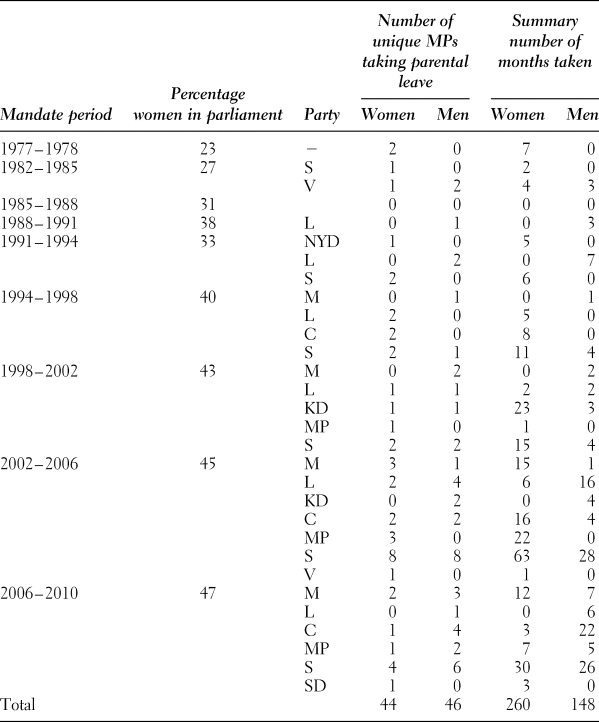
Table 1 displays the original register data collected for this analysis on parental leaves by legislators in the Swedish Parliament over time, sorted by women, men, and party affiliation. The independent variable, experience of parental leave, is coded as (1) or (0), and the minimum length of parental leave considered is one month. Hence, I assume that there is a threshold above which any additional amount of care experience does not add to the effects, and here this threshold is set to one month.
Parental leave among legislators during their time in parliament, Sweden, 1977–2010 (total sample)

Comment: Mandate period starts in September and ends in August. Abbreviations for parties are as follows: V = Left Party, S = Social Democratic Party, L = Liberal Party, C = Center Party, M = Conservative Party, KD = Christian-Conservative Party, NYD = New Democracy, SD = Sweden Democrats. The one woman in KD has taken parental leave for two children, for a total of 23 months.
First, Table 1 shows that Swedish legislators do indeed use the parental leave provision. Consequently, a general assumption that female politicians at the national level need to adopt a male lifestyle and to abstain from having children does not seem to hold. Since 1991 in particular, the number of legislators taking parental leave, as well as the length of their leaves, has steadily increased, and since 2002, the uptake has been fairly gender equal; During the mandate period 2002–2006, 19 women and 17 men took parental leave, although women took longer periods, 124 months compared to 53 months for men. During the subsequent mandate period, however, the figures were almost reversed; nine women and 16 men took parental leave, with men taking 66 months in total and women taking 55 months. Distinguishing between parties, Table 1 further shows that the first man to take parental leave was from the Left Party, followed by a man from the Liberal Party. Liberals have been the strongest advocates for a gender-neutral parental leave reform (Florin and Nilsson Reference Florin and Nilsson1999), so this is no surprise. Beginning in 1994, men from larger parties, such as Moderaterna and the Social Democrats, also started to take parental leave.
Dependent Variable: Operationalization of Parliamentarians’ Priorities
Sweden also provides extensive data over time on legislators’ attitudes, which forms the dependent variable. The benefits of this type of time-series data should be emphasized, as internationally, it is rare, if not unique. The dependent variable encompasses legislators’ subjectively expressed interest in policy issues and not their actual actions in parliament. Political actions are often considered more interesting to explore, but as the hypothesis examined focuses on changing priorities related to personal experiences and not to the workings of the parliament, this focus seems well chosen. The data were derived from The Swedish Parliamentary Surveys, directed to Swedish MPs and conducted by the Department of Political Science at the University of Gothenburg during parliamentary terms (1985, 1988, 1994, 2002, 2006, 2010, and 2014). The surveys receive a high response rate (the lowest response rate was 88%, for the year 2014). The question analyzed as the dependent variable was formulated as follows: “Which policy areas are you most interested in?” followed by an open-ended answer. The first three answers (more answers may have been provided) were categorized into 30 or 31 categories, constant over time. In the analysis, I focus on two categories, social policy and family policy, which theoretically can be expected to be associated to experiences of care when on parental leave.
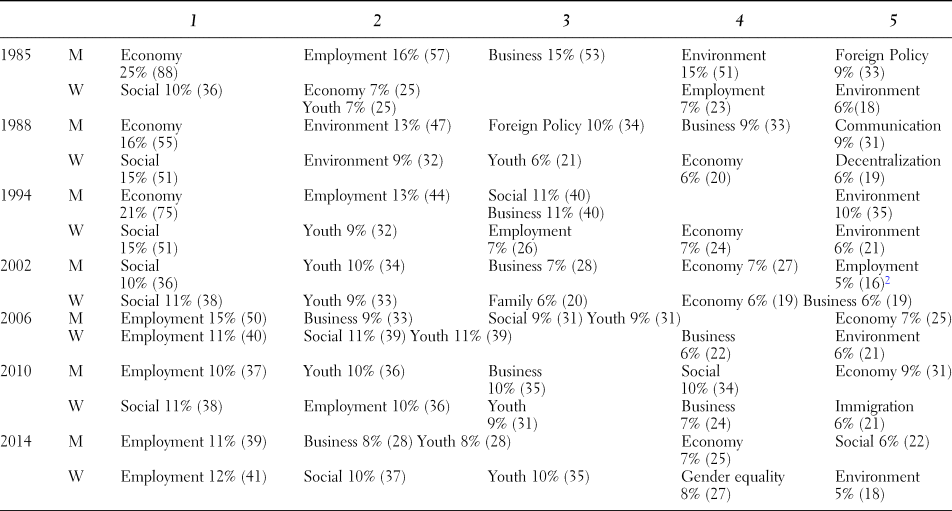
These two categories are created from keywords supplied by the MPs: (a) social policy includes the keywords social policy, social insurance, social security, social insurance administration, pensions, care, welfare state policy, and elderly care, and (b) family policy includes the keywords family policy, family issues, and child care. It cannot be assumed that the expressed interest is progressive in nature. Hypothetically, a legislator could mention social policy due to an interest in limiting social policy, for example, because it is costly, but in this case, it might be more likely that the legislator would identify “economy” as the policy area. Regarding family, the category might bring together MPs who want to strengthen family values with those who want to introduce dual-earner policies. Table 2 displays descriptively the five most prioritized policy areas among female and male legislators over time.
Legislators’ top five priorities, according to open-ended survey responses, women (W) and men (M), 1985, 1988, 1994, 2002, 2006, 2010, and 2014

Comment: The columns refer to rank order. The numbers within parentheses refer to the number of legislators mentioning a category. Total number of categories is 32 (except for 2014, when it is 31).
2 Immigration 5% (16), Law/Justice 5% (16)
Table 2 shows that social policy issues were the top priority for female legislators during four mandate periods and the second priority during the remaining two periods. The table also displays visually a clearly increasing interest in social issues among male legislators. From not being mentioned at all, social policy emerges on the list of the top five prioritized areas in 1994 and remains there throughout the period examined, peaking in 2002.
Analysis
The analysis was performed both as a logistic regression with standard errors clustered on individual level and as a multilevel analysis, which yielded results in a similar direction and with similar significance; however, to facilitate interpretation, the logistic regression results are shown in Table 3. The observational unit is MP each mandate period, so that if MPs are re-elected, they show up in the dataset multiple times. I include respondents’ parental leave during the same or any of the previous mandate periods. All MPs analyzed have been re-elected at least once. Theoretically, this operationalization further means that I assume that any change in preferences evoked by parental experiences is likely to persist. Importantly, it was not possible to acquire information about legislators’ previous parental leave experience before their terms in office. This means, however, that the test of the hypothesis becomes more rigorous, which is commonly considered to strengthen the findings.
Legislators’ interest in “social policy” and “family policy” issues, 1985–2010. Logit regression

Comment: Levels of significance: *p ≤0.05, **p = <0.01, ***p = <0.001. Standard errors are clustered on individual level. Mandate-period dummies are included for all models.
Female legislators are coded as 0 and males as 1 to facilitate interpretation of male legislators’ changes of preference. The analysis further controls for party affiliation as dummy variables; legislators’ previous individual political interest, which is a rather strong causality test; and age, as the likelihood of taking parental leave is centered on fertile ages. Even though fertility biologically has gendered patterns, these are not considered large enough to justify different modeling for women and men. Within the population as a whole, men on average become parents about three years later than women, having their first child at the age of 32 years compared to 29 years among women. From the age of 40 years, the percentage of people who become parents for the first time is small, among both men and women. The share of men who are childless decreases from 25% to 21% between the ages of 40 and 50 years, and among women it decreases from 14% to 13%. This suggests that there are no large differences in terms of becoming a parent between women and men with respect to the population. For a descriptive table of all the variables, see the appendix.
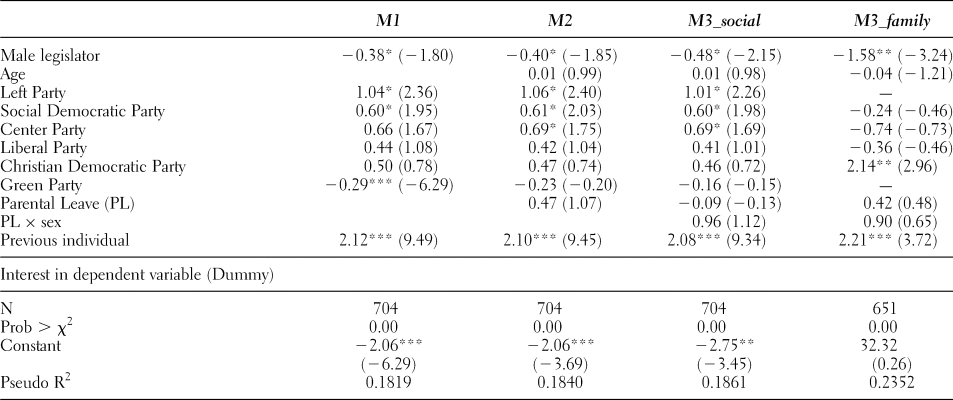
Table 3 shows, for model 1 (M1), that there is a lower probability for men to give priority to social policy than there is for women, under control for party affiliation and previous interest. Thus, there is a clear initial gender difference of women's greater interest in social policy issues, which cuts across party differences. More specifically, the analysis of party differences reveals that legislators belonging to the Left Party and the Social Democratic Party are more interested in social issues than the reference category, the Moderates, while legislators belonging to the Green Party are less interested. Model 2 (M2) includes parental leave and age. Parental leave has no significant effect, and the greater probability for women to be interested in social policy remains in this model. The interaction model M3_social indicates that the interaction term is positive, although not significant. The family interaction model M3_family depicts the interaction model for family issues and shows that men are less interested in these issues. The interaction term is insignificant; hence, there is no effect of parental leave on interest for family policy, either for women or for men. In M3_family, the possible ambivalence of the meaning of a keyword becomes noticeable. The Christian Democrats emphasize family more than other parties, and since this party is conservative in terms of values, it is likely to refer to a strengthening of family values. On the other hand, child care, the other keyword, goes in the opposite direction, emphasizing the dual-earner model.
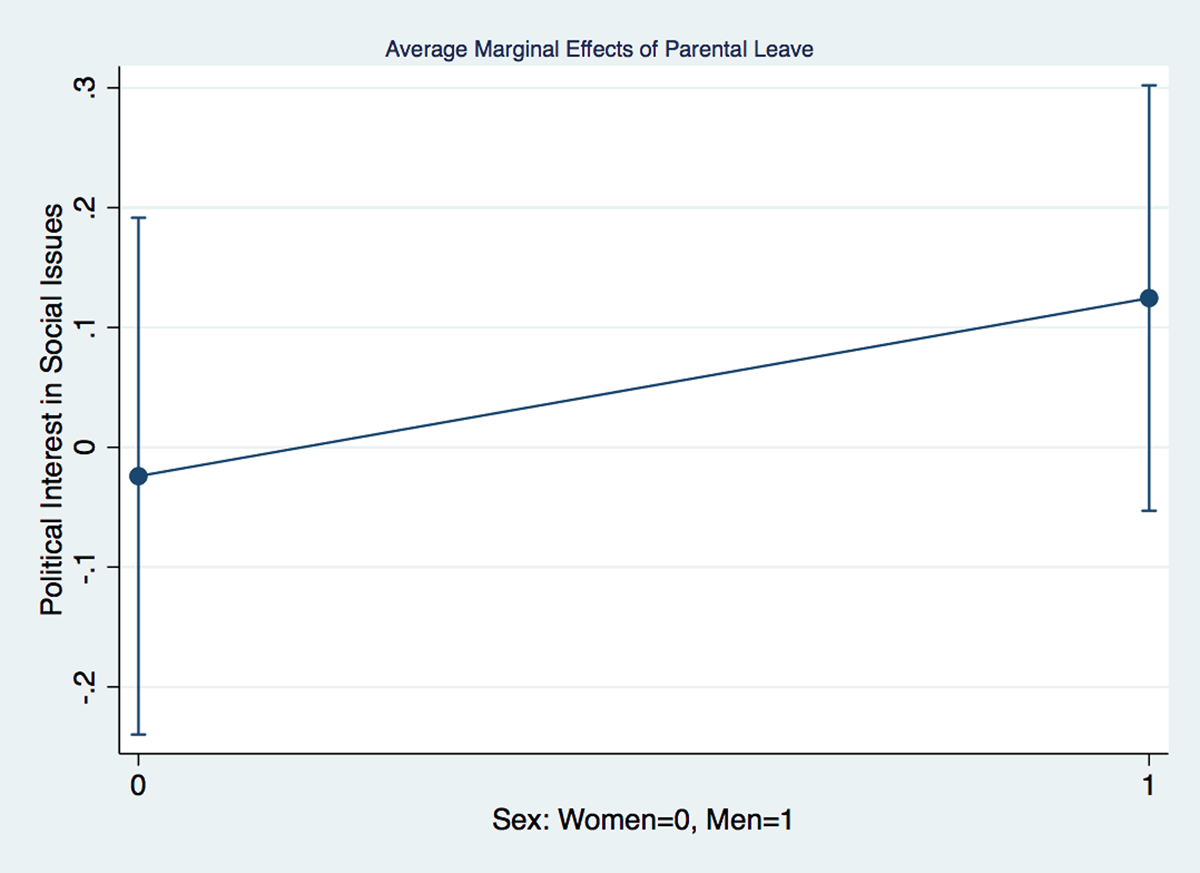
Returning to the analysis of social issues, controlling for previous interest is a rather strong causality test, and because the respondents form a total selection of the population (Swedish legislators), these findings are also descriptively interesting, regardless of significance. As female legislator is set to 0, the effect of parental leave indicates that the effect on female legislators is slightly negative, whereas the positive interaction term indicates the effect on men as a positive direction when added to the initial effect of gender. Based on M3_social, probabilities of a parliamentarian being interested in social policy issues, given sex and parental leave experience, are calculated. The likelihood of male legislators who have been on parental leave being interested in social policy issues increases from 17% to 31%. Figure 1 shows marginal effects of parental leave on interest in social issues, according to sex.
Average Marginal Effects of Parental Leave on Political Interest in Social Issues, Women and Men.

Descriptively, the point for male legislators is further away from zero than the point for female legislators in Figure 1, which is interpreted as a tendency for male legislators in the sample to be positively affected by parental leave during their terms with respect to their interest in social policy. The margin for significance is overlapping, which cautions against interpreting the results in a general way. However, because the sample is a total sample of the population of Swedish legislators, the findings deserve serious consideration.
CARE EXPERIENCE AND POLITICAL PRIORITIES
In the empirical analysis, I assessed whether male legislators who take parental leave develop political concerns in line with those previously associated with women. The original contribution of the article is the empirical analysis set up as a hard test, controlling for sex as well as MPs’ individual previous interest. Because it is based on a total sample of Swedish MPs, the findings are also descriptively interesting.
Regarding men, the tendency for male legislators who have been on parental leave during their terms in office to express a stronger interest in social policy issues is in line with the hypothesis. Hence, this tendency could be interpreted as a care experience mechanism, pertaining to both sexes and describing a situation where experience of care along the life course translates into increased political interest in social policy. With regard to family policy, however, a similar increase for both sexes is not evident, which indicates that these patterns are more complicated and that affirmation of the hypothesis needs to be qualified.
First, there are alternative explanations for male politicians’ increased interest in social policy. Sweden has experienced a change in state structure during recent decades, whereby publicly financed tasks such as elderly care have been partly outsourced to private enterprises. As men are more frequently represented as entrepreneurs than women, this might evoke a new basis for “male” social policy interest. This possibility has not been empirically examined in this article, but it could be an interesting subject for future research. Further, men's increased interest in social policy may flow over channels other than individual experience, for example, through the way fatherhood is represented in the cultural context.
However, thinking further along the diverging findings regarding social and family policy and the composition of the keywords making up the categories, social policy could be interpreted as a broader category and family policy as more narrowly constituting policies that affect the sexual division of labor, thus making it more pointedly “feminist.” Thus, the experience of care responsibility has partly similar and partly different content for women and for men. Among men, it could further a broader interest in social policy but not reach deeper into policy issues affecting gendered power relations more particularly, such as child-care policy, which is included in the category of family policy. Considering previous theory, this could further be interpreted as affirming theories of ethics of care, which emphasize the importance of bodily experience of care for fostering capacities and interests related to care. At the same time, it could be interpreted as affirming Sapiro's argument that only women can bring about transformative feminist change because of their specific position in society. Men's position in society does not change just because they become devoted fathers.
Regarding women, this analysis shows that women legislators have an enduring stronger interest in both social and family issues that is not affected by their individual experience of parental leave during their terms in office. This finding, on one hand, need not refute the hypothesis of individual care experience influencing political priorities; it could be due to women having experienced parenthood before their terms in office. In 2014, the average age among Swedish female parliamentarians was 45 years, and 77% of female MPs were mothers. Because it is very unusual that mothers do not take parental leave (within the population, 97.3% of mothers take more than 60 days of leave before the child is two years old (SSIA 2018, figures from 2013), it could be assumed that many female MPs already have experience of caring for their children before their terms in office.
Admittedly, a share of male MPs who are fathers most likely also experience parental leave before their terms; however, this does not argue against the hypothesis because a tendency is still evident.
On the other hand, the strong effect of female sex on interest in social and family policy indicates that experience of individual care responsibility is only one factor influencing women's political interests. The sexual division of labor includes various other divides, for example, in education and occupation, which might play a role here; further, sexually based exploitation, including exposure to sexual violence and sexual harassment, may not be central to social and family policy but may nevertheless contribute to the overall pattern, in which women and men find themselves in different positions. The experiences of these positions may further run also through indirect channels, for example, when women are affected by stereotypes of female behavior and preferences.
Regarding the period after parental leave, studies from numerous countries, including Sweden, show that women spend more time with children than men do. Hence, the experience of care responsibility might be “refilled” among mothers more regularly than among fathers, which might also affect the more long-term political effects of care responsibility.
With these reservations considered, the analysis has taken the first step to empirically examine how experiences that we usually connect to women's political interests may play out among men. Although not without qualifications, there could be a care experience mechanism, pertaining to both sexes and describing a situation in which the experience of care responsibility, along the life course, translates into increased political interest in social policy. The analysis further points to the fruitfulness of unpacking the content of gender regarding particular experiences connected to societal divides and using it to develop dynamic aspects of the gradual changes of structural divisions in society and their potential political consequences.
The analysis also allows for a new set of concerns in relation to representation. First, if men are now (in some contexts) coming to endorse care issues, previously seen as women's issues, should such issues then be redefined as issues of human interest? This proposal would seem to support the position of care ethics theorists who argue that care is a human concern and not particularly attached to women (Tronto Reference Tronto1994). It also picks up on the discussion within research on representation on how the connection between policy issues and actors might evolve over time, such as child-care policy having come to attract male legislators, although Bratton and Ray (Reference Bratton and Ray2002) suggest a different mechanism. Second, other experiences related to care and the sexual division of labor might also translate into political interest, such as choosing an education or occupation in the area of care or caring for elderly parents. Do these experiences also translate into political interests, regardless of sex? These are questions for future empirical research.
Finally, this analysis has focused on direct experience of care, but indirect experience may also be of importance. For example, men without children of their own might be influenced by seeing other men in the streets with their strollers, as discussed in the literature on involved fatherhood. Regarding women's political commitment, as well, individual experience is seen as one path to forming preferences, but other more general, culturally embedded paths are also discussed.
These findings contribute to research on new ways to empirically measure gender. Although the term sex theoretically has long since been replaced by gender, the practice of using bodily sex as a proxy for gender has endured, including in research on representation. The elaboration of a care experience mechanism represents an alternative path, as it operationalizes gender as a particular type of experience and measures its power under control for bodily sex. I believe that this is a way to go forward in research on representation and gender, to set up analyses that measure gender both as bodily sex and as more truly empirical categories of gender. As has been discussed, the effects of other types of experiences could be examined in similar ways. Researchers could then, using various experiences as independent variables, start to ask “which men” and “which women” advance which policy issues through which strategies. This approach might also shed light on policy areas where we, today, find considerable differences in preferences between sexes, such as those regarding immigrants and Neo-Right radicalism as well as environmental concerns and welfare state services.