I. Introduction
In speaking of a “spectrum of approaches” to allegory, the title of this essay bears a twofold meaning.Footnote 1 Its first sense concerns modern scholars and the variety of ways they have understood the European reformers of the sixteenth century to have viewed and utilized allegorical exegesis. Its second sense concerns the reformers themselves and the multiple approaches they espoused to allegory. The first sense is well documented and will not detain us long, except to note some of the major positions held, as well as some aspects of these positions, which I will question. The second sense will be this essay’s primary focus, as I will seek to offer a typology – not an allegory – of the nuanced variety of views the reformers themselves held concerning the allegorical exegesis of the Bible. Understanding this variety within its own historical context, using terms the reformers themselves would have recognized, both challenge some prevalent views regarding the reformers and allegory, and offers much needed nuance on just what it means to say that a particular reformer read the Bible in this way.
As to the title’s first sense, scholarship over the past century or so has broadly been of two minds. Older scholarship generally, though not universally, saw the reformers as stringently opposed to allegorical interpretation. Gerhard Ebeling notably advanced this thesis regarding Martin Luther (1483–1546); for many years, scholars of John Calvin (1509–1564) held to it fairly unanimously regarding their subject; and the Reformation as a whole was broadly seen as a turn to a rather exclusive literalism.Footnote 2 Some recent critics still concur – even seeing Reformational literalism as the dangerous birthplace of modern fundamentalism – though most recent studies are more tempered in this regard.Footnote 3 In contrast to this older view, much newer scholarship has been of a different mind. Historians such as John Thompson, Richard Muller, and others have pushed back against the previous consensus, arguing that the reformers in fact retained a recognizable place for the allegorical or spiritual reading of scripture.Footnote 4 Some recent literary critics, distinctly yet similarly, see the Protestant preference for literalism as actually concealing an underlying commitment to allegory, a commitment that flowered in late Reformation works such as Bunyan’s Pilgrim’s Progress or Spenser’s Faerie Queene. Footnote 5
According to this more recent vein of scholarship, the reformers are usually seen to have retained allegorical exegesis in a couple of ways. Some happily continued to promote allegorical interpretation as a legitimate method of reading scripture, though they of course aligned its outcomes with their own confessional commitments. Others are often claimed to have been halting (at best) or inconsistent (at worst) in their attitude toward allegory. Scholarship on John Calvin may here serve as a case in point. David Puckett, for instance, has characterized Calvin’s approach to allegory as an “exegetical via media.” On the one hand, when Calvin theoretically discussed allegory, he regarded it not only as foolish but as “literally diabolic.”Footnote 6 On the other hand, in his actual exegetical practice, Calvin “sometimes approves of what he clearly regards as an allegorical understanding of the text.”Footnote 7 John Thompson has likewise argued for a notable inconsistency between Calvin’s hermeneutical theory and his interpretive practice, writing that “as we turn to examine Calvin’s actual exegetical practice, we will see how his seemingly absolute dismissal of allegory was heavily modified in the field.”Footnote 8
This study, while building on the insights of these previous works, aims to both question and complicate them by drawing forth some of the main questions the reformers asked of allegory, as well as the spectrum of answers they offered, through a close reading of Reformation-era commentaries on Galatians 4:21–31. In this text – arguably the clearest New Testament example of allegory – the apostle Paul reflected on the narrative of Abraham’s two sons from the book of Genesis to make a case for the Christian’s freedom from the Mosaic law. After outlining the bare facts of the story, Paul explicitly claimed “these things are allegorical” (ἅτινά ἐστιν ἀλληγορούμενα), a phrase which has elicited much commentary ever since. Extended discussions of what Paul meant, along with explicit reflection on scripture’s multiple senses, appear, for example, in the medieval commentaries on this passage of Thomas Aquinas (1225–1274) and Nicholas of Lyra (ca. 1270–1349).Footnote 9 Similarly, this text is still one frequently invoked by modern works of retrieval and biblical hermeneutics, whether to justify allegory or to explain how what Paul was doing was not, strictly speaking, allegorical interpretation at all.Footnote 10 Surprisingly, however, no studies exist that comparatively examine a wide range of reformers on this passage.Footnote 11 To remedy this, I have examined readings of this text in all the published commentaries on Galatians of which I am aware, from the work of Reformation forerunner Jacques Lefèvre d’Étaples (ca. 1450–1536; commentary = 1512) to that of Puritan theologian William Perkins (1558–1602; commentary = 1604).Footnote 12
Such a comparative examination, while not giving anything like an exhaustive treatment of the reformers’ approaches to allegory, nevertheless does offer an illuminating window into that issue. It further vindicates some claims of existing scholarly portrayals, while questioning other aspects. The ease which most reformers felt in accepting that Paul was allegorizing Genesis, as we will see, supports claims of the continuance of allegorical exegesis among the reformers. Yet close attention to Reformation-era commentaries on Galatians 4 also raises numerous questions that have too rarely been considered. Specifically, while most scholarship has fixated on the reformers’ views regarding whether the Bible should be read allegorically, sixteenth-century commentators also debated a far more nuanced set of questions regarding the nature, status, and purposes of allegory. Understanding these debates, it seems to me, challenges many of the examples scholars have brought forth to argue that reformers like Calvin were inconsistent between their stated ideals regarding allegorical exegesis and their interpretive practice. Perhaps more importantly, however, it also offers a much richer set of considerations for what it means to speak of the reformers’ spectrum of approaches to allegory than has typically been given.
II. The Nature of Allegory
Discussions of the reformers and allegorical exegesis must keep in mind a simple fact: what constituted allegory was never an agreed-upon matter. Just as David Steinmetz has remarked that “the phrase ‘the literal sense of the text’ is not unambiguous and has meant different things at different times to different authors,” so too with the allegorical sense of scripture.Footnote 13 Before deciding whether a reformer read the Bible allegorically or not, therefore, we must first grasp what they understood the term “allegory” to mean and what they believed constituted the allegorical exegesis of the Bible. Two issues pertaining to the nature of allegory repeatedly surface in Reformation-era readings of Galatians 4 – first, how allegorical exegesis related to figures of speech, especially metaphor, and second, the question of whether allegories (allegoriae) could be distinguished from the use of types (typi).
In order to understand the first issue of how the reformers saw the relationship between allegorical interpretation and figures of speech, we must begin by zooming our camera out from the sixteenth century to a much earlier period. When it came to rhetorical matters, most of the reformers were steeped in classical precedents. For the nature of allegory and its close relation, metaphor, none was more important than Quintilian’s Institutio Oratoria. Quintilian had famously defined a metaphor as when a noun or verb was transferred from its “proper” meaning to an “improper” one.Footnote 14 We could say, for example, that a particular man is a lion. More biblically, we might say that God is a rock and a fortress. Such constituted “improper” or metaphorical usages of these terms. An allegory, then, according to Quintilian, was a continuous or perpetual metaphor, which set forth one thing by its words but another in its meaning.Footnote 15 The most influential sixteenth-century treatises on biblical interpretation simply took this classical definition for granted. The 1519 Ratio of Erasmus (ca. 1466–1536), one of the most important hermeneutical manuals of the early sixteenth century, thus followed classical precedent in defining allegory as “a perpetual metaphor,” while the popular Studiorum Ratio of Heinrich Bullinger (1504–1575) concurred, pointing readers to Quintilian and to Erasmus’s Copia for fuller treatments of metaphorical speech.Footnote 16
Sixteenth-century commentators on Galatians 4:21–31 likewise uniformly showcase agreement with these classical definitions. In commenting on Paul’s phrase “these things are allegorical,” for example, Swiss reformer Caspar Megander (1495–1545) repeated Quintilian’s definition of an allegory as a “perpetual metaphor.”Footnote 17 Bullinger, in his Galatians commentary, argued similarly, citing Quintilian, Jerome, Augustine, and Pseudo-Plutarch as all concurring on essentially that same understanding.Footnote 18 The reformers here also had patristic precedent, especially in a famous remark made by John Chrysostom, which was conveyed to many through its inclusion in Erasmus’s Annotations. Footnote 19 Commenting on Paul’s reading of Genesis, Chrysostom agreed that an allegory was a continuous metaphor. He used this definition, however, to make the intriguing suggestion that the apostle here actually used the word “allegory” improperly, since he thought what Paul was doing was closer to a typological reading. For now, it suffices to note that Chrysostom too understood allegory as perpetual metaphor, though we will later have the opportunity to return to his tantalizing comment that Paul might not have been engaging in allegorical exegesis after all.
A classical definition of allegory was therefore widely agreed upon in the sixteenth century. This, however, raised a more contentious question of whether perpetual metaphors, which we might, for the sake of precision, call literary allegories, were something different than allegorical interpretations or the classic sensus allegoricus. Literary allegories, to use this distinction, concerned the various figures of speech at play in a text, while allegorical exegesis dealt with a distinguishable issue, that of the text’s interpretation. An interpreter could see a text as literarily “allegorical” in the sense of it being a perpetual metaphor, without thereby interpreting it in what is usually thought of as an allegorical manner, wherein various details of the text are equated with a set of extra-textual referents.Footnote 20
Such a distinction was by no means unknown to patristic and medieval authors, who had debated it with varying degrees of clarity. By the late fifteenth and early sixteenth centuries, however, confusion often reigned here as various authors conflated literary allegories and allegorical exegesis.Footnote 21 Theologians of the late medieval era similarly often blurred the lines between the literal and spiritual senses, and Jacques Lefèvre’s 1512 comments on Galatians 4:24 demonstrate each of these muddy distinctions.
An allegory, as Jerome says, is that which sets forth one thing in words but signifies another thing in meaning. Things which are given in a type and figure are allegorical. Things not given in a figure are not allegorical, and do not require another sense besides that which is expressed and which the author intended—who is mainly the Holy Spirit. Things of this sort are called the literal sense, because they are without type and figure. But the same things are also spiritual. For how could something whose author is the Spirit not be the spiritual sense?Footnote 22
Lefèvre here claimed that the literal sense, by nature, did not include types and figures. Such figures of speech (what I am calling “literary allegories”), in other words, necessitated allegorical interpretation. At the same time, he essentially conflated the literal and spiritual senses of scripture by insisting that the literal sense was itself spiritual in nature. Erasmus likewise frequently conflated metaphorical speech with the sensus allegoricus, seeing the former as inherently part of the latter.Footnote 23
Other interpreters, however, maintained a distinction here, especially as the sixteenth century wore on. For example, William Perkins’ comments on Galatians 4, written nearly nine decades after Lefèvre’s, offer a clear example of distinguishing literary allegories from the allegorical sense, though similar instincts are also found in earlier readers, including Luther and Calvin. Perkins utilized classical categories to distinguish between when scripture spoke in “proper tearmes” and when it utilized “figures and allegories,” here meaning figures of speech and perpetual metaphors. For the latter, he offered Psalm 45:4 as an example: “Ride on upon the word of truth, meekness, and justice.” There, the Psalmist described a prince’s chariot “by allegorie,” that is, with a continuous metaphor wherein “the Guide is the word, the horses that draw it are three, Truth, meekness, iustice.” The literal sense, in this understanding, was “sometimes expressed in proper, and sometimes in borrowed [that is, improper] or figurative speaches.”Footnote 24 Importantly, however, and in direct opposition to Lefèvre and Erasmus, Perkins saw metaphorical speeches and their borrowed or “improper” meanings as themselves part of the sensus litteralis. Footnote 25 Interpreters like Perkins who distinguished literary allegories from allegorical interpretation could therefore say that a biblical passage spoke “allegorically” without thereby implying the validity of allegorical exegesis. In this regard, Martin Luther, noting Paul’s quotation of Isaiah 54:1 in Galatians 4:27, remarked that this passage of the prophet was “completely allegorical” (totus est allegoricus).Footnote 26 This remark has nothing to do with the allegorical sense of scripture, but is simply another way of him saying that Isaiah 54:1 is an extended metaphor.Footnote 27
This distinction between literary allegories and allegorical exegesis has often been missed in contemporary scholarship, leading to many mistaken claims regarding the reformers’ exegesis. We have already noted that Calvin, for example, is frequently argued to have quietly embraced allegorical exegesis in his practice, despite the fact that in his comments on Galatians 4 he makes clear that he regards non-literal interpretations as not only “dubious” but also as “deadly seductions.”Footnote 28 Grasping the distinction between allegory as a figure of speech (an extended metaphor) and allegorical exegesis, however, clarifies many of Calvin’s instances of allegedly allegorical interpretation.Footnote 29 To leave Galatians briefly in order to illustrate this phenomenon, we may note Calvin’s reading of Isaiah 30:25, a reading which has often been cited to prove his embrace of allegorical exegesis.Footnote 30 Regarding this verse (“And there shall be upon every high mountain, and upon every high hill, rivers and streams of waters in the day of the great slaughter, when the towers fall”), Calvin states,
When the prophets describe the kingdom of Christ, they commonly draw metaphors (similitudines) from the ordinary life of men … [This verse] amounts therefore to this, that they who obey God, and submit to Christ as their king, shall be blessed. Now, we must not judge of this happiness from abundance and plenty of outward blessings, of which believers often endure scarcity, and yet do not on that account cease to be blessed. But those expressions are allegorical (sed allegoricae sunt istae loquutiones), and are accommodated by the Prophet to our ignorance, that we may know, by means of those things which are perceived by our senses, those blessings which have so great and surpassing excellence that our minds cannot comprehend them.Footnote 31
When Calvin here says that Isaiah’s expressions here are allegoricae, he is not inconsistently endorsing the sensus allegoricus. Rather, he is merely restating in different words what he earlier said about the words being similitudines (a shortened form of metaphors).Footnote 32 His comments here, in fact, say nothing pertaining to allegorical exegesis.Footnote 33 Rather, as a good rhetorician, Calvin is simply recognizing the figures of speech which Isaiah employs, figures of speech which are themselves seen by him as being part of the sensus litteralis. Footnote 34
Contemporary confusion over this stems in part from the limited terminological apparatus that scholarship often uses to describe the exegesis of the reformers. Modern scholars have at times been content to describe the reformers’ interpretations as either “literal” or “allegorical,” whereas early modern commentators had a richer and more nuanced set of interpretive vocabulary. Puckett, for instance, speaks of Calvin’s interpretation of Old Testament prophecies in the following way: “Old Testament texts that, if taken literally, promise a time of great earthly blessing for God’s people, are usually given a spiritual (or allegorical) interpretation by Calvin.”Footnote 35 Puckett takes Calvin’s reading of the restoration of Jerusalem’s walls in Jeremiah 31:38–40 as his example. It would be more precise, however, to say that such Old Testament passages, if taken strictly or properly (that is, nonmetaphorically), promise great earthly blessing.Footnote 36 That Calvin views the text’s words as metaphorical (that is, a literary allegory) does not, for him, mean that he is practicing allegorical interpretation, as perpetual metaphors for Calvin can be part of the literal sense of the text.Footnote 37
The reformers thus continued a medieval legacy in debating the relationship between literary allegories and allegorical exegesis. This debate is central to the period and must be kept in mind in discussions of the reformers and allegory. A second debate concerning the nature of allegory is not as prominent in their commentaries but nevertheless pops up from time to time, namely the question of whether allegories could be separated from types, and whether “typical” readings of scripture were distinct from allegorical interpretation.Footnote 38 Here, the reformers’ views are most often implicit in their exegesis, with the strong numerical majority of commentators on Galatians 4:21–31 taking it for granted that types are an interpretive tool utilized in allegories. Others, however, attempted to distinguish between types and allegories, and Calvin, it seems, led the way here.
Most interpreters from the period use typus as a subset of what happens within an allegoria, thereby seeing the two phenomena as inseparably linked. Jacques Lefèvre used the terms in this manner, while Heinrich Bullinger similarly spelled out a series of different types that Paul made use of in his allegoria. Footnote 39 The Lutheran theologian Erasmus Sarcerius (1501–1559) likewise insisted that Paul was allegorizing Genesis by using various types, including Abraham, Hagar, Ishmael, and Sarah.Footnote 40 Others who took this approach, as seen in their interchangeable uses of the terms “type” and “allegory,” include Sebastian Meyer (1465–1545),Footnote 41 Johannes Brenz (1499–1570),Footnote 42 Wolfgang Musculus,Footnote 43 Niels Hemmingsen (1513–1600),Footnote 44 Rudolph Gwalther (1519–1586),Footnote 45 and Benedictus Aretius (1505–1574).Footnote 46
A smaller subset of interpreters objected. John Chrysostom, it will be recalled, had argued that Paul read Genesis typologically rather than allegorically, thereby drawing a distinction between these two kinds of exegesis. John Calvin followed his favorite Church Father here, and in the process became the first sixteenth-century commentator on Galatians 4 to argue both that Paul was not allegorizing Genesis and that types were clearly distinct from allegories. Calvin attacked those who saw the literal sense as “too meager and poor,” a mere “shell of the letter,” which concealed deeper mysteries. Paul, he claimed, was sticking to the “natural” (germanus) and “simple” (simplex) sense of scripture, a literal sense that included the many “types” the apostle drew from Abraham’s family.Footnote 47 The use of types, for Calvin, was not equivalent to allegorizing, and Paul stuck squarely to scripture’s literal sense. Calvin’s successor, Theodore Beza (1519–1605), offered a similar, though more cautious approach, citing Chrysostom (via Erasmus) to argue that Paul was narrating a true historical account, not a fictitious allegorical discourse. He further attempted to distinguish a “sacramental signification” from a purely typical one. In the former, faith received what God offered, while in the latter, future matters were foreshadowed.Footnote 48 Beza, nevertheless, several times called Paul’s argument an allegoria – something not conceded by Calvin – even though he then went to lengths to carefully circumscribe just what that meant.Footnote 49
Other later interpreters, perhaps influenced by Calvin, did not explicitly insist that Paul was not reading Genesis allegorically, but did raise this possibility by rather impressively managing to comment on all of Galatians 4:21–31 without ever using the term “allegory.” While it is hard to be certain if their reticence to mention allegory was a theologically driven decision, the term “allegory” is entirely absent from the comments of Caspar OlevianusFootnote 50 (1536–1587) and English reformer John PrimeFootnote 51 (1549/50–1596), and is mentioned only once by Johannes Piscator (1546–1625), who then immediately clarified that Paul was in fact interpreting “analogically.”Footnote 52 Considering, however, that Prime’s exposition of these brief verses rambled to a solid fifty pages in length, his complete omission of the term “allegory” is a noteworthy feat. Instead of speaking of allegories, these interpreters usually preferred the terms typus and figura, each seen by them as part of the literal sense of Genesis.
Calvin’s truest disciple in explaining Paul’s words, however, was William Perkins. Perkins, like the Genevan reformer, made abundantly clear that Paul was not allegorizing. The apostle rather saw Old Testament persons, such as Hagar and Sarah, as types or figures of future realities.Footnote 53 If one insisted that this was allegorical, such was simply to misunderstand the nature of the literal sense. The account of Abraham’s family related not only “bare historie” but also signified further realities, and these constituted “not two senses, but two parts of one full & intire sense … the full sense of the h.G. [Holy Ghost].”Footnote 54 For Perkins, not only the sign, but also the thing signified were contained in the literal sense, and to split these apart was to make scripture into a plain history devoid of edifying value.Footnote 55
Most interpreters in the sixteenth century, therefore, used types and allegories as closely linked terms, while a small subset of theologians, led by Calvin, differed. One final commentator deserves to be mentioned on this issue, however, both for offering the fullest reflection on the relationship between types and allegories, and for showcasing the at-times tenuous nature of this distinction. The Flemish professor at Marburg, Andreas Hyperius (1511–1564), began his comments on Paul’s exposition by using “type” and “allegory” interchangeably several times.Footnote 56 A reader of his commentary could therefore be forgiven for assuming that he saw no distinction between these terms. When he came to Galatians 4:24, however, Hyperius offered a fascinatingly equivocating statement on types and allegory.
Which things are said through allegory. That is, as Chrysostom rightly annotated, through a type. For there is a distinction between a type and an allegory. Allegories are spread more widely and are in fact adapted to many more things, persons, times, and so on, than are types, which, taken as they are chiefly from the Old Testament and situated always in the histories, must be applied to specific matters that either have transpired or must transpire in the church. And types, meanwhile, are more frequently and safely employed than allegories. In every allegory something is set forth to be considered which the words mean, and a different matter is sketched out by a certain comparison. Thus the apostle himself here immediately explains what should be understood through the two sons of Abraham, one of whom was cast out, and the other established as heir. Hence when he here says that he narrates the history about the two sons “through allegory,” he commands each person to hunt for and seek out something higher that is signified through the history. And because it might be difficult for someone to discern what is fitting to be understood through the matter here described, it therefore does not belong to just anyone to explicate things through allegory, but only to the most skillful practitioners.Footnote 57
Hyperius began by distinguishing between a type and an allegory, following Chrysostom in claiming that Paul was interpreting through a type. Yet, by the time his explanation is complete, he has already gone back on his own words, now claiming that Paul in this passage is a textbook example of a skillful practitioner of allegory. Hyperius attempted to distance types from allegories, while simultaneously being inexorably drawn back to the conclusion that Paul was, in fact, allegorizing the text of Genesis.
Sixteenth-century readers of Paul in these ways sparred over the nature of allegory. They split into at least two camps over what constituted an allegorical reading and likewise offered contrasting opinions on whether types could be distinguished from the sensus allegoricus. The task of historians is not to adjudicate which interpreters offered correct definitions of allegory or to decide whether types can in fact be distinguished from allegories. It is rather to recognize clearly the nature of these sixteenth-century differences and to not interpret the reformers according to our later categories of what does or does not constitute allegorical exegesis. While the disagreements just explored occurred over the nature of allegory, similar sets of distinctions appear regarding the status and purposes of allegorical interpretation.
III. The Status and Purposes of Allegory
Few among the sixteenth-century reformers argued that Paul was doing something other than allegorizing Genesis in Galatians 4:21–31. While we have seen that some such as Calvin and Perkins denied this, theirs was a decidedly minority opinion. The strong majority of reformers accepted that Paul was allegorizing; they differed, however, over whether allegory constituted a legitimate sensus of scripture, or whether allegory’s proper function lay elsewhere.
The traditional medieval view, summarized in the quadriga, had of course seen allegory as the second of scripture’s four senses. Whereas the literal sense dealt with the events of scripture, while tropologies dealt with morals and anagogies with eschatological hopes, allegories were usually understood to conceal hidden, higher meanings that concerned spiritual truths or doctrines. It was the duty of the spiritually adept interpreter, then, to search out such allegorical meanings, thereby moving from the passage’s supposedly literal husk to its (allegorical) kernel. Some of the earliest sixteenth-century commentators on Galatians saw Paul as engaging in precisely this interpretive duty. Lefèvre viewed Paul as expounding the allegorical sense of scripture, and Erasmus concurred that the apostle was searching out “deeper and more sublime” meanings “through allegory.”Footnote 58 This “medieval” view, which saw the sensus allegoricus as containing divinely intended meaning, did not die out during the Reformation but carried on as a minority opinion among the reformers.
Konrad Pellikan (1478–1556), for example, cribbed most of his comments on Galatians 4:21–31 directly from Erasmus’s Annotations, yet he added only a single clause of his own: “This is the allegorical or mystical sense, useful for instructing the soul.”Footnote 59 Scripture, according to Pellikan, spoke with two legitimate senses, not just one. The early Reformed theologian Sebastian Meyer likewise viewed Paul as utilizing the “allegorical sense,” though he was quick to caution that allegories should only be utilized sparingly and in suitable ways.Footnote 60 Several decades later, Rudolph Gwalther agonized (as did many) over Paul’s rather confusing claim that Mount Sinai “corresponded” to the far distant Jerusalem (Galatians 4:25). This could not literally be true, Gwalther believed, and therefore was said by Paul “with respect to the typical or mystical sense.”Footnote 61 This subset of reformers saw scripture as speaking with multiple legitimate senses, one of which was the traditional sensus allegoricus.
Others who saw Paul as allegorizing did not here comment directly on whether allegory was a legitimate sense of scripture, but nevertheless made clear that allegorizing was licit, provided certain conditions were met. Erasmus Sarcerius provided perhaps the most careful exposition of such conditions, writing,
There are some who rashly condemn all allegories in scripture. Yet they err, for by Paul’s very example it is acceptable to allegorize, provided it’s done in a godly manner. Nevertheless, we do not deny that it is dangerous to allegorize, as seen in Origen. The true and godly manner of allegorizing is to allegorize from the Word, to establish allegories from the Word and from scripture, and by them to support faith, free righteousness, the gospel, and other commonplaces of scripture. The false and wicked manner of allegorizing is to allegorize without the Word of God, without scripture, against faith, against free righteousness; to follow private speculations and thoughts. A carefully arranged allegory is a manner of interpreting scripture. Yet an interpretation of scripture ought to agree with the analogy of faith (Romans 12), and therefore an allegory should agree with the analogy of faith.Footnote 62
Allegory, according to Sarcerius, must support a Protestant understanding of scripture’s central subject matter – justification by faith and free righteousness. Apart from this, allegory could become doctrinally and exegetically hazardous. Interpreters who viewed allegory’s legitimacy in a number of different ways nevertheless concurred with Sarcerius that, even when allegory was used, it must be engaged with caution. Luther called Paul a “very fine craftsman” of allegories but insisted that not everyone had the skill to properly allegorize.Footnote 63 His sentiment was closely echoed several decades later by Andreas Hyperius, who argued that only “the most skillful craftsmen” should engage in allegorical exegesis.Footnote 64
While a subset of interpreters therefore viewed allegory as a legitimate second sense of scripture, many more objected. Martin Luther here stands as a fountainhead who set a trajectory for later interpreters, especially those of a Lutheran persuasion. Already in his early 1519 commentary on Galatians, Luther understood Paul to be allegorizing, yet nevertheless called allegory a “game.” Some reformers, such as Calvin and Perkins, used this language of allegory as a “game” to deny allegory any legitimacy. Calvin in particular frequently returned to this epithet, teaching that allegorical readings were tantamount to the interpreter speculatively toying with the text, thereby depriving the reader of certainty and the biblical text of authority.Footnote 65 Luther, however, used the term “game” somewhat less negatively. The game of allegory, for the Wittenberg reformer, served one central purpose: “These interpretations add extra ornamentation (accessoria oramenta), so to speak, to the main and legitimate sense, so that a topic may be more richly adorned (ornetur) by them.”Footnote 66 Allegory could not make arguments – such belonged only to the literal sense – rather, allegory’s central purpose was to adorn or illustrate arguments already established through literal exegesis. This understanding of allegory as adornment became the mainstay Lutheran approach to understanding Paul’s words in our passage and offered an attractive approach to allegory for Protestants of many stripes.Footnote 67
Luther’s disciple Johannes Brenz followed his mentor here, noting that before Galatians 4:21–31, Paul had already “sufficiently proven and confirmed” his argument. Here, in an “epilogue,” he simply adorned and illustrated it, thereby allowing it to stick more vividly in the memories of his hearers and readers.Footnote 68 Victorinus Strigel (1524–1569), the Lutheran professor at Jena, agreed, writing that Paul was “illustrating with certain pictures” (picturis quibusdam … illustrat), while Niels Hemmingsen said that Paul here taught and adorned “with a typical similitude the same manner which he previously taught with many reasons.”Footnote 69 While viewing allegory’s proper purpose as adornment was a mainstay of Lutheran exegesis in the second half of the sixteenth century, Reformed figures at times fell into this camp as well. Rudolph Gwalther, for example, similarly viewed Paul as illustrating his argument in this section of Galatians, and the early Zürich theologian Caspar Megander argued that Paul here was practicing “amplification” of his argument, no longer providing rhetorical proofs but instead conjectural ones.Footnote 70
Most reformers, then, viewed allegorical exegesis as in some sense licit, with Calvin and Perkins proving to be the rather hard-nosed exceptions. How allegory should function, however, was a matter of more disagreement. The patristic and medieval tradition of seeing allegory as a legitimate second sensus of scripture lived on among various Protestant reformers, though in readings of Galatians 4, it was a decidedly minority opinion. In contrast, Luther’s claim that allegory simply illustrated or adorned arguments made elsewhere from the literal sense became the predominant approach to Paul’s allegorizing among Lutheran theologians, and this understanding at times crossed confessional lines into the Reformed camp as well.
IV. Reading Paul’s Allegory
We have thus far seen a variety of opinions the reformers held concerning the relationship between literary allegories and allegorical interpretation, their spectrum of approaches to the relationship between types and allegories, and their differences over whether allegory was a legitimate sense of scripture or only a tool to be used for illustrating meanings discerned from the literal sense. What remains is simply to spell out in a bit more detail their actual readings of Galatians 4:21–31. Noting the basic outlines of these readings, with a focus on what most reformers agreed upon, will highlight their concrete reading strategies, as well as showcase how they came to terms with their at times uncomfortable relationship with Paul’s “allegorical” exposition.
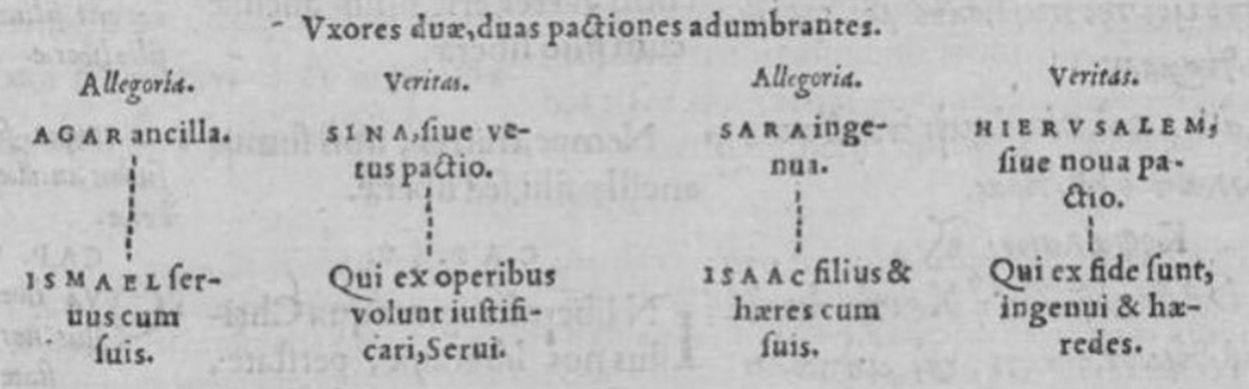
The most common approach to Paul’s exegesis of the Genesis narrative about Sarah and Hagar was to see the apostle as offering an elaborate series of comparisons, some explicitly mentioned, others not. Not every interpreter agreed on just what these comparisons were, but nearly all concurred that drawing such comparisons was at the heart of Paul’s reading of the Genesis account. For the early Luther, Hagar figured the Old Testament, Sarah the New, and Moses figured the law.Footnote 71 Others offered similar sets of correspondences, for example, seeing Abraham as a type of God, Sarah as a type of the church or of the heavenly Jerusalem, Ishmael as a type of people bent on works righteousness, and Isaac as a type of those who freely received justification by faith.Footnote 72 At times, these sets of comparisons became rather extensive, leading several Reformed interpreters, in the interests of clarity, to go so far as to include charts in their commentaries that outlined Paul’s proposed correspondences (see Figures 1 and 2).Footnote 73
Theodore Beza, Iesu Christi D.N. Nouum testamentum, sive Nouum foedus. ‥ eiusdem Th. Bezae Annotationes, quas itidem hac secunda editione recognovit, & accessione non parva locupletavit, 2 vols. (Geneva: Henricus Stephanus, 1565), 2:369.

Johannes Piscator, Analysis logica sex epistolarum Pauli (Herborn, 1589), 52.

Notably, Paul himself did not explicitly draw out most of these comparisons, being content to leave the inner logic of his allegory unexplained. What this cross-confessional penchant for such comparisons tells us, however, is how central such correspondences were seen to be for understanding the nature of allegorical interpretation. Allegories involved not merely the words of scripture carrying a different, higher sense, but also sets of correspondences based on shared resemblances or likenesses between Old Testament shadows and New Testament realities.
A further detail of the reformers’ expositions deserves noting, and it concerns the way in which many attempted to ground Paul’s allegory in various textual details, thereby presumably making the apostle’s reading of Genesis more solid and less fanciful. Allegory, according to commonly received opinion, was supposed to have some basis in the literal sense, though the nature of this basis had never been particularly well defined. A number of reformers from across the confessional spectrum, therefore, eagerly sought a literal basis for Paul’s allegory in the words and litterae of scripture. The most commonly employed tactic for grounding Paul’s allegory came from a curious claim that in the Arabic language, Mount Sinai was known as Hagar. Erasmus took this suggestion from the “scholia of the Greeks” and from the eleventh-century Greek commentator Theophylact, including it in his annotation on Galatians 4:24. He thereby transmitted the suggestion to virtually all later sixteenth-century commentators.Footnote 74 This linguistic detail, odd though it was, went a long way in explaining the logic behind Paul’s otherwise enigmatic statement, “Hagar is Mount Sinai” (Galatians 4:25). How Hagar could be a mountain was, at first glance, a rather difficult claim to explain. If, however, Paul was here subtly engaging in a rather learned wordplay, that made his rather allegorical statement much more textually reliable.
Martin Luther endorsed this understanding of Arabic in both of his Galatians commentaries, and the argument went on to have huge popularity, with Bugenhagen, Megander, Sarcerius, Brenz, Meyer, Aretius, and even the Roman Catholic cardinal Cajetan (1469–1534) favorably including this detail as well.Footnote 75 While many simply reported the linguistic argument, some explicitly used it to shore up the legitimacy of Paul’s allegory. Luther, for example, mentioned the Hagar/Sinai wordplay only in passing in his 1519 Galatians commentary, but by 1535, he had expanded on its usefulness. “I imagine,” he argued, “that this similarity of names gave Paul the idea and opportunity to pursue this allegory.”Footnote 76 Johannes Brenz later made a similar argument: “Since, therefore, Mount Sinai, on which the Decalogue was given, can be called by another name, Hagar, and since Ishmael was born from Hagar, Ishmael therefore rightly bears a type of those people who seek their righteousness in the law which was given on Mount Hagar.”Footnote 77
The correspondences Paul drew in his allegory were not applied arbitrarily, but rather “rightly,” as a detail of Arabic language and culture made clear. Mount Sinai was, in fact, Mount Hagar, and therefore Hagar and the mountain bore a divinely intended correspondence. While this argument may appear curious to modern ears, it was a mainstay of sixteenth-century attempts to ground Paul’s allegory in a literal detail. Notably, no commentator that I have seen in the sixteenth century denied the legitimacy of this supposed wordplay. Rather, all either supported it or, if they were uncertain of its veracity, simply omitted mention of it altogether.
A second attempt to place Paul’s allegory on more solid ground came via his quotation of Isaiah 54:1 in Galatians 4:27. The typically Pauline introductory formula, “For it is written,” itself seemed to suggest that Paul was using Isaiah to support his reading of Genesis, and some reformers were hungry to see in this quotation a prior biblical basis for Paul’s allegory. The 1535 Luther was somewhat tentative here, seeing the Isaiah quotation “as a kind of interpretation of the allegory,” though not a proof of its validity.Footnote 78 Hemmingsen likewise called it a “confirmation” (confirmatio) of Paul’s argument, though he too did not rest much weight upon this. Later Reformed interpreters, however, drew more comfort from Paul’s quotation of the Old Testament prophet. Theodore Beza rather confidently declared, “I have no doubt that the apostle borrowed his entire allegory from this passage in Isaiah.”Footnote 79 Paul was not baselessly crafting subtle interpretations, but rather simply followed along with the grain of earlier scriptures. Rudolph Gwalther likewise saw Paul as firmly relying on the testimony of prior scripture in crafting his allegory, something which ought to put to rest any suspicions that the apostle “too freely invented an allegory from his own imagination.”Footnote 80 Paul’s allegory, for the reformers of the sixteenth century, rested on a series of resemblance-based correspondences, and was textually grounded in various details of the Old and New Testaments. It was certainly a creative reading of the Genesis narrative, but according to the reformers, it was far from fanciful.
V. Conclusion
In surveying sixteenth-century commentaries on Galatians 4:21–31, I have sought to demonstrate how the reformers not only debated whether the Bible should be read allegorically but were also concerned with what counted as allegorical exegesis, with the relationship between types and allegories, with allegory’s proper function, and with questions of how to ground allegories of whatever sort in the literal sense of the text. When discussing these issues, the reformers used a rich, semi-technical vocabulary of terms and concepts that were rarely interchangeable and whose nuances have too often been neglected. Depending on the reformer in question, “types” may or may not have been the same as “figures,” and either could be different from “allegories”; the mention of an allegoria could be a statement about literary figures of speech or about the spiritual sense of the text; and allegories could be variously seen as a legitimate second sense of scripture, as illegitimate fabrications, or as embellishments suited only for colorful illustration.
The vast majority of Protestant interpreters believed that in Galatians 4 the apostle Paul was, in one way or another, allegorizing the text of Genesis. This did not trouble them. They differed, however, over how and to what end the apostle did this. A minority of commentators, comprised mainly of Swiss reformers, saw Paul as utilizing the sensus allegoricus, a legitimate second sense of scripture, which carried divinely intended meaning. Martin Luther, in contrast, led a more popular tradition, which viewed Paul’s allegorizing as licit, but only because the apostle was illustrating arguments he had already made elsewhere from scripture’s literal sense. John Calvin led yet a third small but vocal group of interpreters who denied that Paul was practicing allegory of any sort. In order to accomplish this, Calvin drew a sharp line between types and allegories, and in this he was followed to varying degrees by William Perkins, John Prime, Andreas Hyperius, and others.
This variety of views on the nature, status, and purposes of allegory complicates any straightforward statements that various reformers either did or did not read the Bible allegorically. The reality was never that simple. Protestant literalisms at times opposed allegorical exegesis, but at times embraced it, provided it was used for the right purposes. Protestant authors could, with consistency, deplore allegorical exegesis of the biblical text, yet simultaneously craft allegories as adornment or engage in the production of allegorically inflected works of literary genius.
Understanding some of the complexities that went into determining what counted as allegorical interpretation also goes a long way toward explaining how reformers like Calvin could reject allegory in theory but then, in practice, endorse what many scholars have struggled to see as anything other than allegorical readings of scripture. As I have sought to argue, in many such instances of Calvin’s alleged allegorizing, scholars have either inadequately understood the rhetorical nuances of Clavin’s interpretive toolkit (such as the distinction between allegory as a figure of speech and allegorical exegesis), or run the risk of viewing him through modern definitions of allegory (for example, by rejecting his distinction between types and allegories as illegitimate). While such arguments can be made, we must make it clearer that if we argue such conclusions, we have left the realm of historical analysis and moved squarely into a normative theological evaluation.
The sixteenth century was long seen as a rather literal age. More recently, we have come to appreciate the degree to which the allegorical exegesis of scripture lived on, even among the Protestant reformers. What it meant to read the Bible allegorically, however, was never a straightforward issue. The reformers, for this reason, cannot be straightforwardly labeled as either wholesale champions or complete opponents of allegorical interpretation. Rather, it is only by understanding the nuanced early modern debates over the nature, status, and purposes of allegory that we will be able to properly speak of the reformers’ spectrum of approaches to the allegorical interpretation of scripture.