Introduction
Attention deficit hyperactivity disorder (ADHD), a highly prevalent (∼5%) and strongly heritable (70–75%) neurodevelopmental disorder, is often accompanied by weaknesses in executive functions (EFs) (Willcutt et al. Reference Willcutt, Doyle, Nigg, Faraone and Pennington2005). These functions are defined as neurocognitive processes that maintain an appropriate problem-solving set to attain a future goal (Welsh & Pennington, Reference Welsh and Pennington1988) and mainly encompass inhibitory control, working memory, shifting and planning (Best et al. Reference Best, Miller and Jones2009). Meta-analyses indicate that working memory (weighted effect sizes 0.47–0.85) and inhibition (weighted effect sizes 0.58–0.61) are strongly associated with ADHD (Lijffijt et al. Reference Lijffijt, Kenemans, Verbaten and van Engeland2005; Martinussen et al. Reference Martinussen, Hayden, Hogg-Johnson and Tannock2005; Willcutt et al. Reference Willcutt, Doyle, Nigg, Faraone and Pennington2005; Kasper et al. Reference Kasper, Alderson and Hudec2012). However, the causal role of EF deficits in ADHD is unclear, given that only about a third of patients suffer from such deficits (Nigg et al. Reference Nigg, Willcutt, Doyle and Sonuga-Barke2005; Willcutt et al. Reference Willcutt, Doyle, Nigg, Faraone and Pennington2005; Fair et al. Reference Fair, Bathula, Nikolas and Nigg2012) and that about half of healthy control children have one or more EF impairments (Nigg et al. Reference Nigg, Willcutt, Doyle and Sonuga-Barke2005). This suggests that EF deficits are neither necessary nor solely responsible for ADHD in all patients (Willcutt et al. Reference Willcutt, Doyle, Nigg, Faraone and Pennington2005), although they may have a causative role in a subset of patients.
Some key aspects in the relationship between ADHD and EF are still underexplored, including whether EF deficits and ADHD co-segregate from parent to offspring. To our knowledge, only one study addressed this question. In their study of patterns of inheritance of both ADHD and inhibitory control, Goos et al. (Reference Goos, Crosbie, Payne and Schachar2009) found that paternal inhibitory control was related to offspring inhibitory control independently of ADHD symptom severity. Similarly, we did not find EF in children to influence the association between parent and offspring ADHD symptoms (Thissen et al. Reference Thissen, Rommelse, Altink, Oosterlaan and Buitelaar2012), which suggests that EF may not be part of the causal pathway from genes to ADHD symptoms. Other studies have reported EF to be modestly associated in parents and offspring (Nigg et al. Reference Nigg, Blaskey, Stawicki and Sachek2004; Jester et al. Reference Jester, Nigg, Puttler, Long, Fitzgerald and Zucker2009) or ADHD (Nigg et al. Reference Nigg, Blaskey, Stawicki and Sachek2004; Seidman et al. Reference Seidman, Biederman, Monuteaux, Valera, Doyle and Faraone2005; van Steijn et al. Reference van Steijn, Richards, Oerlemans, de Ruiter, van Aken, Franke, Buitelaar and Rommelse2012) but these studies did not investigate whether ADHD and EF deficits are transmitted together between generations, which would indicate an aetiological link between the two. Despite familial associations being modest, the inclusion of EF endophenotypes can facilitate unravelling the aetiological nature of parent–offspring relationships, which can lead to identification of more homogeneous aetiological subgroups in ADHD and/or parent-specific causal pathways underlying cognitive deficits (Coghill et al. 2005; Thissen et al. Reference Thissen, Rommelse, Altink, Oosterlaan and Buitelaar2012).
Other study designs have found support for the hypothesis that ADHD and EF partly share aetiological factors. Twin modelling studies have shown a moderate/substantial overlap in genetic influences on ADHD and EF measures of inhibition and working memory (Kuntsi et al. Reference Kuntsi, Rogers, Swinard, Borger, van der Meere, Rijsdijk and Asherson2006; Bidwell et al. Reference Bidwell, Willcutt, Defries and Pennington2007). Similarly, several family studies have provided evidence that ‘cool’ [inhibition, verbal (VWM) and visuospatial working memory (VsWM)] and ‘hot’ (delay aversion) EF impairments are also present in the unaffected siblings of ADHD patients (Rommelse, Reference Rommelse2008; Bitsakou et al. Reference Bitsakou, Psychogiou, Thompson and Sonuga-Barke2009). Furthermore, reports on the association between ADHD candidate genes and measures of EF suggest that some genes may indeed increase the risk of both ADHD and EF deficits (Cummins et al. Reference Cummins, Hawi, Hocking, Strudwick, Hester, Garavan, Wagner, Chambers and Bellgrove2012; Gilsbach et al. Reference Gilsbach, Neufang, Scherag, Vloet, Fink, Herpertz-Dahlmann and Konrad2012). However, on the basis of these studies it cannot be concluded that EF deficits give rise to ADHD.
Another view on this issue is offered by studies of patients with persisting or remitting ADHD. Core neurocognitive deficits of ADHD are those deficits that are present in patients with remitting ADHD, whereas deficits that are no longer present in these patients are seen as epiphenomena (Halperin & Schulz, Reference Halperin and Schulz2006), that is, related to the same factors as ADHD but not mediating between risk factors and ADHD (Walters & Owen, Reference Walters and Owen2007). However, it could also be argued that the deficits that disappear when symptoms diminish are the ones that are aetiologically related to, or at least play an important role in maintaining, ADHD. One study found that patients with ADHD in remission no longer had EF abnormalities (Halperin et al. Reference Halperin, Trampush, Miller, Marks and Newcorn2008); however, in general, studies have not reported inhibition or VWM to be associated with changes in symptoms (for an extensive review on this topic, see van Lieshout et al. Reference van Lieshout, Luman, Buitelaar, Rommelse and Oosterlaan2013). Given that the argument of EF being causal for ADHD cannot be based solely on the concurrent improvement of EF performance and ADHD symptom decline throughout development within an observational study design, more research is needed.
Because age clearly plays a significant role in both ADHD symptom decline and EF development, the influence of developmental factors needs to be taken into account when studying both. In light of executive functioning relying significantly on frontal lobe functioning (Rubia et al. Reference Rubia, Russell, Overmeyer, Brammer, Bullmore, Sharma, Simmons, Williams, Giampietro, Andrew and Taylor2001, Reference Rubia, Smith, Brammer and Taylor2003), the relationship between ADHD and EF in adolescence is of particular interest because it is this area of the brain that shows pronounced developmental changes during adolescence and young adulthood in healthy subjects (Blakemore & Choudhury, Reference Blakemore and Choudhury2006) and also abnormal activity in individuals with ADHD (Durston et al. Reference Durston, Tottenham, Thomas, Davidson, Eigsti, Yang, Ulug and Casey2003). In healthy individuals, performance on EF tasks, such as inhibitory control and VWM, continues to develop during adolescence (Leon-Carrion et al. Reference Leon-Carrion, Garcia-Orza and Perez-Santamaria2004; Luna et al. Reference Luna, Garver, Urban, Lazar and Sweeney2004; Luciana et al. Reference Luciana, Conklin, Hooper and Yarger2005) and even in young adulthood (De Luca et al. Reference De Luca, Wood, Anderson, Buchanan, Proffitt, Mahony and Pantelis2003). Nevertheless, to what extent development may moderate the relationship between ADHD and EF is still unknown.
The aim of the present study was to investigate the association between ADHD and EF by determining whether they have similar aetiological roots during adolescence. In this case it was expected that (a) ADHD and EF would co-segregate from parent to offspring, (b) ADHD and EF would cross-correlate between siblings and (c) unaffected siblings would show EF weaknesses comparable to those seen in their affected siblings. This is the first study to investigate these issues in a large family sample of parents and their adolescent offspring, using data obtained with robust EF tasks (a stop task, a verbal digit span task and a visuospatial grid task) previously shown to be sensitive to EF impairments in children with ADHD (Klingberg et al. Reference Klingberg, Forssberg and Westerberg2002; Westerberg et al. Reference Westerberg, Hirvikoski, Forssberg and Klingberg2004; Rommelse et al. Reference Rommelse, Altink, Oosterlaan, Buschgens, Buitelaar and Sergeant2008).
Method
Participants
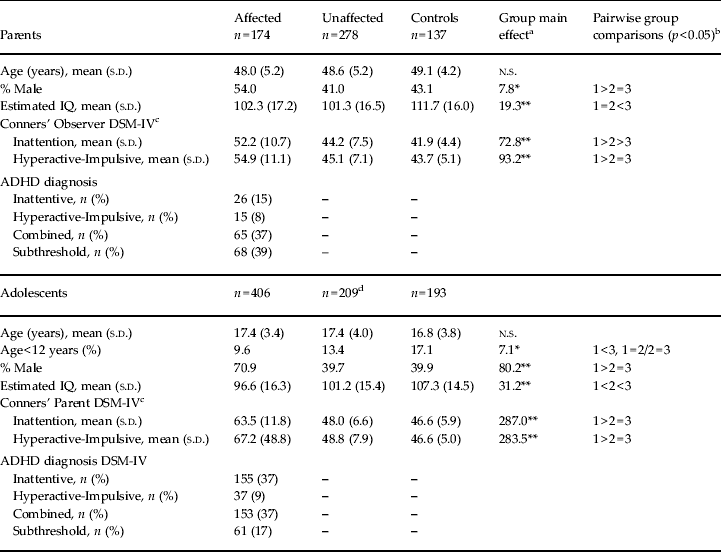
Participants were selected from the Dutch follow-up (2009–2012) of the International Multicentre ADHD Genetics (IMAGE) study performed between 2003 and 2006 (as described previously in Nijmeijer et al. Reference Nijmeijer, Hoekstra, Minderaa, Buitelaar, Altink, Buschgens, Fliers, Rommelse, Sergeant and Hartman2009). Inclusion criteria at enrolment for all participants were offspring age between 5 and 19 years, European Caucasian descent, IQ ⩾ 70, and no diagnosis of autism, epilepsy, general learning difficulties, brain disorders or known genetic disorders (such as Fragile X syndrome or Down syndrome). All family members were invited to a follow-up assessment, with a mean follow-up period of 5.9 (s.d. = 0.72) years and no additional inclusion criteria, apart from a minimum age of 8 years for neuropsychological testing and imaging. The current study involved 259 ADHD families and 98 control families with at least one family member with a complete neuropsychological assessment. The ADHD families consisted of 406 affected siblings (153 combined, 155 inattentive, 37 hyperactive-impulsive subtype and 61 subthreshold cases), 209 unaffected siblings and 452 parents (174 affected, 278 unaffected). The control families consisted of 193 children and 137 parents. The mean age of the offspring was 17.3 (s.d. = 3.7) years and that of the parents was 48.6 (s.d. = 5.0) years. Table 1 provides details of the participants’ characteristics.
Sample characteristics of parents and adolescents
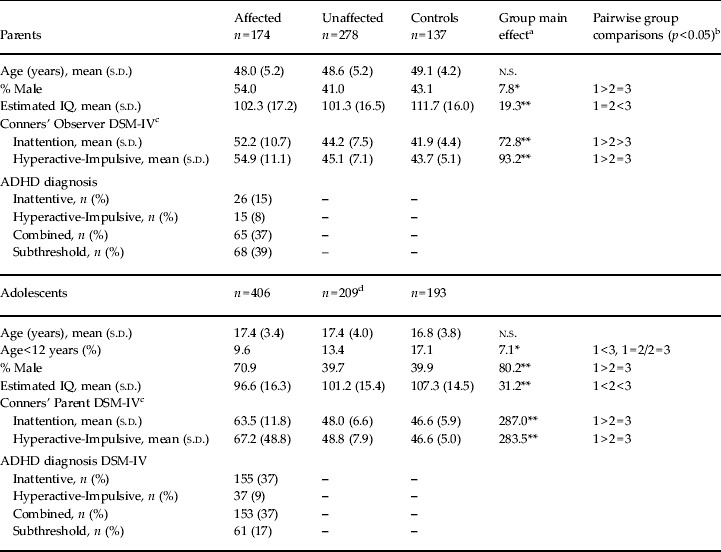
ADHD, Attention deficit hyperactivity disorder; s.d., standard deviation; n.s., not significant.
a F statistic; group differences for % male were tested with χ 2 tests.
b 1 = Affected, 2 = Unaffected, 3 = Control.
c t scores based on American norm group; Dutch t scores are found to be lower [Dutch (Adult) Twin Register].
d Twenty-three (11%) remitted cases, similar to the International Multicentre ADHD Genetics (IMAGE) approach; results with and without remitted cases did not differ.
* p < 0.05, **p < 0.001.
ADHD diagnoses
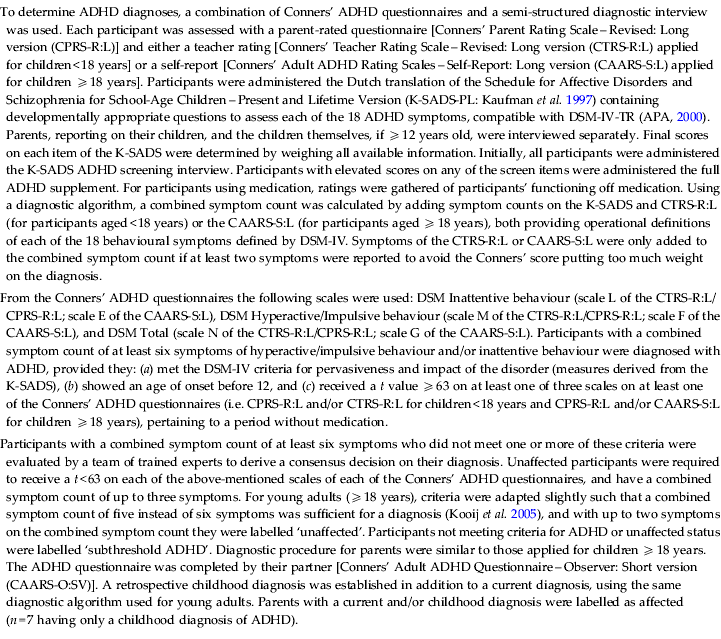
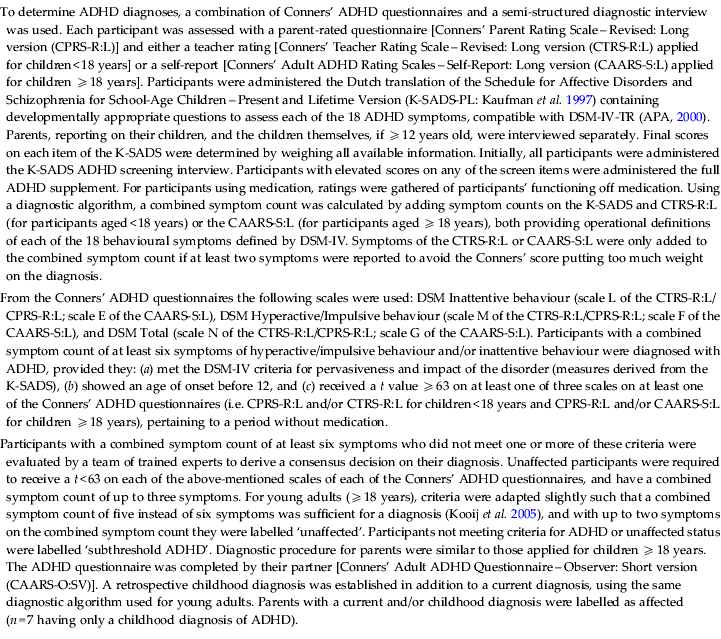
All participants were reassessed using a semi-structured diagnostic interview [Dutch translation of the Schedule for Affective Disorders and Schizophrenia for School-Age Children – Present and Lifetime Version (K-SADS-PL; Kaufman et al. Reference Kaufman, Birmaher, Brent, Rao, Flynn, Moreci, Williamson and Ryan1997)] and Conners’ ADHD questionnaires to determine current ADHD diagnoses. A diagnostic algorithm was applied to combine symptom counts on the K-SADS-PL and Conners’ questionnaire. A detailed description of the algorithm is provided in Table 2.
Diagnostic algorithm for attention deficit hyperactivity disorder (ADHD) in the International Multicentre ADHD Genetics (NeuroIMAGE) sample
Measures
Parent and offspring ADHD symptoms
Information concerning current ADHD symptoms was obtained using the Dutch version of the Conners’ Adult ADHD Rating Scale – Observer: Screen Version (CAARS-O:SV) for parents and the Conners’ Parent Rating Scale – Revised: Long version (CPRS-R:L) for children (Conners et al. Reference Conners, Erhardt and Sparrow1999). For each parent, the DSM Total Score was used as a measure of current parental ADHD severity. Scores on the ADHD Inattentive and Hyperactive-Impulsive scales were used to verify possible differential effects for inattention and hyperactivity-impulsivity. The same method was used for offspring, using the subscales DSM Total Score, ADHD Inattentive and ADHD Hyperactive-Impulsive.
Neuropsychological paradigms
Inhibition
A visual Stop task (Logan et al. Reference Logan, Cowan and Davis1984) was used to measure inhibition of an ongoing response. Details of the task and its administration have been described elsewhere (Rommelse et al. Reference Rommelse, Altink, Oosterlaan, Buschgens, Buitelaar and Sergeant2008). Functional magnetic resonance imaging (fMRI) scans were recorded while the children performed the task, which consisted of four experimental blocks of 48 Go and 12 Stop trials. The delay between Go and Stop signals was adapted online so as to lead to successful inhibition in 50% of the trials. The outcome measure was the Stop Signal Reaction Time (SSRT), which reflects the latency of the inhibitory process.
VsWM
VsWM grid tasks, including active rehearsal and dual-task requirements, were used to measure executive VsWM in parents (Westerberg et al. Reference Westerberg, Hirvikoski, Forssberg and Klingberg2004) and children (Dumontheil & Klingberg, Reference Dumontheil and Klingberg2012). Parents had to reproduce sequences of circles appearing in a 4 × 4 grid by pointing to the corresponding positions with an arrow driven by a computer mouse. Trials increased in sequence length from two to nine. At every level, the last two trials (sublevel B) contained a more complex spatial pattern than the first two trials (sublevel A). The task was stopped when subjects failed to complete both trials of a sublevel. The number of correct trials, taking into account both location and order, was used as a measure of VsWM in parents.
Children performed a slightly different version of the task while fMRI scans were recorded. The task consisted of experimental and control trials, the latter being used to control for non-working-memory-related brain activity in fMRI analyses (not part of this study). After each sequence, the children were presented with a number and a question mark in the grid, probing both spatial and temporal positions in the sequence. With a yes/no response they had to indicate whether the probed location was indeed stimulated at that position in the sequence. The task consisted of four experimental blocks of 24 trials. In each block, two types of task load (sequence length either three or six) were presented, and within each task load 50% of the trials were experimental or control. The number of correct experimental trials, taking into account both location and order, was used as a measure of VsWM in children, including both task loads because all groups differed equally on both low and high memory loads (van Ewijk et al. Reference van Ewijk, Heslenfeld, Luman, Rommelse, Hartman, Hoekstra, Franke, Buitelaar and Oosterlaan2013).
VWM
The total number of correct trials (Total score) on the Digit Span Backwards of the Wechsler Intelligence Scale for Children (WISC; Wechsler, 2002) or the Wechsler Adult Intelligence Scale – III (WAIS-III; Wechsler, 2000) was used as a measure of VWM in parents and children.
Intelligence
Full-scale IQ was estimated in parents and children by combining scores on the two subtests of the WISC/WAIS-III that show the highest correlation with full-scale IQ score, namely Vocabulary and Block Design (0.88 for WISC and 0.90 for WAIS) (Silverstein, Reference Silverstein1975, Reference Silverstein1982).
Procedure
This study was part of a comprehensive assessment protocol. Because of time constraints in recording fMRI scans, the VsWM and Stop tasks were administered in a random 75% sample of all scans, with a maximum of two children per family. fMRI scans were not recorded in parents. Participants were asked not to use psychostimulant drugs from 48 h before the assessment and not to use any other psychotropic medication at least 3 days before the assessment. After the study procedures had been carefully explained, all participants gave their written informed consent, with parents providing consent for children aged below 12 years. The study protocol was approved by the local medical ethics committees of the Radboud University Nijmegen Medical Centre and the VU Medical Centre Amsterdam.
Data analyses
MRI was contraindicated in about 25% of the children (for instance because of wearing braces), so that data were available for the Stop task and the VsWM task for 460 (54%) and 475 (56%) children respectively (missing data not replaced). Children with and without data on the Stop task did not differ in age (mean = 17.7 v. 17.2 years, p = 0.053), sex (male 56% v. 55%, p = 0.82), IQ (mean = 101 v. 100, p = 0.25) or proportion diagnosed with ADHD (50% v. 52%, p = 0.36). This was also the case for children with and without VsWM task data (p's between 0.14 and 0.95). Less than 6% of data for all other measures were missing and seemed to be missing at random. The missing data (i.e. < 6%) were replaced by means of expectation maximization. Cognitive and ADHD measures were successfully normalized and standardized into z scores (van der Waerden transformation) for parents and offspring separately. For SSRTs, z scores were mirrored, so that higher z scores for all measures would have the same meaning: better EF performance or more severe ADHD symptomatology. The results based on raw and standardized measures were similar.
To test whether parental ADHD and cognitive functions predicted offspring ADHD and cognitive functions, generalized estimating equations (GEEs) were used with a linear regression model and robust estimators. To maximally correct for familial dependence within the data set (for example, two mother–child effects were calculated in most families), family number was used as a repeated measure and the structure for working correlation matrices was set at exchangeable. In all parent–offspring analyses (carried out separately for ADHD symptomatology, inhibition, VWM, VsWM and IQ), age and sex of the child, parental age and their interactions with the main predictor were implemented in the model. Maternal and paternal total ADHD symptomatology (which were not strongly correlated: r = 0.19, p < 0.001) were included simultaneously in the same models. The mediation effects of child EF on parent–offspring ADHD relationships were computed using a multiple mediation bootstrap analysis (Preacher & Hayes, Reference Preacher and Hayes2004) and the moderation effects of parental EF were investigated by examining the interaction between parental ADHD and EF in relation to offspring ADHD. Individual correlations between EF/IQ and ADHD, and sibling (first and second born) and spouse correlations for EF/IQ and ADHD were calculated with correction for age differences (spouse and sibling) and sex differences (siblings). Individual correlations were calculated with GEEs to correct for familial dependence. Group differences [ADHD affected, unaffected (but related to affected sibling or child), control] were calculated for parents and offspring separately, using the aforementioned model with GEEs including group and sex as factors and age as a covariate. For EF measures, analyses were conducted with and without IQ as a covariate. Performance ceiling effects did not occur on any of the tasks, as indicated by boxplot analyses with raw data. Effect sizes in all models were defined in terms of standardized b (in parent–offspring analyses indicating the z score increase of a dependent measure at the increase of one z score on an independent measure) or Cohen's d (group comparisons). A false discovery rate (FDR) correction was used when there were multiple comparisons, using a q value setting of 0.05.
Results
Parental and adolescent EF and IQ group differences
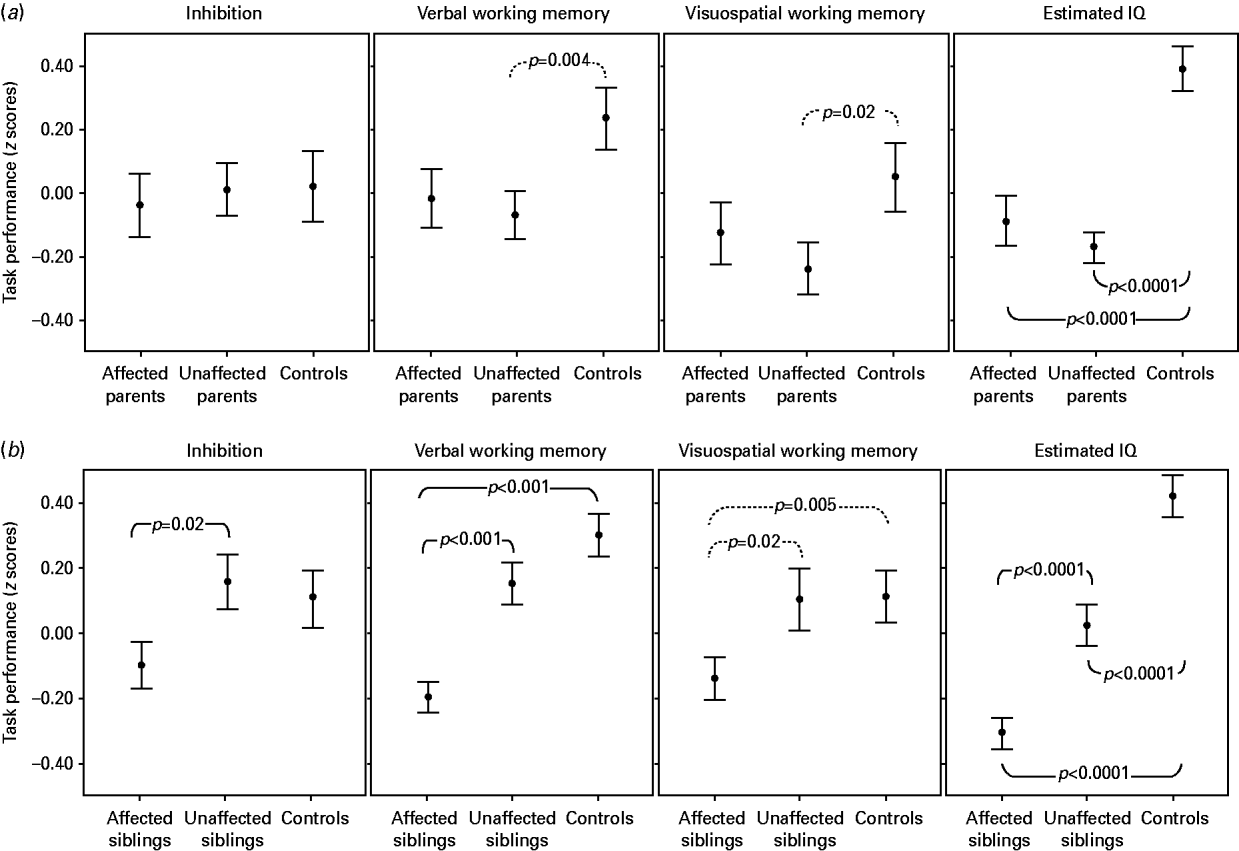
The performance of the three parent groups is presented in Fig. 1 a. Group differences with medium to large effect sizes were found for VsWM, VWM and IQ. Affected and unaffected parents performed similarly on all EF measures. Control parents performed better than unaffected parents on VsWM and VWM (d = 0.30, p = 0.02 and d = 0.27, p = 0.01 respectively). After correction for IQ, group differences for VsWM and VWM were no longer significant. There were no interactions between group and age or sex on any cognitive measure, except for VWM (group × age b = –0.04, p = 0.03). Post-hoc tests revealed that age had only a minor negative effect in the unaffected group (b = −0.02, p = 0.01). Small negative main effects for age, but not sex, were found on VsWM (b = –0.04, p < 0.001) and IQ (b = 0.03, p = 0.004).
Group differences on cognitive performance (a) between parents with attention deficit hyperactivity disorder (ADHD), unaffected parents of affected offspring and healthy control parents and (b) between adolescents with ADHD, their unaffected siblings and healthy controls. Higher z scores indicate better performance. Group differences indicated with dotted lines did not reach significance after correction for IQ.
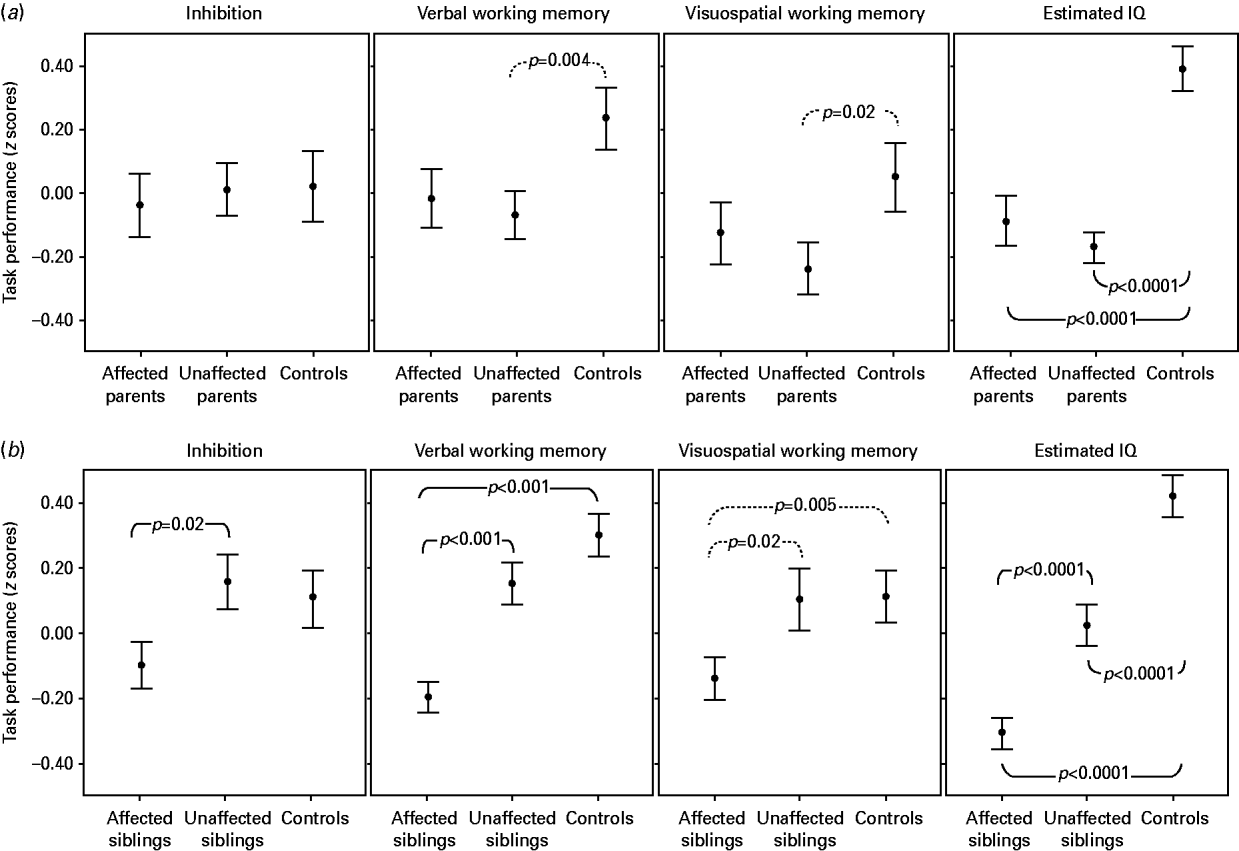
The results for adolescent group comparisons are presented in Fig. 1 b. Medium to large group differences were found for all EF measures and IQ. Unaffected siblings and controls performed similarly on all EF measures (p's between 0.60 and 0.87). Affected siblings performed worse than unaffected siblings on the inhibition task (d = 0.24, p = 0.02) and worse than unaffected siblings and controls on VsWM (d = 0.23 and 0.24 respectively, p's < 0.03) and VWM (d = 0.36 and 0.54 respectively, p's < 0.001) tasks. After correction for IQ, group differences for VsWM were no longer significant. Small positive effects of age, but not sex, were found on all four measures (b's between 0.02 and –0.09, p's < 0.03). There were no significant interaction effects with group, except for a group × age effect on inhibition, with task performance improving significantly with age in the unaffected adolescents only (b = 0.06, p = 0.004).
Similar results were obtained when patients with subthreshold ADHD were excluded from the affected group.
Parent–offspring relationships for ADHD and EF
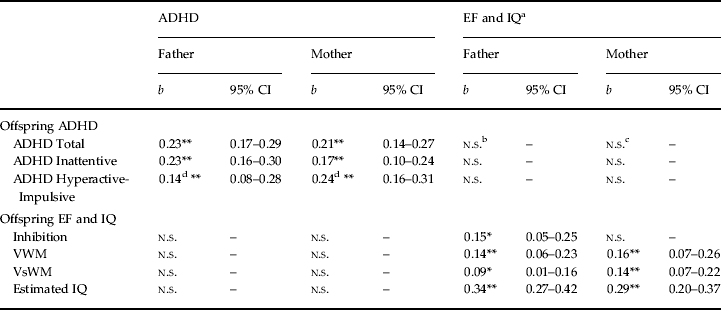
Table 3 shows the results for parent–offspring analyses. The minor to moderately strong relationship between parental and offspring ADHD (total and inattentive) was equally strong for fathers and mothers (p's < 0.001). The parent–offspring relationships for EF and IQ were positive for all measures and both parents (father–offspring VsWM: p = 0.026; all other p's < 0.001) except for maternal inhibition (p = 0.85). The largest effect size was found for IQ (b = 0.34), followed by VWM, inhibition and VsWM (b = 0.09). Testing for contrast effects revealed a stronger maternal than paternal parent–offspring relationship for hyperactive-impulsive symptoms, but there were no other paternal and maternal differences in the parent–offspring relationships for any of the cognitive measures (p's between 0.15 and 0.75), illustrating no effects of parental origin. None of the parent–offspring relationships interacted with child's age, child's sex or parental age (p's between 0.06 and 0.81).
Effects of parental ADHD and EF/IQ on offspring ADHD and EF/IQ in ADHD families (n = 259) and healthy control families (n = 98) based on GEE regression analyses with standardized z scores
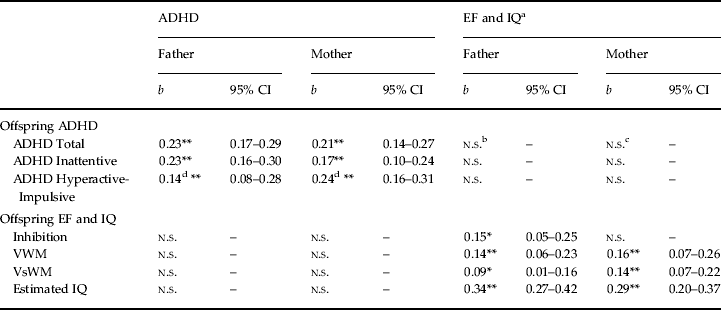
ADHD, Attention deficit hyperactivity disorder; EF, executive functioning; GEE, generalized estimating equation; VWM, verbal working memory; VsWM, visuospatial working memory; CI, confidence interval; n.s., not significant.
All reported effects did not differ between ADHD and healthy control families, and were neither mediated by child's EF (all CIs contained 0) nor moderated by parental EF (all p's > 0.17).
a In relation to offspring EF/IQ, b values apply to the same parental cognitive function as noted in the row.
b Only for paternal IQ was a negative effect found on offspring ADHD (b = –0.22, p < 0.001).
c For maternal verbal working memory a positive effect was found on offspring ADHD (b = 0.12, p = 0.04), not surviving false discovery rate (FDR) correction.
d Significant contrast effect (p = 0.02).
* p < 0.03, ** p < 0.001
To determine whether the aforementioned parent–offspring relationships for ADHD and EF/IQ differed between ADHD and control families, ‘family type’ was included in the interaction with all independent parental measures. After FDR correction for multiple testing (14 interactions were tested), no significant results remained (p's between 0.03 and 0.97), suggesting that parent–offspring effects were similar in ADHD and healthy control families.
Co-segregation of EF and ADHD from parents to offspring
Parental ADHD was not significantly associated with any offspring EF (p's between 0.14 and 0.66) or IQ (p's > 0.30), nor was parental EF associated with offspring ADHD (p's between 0.17 and 0.93, and 0.04 for maternal VWM, not surviving FDR correction), indicating that the transmission of ADHD and EF from parent to offspring was not associated in this sample. Multiple mediation bootstrapping revealed non-significant indirect effects of parental ADHD on offspring ADHD through child EF and IQ (effects sizes between 0.005 and 0.01; all confidence intervals contained 0). Including parental EF as a quantitative measure in the interaction with parental ADHD measures did not yield any significant results (p's between 0.29 and 0.89). These findings suggest that neither child EF nor parental EF influenced the parent–offspring ADHD relationship and that therefore there was no co-segregation of ADHD and EF from parents to offspring.
Correlation analyses
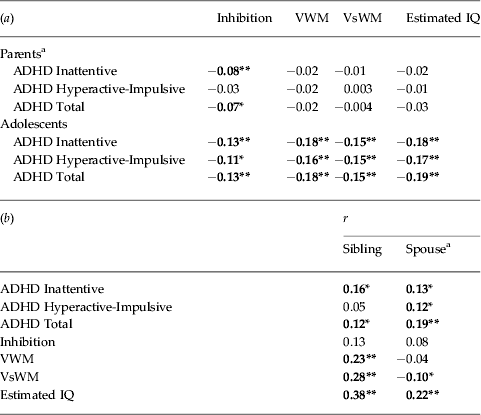
Individual correlations between ADHD and EF/IQ are presented in Table 4
a. In offspring, EF/IQ was weakly to moderately correlated with ADHD, whereas in parents almost none of the correlations were significant, except for a small effect for (inattentive) ADHD with inhibition. Table 4
b shows correlations within families. Correlations between siblings were minor for ADHD and around moderate for EF/IQ. Cross-correlations (ADHD sibling 1 – EF/IQ sibling 2 and vice versa) were not significant (p's between 0.17 and 0.89), except for IQ (r = –0.13 p = 0.02). Spouse correlations for ADHD and EF/IQ were overall small.
(a) Individual correlations between ADHD symptomatology and cognitive functioning for parents and adolescents separately and (b) sibling and spouse correlations (r) for ADHD symptomatology and cognitive functioning ADHD, Attention deficit hyperactivity disorder; VWM, verbal working memory; VsWM, visuospatial working memory. Significant correlations are indicated in bold.
a
ADHD scores obtained from observer reports. *
p < 0.05, **p < 0.01.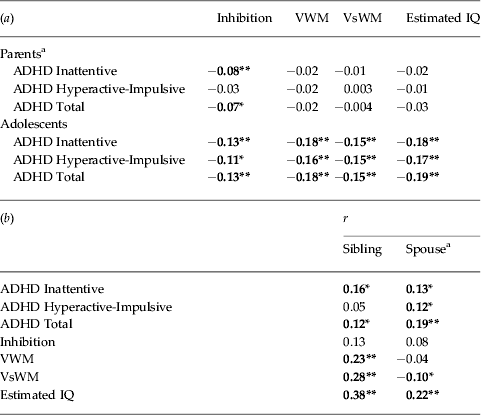
Discussion
In a large sample of ADHD affected and unaffected adolescents and their parents, we observed that ADHD and EF were independently related between parents and offspring and were not cross-correlated in adolescent siblings, suggesting that independent familial factors underlie both ADHD and EF. Moreover, the EF deficits documented during childhood in the unaffected siblings 5 years ago (Rommelse et al. Reference Rommelse, Altink, Oosterlaan, Buschgens, Buitelaar and Sergeant2008) were no longer found during adolescence in the current study. This, together with the observation that parents with ADHD did not have profound EF deficits, suggests that initially present EF deficits tend to resolve with age. Given the lack of a familial association between ADHD and EF, the results suggest that, after childhood years, the majority of influences on ADHD are independent from those on EF. In our large sample, the role of EF as a familial risk indicator for ADHD was not evident, which has consequences for causal models for ADHD. However, affected adolescents still had EF impairments, so that ADHD and EF are not completely dissociable in adolescence. Both may be (aetiologically) related in a subsample of patients with ADHD.
Our results are in agreement with previous research (Nigg et al. Reference Nigg, Blaskey, Stawicki and Sachek2004; Goos et al. Reference Goos, Crosbie, Payne and Schachar2009; Jester et al. Reference Jester, Nigg, Puttler, Long, Fitzgerald and Zucker2009; Boomsma et al. Reference Boomsma, Saviouk, Hottenga, Distel, de Moor, Vink, Geels, van Beek, Bartels, de Geus and Willemsen2010; Thissen et al. Reference Thissen, Rommelse, Altink, Oosterlaan and Buitelaar2012) on parent–offspring relationships regarding the separate domains of ADHD and EF, but are in sharp contrast to the results of sibling and twin studies showing shared familial/genetic origins of EF and ADHD and EF abnormalities in unaffected siblings (Kuntsi et al. Reference Kuntsi, Rogers, Swinard, Borger, van der Meere, Rijsdijk and Asherson2006; Waldman et al. Reference Waldman, Nigg, Gizer, Park, Rappley and Friderici2006; Bidwell et al. Reference Bidwell, Willcutt, Defries and Pennington2007). The main difference between our study and previous studies is that we investigated adolescents and not children. It may therefore well be that age is a strong moderator in the relationship between ADHD and EF. Although there was only a group by age interaction on inhibition in the current study, when an age split at 12 years was introduced, all EF measures in the youngest unaffected siblings only tended to be impaired (data available upon request). Although challenging the notion that executive functioning is an endophenotype of ADHD, our finding that EF deficits do not convey an increased familial risk of ADHD in adolescents may be consistent with the hypothesis that the development of brain regions underlying ADHD is delayed but not abnormal (Shaw et al. Reference Shaw, Eckstrand, Sharp, Blumenthal, Lerch, Greenstein, Clasen, Evans, Giedd and Rapoport2007) and that brain networks in some patients with ADHD undergo adaptive reorganization (Johnson, Reference Johnson2012). It might even be suggested that unaffected siblings show a somewhat delayed brain development compared to controls in childhood, yet accelerated compared to affected siblings in adolescence, with EF deficits during childhood being markers of this delay. When compared to their performance in childhood, we indeed found support for an amelioration over time in unaffected, but not affected, adolescents’ performance, with unaffected siblings and controls not differing in ADHD symptoms, comparable to the current findings (Rommelse et al. Reference Rommelse, Altink, Oosterlaan, Buschgens, Buitelaar and Sergeant2008), and with improved performance in unaffected siblings on several EF domains (inhibition: d = 0.19, p = 0.048; VWM: d = 0.20, p = 0.02; VsWM: p = 0.54), but not affected siblings (p's between 0.18 and 0.33) or controls (p's between 0.06 and 0.35).
Alternatively or additionally, it may be that the same genetic/familial mechanisms underlie EF deficits and ADHD during childhood but not during adolescence and possibly adulthood, which is in line with our results and many other studies showing no or only subtle impairments in adults with ADHD (Woods et al. Reference Woods, Lovejoy and Ball2002; Boonstra et al. Reference Boonstra, Oosterlaan, Sergeant and Buitelaar2005; but see Hervey et al. Reference Hervey, Epstein and Curry2004; Goos et al. Reference Goos, Crosbie, Payne and Schachar2009 for contrasting findings). However, phenotypic correlations between ADHD symptoms and EF task scores are typically found to be small in childhood (population) samples as well (Willcutt et al. Reference Willcutt, Doyle, Nigg, Faraone and Pennington2005; Crosbie et al. Reference Crosbie, Arnold, Paterson, Swanson, Dupuis, Li, Shan, Goodale, Tam, Strug and Schachar2013), suggesting non-EF factors play a role in the aetiology of ADHD throughout the lifespan. Although we cannot draw conclusions about the role of genetics, the interpretation of our results with regard to genetics is intriguing. It is known that gene transcription is strongly influenced by developmental and the environment (Rutter et al. Reference Rutter, Moffitt and Caspi2006). Moreover, new, age-specific effects account for more than half of the familial (genetic and shared environmental) influences on ADHD in early adolescence (Greven et al. Reference Greven, Asherson, Rijsdijk and Plomin2011). Taken together, the results clearly indicate that the endophenotype construct of executive functioning for ADHD is in any case dependent on developmental stage, a finding that should prompt reconsideration of our current understanding of the relationship between EF and ADHD.
Strengths and limitations
We improved upon previous studies by including a large sample with cognitive data available for parents and adolescent siblings and by performing careful diagnostics. Furthermore, we investigated several EF paradigms and explicitly tested whether EF affected the relationship between parent–offspring ADHD. We also conducted all necessary analyses to investigate the shared familiality of EF and ADHD and took a thorough statistical approach by using GEEs for analyses with correction for familial clustering. However, some limitations should be acknowledged. For example, we included patients who were using medication. Although participants were asked not to use their medication from 48 h prior to testing, there may still have been confounding effects through medication withdrawal and/or medication tolerance. We also used single measures of the EF constructs of interest. However, these measures were well validated and have been shown to be robustly associated with ADHD (Lijffijt et al. Reference Lijffijt, Kenemans, Verbaten and van Engeland2005; Martinussen et al. Reference Martinussen, Hayden, Hogg-Johnson and Tannock2005; Willcutt et al. Reference Willcutt, Doyle, Nigg, Faraone and Pennington2005; Kasper et al. Reference Kasper, Alderson and Hudec2012). Another potential limitation is that inhibition and VsWM were measured in offspring while they underwent fMRI, so that they performed tasks under different conditions from those of adults or from those when they were tested in childhood. This might have diminished the strengths of the parent–offspring EF relationship and the comparability of childhood and adolescent performance. However, with regard to parents and offspring findings, if the different test environment is the explanation for the absence of cross-relationships for ADHD and EF, we would not expect to find parent–offspring relationships for the EF tasks either, which was clearly not the case. Concerning the differential task conditions in childhood and adolescence, we consider that the different task conditions in childhood and adolescence are unlikely to explain the observation that EF deficits seemed to improve in unaffected offspring only (i.e. unaffected siblings would then profit differentially from a test environment normally experienced as more stressful). The finding that the youngest (below 12 years) unaffected siblings still showed EF deficits similar to those previously reported in childhood supports the notion that age, not task condition, is the most appropriate explanation for the improved EF performance in the adolescent unaffected siblings. With regard to our findings in adults, it might be possible that no clear EF deficits were found in relation to ADHD because real-life EF difficulties cannot be detected with the standard tasks (Torralva et al. Reference Torralva, Gleichgerrcht, Lischinsky, Roca and Manes2013) used in our sample of ADHD parents, who were recruited indirectly through their affected offspring. However, all tasks could detect EF deficits in affected adolescents, which suggests that the EF tasks used are sensitive to ADHD pathology. Nevertheless, we recommend that more ecologically valid EF tasks be used in future studies as well.
Future directions
Our findings showing the importance of the effect of age or developmental stage on the relationship between executive functioning and ADHD have potential implications for current aetiological models of causality in ADHD. Therefore, a focus on age could lead to greater insights concerning the relationship between EF and ADHD. This paves the way for longitudinal studies of developmental trajectories of, for example, EF in unaffected adult siblings and also sibling (cross-)correlations in adult ADHD samples. We aim to follow up the current sample of adolescents into adulthood, to determine whether EF deficits will eventually ameliorate in this sample of ADHD adolescents, and hence to establish a comprehensive and sound model for EF and ADHD during development.
Acknowledgements
We thank all the families and teachers who took part in this study and all interns for their assistance in data collection. We also thank R. Donders for his advice on the statistical analyses.
This work was supported by National Institutes of Health (NIH) Grant R01MH62873, The Netherlands Organization for Scientific Research (NOW) Large Investment Grant 1750102007010, and grants from Radboud University Nijmegen Medical Centre, University Medical Centre Groningen and Accare, and VU University Amsterdam.
Declaration of Interest
J. K. Buitelaar has been a consultant to/member of advisory board of/and/or speaker for Janssen Cilag BV, Eli Lilly, Bristol–Myers Squibb, Organon/Shering Plough, UCB, Shire, Medice, Roche and Servier. P. J. Hoekstra has received advisory panel payments from Shire and Eli Lilly. All other authors have no conflict of interest to disclose.