Introduction
The majority of patients with multiple sclerosis (MS) complain of fatigue. The fatigue is often severe, chronic, and interferes with daily life. Fatigue in MS is not only determined by disease characteristics or by the physical impairments caused by the illness. Cognitions and behaviours related to the fatigue and the illness also play a role in the maintenance of fatigue (Vercoulen et al. Reference Vercoulen, Swanink, Galama, Fennis, Jongen, Hommes, van der Meer and Bleijenberg1998; Van der Werf et al. Reference Van der Werf, Evers, Jongen and Bleijenberg2003; Bol et al. Reference Bol, Duits, Hupperts, Vlaeyen and Verhey2009; Skerrett & Moss-Morris, Reference Skerrett and Moss-Morris2006).
A cognitive behavioural model of MS fatigue has been formulated in which the primary disease factors, inflammation and demyelination, trigger the fatigue (van Kessel & Moss-Morris, Reference van Kessel and Moss-Morris2006). Cognitive, behavioural and emotional responses worsen or perpetuate the fatigue. The cognitions involved may be beliefs specific to fatigue, such as the idea of having no control over fatigue or the fatigue lasting forever, or may be more general beliefs about the illness and other symptoms of MS. Examples of the latter are catastrophizing about the experience of MS symptoms or thinking it is better not to engage in activities to avoid embarrassment about the nature of the symptoms. Research suggests that these cognitive responses are related directly to MS patients' fatigue or indirectly by eliciting negative emotions (Van der Werf et al. Reference Van der Werf, Evers, Jongen and Bleijenberg2003; Skerrett & Moss-Morris, Reference Skerrett and Moss-Morris2006).
MS patients' behaviour can also worsen or perpetuate the fatigue. People may overexert themselves attempting to meet perceived demands and, by doing so, increase the fatigue and the need to rest and recover (all-or-nothing behaviour; Skerrett & Moss-Morris, Reference Skerrett and Moss-Morris2006). The fatigue could also lead to avoidance and rest. Excessive rest and day-time sleep can create a disturbance of sleep and the sleep–wake cycle. In turn, this sleep disturbance can perpetuate the fatigue (Strober & Arnett, Reference Strober and Arnett2005).
Emotional responses are also thought to be related to the fatigue. Depression is common in MS (Siegert & Abernethy, Reference Siegert and Abernethy2005; Feinstein, Reference Feinstein2007). Depression and anxiety can be worsened or generated by the cognitions surrounding fatigue and the illness. At the same time these emotional responses are known to increase fatigue (Strober & Arnett, Reference Strober and Arnett2005).
The cognitive behavioural model of MS fatigue suggests that the complex interaction between these cognitive, behavioural and emotional responses can create a vicious cycle in which they interact with physiological changes such as disrupted circadian rhythms, heightened autonomic arousal, deconditioning and inflammation in maintaining the fatigue (van Kessel & Moss-Morris, Reference van Kessel and Moss-Morris2006). Similar models have been developed in other conditions, and cognitive behavioural therapy (CBT) aimed at altering unhelpful cognitions and behaviours has been shown to effectively reduce fatigue in chronic fatigue syndrome (CFS) and chronic fatigue in cancer survivors (Gielissen et al. Reference Gielissen, Verhagen, Witjes and Bleijenberg2006; Price et al. Reference Price, Mitchell, Tidy and Hunot2008). Therefore, a CBT intervention was developed based specifically on the model of MS fatigue and tested in a recent randomized controlled trial (RCT) (van Kessel et al. Reference van Kessel, Moss-Morris, Willoughby, Chalder, Johnson and Robinson2008). The effects of CBT were compared to relaxation training (RT), a more general, non-specific and largely behavioural intervention. Both CBT and RT had a positive effect on the level of fatigue and related disability. However, in the CBT group the level of fatigue decreased significantly more directly following treatment. The level of fatigue following CBT was less than that of a healthy control group and the effects of treatment were maintained at follow-up, 6 months later. CBT participants also reported significantly fewer depressive symptoms and were less anxious than the RT group at the end of treatment.
Although CBT is an effective treatment for MS fatigue, the mechanisms by which the positive effect on fatigue is reached are not known. The cognitive behavioural model of MS fatigue is broadly formulated and the intervention is complex, consisting of several different elements. Testing mediation is a strategy to identify variables that intervene in the relationship between treatment and outcome. Mediation analysis can help to better understand how treatment works (Frazier et al. Reference Frazier, Tix and Barron2004) and in the case of CBT for MS fatigue can give insight into which factors are most important for the specific effect of CBT compared to RT. This may increase our understanding of CBT not only for MS fatigue but also for chronic fatigue in other conditions.
The CBT for MS fatigue developed by van Kessel et al. (Reference van Kessel, Moss-Morris, Willoughby, Chalder, Johnson and Robinson2008) consists of six elements. The first element is the introduction of the cognitive behavioural model of fatigue. This could help to increase the self-efficacy of the patient and create a coherent understanding of MS fatigue based on a biopsychosocial model. A second element is activity scheduling. Patients learn to stop avoiding activity and also to change all-or-nothing behaviour that results in periods of overactivity followed by worsening of the fatigue. A third element addresses changing unhelpful cognitions surrounding MS and fatigue. The fourth element focuses on sleep hygiene and restoring sleep–wake cycles. The other two remaining elements address managing negative emotions and the role of social support.
The first objective of the current study was to assess whether CBT compared to RT significantly reduced the cognitions and behaviours that are thought to perpetuate the fatigue and that are addressed in CBT. Cognitive behavioural variables were selected based on the model and elements addressed in the CBT programme (Skerrett & Moss-Morris, Reference Skerrett and Moss-Morris2006; van Kessel et al. Reference van Kessel, Moss-Morris, Willoughby, Chalder, Johnson and Robinson2008). The cognitive factors included three cognitive interpretations of MS symptoms: the tendency to catastrophize about symptoms, feelings of embarrassment about symptoms, and beliefs that symptoms signal damage to the body (damage beliefs). The tendency to focus on MS symptoms, more a cognitive process than a specific interpretation, was also assessed. We also evaluated the change in patient's negative representation of fatigue, that is the belief that fatigue is out of one's control, difficult to understand, likely to be ongoing and have serious consequences. The behavioural factors included resting/avoidance, all-or-nothing behaviour and sleep problems.
The second objective was to assess whether any of the cognitive and behavioural variables significantly altered by CBT were mediators of the positive effect of CBT on fatigue using a multiple mediation analysis (Preacher & Hayes, Reference Preacher and Hayes2008). The third objective was to assess whether any changes in cognitions and behaviours mediated the change in fatigue independent of the changes in depression and anxiety. The relationship between depression and fatigue is often emphasized in the literature, although the empirical support for this relationship is not consistent (Siegert & Abernethy, Reference Siegert and Abernethy2005). However, effective treatment for depression in MS has shown a positive effect on fatigue (Mohr et al. Reference Mohr, Hart and Goldberg2003; Strober & Arnett, Reference Strober and Arnett2005) and CBT for MS fatigue resulted in improvement in both depression and anxiety (van Kessel et al. Reference van Kessel, Moss-Morris, Willoughby, Chalder, Johnson and Robinson2008). Therefore, it is possible that the positive effect of CBT on fatigue is not brought on by changes in the cognitions or behaviours associated with fatigue, but by a reduction in depression and anxiety.
Method
Patients
Additional data in conjunction with the fatigue and mood data collected from a previous RCT were used in the present study (van Kessel et al. Reference van Kessel, Moss-Morris, Willoughby, Chalder, Johnson and Robinson2008). In the original study 72 MS patients were randomized, 35 to CBT and 37 to RT. The majority of the patients were female (80% in the CBT group and 70% in the RT), the mean age was 42.9 (s.d.=9.3) years in the CBT group and 47.0 (s.d.=9.4) years in the RT group. The mean illness duration was over 5 years (5.5, s.d.=4.8 in the CBT group and 6.7, s.d.=5.9 in the RT group). More details of the baseline characteristics of both groups are provided in the original publication.
Both interventions consisted of eight weekly individual sessions delivered by the same therapist. Three sessions were face-to-face, five were completed by telephone. In both groups, 35 patients completed the treatment and the first post-treatment assessment. Two patients dropped out from the RT intervention. The present study used data from the baseline and post-treatment assessment (directly following the intervention) of the 70 patients who completed treatment.
Instruments
Fatigue
The Chalder Fatigue Questionnaire (CFQ; Chalder et al. Reference Chalder, Berelowitz, Pawlikowska, Watts, Wessely, Wright and Wallace1993) was used to measure fatigue severity. It consists of 11 items that can be scored on a Likert scale ranging from 0 (symptom less than usual present) to 3 (much more than usual present). Scores can range from 0 to 33 and higher scores reflect higher fatigue severity. The CFQ is a reliable and valid measure in MS patients (Aikens, 2003).
Cognitive and behavioural variables
Sleep Problems Questionnaire (SPQ)
The four-item SPQ was used to assess different aspects of sleep (delay in sleep onset, difficulty staying asleep, early awakening, and feeling tired after sleep). Patients are asked how often they experienced sleep problems during the previous month. Items are scored on a scale from 0 to 5 and total scores range from 0 to 20. Higher scores reflect more severe sleep problems. The SPQ has acceptable reliability and internal consistency (Jenkins et al. Reference Jenkins, Stanton, Niemcryk and Rose1988).
Cognitive and Behavioural Responses to Symptoms Questionnaire (CBSQ)
The CBSQ consists of two behavioural subscales and six cognitive subscales, all measuring different aspects of the response to symptoms. The CBSQ subscales have an acceptable internal reliability and the scale has been used in MS patients (Skerrett & Moss-Morris, Reference Skerrett and Moss-Morris2006). In the present study two behavioural subscales and four cognitive subscales shown to be most relevant to MS fatigue were used (Skerrett & Moss-Morris, Reference Skerrett and Moss-Morris2006). The behavioural subscales are ‘resting/avoidance’ (eight items) and ‘all-or-nothing’ behaviour (five items). The latter scale reflects the behavioural tendency of patients to overexert themselves, followed by periods of inactivity. The symptom focusing subscale (six items) measures how much patients focus on MS symptoms, and the three remaining cognitive subscales assess interpretation of the symptoms. These are the subscales ‘catastrophizing’ (four items), ‘damaging beliefs’ (seven items) and ‘embarrassment avoidance’ (six items). All items are scored on a five-point frequency scale ranging from never (0) to all the time (4). Item scores are added from each subscale to obtain a total score.
Brief Illness Perceptions Questionnaire (B-IPQ; Broadbent et al. Reference Broadbent, Petrie, Main and Weinman2006)
The B-IPQ was used to assess beliefs and ideas about fatigue. In this study, the word illness was replaced with fatigue so the items measured beliefs about fatigue in general rather than just MS fatigue. Two items that were not relevant to perceptions of fatigue were excluded with permission from the lead author. The remaining seven items measured beliefs about fatigue on different dimensions scored on a Likert scale from 0 (not at all) to 10 (extremely) including consequences (the expected outcome of the fatigue), timeline (how long the person believes the fatigue will last), personal control (over the fatigue), treatment control (the extent to which the person thinks treatment for fatigue can help), illness coherence (the extent the person believes that they understand their fatigue), concern (about the fatigue) and emotional representation (the extent to which the fatigue affects them emotionally). A sum score was calculated, with lower scores indicating a more negative representation of fatigue and higher scores a more positive view.
Mood
Hospital Anxiety and Depression Scale (HADS; Zigmond & Snaith, Reference Zigmond and Snaith1983)
The HADS is a widely used self-report instrument for assessing depression and anxiety in patients with medical illnesses. It has two subscales, anxiety and depression, each consisting of seven items. All items are scored on a four-point scale (0 to 3). The HADS has excellent psychometric properties (Zigmond & Snaith, Reference Zigmond and Snaith1983).
Statistical analysis
Statistical analysis was performed using SPSS version 16.0 (SPSS Inc., USA). First we tested whether there was a difference in scores between the CBT and RT condition at the post-treatment assessment with respect to the cognitive variables (symptom focusing, catastrophizing, damaging beliefs, embarrassment avoidance, and perception of fatigue) and the behavioural variables (resting/avoidance, all-or-nothing behaviour, and sleep problems). For this an ANCOVA was used (Van Breukelen, Reference Van Breukelen2006) with the score post-treatment as the dependent variable, the baseline score as the covariate and condition as the fixed factor (two levels). Overall, a significance level was assumed at p<0.05, but to correct for multiple testing the significance for the ANCOVA was adjusted to p<0.007 (0.05/8).
For the mediation analysis residualized change scores were computed by regressing the relevant end of treatment variable on its baseline value. This was done for all cognitive and behavioural variables that were significantly larger in the CBT condition than in the RT condition and for the two HADS subscales. The residualized change scores were entered as proposed mediators in a multiple mediation analysis. This analysis can help to determined to what extent the change in fatigue brought on by CBT compared to RT is mediated by these variables. A macro expansion for SPSS introduced by Preacher & Hayes (Reference Preacher and Hayes2008; updated version February 2009) was used to conduct the mediation analysis. The multiple mediation model is illustrated in Fig. 1. In Fig. 1 a, the change in fatigue is explained by the allocation to CBT instead of RT (path c). This had already been tested in the original RCT (van Kessel et al. Reference van Kessel, Moss-Morris, Willoughby, Chalder, Johnson and Robinson2008). In Fig. 1 b, the effect on fatigue (path c′) is potentially mediated by a change in several mediators (path a1 to an). Paths an, bn, c and c′ were analysed using regression analysis, where n stands for the number of proposed mediators. For each proposed mediator the changes in that variable were regressed on treatment (CBT v. RT, path an). In addition, for each mediator, path bn was examined by regressing changes in fatigue on the change in the proposed mediator, correcting for treatment. In the case of path c, the change in fatigue was regressed on treatment, and path c′ was examined by regressing change in fatigue on treatment, this time correcting for changes in all the proposed mediators simultaneously. The size of the mediation effect was computed for all mediators together and for each of the proposed mediators separately using the product-of-coefficient approach. The advantage of testing all variables simultaneously is that we can determine whether the mediation of a particular variable is independent of the effect of the other mediators (Preacher & Hayes, Reference Preacher and Hayes2008). Statistical significance of the mediation effect was tested using a non-parametric bootstrap approach (Preacher & Hayes, Reference Preacher and Hayes2008). The observed dataset was randomly resampled 5000 times with replacement, which resulted in 5000 samples with mediation effect. The mean of these mediation effects was used as the population parameter. When the 95% confidence interval (CI) around this parameter did not include zero, the null hypothesis was rejected. When the 95% CI did include zero, the mediation hypothesis was rejected. This procedure was used to test the specific mediation by each of the variables; it increases the power to detect significant effects in small, non-normally distributed samples.
The effect of cognitive behavioural therapy (CBT) on multiple sclerosis (MS) fatigue, (a) without and (b) with the proposed mediators.

Finally, the mediation analysis was repeated with the variables that mediated the specific effect of CBT compared to RT but now the HADS subscales anxiety and depression residualized change scores were added as a covariates to determine the contribution of emotional factors to the treatment response and mediation effect.
Results
The specific effect of CBT on behavioural and cognitive variables
The ANCOVA data presented in Table 1 show that the CBT group compared to the RT group reported greater positive changes directly following treatment in all the cognitions and behaviours measured except for sleep. Four out of the eight variables met the stringent Bonferroni-adjusted significance level, including rest and avoidance of activity, symptom focusing, and damaging beliefs from the CBSQ and the B-IPQ perception of fatigue.
ANCOVA results and changes scores (95% confidence interval) for the cognitive and behavioural variables across groups

CBT, Cognitive behavioural therapy; RT, relaxation training; CBSQ, Cognitive and Behavioural Responses to Symptoms Questionnaire; B-IPQ, Brief Illness Perception Questionnaire.
a Selected as a potential mediator for the mediation analysis, that is CBT significantly different from the relaxation condition, p<0.007.
Testing the proposed mediators of the change in fatigue following CBT compared to RT in a multiple mediation analysis
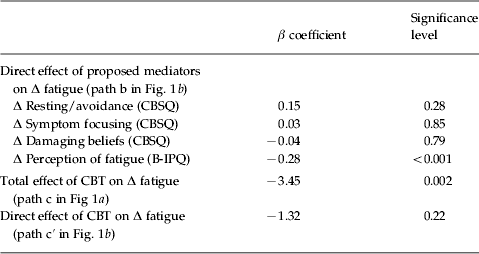
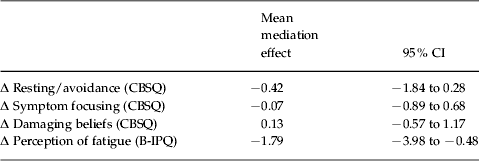
The residualized change scores on the cognitive behavioural variables that were significantly different between both conditions (symptom focusing and damaging beliefs from the CBSQ, the B-IPQ negative representation of fatigue and avoidance of activity) were entered in a multiple mediation analysis. The results of this analysis are given in Table 2 (regression coefficients) and Table 3 (bootstrap CIs of the proposed mediators). The regression coefficients of the effect of CBT on the proposed mediators are not shown in Table 2 as this relationship was tested in the previous analysis (see Table 1). The multiple mediation analysis showed that only the change in the negative perceptions of fatigue, as measured with the B-IPQ, mediated the change in fatigue brought on by CBT. The significance of this mediation was tested using bootstrapping. As zero is not within the 95% CI of the estimated indirect effect of CBT through the B-IPQ, it can be concluded that the B-IPQ is a significant mediator. This mediation was complete as the direct effect of CBT on the change in fatigue (c′) was no longer significant when correcting for the change mediated by the proposed mediators (see Table 2). The tested model explained 39% of the variance in the change in fatigue [adjusted R 2=0.39, F(5, 64)=9.759, p<0.001].
Regression coefficients derived from the Preacher & Haye's mediation macro (Reference Preacher and Hayes2008) with significance levels

CBSQ, Cognitive and Behavioural Responses to Symptoms Questionnaire; B-IPQ, Brief Illness Perception Questionnaire; CBT, cognitive behavioural therapy.
Testing the significance of the indirect effect of CBT (path ab) on fatigue through the proposed mediators using bootstrapping

CBT, Cognitive behavioural therapy; CI, confidence interval; CBSQ, Cognitive and Behavioural Responses to Symptoms Questionnaire; B-IPQ, Brief Illness Perception Questionnaire.
One of the items of the B-IPQ asks the patient to what extent they think that treatment for fatigue could help. This is likely to be associated with the change in fatigue and the effect of CBT on fatigue. To correct for this effect, the multiple mediation analysis was repeated, with the total score on the B-IPQ minus the score on the treatment item. This analysis gave similar results: the B-IPQ was a mediator and the mediation of the effect of CBT was complete. The regression coefficient of the direct effect of the B-IPQ minus the treatment item was −0.29 (p<0.001) and the 95% CI of the bootstrap results testing the significance of the mediation was −2.87 to −0.32 (mean=−1.45). The percentage explained variance of the change in fatigue by the model was 38% [adjusted R 2=0.38, F(5, 64)=9.520, p<0.001].
The role of the change in depression and anxiety in the mediation of the effect of CBT on fatigue
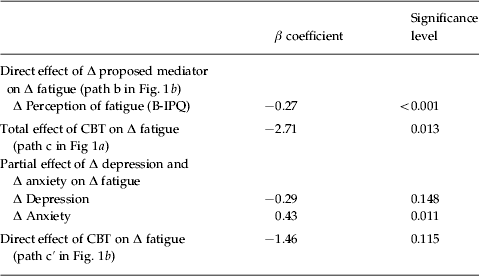
The mediation analysis was repeated with the B-IPQ score as the proposed mediator and the changes in anxiety and depression as covariates. As can be inferred from Table 4, the change in the negative perception of fatigue is still a mediator of the effect of CBT even when the effects of the reduction in anxiety and depression are taken into account. The bootstrap results show that mediation was significant (mean indirect effect=−1.221, 95% CI −2.58 to −0.21). Anxiety significantly covaried with the reduction in fatigue brought on by CBT. The model explained 45% of the variance in the effect of CBT on fatigue compared to RT [adjusted R 2=0.45, F(4, 65)=14.90, p<0.001].
Regression coefficients derived from Preacher & Haye's macro (Reference Preacher and Hayes2008) with the change in perception of fatigue (B-IPQ) as the proposed mediator and the change in anxiety and depression as covariates

B-IPQ, Brief Illness Perception Questionnaire; CBT, cognitive behavioural therapy.
Discussion
The results of this study suggest that a change in the negative representation of fatigue plays a crucial role in the reduction of fatigue in MS after CBT. Having more positive views about fatigue (i.e. perceiving it as more controllable, as something one can understand, as time limited and as having less serious concrete and emotional consequences) is closely related to the reduction of severity in fatigue. This change in the overall perception of fatigue seems to be more important than the changes in the behavioural factors (avoidance, all-or-nothing behaviour and sleep problems) in mediating the effect of CBT in MS patients. The same is true for more general symptom-related errors in thinking; that is, the tendency to catastrophize or have feelings of embarrassment about MS symptoms, beliefs that symptoms signal damage to the body and the tendency to focus on MS symptoms. The changes in these beliefs do not mediate the specific effect of CBT on fatigue. Our findings are in accordance with three previous studies that used mediation analysis to study mechanisms of change in behavioural interventions for chronic fatigue. These studies found that, in patients with CFS, it was not the increase in physical activity or fitness but a change in cognitions that mediated the positive effect of both CBT and graded exercise therapy (GET) on the level of fatigue (Moss-Morris et al. Reference Moss-Morris, Sharon, Tobin and Baldi2005; Wiborg et al. Reference Wiborg, Knoop, Stulemeijer, Prins and Bleijenberg2010, Reference Wiborg, Knoop, Prins and Bleijenberg2011). Our findings also support the broader discussion of the central role of cognitions in the perpetuation of chronic fatigue (Knoop et al. Reference Knoop, Prins, Moss-Morris and Bleijenberg2010). It seems that a focus on changing unhelpful cognitions about fatigue needs to be a key ingredient in future interventions for fatigue.
In light of some of the existing literature on the relationship between depression and fatigue in MS patients (e.g. Mohr et al. Reference Mohr, Hart and Goldberg2003), it was particularly interesting that the decrease in fatigue following CBT was unrelated to the reduction of depressive symptoms. This suggests that a change in depressive symptoms is not crucial for a reduction in fatigue. It also suggests that a CBT-based fatigue intervention needs to target specific fatigue-related beliefs rather than focus on general negative self-evaluations that are characteristic of depression. This is in accordance with previous research that showed that illness- and symptom-specific cognitions are associated with CFS but that the more traditional depressogenic cognitions such as low self-image and misinterpreting personal interactions are not (Moss-Morris & Petrie, Reference Moss-Morris and Petrie2001).
Several aspects of MS can induce anxiety, such as the potential for relapse and progression of the illness and uncertainty about the future. The relationship between MS fatigue and anxiety has not received much attention, but some studies have found a modest association with fatigue (Bol et al. Reference Bol, Duits, Hupperts, Vlaeyen and Verhey2009). The results of our treatment suggest that this relationship is relevant in an intervention for MS fatigue as the decrease in anxiety covaried with the reduction in fatigue. The nature of this relationship is unclear. It could be that, by learning to cope with fatigue (and perhaps other MS symptoms) in CBT, a patient's anxiety decreases. It could also be that a reduction in anxiety leads to a further decrease in fatigue. Further research is needed to better understand the relationship between the change in fatigue brought on by CBT and anxiety in MS.
A limitation of our study is that the RT originally designed as a control condition for comparison with CBT includes some active components. Although CBT was significantly more effective directly following treatment, the RT also led to a significant reduction in fatigue. Several possible explanations for the unexpected positive effect of RT on fatigue were given in the original study (van Kessel et al. Reference van Kessel, Moss-Morris, Willoughby, Chalder, Johnson and Robinson2008). Non-specific treatment factors including support, therapist time and attention were present in both conditions and could have had a positive effect on fatigue in the RT. The RT also included components that are core elements of CBT for MS fatigue, such as providing a treatment rationale, collaboration, active participation, and homework. There are indications that the positive effects of more non-specific or placebo conditions on fatigue are related to an increased belief that an MS patent can effectively control and manage this symptom (Bol et al. Reference Bol, Duits, Hupperts, Vlaeyen and Verhey2009). However, the current study suggests that CBT has a greater effect on these perceptions that RT, which goes some way in explaining why CBT was the more effective treatment.
It is also possible that changes in some of the other variables that were not responsible for the specific effect of CBT (improved sleep, other cognitive behavioural variables, depression and anxiety) did mediate the reduction in fatigue that occurred in both conditions. In the original study we suggested that RT may have a positive effect on sleep, which may in turn improve fatigue. The results of the current study do not support this hypothesis as there was no significant difference in self-reported improvement in sleep between the RT and CBT groups. A comparison in a future study of the effects of CBT with a waiting list control condition for MS fatigue could provide more insight into the mediators of the effect of CBT.
A limitation of this study was that we relied on self-report measures to assess behaviours. It could be argued that these do not necessarily reflect the actual behaviour of patients and therefore do not correctly assess the role of behaviour change in the reduction of fatigue. For some behavioural changes more objective measures, such as actigraphy, are available to assess changes in sleep or physical activity, and these could be used in MS patients (see, for example, Wiborg et al. Reference Wiborg, Knoop, Stulemeijer, Prins and Bleijenberg2010).
Another limitation is the fact that a few of the constructs being measured show some overlap. This is especially relevant for the assessment of fatigue severity and the perception of fatigue. The B-IPQ and the CFQ are significantly correlated in our patient population (r=−0.34 in the total group of 70 patients, p=0.01), signifying some shared variance. However, the correlation is small to moderate in size, suggesting that it is valid to separate beliefs about the fatigue and the experiences of the severity of the fatigue.
A final limitation of our study is the fact that both the proposed mediators and fatigue were measured at the same time. Process measures, with assessments of the change in mediators prior to the change in outcome measures, are necessary to draw firmer conclusions about an assumed causal relationship between the change in fatigue-related cognitions and the reduction in fatigue. We consider that our understanding of how CBT works would be greatly enhanced if more treatment studies measured potential mediators prior to outcome measures.
Although this study can be seen as preliminary, it is the first to investigate the mechanisms of change in an effective intervention for MS fatigue. The findings suggest that negative beliefs about fatigue play a central role in the maintenance of fatigue in MS. This could aid in the development of more effective and efficient interventions that are specifically aimed at the perceptions of fatigue.
Acknowledgements
This paper was written while H. Knoop was a visiting staff member of the School of Psychology at the University of Southampton. The working visit was made possible by a grant from the Dutch MS Research Foundation (Stichting MS Research). The original RCT was funded by a grant awarded to R. Moss-Morris by the New Zealand Neurological Foundation.
Declaration of Interest
None.