Introduction
Historically, dementia has been portrayed as a slow living death, destroying a human being as a person and moral agent. Although this perspective is no longer prevalent in modern clinical practice, it still influences the way in which people with dementia are related to, considered and conceptualized. Tom Kitwood was the first scholar to use the term ‘person-centred’ in relation to people living with dementiaReference Brooker1, Reference Kitwood2 with the aim of bringing together ideas and ways of working that emphasized communication and relationships, rather than medical and behavioural management. Kitwood built on the work of Carl Rogers, one of the founders of the humanistic approach to psychology. Rogers emphasized an empathic understanding of a person's internal frame of reference and the endeavour to communicate this experience to the person.Reference Rogers3,4
The concept of personhood is at the core of person-centred care (PCC). Personhood emerges in a social context: ‘personhood is not, at first, a property of the individual; rather, it is provided or guaranteed by the presence of others’ (Kitwood and Bredin, 1992; Reference Kitwood and Bredin5 p. 275). Kitwood's theoretical perspective stated that being cognitively impaired does not necessarily reduce personhood but rather it was not being recognized as a person that could cause severe ill-being, or even the state of vegetation. He predicted that this would erode the global psychological states that are fundamental for all human beings: self esteem, sense of agency, social confidence and hope.Reference Kitwood6
However, PCC is often used synonymously with individualized care, and the emphasis on relationships that Kitwood promoted gets lost. Indeed, the concept of relationship-centred care was developed as a counter to this emphasis on the individual.Reference Kitwood2, Reference Kitwood and Bredin5, Reference Brooker7 In an earlier review in this journal,Reference Brooker1 a four-part composite definition of person-centred care in relationship to people with dementia was developed. This definition synthesized different threads emerging at that time in the literature and rhetoric of person-centred care whilst maintaining the sophistication of Kitwood's original ideas. Using the acronym VIPS (commonly understood as Very Important Persons) person-centred care was defined as having four major elements:
V a Value base that asserts the absolute value of all human lives regardless of age or cognitive ability;
I an Individualized approach, recognizing uniqueness of the person living with dementia;
P understanding the world from the Perspective of the of the person living with dementia;
S positive Social psychology in which the person living with dementia can experience relative well-being.
Following the publication of the review, the VIPS definition was incorporated in the NICE/SCIE Guideline on Dementia.8 Professional dementia care is dependent on attributes of organizations as well as individual practitioners. The VIPS definition was subsequently utilized to provide an evidence-based structure for good practice in person-centred care in the dementia care field – particularly in relation to care home practice.Reference Brooker9 Given the complexity of defining person-centred care it was deemed helpful to delineate a set of concrete indicators that care providers could benchmark their services against. Pilot indicators were reviewed by around 50 care providers and service user organizations worldwide to arrive at a detailed description of what a person-centred care provider should have in place. This list of 24 indicators grouped around the four elements of the definition set out above has become known as the VIPS framework.Reference Brooker9–Reference Brooker and Dening12 It has been taken up by many English-speaking care providers and the concepts have been translated into German,Reference Brooker and Rusing13 Japanese and Norwegian, and with translation planned in Portuguese and Spanish.
Recently, the VIPS framework has been utilized as a structure for guiding interactions and communication with health care professionals and people living with dementia14 from early diagnosis to palliative care. The VIPS elements are used as the general guiding principles for health care practitioners to reflect on their interactions with people with dementia and their families. These reflective questions include:
• Does my behaviour and the manner in which I am communicating with this person show that I respect, value and honour them?
• Am I treating this person as a unique individual?
• Am I making a serious attempt to see my actions from the perspective of the person I am trying to help? How might my actions be interpreted by this person?
• Does my behaviour and interactions help this person to feel socially confident and that they are not alone?
These guiding principles can be applied in all professional interactions with people with dementia. They can be applied when professionals or care workers are involved in delivering a clinical procedure such as giving an injection or changing a dressing; they can be applied in situations where the person with dementia is being helped to complete a self-care task such as using the bathroom; equally they can be applied in discussions about care management or in running psychosocial interventions such as a reminiscence group. It is not the task that is person-centred but the way in which that task is done that can make it person-centred or not.
The 24 VIPS indicators provide a checklist that care providers can use as a benchmark to assess the person-centredness of their service for people with dementia.14 There is still a gap in provision, however, for how to provide a way forwards for using the VIPS framework to implement changes in practice and to provide ideas and practical resources that can be used to meet different challenges. The Care Fit for VIPS website (www.carefitforvips.co.uk) provides an online free tool kit for both undertaking a benchmark, creating an action plan and in locating online resources that can assist with quality improvement plans. This is subject to an on-going evaluation in practice.
The VIPS framework was operationalized into the VIPS practice model (VPM)Reference Rosvik15 for achieving person-centred care in Norwegian nursing homes and home care. A recent randomized controlled trial (RCT) showed positive results. The development of the VPM was built on evidence-based practice. It is presented below and its application in practice is reviewed.
The VIPS practice model (VPM)
It is contended that PCC is far more talked about than it is implemented. Kitwood also pointed out that ‘The challenge is to get organizations to do it, rather than simply maintain a facade’ (Kitwood 1997;Reference Kitwood16, Reference Baldwin and Capstick17 p. 115). Kitwood did not offer a comprehensive practice-friendly framework for translating his ideas into action.Reference Baldwin and Capstick17, Reference Dewing18 For many professionals and staff, PCC continues to remain an elusive ideal. Nursing staff have been shown to have a limited conception of PCC.Reference McCarthy19 Despite the development of the VIPS framework in written and online forms, having a vehicle for how to put these into everyday institutional practice may still be required. Also, in order to evaluate the utility of the framework through an RCT it was necessary to develop a replicable protocol. This led to the development of the VIPS practice model in Oslo, Norway, in 2010. It was trialled in a 9-week pilot study in two nursing homes and evaluated in four focus groups.Reference Rosvik15 Adjustments were made following the pilot study and focus groups before it was tested within the RCT mentioned above.
Basing care on PCC values is not simply about adopting a new terminology, it means to develop a culture of care that includes people with dementia in social relations and meaningful activity.Reference Kitwood16 Culture has been defined as a link or transition between individual and collective behaviour. Organizational culture can be perceived as something embodied in individuals but shared by the collective.Reference Carlstrom and Ekman20, Reference Miettinen and Virkunnen21 The development of the VPM (Table 1) addressed the problems of how to build a shared base of person-centred values in the staff, followed by and intertwined with the challenge of seeing a situation from the perspective of the person with dementia, and the further problem of applying knowledge of PCC acquired at training courses in concrete situations; in other words, how to facilitate the transition of PCC values and knowledge embodied in the individual nurse to collective behaviour of the staff.
The VIPS practice model (VPM): the vehicle for change

The VPM was designed to address these problems within existing resources and routines in the nursing home setting. In Norway the traditional form of organization in nursing homes is wards of 20–25 residents with a registered nurse providing the administrative and professional lead for each ward. Special care units (SCU) for people with dementia have fewer residents (11–15). The staff–resident ratio on a day shift on a week day is normally around 3:10 for regular wards and 3.5:10 for SCUs.Reference Kirkevold, Sandvik and Engedal22 In many nursing homes, some of the wards are divided into smaller units, for instance SCUs. The staff in the wards consists of approximately 50–60% auxiliary nurses (AN), 20–30% registered nurses (RN) and 10–15% unskilled workers in addition to other types of health care professionals, with more RNs in the SCUs than in ordinary wards.Reference Kirkevold, Eek and Engedal23 In the VPM the ANs in the ward have central roles and functions.
The VPM education programme
Practice can be defined as ‘a coherent set of human actions characterised by a commonly understood object, or good – i.e. telos; and by a socially structured and commonly accepted repertoire of means, whether instruments or skills (. . .) as well as commonly understood norms’ (Wartofsky, 1987; p. 364).Reference Wartofsky, Shimony and Nails24 Previous research has shown that training courses alone are seldom enough to achieve and maintain changes in practice. Repeated feedback and ongoing supervision are necessary to prevent staff from reverting back to previous styles of working.Reference Spector, Orrell and Goyder25–Reference Burgio27 It is often difficult for an entire care team to attend the same training course. Those who attend the course face the challenge of conveying new ideas to the rest of the team as well as convincing them of the benefits of change. Studies report concerns that organizational factors may limit the impact of educational programmes or prevent staff from applying ideas from training consistently in practice.Reference Moniz-Cook28, Reference Visser29 Implementing ideas acquired at PCC training courses, such as individualized care planning or group activities, often impacts on the routines in the care facility. A routine is a stabilized, rule-governed pattern of acting, the skills of an organization.Reference Miettinen and Virkunnen21 Reflective thought is needed when institutionalized ingrained behaviours are at odds with changing circumstances;Reference Miettinen and Virkunnen21 in other words, when the ways of working do not support the new desired values. To be able to see whether routines can be flexible in accommodating change, the routines themselves must be discussed. This can be done by making reflection on practice a part of an activity. The team can formulate hypotheses about important problems and their causes in a selected area which are tested, adjusted and then changes are embedded into the routines.Reference Miettinen and Virkunnen21
To facilitate the continuous collective reflection that leads to learning and changes in practice, the VPM makes staff active participants in the decision-making process in the consensus meeting (see Table 1). This is in line with Vygotsky's sociocultural approach to learning,Reference John-Steiner and Mahn30 in which the students play an active role in learning, and collaboration is essential in order to facilitate meaning construction.Reference Vygotski31 The staff selected to hold key roles within VPM are selected by the management team and attend a two-day course. The director of the institution is also invited and recommended to participate. The course provides an introduction to the main concepts of PCC and the VPM and is regarded as the starting point of the process of implementing PCC.
The perspective of the person with dementia is central throughout the training course. Films and stories are used to illustrate how people with dementia may experience the world around them. Role-plays based on situations from their own practice are utilized to train the participants in understanding the perspective of the resident. All participants try out the different roles in the VPM to be prepared to give support and feedback in the implementation in their work place. After the basic course the education and coaching is continued within the staff group undertaking change. In Norway this would be the staff group in a ward. The staff group receives a three-hour introduction to PCC and the VPM. This is a ready made programme with lectures on DVD covering the main topics in the basic course, and films illustrating the perspective of the person with dementia and the consensus meeting. The films and DVDs can also be used if a ward is having difficulties with the implementation of the VPM or as a part of the introduction to new staff.
A VIPS manual with practical knowledge and examples of PCC and non-pharmacological treatment related to each indicator in the VIPS framework is available at the nurse's station. It also contains assessment tools for wellbeing, behavioural and psychological symptoms of dementia (BPSD), pain, etc., with descriptions of when and how to use them. The staff can take the VIPS manual or the films and DVDs home to look at them on their own. The senior staff also receive a Consensus Meeting Manual, which elaborates on the different roles and how to supervise the staff.
The VPM staff roles and functions
The V-indicators in the VIPS framework describe that if the staff who deliver direct care feel valued for the work they undertake, they will in turn value those they care for on a day-to day basis.Reference Brooker1, Reference Brooker9 An AN undertakes the leadership of the consensus meeting, a role known as the Resource Person (RP). As ANs constitute the majority in Norwegian nursing homes, an AN holding this function contributes to the legitimacy of the VPM in staff.Reference Rosvik15 The threshold to approach the RP is low for the front-line staff and, being an AN, the RP knows what care situations currently concern them the most. Based on input from the staff, the RP prepares the agenda together with the leading RN in the ward.
The P-element in the VIPS framework is about treating the rights of the person with dementia as important as the rights of other people in the same situation.Reference Brooker1, Reference Brooker9 In the consensus meeting the staff reflect on and discuss resident–staff interaction. The VPM has given each resident a spokesperson, the primary nurse (PN), to present their perspective and safeguard their rights when a situation concerning the resident is on the agenda. In a phenomenological-hermeneutic study nurses described difficulty in understanding and interpreting the world of the residents.Reference Hansebo and Kihlgren32 To help the primary nurse prepare, the VIPS manual contains an example of how a situation can be presented from the resident's point of view by the use of three questions:
(1) How do you think the person with dementia perceives what is happening to her/him?
(2) On what observations or knowledge of the resident do you base your assumption?
(3) What may cause the resident to react the way s/he does? Describe her/his emotional state.
The primary nurse must spend time with the resident and collect information from the family about the resident's life history, important persons and key stories to answer these questions. The resident's symptoms of and reactions to the neurological impairment and her/his general health must also be observed.Reference Kitwood16 The function of the leading ward RN is to undertake the responsibility for supporting, encouraging and thereby valuing the staff's commitment to care and their engagement with the residents. The leading ward RN is the repository for a significant body of knowledge.Reference Carlstrom and Ekman20 Middle managers, like a leading ward RN, represent attitudes, behaviour and expectations derived from personal factors such as experience, cultural norms and socialization. Middle managers in health care are in a position to strongly influence organizational change.Reference Adorian35 An RN with responsibility for the professional development in the wider institution has the role of an internal VIPS coach in the nursing home. The coach's function is to give the three-hour introduction of the VPM to the whole staff group and to new staff. The coach also provides supervision and support to the RPs and the leading ward RNs in groups or individually when needed.
The VPM consensus meeting
According to organization theory, the organization is conceptualized as a dynamic balance between individual competence, the control that exists in formal structures, and teamwork.Reference Keidel34 Studies from other health care settings have shown the effectiveness of teamwork. Regular team discussions and feedback have significantly improved detection, treatment and follow-up of patients with high blood pressure.Reference Adorian35 Furthermore, teams focusing on listening to all members, carers relatives and residents have been shown to improve risk assessment in mental health care.Reference Reith36 A supportive culture in teams is a powerful source that benefits change processes;Reference Firth-Cozens37 the feeling of belonging to a community can have a favourable effect on readiness for change.Reference Elwing38 Studies have found that organizations that succeed in implementing and sustaining change possess cultures with two seemingly opposite characteristics: openness for change and structure.Reference Alharbi39 A regular forum for professional development, the consensus meeting, is the strategy to obtain these qualities in the VPM.
It was recommended that the consensus meeting should be held weekly. It was seen as a continuation of the process of culture change that was initiated by the basic course. The structure ensures that all staff understand their roles; the agenda gives them opportunity to prepare. The main issue on the agenda, chosen from proposals from the staff, is an actual situation that is causing distress for the resident. A common example would be where a resident was agitated whilst being given help with personal hygiene during morning care. At the start of the consensus meeting the PN presents the situation from the resident's point of view. The other staff supply their observations of the resident's needs, habits or reactions. The situation is then assessed in relation to all four elements in the VIPS framework. A few minutes are spent to choose which of the 24 indicators are the most relevant to the situation or the best place to start in order to meet the needs of the resident.
Staff discuss their knowledge and arrive at a workable decision or changes to improve the quality of care. Interventions might also be to use assessment tools to elucidate the underlying causes of behaviour. The interventions are assessed on behalf of the resident by the PN. The date for review of the interventions is set and the PN records the decisions in the resident's record or care plan. Resident-focused evaluation is seen as essential to decide if the interventions benefit the resident and for the staff to stay focused on the resident's wellbeing.
Barriers in implementation of the VPM
The VPM was designed to fit within existing resources and routines in the care unit and to be easy to implement. Even so, barriers were encountered, particularly the frequency of the consensus meeting.Reference Rosvik15 None of the units that took part in the RCT conducted weekly consensus meetings; the median number of meetings was 1.4 per month. The main reason conveyed was that the leading ward RN did not attend the consensus meetings but left it to the RP to handle it. It has been contended that the middle manager is the only one in the organization with the real potential to calm troubled employees, for instance when a process of change occurs.Reference Huy40 Interventions decided upon in the consensus meeting often did not have legitimacy in the staff if the leading ward RN was not present to sanction and authorize them.Reference Rosvik15 Neglect is a concept in organizational research signifying non-management. It may be a deliberate strategy to let competent staff solve problems by themselves, but it could also be a solution to an intolerable situation for a leadership who has too many and conflicting responsibilities and expectations.Reference Carlstrom and Ekman20 A study of the implementation of a new IT documentation system in a health care setting found that a co-operative culture combined with a consensus-building leadership led to effective adoption of decisions.Reference Scott41 In Norway, the absence of the leading ward RN in the consensus meetings may be explained by competing priorities from administrative tasks such as budget management. It may be necessary to discuss how the leading ward RN's time is to be spent, and whether the main task is to be administrative assignments or professional engagement in the ward.
Another barrier in implementation of the VPM was high staff turnover, both among the leading ward RNs and ANs holding roles as RPs. Sometimes this meant that no staff in the ward had attended the basic VIPS course. The internal VIPS coach trained new staff using the films, DVDs and the VIPS manual; still, it meant that the process in the ward was delayed.
Improving and sustaining change using VPM
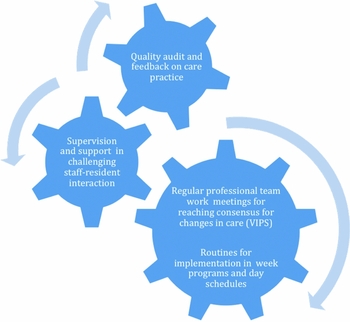
The future plan of development for the VPM is to make it a part of a system of methods working together as cogwheels running into each other (Figure 1). Supervision from external experts can help staff through difficult periods; for instance, when facing the resident's symptoms of and reactions to the dementing illness is perceived as demanding that it reduces the nurse's confidence in her/his ability as a caregiver.Reference Kitwood6, Reference Kitwood16 Dementia care mapping (DCM)Reference Kitwood6, Reference Brooker42 or other on-going audits could be utilized as the component providing quality audit and feedback on effects of care routines. To strengthen the structural component, weekly programmes and daily schedules saying who will do what and when may be added to ensure that changes are implemented in daily practice.Reference Røen, Storlien and Rokstad43 Together these components are suggested as a means of providing more power to sustain change.
Model with components for implementation and sustainability of person-centred care

Conclusion
The VIPS framework is a four-part definition of PCC used as the general guiding principles for health and social care practitioners to reflect on their interactions with people with dementia and their families. It was introduced to provide the evidence base for good practice in person-centred care in the dementia care field – particularly in relation to care home practice. To provide a way forwards for using it to implement changes in practice, the VIPS framework has recently been operationalized into the VPM for achieving person-centred care in Norwegian nursing homes. The VPM addresses the problems of how to build a shared base of person-centred values in the staff followed by and intertwined with the challenge of seeing a situation from the perspective of the person with dementia, and further the problem of applying knowledge of PCC acquired at training courses in concrete situations. It is regarded as feasible in care homes, but is dependent on the engagement of leadership to overcome the barriers of implementation. The next step suggested in order to sustain changes and maintain a PCC culture of care is for the VPM be a part of a system of methods that can work together to provide structure as well as openness for change.
The original VIPS definition of person-centred dementia care grew out of a review of the literature on person-centred dementia care. This has led to a number of practical applications in the dementia care field, VPM being the most recent. VPM as a vehicle for change in Norwegian care homes utilized the literature on organizational change to build a sustainable practical model. Although there were issues with the frequency of the consensus meetings, they still provided a productive reflective space, utilizing principles of clarifying staff roles, education, taking the perspective of the person with dementia, valuing front-line staff, providing coaching and supervision, and having measurable outcomes. Reviewing literature to build models and interventions that have practical applications is central to this work.
Conflict of interest
None of the authors has any conflict of interest to declare.
Acknowledgements
This work was funded by The Research Council of Norway.