Introduction
If we asked a range of people what is the question for exploring planets beyond our own, we suspect the dominant answer would be: Does life exist beyond Earth? As for the next most important question, we suspect there would be debate. That being acknowledged, we will suggest a second tier question that revolves around issues central to life: the balance between chance and necessity, contingency and determinism, order and irreversibility (Bohm Reference Bohm1961; Monod Reference Monod1970; Prigogine Reference Prigogine1996).
The question we pose relates to habitability – the ability of a planet to harbour life. Studies that have sought to provide a tighter definition of the term habitability, by elucidating specific conditions required for life, are numerous and continue to grow. Whatever specific conditions are attached to habitability it is being used, and will continue to be used, as a variable to classify planets (e.g. different groups can disagree on criteria critical for life on our own planet but all still refer to the Earth as habitable). This suggests a question: When we use habitable as a variable to categorize planets, what type of variable are we talking about?
To make distinctions clear, and to connect to the habitable zone concept (Kasting et al. Reference Kasting, Whitmire and Reynolds1993), we start with a phase diagram (Fig. 1). A phase change framework has been employed for issues ranging from innovation (Bahcall Reference Bahcall2019) to the origin of life (Smith and Morowitz, Reference Smith and Morowitz2016) and, as we will discuss, habitability. In a phase change framework, the particular temporal path that leads to the crossing of a phase boundary does not affect whether a phase change will occur. There is also a level of reversibility – if the boundary is re-crossed, in the other direction, the system returns to the initial phase. In short, phase is a state variable (Bridgman Reference Bridgman1941).
Phase diagram for water.

The counter to a state variable is a process variable (Bridgman Reference Bridgman1941). Process variables have path dependences and allow for hysteresis. This introduces irreversibility as the boundary between modes can depend on the direction of the transition between them. It also introduces a probabilistic element as differences in initial conditions, and/or contingencies along evolution paths, can lead very similar starting evolutions to diverge in terms of whether they do or do not transition between modes of behaviour. An example of a state variable (beyond the phase of matter) is temperature. An example of a process variable is heat. The latter is energy that flows through a system whereas the former is a measure of the internal energy of a system.
This sets up our second tier question: Is habitability a state or a process variable? Is it something that characterizes a planet or is it something that flows through a planet? This relates to another question about habitability that has become the subject of recent debate: Is habitability a binary or a continuous property (Cockell et al. Reference Cockell, Stevens and Prescott2019; Heller Reference Heller2020).
Nature shies away from being pigeon holed, so an answer to our question might be ‘something in-between’. Granted, but the issue we pose is can we use future observations, from planets in solar systems beyond our own (exoplanets), to help us answer where the balance lies? We argue that this is within reach and requires no new theoretical/modelling studies. That said, it can feed into future modelling. The next section discusses observational tests and readers principally interested in that aspect can bypass the section that follows. Readers interested in how the question posed could feed into theory and modelling can read the ‘Implications’ section.
Observational tests
The habitable zone is defined as the region around a star with surface conditions that allow for liquid water. The habitable zone concept has been used to guide target selection for exoplanet observations. Arguments against this strategy being acknowledged (Stevenson Reference Stevenson2018), we will take the pragmatic view that it will continue (Wright Reference Wright2019). The issues we pose do not relate to the utility of the concept for target selection. Rather, they relate to a priori expectations of what will lie within the habitable zone and how that can influence the nature of observations that will be made.
Figure 2(a) is based on habitable zone models (Kopparapu et al. Reference Kopparapu, Ramirez, Kasting, Eymet, Robinson, Mahadevan, Terrien, Domagal-Goldman, Meadows and Deshpande2013). The models involve considerations of solar and internal planetary energy. Internal energy drives volcanic and tectonic activity that can buffer greenhouse gasses in the atmosphere of a planet (Walker et al. Reference Walker, Hays and Kasting1981). Lower/higher levels of greenhouse gasses nearer/farther from a star can expand the region where temperate conditions can be maintained (Fig. 2(b)). The volcanic-tectonic activity of planets, and associated buffering of greenhouse gases, has also been approached from a regime diagram view that treats planetary tectonics as a state variable (Foley and Driscoll Reference Foley and Driscoll2016).
(a) Diagram of the habitable zone concept. (b) Connection between the classic habitable zone and buffered levels of atmospheric greenhouse gasses.

The classic habitable zone model is testable (Bean et al. Reference Bean, Abbot and Kempton2017). Observational constraints from terrestrial exoplanets, receiving different levels of stellar energy, can be used to determine if a habitable zone prediction is supported by observations (Fig. 3(a)). Multiple observations will be required as the test needs to allow for the potential of variations about a mean trend (Fig. 3(b)). As such, the tests will be statistical (Checlair et al. Reference Checlair, Abbot and Webber2019).
Proposed tests of the classic habitable zone concept.

The test of Fig. 3 allows for a negative result. If observations do not follow the predicted trend, then this could indicate that life beyond Earth is rare. The debate between a rare Earth hypothesis and the principle of plenitude is a long standing one in our thinking about life beyond Earth (Cirkovic Reference Cirkovic2018). That exoplanet observations could be used to address the debate is an added motivator for adopting a statistical strategy for future explorations (Walker et al. Reference Walker, Bains and Cronin2018).
Whatever strategy is adopted, humanity will be exploring the unknown. Having a hypothesis in hand when exploring the unknown is a part of science. However, assuming a singular view of habitability could lead to incorrect inferences. The idea of approaching exploration via multiple working hypotheses stems from this type of concern (Chamberlin Reference Chamberlin1897). The philosophy of multiple working hypotheses relates to the question of how do we anticipate unknowns. Francis Bacon proposed a method: If one wants to test an idea, then one should consider the most extreme, yet viable, alternative and seek to show it correct (Bacon Reference Bacon, Ellis and Spedding1620). An alternative hypothesis is not the same thing as allowing for the null of a particular hypothesis (i.e. allowing for a negative result). A goal is to expand thinking about potentiality space. As observations come in, one should be prepared to adjust expectations, update alternatives, and add new alternatives accordingly (Feduzi and Runde Reference Feduzi and Runde2014). The classic habitable zone concept, in effect, treats habitability as a state variable. By association, regime diagrams are viewed as valid for helping us understand future observations. An implication is that valid inferences can be made without having to consider temporal evolution paths. The alternative is that habitability cannot be viewed as a state variable, even at a level of approximation. It should be viewed as a process variable until observations show otherwise.
Process variables depend on factors that must, for all intents and purposes, be viewed as chance. A thought might be that, as a result, a process variable hypothesis is untestable. That is, observations we will have from exoplanets, observations made at a point in time, cannot provide information about historical contingencies, concatenations and/or stochastic processes. If this was the case, then statistical mechanics would fail. It has not (Landau and Lifshitz Reference Landau and Lifshitz1951). The hypothesis is testable in the same way that the classic view of habitability is testable.
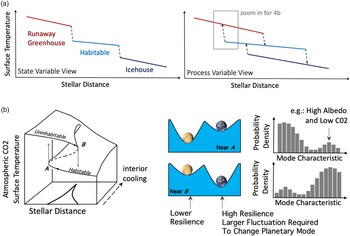
If habitability is a process variable, then planets will allow for bistable behaviour in terms of being habitable and un-inhabitable (Lenardic et al. Reference Lenardic, Crowley, Jellinek and Weller2016). History will play a role and multiple modes of behaviour will be possible (Fig. 4(a)). Stochastic events and/or contingencies can be treated as perturbations that can cause mode transitions over time. The relative odds of transitions will depend on the stability properties of different modes (chance blends with an element of necessity). The statistical expectation, from a number of planets that have evolved as long as the Earth, is for a bimodal distribution (Fig. 4(b)). Observations can be used to discriminate between a bimodal versus a unimodal distribution of atmospheric gas abundances and/or planetary albedos. This provides a first-order discriminant between habitability as a process versus a state variable.
Habitability as a process versus a state variable (a) along with potential tests (b).

A proof of concept already exists for the above (Bruno et al. Reference Bruno, Lewis, Stevenson, Filippazzo, Hill, Fraine, Wakeford, Deming, Kilpatrick, Line, Morley, Collins, Conti, Garlitz and Rodriguez2017). The study focused on two Jupiter-like exoplanets that are similar in multiple respects. A quote from the second author encapsulates the pertinent results: ‘Right now, they appear to have the same physical properties. So, if their measured composition is defined by their current state, then it should be the same for both planets. But that's not the case. Instead, it looks like their formation histories could be playing an important role’. Although the planets may have diverged early (near formation), the divergence could have been more recent. In any event, history (planetary path) is playing a key role. A similar approach could target exoplanets that are like Venus in terms of size, mass, star type and stellar distance. If a planet of this type shows indications of clement climatic conditions, then this would support the hypothesis that habitability is a process variable. This, in turn, would support the idea that present day Earth–Venus differences are not principally due to differences in the size and orbital parameters but are, instead, due to historical contingency. By association, methods that address Earth-Venus differences by scaling Earth models to Venus conditions would lose validity.
Although the above involves a search slightly outside the classic habitable zone, it does not require a major revision in terms of search strategies. Exploring the Venus zone is already being argued for based on scientific goals different than the ones discussed herein (Kane et al. Reference Kane, Arney, Crisp, Domagal-Goldman, Glaze, Goldblatt, Grinspoon, Head, Lenardic, Unterborn, Way and Zahnle2019). This is bolstered by studies that have shown the viability of habitable planets within the Venus zone (Way and Del Genio Reference Way and Delgenio2020). It could also provide a test for the idea that life can expand habitability beyond what we would imagine based on models that do not account for biologic feedbacks (Maxwell Reference Maxwell, Campbell and Garnett1873; Lotka Reference Lotka1924; Lovelock and Margulis Reference Lovelock and Margulis1974; Zuluaga et al. Reference Zuluaga, Salazar, Cuartas-Restrepo and Poveda2014).
Future observations may focus on the conservative habitable zone. At present, we do not have enough observations to know whether the heart of the habitable zone actually lies from a galactic perspective but, from a practical standpoint, arguments could be made that we focus on planets most akin to Earth in terms of size, mass and orbital parameters. Discriminating between a state versus a process hypothesis of habitability will require determining if the population of such planets follows a unimodal or a bimodal distribution in terms of observables that connect to temperate surface conditions. The number of observations needed is difficult to pre-specify but, as a rule of thumb, a minimum of 30 planets would need to be characterized (Hogg and Tanis Reference Hogg and Tanis1997; Lenardic and Seales Reference Lenardic and Seales2019). In terms of assessing the number of observations needed, the distinction between a bimodal distribution and a unimodal distribution with outliers should be kept in mind. If a distribution is bimodal, then each modal region must have observed planets within it that exceed one or two (it is possible that the Earth is an outlier in a unimodal distribution, which would support the rare Earth hypothesis more so than it would support the idea that habitability is a process variable).
The approach above comes with added cost and added gain. Metrics have been proposed to characterize exoplanets relative to Earth (from Earth-similarity to habitability indices that use Earth as a cornerstone). At present, we do not know where the Earth itself sits on a habitability index (planets in habitable wells near points A and B in Fig. 4 are not the same). We can make predictions where the Earth sits in a galactic distribution but observations are lacking. This is an added value of using exoplanet observations to discriminate between habitability as a property versus a process -–whichever is favoured, we will learn more about our own planet within a galactic context.
Theoretical and modelling implications
The habitable zone concept is connected to models and theory (Walker et al. Reference Walker, Hays and Kasting1981; Kasting et al. Reference Kasting, Whitmire and Reynolds1993; Kopparapu et al. Reference Kopparapu, Ramirez, Kasting, Eymet, Robinson, Mahadevan, Terrien, Domagal-Goldman, Meadows and Deshpande2013) as is a process variable view (e.g. it connects to studies that argue for the viability of bistable climate (Budyko Reference Budyko1969; Leconte et al. Reference Leconte, Forget, Charnay, Wordsworth, Selsis, Millour and Spiga2013) (Spiegel et al. Reference Spiegel, Menou and Scharf2008) and global volcanic-tectonic modes (Sleep Reference Sleep2000; Crowley and O'Connell Reference Crowley and O'Connell2012; Weller and Lenardic Reference Weller and Lenardic2012; Lenardic et al. Reference Lenardic, Crowley, Jellinek and Weller2016). Hypotheses discrimination does not require added modelling. However, putting results into context will make use of models and theory. It could also drive new modelling studies constructed with statistical data in mind.
Modelling planetary habitability has become a cottage industry with models spanning a range of complexity. In choosing a level of model complexity, it is useful to consider observations that will be available to constrain models. The idea of minimal models stems from this consideration (e.g. Brooks and Tobias, Reference Brooks and Tobias1996; Barzel et al., Reference Barzel, Liu and Barabasi2015). Anticipating that forthcoming observations may be in the form of statistical distributions suggests a particular minimal approach.
The behaviour sketched in Fig. 4(b) is an example of a cusp catastrophe (Thom Reference Thom1983; Arnold Reference Arnold1986). The term catastrophe stems from the applicability of Thom's theory to systems that display large, and often sudden, changes in behaviour for variations in a system parameter. Catastrophe theory classified a finite number of generic mathematical forms that could allow for this (akin to normal forms in bifurcation theory Guckenheimer and Holmes Reference Guckenheimer and Holmes1983). The cusp is one of those fundamental forms. The generic behaviour of systems that allow for cusp catastrophes can be modelled, independent of detailed differences between specific systems, using a minimal complexity level model that describes that catastrophe form. This approach has been applied to good effect in ecological modelling (Scheffer Reference Scheffer2009). We take it as a starting point. Our intent, herein, is not specific application(s) to exoplanets but rather to suggest an approach that is not standard in habitability studies to date.
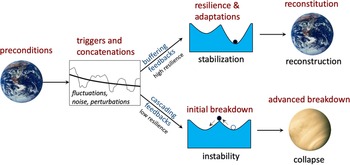
Figure 5 diagrams the approach. Bimodal behaviour is modelled by treating each mode as an attracting domain/basin in system space. Models start in one of the attracting basins (the precondition). Habitability models often track mean trends (e.g. mean surface temperature over time), shown as the thick line in the second panel of Fig. 5. The approach we suggest goes beyond mean trends and focusses on how models respond to fluctuations/perturbations. These can represent endogenic fluctuations (e.g. chaotic variations in volcanic activity) or exogenic perturbations (e.g. meteorite impacts). The structure of an attracting basin and the amplitude of fluctuations/perturbations will determine if a model path remains within its starting mode. These parameters can be varied to build up statistical distributions. Assuming we start with a number of planets in a habitable basin, the procedural goal is to determine how many maintain that mode. To paraphrase the title of a popular textbook (Broecker Reference Broecker1987), this flips the problem from ‘how to make a habitable planet’ to ‘how to break a habitable planet’. In effect, the modelling problem is cast in the form of a stability problem.
Visual layout of methodology to model the robustness of planetary habitability. Although they address different problems, this figure is based on a figure that appears in Butzer (Reference Butzer2012).

The framework of Fig. 5 differs from classic stability analysis in that it tracks the robustness of planetary modes. Robustness analysis seeks to determine the persistence of a mode of behaviour to perturbations that go beyond small amplitude variations, incorporates temporal changes in system topology (e.g. the strength of different attractors) and addresses the persistence of modes subjected to multiple perturbations over time (Jen Reference Jen2003). In ecological modelling, the term resilient is often used to describe robust behaviour (Carpenter et al. Reference Carpenter, Walker, Anderies and Abel2001). Terminology aside, the modelling procedures come down to defining a system space for dynamic modes (e.g. strength of attracting domains) and determining how persistent modes of behaviour are in the face of variable fluctuations/perturbations.
The system space, for habitability variables given by x, can be defined by functions F(x) that represent different attracting basins. Often in dynamical systems theory, these functions are represented as potential functions, E(x) (Thom Reference Thom1983). Table 1 provides examples.
Model attractor space functions

Parameters in system space functions (e.g. k, m, n) can be varied to model different basin structures. Model solutions that sit at the bottom of a basin are equilibrium points (steady state solutions). Other solutions are time-dependent and a reactance time can be defined as the time it would take those solutions to return to equilibrium (e.g. Seely, Reference Seely1964; Close et al. Reference Close, Frederick and Newell2001). Model paths with long reactance times can be pushed towards mode transitions due to fluctuations/perturbations over time. There is also the possibility that a large enough single perturbation, a ‘fatal shock’, could cause a transition (Halekotte and Feudel Reference Halekotte and Feudel2020).
Using a single basin as an example, evolutionary paths can be modelled via equations of the form of

where ε(t) is a function that models perturbations, chaotic fluctuations and/or stochastic noise. The methodology is similar to structural stability analysis which also adds a noise term to test model stability in the face of unaccounted for effects – all models, by definition, exclude real world effects, some known and some unknown, and structural stability analysis determines if qualitative model behaviour is stable given inherent model simplifications (Guckenheimer and Holmes Reference Guckenheimer and Holmes1983; Seales et al. Reference Seales, Lenardic and Moore2019). Structural stability is restricted to small amplitude fluctuations applied to a static model system space whereas resilience/robustness analysis considers larger system shocks and/or temporal fluctuations and the potential that the base level model can be altered by perturbations (Jen, 2013).
Methods are available to constrain attracting basin parameters. For example, an analytic energy balance formulation has been applied to map regions in parameter space that allow for bistable volcanic-tectonic behaviour (Crowley and O'Connell Reference Crowley and O'Connell2012). The analysis can determine the relative depths of attracting basins for modes of planetary tectonics and models can then be constructed that add perturbations/fluctuations to the system space. The amplitudes of fluctuations, inherent to different tectonic modes, can also be constrained using existing models (e.g. Lenardic, Reference Lenardic2018). The strength of attracting domains connects to negative feedbacks and feedback analysis can also be used to determine the structure of an attractor space consistent with the dominant feedbacks of a system (Astrom and Murray Reference Astrom and Murray2008). Feedback-based analysis has been used to map the regions of stable and unstable behaviour in climate systems (Roe and Baker Reference Roe and Baker2010) and to solid planet issues that relate to habitability (Crowley et al. Reference Crowley, Gž and O'Connell2011; Lenardic et al. Reference Lenardic, Weller, Hoink and Seales2019; Seales and Lenardic Reference Seales and Lenardic2020).
The approach sketched above has not addressed the combined effects of solid planet and climate evolution. Doing so could provide theoretical mappings to deconvolve the effects of fluctuations over a planet's lifetime from the properties of attracting basins that represent habitable versus uninhabitable modes. That type of mapping could, in turn, provide added context for interpreting observed statistical distributions of planetary properties (which will be the result of convolved effects). Although that is an avenue for future study we can end with a toy example to show how an added issue can be brought under a minimal model umbrella.
If a mode of behaviour is statistically robust, then a finite percentage of systems that allow for it will display it. The greater the percentage, the greater the robustness in the face of a range of perturbations, fluctuations and/or contingencies (from a statistical perspective, robustness is not a binary measure). If a mode of behaviour weakens as the system is perturbed, then it is fragile. The flip side is antifragile behaviour (Taleb Reference Taleb2012). In the context of the modelling approach laid out, antifragile behaviour would lead to the progressive deepening of an attracting basin. That is, the system would be capable of reconfiguring itself in a way that enhances robustness. If habitability is a process variable, something that flows through a system, then this tendency can be put in the context of constructal theory (which would also open new modelling avenues). The principal idea of constructal theory is that flow systems will, subject to constraints, configure themselves over time so as to maximize flow through the system (Bejan Reference Bejan2000; Bejan and Lorente Reference Bejan and Lorente2006). Consideration of fragile versus antifragile habitability relates to another meta-level question: Does life enhance or weaken habitability (Lovelock Reference Lovelock1979; Ward Reference Ward2009)? Minimal models can be used to address how these different end-members can effect observed distributions.
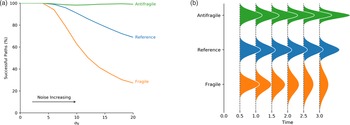
We can use equation (1) as an example. Perturbations, ε(t), are drawn from a normally distributed set defined by a mean of zero and a variable standard deviation (σ). The size of σ influences how far a model path fluctuates from equilibrium, which is set at x = 1. For illustrative purposes, a region about that attractor ranging from 0 ≤ x ≤ 2 is taken to be habitable. The parameter k determines the strength of the attractor. For our reference model we set k = 1. For k > 1, the attractor is stronger, and it is weaker when k < 1. The value of m can increase or remain fixed as a model path leaves and returns to the safe (habitable) region. If k > 1, increasing m strengthens the attractor, i.e. antifragile behaviour. If k < 1, increasing m weakens the attractor (stabilizing feedbacks tend to deteriorate). We evaluated how increasing σ, from zero to 0.2 in 0.02 increments, influenced the solution space of the three different modes of behaviour. Models began at x = 1 and m = 1 and were integrated forward in time at a non-dimensional time step of 0.01 units. At each time step, a randomly drawn value from the perturbation set was applied to a model path. If the path left and returned to the safe zone, the value of m was incremented for the fragile and antifragile modes. Once a model path ran the full model time, we restarted the model and ran it forward with a new sequence of random perturbations. For each σ value, we ran 10 000 model paths for the reference, fragile, and antifragile modes (each 10 000 path grouping is referred to as an ensemble). Figure 6(a) shows results in terms of the number of paths that remained in the habitable region. Figure 6(b) shows how model distributions evolved over time. Although a full model uncertainty quantification is required prior to model application (Seales and Lenardic Reference Seales and Lenardic2020), this simple example does show that the differences between fragile and antifragile behaviour can have observable effects on distributions.
(a) Percentage of model paths that remain within a particular region as a function of maximum perturbation amplitude. (b) Temporal evolution of distribution functions for model sets associated with a static system space (reference), with attractors that weaken with perturbations (fragile), and with attractors that strengthen with perturbations (antifragile).

Discussion and conclusion
The term habitable is commonly used as a variable to categorize planets. The question of whether habitability is a state or a processes variable sits above debates as to the specific conditions that allow a planet to be habitable (e.g. different groups can agree that it is a state variable and disagree on specific conditions required for habitability). If habitability is a state variable, a property, then it is valid to view it as binary and reversible. If it is a process, then that is not the case. Process measures are not of the moment. They need to include considerations of robustness, irreversibility and fragility (which all allow for continuous elements).
We have argued that future observations of exoplanets can discriminate between competing hypotheses as to the type of variable habitability is. This will require search strategies that come with higher, but not inordinate, cost (Bean et al. Reference Bean, Abbot and Kempton2017; Walker et al. Reference Walker, Bains and Cronin2018; Checlair et al. Reference Checlair, Abbot and Webber2019; Lenardic and Seales Reference Lenardic and Seales2019). The goal is to map distributions. We already know the Earth will be in a habitable region of any distribution(s). Beyond that, we do not know where the inhabited Earth sits in a galactic distribution (it may sit in the heart of habitability or it may be an outlier). We can assume distributions and Earth position within them but we do not know either. This is an added value of using exoplanet observations to discriminate between habitability as a property versus a process. A final implication is that modelling efforts should anticipate, and account for, observations in the form of statistical distributions.
Acknowledgments
We thank the editor for being open to discussions of meta-science and alternative working hypotheses. We thank Norm Sleep for being Norm Sleep. This work was supported by the Virtual Planets Lab (NASA Grant 80NSSC18K0829) and CLEVER Planets (NASA Grant 80NSSC18K0828)