Introduction
The international distribution of cultural products and their reception in local markets is a matter that straddles the domains of business, economics, and cultural studies. As an example of a recorded entertainment commodity, film can be replicated at little or no additional cost, encouraging as wide an international distribution as possible. Yet the cultural properties of film as an aesthetic artifact make the task of finding, and satisfying, a global audience more troublesome. As one economic study of the international film industry puts it: “… cultural products are intimately bound up with matters of selfhood, identity and consciousness … each individual’s consumption of cultural products is replete with externalities for all other individuals in the same society. Politicized responses to the flow of cultural products from one society to another are therefore to be expected.”Footnote 1 Thus, although films can technically be made available everywhere at minimal marginal cost once they are produced, consumers and regulators may have no wish accept them. As a consequence, film producers in most countries have struggled to reach international audiences.
Broadly speaking, explanations for the difficulties faced by film producers in reaching international audiences fall into two categories: a demand-side explanation, emphasizing the distinct tastes and preferences of audiences (consumers) in different countries; and a supply-side perspective, highlighting barriers or constraints limiting free access markets for foreign-made cultural products. Untangling these two effects can be very difficult. Do foreign products fail to find a foothold in domestic markets because audiences reject them in favor of locally produced content, or because these products are not easily accessible to local audiences in the first place? Most studies up to the present have treated national markets as homogeneous. In this article we examine the possibility that different audiences in different regional centers with different cultural traditions have different preferences. When analysis is focused on the subnational level, differences in consumer preferences between specific cities or regions cannot be explained by national-level policies designed to influence supply flows, such as quotas, tariffs, or tax incentives, leaving us in a better position to separate these differences for analytical purposes. The film industry is a particularly apt for this purpose, because differences in quality are not reflected in differences in price, meaning income or substitution effects are not discernible in consumer behavior.
Many existing explanations for the remarkable international success achieved by Hollywood entertainment have emphasized the roles played by firms and U.S. government departments in overcoming barriers to entry to foreign markets.Footnote 2 The activities of the U.S. State Department and the Department of Trade in pressuring foreign governments to open up their markets to U.S. film imports feature prominently in these accounts. So too does the expansion of international distribution by U.S. firms, with the major American producer-distributors operating extensive networks of distribution offices by the 1920s.Footnote 3 The extent to which audiences in these foreign markets genuinely preferred Hollywood entertainment to locally produced content is not so easy to determine. Gerben Bakker has certainly demonstrated that film production budgets in the United States escalated rapidly in the 1910s, enabling U.S. producers to take an unassailable lead over European rivals in the so-called quality race.Footnote 4 Similarly, Peter Miskell has shown that U.S. firms during the studio era built into their production portfolios a proportion of films apparently designed to appeal specifically to international audiences.Footnote 5 Clearly, throughout its history Hollywood has produced films designed to attract a widespread, international popular audience. The films of Greta Garbo for MGM during the 1930s are a famous example of this strategy.Footnote 6 But not all films emanating from Hollywood were as equally attractive to foreign audiences and outperformed home-produced films.
Set against the success of Hollywood in international markets is the knowledge that outside of the United States, indigenous production, often manifesting much poorer technical qualities, has captured significant market share in its home market. In his study of the small interwar French company Les Film Albertros, Gerben Bakker shows that in order for such firms to survive, they had to produce low-cost films of sufficient quality necessary to attract the size of audience that allowed cinema owners to cover their fixed costs.Footnote 7 Empirical studies of the Australian, British, and Dutch markets in the 1930s and the Italian market in the mid-1950s show that in each country, home-produced films could be extremely popular with audiences.Footnote 8 Yet, as Joseph Garncarz has shown for the first half of the1930s, while very few French and British films were popular in Germany, or German and British films in France, or French and German films in the United Kingdom, the American product was ubiquitous. Hollywood, as Richard Kuisel puts it, was “everyone’s second culture.”Footnote 9
The picture that emerges from this literature is the presence, since at least the 1930s, of two distinct categories of popular cinema. On the one side, we have an internationally oriented mode of production, centered in Hollywood, which conceived its audience as global. On the other side, a series of “national cinemas,” often defined against a Hollywood “other,” with a deeper but narrower domestic appeal. This phenomenon links to two related swaths of literature around the banners of “cultural distance” and the “liability of foreignness.”Footnote 10 In short, Hollywood worked assiduously (and often effectively) to overcome liabilities of foreignness, while national cinemas operated firmly within these confines.
But just how “national” were national cinema industries outside the United States? A number of studies have indicated that the output of leading national producers was often more popular in metropolitan centers than in provincial or suburban areas.Footnote 11 This article will examine not just the popularity of films in different regional locations, but also whether identifiably different types of films were developed for specific regional audiences.
One way of thinking about the choices made by film consumers is to distinguish between products that are horizontally and vertically differentiated.Footnote 12 Films are horizontally differentiated by means of their characteristics, so that when positioned along a continuum films that are perceived by consumers to be similar are clustered together. Film genres are example of horizontal differentiation, the national origins of film are another, and types of star are a third, each offering a mechanism by which consumers can readily categories cultural products, allowing them one means of navigating what Richard Caves refers to as the “infinite variety” of choice available.Footnote 13 In contrast, films that are differentiated vertically are widely recognized by consumers as being qualitatively better: some are preferred to others, hence the highly skewed distribution of revenues generated by the films released in any given market.Footnote 14 Whereas horizontal differentiation is something that can be shaped and controlled by film producers and distributors—for instance, films can be quite deliberately marketed as “horror” or “sci-fi” movies—vertical differentiation is determined by the reaction of audiences and far less predictable. Neither producers nor consumers can really know in advance whether films will be hits or flops, hence the well-worn industry mantra that “nobody knows anything.”
Studying variations in the reception of different types of film at the subnational level allows for an exploration of both horizontal and vertical forms of differentiation. It is possible to identify which films were disproportionately popular, or unpopular, in each city and make comparisons. Furthermore, from this empirical base, audience preferences for certain “types” of horizontally differentiated products can be established. In other words, we can observe whether there was a mode of “regional” production to add to the well-established categories of “national” and “international” films.
Drawing upon evidence from the Italian market in the postwar era, this article investigates film consumer choice by means of an analysis of city box-office data, specifically for the ten seasons 1957–58 to 1966–67. The selected cities and regional capitals are Rome in the center, Milan and Turin in the north, and Naples and Bari in the south. In particular, the focus is on how consumer preferences varied according to location and, with this, the extent to which the Italian film market was really a national one or, rather, a series of distinct regional markets. As a consequence, among other things, the analysis will shed light on regional differences in the demand for home- and Hollywood-produced films.
Context
This was a period during which the so-called ‘Italian Miracle’ was in full swing, during which per capita income and living standards in Italy grew dramatically, doubling between the mid-1950s and 1960s during which the historical divide between the south and north narrowed.Footnote 15 The role of mass culture in the process has been well documented by David Forgacs and Stephen Gundle, who write:
…mass culture set in motion two processes that worked in opposing directions during the period under analysis. First, certain media products—radio programs, recorded music, cinema, news reels, magazine photographs—helped make Italian society more visible and audible to its members … Second, the media and mass culture put in circulation words and sounds from other societies and these fuelled private aspirations and desires, changed perceptions of what were deemed acceptable secular behaviour and gender roles and drove wedges between generations, helping to create new social demarcations.Footnote 16
The period witnessed the resurgence in domestic Italian film production, including a rapid growth in the number of international coproductions between European producers.Footnote 17 Furthermore, the impact of television as a substitute good was less pronounced in Italy during these years, with the diffusion rate in 1966 still less than half of all households.Footnote 18 Indeed, an international comparison shows that in Italy in 1965 there were 12 televisions for every 100 inhabitants, in contrast to 25 in the Great Britain, 19 in Germany, and 13 in France.Footnote 19
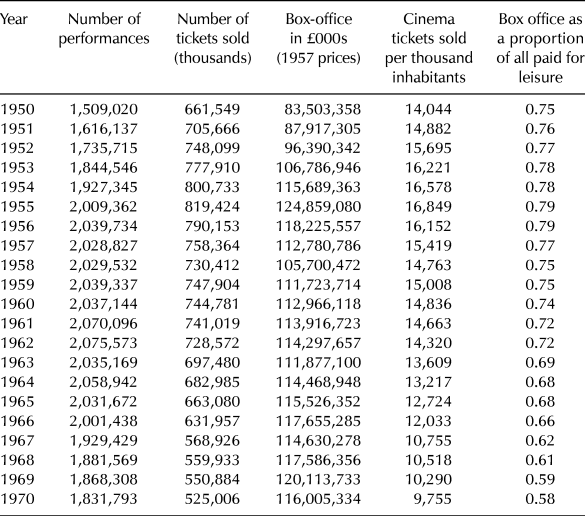
Table 1 shows that film dominated all other entertainments: audiences in Italy peaked in the mid-1950s, some ten years after the United Kingdom and United States, and remained relatively stable until at least the mid-1960s.Footnote 20 Indeed, the dramatic decline in attendance seen in the United States, United Kingdom, and elsewhere in the 1950s and 1960s did not occur in Italy until the 1970s. The Italian market therefore became increasingly important to American distributors, as well as to other European producers.
Assorted cinema statistics

Sources: Italian Historical Statistical Repository, http://timeseries.istat.it, table 8.4; Giornale dello spettacolo.
Film distribution in Italy during this period was typically organized either by domestic Italian companies—of which we identify fifty-nine in total—or by local subsidiaries of the seven major American distributors. There were a small number of Italian-American distribution joint ventures, but such partnerships offered more obvious benefits to American firms than local ones, and only two such collaborations were really enduring.Footnote 21 While there is some evidence that local distributors were more effective than foreign ones at maximizing screen time for the most successful pictures, there is no evidence that distributors routinely offered different rental terms for their pictures. Rental prices were negotiated nationally by industry bodies representing exhibitors (Associazione Generale Italiana dello Spettacolo, AGIS) and distributors (Associazione Nazionale Industrie Cinematografiche e Affini, ANICA) and applied equally to American and Italian firms. All American distributors, and all but two of the Italian ones, operated on a national basis, releasing pictures through 16 distribution hubs in major cities throughout the country.Footnote 22 We have no reason to believe, therefore, that any regional variations in demand would have been created by supply-side distortions.
Box-Office Characteristics
Over the ten-year period between 454 and 617 films were released annually on the market with Italian film producers responsible for approximately a quarter of releases in 1957, rising to a half by 1966. During these years coproductions increasingly came to dominate domestic production. Indeed,143 films were coproduced in 1966 compared with 89 solo home productions.Footnote 23 Overall, it is clear that Italian film consumers had a plethora of films to choose among.
The most important source of statistical evidence about the revenues generated by films circulating in Italian cities during these years was located in the section Borsa Film found in the twice-monthly trade publication Giornale dello Spettacolo—an official trade publication sponsored by the national association of exhibitors (AGIS). Along with commentaries on the performance of films in the Italian market, for the ten years of this study, Borsa Film published first-run box-office records of sixteen Italian cities that served as regional distribution centers.Footnote 24
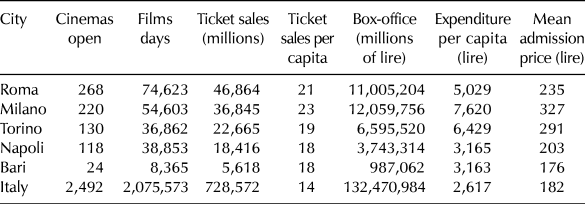
Selecting 1962 as a typical year, in which 551 films were in circulation, statistics of the five cities chosen for analysis are the subject of Table 2. Drawn from records collected by the Italian Society of Authors and Publishers (SIAE) and published in their annual publication Annuario dello spettacolo, the data given in Table 2 demonstrate that the size of market (by value), cinema admission prices, and per capita cinema expenditure varied from city to city but were considerably lower in the southern cities, reflecting the large discrepancy in GDP per capita between southern Italy and the northern and central regions.Footnote 25 However, it is also noteworthy that ticket sales per capita in Naples and Bari did not lag that far behind those of Rome, Milan, and Turin. Thus, although the economic circumstances of film consumption may have differed from city to city, the appetite for films was more uniform.Footnote 26
Selected cinema statistics for five cities, 1962

Source: Tables 29 and 38, Annuario dello spettacolo (1962).
First analyzed in detail by Arthur De Vany and David Walls, the film market is characterized by highly unequal revenue distributions that generate very high Gini coefficients.Footnote 27 In their comparative study of British and U.S. film markets during the mid-1930s, John Sedgwick and Michael Pokorny found that the mean and median film revenues both fell into the first decile of the revenue distribution.Footnote 28 It would appear that the long-right-tail phenomenon is an empirical regularity in film markets across all territories and over time, a factor that has given rise to the particular supply arrangements that characterize the industry, designed to ensure that distributors maximize revenues by making films that are popular ubiquitous. Film (like music, book publishing, or video game production) can be described as a “hits-based” industry.Footnote 29
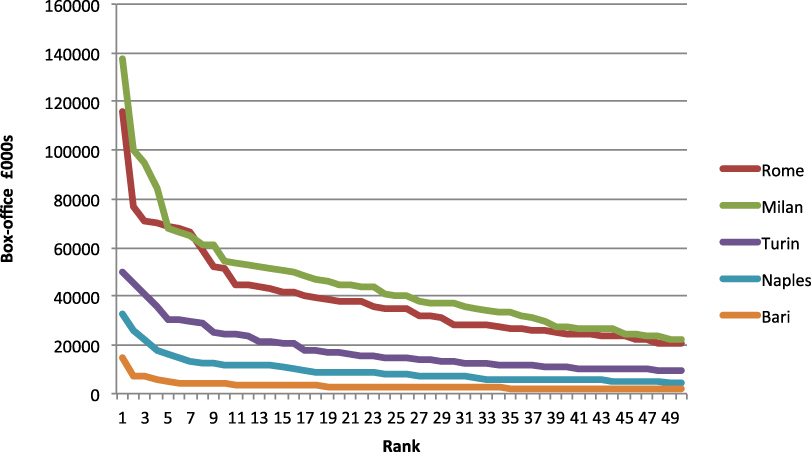
Arbitrarily selecting the top fifty films for the season 1961–62, Figure 1 reveals aspects of this phenomenon within the Italian market at the city level. (Because the films taking up these top berths were in many cases similarly popular across the five cities, aggregating earnings within a territory will accentuate both the steepness of the decline and the comparative flatness of the tail of the rank revenue distribution.) In Figure 1, typically, a sharp drop in box-office revenue can be noticed between the first- and fifth-ranked films, followed by a further significant drop to the tenth-ranked film, before the curve starts to flatten out to form a long tail beyond the fifty-film limit in Figure 1. While the basic distribution of box-office revenues follows a broadly similar pattern in each city, it is evident that the overall size of these markets was very different and that the smaller the market, the relatively flatter the distribution: smaller markets are less able to fuel major film attractions with audiences. Thus, the top-ranked film in the largest markets of Rome and Milan collected far more revenue than in Naples or Turin, and these markets were in turn much more lucrative than Bari. The highest-earning film in Bari generated approximately the same amount of revenue as the sixth-ranked film in Naples, twenty-fifth-ranked film in Turin, sixty-eighth-ranked film in Milan, and seventy-fifth-ranked film in Rome.
City box-office characteristics in the 1961–62 season, in lire.
Source: Giornale dello spettacolo (1963).

Unfortunately, the city-based box-office data drawn from Giornale dello spettacolo, upon which Figure 1 and the remainder of the article is formed, are restricted to first-run markets, clearly limiting what can be said about film consumer behavior. Nevertheless, while not providing definitive evidence on film performance in these cities, previous studies indicate that it is highly likely that the films that achieved the largest market share in first-run markets would also have been widely distributed in second- and third-run markets.Footnote 30 Therefore, we are confident that our data offer a reliable means of identifying the most popular films in each of the regional capitals that forms this study.
Comparative Approach
The absolute performance of films in different city markets poses a problem when it comes to comparing the popularity of films between cities. Simply comparing the box-office revenues of films gives little indication of the relative popularity of each film in each city. Such a comparison would no doubt reveal wide differences between the earnings of each film, but these would be driven by differences in market size as well as by variations in relative popularity. An alternative approach is to look at the annual rank of each film in each city. This at least allows us to identify the most popular films in each location, but while the rank ordering of films produces a neat linear pattern, as we have seen in Figure 1, the actual distribution of film revenues is not linear at all. The difference in popularity between films ranked 1 and 5 is not comparable with that between films ranked 41 and 45, and even less so for ranks 101 and 105.
To overcome this problem, a metric has been constructed that captures the relative popularity of films, termed the relative popularity index (RelPOP).Footnote 31 To ensure that the films analyzed were screened in each of the cities, a truncated sample of the 100 most popular films for each of the 10 cinema seasons from 1957–58 to 1966–67 have been selected, amounting to 1,000 films over the period. Given that as many as 600 films were released annually into these markets, many of which were screened in only a few cinemas, for only a few days, the sample clearly excludes large numbers of films. However, as an objective of this study is to compare the popularity of films, the selection of the top 100 films annually necessarily captures the most prominent new releases.
RelPOP is calculated by simply dividing the box-office revenue of the focal film in each city by that of the box office earned by the median film (taken as the fifty-first film in the annual city series). Thus, separate RelPOP scores are generated for films in each city market. Accordingly, a film with a RelPOP of 5 will have generated five times more revenue than the fifty-first film: a RelPOP of less than 1 indicates that the film was less popular than the fifty-first film. Taken together, over the five markets, the mean RelPOP score (eq. 1) of each film released constitutes an unweighted popularity series in which each city is treated equally, irrespective of market size. This can be then used to compare the popularity of films among the five cities, either separately or in total, and the degree to which they vary: it is possible to say that film X is more popular in Bari than in Turin, or that it is more popular in Bari than on average across the five cities, or that the variation in reception across the five cities is greater than that of film Y.
 $$RelPo{p_i} = \sum\limits_{c = 1}^5 {{{B{O_{ic}}} \over {B{O_{mc}}}}} \div 5$$
where, BO = box office, i = ith film, c = cth city, and m = median film.
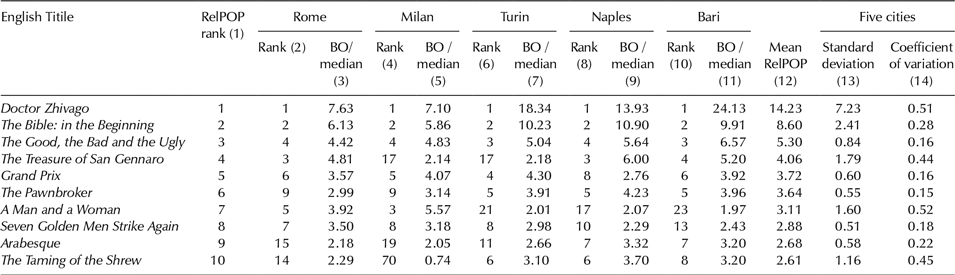
By way of example, Table 3 presents top ten results for the season 1966–67. The notes section of the table guides the reader as to how the mean RelPOP and associated measures of variance are calculated. Even from this cross section, a number of matters become apparent: the steep fall in mean RelPOP values with rank; the number of films that are commonly popular—overall top ten films take up thirty-eight of the possible fifty berths; the extraordinary performance of Doctor Zhivago across the board, but particularly in Turin, Naples and Bari; the relatively poor performance of The Bible: In the Beginning in Rome and Milan; set in Naples, the relatively poor performance of the Italian crime comedy The Treasure of San Gennaro in the northern cities; the relatively strong performance of A Man and a Woman in Rome and Milan; the mediocre performance of The Taming of the Shrew in Milan; while a number of films, including The Good, the Bad and the Ugly, were universally popular, generating low coefficient of variation (CofV) values.
Top ten films in season 1966–67*

Source: Giornale dello spettacolo.
* The RelPOP rank (col. 1) is drawn from the mean RelPOP (12). It is derived by suming the RelPOP (box-office/median) scores for each city (cols. 3,5,7,9, and 11) and dividing by 5. The standard deviation (col. 13) is a measure of variance across these scores and is standardized by dividing it by the mean to form the coefficient of variation (col. 14).
The Italian Market
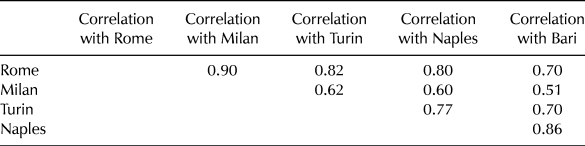
The RelPOP metric provides many insights into the operation of the Italian film market. A simple process of correlating the RelPOP scores of films of each city with those of the other four cities is presented in Table 4 and shows a clear positive relationship in each case.Footnote 32 On the whole we find that films at the bottom end of the distribution in one city were also likely to be positioned toward the lower end in the other cities. Each season’s major hits, meanwhile, were likely to be popular everywhere. If the existence of such clear positive relationships is unsurprising, it is perhaps more interesting to examine the strength of these relationships. Here we see some degree of variation, with extremely strong correlations between Rome and Milan (0.90) and Naples and Bari (0.86), but somewhat weaker relationships between Milan and Bari (0.51) or Milan and Naples (0.60).
Correlation of city popularity index values, 1957–58 to 1966–67*

Source: Giornale dello spettacolo.
* The correlations are drawn from the annual top 100 films and are thus based on 1,000 observations.
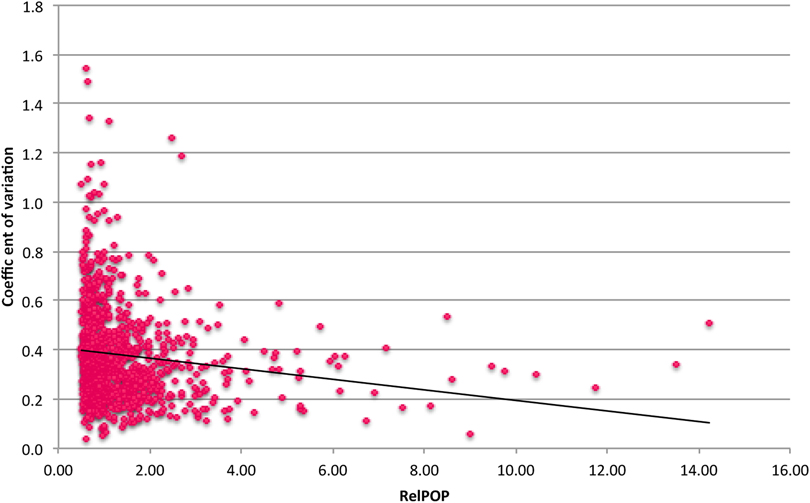
Table 4 indicates the prevalence of variance in film popularity data between the five cities. Figure 2 makes this explicit by reporting the degree of variance with respect of the mean RelPOP values of the 1,000 films in the sample data set against their respective coefficients of determination.
Scatter plot of the CofV of RelPOP values: annual top 100 films, 1957–58 to 1966–67. Number of observations = 1,000.
Source: Giornale dello spettacolo.
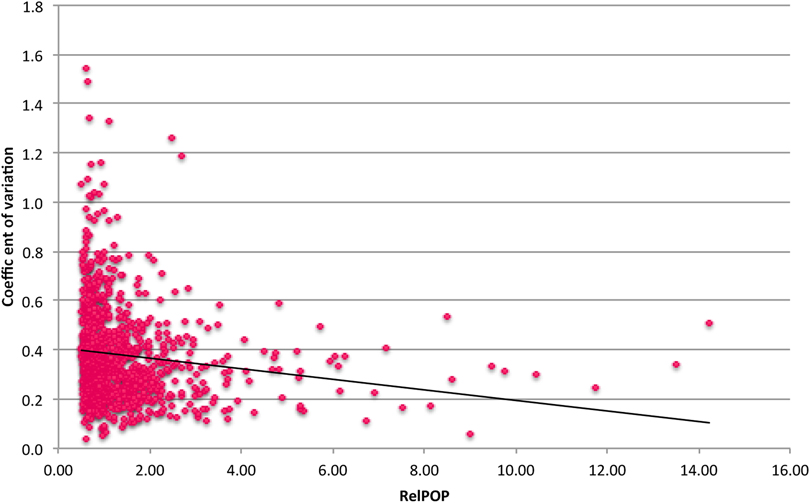
Two observations are apparent from Figure 2. The first is that even though the analysis is based on the 100 most popular films released annually into the Italian market, the revenue distribution exhibits a high degree of inequality, in which a small number of films generate extraordinary box-office returns in relation to the median, with twenty-six films generating a RelPOP value of 5 or more; eighteen of 6 or more; twelve of 7 or more; and eleven of 8 or more.
The second is that the CofV trends downward in conjunction with popularity and thus the range of variance is typically lower among the most popular films. The biggest hits were indeed hits everywhere. It is among the slightly lower-ranked films that second-order variability—the variation in the CofV associated with films generating similar RelPOP values—is more apparent, becoming more marked as the weight of the distribution is approached at the lower end of the RelPOP scale. Indeed, at the lower end of the distribution, there is a roughly equal split between films above and below the trend line, suggesting that large numbers of films at this end of the spectrum were either commonly or unevenly attractive to audiences.
From these observations it is possible to surmise that the film market effectively distributed films to where audience wanted to see them, both in terms of extent and selectivity, supporting the conjecture that both vertical and horizontal product differentiation are evident: that is, a small number of films appear to be qualitatively superior to the rest, while the bulk of films attracted much smaller audiences, some consistently across the board but not others. From the data presented in Figure 2 and Table 4, we conclude that Italy during this period was a receptive market in which hit films typically performed well in all markets, while regional variation—especially between cities in the north and south—was not uncommon, particularly at the lower end of the distribution.
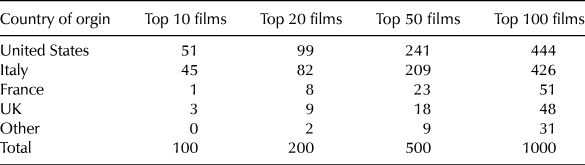
The national origin of the films that form the 1,000-film sample of this study is the subject of Table 5. Grouping coproductions under the first-named national partner (Italian-French coproductions count as Italian films), Table 5 shows that the Italian market was dominated in almost equal part by films emanating from the studios of Hollywood and Cinecitta. As a rule, Italians were not drawn to the films made by French, German, and British production companies, suggesting how segregated the European market was during this time.
National origins of annual top 10, 20, 50, and 100 films, 1957–58 to 1966–67*

Source: Giornale dello spettacolo.
* To simplify the table, the count includes the first country listed in films classified as coproductions.
The Film “Giants”
Films that were extraordinarily popular are the “giants” of the business. They draw audiences many times the average. The extreme statistics associated with these films suggest that in addition to what Leo Handel categorized as regular and habitual filmgoers, such films attract large numbers of occasional filmgoers to what is in effect a special event.Footnote 33 Distributors and exhibitors feast on such films—distributors because of the higher rental percentages they can charge; exhibitors because of the volume of customers passing through the box office.
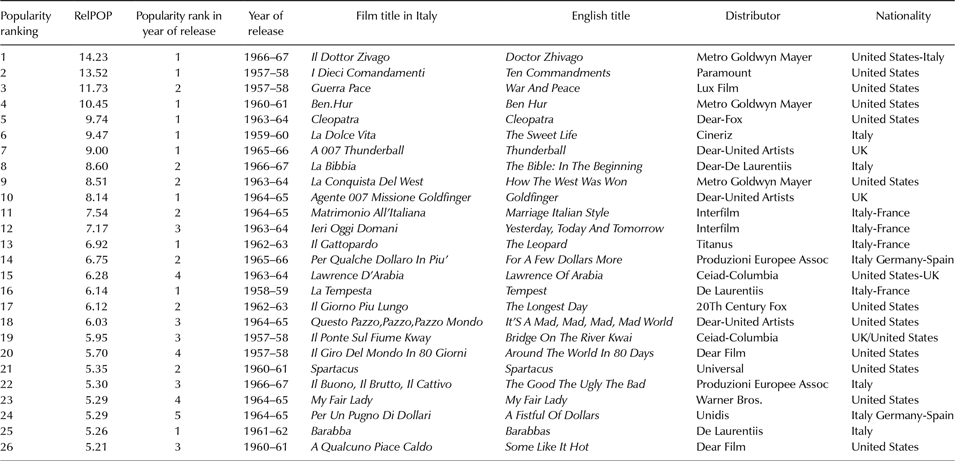
Table 6 lists the twenty-six films that formed the right tail of the rank distribution found in Figure 2: films that generated at least five times median revenues. Among these are the ten annual number one films, while seven of the ten films ranked annually in second position are also represented in the table. However, beyond this, the annual pattern is varied, with the 1964–65 season having five films that garnered RelPOP values greater than 5, while the seasons 1959–60, 1960–61, and 1961–62 had just one.
Films with a comparative popularity index (RelPOP) greater than 5, 1957–58 to 1966–67

Source: Giornale dello spettacolo.
Although extremely wide-ranging in content, production values, and budgets, the films in Table 6 are well represented by biblical, historical, or literary epics, as well as adventures (wartime, or otherwise). Other traits that emerge are the appearance and popularity of spaghetti westerns; the popularity of the James Bond movies; the singling out of My Fair Lady as the only musical in the list (set, incongruously, in Edwardian Britain); the fact that two American comedies are listed—It’s a Mad, Mad, Mad, Mad World and Some Like It Hot; and the limited number of films that depict the quotidian of everyday life—the comedy The Treasure of San Gennaro and two Italian melodramas, Marriage Italian Style and Yesterday, Today and Tomorrow, both directed by Vittorio De Sica and starring Sophia Loren and Marcello Mastroianni. On the production side, with the exception of the latter three Italian films, all have an international dimension, be it subject matter, star(s), and/or director. The national origins of these films indicate that big-budget Hollywood and British productions (distributed and financed by American companies) coexist with Italian solo or coproduction.
Films That Most Divided Audience Opinion
Central to this article is the issue concerning the differential performance of films within a single national territory. From the evidence presented in the scatter plot in Figure 2, a large body of films received variable attention from Italian audiences. In an efficient market, this observation can be taken to indicate that audience tastes for some films differed noticeably from city to city and that supply adjusted to this. Evidence presented in Tables 3 and 4 supports this contention. An alternative hypothesis might be that differential performance is the consequence of institutional rigidities—for instance, distributors did not receive sufficient copies of some films in some cities to satisfy demand. For this to be the case, we should expect that among those films that performed poorly in specific cities were a number of films for which daily box-office returns were similar to other films that had a much longer run. No evidence of this was found, implying that poorly performing films consistently generated lower daily box-office returns.
To identify 100 films that attracted particular local interest, two methods are followed. The simplest approach is to rank films by their CofV values and select the 100 most variably received films. This method certainly allows for the identification of films that performed strongly in just one city, but does not exclude other films that were relatively popular in two or three cities (and relatively unpopular in the others). Hence, if our interest is not just in the variability of a film’s appeal, but in identifying those films with an appeal that seemed to be specific to just a single city, then an alternative approach is required. To this end we have also ranked films on the basis of how far their performance in any one of the five cities deviated from the average. This involved comparing each film’s RelPOP score in each city with its overall RelPOP score for the five cities combined and searching for instances in which the difference between the local and the overall RelPOP score was greatest. The 100 most variable films, on this basis, turned out to be ones in which the RelPOP score in one city was approximately 90 percent higher than the overall RelPOP.
Not surprisingly, there is a large amount of overlap between the two lists of 100 films generated by these competing methods. By way of explanation, some examples of films that appeared on one list, but not the other, are found in Table 7. The top two films on this list have a CofV score (just) high enough to make it into the top 100 on this measure, but in neither case is there a city RelPOP score that is 90 percent higher than the overall RelPOP. The bottom two films, on the other hand, fell outside the top 100 when ranked by their CofV but generated RelPOP scores in a single city (Naples and Milan, respectively) that were approximately 100 percent higher than the overall RelPOP.
Example of the two methods for selecting 100 most variable films

Source: Giornale dello spettacolo.
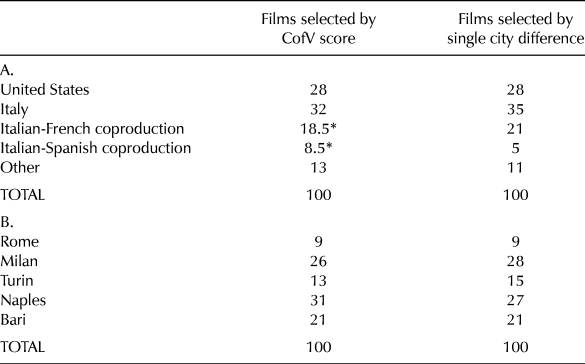
Using each criterion, Table 8 presents a breakdown of the 100 most variable films, classified by: (1) their national origin and (2) the city in which they were most popular. When Italian solo and coproductions are grouped together, a comparison with Table 5 makes it clear that the representation of national productions among the most variably received films is markedly higher than in the overall population, with respectively fifty-nine and sixty-one films being listed. It would appear that Italian films were much more likely to either excite local passions, or marked indifference, than their American counterparts.
The 100 most variable films by (A) national origin and (B) city of greatest popularity

Source: Giornale dello spettacolo.
* One film from the list generated by the CofV method, Totò, Vittorio e la Dottoressa (The Lady Doctor) was a coproduction of Italy, France, and Spain. That film is shared between two categories.
When we look at the cities in which these films were most popular (Table 8), we also see consistency between the two lists. Roman audiences were the least likely to differ from the five-city average, while those in Milan and Naples were most likely to welcome films that audiences elsewhere in Italy rejected. These statistics are broadly consistent with the findings of the correlation analysis reported in Table 4, which showed a high degree of correlation between Rome and other cities, with lower levels of correlation in the other pairings.
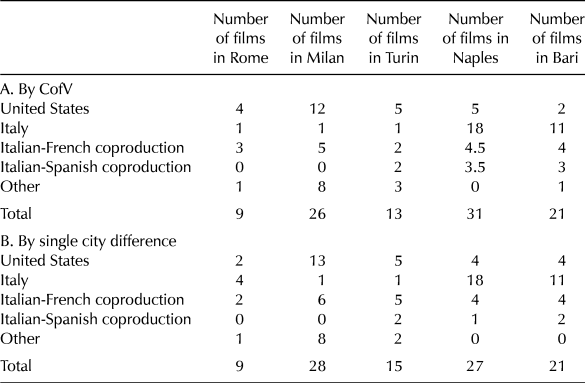
When we bring these two lines of enquiry together and examine the nationalities of the most variable films, with the cities in which these films were most popular, some quite striking differences emerge. Table 9 shows a fairly clear north-south divide. The southern cities of Naples and Bari were ones in which the clear majority of films that held a distinctive local appeal were domestic Italian productions. The northern cities of Milan and Turin, on the other hand, were ones in which audiences seldom showed any particularly local preference for domestic films but were much more likely to be won over by certain international productions that failed to generate a popular response in other parts of the country.
Variable films: by national origin and city of strongest reception

Source: Giornale dello spettacolo.
Before exploring the significance of these findings in closer detail, it is worth returning to the distinction referred to in our introduction between vertical and horizontal differentiation of cultural products. Horizontal differentiation involves the construction of categories (such as genres) that enable consumers to form a judgment about the nature of the product in question and its intended target audience. Vertical differentiation refers to the perceived “quality” of such products in terms of the strength of their audience appeal. Within any given horizontal category, some films will prove more popular than others. Some horizontally defined categories will be much narrower than others, so the most successful production in a specialist category may end up attracting a much smaller audience than a mediocre offering in a more mainstream field. For film, this means that across the market as a whole, indicators of vertical differentiation based on box-office appeal give a clear indication of a film’s reach, but not necessarily of its perceived quality. Within carefully defined horizontal categories, however, vertical differentiation by box-office revenue offers a much stronger indication about perceived product quality.
How do local variations in audience taste play into these distinctions between horizontal and vertical differentiation? There are at least three ways in which we might think about local variations in these terms. First, we can imagine that some horizontally defined categories of film might have a stronger audience base in some locations than others, in which case we would expect to see the most popular films within such categories attracting a varied response. For instance, during the mid-1930s in industrial Bolton, Lancashire, the locally born star Gracie Fields was so popular with audiences that the films in which she appeared topped the listings, contrasting strongly with the performance of her films in the southern counties of England.Footnote 34 If we follow this point to its logical conclusion, we arrive at our second possibility, which is that certain horizontal categories of film might emerge specifically in response to consumer demand in a particular location. In this sense, local cultural identity itself forms the basis of a specific category of film. Andrew Higson has shown that this phenomenon is well understood at the national level but is less often discussed at the subnational level.Footnote 35 Was there, for example, a category of films being produced in Italy that was specifically intended to capture a southern Italian (or more specifically a Neapolitan) sense of culture and identity? The third possibility is simply that audiences in certain locations would occasionally reach an a typical collective judgment about the “quality” of any given film, and thus provide it with an unusually high or low vertical ranking. In the first two cases, local variations in consumption patterns can be explained and, to a lesser extent, predicted. In the third case, local variations are far more random and add another dimension to what Richard Caves calls the “nobody knows” principle.
Looking at the films that received the most variable response within Italy during our period, it would seem that all three factors might have been in play. In the northern Italian cities, and in Milan in particular, we find a prevalence of European films among those that received a distinctively strong reception. Some of these were older films being given a national re-release (such as M and Kind Hearts and Coronets); others included The Seventh Seal, Tom Jones, Ballad of a Soldier, and Hiroshima Mon Amour. While it would be difficult to group these films together into a single genre, we might nonetheless think of them as part of a horizontal grouping likely to appeal to an internationally minded and cosmopolitan audience. Thought of in these terms, it may not be surprising that such films did much better in Milan than in most other Italian cities. This is not to say, of course, that there were not cosmopolitan audiences in other Italian cities too, but the size of this audience segment in Milan was likely to have been much larger.
In the case of the southern cities of Naples and Bari, it is striking just how many domestically produced films were among those receiving an unusually strong local reception. This does beg the question whether the Italian producers of these films were intending to appeal primarily to a local rather than a national audience. In the case of the international films that went down so well in Milan or Turin, it is hard to imagine that northern Italian audiences were the primary target market that directors such as Ingmar Bergman or Tony Richardson, or their producers, had in mind when making their films. It is much more likely that there happened to be a much larger market for the films of leading European directors in Milan than in other parts of Italy. But was it also the case that Neapolitan audiences just happened to prefer certain types of domestic Italian film, or were domestic Italian producers actively producing films for Neapolitan audiences?
Whichever method we employ for identifying the 100 films with the most varied local reception, we find that 18 of them (Table 9) were solo domestic Italian productions that proved unusually popular in Naples. The majority of these films (12 or 13 depending on the selection method employed) starred the Neapolitan comic actor Totò often appearing alongside fellow Neapolitan Peppino De Filippo. Most of these films featured the lead actor’s name very prominently in the title (e.g., Totò, Peppino e la Dolce Vita, Totò e Peppino Divisi a Berlino, Totò Diabolicus), clearly indicating that these films belonged to an identifiable series (or horizontal category). A further five Totò films also appeared on the list of films that were particularly popular in Bari. Indeed, so partial to these films were the audiences of both cities, that in their absence the number of Italian films on the list of the 100 most variably received films would be no more than those emanating from Hollywood.
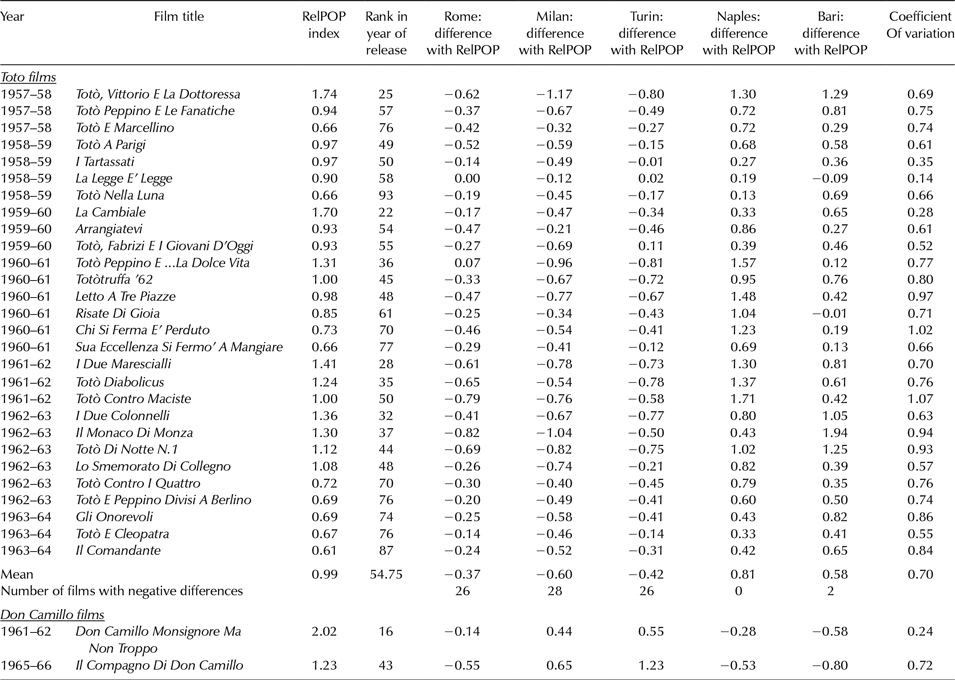
Table 10 provides information on the twenty-eight Totò films released during seven seasons 1957–58 and 1963–64 and illustrates that while not among the hits of their day, with RelPOP scores varying around the median, they were consistently more warmly received in the two cities of the South than in Rome, Milan, or Turin. Interestingly, Totò seems to have understood his worth, moving between studios—sixteen studios were responsible for these twenty-eight films—according to his latest biographer, in pursuit of earnings. He is quoted as saying:
Today I get a lot of contracts, a lot of money and tomorrow? Nobody knows. Maybe tomorrow the audience is no more interested in my movies or the producers do not trust me anymore. What could I do? Back to the theatre as an old man? No, it’s better to make everything now, to take every single opportunity, as long as it lasts.Footnote 36
City differences in the 28 films starring Totò, 1957–58 to 1963–64, in contrast to two Don Camillo films

Source: Giornale dello Spettacolo.
By way of contrast, the much smaller comedy series built around the feuding relations between Catholic priest Don Camillo (played by the French comic actor Fernandel) and Communist mayor Peppone (Gino Cervi) further illustrates this point about regional loyalties. Set in a small agricultural community in the Po Valley, the two films (listed in Table 10), along with three others made outside of the period of this investigation, attracted strong positive audience responses in Turin and Milan, but for audiences in Rome, Naples, and Bari their appeal was muted.Footnote 37
The American films in our lists of the most variable films are far harder to categorize. Those popular in the north included a handful of Tom and Jerry films, along with Operation Petticoat and Elmer Gantry (Milan) and My Man Godfrey and Imitation General (Turin). Those proving unusually popular in the south included Flower Drum Song and Madame X (Naples) and The Big Fisherman and The Happy Road (Bari). These films do not appear to belong to any discernible horizontal category. They are all examples of what we might loosely describe as mainstream Hollywood entertainment, for which there was a receptive market throughout Italy. None were major hits, but in each case we see that audiences in one of our five cities responded particularly strongly, (vertically) ranking them much more highly than audiences elsewhere.
Discussion and Conclusion
Film and cultural historians have emphasized the role that cinema-going played in maintaining a sense of social identity at a local and regional level in the mid-twentieth century.Footnote 38 For Forgacs and Gundle, cinema contributed to process of drawing Italians “…en masse into the collective life of their nation and were attributed importance in shaping its destiny.”Footnote 39 Before the widespread adoption of television, the cinema often served as a neighborhood focal point around which local communities would cohere. Here, audiences might collectively embrace the glamour and spectacle of the latest Hollywood entertainment, but equally they could reject content that failed to resonate with their desires, beliefs, and ideals. These local dynamics of cinema-going, however, have seldom been incorporated into economic analyses of the film industry—in part because of the limited availability of directly comparable local data sources. A more detailed and nuanced picture of film markets at a subnational level, however, is important if we are to understand the extent to which heterogeneity is a factor in consumer taste, with respect to cultural products and how, in the instance of the film industry, these are catered for.
Previous studies have identified local or regional variations in film taste, but usually in relation to the reception of foreign (i.e., American) films within specific national markets. Examinations of film audiences in the 1930s in various countries have suggested that domestic productions fared better in metropolitan centers, while American films were more warmly received in the provinces or suburbs.Footnote 40 There have been fewer attempts to explore regional variations in the reception of domestically produced films within national markets, and thus of the extent to which filmmakers sought to exploit regional, as well as national, cinema markets. Our evidence about the regional specificity of the audience for Totò films in Italy in the 1960s, rather like that for the films of Gracie Fields in Britain in the 1930s, suggests that these regional differences could indeed be important in helping to shape film culture.
This article has examined the Italian market for films during a period when the economy was growing at an unprecedented rate but the north–south divide was still pronounced. Based on regional city data collected by the exhibitors’ association (AGIS), it has been possible to identify those films that were commonly popular across the country and to highlight variations in the appeal of some films in different parts of the country? It is clear that the latter were not the major blockbuster hits that captured the largest share of the market. We needed to delve deeper than the annual box-office top ten to locate such films.
What our analysis shows, we suggest, is that among the films that had a highly uneven reception in Italy were a mixture of curiosities (which we make no real attempt to explain) along with others that constituted a distinct category of film production in their own right. The existence of an observable category of films that consistently elicited strong local/regional responses would imply strongly that such films were deliberately targeted at a local rather than a national market. Both types of films have something to teach us about the functioning of the Italian film industry.
To deal with the historical curiosities first, the important point about such films is precisely that the variability of their local reception was so unpredictable. We may never know why It Started with A Kiss, starring Glenn Ford and Debbie Reynolds, failed in Milan while attracting good business in Naples, or why the opposite was true of Ask Any Girl, featuring David Niven and Shirley MacLaine. Such cases serve as a reminder that local audiences could, and did, respond in unpredictable ways to individual films, and that these responses cannot easily be attributed to the level of promotional support provided in different locations. The two films referred to above were both distributed by MGM throughout Italy in the same year. While differences in film choice between national markets are often influenced by film policy and the protectionist support offered to local productions, such features are less evident when it comes to local differences within national markets. What we appear to see here are quite genuine (and unpredictable) differences in consumer preferences, which the system of film exhibition within Italy was able to quickly recognize and respond to accordingly.
The existence of a body of films that appeared to be targeted at specific local or regional audiences suggests that some local differences in taste were more predictable than others. The enduring series of Totò films constituted a recognizable category of productions that were horizontally differentiated from other products in the market. Yet this was a category of films that consistently failed to generate significant popular appeal in major cities such as Rome, Milan, or Turin. Their appeal was largely restricted to southern Italy, where they consistently attracted strong audiences. Such films illustrate that within this national film market, it was possible to identify (and exploit) entrepreneurial opportunities on the basis of local variations in consumer demand.
Drawing upon the conceptual distinction between the vertical and horizontal differentiation of films, it seems clear that films are differentiated in many ways in the minds of audiences and that for different films different factors predominate. Sometimes regional variations in demand are predictable and sometimes they are not. The strong positive reaction to the films of Totò in Naples in the 1950s and 1960s, in contrast to the indifference shown by audiences in Rome, Milan, and Turin, was certainly a consistent (and predictable) pattern.
That such a pattern was able to develop, however, tells us something important about the adaptability of the film industry. It draws attention to the existence of distinctive local preferences, which were an integral feature of cinema culture during this period. It also illustrates the extent to which film producers were attracted by content that had a high likelihood of achieving a genuinely popular appeal (even if only on a regional basis). In an industry as riven with uncertainty as film production, any sign of a predictable and reliable market for a particular category of films constituted an important opportunity (provided production budgets could be controlled accordingly). Where such markets were uncovered, they could form the basis of sustainable film production activities, even if only on a limited scale. Just as “national” cinema production was able to survive and flourish alongside the more internationally oriented output of Hollywood, so (if we look hard enough) we can find evidence of “regional” films that were able to serve a valuable function within heterogeneous national cinema markets.