Implications
The welfare of intensively housed pigs is a matter of public concern. A crowded and barren environment is known to cause signs of stress. This research was designed to investigate effects on stress physiology of a very moderate amount of bedding provided at different stages of the life of pigs raised for slaughter. The quality (wood shavings and chopped straw) and amount was chosen to be compatible with partly slatted pen floors and slurry manure systems. The results indicate that a small amount of bedding in early life (0 to 4 weeks of age) will prevent physiological signs of stress at a later age. Due to use of unestablished methods the biological significance of these results needs more evidence to be disclosed.
Introduction
The welfare of pigs in modern production systems is subjected to substantial public concern. Barren environmental conditions in such facilities are associated with behavioural signs of chronic stress (Pearce and Paterson, Reference Pearce and Paterson1993; Beattie et al., Reference Beattie, Walker and Sneddon1995 and Reference Beattie, Walker and Sneddon1996). Enrichment of an otherwise poor environment with bedding material is believed to be a useful tool to limit stress in pigs. Straw provides several beneficial aspects due to use as a recreational stimulus, a nutritional substrate, bedding and insulation (Fraser et al., Reference Fraser, Phillips, Thompson and Tennessen1991).
Stress activates the hypothalamic–pituitary–adrenal (HPA) axis, resulting in the release of glucocorticoids (GC) from the adrenal glands (Selye, Reference Selye1936). In pigs, cortisol is the main GC secreted (Bottoms et al., Reference Bottoms, Roesel, Rausch and Akins1972). Chronic stressors cause on-going hypersecretion of GCs, initiating potentially harmful counter-regulatory changes at different stages of the HPA axis (Jensen et al., Reference Jensen, Hansen and Pedersen1996).
Basal GC secretion follows a circadian (i.e. about 24 h) rhythm. Concentrations in plasma peak in the morning and decline to reach a nadir in the evening (in pigs: Evans et al., Reference Evans, Christopherson and Aherne1988; Griffith and Minton, Reference Griffith and Minton1991). The same is evident in saliva (Ekkel et al., Reference Ekkel, Dieleman, Schouten, Portela, Cornelissen, Tielen and Halberg1996; Ruis et al., Reference Ruis, te Brake, Engel, Ekkel, Buist, Blokhuis and Koolhaas1997). An additional concentration peak is sometimes found in the afternoon (Evans et al., Reference Evans, Christopherson and Aherne1988; Griffith and Minton, Reference Griffith and Minton1991). A similar circadian rhythm is present in man (Krieger, Reference Krieger1979).
Cortisol diffuses from blood to saliva. The saliva concentration is a good indicator of the amount of biologically active cortisol in pig plasma, useful for investigating both basal (Kirschbaum and Hellhammer, Reference Kirschbaum and Hellhammer1989; Cook et al., Reference Cook, Schaefer, Lepage and Jones1996) and adrenocorticotropic hormone (ACTH)-modified secretion (Parrott et al., Reference Parrott, Misson and Baldwin1989; Cook et al., Reference Cook, Schaefer, Lepage and Jones1996). Sampling of saliva is obviously an animal-friendly method, which can be assumed to affect cortisol concentrations less than blood sampling.
There are several working definitions of a normal cortisol rhythm. Krieger et al. (Reference Krieger, Allen, Rizzo and Krieger1971) characterized it by a decline of at least 25% comparing morning concentrations to all later values, whereas Santiago et al. (Reference Santiago, Jorge and Moreira1996) required a drop of at least three times the mean intra-assay coefficient of variation (CV) from morning to both afternoon and night. The method described by Krieger et al. (Reference Krieger, Allen, Rizzo and Krieger1971) was applied to pig data by Gallagher et al. (Reference Gallagher, Giles and Wynn2002). Others have based a normal rhythm on significantly higher morning than afternoon group-level mean values (e.g. Janssens et al., Reference Janssens, Helmond and Wiegant1995), or a significant difference in day-time means between treatment groups (de Jong et al., Reference de Jong, Ekkel, van de Burgwal, Lambooij, Korte, Ruis, Koolhaas and Blokhuis1998). Cosinor analysis, a chronobiological tool described by Halberg (Reference Halberg1969), has been applied to pig data by Ekkel et al. (Reference Ekkel, Dieleman, Schouten, Portela, Cornelissen, Tielen and Halberg1996), among others.
Behavioural studies provide substantial evidence of stress in barren environments in the form of increased inactivity (e.g. Wood-Gush and Beilharz, Reference Wood-Gush and Beilharz1983; Schouten, Reference Schouten1986; Beattie et al., Reference Beattie, Walker and Sneddon1995) and harmful social activities (Fraser et al., Reference Fraser, Phillips, Thompson and Tennessen1991; Arey, Reference Arey1993; Beattie et al., Reference Beattie, Walker and Sneddon1995). Physiological indicators of environmental stress in pigs have, however, received relatively little attention. A blunted circadian secretion rhythm of basal cortisol is reported in response to barren housing (de Jong et al., Reference de Jong, Prelle, van de Burgwal, Lambooij, Korte, Blokhuis and Koolhaas2000) and tethering (Janssens et al., Reference Janssens, Helmond and Wiegant1995). Stimulation with ACTH has been used as a measure of the functional state of the HPA-system (Mormède et al., Reference Mormède, Dantzer, Bluthé and Caritez1984). An exaggerated cortisol response, as shown in tethered as compared to loose-housed sows by Janssens et al. (Reference Janssens, Helmond and Wiegant1994), is taken as evidence of chronic HPA-axis activation.
Environmental influences on signs of stress have mostly been investigated using both substrate and extra space as enriched treatments (e.g. Pearce and Paterson, Reference Pearce and Paterson1993; Beattie et al., Reference Beattie, Walker and Sneddon1995 and Reference Beattie, Walker and Sneddon1996; de Jong et al., Reference de Jong, Ekkel, van de Burgwal, Lambooij, Korte, Ruis, Koolhaas and Blokhuis1998 and Reference de Jong, Prelle, van de Burgwal, Lambooij, Korte, Blokhuis and Koolhaas2000). Knowledge of effects of substrate only, used in limited amounts compatible with slurry manure systems in commercial environments, is lacking. As enrichment is believed to affect the ontogeny of behaviour more than stocking density (Pearce and Paterson, Reference Pearce and Paterson1993; Beattie et al., Reference Beattie, Walker and Sneddon1996), we hypothesize that (i) physiological signs of chronic stress in barren environments can be prevented with provision of moderate amounts of substrate, given that space is adequate.
In man, adult HPA-axis function is affected by early life experience. Stress response systems are developed during the early postnatal period, with environmental stimuli playing an important role in the process (review by Luecken and Lemery, Reference Luecken and Lemery2004). In pigs, the early environment is known to affect later stress responses (De Jonge et al., Reference De Jonge, Bokkers, Schouten and Helmond1996), as well as some aspects of behaviour (De Jonge et al., Reference De Jonge, Bokkers, Schouten and Helmond1996; Olsson et al., Reference Olsson, de Jonge, Schuurman and Helmond1999), suggesting that early calibration may take place in this species as well. To address this issue, we hypothesized that (ii) environmental enrichment early in life has effects on cortisol secretion lasting until slaughter age of fattening pigs. The aim of the present study was to test these hypotheses by exposing growing pigs to bedding material at different stages of their development.
Materials and methods
Animals, housing and husbandry
The experimental procedure was approved by the ethical committee of MTT Agrifood Research Finland (permission number SIK 6/04, 2004-08-26). The experiment was conducted from October 2004 to December 2005 at the experimental pig farm of MTT Agrifood Research Finland in Hyvinkää. Two hundred and fifty-two pigs representing Finnish Yorkshire (FY, 19 litters), Finnish Landrace (FL, 20 litters), their crosses (16 litters) and crosses of Duroc × FL boars and FY × FL sows (eight litters) participated in the study. The litters were randomly allotted to the treatments after division in 10 blocks based on breed and time of birth. Each block consisted of six litters, three of which were replaced during the study to yield a total of 63 litters. The experimental unit of interest consisted of four siblings representing a litter, two castrates plus two females of equal weigh chosen at weaning and kept as a group until slaughter. Litters varied between 8 and 12 siblings.
Housing conditions, husbandry and feeding will be described only briefly, as details are given elsewhere (Munsterhjelm et al., Reference Munsterhjelm, Peltoniemi, Heinonen, Hälli, Karhapää and Valros2009). The animals were subjected to standard commercial interventions and housed in spacious partly slatted pens at all times. The sows farrowed in pens measuring 5.4 m2 without crates. Stocking density was 0.7 m2 per animal in the nursery (5 to 9 weeks of age; weeks N5 to N9) and 1.2 m2 in the fattening phase (10 to 24 weeks of age; F10 to F21). In the nursery, piglets were fed ad libitum from a feeder, and in the fattening unit in a trough at 0700 and 1500 h according to a restricted scale. No additional roughage was used. Animals had full artificial lighting between 0700 and 1600 h and dimmed lighting for the remainder of the time. The dimmed light came from heat lamps in the farrowing rooms and, thereafter, from led-lights with dark-coloured covers that were used for night-time videotaping.
Experimental design
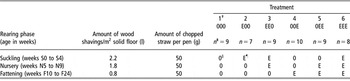
In each of the three growing phases, pens either were or were not bedded. Hereby, five enrichment treatments were designed to be compared with barren housing from birth to slaughter (Table 1). The enrichment material consisted of wood shavings and chopped straw that was topped up mornings and afternoons to leave the amount given in Table 1. Barren and enriched groups were housed in the same rooms, exposing all animals to the sight of littering down. In the farrowing unit, all sows had access to bedding until two days after farrowing, when it was removed in treatments 000, 00E and 0EE (see Table 1 for abbreviations of treatments).
Experimental treatments and the amount of bedding used

†Control.
‡The number of groups with a complete data set; the number of groups entering the study was n = 10, 11, 12, 10, 10, 10 for treatments 1 to 6, respectively.
§0 = barren.
¶E = enriched with wood shavings and chopped straw.
Saliva sampling, ACTH stimulation test and cortisol analysis
Saliva samples were taken at the end of the nursery and finishing phases (Tuesdays at N9 and Fridays at F21) every hour from 0700 to 1900 h (13 + 13 samples). All animals were accustomed to the procedure prior to the first sampling, but only one randomly chosen barrow in each group was sampled. The focal animal was allowed to chew on a cotton swab (Salivette®; Sarstedt, Nümbrecht, Germany) until thoroughly wet (30 seconds to one minute). Saliva was extracted by centrifugation for 10 min at 3000 rpm and immediately frozen for storage at −18°C until analysis.
An ACTH test was conducted in the morning after the saliva sampling in F21. The same focal animals were used. Immediately after a basal sample at 0900 h, the animals were injected intramuscularly with 500 IU synthetic ACTH (Synacthen®, 0.25 mg/ml; Novartis, Täby, Sweden). Thereafter, a total of five saliva samples were taken every 30 min.
Salivary cortisol concentration was analysed by radioimmunoassay with a kit (Coat-A-Count Cortisol; OrionDiagnostica, Turku, Finland) validated for use with pig saliva (Oliviero et al., Reference Oliviero, Heinonen, Valros, Hälli and Peltoniemi2008). The samples were analysed in duplicate. Inter-assay and intra-assay CV was 9.6% and 10.9%, respectively.
Behavioural observations and body lesions
Collection of behavioural and body lesion measures is described in detail in Munsterhjelm et al. (Reference Munsterhjelm, Peltoniemi, Heinonen, Hälli, Karhapää and Valros2009). Animals were videotaped in N5, N9, F10, F14 and F21. Agonistic and explorative behaviours were recorded continuously for 3 × 10 min, and time budgets scan sampled for 24 h. Occurrence of lesions on the skin, ears and tail were recorded weekly throughout the experiment to calculate severity-based indices.
Statistical analyses
Rhythmicity of salivary cortisol
SPSS software (SPSS Inc., Chicago, USA) of versions 12.0.1 and 16.0.1 were used for the analyses. A circadian cortisol secretion rhythm was characterized by a decline of at least 32.7% (three times the mean intra-assay CV, as defined by Santiago et al., Reference Santiago, Jorge and Moreira1996) from the morning concentration (average of the 0700 and 0800 h samples) to both the afternoon (average of the 1500 and 1600 h values) and evening values (average of the 1800 and 1900 h samples). These averages were chosen after graphical investigation of the pooled raw data. In F21, the 0800 h sample was ignored, as the mean concentration decreased rapidly (with on average 23%) after 0700 h.
Effects of treatments on the odds of a circadian secretion rhythm were investigated using binary logistic regression. Separate models for both sampling ages (N9 and F21) were built by manual backward elimination starting with average weight at birth for the animals in the pen, average weight for the pen at sampling and treatment as fixed effects. Weaning age and days of post-weaning diarrhoea were included as well, as these factors differed significantly between treatments (for details see Munsterhjelm et al., Reference Munsterhjelm, Peltoniemi, Heinonen, Hälli, Karhapää and Valros2009). To count for the repeated nature of the data a dichotomous variable describing the occurrence of a circadian cortisol secretion pattern at N9 was included. Two-way interactions were investigated in addition to the main effects.
Treatment was expressed as both actual treatments (00, E0, 0E and EE at N9 and 000, E00, EE0, 00E, 0EE and EEE at F21) and main effects of enrichment status (yes/no) in the three growing stages. Although the six treatments can be considered as interactions of the main effects, all interactions could not be included in the models due to collinearity and absence of some cells in the interaction matrix (i.e. treatments E0E and 0E0 did not exist).
A P-value exceeding 0.1 was used as a basis for removal of a variable, except for replicate that was forced into both models. Average weight for the group at sampling affected the odds of a rhythm at N9 significantly, but the variable was suspected to act as an intervener and was thus removed.
The Nagelkerke R 2 effect size (0.48 and 0.55 for N9 and F21, respectively), indicating the usefulness of the explanatory variables in predicting the outcome, demonstrated good predictive efficacy of both models (Nagelkerke, Reference Nagelkerke1991). Hosmer–Lemeshow tests were performed to assess the fit of the model. Residuals were checked for normality as well as leverage for large values.
Salivary cortisol concentration
Single missing values (n = 9) in the data set were generated using linear interpolation. Treatment effects on salivary cortisol concentration were analysed with a repeated measures GLM after performing appropriate transformations to meet the assumptions of the procedure. Age (N9 and F21) and time of measurement (hourly from 0700 to 1900 h, n = 13) were designed as within-subjects factors. The model was built using manual backward elimination with P > 0.1 as removal criterion. Replicate and treatment (six levels or main effects as described above) were designed as between-subjects factors, and weaning age and average birth weight of the animals in the pen as covariates. Replicate was forced into the model. Two-way interactions involving treatment were investigated. The final model included the between-subjects factors replicate, treatment, weaning age and an interaction between weaning age and treatment. The Huynh–Feldt correction was applied to count for the failure to meet the sphericity assumption (Huynh and Mandeville, Reference Huynh and Mandeville1979). Post-hoc comparisons were performed using the Bonferroni adjustment.
Salivary cortisol concentration after the ACTH challenge
For each focal animal, total response of the HPA axis was expressed as the area under the response curve (AUC) above the baseline value at t = 0 min. Treatment effects were investigated by Mann–Whitney U and Kruskal–Wallis tests due to non-normal distributions of the variables.
Associations between cortisol rhythmicity, behaviour and body lesions
Differences in group-level behaviour between groups with the focal animal exhibiting a cortisol rhythm and groups with a non-rhythmic focal animal were investigated by Mann–Whitney U and χ 2 tests. Effects of rhythmicity at N9 and F21 were analysed separately. Behaviours investigated were those thought to reflect stress: agonistic behaviours pooled, tail biting and exploration. The number of body lesions (skin, ear and tail separately; see Munsterhjelm et al., Reference Munsterhjelm, Peltoniemi, Heinonen, Hälli, Karhapää and Valros2009) were analysed per growing stage.
Results
Rhythmicity of salivary cortisol
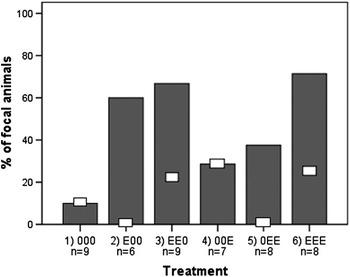
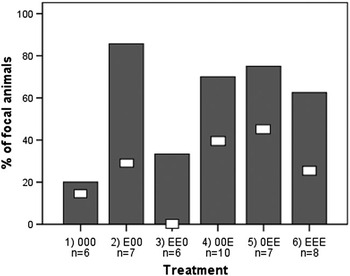
The proportion of animals displaying a circadian rhythm of salivary cortisol was 43% at N9 (n = 47) and 61% at F21 (n = 44). Seventeen per cent of the focal animals lost an existing rhythm between 9 and 21 weeks, while 29% of non-rhythmic subjects gained one during this time (for details per treatment see Figures 1 and 2).
Percentage of groups in the different treatments with an identifiable circadian rhythm of salivary cortisol at 9 weeks of age. The lighter-coloured rectangles display the relative amount of groups that went on to lose the rhythm when re-assessed at 21 weeks of age.

Percentage of groups in the different treatments with an identifiable circadian rhythm of salivary cortisol at 21 weeks of age. The lighter-coloured rectangles display the relative amount of groups that had acquired a rhythm since assessment at 9 weeks of age.

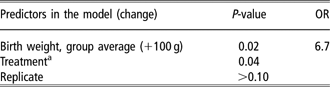
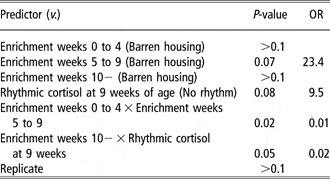
In the logistic models, the odds for rhythmicity of cortisol at N9 was increased by increasing average birth weight in the group, and by treatment EE as compared to 00 (odds ratio (OR) = 30.0, P < 0.01; see Table 2 for details). The final model predicting treatment effects on rhythmicity at F21 is given in Table 3. Previous experience was significant as an interaction between enrichment in farrowing and nursery stages. Crosstabulation of the interaction revealed that nursery stage enrichment promoted cortisol rhythmicity significantly only in animals from barren farrowing pens (P < 0.05 in animals from barren farrowing pens, n = 25; P > 0.1 in animals from enriched farrowing pens, n = 22, χ 2 test).
Effects of moderate bedding in different growing phases on the presence of a normal cortisol secretion rhythm at 9 weeks of age

OR = odds ratio.
a00, E0, 0E and EE (0 = barren, E = enriched in farrowing and nursery stages, respectively).
Effects of moderate bedding in different growing phases on the odds of a circadian secretion rhythm of cortisol at 21 weeks of age

OR = odds ratio.
Fattening phase enrichment increased the odds of a cortisol rhythm at F21 only as an interaction with a variable describing rhythmicity at N9. Crosstabulation indicated that fattening phase enrichment affected cortisol rhythmicity significantly only in animals without a rhythm at N9 (81% of enriched groups and 27% of barren groups without a rhythm at N9 displayed one at F21; n = 22, P = 0.01, χ 2 test). Subjects with a distinctive rhythm N9 were unaffected by fattening phase environment (44% of enriched and 55% of barren groups displayed a rhythm; n = 22, P > 0.1, χ 2 test).
Salivary cortisol concentration
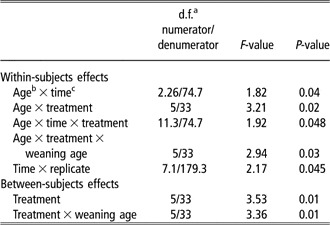
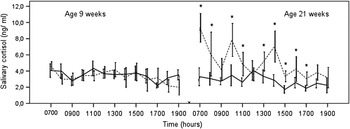
A complete data set was yielded from 52 animals. The main within-subject effects in the repeated measures GLM (age and time of measurement) were not significant, in contrast to their interaction. Significant effects in the model are given in Table 4. Post hoc, all other treatments were compared to the control (000). At N9, the tests did not have adequate power (⩾0.8) to assume that no Type II error was made. E00 affected the cortisol concentration significantly at nine of 13 sampling times indicated in Figure 3, and EEE at 1200 h at F21 (P < 0.05).
Effects of treatment on salivary cortisol concentration in a repeated measures GLM with age and time of measurement as within-subjects factors

aSubjected to the Huynh–Feldt correction.
bAge at sampling (9 or 21 weeks).
cTime of sampling (hourly between 0700 and 1900 h, n = 13). Only significant factors and interactions are given.
Average cortisol concentration (±s.e.) in treatments E00 (interrupted line) and 000 (solid line) at 9 and 21 weeks of age. Asterisks indicate a significant difference at a given time.

Several interactions with weaning age were significant at F21 (Table 4). They were investigated by splitting the data in two subsets based on weaning age: ‘low’ (26.0 ± 0.15 days, 50% of cases) and ‘high’ (31.1 ± 0.38 days, 50% of cases). Repeated measures GLM-models were built for both subsets with time as within-subject factor, and a two-level variable for treatments 000 and E00 as a between-subjects factor. Treatment affected cortisol concentration significantly only in groups with ‘low’ weaning age.
The ACTH stimulation test
The total response of the HPA axis was unaffected by treatment (data not shown, n = 47). The basal concentration at t = 0 min (0900 h) was 4.3 ± 0.39 ng/ml. The cortisol concentration pooled for all focal animals reached the peak concentration 13.1 ± 0.81 ng/ml at t = 90 min.
Associations between cortisol rhythmicity, behaviour and body lesions
Cortisol rhythmicity was associated with time budgets only occasionally. Groups with a cortisol rhythm at N9 performed less agonistic behaviours recorded during 30 min of the most active part of the day (see Munsterhjelm et al., Reference Munsterhjelm, Peltoniemi, Heinonen, Hälli, Karhapää and Valros2009) at F14 (median 0.0 [range 1.1] % of observation time for rhythmic v. 0.01 [range 8.2] % for non-rhythmic groups; P = 0.003, Mann–Whitney U).
Cortisol rhythmicity was not associated with tail-biting behaviour at any age. However, in the fattening unit (weeks F10 to F21), tail lesions occurred in fewer groups where the focal animal had a cortisol rhythm at F21 than non-rhythmic groups (in 6.9% of rhythmic and 27.8% of non-rhythmic groups; P = 0.05).
Skin and ear lesion indices were unaffected by cortisol rhythmicity. In the fattening unit, the tail lesion index was larger in non-rhythmic than rhythmic groups (P = 0.05).
Discussion
The present study aimed to investigate effects of moderate substrate-enrichment on stress physiology of growing pigs by hypothesizing that (i) signs of chronic stress in barren environments can be prevented with provision of substrate, and that (ii) environmental enrichment early in life has effects lasting until slaughter age of fattening pigs. The results provided some support to the hypotheses that was backed up by behavioural observations in the same animals (Munsterhjelm et al., Reference Munsterhjelm, Peltoniemi, Heinonen, Hälli, Karhapää and Valros2009). However, the effects could have been more convincing, and lack of established methods for interpretation of basal cortisol secretion patterns in pigs leaves the biological significance of these findings undisclosed.
Day-time salivary cortisol levels obtained were comparable with earlier reported ones (de Jong et al., Reference de Jong, Prelle, van de Burgwal, Lambooij, Korte, Blokhuis and Koolhaas2000; Hillmann et al., Reference Hillmann, Schrader, Mayer and Gygax2008) as were cortisol responses to ACTH (Cook et al., Reference Cook, Schaefer, Lepage and Jones1996). A circadian rhythm of cortisol was defined as a sufficient decline in the saliva concentration from morning to afternoon and evening (Santiago et al., Reference Santiago, Jorge and Moreira1996). Absence of the expected morning surge, leaving a flat basal secretion pattern, is, in man, associated with severe or prolonged stress and certain psychopathologic states (review by Gunnar and Vazquez, Reference Gunnar and Vazquez2001). In pigs, such blunted cortisol curves have been reported in conditions associated with behavioural signs of stress, that is, tethering (Barnett et al., Reference Barnett, Hemsworth and Winfield1987; Janssens et al., Reference Janssens, Helmond and Wiegant1995) and crowded housing without substrate (de Jong et al., Reference de Jong, Ekkel, van de Burgwal, Lambooij, Korte, Ruis, Koolhaas and Blokhuis1998 and Reference de Jong, Prelle, van de Burgwal, Lambooij, Korte, Blokhuis and Koolhaas2000). Absence of a circadian rhythm in the present subjects may thus be indicative of chronic stress.
Behavioural and body lesion measures were used as validation of cortisol data. The interpretation of associations was complicated by different levels of observation (one focal animal per group for cortisol v. the whole group for the other measures); nevertheless, agonistic behaviour and tail lesions were less frequent in rhythmic than non-rhythmic groups at certain ages. With agonistic activity and tail biting being recognized signs of stress (Salzen, Reference Salzen1991; Wiepkema and Koolhaas, Reference Wiepkema and Koolhaas1993), these findings further support the assumption that a blunted cortisol rhythm in the present animals was a sign of stress. Generally, the treatments seemed to affect behaviour slightly more than basal cortisol secretion. This may be expected as behaviour is considered a sensitive measure of stress, reflecting attempts to cope with a stressor before physiological deviations are evident (Dawkins, Reference Dawkins1998).
Moving from enriched to barren quarters increased tail-biting activity (Munsterhjelm et al., Reference Munsterhjelm, Peltoniemi, Heinonen, Hälli, Karhapää and Valros2009). A relative impoverishment of the environment is known to be aversive to pigs (Beattie et al., Reference Beattie, Walker and Sneddon1995; Bolhuis et al., Reference Bolhuis, Schouten, Schrama and Wiegant2006), and although it did not seem to affect cortisol secretion, it may explain the low proportion of rhythmic animals in treatment EE0 in the fattening stage.
Both cortisol and behavioural results (Munsterhjelm et al., Reference Munsterhjelm, Peltoniemi, Heinonen, Hälli, Karhapää and Valros2009) suggest that enrichment early in life has more effects on stress measures in fattening-stage pigs than the current environment, and that the consequences of barren rearing are negative. These findings may reflect sensitivity of developing stress response systems, and they seem to agree with a substantial body of evidence for effects of early experience on later stress physiology in man and rodents (Luecken and Lemery, Reference Luecken and Lemery2004). Components of the immediate environment are known to permanently calibrate stress response systems in the early postnatal period (Luecken and Lemery, Reference Luecken and Lemery2004).
Enrichment from birth (treatment EE) increased the odds of a distinctive rhythm at N9 as compared to barren housing (treatment 00). E0 and 0E failed to cause significant effects as compared to 00, suggesting that the HPA axis responded to the environment only after several weeks of exposure. These results indicate environmental effects already at 9 weeks of age in contrast to de Jong et al. (Reference de Jong, Ekkel, van de Burgwal, Lambooij, Korte, Ruis, Koolhaas and Blokhuis1998 and Reference de Jong, Prelle, van de Burgwal, Lambooij, Korte, Blokhuis and Koolhaas2000), who suggested that the HPA axis of pigs would not be susceptible to stress before 15 weeks.
Not much has been published on early development of the HPA system in pigs. De Jonge et al. (Reference De Jonge, Bokkers, Schouten and Helmond1996) showed that in subordinate pigs, environmental conditions in the first 6 weeks of life affected the expression of several symptoms of social stress later on. Weaver et al. (Reference Weaver, Aherne, Meaney, Schaefer and Dixon2000) and Kanitz et al. (Reference Kanitz, Tuchscherer, Puppe, Tuchscherer and Stabenow2004) reported effects on later stress physiology of early adverse experience in the form of short-time social isolation during the first 11 to 14 days of life.
The present results may have been affected by variation in the physiological maturation time of the cortisol rhythm, or the treatments may have affected the schedule of maturation. Animals entering the fattening unit exhibiting a normal rhythm seemed quite resistant to the stress of a barren environment (27% responded), indicating some kind of previous calibration. Animals without a rhythm readily acquired one (81% responded) in response to the substrate. It may be argued, that animals non-rhythmic at N9 still had an immature secretion pattern and were thus more responsive to the fattening-unit environment.
Reported ages of maturation of the cortisol rhythm in pigs vary substantially. Gallagher et al. (Reference Gallagher, Giles and Wynn2002) reported a distinctive pattern at 6 to 10 days upon CV-based analysis, whereas cosinor rhythms have emerged between 8 (Ekkel et al., Reference Ekkel, Dieleman, Schouten, Portela, Cornelissen, Tielen and Halberg1996) and 20 weeks (Ruis et al., Reference Ruis, te Brake, Engel, Ekkel, Buist, Blokhuis and Koolhaas1997). Results by De Jong et al. (Reference de Jong, Prelle, van de Burgwal, Lambooij, Korte, Blokhuis and Koolhaas2000) indicate that one possible factor explaining these differences is housing: enriched-, but not barren-housed (difference in space and substrate from birth), animals had developed a clear rhythm at 22 weeks of age, as defined by significantly higher day-time group mean values. In man, environmental effects are suggested to be more important than genetics (Custodio et al., Reference Custodio, Martinelli, Milani, Simões, de Castro and Moreira2007).
Lack of treatment effects in the ACTH test raises concerns about the validity of the basal cortisol results as indicators of chronic stress. Although chronic stress generally is expected to increase the cortisol response to ACTH, tests in animals assumed to be in a state of stress have sometimes failed to yield such results. Janssens et al. (Reference Janssens, Helmond and Wiegant1995) subjected chronically stressed (tethered) sows to acute stress treatments, comparable with ACTH challenges, to conclude that the cortisol response did not differ from the controls due to inhibition by endogenous opioids. In growing pigs, repeated regrouping caused behavioural and physiological signs of stress, but a smaller than expected ACTH response at the end of the experiment (Coutellier et al., Reference Coutellier, Arnould, Boissy, Orgeur, Prunier, Veissier and Meunier-Salaün2007). This result may have been explained by habituation to the treatment over time, as the signs of stress were diminishing. In the present study, habituation cannot be ruled out as a cause for the ACTH results. Behavioural observations support this theory, as all differences between treatments had disappeared by F21 when the ACTH test was conducted (Munsterhjelm et al., Reference Munsterhjelm, Peltoniemi, Heinonen, Hälli, Karhapää and Valros2009). The possible role of endogenous opioids is questionable, as the authors are unaware of any reports on this matter in other than restrictively housed sows.
An increasing birth weight increased the OR for a circadian cortisol rhythm at N9. Low birth weight indicates suboptimal conditions in utero, which may affect later stress physiology by altering foetal HPA axis development and pre-partum maturation (Wust et al., Reference Wust, Entriger, Federenko, Schlotz and Hellhammer2005). Moreover, heavier piglets are certainly better prepared for thermal challenges and successful fighting for social rank and the best teats. These factors are likely to enhance overall physiological development.
In conclusion, moderate substrate-enrichment of the early (0 to 9 weeks of age) environment of pigs appears to affect basal cortisol secretion at least until 21 weeks of age. The biological relevance of these results needs further evaluation.
Acknowledgements
This work was part of the project Welfare and Production in the Pig (ID 4934/501/2003), funded by the Finnish Ministry of Agriculture, Raisio Feed Ltd, Oy Snellman Ab and Mercedes Zachariassen’s Fund. The authors wish to thank the staff at the experimental farm Agrifood Research Finland in Hyvinkää. There is no conflict of interest that would prejudice the impartiality of this paper.