Teaching is regarded as a highly stressful occupation (Johnson et al., Reference Johnson, Cooper, Cartwright, Donald, Taylor and Millet2005; Lomas, Medina, Ivtzan, Rupprecht, & Eiroa-Orosa, Reference Lomas, Medina, Ivtzan, Rupprecht and Eiroa-Orosa2017). In Australia, recent government data ranked school teachers second (after defence force members, fire-fighters and police) in terms of the average number of mental health claims made over a 5-year period (Safe Work Australia, 2015). Sources of teacher stress vary between, and even within, schools (Pietarinen, Pyhältö, Soini, & Salmela-Aro, Reference Pietarinen, Pyhältö, Soini and Salmela-Aro2013). Despite this, a range of Australian and international research into the experience of both primary and secondary school teachers indicates that the highest ranking teacher stressors include maintaining classroom discipline, teaching students who lack motivation, constant evaluation by others, challenging interactions with colleagues, curriculum reform, increasing workload demands, perceived lack of professional support and generally poor working conditions (Kyriacou, Reference Kyriacou2001; Pietarinen et al., Reference Pietarinen, Pyhältö, Soini and Salmela-Aro2013; Precey, Reference Precey2015; Sharplin, O’Neill, & Chapman, Reference Sharplin, O’Neill and Chapman2011).
Emotion regulation has been identified as a factor with the capacity to influence teachers’ abilities to cope with job stress (Montgomery & Rupp, Reference Montgomery and Rupp2005). Emotion regulation can be defined as ‘the processes by which individuals influence which emotions they have, when they have them, and how they experience and express these emotions’ (Gross, Reference Gross1998b, p. 275). Ineffective emotion regulation in teachers has been linked to increased negative interactions with students, stress and burnout, and teacher attrition (Darling-Hammond, Reference Darling-Hammond2001; Montgomery & Rupp, Reference Montgomery and Rupp2005). Moreover, poor emotion appraisal and self-regulation, two of the elements of emotion regulation, have been associated with teacher burnout (Chan, Reference Chan2006). Conversely, teachers with greater capacity to regulate emotion are better prepared to deal with the demands of teaching (Hosotani & Imai-Matsumura, Reference Hosotani and Imai-Matsumura2011), and effective emotion regulation ability has been correlated with job satisfaction and positive affect (Brackett, Palomera, Kaja, Reyes, & Salovey, Reference Brackett, Palomera, Kaja, Reyes and Salovey2010). Thus, professional development programs that focus on the development of emotion regulation skills may protect teachers against potential stress and burnout, which may also lead to positive flow-on effects in the classroom (Jennings, Snowberg, Coccia, & Greenberg, Reference Jennings, Snowberg, Coccia and Greenberg2011). This may be even more critical within an alternative school setting due to the unique factors affecting the operation of many of these schools.
Alternative education
‘Alternative education’ is a term used to refer to the provision of educational opportunities outside the mainstream education system (Wilson, Stemp, & McGinty, Reference Wilson, Stemp and McGinty2011). The term has been used variously to refer to a wide range of educational institutions, including specialist education units, flexible learning centres, and alternative curricular models set up by state or private education organisations or other community groups (te Riele, Reference te Riele2007). For the purposes of this study, however, ‘alternative education’ is used to refer to schools established specifically for students ‘at-risk’ of withdrawing from the conventional school system (Lehr, Tan, & Ysseldyke, Reference Lehr, Tan and Ysseldyke2009). A review of the literature reveals the sporadic nature of research into issues facing alternative schools, and more particularly, the role of teachers in these schools (e.g., Shay, Reference Shay2013; te Riele, Reference te Riele2012). This is despite the fact that both internationally and within Australia, there has been a recent increase in the number of students enrolled in alternative education programs (Lehr, Moreau, Lange, & Lanners, Reference Lehr, Moreau, Lange and Lanners2004; Shay, Reference Shay2013; te Riele, Reference te Riele2014).
Alternative schools often differ from mainstream schooling models in terms of overall environment, curriculum design and implementation (Dyson & Plunkett, Reference Dyson and Plunkett2012). They offer innovative and experiential modes of learning, which emphasise a sense of community and belonging to encourage marginalised young people to access alternative education options (Dyson & Plunkett, Reference Dyson and Plunkett2012; McGregor & Mills, Reference McGregor and Mills2012; Morgan, Reference Morgan2013). In order to create this sense of community, the alternative school system requires dedicated and well-trained staff, with an understanding of the complex social, emotional, physical and intellectual needs of the student population (Wilson et al., Reference Wilson, Stemp and McGinty2011). The positive emotional connections between the staff and young people at these schools are critical to their effectiveness (McGregor & Mills, Reference McGregor and Mills2012; te Riele, Reference te Riele2012) and can literally be ‘life changing’ for students (Australian Industry Group & Dusseldorp Skills Forum, 2007, p. 35).
One of the central themes echoed in the research, however, is the difficulty of finding and retaining quality staff for alternative schools, as well as the related issue of supporting staff through professional development (Cancio & Conderman, Reference Cancio and Conderman2008; Lehr et al., Reference Lehr, Moreau, Lange and Lanners2004; Swars, Meyers, Mays, & Lack, Reference Swars, Meyers, Mays and Lack2009; te Riele, Reference te Riele2012). Poor staff retention rates have been attributed to stress deriving from a range of individual and organisational characteristics, including student-related factors such as academic and social skills deficits, complex psychological needs, emotional and behavioural disorders, and poor coping strategies (Cancio & Conderman, Reference Cancio and Conderman2008; Swars et al., Reference Swars, Meyers, Mays and Lack2009). International literature suggests that students with emotional and behavioural disabilities attend alternative programs in far greater numbers than in conventional schools (Lehr et al., Reference Lehr, Moreau, Lange and Lanners2004). In order to teach effectively in an alternative school, then, teachers need highly developed self-awareness and interpersonal skills to meet the needs of the students accessing the school (de Jong & Griffiths, Reference De Jong and Griffiths2006). Moreover, not only do the complex needs of students contribute to the demanding nature of the work required of staff, but alternative schools tend to employ fewer teachers on site, meaning that teachers potentially need to be skilled across a range of subject areas, with expertise in both regular and special education (Lehr & Lange, Reference Lehr and Lange2003). These issues, specific to the context of alternative schools, clearly increase the challenge of finding and retaining quality staff.
The retention of experienced staff is, however, critical to the relational foundation of alternative education programs. This is a thread that runs through the literature on the topic, both internationally and nationally, and is accompanied by an appeal for professional development to assist with the emotionally complex workloads of staff in alternative schools (Berry & Center for Teaching Quality, Reference Berry2007; Lehr et al., Reference Lehr, Moreau, Lange and Lanners2004; te Riele, Reference te Riele2012). The need for professional development to provide support for alternative school teachers served as the impetus for this study, which focuses specifically on the incorporation of mindfulness into teacher professional development programs.
The role of mindfulness
Mindfulness has been defined as ‘the awareness that arises by paying attention on purpose, in the present moment, and non-judgmentally’ (Kabat-Zinn, Reference Kabat-Zinn1990, p. xxxv). From this definition, two key components of mindfulness emerge: (1) self-regulation of attention on present-moment experience, and (2) an attitude of curiosity, openness and acceptance (Bishop et al., Reference Bishop, Lau, Shapiro, Carlson, Anderson, Carmody and Devins2004). Mindfulness training courses are used in a variety of contexts with wide-ranging benefits for participant wellbeing (e.g., Baer, Reference Baer2003; Brown, Ryan, & Creswell, Reference Brown, Ryan and Creswell2007) and are increasingly being used in educational settings (e.g., Garrison Institute, 2014; Jennings, Lantieri & Roeser, Reference Jennings, Lantieri, Roeser, Brown, Corrigan and Higgins-D’Alessandro2012).
The general pattern arising from the research into teacher-based mindfulness interventions reveals beneficial outcomes. A number of studies have made connections between increased levels of mindfulness brought about as a result of mindfulness practice, and reductions in clinical measurements of psychological stress (Gold et al., Reference Gold, Smith, Hopper, Herne, Tansey and Hulland2010; Roeser et al., Reference Roeser, Schonert-Reichl, Jha, Cullen, Wallace, Wilensky and Harrison2013; Winzelburg & Luskin, Reference Winzelberg and Luskin1999), anxiety (Flook, Goldberg, Pinger, Bonus, & Davidson, Reference Flook, Goldberg, Pinger, Bonus and Davidson2013; Poulin, Reference Poulin2009; Roeser et al., Reference Roeser, Schonert-Reichl, Jha, Cullen, Wallace, Wilensky and Harrison2013), and burnout (Anderson, Levinson, Barker, & Kiewra, Reference Anderson, Levinson, Barker and Kiewra1999; Flook et al., Reference Flook, Goldberg, Pinger, Bonus and Davidson2013; Jennings, Frank, Snowberg, Coccia, & Greenberg, Reference Jennings, Frank, Snowberg, Coccia and Greenberg2013; Roeser et al., Reference Roeser, Schonert-Reichl, Jha, Cullen, Wallace, Wilensky and Harrison2013). However, these results are not consistent across the entire body of research. A recent review of the literature (Emerson et al., Reference Emerson, Leyland, Hudson, Rowse, Hanley and High-Jones2017), which identified eight studies on both general and occupation-specific stress, found that 60% of the results were significant, although these results were reported in both low- (Gold et al., Reference Gold, Smith, Hopper, Herne, Tansey and Hulland2010) and high-quality (Jennings et al., Reference Jennings, Frank, Snowberg, Coccia and Greenberg2013) studies. Furthermore, the effects of mindfulness-based interventions on more general measures of psychological wellbeing have also been reported, with contrasting results ranging from significant improvement (Flook et al., Reference Flook, Goldberg, Pinger, Bonus and Davidson2013) to no significant improvement (Frank, Reibel, Broderick, Cantrell, & Metz, Reference Frank, Reibel, Broderick, Cantrell and Metz2015). Research in this area is in its infancy and there is still much unknown. Variability in the quality of the research clearly has an impact on the reliability of some of the published data (Emerson et al., Reference Emerson, Leyland, Hudson, Rowse, Hanley and High-Jones2017). However, in general, the emerging body of research yields promising results that warrant further investigation.
Similarly, while the literature is beginning to explore the mechanisms that underlie the seemingly beneficial effects of mindfulness (Shapiro, Carlson, Astin, & Freedman, Reference Shapiro, Carlson, Astin and Freedman2006), we do not yet have an integrated model to explain these apparent effects. Mindfulness has been hypothesised to have a positive impact on emotion regulation capacity (e.g., Farb, Anderson, Irving, & Segal, Reference Farb, Anderson, Irving, Segal and Gross2013; Holzel et al., Reference Holzel, Lazar, Gard, Schuman-Olivier, Vago and Ott2011), and there is some suggestion that this is one pathway through which mindfulness may produce positive outcomes, particularly for teachers (Emerson et al., Reference Emerson, Leyland, Hudson, Rowse, Hanley and High-Jones2017; Taylor et al., Reference Taylor, Harrison, Haimovitz, Oberle, Thomson, Schonert-Reichl and Roeser2016). According to the theoretical framework that informs this study, emotion regulation strategies may be either antecedent-focused, occurring before emotional responses are fully activated (e.g., through intentional selection or modification of situations, or through cognitive reappraisal of situations), or response-focused, taking place after an emotional response has been aroused (e.g., through response modulation or suppression; Gross, Reference Gross1998a; Gross & John, Reference Gross and John2003). This framework emphasises the critical importance of the timing of emotion regulation and suggests that more positive consequences ensue the earlier one regulates emotion (Gross, Reference Gross1998a). According to recent research that proposes a model of mindful emotion regulation, mindfulness may play a role in the early activation of adaptive antecedent-focused emotion regulation strategies (Farb et al., Reference Farb, Anderson, Irving, Segal and Gross2013), thus resulting in potentially beneficial physical, cognitive, social and emotional outcomes (Gross, Reference Gross1998a).
Some studies that have explored the use of mindfulness for teachers have found statistically significant improvements in quantitative measures of participant emotion regulation ability (Jennings et al., Reference Jennings, Frank, Snowberg, Coccia and Greenberg2013; Taylor et al., Reference Taylor, Harrison, Haimovitz, Oberle, Thomson, Schonert-Reichl and Roeser2016). Researchers attribute these improvements to the use of mindfulness in challenging emotional situations. Teachers who receive mindfulness training appear to develop greater efficacy in meeting the emotional demands of the classroom and become less emotionally reactive to work-related stressors (Taylor et al., Reference Taylor, Harrison, Haimovitz, Oberle, Thomson, Schonert-Reichl and Roeser2016). Jennings and Greenberg (Reference Jennings and Greenberg2009) suggest that mindfulness interventions assist in the recognition and regulation of stress through the development of greater self-awareness. Similarly, Chiesa, Serretti, and Jakobsen (Reference Chiesa, Serretti and Jakobsen2013) propose that mindfulness interventions can result in increased self-awareness and attentional capacity, which cultivates an enhanced ability to identify and modify emotional reactivity (Garland, Gaylord, & Frederickson, Reference Garland, Gaylord and Frederickson2011; Sharp & Jennings, Reference Sharp and Jennings2016). There appears to be a strong effect of mindfulness on emotion regulation in both quantitative (Frank et al., Reference Frank, Reibel, Broderick, Cantrell and Metz2015; Jennings et al., Reference Jennings, Frank, Snowberg, Coccia and Greenberg2013) and qualitative teacher studies (Schussler, Jennings, Sharp, & Frank, Reference Schussler, Jennings, Sharp and Frank2016; Taylor et al., Reference Taylor, Harrison, Haimovitz, Oberle, Thomson, Schonert-Reichl and Roeser2016), although some research indicates a slightly weaker effect on teaching-specific emotion regulation, as measured by the Emotion Regulation at Work Self-Efficacy Scale (Benn, Akiva, Arel, & Roeser, Reference Benn, Akiva, Arel and Roeser2012; Emerson et al., Reference Emerson, Leyland, Hudson, Rowse, Hanley and High-Jones2017). The relevance of this is, as yet, uncertain and points to the need for more observational measures of teacher behaviour in the classroom to validly assess various claims about the potential impact of mindfulness interventions (Taylor et al., Reference Taylor, Harrison, Haimovitz, Oberle, Thomson, Schonert-Reichl and Roeser2016).
Furthermore, there is very little research into the use of mindfulness in alternative schools. The few teacher studies that do broadly relate to the context of alternative schools suggest that mindfulness interventions may have a beneficial impact in challenging settings (Jennings, Snowberg, Coccia, & Greenberg, Reference Jennings, Snowberg, Coccia and Greenberg2011; Singh, Lancioni, Winton, Karazsia, & Singh, Reference Singh, Lancioni, Winton, Karazsia and Singh2013). However, there is no directly relevant research of which we are aware in relation to alternative school teachers, mindfulness and emotion regulation.
The purpose of this study was therefore to extend the research into the perceived influence of mindfulness as a strategy to manage teacher stress and to support the emotion regulation of teachers in an alternative school. The following research questions formed the basis of the study: (1) What are alternative school teachers’ levels of mindfulness, emotion regulation, and stress pre and post a mindfulness training program? (2) How do alternative school teachers perceive the impact of a mindfulness training program as a strategy to manage stress and support their emotion regulation within a professional context?
Method
The study took the form of a case study, following the experiences of four educators who participated in a mindfulness training program in a metropolitan Queensland alternative secondary school or Flexible Learning Centre (FLC). The flexi-school offers a formal curriculum in Vocational Education and Training (VET) and Queensland Curriculum and Assessment Authority (QCAA) approved courses. In addition, the school offers an informal curriculum in care, relationship-building and communication (EREA, 2016a). A significant component of the workload of the flexi-school educators is the provision of emotional support to the young people (aged 14–25) who access the school. These young people access the school because they are disengaged from mainstream education for a variety of reasons; they may have experienced backgrounds such as homelessness, domestic violence, mental illness, drug and alcohol abuse, and contact with the youth justice system, and a range of issues stemming from poverty and marginalisation (EREA, 2016b). Thus, the emotional demands of the job are high (FLC Head of Campus, personal communication, April 27, 2016).
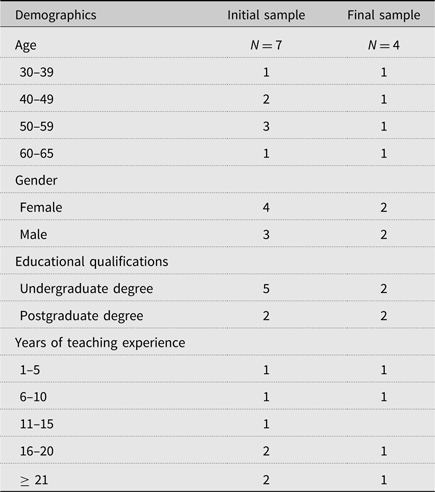
Voluntary registration for the mindfulness training program was open to all educators employed at the school, resulting in a convenience sample of educator-participants. While not all educators at the school were qualified teachers registered with the Queensland College of Teachers (QCT), all of the educators did have some form of tertiary qualification. Relevant participant demographic information is included in Table 1. Consent forms and pre-training questionnaire data were obtained from an initial sample of seven participants (N = 7). Of these seven registrants, four participants (n = 4) completed all components of the research; that is, they attended at least four of the six mindfulness sessions, completed both pre- and post-program questionnaires, submitted their reflection journal and attended individual post-program interviews.
Participant Demographics

Procedure
The study was conducted in three distinct stages: pre-mindfulness training, mindfulness training and post-mindfulness training.
Pre-mindfulness training
A pre-training questionnaire was administered online, with access provided to participants one week prior to the training start date. As described below, the questionnaire took measures of participant stress, emotional exhaustion, emotion regulation and mindfulness.
Mindfulness training program
The study implemented a modified Mindfulness Based Stress Reduction (MBSR) training program in 2016. The training was delivered by one of the researchers whose personal mindfulness experience and teaching background was equivalent to the prerequisites required by the Guidance for Teaching Mindfulness (UK Network of Mindfulness-Based Teacher Trainers, 2011). The training was delivered at the school in a group format across six consecutive weeks, one afternoon per week for 1.5 hours. The training covered a range of formal mindfulness practices, such as guided meditation, breath awareness, body scans and gentle yoga, and informal mindfulness practices, such as mindful eating and mindful communicating. As part of the training, participants were provided with a range of materials, including readings related to course content for each week, a personal reflection journal, and weekly recordings of guided meditations.
The traditional structure and content of the MBSR program were retained for the purposes of this study; however, the training program applied the learnings to teaching, placing greater emphasis on interpersonal mindfulness in recognition of the highly social nature of teachers’ work and also incorporating weekly discussions tailored to the applicability of mindfulness in the specific school context. Training was offered over a 6-week period (rather than the typical 8 weeks) and the expectation for daily home practice was reduced to 15 minutes, 6 days per week (rather than the typical 45 minutes). Participants were considered to have completed the training if they attended four out of six sessions. This decision was made in accordance with research which suggests that the minimum effective dose of similar mindfulness-based programs is at least four of eight weekly sessions (Segal, Teasdale, & Williams, Reference Segal, Teasdale, Williams, Hayes, Follette and Linehan2004).
Mindfulness training data collection
Data collected during the training period consisted of participants’ personal journal reflections. During each session, participants were given 10–15 minutes to respond to semi-structured reflection questions, such as: ‘Did you remember to practise everyday mindfulness this week? If so, what did you notice?’ After the final session, participants’ journals were collected, scanned and transcribed for subsequent analysis.
Post-mindfulness training — Questionnaire and semi-structured interviews
The post-training questionnaire (identical to the pre-training questionnaire) was administered online and semi-structured interviews were held with each of the four case study participants within three weeks of the conclusion of the training. Interview questions focused upon the participants’ current perceived mindfulness levels, emotion regulation abilities, stress levels and emotional exhaustion, as well as additional questions about the perceived benefits of and barriers to the mindfulness training program. Each interview was conducted by an independent researcher. Interviews lasted between 30 to 45 minutes and were audio recorded for subsequent transcription.
Measures
The pre- and post-training questionnaires provided baseline and follow-up data in relation to relevant sections of the following self-report measures:
Depression Anxiety Stress Scales (stress subscale) (DASS21; Lovibond & Camilleri, Reference Lovibond and Camilleri2014); DASS Manual (Lovibond & Lovibond, Reference Lovibond and Lovibond1995)
The DASS21 is a 21-item, self-report, Likert-type scale (0 = did not apply to me at all, to 3 = applied to me very much, or most of the time), which has been reported to validly measure dimensions of depression, anxiety and stress (reliability coefficient alphas: .88, .82, and .90 respectively; Henry & Crawford, Reference Henry and Crawford2005). The current study employed only the stress subscale of the DASS21, given the study’s general focus on the experience of stress in a non-clinical teacher population. The current study used items from the DASS-21, which is a short-form version of the full 42-item DASS scale able to be interpreted by reference to the normative values for the full scale (see Figure 1). Sample items from this subscale included: ‘Over the past week, I found it hard to wind down’ and ‘Over the past week, I found it difficult to relax.’ The higher the score, the higher the level of stress.
Participant stress levels pre- and post-intervention shown with normative data for DASS (Lovibond & Lovibond, Reference Lovibond and Lovibond1995).

Maslach Burnout Inventory (emotional exhaustion subscale) (MBI; Maslach & Jackson, Reference Maslach and Jackson1981; Maslach, Jackson, Leiter, Schaufeli, & Schwab, Reference Maslach, Jackson, Leiter, Schaufeli and Schwab2015); MBI Manual (Maslach, Jackson, & Leiter, Reference Maslach, Jackson and Leiter1996)
The MBI is the most frequently used instrument to determine whether respondents are at risk of burnout across three dimensions of burnout: emotional exhaustion, depersonalisation, and personal achievement. Only the emotional exhaustion subscale (alpha coefficient = .91), often considered the core component of burnout (e.g., Hulsheger, Alberts, Feinholdt, & Lang, Reference Hulsheger, Alberts, Feinholdt and Lang2013; Koeske & Koeske, Reference Koeske and Koeske1989; Tsouloupas, Carson, Matthews, Grawitch, & Barber, Reference Tsouloupas, Carson, Matthews, Grawitch and Barber2010) was measured in the current study. Sample items from this seven-item, Likert-type subscale (0 = never, to 6 = every day) included: ‘I feel emotionally drained from my work’ and ‘I feel frustrated by my job’. The higher the score, the higher the level of emotional exhaustion.
Five-Facet Mindfulness Questionnaire (FFMQ; Baer, Smith, Hopkins, Krietmeyer, & Toney, Reference Baer, Smith, Hopkins, Krietemeyer and Toney2006)
The FFMQ is a 39-item, Likert-type scale (1 = never or very rarely true, to 5 = very often or always true) that measures five dimensions of mindfulness: observing, describing, acting with awareness, non-judging of inner experience, and non-reactivity to inner experience (Baer, Reference Baer2014). The FFMQ has reported coefficient alphas for internal consistency ranging from .84 to .92 (Siegling & Petrides, Reference Siegling and Petrides2014). The FFMQ has been used in the most recent and methodologically rigorous research into mindfulness and teachers (Flook et al., Reference Flook, Goldberg, Pinger, Bonus and Davidson2013; Frank et al., Reference Frank, Reibel, Broderick, Cantrell and Metz2015; Jennings et al., Reference Jennings, Frank, Snowberg, Coccia and Greenberg2013; Lomas et al., Reference Lomas, Medina, Ivtzan, Rupprecht and Eiroa-Orosa2017). Sample items included: ‘I am easily distracted’ and ‘I find myself doing things without paying attention’. The higher the score, the higher the level of mindfulness.
Emotion Regulation Questionnaire (ERQ; Gross & John, Reference Gross and John2003)
The ERQ is a 10-item, Likert-type scale (1 = strongly agree, to 7 = strongly disagree) designed to measure respondents’ emotion regulation ability through antecedent-focused cognitive reappraisal (adjusting the way a situation is interpreted to modify its emotional impact) or response-focused suppression (reactively adjusting the outer expression of an emotional response). The measure demonstrates satisfactory internal consistency with coefficient alphas of .79 to .85 (Gross & John, Reference Gross and John2003; Ioannidis & Siegling, Reference Ioannidis and Siegling2015). Sample items included: ‘When I want to feel more positive emotion (such as joy or amusement), I change what I’m thinking about.’ The higher the score on each type of emotion regulation, the more likely the respondent is to engage in that type of emotion regulation.
Analysis
Questionnaire data analysis
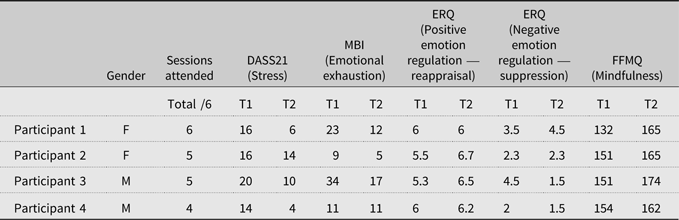
Each questionnaire was scored in accordance with instructions from the relevant manual or publication. Individual participant data for each measure (see Table 2) were compared with the published normative data (see Figures 1–5) to provide a rating for each participant’s stress, emotional exhaustion, emotion regulation, and mindfulness levels both before and after completion of the mindfulness training. The self-report data from these four questionnaires were used to compile a profile for each of the case study participants. The self-report survey data were used to inform and enrich the analysis of the qualitative data collected. Only descriptive data analysis took place due to the small sample size. Pre- and post-training levels were examined for each participant to assess whether there had been any changes on any of the measures following mindfulness training. A Reliable Change Index (RCI) was calculated using the ACORN RCI calculator (ACORN, 2007) for each participant across each measure. The RCI specifies the amount of change an individual must show on a specific psychometric instrument between measurement occasions for that change to be reliable, that is, larger than that reasonably expected due to measurement error alone.
Questionnaire Data Before (T1) and After (T2) Mindfulness Training

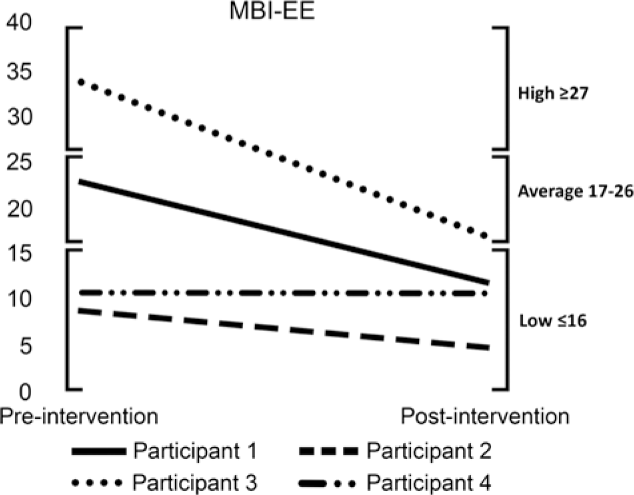
Participant emotional exhaustion levels pre- and post-intervention shown with normative data for MBI (Maslach et al., Reference Maslach, Jackson and Leiter1996). Adapted from Maslach Burnout Inventory Manual (3rd ed.), by Maslach, C., Jackson, S.E., & Leiter, M.P. Reproduction by special permission of the publisher, Mind Garden, Inc., www.mindgarden.com. Further reproduction is prohibited without the publisher’s written consent.

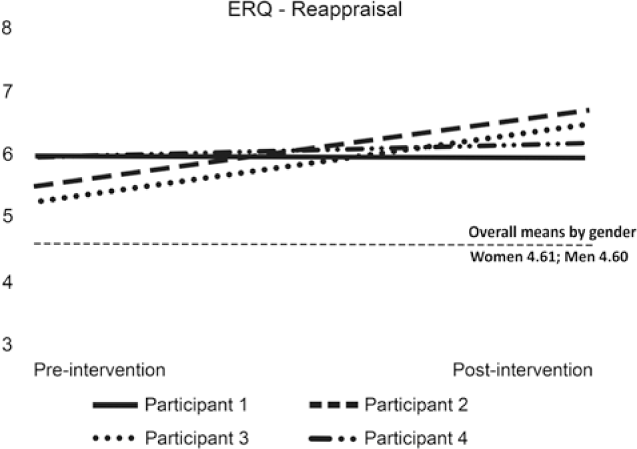
Participant emotion regulation (reappraisal) levels pre- and post-intervention shown with overall means by gender for ERQ (Gross & John, Reference Gross and John2003).

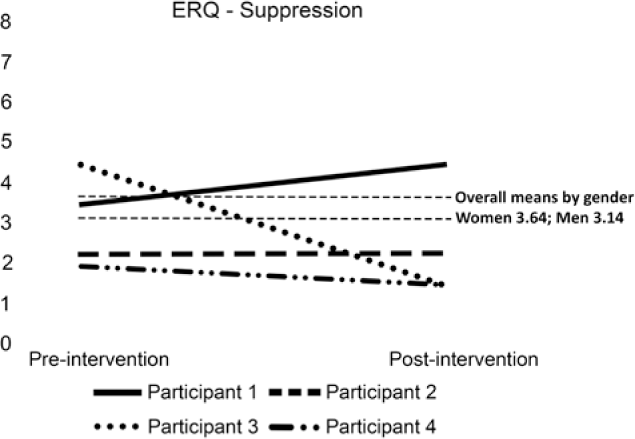
Participant emotion regulation (suppression) levels pre- and post-intervention shown with overall means by gender for ERQ (Gross & John, Reference Gross and John2003).

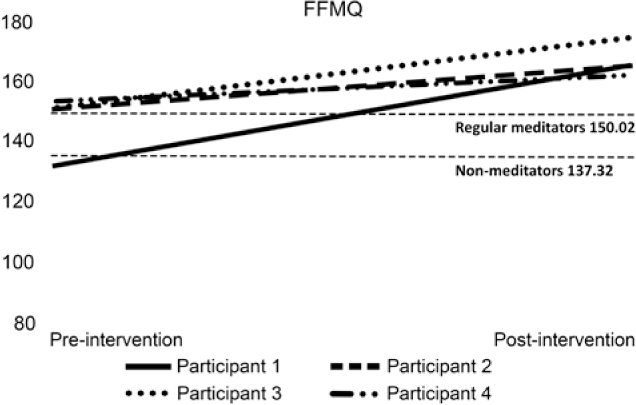
Participant mindfulness levels pre- and post-intervention shown with overall means in demographically-similar populations for FFMQ (adapted from Baer et al., Reference Baer, Smith, Lykins, Button, Krietemeyer, Sauer and Williams2008).

Qualitative data analysis — thematic coding
(1) First round analysis — the individual experience: The qualitative data for each participant (collected in the form of interviews (I) and journal reflections (J)) were analysed through a cycle of deductive and inductive thematic coding (Braun & Clarke, Reference Braun and Clarke2006). The deductive thematic analysis was guided by research related to stress, emotional exhaustion, emotion regulation and mindfulness. Data related to research question 1 was primarily deductive or theory-driven. In contrast, the open-ended nature of research question 2 allowed for a more inductive response to the data. In response to this question, data related to the participants’ subjective experiences of the mindfulness training program were collected at this stage. (2) Second round analysis — the collective experience: Once the initial round of coding was completed, individual participant comments were collated and organised into themes to provide an analysis of the collective experience of the participants.
Results
Collated questionnaire data for each participant can be seen in Table 2. This table details individual participant scores before (T1) and after (T2) mindfulness training for each of the measured scales. Figures 1 to 5 represent collated participant data, shown with normative data, for each of the measures taken in this study.
Participant 1
Participant 1 was a 42-year-old female qualified teacher with seven years of teaching experience. Her exposure to mindfulness prior to the training program was minimal, which she explained was limited to a couple of introductory meditation sessions. During her interview, she categorised the emotional demands of her job as ‘quite high’, describing the needs of the young people who attend the school as ‘high level’. This participant attended all six mindfulness sessions. She struggled to commit to a home practice of formal mindfulness techniques; however, she practised informal mindfulness practices almost daily, describing this as ‘a more mindful approach to living with little breaks in the hurly-burly of life’.
Stress and emotional exhaustion
Despite her lack of formal practice, this participant revealed a reduction in both stress and emotional exhaustion levels from T1 to T2 (see Figures 1 and 2). The participant’s change score of 10 for the DASS21 exceeded the RCI index of 5.52 (p < .05) thereby showing a significant improvement in her stress levels. The participant did not show a significantly reliable change in her levels of emotional exhaustion (RCI = 11.15, pre–post change score = 11, p > .05). Her reduction in stress and emotional exhaustion levels is, however, supported by both her journal (J) entries and interview (I) responses. She noted that post-training, the external stressors in her life had increased when compared to pre-training stressors, yet her stress levels seemed to have decreased. In support of this, she noted that she was ‘able to step back a bit … and see (stressful events) in the grand scheme of the world’ (I). She also described her post-training emotional state as more relaxed and like ‘being on more of an even keel’ (I).
Emotion regulation ability
Participant 1’s baseline reappraisal scores were above average when compared with the mean overall score for women (see Figure 3). There was no change in her pre- and post-training scores for reappraisal (positive emotion regulation). However, her score for total suppression unexpectedly and significantly increased between pre- and post-mindfulness training (RCI = 3.87, pre–post change score = 4, p < .05; see Figure 4).
Participant 1’s interview responses provide evidence of a subjective experience of change in emotion regulation ability over the course of the research program. Her journal entry for the final training session noted that she had observed changes in coping with emotionally challenging situations over the course of the training. She described an increased ability to ‘move on more quickly’, increased compassion for others, and an increased ability to detach from intense emotional exchanges in the moment and ‘not take it so personally’ (I). She drew upon examples from both her personal and professional life in support of her subjective experience. Within the context of work, she noted that she had been using mindfulness to deal with stressful interactions, ‘sometimes in the very moment and other times a short while after to help … think about it in a more relaxed way’ (J).
Mindfulness
Participant 1’s overall mindfulness score increased from a level slightly lower than average for a demographically similar non-meditator at T1 to above average for a regular meditator at T2 (see Figure 5). Changes in pre- and post-training scores were significant (RCI = 13.41, pre–post change score = 33.00, p < .05). She also identified an increased subjective experience of mindfulness over the course of the training, observing that an increased sense of mindfulness assisted her in activating compassion, detachment and acceptance in the moment. She described her experience of mindfulness as a ‘sort of double thinking’ or meta-awareness, where ‘you’re aware of what you’re aware … [able to] detach a little and … float above it a little and see it’ (I). She also found that bringing a sense of curiosity to challenging feelings was ‘soothing’ during stressful times (J).
Participant 2
Participant 2 was a 62-year-old female qualified teacher with 16 years of teaching experience. Prior to the training, she had developed a solid understanding of mindfulness having completed a full 8-week Mindfulness Based Stress Reduction (MBSR) course in the previous calendar year. She described the emotional demands of her job as variable from day to day but conceded that they could reach ‘substantial heights’ (I). During her interview, she estimated that she engaged in formal mindfulness practices approximately 10–15 minutes per day throughout the duration of the training and used brief mindfulness practices, such as a quick body scan or breath awareness, quite frequently.
Stress and emotional exhaustion
Participant 2 revealed a slight reduction in both stress and emotional exhaustion levels from T1 to T2, with no reliable change between pre- and post-training scores. A shift in stress levels was identified by the participant in her interview responses where she suggested that her stress levels had changed because she was more aware of the early signals of stress and was able to intervene before stress had an opportunity to build. She also commented that she was less reactive than previously, which seemed to allow stress to dissipate, and in general noticed that she was able to manage ‘a lot better’ with the stressors of school over the course of the mindfulness training (I). She also commented that her growing sense of acceptance about things seemed to have resulted in a more ‘even’ emotional state overall (I).
Emotion regulation ability
Participant 2’s baseline reappraisal scores were above average and significantly increased post-training (RCI = 4.85, pre–post change score = 7, p < .05); however, there was no reliable change in suppression levels pre- and post-training. The participant’s questionnaire scores indicate a highly developed emotion regulation ability. When asked whether she had noticed any difference in the way she dealt with interactions with others, particularly in her professional role, she stated that she had not noticed a great deal of difference with the young people at school. However, in personal situations she noted that she had become able to cope with difficult interactions in shorter periods of time by focusing on her response rather than staying with or reacting to painful emotions. This distinction is captured in her comment that ‘I’m noticing I am more able to let well alone rather than react — this is more in personal situations. It is easier in professional situations’ (J).
Mindfulness
Participant 2’s baseline mindfulness score was already at a level that was approximately equivalent to a regular meditator at T1 (see Figure 5). At T2, her mindfulness levels significantly increased to above average for a regular meditator (RCI = 13.41, pre–post change score = 14, p < .05). She stressed that an increased body awareness, which had developed over the course of the mindfulness training, was fundamental to her sense of greater connection with the external world: ‘Sensing how I really am in my body … am I crunching my jaw, is my brow knitted … it’s like I’m holding myself in and not being open to what’s actually going on … I can let that go (and) actually connect more outside my body … with other people … I feel more connected to the universe’ (I). She commented that mindfulness had assisted her in finding ‘patches of energy’ and was allowing her to feel more focused and proactive at work. (J) She commented that, as a professional development tool: ‘(Mindfulness) is perfect … I think some teachers get to such a point of frustration that they don’t know what to do and some of them can’t control their own emotions and it’s really sad that teachers … can get into that situation without this kind of support’ (I).
Participant 3
Participant 3 was a 51-year-old male qualified teacher with 30 years of teaching experience. Prior to the mindfulness training, he had a limited understanding of mindfulness, having completed only a few guided sessions using an online mindfulness application. As the head of campus, responsible for the welfare of both the staff and young people at the school, he described the emotional demands of his job as ‘extraordinary’: ‘It’s very difficult. I have to keep the place running as … a caring positive place … at the same time dealing with a range of traumatised young people and care for the staff that are bearing the brunt of that behaviour…That is an emotionally draining thing to do’ (I). During his interview, he estimated that he engaged in formal mindfulness practices two or three times per week for 15–20 minutes for the duration of the training. In addition, he practised mindful walking on his journey to work most weekdays for about 20 minutes.
Stress and emotional exhaustion
Participant 3 revealed a significant and reliable reduction in stress levels from T1 to T2 shifting from moderate to normal stress levels (see Figure 1) over the course of the training (RCI = 9.75, pre–post change score = 10, p < .05). His emotional exhaustion levels also significantly decreased from T1 to T2 (RCI = 11.15, pre–post change score = 17, p < .05). His baseline emotional exhaustion levels were in the high range of experienced burnout, whereas after the training, he scored at the lower end of the average range of experienced burnout (see Figure 2).
These apparent shifts were also identified by the participant in his interview responses. He observed that since commencing mindfulness practice, although he still had moments where he was ‘highly stressed’, he had ‘calmed down by an order of magnitude’ (I). He noted that, although he still experienced stress, he no longer worried about it as much and was able to see it as ‘part of (him) rather than being all pervasive’ (J). This allowed him to ‘shed stress more quickly and to have a lower baseline of stress in general’ (I).
Interestingly, his own observations were that his level of emotional exhaustion had probably remained stable, even after the training. Despite this observation, he emphasised his ability to disengage from work stressors as a critical factor in an increased sense of happiness that he had experienced over the course of the mindfulness training. He observed that his mindfulness practice seemed to ‘make space’ in his life: ‘I find it very easy in my particular role to get very tightly bound up in the various stories that are going on in the school and that can be difficult in that I can’t find ways … to have an educational impact or I can become a little bit vicariously traumatized myself. So, I think that one of the things [I experienced] as a result of doing the mindfulness (was) a little bit of space and perspective … It actually removed the story for a moment so that I was able to re-centre’ (I). As a result, this participant felt that he was able to find some kind of ‘respite’ from the stressful nature of his work, rather than being fixed in constant problem-solving mode (I). He also commented on the ‘clear calming effect’ of mindfulness, of feeling ‘more alert and focused’ (J) and the improved quality of his thoughts overall.
Emotion regulation ability
Participant 3’s baseline emotion regulation ability scores were above average when compared with the mean overall score for men (see Figures 3 and 4), with both reappraisal and suppression scores moving in the expected direction post-training. This participant registered a significant increase in his emotion regulation reappraisal score (RCI = 4.85, pre–post change score = 7, p < .05), as well as demonstrating a significant reliable change in suppression scores from pre- to post-training (RCI = 3.87, pre–post change score = 12, p < .05). He reflected that his ability to use mindfulness to explicitly deal with challenging situations had increased (J). Likewise, he observed that if he was being ‘short’ with someone, he had become more able to recognise that in the moment and to decide that ‘it’s probably time to engage in a bit more mindfulness’ (I).
Mindfulness
Participant 3’s baseline mindfulness score was already at a level which was approximately equivalent to a regular meditator at T1 (see Figure 5). This score increased to well above average for a regular meditator at T2. There was a significant and reliable improvement from pre- to post-training mindfulness scores (RCI = 13.41, pre–post change score = 23, p < .05). He observed that he had become ‘much better at moving into mindfulness and remaining more focused’ (J). He noted that he was still easily distracted but that he was able to recognise when he was not being mindful and was able to take action (J).
Participant 4
Participant 4 was a 35-year-old male teacher with 2 years of teaching experience. This participant was not a registered teacher, coming instead from a background in music. Prior to the training, he had minimal experience with mindfulness, having completed a few guided sessions using an online mindfulness application with other staff members. He described the emotional demands of his job as variable from day to day with the potential to be quite demanding. He estimated that he engaged in an average of 15 minutes per day practising informal mindfulness, such as mindful walking, mindful eating and interpersonal practices, although these practices were generally restricted to weekdays. His formal mindfulness practice was limited. He estimated that he engaged in short formal mindfulness practices approximately half a dozen times each week for a few minutes at a time (I).
Stress and emotional exhaustion
Although participant 4’s stress level remained within the normal range (see Figure 2) from pre- to post-training, his questionnaire responses (Table 2) revealed a significant and reliable reduction within the normal range from T1 to T2 (RCI = 5.52, pre–post change score = 10.00, p < .05). His emotional exhaustion levels remained stable in the low range of experienced burnout.
A subjective decrease in stress levels was identified by the participant in his interview responses. He observed that he had developed a greater awareness of physical tension that assisted him to take action before his stress levels became too elevated (I). He also noted that he often felt re-energised after the training sessions — ‘kind of buzzing’ (I) — which he managed to carry into the rest of his evening and served as a reminder to him of why the mindfulness practices were worthwhile. He described the practices as ‘grounding … centring … even energising … and focus(ing)’ (J). He also stressed the importance of mindfulness for staff at the school to minimise the energy they absorbed due to the mix of mental health, drug abuse and family violence issues experienced by young people who access the school: ‘Reminding yourself of what you can do and what you can’t do is important … mindfulness practice helps you re-centre’ (I).
Emotion regulation ability
Participant 4’s baseline reappraisal scores were well above average when compared with the mean overall score for men (see Figure 3), increasing slightly post-training. His baseline suppression score was well below average for men (see Figure 4) and this score decreased marginally post-training. Changes in reappraisal (RCI = 4.85, pre–post change score = 1, p < .05) and suppression scores (RCI = 3.86, pre–post change score = 2, p < .05) were not reliably significant.
Mindfulness
Participant 4’s baseline mindfulness score was already at a level that was approximately equivalent to a regular meditator at T1, increasing to above average for a regular meditator at T2 (see Figure 5). However, changes in mindfulness levels pre- and post-training were not significant (RCI = 13.41, pre–post change score = 8, p < .05). Subjectively, this participant commented upon an increased awareness of being mindful. In particular, he noticed an increased level of interpersonal mindfulness, both personally and professionally: ‘In a school context I’m conscious of being attentive to a conversation that’s going on with the young people I’m working with. Sometimes when I’m at home I might be trying to do three things at once … I realized that I was doing all three of those things kind of inefficiently. I’ve brought that into being more present … in home conversations’ (I).
Discussion
The remainder of the article synthesises the results of this study in line with the stated research purpose by evaluating the perceived influence of mindfulness as a strategy to manage teacher stress and to support the emotion regulation of teachers in this alternative school context. As such, the following sections address the research questions that formed the basis of the study: (1) What are alternative school teachers’ levels of mindfulness, emotion regulation, and stress pre and post a mindfulness training program? (2) How do alternative school teachers perceive the impact of a mindfulness training program as a strategy to manage stress and support their emotion regulation within a professional context?
Emotion regulation and improved coping mechanisms
All of the participants noted that their ability to cope with stressful emotional situations seemed to improve over the course of the training. Notably, three of the four participants registered reliably significant reductions in stress from T1 to T2. Participant 3 was the only participant to record a reliably significant reduction in emotional exhaustion levels from T1 to T2. However, he was also the only participant to have above average baseline emotional exhaustion levels; thus, this result may not be surprising, given that he had more scope for improvement on this score.
An overall subjective perception of improved ability to cope with stress was reflected in each of the participants’ journal and interview responses. Participant 3, for example, noted that although stress did not disappear from his life, his ability to ‘shed stress’ improved, resulting in a lower baseline of stress overall. Similarly, participants 1 and 2 commented on their ability to cope more effectively despite their experience of external stressors remaining stable or even increasing over time. Participant 3 also noted an increased ability to ‘leave it behind’. This ability to ‘leave it behind’ suggests an increased ability to regulate attention by diminishing ruminative tendencies, which has also been linked to improved emotion regulation ability (Chiesa et al., Reference Chiesa, Serretti and Jakobsen2013).
Emotion regulation and physical outcomes of mindfulness
These improved coping mechanisms seemed to be partially attributable to the physical outcomes of the mindfulness program. These outcomes, as subjectively reported by the participants, appeared to be twofold. First, the participants reflected on immediate physical benefits, such as increased energy levels, which were experienced as beneficial per se. However, in addition to these immediate benefits, participants also reported a heightened sense of body awareness cultivated through mindfulness practice — also known as interoception. Participants 2 and 4 identified, in the interview data collected at the conclusion of the training, that their awareness of body tension had heightened over the course of the training, and their subsequent ability to release physical tension had resulted in an improved capacity to relieve stress before it became more deeply entrenched and problematic. Thus, heightened interoception may have enabled these participants to proactively relieve stress earlier than may previously have been the case.
The participants’ comments lend support to repeated suggestions in the literature that not only is interoception a key outcome of mindfulness practice, it is also one of the central mechanisms underpinning the benefits of mindfulness (Brown et al., Reference Brown, Ryan and Creswell2007; Holzel et al., Reference Holzel, Lazar, Gard, Schuman-Olivier, Vago and Ott2011). The model of mindful emotion regulation (Farb et al., Reference Farb, Anderson, Irving, Segal and Gross2013) pinpoints early identification of stressful stimuli as critical to effective emotion regulation. Early identification is enabled through heightened interoception, seemingly cultivated through mindfulness practice, which increases access to momentary changes in body sensation. These changes provide clues as to physical manifestations of stress that are yet to reach cognitive awareness, thus allowing the proactive activation of adaptive emotion regulation strategies (Farb et al., Reference Farb, Anderson, Irving, Segal and Gross2013). Findings of heightened body awareness also seem to suggest that participants are engaging in a process of reflexivity, which is characteristic of some antecedent-focused emotion regulation strategies (Gross & John, Reference Gross and John2003; Sharp & Jennings, Reference Sharp and Jennings2016). Support for this suggestion is also found in a recent study, which concluded that heightened interoceptive awareness was correlated with more effective emotion regulation (Fustos, Gramann, Herbert, & Pollatos, Reference Füstös, Gramann, Herbert and Pollatos2013). Thus, the beneficial outcomes reported by this study’s participants appear to be partially explained by the theoretical model, which posits a connection between mindfulness and improved emotion regulation ability, possibly as a result of heightened interoceptive awareness.
Decentring, detachment and decreased reactivity
In addition, a number of the participants’ comments appear to be evidence of the participants experiencing a sense of detachment or ‘de-centring’ of experience in relation to the self; this has previously been identified as a key mechanism of mindfulness (Fresco et al., Reference Fresco, Moore, van Dulmen, Segal, Ma, Teasdale and Williams2007; Holzel et al., Reference Holzel, Lazar, Gard, Schuman-Olivier, Vago and Ott2011). Participants described a form of meta- or ‘double awareness’, or an ability to notice what they were noticing. Participant 1 described it as ‘floating above’ situations, which enabled a slight detachment or separation from being in the moment. The experience of detachment has previously been posited to lead to a reduction of self-referential processing, which decreases the significance of stimuli to oneself and increases one’s self-awareness and ability to self-regulate in adaptive ways (Holzel et al., Reference Holzel, Lazar, Gard, Schuman-Olivier, Vago and Ott2011). As such, the experiences of ‘detachment’ described by the participants may have formed a pathway between mindfulness and the participants’ improved ability to cope with stressful experiences.
Participants also commented on a sense of ‘space’ or ‘separation’, or an ‘ability to disengage’ from difficult emotional experiences with others, again raising the notion of detachment (Fresco et al., Reference Fresco, Moore, van Dulmen, Segal, Ma, Teasdale and Williams2007; Holzel et al., Reference Holzel, Lazar, Gard, Schuman-Olivier, Vago and Ott2011) cultivated by mindfulness. Some participants commented specifically on the differences they had experienced in emotional interactions with others; for example, participant 1 noted that she was taking things less personally and was more able to activate a sense of compassion for others while in the midst of a difficult communication. Participant 3 noted that mindfulness seemed to allow him to momentarily ‘remove the story’ from difficult interpersonal experiences in order to observe the situation from a more objective perspective. Participant 2 noticed that she had become ‘less reactive’ and more able to ‘let well alone’. Participants appeared to be describing a decreased sense of emotional reactivity, which is a theme that recurs throughout the research on mindfulness and emotion regulation (e.g., Bernay, Reference Bernay2014; Schussler et al., Reference Schussler, Jennings, Sharp and Frank2016).
These participant comments suggest that they were engaging in a process of cognitive reappraisal as an active coping mechanism (Chang, Reference Chang2013; Gross, Reference Gross2015; Lazarus & Folkman, Reference Lazarus and Folkman1984). This is in keeping with both the theoretical framework for this study and research that suggests that novice meditators experience improvements in emotion regulation ability by engaging in active cognitive regulation of emotional reactions through processes such as cognitive reappraisal (Holzel et al., Reference Holzel, Lazar, Gard, Schuman-Olivier, Vago and Ott2011). The process of cognitive reappraisal is particularly reflected in participant 1’s comment that: ‘I was more of a black and white thinker before [the mindfulness training] … but now I think I’m more able to say, “Well, this is a bad moment in our relationship — it’s not the whole relationship”.’
Personal and professional benefits
Interestingly, although the mindfulness training was structured specifically for teachers and focused on the use of mindfulness within the context of the school, participants registered social and emotional benefits primarily in their personal lives. This is consistent with a number of previous studies in which participants observed that a general improvement in their perceived quality of life had a spill-over effect from work to home (Crain, Schonert-Reichl, & Roeser, Reference Crain, Schonert-Reichl and Roeser2017; Singh et al., Reference Singh, Lancioni, Winton, Karazsia and Singh2013; Soloway, Reference Soloway2011).
This is not to suggest that participants did not register any benefits in relation to their professional roles; for example, participant 2 commented that she was better able to manage the daily ‘wear and tear’ of work as a result of mindfulness training. Moreover, there were positive observations around professional interpersonal connections. Participant 1 commented that she had been using mindfulness to help cope with stressful interactions with the young people at work; this is consistent with previous research in which teacher participants have observed more positive interactions with students as a result of mindfulness training (Schussler et al., Reference Schussler, Jennings, Sharp and Frank2016), as well as improved capacity to manage student behaviour (Jennings et al., Reference Jennings, Frank, Snowberg, Coccia and Greenberg2013; Singh et al., Reference Singh, Lancioni, Winton, Karazsia and Singh2013). Previous studies have commented on the need to conduct further research into the impact of mindfulness on teacher-student interactions (e.g., Schussler et al., Reference Schussler, Jennings, Sharp and Frank2016); this is particularly so in the case of alternative schools.
Overall, then, participants appeared to focus more on the benefits in their personal lives than their professional lives. Indeed, participants 2 and 4 commented specifically that they had not noticed a great deal of difference in the emotional interactions experienced in their professional life. Perhaps the experience of the educators in this study is due, in part, to the differences in expectation that alternative school educators may have in relation to their professional roles when compared to their personal lives. During their post-training interviews, each of the participants commented that their professional role at the flexi-school was inherently emotionally demanding. Moreover, participants 1, 2 and 4 commented that they already practised mindful principles of non-judging, compassion and acceptance in their professional roles. They also suggested that those qualities were essential for them to function effectively in the context of the flexi-school. As the research into alternative schools indicates (McGregor & Mills, Reference McGregor and Mills2012; Morgan, Reference Morgan2013; te Riele, Reference te Riele2012), the relational component of these schools is perhaps their most critical function. There is an expectation among flexi-school educators that their role is to provide emotional support and to model appropriate social behaviour to young people at these flexi-schools. Perhaps the importance of creating an emotionally supportive environment is so high up in the consciousness of the flexi-school educators that they are already meeting the needs of students in this way. In contrast, perhaps the need to create an emotionally supportive environment is not as critical within the personal lives of these educators. Certainly, the dynamics of a personal relationship means the teachers are not in the role of being professionally responsible in that context. Perhaps mindfulness practice raised an awareness of emotional reactivity in the participants’ personal lives, resulting in a greater subjective experience of change in the participants’ personal lives as compared to their professional lives. It is possible, then, that differences in both emotional expectations and emotional responses generally operate in these two contexts.
Mindfulness practice and emotion regulation ability
It could be argued that the high range within which the educators in the current study scored on emotion regulation ability and mindfulness prior to the mindfulness training should have resulted in little or no discernible improvement in scores following the training. However, all of the participants did register an increase on their overall mindfulness score post-training, with three of the four participants registering a significant increase according to the Reliable Change Index. In addition, two of the participants registered a reliably significant increase on their emotion regulation reappraisal score post-training (while the third participant registered a non-significant increase and the final participant remained stable on this score). In terms of the emotion regulation suppression scores, most participants registered a decreased score, also indicating improved emotion regulation ability. Participant 1, however, did register an unexpectedly significant increase in suppression, which is considered to be a less adaptive form of emotion regulation, post-training. Despite this discrepancy, the overall results of this study indicate that there may be a connection between mindfulness and emotion regulation ability, which is consistent with findings of previous studies (Frank et al., Reference Frank, Reibel, Broderick, Cantrell and Metz2015; Jennings et al., Reference Jennings, Frank, Snowberg, Coccia and Greenberg2013; Lomas et al., Reference Lomas, Medina, Ivtzan, Rupprecht and Eiroa-Orosa2017; Schussler et al., Reference Schussler, Jennings, Sharp and Frank2016).
The high initial emotion regulation ability scores together with the high initial mindfulness scores indicate that a link may exist between mindfulness and emotion regulation ability, although these results would be unrelated to the mindfulness training. This is consistent with research which indicates that trait or dispositional mindfulness is meaningfully related to behaviour regulation and psychological health in non-clinical populations with no experience of either meditation or mindfulness training (Brown & Ryan, Reference Brown and Ryan2003; Hulsheger et al., Reference Hulsheger, Alberts, Feinholdt and Lang2013; Weinstein, Brown, & Ryan, Reference Weinstein, Brown and Ryan2009). The connection in this study is, however, also evident in the overall increases in both mindfulness and emotion regulation ability observed post-training, particularly as these increases were registered despite the very high initial scores of the sample overall. The results also suggest that the mindfulness training may have resulted in increased mindfulness levels for all participants. However, given the limitations inherent in the research design (discussed in the following section), this evidence is not conclusive. The data does, however, reveal that participants experienced increased levels of both mindfulness and emotion regulation ability, in conjunction with decreased stress and emotional exhaustion levels.
Limitations
A number of limitations inherent in the research design had an impact upon the generalisability of this study’s findings. First, the small sample size of four participants affects the generalisability of the study’s findings, as does the school-specific context of the study, which limits transferability to other contexts, including other alternative school contexts. Due to the small sample size and lack of experimental design, the study is not able to present conclusions of any statistical significance. Thus, the study cannot conclusively suggest that there is a causal connection between the mindfulness training and the outcomes of this study.
The fact that the study sample consisted exclusively of volunteers may also have biased the study’s results. The use of volunteer samples is typical of educational research and raises questions as to whether beneficial outcomes would also be observed in non-volunteer samples.
A further limitation of the study is the possibility that social desirability bias affected the validity of the study’s findings (Vogt, Reference Vogt2005). While all possible measures were taken to ensure that participants felt comfortable revealing their experiences in a genuine and authentic way, thereby minimising bias, social desirability bias is inherent in the study’s use of predominantly subjective data consisting of self-report survey measures, journal reflections and interviews.
The study was also limited by the challenges inherent in measuring mindfulness as a construct. Part of the problem inherent in the operationalisation of mindfulness as a construct derives from conceptual differences in understanding mindfulness. However, these differences are compounded by differences among respondents in understanding scale items, which seems to depend on length and experience of meditation practice (Grossman, Reference Grossman2008). Thus, there is a problem in measuring mindfulness in experienced meditators as compared to non-meditators and also as a pre–post intervention measure (Van Dam, Earleywine, & Danoff-Burg, Reference Van Dam, Earleywine and Danoff-Burg2009). Moreover, there are potentially significant discrepancies between respondents’ self-rated mindfulness and actual levels of mindfulness (Grossman, Reference Grossman2008). The difficulties in accurately assessing mindfulness levels arguably make the qualitative component of this research more valuable by providing open-ended insight into the subjective experiences associated with the mindfulness intervention.
Despite these limitations, the available data offers rich descriptions of the current participants’ experiences of a mindfulness intervention and assists in creating a fuller understanding of the role of mindfulness in supporting the emotional work of teachers in alternative schools.
Conclusions
Participants in this study, within the specific context of this metropolitan Queensland flexi-school, experienced beneficial outcomes on measures of mindfulness, emotion regulation ability (cognitive reappraisal), stress and emotional exhaustion. While it is not possible to draw any causal conclusions from these results, the results of this study indicate that there may be a connection between mindfulness and emotion regulation ability, which is consistent with findings of previous studies (Frank et al., Reference Frank, Reibel, Broderick, Cantrell and Metz2015; Jennings et al., Reference Jennings, Frank, Snowberg, Coccia and Greenberg2013; Lomas et al., Reference Lomas, Medina, Ivtzan, Rupprecht and Eiroa-Orosa2017; Schussler et al., Reference Schussler, Jennings, Sharp and Frank2016).
Overall, then, the study supports the general trend of previous research that reveals the beneficial outcomes of mindfulness training programs. Based on both the qualitative and quantitative data, mindfulness training may be effective for the prevention and management of stress and burnout through the cultivation of emotion regulation, due to the high emotional intensity of working within an alternative school context. In fact, mindfulness practice mirrored the focus on communication, collaboration and reflective practice that was evident in this particular flexi-school. The study therefore suggests that mindfulness training may be particularly suited to the context of alternative schools, which prioritise relational ways of educating for the benefit of both staff and students.
Research into the relationship between mindfulness and teacher wellbeing is promising, but there is still debate concerning the processes that lead to the most beneficial outcomes of mindfulness training programs. Moreover, there has been limited research focusing on the use of mindfulness for teachers in alternative schools. Based on the findings from this study, future research should consider exploring mindfulness-based programs that are customised specifically for the needs of alternative school teachers. Customisation of mindfulness programs may provide accessible pathways for alternative school teachers to experience the potentially beneficial outcomes of mindfulness. In addition, they may present a practical, cost-effective solution to the related issues of teacher stress and emotion regulation, thus allowing teachers to concentrate on their core business of achieving beneficial outcomes for students.
Author ORCIDs
Kim Preston 0000-0001-9447-2559
Financial support
This research received no specific grant from any funding agency, commercial, or not-for-profit sectors.
Conflicts of interest
None.