Introduction
Cholesteatoma consists of keratinising squamous epithelium in the tympanic cavity or mastoid, and progressive accumulation of keratin debris, with a possible surrounding inflammatory reaction that leads to complications by the destruction of nearby structures.Reference Olszewska, Wagner, Bernal-Sprekelsen, Ebmeyer, Dazert and Hildmann1 The growth patterns and routes of spread of middle-ear cholesteatoma have been widely described in the literature.Reference Rosito, Netto, Teixeira and da Costa2 Although there are subtle differences among the various classifications, most authors generally recognise cholesteatomas rising from the pars flaccida, with epitympanic involvement, and a tendency for mastoid extension through the aditus ad antrum, with disease originating from the pars tensa, and with mesotympanic and posterior mesotympanic involvement.
Definitive treatment consists of surgical removal, with several possible approaches including canal wall up and canal wall down tympanoplasty, with or without mastoid obliteration and canal wall reconstruction, and the more recently described endoscopic techniques.Reference Kuo, Liao and Shiao3,Reference Tarabichi, Nogueira, Marchioni, Presutti, Pothier and Ayache4 The choice of these possibilities is affected by the extension of the disease, as well as the hearing status of the patient, previous otological treatment and the experience of the surgeon.Reference Yu, See, Ng, Low, Tan and Yuen5
Historically, canal wall down tympanoplasty has been preferred for cholesteatomas involving difficult access subsites, for multiple recurrences after canal wall up tympanoplasty, and in cases of a contracted mastoid.Reference Komori, Morita, Tono, Matsuda, Yamamoto and Sakagami6 The crucial step of this procedure is represented by the lowering of the facial ridge, namely the bone that covers the facial nerve in its mastoid tract. Traditionally, a complete lowering of the facial ridge is encouraged to obtain a wide exposure of the middle ear, in order to achieve thorough eradication of the disease and to ensure a self-cleansing mastoid.Reference Sanna, Sunose and Mancini7
Considering the surgical view, a high facial ridge could impair visualisation of the mesotympanum and posterior mesotympanum, but does not affect the epitympanic and mastoid exposure.Reference Sanna, Sunose and Mancini7 According to this, it could be stated that the facial ridge needs to be completely lowered in cases of mesotympanic or posterior mesotympanic extension of the cholesteatoma, while it can be left higher without altering the normal anatomy of the patient when sole involvement of the attic or the mastoid, or minimal extension to the mesotympanum, is encountered.
Previous studies have focused on the impact of a higher facial ridge on the discharging mastoid cavity after canal wall down tympanoplasty, but there have been no assumptions about the risk of residual cholesteatoma related to facial ridge height.Reference Wormald and Nilssen8–Reference Berçin, Kutluhan, Bozdemir, Yalçiner, Sari and Karameşe12 Possible advantages of a higher facial ridge come from its role as additional support in the reconstruction and better acoustic properties.Reference Tos13–Reference Rosowski and Merchant15
The present study aimed to assess the risk for residual cholesteatoma after canal wall down tympanoplasty when the facial ridge is managed according to the abovementioned principles, with complete lowering of the facial ridge when the disease involves mesotympanic and posterior mesotympanic subsites, and with the facial ridge kept higher in cases of solely epitympanic and mastoid extension.
Materials and methods
Study design and oversight
A retrospective multicentric study was conducted at two centres (ENT Clinic, Head and Neck Department, University Hospital of Trieste, Italy; and ENT and Department of Neurosciences, Section of Otorhinolaryngology and Skull Base Microsurgery, Papa Giovanni XXIII Hospital, Bergamo, Italy).
As this was a retrospective investigation, the local ethical committees of the participating centres did not perform a formal ethical assessment. All patients signed informed consent forms to allow the use of their clinical and demographic data for research purposes. The authors assert that all procedures contributing to this work comply with the ethical standards of the relevant national and institutional guidelines on human experimentation, and with the Helsinki Declaration of 1975, as revised in 2008.
Patients
The charts of patients who underwent surgical treatment for middle-ear cholesteatoma at the participating centres between 1 January 2004 and 31 December 2018 were retrospectively reviewed. Patients were deemed eligible if they were treated with a canal wall down tympanoplasty (or other procedures comprising lowering of the facial ridge, including the modified Bondy technique) for cholesteatoma of the middle ear, with a minimum follow-up period of two years.
Patients who had undergone a previous tympanoplasty or mastoidectomy were excluded, as were those affected by petrous bone cholesteatoma (classes 1–5 petrous bone cholesteatoma according to the Sanna classificationReference Sanna, Zini, Gamoletti, Frau, Taibah and Russo16). Patients were also excluded when it was not possible to retrieve hospital charts, or updated or complete follow-up information.
Data collection
As part of an internal protocol in the participating centres, cholesteatoma extension, ossicular chain status, extracranial and intracranial complications, and facial ridge management are usually described in the surgical report.
Cholesteatoma extension was determined according to the intra-operative description provided in the surgical report, and each case has been staged according to the ‘STAM’ grade system and ‘STAMCO’ classification.Reference van der Toom, van der Schroeff, Janssen, Westzaan and Pauw17 In these systems, the middle-ear and mastoid spaces are divided into four sites: supratubal recess and sinus tympani difficult-to-access sites (S1 and S2, respectively); tympanic cavity (T); attic (A); and mastoid and antrum (M). In the ‘STAMCO’ classification, pre-operative complications (C) and ossicular chain status (O) are also included. The complications (C) status consists of three categories: 0 (no complications), 1 (extracranial complications) and 2 (intracranial complications). Ossicular chain status (O) is graded as 0 (intact ossicular chain), 1 (one ossicle missing or destroyed), 2 (two ossicles missing or destroyed) or 3 (three ossicles missing or destroyed, or any situation with a fixed stapes footplate).
The facial ridge is defined as the bony area that covers the facial nerve in its mastoid tract. Facial ridge management has been categorised as follows: (1) completely lowered facial ridge, in cases where the bone covering the mastoid tract of the facial nerve was radically removed to skeletonise the nerve; and (2) non-completely lowered facial ridge, in cases where the mastoid tract of the facial nerve was not exposed.
The follow-up programme consists of periodic examinations, as follows. Initially, microscopic examination is performed at one and two months after surgery. If needed, second-look surgery is scheduled at six to eight months after the primary surgery. If second-look surgery is not required, patients are regularly evaluated every six months. Facial nerve function is evaluated at each examination and assessed with the House–Brackmann grade. Magnetic resonance imaging (MRI) with non-echoplanar diffusion-weighted imaging sequences is scheduled for one year after surgery. If recidivism or residual disease are suspected on clinical or radiological evaluation, an explorative tympanotomy revision is scheduled. In this study, the event ‘residual’ was recorded if confirmed by histology or by intra-operative direct observation.
Outcomes
An assessment of the factors that influenced facial ridge management was performed according to patient characteristics and cholesteatoma extension following the ‘STAM’ grade system and ‘STAMCO’ classification (described above).
The difference in disease-free survival between the completely lowered facial ridge group and the non-completely lowered facial ridge group was calculated, both overall and according to the ‘STAM’ grade system and ‘STAMCO’ classification. The risk of residual disease related to facial ridge management was determined in a multivariate model.
Sample size calculation
The sample size was calculated with G*Power software, version 3.1. Assuming two groups, one with a completely lowered facial ridge and one with non-completely lowered facial ridge, and a medium effect-size (ρ = 0.30), given α = 5 per cent and power (1 – β) of 95 per cent, with 2 degrees of freedom, it was necessary to enrol at least 172 patients, 86 per group.
Statistical analysis
Categorical variables are expressed as numbers (and percentages). The distribution of the continuous variables was determined with the Shapiro–Wilk test, and continuous variables are expressed as mean (standard error) or median (interquartile range) as appropriate.
Contingency tables were created to show the distribution of the variables among the considered groups. In the univariate analysis, Fisher's exact test was used to compare categorical variables. The student's t-test or Mann–Whitney U test was used to compare continuous variables between two groups, whereas a multinomial one-way analysis of variance or Kruskal–Wallis H test was used to compare continuous variables between more than two groups, according to their distribution. The Pearson's correlation and Spearman's correlation were adopted to analyse correlations of continuous variables, according to their distribution.
Logistic regression was used to compare factors affecting facial ridge management in the multivariate analysis, and related odds ratios and 95 per cent confidence intervals were calculated.
Disease-free survival times were represented using the Kaplan–Meier method and were compared using the log-rank test. For disease-free survival evaluation, the entry timepoint was the date of surgery, whereas the final timepoint was the date of the selected event or the date of the last follow-up appointment for patients without residual disease at the end of the study (censored observations). A multivariate Cox proportional hazard model was built to evaluate the adverse factors influencing the outcome. The estimated hazard ratios and 95 per cent confidence interval were calculated.
Two-sided p-values of less than 0.05 were considered statistically significant. All statistical analyses were performed using SPSS software, version 26 (IBM, Armonk, New York, USA).
Results and analysis
Patient characteristics and procedures
A total of 727 patients with a clinical diagnosis of chronic otitis media with cholesteatoma were operated on at two tertiary centres between 1 January 2004 and 12 December 2018. Of these patients, 214 had been previously treated with tympanoplasty with mastoidectomy, 41 were affected by petrous bone cholesteatoma, 131 were treated with surgical techniques other than canal wall down tympanoplasty, and 23 had chronic otitis media without cholesteatoma at the surgical exploration or pathological examination; 40 were lost at follow up and did not answer when called, or could not provide all the needed information. An acquired cholesteatoma was assessed in all but two cases, which were congenital. Because of the low number of congenital cholesteatoma cases, these were removed from the final series.
The final cohort comprised 321 patients, 139 right and 182 left ears, with a higher prevalence of males (199 males vs 122 females) and with a median age of 46.1 years (interquartile range = 31.7). The median follow-up period was 3476 days (interquartile range = 2285). A canal wall down tympanoplasty was performed in 321 cases. Of these, 194 (60.4 per cent) were performed with obliteration, 102 (31.8 per cent) were performed without obliteration, and 25 patients (7.8 per cent) received a modified Bondy technique. Intra-operative nerve monitoring was used in the procedures performed at the Trieste University Hospital (49 patients, 15.2 per cent).
Pre-operative extracranial complications were present in 47 patients: 19 patients had lateral semicircular canal fistulas, 17 had destruction of the tegmen, 8 had adhesive otitis, 1 had canal wall destruction and 2 had facial palsies (House–Brackmann grade 4). Of these last two patients, one showed a post-operative improvement of facial nerve function to House–Brackmann grade 3, while the nerve function of the other patient remained at House–Brackmann grade 4. Two patients presented with extracranial complications, namely meningoencephalic herniations.
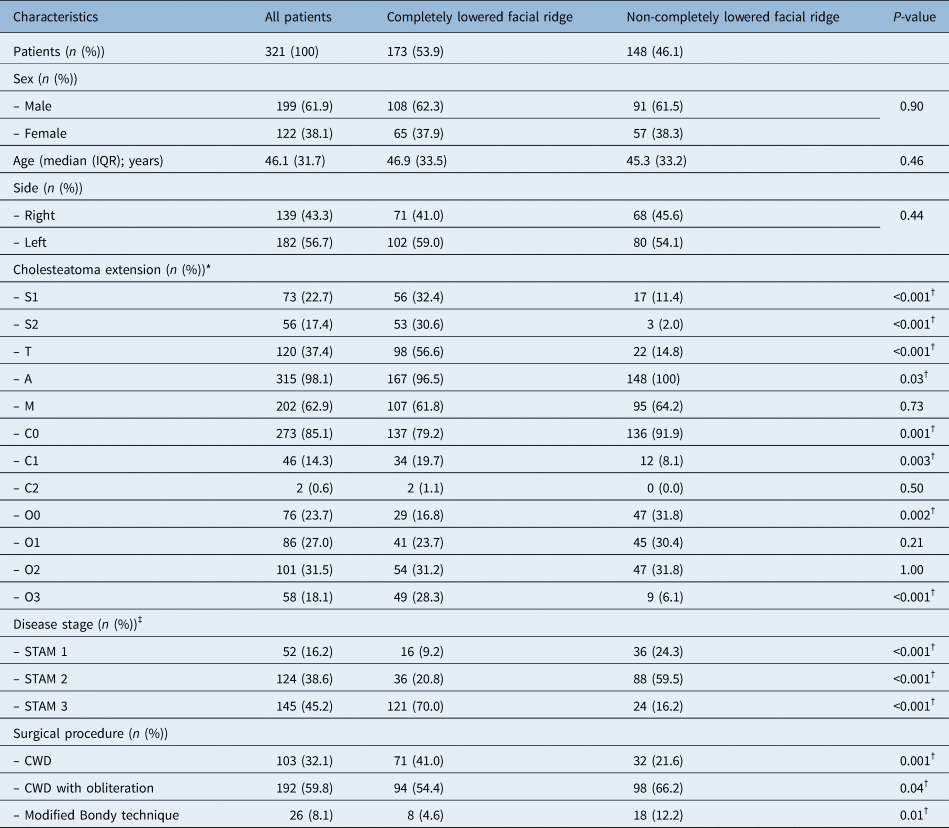
Further details about disease extension, stage and surgical procedures are reported in Table 1.
Patient and disease characteristics, overall and according to facial ridge management

*According to the ‘STAMCO’ (supratubal recess (S1) sinus tympani (S2), tympanic cavity (T), attic (A), and mastoid and antrum (M), and complication (C) and ossicular chain (O) status) classification. †p < 0.05. ‡According to the ‘STAM’ (supratubal recess (S1) sinus tympani (S2), tympanic cavity (T), attic (A), and mastoid and antrum (M)) grade system. IQR = interquartile range; CWD = canal wall down
A temporary iatrogenic facial nerve palsy was found in one patient with House–Brackmann grade 3 from the completely lowered facial ridge group, which recovered within six months to House–Brackmann grade 1.
Facial ridge management
The distribution of completely lowered facial ridge and non-completely lowered facial ridge cases has been analysed according to patient and disease characteristics (Table 1). There were no significant differences in demographic features between the completely lowered facial ridge and non-completely lowered facial ridge groups. The facial ridge was completely lowered more frequently when cholesteatoma was located in the supratubal recess (S1) difficult access site, sinus tympani (S2) difficult access site and tympanic cavity (T) subsite, while attic (A) involvement was more frequent in the non-completely lowered facial ridge group. Extracranial complications were more prevalent in the completely lowered facial ridge group, as well as O3 cases (destruction of the ossicular chain or stapedo-ovalar joint fixation). Conversely, the non-completely lowered facial ridge group had more patients with no complications and an intact ossicular chain. Patients with higher ‘STAM’ (supratubal recess (S1) sinus tympani (S2), tympanic cavity (T), attic (A), and mastoid and antrum (M)) stages were more frequently treated with complete lowering of the facial ridge, and patients with lower ‘STAM’ stages were more frequently treated with non-complete lowering of the facial ridge.
Finally, in the non-completely lowered facial ridge group, there was a higher prevalence of patients who underwent canal wall down with obliteration and the modified Bondy technique, rather than canal wall down tympanoplasty without obliteration.
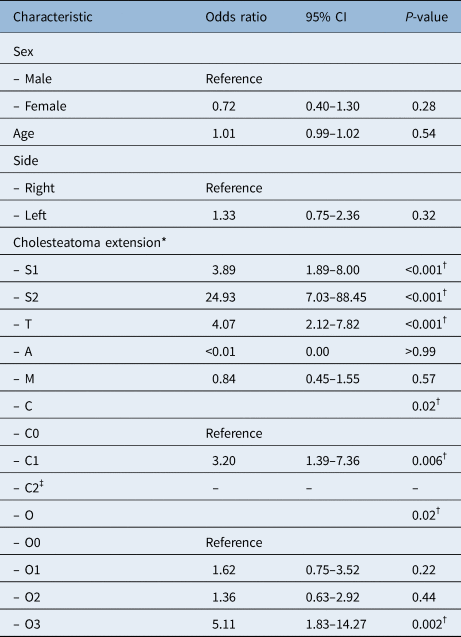
In the multivariate analysis, patients with cholesteatoma involving the S1, S2 and T subsites, as well as those showing an extracranial complication or ossicular chain destruction or platina fixation, had higher odds of having the facial ridge completely lowered. Neither demographic characteristics nor disease location at the epitympanum or mastoid influenced the extent of facial ridge lowering (Table 2).
Factors determining complete lowering of facial ridge

*According to the ‘STAMCO’ (supratubal recess (S1) sinus tympani (S2), tympanic cavity (T), attic (A), and mastoid and antrum (M), and complication (C) and ossicular chain (O) status) classification. †p < 0.05. ‡Odds ratios for C2 could not be calculated because of the low number of cases and abnormal distribution of the variable. CI = confidence interval
Survival analysis
Residual disease rates were 10.8 per cent (n = 16) in the non-completely lowered facial ridge group and 16.6 per cent (n = 29) in the completely lowered facial ridge group. The difference between groups was not statistically significant (p = 0.15).
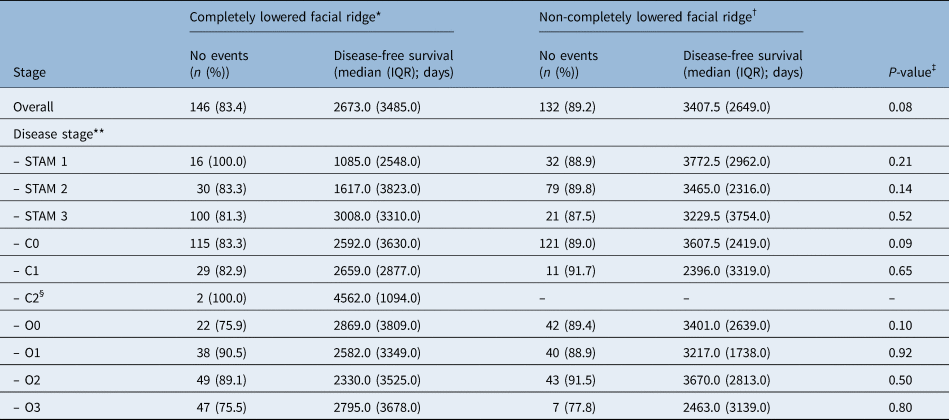
Kaplan–Meier curves were drawn, to compare disease-free survival between the completely lowered facial ridge and the non-completely lowered facial ridge groups, overall and according to ‘STAM’ stage, as well as to complication (C) and ossicular chain (O) status (Table 3 and Figure 1). No statistically significant differences in disease-free survival were noted between those who had the facial ridge completely lowered and those who did not, overall or for any disease stage. Curves for patients staged C2 could not be traced because of the small number of cases.
Residual-free survival analysis in relation to facial ridge management, overall and according to the ‘STAM’ (supratubal recess (S1) sinus tympani (S2), tympanic cavity (T), attic (A), and mastoid and antrum (M)) stage. P-values of the log-rank test are shown. (a) Overall cases; (b) ‘STAM’ stage 1; (c) ‘STAM’ stage 2; and (d) ‘STAM’ stage 3. NLFR = non-completely lowered facial ridge; CLFR = completely lowered facial ridge

Residual-free survival analysis in relation to facial ridge management

*n = 175; †n = 148. ‡P-values refer to the log-rank test. **According to the ‘STAMCO’ (supratubal recess (S1) sinus tympani (S2), tympanic cavity (T), attic (A), and mastoid and antrum (M), and complication (C) and ossicular chain (O) status) classification. §Survival analysis for C2 status could not be performed because of the low number of cases. IQR = interquartile range
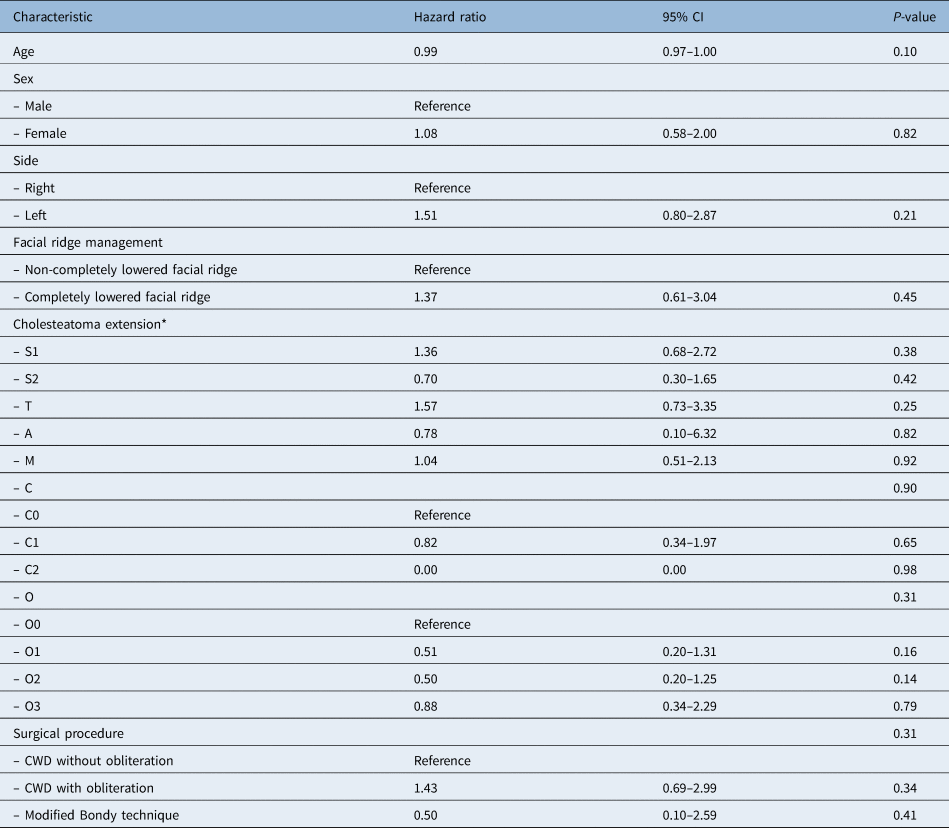
The Cox regression model was built to estimate the risk of residual cholesteatoma according to patient and disease characteristics, facial ridge management and the procedure performed. No statistically significant risk factors for residual disease emerged from the multivariate analysis (Table 4).
Cox proportional hazard model for disease-free survival

* According to the ‘STAMCO’ (supratubal recess (S1) sinus tympani (S2), tympanic cavity (T), attic (A), and mastoid and antrum (M), and complication (C) and ossicular chain (O) status) classification. CI = confidence interval; CWD = canal wall down
Discussion
Facial ridge management in canal wall down tympanoplasty follows two basic principles: (1) to gain sufficient exposure to thoroughly remove cholesteatoma from the tympanic cavity and allow good control of all the subsites for residual disease; and (2) to ensure a self-cleansing and dry cavity in the case of wide and deep mastoidectomy. While available studies have focused on this latter aspect, the former lacks empirical proof and only follows traditional, although logical, habits.Reference Wormald and Nilssen8–Reference Berçin, Kutluhan, Bozdemir, Yalçiner, Sari and Karameşe12
As a general rule, the facial ridge must be lowered when a large, deep, open cavity is planned according to the pre-operative disease assessment, or when wide exposure is needed to control cholesteatomas located in the mesotympanum and posterior mesotympanum. In our series, the location of cholesteatoma in the S2 and T subsites (sinus tympani and tympanic cavity, respectively) was associated with a completely lowered facial ridge. Furthermore, the S1 subsite, namely the supratubal recess, was related to extensive removal of the facial ridge: the S1 involvement could have been found in the context of widespread disease, therefore requiring more aggressive treatment. Conversely, in the logistic regression, the A and M locations (namely the attic, and the mastoid and antrum, respectively) did not represent a ‘risk factor’ for complete lowering of the facial ridge; this is congruent with the former statements, as exposure of the attic and mastoid is not affected by facial ridge height.
In our case series, higher ‘STAM’ and ‘STAMCO’ stages increased the likelihood of complete lowering of the facial ridge. In particular, involvement of the S1, S2 or T subsites encouraged the operator to radically remove the facial ridge. These results agree with the principle by which the facial ridge should be completely lowered in cases of cholesteatoma involving the mesotympanum and posterior mesotympanum. This presumably reflects the actual usefulness of lowering the facial ridge to enable access to all the tympanic subsites and achieve gross total disease removal. Our hypothesis finds further indirect confirmation from the results of the multivariate Cox regression model: the final height of the facial ridge, managed according to the abovementioned principles, did not affect the risk of residual disease, despite the involved subsites; plausibly, cholesteatomas involving the tympanic cavity and hidden areas were reached after thorough lowering of the facial ridge. Moreover, the current use of devices such as the 45° or 70° angled endoscopes through the canal wall down mastoidectomy could have helped to explore hidden recesses like the sinus tympani or the sub-pyramidal space, additionally reducing the role of the facial ridge as a risk factor for residual disease in this area.Reference Bonali, Anschuetz, Fermi, Villari, Mariani and Manzoli18–Reference Alicandri-Ciufelli, Fermi, Bonali, Presutti, Marchioni and Todeschini20
Finally, the facial ridge was more frequently left high in cases of mastoid obliteration. The traditional concept that discourages mastoid obliteration in cases of mastoid invasion by cholesteatoma can be circumvented by follow up with MRI, which means that direct otoscopy is no longer mandatory. This could explain why in our series, mastoid invasion per se did not influence the choice of facial ridge management: the possibility of post-operative imaging could have left the surgeon free to obliterate even these cases.Reference Sanna, Sunose and Mancini7
Possible advantages of partially preserving the facial ridge include reducing the risk of facial nerve injuries and providing additional support for reconstruction.
In his retrospective case series, Tu reported a significantly higher risk for iatrogenic facial palsy when the facial ridge was extensively lowered in pneumatised mastoid cases.Reference Tu21 A multicentric case series by Linder et al. reported that more than one-third of facial nerve injuries occurred at the second genu area of the facial nerve.Reference Linder, Mulazimoglu, El Hadi, Darrouzet, Ayache and Somers22 These findings are in line with those of Ryu and Kim.Reference Ryu and Kim23 Identification of the surgical landmarks and of the nerve itself, together with knowledge of anatomical variations of its course, constant irrigation and intermittent drilling, are useful to avoid complications; beginner surgeons could find intra-operative nerve monitoring helpful.Reference Linder, Mulazimoglu, El Hadi, Darrouzet, Ayache and Somers22 However, whenever extensive lowering of the facial ridge is required, diamond head drill-bits with constant irrigation should be used, as this will prevent damage to the nerve if the nerve is inadvertently exposed.Reference Nilssen and Wormald24
A higher facial ridge could be useful in the reconstruction phase. After a canal wall down mastoidectomy with partial preservation of the facial ridge, this can maintain a certain height of the tympanic cavity. In such cases, reconstruction and re-pneumatisation of the attic can be performed by laying fascia on the facial ridge and the remaining ossicles. When the facial bridge is completely removed together with the posterior buttress, a high facial ridge gains further importance for reconstructive purposes if ventilation of the attic is pursued.Reference Tos13 Takahashi and Nakano have described a canal wall down tympanoplasty with obliteration and preservation of a high facial ridge: they obliterate the cavity with hydroxyapatite granules and reconstruct the ear canal wall with slices of cortical bone.Reference Takahashi and Nakano14 In this procedure, the mastoid obliteration avoids concerns about a self-cleansing mastoidectomy cavity, bypassing the possible problems yielded by a high facial ridge in a deep open cavity.
Further benefits from a high facial ridge could be represented by the positive effect of a larger tympanic volume on the acoustic properties of the reconstructed ear. Low-frequency hearing loss has been associated with decreased middle-ear volume.Reference Rosowski and Merchant15 The normal combined middle-ear–mastoid volume measures approximately 6 ml. A combined middle-ear–mastoid volume of 0.5 ml is predicted to cause about a 10 dB air–bone gap. Volumes lower than 0.5 ml are predicted to result in progressively larger gaps. Conversely, volumes greater than 1 ml provide little additional acoustic benefit.Reference Merchant, Ravicz, Voss, Peake and Rosowski25 In the context of a canal wall down tympanoplasty, the tympanic cavity can gain further height from a higher facial ridge, resulting in a possible acoustic benefit from a greater volume.
All these observations could underlie the need for future studies assessing the functional aspects related to facial ridge management in canal wall down tympanoplasties, such as its impact on the resorption of the obliterative material and hearing features.
The main limitation of this study is represented by the impossibility of retrospectively determining the exact final height of the facial ridge. Thus, the non-completely lowered facial ridge group could include patients with both minimal and more extensive removal of the facial ridge. The main issue concerns the T (tympanic cavity) subsite, as its exposure varies considerably depending on the facial ridge height. However, in our opinion, this aspect is represented by the different hazard ratios reported in Table 2: disease involvement of S1 (supratubal recess), S2 (sinus tympani) or T subsites induced the surgeon to completely lower the facial ridge, but S2 has a hazard ratio six to eight times greater than S1 and T. In other words, the surgeon was strongly induced to lower the facial ridge in cases of sinus tympani location, while in cases of anterior attic or mesotympanic involvement, the choice was possibly influenced by other factors (e.g. experience, anatomical variations, middle-ear exposure). However, this bias is unavoidably related to the retrospective nature of the study. A prospective study with an objective measurement of the facial ridge is required to clarify this aspect.
• Facial ridge lowering is a fundamental step in canal wall down tympanoplasty for middle-ear cholesteatoma, encouraged to ensure thorough eradication of disease
• A multicentric retrospective study was conducted of 321 patients treated with primary canal wall down tympanoplasty for middle-ear cholesteatoma
• Complete facial ridge removal was favoured in cases of cholesteatoma in the sinus tympani, mesotympanum or supratubal recess
• The facial ridge was often completely removed in cases of pre-operative extracranial complications, ossicular chain destruction or platina fixation
• The facial ridge was left higher more frequently in cases of attic and mastoid involvement, or when mobile ossicular chain was partially or completely preserved
• Final facial ridge height did not represent a risk factor for residual cholesteatoma
The strengths of our work are the high number of cases and the long median follow-up period, which provide strength to our primary outcome, especially as cholesteatoma can recur after more than 10 years later.Reference Sanna, Sunose and Mancini7
Conclusion
The complete lowering of the facial ridge ensures adequate exposure when the cholesteatoma involves the sinus tympani, mesotympanum or supratubal recess, while it can be safely preserved in cases of solely epitympanic, mastoid or minimal mesotympanic extension, without adjunctive useless alteration of the normal anatomy. When the facial ridge is managed according to these principles, its final height does not represent a risk factor for residual disease after canal wall down tympanoplasty for middle-ear cholesteatoma. A higher facial ridge could be useful in the reconstruction phase and for middle-ear re-ventilation, maintaining the height of the tympanic cavity, with possible better acoustic properties.
Acknowledgement
The authors wish to thank Itala Mary Ann Brancaleone, teacher of Medical English at the University of Trieste, for her support in editing the manuscript.
Competing interests
None declared