Introduction
Mild cognitive impairment (MCI) is thought to be the transitional state between normal aging and Alzheimer's disease (AD), but not everyone with MCI will develop Alzheimer's disease (Petersen et al., Reference Petersen, Smith, Waring, Ivnik, Tangalos and Kokmen1999; Grundman et al., Reference Grundman2004). Although people with amnestic MCI have normal general cognitive function and intact activities of daily living, the condition is clinically important as patients with MCI constitute a very high-risk group in terms of developing AD. Annual conversion rates of MCI to dementia vary from 5% to 32%; these high incidence rates mean that it is good clinical practice to monitor the cognitive domains and daily function of patients with MCI (Petersen et al., Reference Petersen, Stevens, Ganguli, Tangalos, Cummings and DeKosky2001; Geslani et al., Reference Geslani, Tierney, Herrmann and Szalai2005). This may be very difficult for the patients, who are usually not offered interventions, but who know that there is a high chance of developing AD.
Several studies have reported the frequency and prevalence of neuropsychiatric symptoms (NPS) in MCI and they show that those symptoms are common; a recent systematic review found that the prevalence varied from 35% to 85% (Lyketsos et al., Reference Lyketsos, Lopez, Jones, Fitzpatrick, Breitner and DeKosky2002; Geda et al., Reference Geda2008; Lee et al., Reference Lee, Cho, Hong, Kim and Oh2008; Rozzini et al., Reference Rozzini2008; Monastero et al., Reference Monastero, Mangialasche, Camarda, Ercolani and Camarda2009). NPS in MCI are associated with cognitive and functional decline (Chan et al., Reference Chan, Kasper, Black and Rabins2003; Feldman et al., Reference Feldman2004; Robert et al., Reference Robert2006), and some studies have suggested that NPS in MCI might be a predictor of progression to AD (Teng et al., Reference Teng, Lu and Cummings2007; Edwards et al., Reference Edwards, Spira, Barnes and Yaffe2009).
Several studies have examined the importance of the natural history and course of NPS in dementia; however, there is currently no equivalent knowledge about NPS in MCI (Aalten et al., Reference Aalten, de Vugt, Jaspers, Jolles and Verhey2005; Ryu et al., Reference Ryu, Katona, Rive and Livingston2005; Selbaek et al., Reference Selbaek, Kirkevold and Engedal2008). Those studies inidcated that overall NPS persist chronically and have implications in terms of treatment and care costs. As in dementia, the information about the course of NPS in MCI may be useful in increasing knowledge about the prognostic significance of the NPS as well as about clinical management of the symptoms. We measured the prevalence and severity of NPS over six months in participants with MCI in a population of community-dwelling Korean elderly to determine the persistence of NPS in MCI.
Methods
Study population
The participants were consecutively recruited from February 2008 to April 2009 at Seongbuk Center for Dementia, which provides a complete community-based dementia management service in north Seoul, Korea. Of the older people who fulfilled the operational criteria for MCI, 241 were included in the study (Petersen, Reference Petersen2004). The inclusion criteria were: (1) cognitive concern expressed by a nurse, physician, informant, or participant; (2) cognitive impairment in one domain or more (executive function, memory, language, or visuospatial) by comprehensive neuropsychological test; (3) intact activities of daily living (ADL); and (4) no dementia. All participants had a caregiver who had at least 4 hours contact time per week with them, and no any other significant illness. This study was approved by the institutional review boards of Konkuk University Hospital and written informed consent was obtained from all participants.
Interviews
We used the following instruments at baseline and 6-month follow-up:
• The Neuropsychiatric Inventory (NPI) (Cummings et al., Reference Cummings, Mega, Gray, Rosenberg-Thompson, Carusi and Gornbein1994) was used to evaluate NPS. It is a semi-structured instrument administered to the caregiver. The 12 domains cover delusions, hallucinations, agitation/aggression, depression/dysphoria, anxiety, euphoria/elation, apathy/indifference, disinhibition, irritability/lability, aberrant motor behavior, sleep disturbance and appetite disturbance. Each symptom is rated by frequency (score 1 – 4) and severity (score 1–3) or as absent (score 0) and the overall severity score is their product. In this paper the term “symptom severity” means this product of severity and frequency scores. Symptom scores are totaled to give an overall score with a potential maximum of 144. The NPI was administered by trained research nurses for each of 12 symptom domains that had potentially been present in the preceding four weeks.
• The standardized Korean version of the Consortium to Establish a Registry for Alzheimer's Disease (CERAD-K) neuropsychological battery (Lee et al., Reference Lee2002) was used to measure cognitive functioning. This battery includes Verbal Fluency, Boston Naming Test, the Korean version of the Mini-mental State Examination (MMSE), Word List Memory, Constructional Praxis, Word List Recall, Word List Recognition, Constructional Recall, and Trail Making Tests A and B. Cut-off values of these domains were represented as a -1.5 standard deviation (SD) below the mean of the same reference group. We also administered the Korean version of the Geriatric Depression Scale (GDS-K) (Cho et al., Reference Cho1999) and Quality of Life-AD (QoL-AD) (Logsdon et al., Reference Logsdon, Gibbons, McCurry and Teri1999) to the participants and their caregiver.
Statistical analysis
SPSS17.0 for Windows was used for data entry and for analysis. We report summary descriptive statistics including standard deviation (SD) and confidence intervals (CI), as appropriate. We calculated the prevalence of NPS at baseline and 6-month follow-up. Symptom severity may be more important than simply the presence of any symptom because of the effect on patients and carers. A symptom severity score ≥ 4 in the NPI means that the symptom in question is clinically significant in the context of treatment trials (Schneider et al., Reference Schneider2001). We report the prevalence at this threshold at baseline and 6-month follow-up and use this threshold for further analysis. We also calculated new symptom emergence over 6 months.
We used χ2 tests and one-way ANOVA, as appropriate, to compare age, sex, education level, MMSE score, GDS-K, QoL-AD and total NPI score between participants in the whole group at baseline and those with completed 6-month follow-up, those with persistent NPS over 6-month follow-up, and those with significantly persistent NPS over 6-month follow-up. We compared the participants’ scores on individual symptoms over 6 months and divided them into three groups: (1) persistent symptom of any symptom severity, (2) persistent symptom with significant symptom severity, and (3) those with a new symptom (new symptom emergent).
We compared the mean scores of each NPS at baseline between the participants with persistent symptoms and those who no longer had the symptom using the Mann-Whitney test (1% threshold as the data did not verify the normality assumption required for the Student t-test).
Results
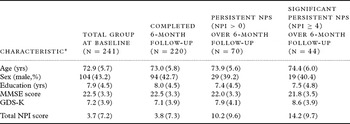
Two hundred and forty-one participants with MCI were evaluated at baseline. The demographic and clinical characteristics and the total NPI score of the participants at baseline and 6-month follow-up evaluation are shown in Table 1. The mean age (SD) was 72.9 (5.7) years and the mean length of education was 7.9 (4.5) years. There were 104 males (43.2%). The MMSE, NPI and GDS-K mean scores (SD) were respectively 22.5 (3.3), 2.14 (4.07) and 6.02 (3.97). One hundred and eight (44.8%) of the participants had at least one NPS and 66 (27.4%) had an NPI score ≥ 4 in at least one domain. Two hundred and twenty participants (91.3%) had a 6-month follow-up NPI evaluation. There was no difference in cognitive severity or demographic features between those who had NPS at baseline and those who did not. The number of participants with baseline total NPI score > 0 who also completed the 6-month follow-up was 97 (44.1%). Of these, 70 (72.1%) had at least one NPS in any domain at 6 months (even if this was a different symptom to baseline). The number of participants with at least one domain with NPI score ≥ 4 who completed the 6-month follow-up was 60. Of these, 44 (73.3%) had a persistent NPI score ≥ 4 in at least one domain.
Characteristics in the total group and the subgroups who completed six-month follow-up evaluation at baseline

MMSE = Mini-mental State Examination; NPI = Neuropsychiatric Inventory; NPS = neuropsychiatric symptoms; GDS-K = Korean version of the Geriatric Depression Scale.
*All data: mean (SD) except sex – n (%), no significant difference between groups except higher total NPI score in significant symptom persistent group.
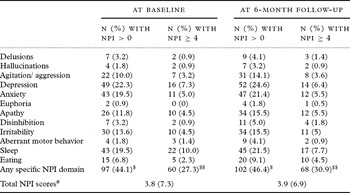
Table 2 shows the point prevalence of each NPS at baseline and at 6-month follow-up in participants who completed the 6-month follow-up. The follow-up rate was quite good and there was no difference in baseline demographic data between those with and without follow-up. Of the 220 at 6-month follow-up, 102 (46.4%) had at least one NPS (NPI > 0) and 68 (30.9%) had clinically significant symptoms (symptom severity ≥ 4) in at least one domain. Agitation, depression, anxiety, apathy, irritability, and sleep were present in over 20% of participants on both occasions. There was no significant difference in frequency and severity of any symptoms between baseline and 6-month follow-up.
Frequency of NPS and total NPI scores at baseline and 6-month follow-up for the 220 participants who completed 6-month follow-up evaluation*

*no significant difference in frequency and total NPI scores.
$Any specific NPI domain > 0, $$Any specific NPI domain ≥ 4.
#Data: mean (SD).
NPS = neuropsychiatric symptoms; NPI = Neuropsychiatric Inventory.
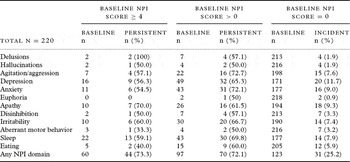
Table 3 shows the frequency of persistent symptoms both for any symptom severity and for clinically significant symptoms and also incident symptoms over 6 months. All NPS were persistent in more than 50% of the participants with any symptom severity. Of the participants with any symptom at baseline, 72.1% o had persistent NPS with any severity over six months. Of the participants with any baseline significant NPS, 73.3% had persistent significant NPS over 6 months. More than 50% of the participants with baseline clinically significant symptoms of delusions, hallucinations, agitation/aggression, depression, anxiety, apathy, disinhibition, irritability, and sleep disorders had persistent symptoms. Of the participants with no NPS at baseline, 31 (25.2%) had at least one symptom at 6-month follow-up. Depression emerged in more than 10% of those in whom it had previously been absent.
Number and percentage of 220 participants in each NPI item over 6-month follow-up with persistent and incident symptoms in each NPI domain

NPI = Neuropsychiatric Inventory.
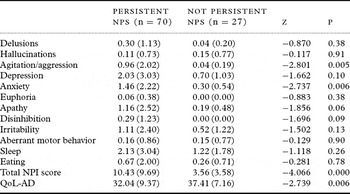
Table 4 compares the severity of NPS at baseline in participants with persistent and remitting symptoms. The median baseline total NPI scores in participants with persistent symptoms were more severe than those with remitting symptoms (Mann-Whitney Z = −4.066, p < 0.01). The participants with agitation/aggression and anxiety had more severe symptoms than those without (Mann-Whitney Z = −2.801, Z = −2.737, respectively, p < 0.01). The participants with persistent NPS had a lower quality of life at 6-months follow-up (Mann-Whitney Z = −2.739, p < 0.01).
Severity of NPS and QoL-AD at baseline in participants with persistent and non-persistent symptoms

All data: mean (SD).
NPS = neuropsychiatric symptoms; SD = standard deviation, NPI = Neuropsychiatric Inventory; QoL-AD = Quality of Life – Alzheimer's Disease.
Discussion
This is the first study to consider persistence of NPS in MCI. We found that more than 70% of NPS in MCI persisted over six months irrespective of severity. This is slightly less than the rates of NPS in dementia, including AD, in which around 80% of participants with at least one significant symptom have persistent symptoms (Levy et al., Reference Levy, Cummings, Fairbanks, Bravi, Calvani and Carta1996; Devanand et al., Reference Devanand1997; Haupt et al., Reference Haupt, Kurz and Jänner2000; Ballard et al., Reference Ballard2001; Steinberg et al., Reference Steinberg2004; Ryu et al., Reference Ryu, Katona, Rive and Livingston2005). In dementia, delusions, depression, apathy and irritability were more persistent than other symptoms, but our study of MCI showed that all NPS domains were highly persistent at any symptom severity (Steinberg et al., Reference Steinberg2004; Ryu et al., Reference Ryu, Katona, Rive and Livingston2005). However, it is difficult to establish how meaningful this high persistence really is as it could be expected by chance. Several studies have stated that overall NPS are chronically present or persist, and it is therefore important to clarify this persistence in terms of care costs, treatment strategies, and familial education (Aalten et al., Reference Aalten, de Vugt, Jaspers, Jolles and Verhey2005; Ryu et al., Reference Ryu, Katona, Rive and Livingston2005; Selbaek et al., Reference Selbaek, Kirkevold and Engedal2008). In MCI, as in dementia, knowing the course of NPS may help the clinician to manage the elderly person with MCI.
Those with more severe symptoms at baseline are more likely to have persistent symptoms and a poorer quality of life. Participants with persistent agitation and anxiety have more severe baseline symptoms. Overall, the higher persistence of NPS in MCI than in dementia may reflect the fact that patients with MCI, even with significant NPS, are not usually offered psychiatric management. In our sample, we excluded those participants who had previously received clinical psychiatric management from psychiatrists. However, we did not gather information on the present use of psychotropic medication. More precise information on the use of psychiatric services that include medication will be needed.
The prevalence rate of NPS in this study was 44.1% and 46.4% at baseline and 6-months follow-up. These rates are within the range of results from previous studies (Lyketsos et al., Reference Lyketsos, Lopez, Jones, Fitzpatrick, Breitner and DeKosky2002; Lee et al., Reference Lee, Cho, Hong, Kim and Oh2008; Geda et al., Reference Geda2008). Depression (22.3%), anxiety (19.5%), and sleep disturbances (19.5%) were the most common symptoms followed by irritability. The systematic review found, similarly, that depression, anxiety and irritability were the commonest reported symptoms (Monastero et al., Reference Monastero, Mangialasche, Camarda, Ercolani and Camarda2009). Our results showed that most NPS in MCI were clinically significant (27.3%) and incident NPS in MCI were relatively common (25.2%).
Limitations
There are some limitations in this study. First, it is based on data from consecutively enrolled people who were motivated to discover whether they or their family members would develop a dementing illness and who used community-based dementia management services. They may have had more NPS than those who did not access these services and therefore this sample may not be truly representative. Secondly, participants’ NPS may have fluctuated over the six-month study period rather than being persistent or consistently improving. Thirdly, for clarity, conclusions were based upon p-values from tests only, regardless of the effect size (unless mentioned). Fourthly, owing to the large number of hypothesis tests in this study, and despite the use of a lowered type I error (1% instead of 5%), multiple comparisons still result in an inflation of type I error. Finally, we have take into account even those participants with NPI scores below 4. This might be erroneous in the analysis for the clinical importance of persistence.
Conclusions
In summary, NPS were common in patients with MCI. The commonest symptoms were depression and anxiety followed by irritability and sleep disturbance, which may be symptomatic of affective disorders. All symptoms were highly persistent overall and individually. More severe symptoms in any domain at baseline were more likely to persist in that domain. Many participants had incident NPS over six months. Because of the high persistence rate and impact on quality of life of NPS, active approaches are appropriate for people with MCI in the community. Finally, our results point to the need for further study of effective management of NPS in MCI.
Conflict of interest
None.
Description of authors' roles
S. H. Ryu designed the study, collected the data, and wrote the paper. He was also responsible for the statistical analysis. J. H. Ha, J. H. Yu and D. H. Park conducted the diagnostic interview. G. Livingston contributed to the analysis and interpretation of data and to the drafting and revision of the paper.
Acknowledgment
This work was supported by Konkuk University in 2010.