Introduction
Background
Dementia is a syndrome caused by a disease of the brain and which is generally of a chronic or progressive nature.1 Those affected display disturbances in several higher cortical and emotional functions, including memory, learning capacity, affect regulation, social behaviour and motivation.1 The majority of the 800,000 affected individuals in the UK live in the community, with most living at home in the early stages of the condition.Reference Lakey, Chandaria, Quince, Kane and Saunders2 The availability of family or lay carers is often a prerequisite for such home care;Reference Lakey, Chandaria, Quince, Kane and Saunders2, Reference Albanese, Banerjee, Dhanasiri, Fernandez, Ferri and Knapp3 thus caring falls substantially on ‘lay’ individuals, often family members or close friends.Reference Lakey, Chandaria, Quince, Kane and Saunders2
Diagnosis of dementia affects both patients and their carers,4–Reference Zarit, Todd and Zarit6 with both at increased risk of psychological morbidity, such as anxiety and depression.Reference Albanese, Banerjee, Dhanasiri, Fernandez, Ferri and Knapp3 As such, carers’ burden (defined as their physical, psychological, emotional, social and financial status)Reference Andren and Elmstahl7 is highlighted as an important concern for clinical services, both in its own right, and because it compromises ability to care.8
Although carers’ frequent high levels of psychological morbidity and unmet support needs have been recognized,Reference Vitaliano, Zhang and Scanlan9, Reference Ory, Yee, Tennestedt, Schulz and Schulz10 in practice, carers who appear to be coping may be assumed to have no need for support, regardless of the distress they experience.Reference Goes and Higginson11 The usual approach to understanding carers’ distress has been to view psychological morbidity as an outcome of the patient's condition, yet such studies have proved unable to explain why some individuals cope well in the face of such adversity whilst others cope less well. In broader research into coping with adversity, there has been a shift towards exploring psychological resources that empower people to cope. Finding a sense of meaning and purpose in life and death is central to the concept of living with a condition for which there is no cure,Reference Kalus, Beloff, Brennan, McWilliams, Payne and Royan12 and is likely to be highly relevant to understanding formal and lay caregivers’ burden.Reference Ablett and Jones13 The process whereby lay carers maintain normal or enhanced functioning in the face of adverse events is not yet fully understood. This process is difficult to defineReference Windle14 but is often referred to as ‘resilience’.Reference Windle14, Reference Hjemdal, Friborg, Stiles, Rosenvinge and Martinussen15
Resilience in adults shares some conceptual overlap with constructs including self-mastery, self-efficacy, acceptance, stress-resistance and hopefulness.Reference Windle, Bennett and Ungar16, 17 WindleReference Windle14 analysed and synthesized data from systematic review, concept analysis and consultation with a range of stakeholders and service users to operationalize a definition of adult resilience as ‘the process of effectively negotiating, adapting to, or managing significant sources of stress or trauma. Assets and resources within the individual, their life and environment facilitate this capacity for adaptation and ‘bouncing back’ in the face of adversity’. Reference Windle14 In this definition, Windle acknowledged that three components must be present in order for an adult to be ‘resilient’: significant adversity or risk, assets or resources to balance the effects of this adversity, and subsequent positive adaptation or avoidance of negative outcomes.Reference Windle14 She also acknowledged that an individual's resilience will vary across their life course.
The current paper will adopt Windle's psychological conceptualization of resilience by viewing resilience as a set of personal qualities, resources and factors that allow an individual to maintain normal or enhanced functioning during times of adversity.Reference Windle14–Reference Windle, Bennett and Ungar16 An understanding of such personal qualities, resources and factors may help practitioners to identify carers at risk of psychological morbidity and to support them using timely and appropriate interventions, thus reducing or potentially preventing carers’ distress.17, Reference Gaugler, Kane and Newcomer18 The aim of this review is therefore to present a narrative synthesis of personal qualities, resources and factors associated with caregivers’ resilience.
Search methods and results
Four electronic databases (MEDLINE, EMBASE, PsycINFO and CINAHL) were searched for relevant published literature from their inception up to March 2013. The searches combined index terms and free text words, adapted for each database to reflect minor modifications specific to their vocabulary or search terms.
Search strategies were based on a combination of synonyms of relevant components: carer, dementia, resilience, coping and burden. The constructs of self-mastery, self-efficacy, acceptance, stress resistance and hopefulness were included in the searches as potential aspects of resilienceReference Windle14 and will be referred to under the umbrella term ‘resilience’ throughout this paper unless otherwise stated. Searches had no language restrictions and did not include methodological filters that would limit results to a specific study (more details available from the authors upon request). A subsequent hand search of high yield journals was carried out, followed by a search of reference lists of all full-text studies, snowballing of relevant references and examination of relevant systematic reviews’ reference lists, and hand search of the researcher's own files.
All identified references were exported to an EndNote® bibliographic database. One author (MGC) scanned all identified titles and abstracts to identify potentially relevant articles, of which full-text versions were subsequently obtained to permit more detailed assessment. These were then assessed for relevance to the review; uncertainty was resolved by discussion with the research team. Conference papers, dissertations, non-English language papers, theoretical papers and papers with no relevance to the aim of the review were subsequently excluded. As the aim was to produce a descriptive synthesis of data, a selection of included studies was then decided upon to best address the aim of the review. Selective wider literature was also consulted to provide context for the data discussed within papers. Whilst the review was selective rather than exhaustive in its approach, searching and selection of studies followed published guidelines to ensure rigour.17
The searches identified 3017 unique papers; 260 full-text papers were obtained, from which relevant data were chosen. Three broad themes were subsequently identified, which are summarized in Fig. 1. These are social and cultural factors, properties and aspects of the care relationship, and carers’ psychological resources, and will each be discussed in turn. Practical recommendations for practitioners based on these three broad themes are outlined at the end of the Results section, before discussion of the implications of this review. The reader must bear in mind that whilst data have been subdivided for ease of presentation, themes might not be considered as individual entities but rather might be considered as interlinked factors influencing resilience,Reference Gaugler, Kane and Newcomer18 as shown in Fig. 1.
Model of factors influencing resilience

Social and cultural factors
Gender
Gender influences carers’ subjective experiences and perceptions of caring, reflected in differences in their resilience.Reference Ashley and Kleinpeter19, Reference Garity20 Males experience less burden and report less need for social support than female carers.Reference Garity20, Reference Etters, Goodall and Harrison21 Whilst this may be somewhat a reflection of males’ generally lower reporting of psychological distress, burden also affects the physical and mental health of male carers to a lesser extent than it does female caregivers.Reference Baker22–Reference Atienza, Henderson, Wilcox and King25
Lazarus and Folkman’sReference Lazarus and Folkman26 adapted model of stress-appraisal copingReference Pearlin, Mullan, Semple and Skaff27 supports the notion of gender differences in coping style. For example, males generally adopt more problem-focused coping styles and females more emotion-focused strategies when faced with caregiving stressors (although it must be noted that different coping styles are applied dependent on the function of the task and the perceived influence on ability to effect change).Reference Garity20, Reference Hooker, Manoogian-O’Dell, Monahan, Frazier and Shifren28, Reference DeVries, Hamilton, Lovett and Gallagher-Thompson29 However, others have argued that, rather than experiencing less stress or differential coping mechanisms, males may express and handle their burden differently than females,Reference Baker and Robertson30, Reference Baker, Robertson and Connelly31 taking a ‘stoic-intellectual’ approach to caring;Reference Davies, Priddy and Tinklenberg32, Reference Kaye and Applegate33 no firm consensus has as yet been reached in the literature.
Caring was historically viewed as a woman's task, with researchers often continuing this gender bias by assuming that primary carers of individuals living with dementia are female.Reference Zarit, Todd and Zarit6, Reference Horowitz34, Reference Kramer35 However, some researchers have called for a ‘degendering’ of caregiving research,Reference Neysmith, Baines, Evans and Neysmith36 arguing that interpretation of carers’ perceptions of their caring roles or subjective meaning assigned to caring may be more important in promoting resilience than considering gender differences. For example, for males, there may be a discrepancy between being a carer and their normative role expectations. Males who adhere to traditional forms of masculinity, characterized by problem-focused coping and limited acknowledgement of emotionality, exhibit more concern about the opinions of others, like to see their family as more independent and engage less in carers’ services than their counterparts.Reference Stommel, Collins, Given and Given37 Thus gender role socialization should be considered in this context,Reference Calasanti and King38 especially as some males report perceived weakness, failure and loss of control following engagement with support groups.Reference Kaye and Applegate39, Reference McFarland and Sanders40 In turn, gender should also be considered as a potential predictor of caregivers’ resilience, in terms of gender role conflict or gender identity.Reference Baker and Robertson30
Ethnicity and culture
Ethnicity and culture have also been identified as factors influencing carers’ resilience. For example, White carers experience higher levels of burden, depression and role strain and lower levels of caregiving satisfaction and mastery than Black or African-American carers.Reference Roth, Haley, Owen, Clay and Goode41–Reference Depuis, Epp and Smale45
Differences in the resilience of carers from different ethnic groups may be in part due to differences in caregiving appraisals, coping styles and availability of social support. Some factors impact on some cultures and ethnicities more than others; for example, caregivers in Hong Kong frequently report burden attributable to financial strain.Reference Chu46, Reference Chan47 Others are not culture specific; for example, patient behavioural pathology (‘challenging behaviour’) consistently increases carers’ subjective burden levels, seemingly irrespective of ethnic or cultural group studied.Reference Harwood, Barker, Ownby, Bravo, Aguero and Duara48–Reference Kar, Sharma and Sengupta51
Similarly, extended family and support networks protect carers against psychological morbidity irrespective of ethnic group.Reference Depuis, Epp and Smale45, Reference Adams, Aranda, Temp and Takaji52 African-American and Latino caregivers rely more on informal long-term care due to cultural norms that emphasize familial care of disabled elders.Reference Gaugler, Kane and Newcomer18, Reference Dilworth-Anderson and Gibson53 However, reliance on such networks can increase Black caregivers’ burden, by increasing their associated adherence to and expectations of such support.Reference Cox54 This literature suggests the importance of culture and ethnicity in shaping resilience.
Knowledge of dementia
Most caregivers have only limited knowledge of dementia,Reference Werner55 with knowledge particularly lacking regarding its prevalence, causes and symptoms.Reference Werner55 Most carer interventions contain educational components designed to raise carers’ knowledge of dementia, yet the association between carers’ knowledge and their psychological well-being is not well studied. Knowledge of the symptoms, causes and prevalence of dementia is associated with decreased carer depression but also with increased anxiety.Reference Proctor, Martin and Hewison56, Reference Graham, Ballard and Sham57 This raises issues regarding how carers translate and apply dementia knowledge and how this shapes their emotional reactions to caring and ultimately their resilience; knowledge in itself may not necessarily be sufficient without carers also knowing how to use it.
In the wider caring literature, individuals display differing degrees of desire for information when faced with stressful situations, with some preferring to reduce the psychological impact of such situations in the short-term by avoiding knowledge and others actively seeking as much knowledge regarding the situation as possible.Reference Miller58 Carers that actively seek information have higher levels of anxiety compared with carers who actively reject information, with carers requiring both biomedical information provision and emotional support when faced with caregiving-related distress.Reference Proctor, Martin and Hewison56 However, perceived knowledge of dementia may influence care provision and carers’ subjective burden more than their actual knowledge,Reference Schindler, Engel and Rupprecht59 thus potentially also influencing their resilience. Whilst this area of research is emergent, findings suggest support for the positive influence of knowledge on carers’ resilience; however, more research is needed to assess the mechanism by which knowledge influences caregiver outcomes.
Religion and spirituality
Opinion is divided regarding the role of religion and spirituality in promoting resilience. Some studies report no influence of religion or spirituality on carers’ subjective burden levels or psychological morbidity,Reference Hinrichsen and Ramirez60–Reference Farran, Miller, Kaufman and Davis64 whereas others report positive influences on social functioning,Reference Burgener65 burden level,Reference Karlin66 caregiver satisfactionReference Lee, Kim and You67 and life satisfaction.Reference Meller68 Others report associations with increased psychological distress levels,Reference Cohen, Teresi and Blum69 and yet others report no association with carers’ emotional states.Reference Rabins, Fitting, Eastham and Zabora70
StuckeyReference Stuckey71 discusses how religion can improve carers’ coping by providing hope for the future. This is particularly observed in African-American caregivers,Reference Stuckey71 although support for private prayer as a mediator between carers’ burden and perceived resilience is also reported across other ethnic groups.Reference Wilks and Vonk72 Whilst the exact mechanism by which religion and spirituality may influence carers’ resilience remains unclear, such qualitative evidenceReference Stuckey71, Reference Wilks and Vonk72 triangulates and supports quantitative data,Reference Haley, Levine, Brown and Bartolucci73, Reference George and Gwyther74 suggesting its importance in aiding caregivers’ coping and meaning making.
Factors relating to properties/aspects of the care relationship
Kinship ties
Carers’ self-reported experiences vary as a function of both their relationship with the person living with dementia and their proximity, with spousal and adult children carers experiencing the greatest objective and subjective burden.Reference Depuis, Epp and Smale45, Reference Barnes, Given and Given75, Reference Conde-Sala, Garre-Olmo, Turro-Garriga, Vilalta-Franch and Lopez-Pousa76 Current opinion is divided as to which care dyad is more beneficial for the psychological health and resilience of the carer. However, it is generally accepted that spousal carers qualitatively experience and construe care in a different way than other family carers,Reference Abel77 adopting different life roles than adult children carers, who may also have to balance complimentary or competing occupational, familial and social demands.Reference Ablett and Jones13, Reference Scharlach78
As spousal carers are older than adult child carers, they are more likely to suffer from physical health problems,Reference Albanese, Banerjee, Dhanasiri, Fernandez, Ferri and Knapp3 leading to greater perceived stress when providing long-term care.Reference Pinquart and Sörensen79 Also, the gradual demise of one's life partner is considered more stressful than the demise of a parent or other family member,Reference Van Den Wijngaart, Vernooij-Dassen and Felling80 particularly given that the spouse is usually the most important adult attachment figure.Reference Hazan and Shaver81 Adult children are also able to reciprocate caring behaviours received from their parents in the past and thus create meaning from caregiving. Spousal carers report this to a lesser extent,Reference Pinquart and Sörensen79 although are still able to create meaning from verbal and non-verbal exchanges.Reference McGovern82
Spousal carers are more likely to live with the person living with dementia and thus experience more day-to-day stressors, primary caring hours and caring tasks than other family carers.83 Cohabitation is associated with fewer opportunities for respite care,Reference O’Rourke and Wenaus84 a factor influencing subjective burden, coping and resilience (operationalized in this instance as three facets: commitment to living, challenge and perceived control)Reference Svanberg, Stott and Spector85, Reference Kupferschmidt86 particularly in adult children carers.Reference Conde-Sala, Garre-Olmo, Turro-Garriga, Vilalta-Franch and Lopez-Pousa76 Indeed, higher levels of psychological distress among spousal carers are mostly explained by increased levels of care provision, indicating the influence of task load on carers’ resilience.Reference Pinquart and Sörensen79
Differences in spousal and adult children carers’ perceptions of the care relationship, and the nature of primary and secondary stressors and demands, subsequently influences their burden, strain and resilience.87 For example, whilst spouses may be used to providing care and assistance throughout the marriage, adult children may consider themselves to be a carer at an earlier time point than a spouse may,87 finding the role of caring for a parent difficult to adjust to.Reference Betts-Adams and Sanders88 Feelings of duty and obligation contribute to predominantly extrinsic motivation for caring in adult children,8 in comparison with the predominantly intrinsic motivation characteristic of spousal carers.Reference Pinquart and Sörensen79 The quality of the pre-dementia relationship between adult children carers and their parent also influences their resilience by influencing feelings of subjective burden and satisfaction within the care relationship,Reference Lopez, Lopez-Arrieta and Crespo89 as does the quality of the pre-dementia relationship between spousal carers.Reference Quinn, Clare and Woods90
Adult daughter carers experience significantly higher levels of depression, strain, burden and negative emotional reactions to caregiving than adult son carers,Reference Covinsky, Newcomer, Fox, Wood, Sands and Dane91, Reference Brody, Dempsey and Pruchno92 reporting similar levels of negative emotions such as guilt, sadness, anger, lack of control and worry as spousal carers.Reference Riddick, Cohen-Mansfield, Fleshner and Kraft93 BrodyReference Brody94 conceptualizes this in terms of ‘women in the middle’, viewing female strain as resulting from difficulties in balancing competing life, social and familial roles. This has been challenged for failing to consider the positive influence of balancing multiple roles.Reference Scharlach78 Additionally, it does not consider the influence of the gender's differential approaches to caring, a factor more influential in explaining gender differences in carers’ distress than the notion of competing demands of multiple roles.Reference Loomis and Booth95
Increased stressors, pressure and depressive symptoms, and decreased caregiver satisfaction have been reported by female carers when required to maintain both a working life and work a ‘third shift’ as a carer.Reference Doress-Worters96 This indicates the potentially detrimental effect of work–life on carers’ resilience,Reference Lopez, Lopez-Arrieta and Crespo89, Reference Chorn-Dunham and Dietz97, Reference Lee, Walker and Shoup98 particularly in carers of individuals with young onset dementia.Reference Svanberg, Stott and Spector85 However, in other studies, female carers reported appreciating the opportunity for distraction provided by employment,Reference Rosenthal, Hayward, Martin-Matthew and Denton99, Reference Rands100 provided that employers were sympathetic to the caregiving demands placed on the carer. Both employmentReference Pavalko and Woodbury101 and quality and extent of carers’ social networksReference Cannuscio, Colditz, Rimm, Berkman, Jones and Kawachi102 buffer the effects of caring on the psychological health state of female carers, suggesting the importance of carers, particularly female child carers, maintaining a working life.
Social support
Carers’ resilience is also influenced by their social relationships,Reference Clay, Roth, Wadley and Haley44, Reference Rutter and Rutter103 namely familial and social support.Reference Wilks and Croom104 This is pertinent when considering that caring may reduce time spent engaging in social activities which in turn may increase carer burden and depression and decrease carer satisfaction.
Social support is as a meta-construct comprising of subjective appraisals of the availability and appropriateness of support, and actual or received support.Reference Gomes and Higginson105 Received social support acts as a buffer against the negative psychological effects of caringReference Dunkin and Anderson-Hanley106 and partially moderates the effect of stress on carers’ resilience,Reference Wilks and Croom104 defined in this instance as a ‘psychological phenomenon referring to effective coping and adaptation although faced with loss, hardship, or adversity’Reference Wilks and Croom104 and measured using the shortened Resilience Scale.Reference Neill and Dias107
However, satisfaction with support has been proposed as the most effective component of support in buffering the effects of stressors on carers’ psychological and physical health.Reference Higginson108 Associations between carers’ social strain and their feelings of frustration from a perceived lack of familial or peer support have been reported;Reference Parrish and Adams109 similarly, perception of social support has been found to be a better predictor of palliative carers’ burden than received social support,Reference Goes and Higginson11 indicating the influence of carers’ subjective appraisals of available support on their resilience.
Mixed findings have been reported regarding the influence of carers’ gender on their social support seeking; some studies report no gender differencesReference Collins and Jones110 whereas others report higher usage of social support in both malesReference Ingersoll-Dayton, Starrels and Dowler111 and females,Reference Sun, Roth, Klemmack and Burgio112, Reference Wallsten113 respectively. Meta-analysis suggests that differences between the genders may be smaller than expected;Reference Pinquart and Sörensen114 although female carers tend to have larger social networks and more available sources of social support than males,Reference Sun, Roth, Klemmack and Burgio112 male carers tend to be more motivated to seek assistance, perhaps due to a lack of comfort with the caring role.Reference Stoller115, Reference Stoller and Cutler116 Consideration of gender differences in support seeking and availability of social support may therefore partially account for observed gender differences in their resilience.
Formal support
Availability and acceptance of formal support is associated with decreased burden,Reference Weuve, Boult and Morishita117 increased self-efficacy when managing problem behavioursReference Gitlin, Corcoran, Winter, Boyce and Hauck118 and increased satisfactionReference Mohide, Pringle, Streiner, Gilbert, Muir and Tew119 and sense of well-being,Reference Winslow120 thus promoting caregiver resilience. However, carers frequently wait until later in the disease process before accepting use of formal services,Reference Bookwala, Zdaniuk, Burton, Lind, Jackson and Schulz121 at which time the intensity of their need for intervention often surpasses the help available.Reference Markle-Reid and Browne122 Frequently cited reasons for non-use include a perceived lack of need for services, reluctance to accept formal help and lack of availability or knowledge about services.Reference Brodaty, Thomson, Thompson and Fine123 Additionally, feelings of guilt, obligation, shame and filial responsibility also negatively influence carers’ uptake of formal services,Reference Pedlar and Biegel124–Reference Kosloski, Montgomery and Karner126 as do predisposing factors such as age, ethnicity, gender, proximity to person living with dementia, severity of their illness and availability of familial or community support.Reference Bass and Noelker127
Congruent with other findings,Reference Gottlieb and Johnson128, Reference Powell and Roberts129 frequency of day service use is negatively associated with spousal carers’ burden, with caregivers reporting feelings of peace of mind with services upon knowing that their partners were receiving the stimulation and socialization they needed to maintain their levels of functioning.Reference Sussman and Regehr130 However, no such associations exist between carers’ burden and homemaking support, the most common form of formal care service provision undertaken,Reference Sussman and Regehr130 indicating that the positive influence of formal care services occurs mostly when they perceive services as providing social and psychological benefits to the person living with dementiaReference Strang and Haughey131 rather than just as respite to the carer.
Symptomatology
Frequency and severity of person living with dementia's behavioural problems and disturbances negatively influences carers’ resilience by increasing their perceived burden and distress levels.Reference Donaldson, Tarrier and Burns23, Reference Hooker, Bowman, Coehlo and Lim132, Reference Fernandez-Lansac, Crespo López, Caceres and Rodriguez-Poyo133 Symptoms such as aggression, repetitive demands, disinhibition and changes in mood and motor function have the greatest influence on carers’ psychological functioning, burden levels, reported distress and subsequent appraised individual resilience (operationalized in this instance as post-adversity strength and measured using the 14-item Resilience Questionnaire).Reference Kumamoto, Arai, Hashimoto, Ikeda, Mizuno and Washio134–Reference Wilks, Little, Gough and Spurlock136 Frequency of aggression negatively predicts carers’ resilience, particularly when combined with carers’ adoption of emotion-focused or avoidant-focused coping strategies.Reference Wilks, Little, Gough and Spurlock136
There is lack of consensus regarding the influence of type of dementia on carer burden. Some researchers argue that carers for individuals living with frontotemporal dementia require differing degrees of emotional support throughout their care career than carers of individuals living with Alzheimer's disease due to the differential impact of symptomatology on carers’ resilience.Reference Nicolaou, Egan, Gasson and Kane137 The influence of symptomatology on carers also varies by gender, with female caregivers more affected by aggressive behaviour than males,Reference Robinson, Adkinsson and Weinrich138 possibly due to females’ increased participation in intimate aspects of caring or their perceived or actual vulnerability to such aggression.Reference Robinson, Adkinsson and Weinrich138
Carers’ perception of their resources available to manage challenging behaviours is a more important predictor of their distress and levels of depression and anxiety than the nature and presentation of the person living with dementia's illness.Reference Donaldson, Tarrier and Burns23, Reference Crespo, Lopez and Zarit139–Reference Rinaldi, Spazzafuma, Mastriforti, Mattioli, Marvardi and Polidori141 Similarly, caregivers’ health status, sense of competence and quality of the care relationship are more important predictors of carers’ depression than the behavioural presentation of the person living with dementia,Reference Zanetti, Frisoni, Bianchetti, Tamanza, Cigoli and Trabucchi142, Reference Grant143 indicating that resilience results from a complex interplay between numerous factors.
Carers’ psychological resources
Attachment style
Attachment theory is a theory of psychosocial development whose main thesis is that all individuals form enduring patterns of behaviour through repeated internalization of interactions with their primary caregiver(s) in childhood. These attachment patterns continue into adulthood, are particularly activated in times of vulnerability or stressReference Ciechanowski, Worley, Russo and Katon144 and strongly influence subsequent behaviour within certain adult relationships, such as care-giving or care-eliciting relationships,Reference Adshead145 in which one party displays neediness, dependence and vulnerability and seeks assistance from the other party. The relationships between dementia carers’ attachment and resilience are not well studied. However, attachment is related to subjective burden and coping style in family carers, with avoidant attachment (characterized by difficulty in trusting others, devaluation of close relationships and an avoidance of intimacy)Reference Collins and Feeney146 and anxious attachment (characterized by habitual pre-occupation and over-involvement in close relationships combined with a fear of abandonment)Reference Collins and Feeney146 positively associated with dysfunctional coping style.Reference Cooper, Owens, Katona and Livingston147
Whilst no causal data have been published regarding attachment style and either emotion-focused or problem-focused coping, secure attachment is positively related to use of ‘helpful’ ways of coping with carer burden and subsequent reduction in carer anxiety.Reference Cooper, Owens, Katona and Livingston147 Similarly, attachment style predicts carer burden, caregiver difficulty and psychological symptomatology, with secure attachment being associated with lower reported burden.Reference Crispi, Schiaffino and Berman148 These findings indicate the potential application of attachment theory to the understanding of individual differences in resilience, with securely attached individuals hypothesized to have greater levels of resilience than their counterparts.
Personality traits
Whilst associations between carers’ personality and negative outcomes of caring, such as sense of burden or stress, are well reported, fewer data relate personality to positive aspects of caring. The personality traits most studied in association with carer well-being are neuroticism,Reference McCrae and Costa149 hardinessReference DiBartolo and Soeken150 and sense of coherence.Reference Kenyon and Koerner156, Reference Bookwala and Schultz157 Highly neurotic carers (characterized by increased anxiety, vulnerability, irritation, worry and guilt) display greater levels of subjective stress and report higher levels of physical and mental health problems than their counterparts.Reference Hooker, Frazier and Monahan151–Reference Hooker, Monahan, Shifren and Hutchinson154 They also elicit less enjoyment from caringReference Reis, Gold, Andres, Markiewicz and Gauthier155, Reference Kenyon and Koerner156 and engage in high levels of emotional reactivity and negative appraisal regarding caring,Reference Bookwala and Schultz157 indicating a negative relationship between neuroticism and constructs associated with resilience.Reference Fernandez-Lansac, Crespo López, Caceres and Rodriguez-Poyo133 However, such carers can still derive pleasure, mastery, personal satisfaction and personal growth from caring whilst experiencing feelings of burden or distress, indicating that people can have combinations of high and low affect. The path between neuroticism and constructs associated with resilience would benefit from further research in a dementia carer population.Reference Silverberg Koerner, Kenyon and Shirai158
Hardiness is a generalized mode of functioning that allows for adaptation when faced with stressful circumstances and consists of three related general dispositions: control, commitment and challenge.Reference Ablett and Jones13 Hardiness is negatively related to problem-focused and positively related to emotion-focused coping in carers and moderates the relationship between causal antecedent variables and carers’ primary cognitive appraisals of the care process.Reference DiBartolo and Soeken150 ‘Hardy’ individuals are more likely to view caring as a positive experience; however, there is no association between nurse hardiness and perceived stress levels,Reference Rodney159 indicating that the influence of hardiness may differ between distinct subgroups of carers and be more pronounced in informal or lay family caregivers than their paid counterparts.
Sense of coherence is a personality disposition that aids individuals in coping with stress.Reference Antonovsky160 It consists of three components; broadly, a belief that life is comprehensible (rational, organized, predictable and structured), manageable (under the conscious control of the individual and the internal and external resources that they have available) and meaningful (worthy of investment and engagement).Reference Antonovsky160 The sense that life is meaningful is the most important element of sense of coherence, particularly when appraising challenges and demands such as the caring process. Whilst the relationship between sense of coherence and resilience is not well studied in carers of people with dementia, sense of coherence is significantly negatively related to such carers’ depressive symptomatology, their available social networks and their burden, isolation, disappointment and emotional involvement.Reference Andren and Elmstahl7, Reference Kristensson Ekvall161, Reference O’Rourke, Kupferschmidt, Claxton, Smith, Chappell and Beattie162 Individuals with a strong sense of coherence are therefore better equipped with the resources needed to promote successful coping during caregiving. Whilst more targeted research could clarify the influence of personality on carers’ resilience, literature currently supports associations with neuroticism, sense of coherence and hardiness.
Sense of meaning
Carers’ ability to find a sense of meaning in their role influences their perception of the positives of caregiving, thus aiding or hindering care sustainability and provision.Reference Quinn, Clare and Woods90 Sense of meaning operates on physical, psychological, social and spiritual levels;Reference Farran, Keane-Hagerty, Salloway, Kupferer and Wilken163 critical antecedents to caring, caring stages, carers’ responses, and phases of suffering all contribute to carers’ growth and meaning-making during the caring process.Reference Farran, Keane-Hagerty, Salloway, Kupferer and Wilken163 However, conceptualization of ‘meaning’ varies;Reference Quinn, Clare and Woods90 researchers generally refer to existential meaning,Reference Farran, Keane-Hagerty, Salloway, Kupferer and Wilken163 view sense of meaning as encompassing cognitive and emotional dimensionsReference Noonan, Tennstedt and Rebelsky164 or interpret finding meaning as a coping mechanism.Reference Pearlin, Mullan, Selmple and Skaff165 Meaning is also viewed as beliefs regarding experiences and satisfaction with the caring role,Reference Noonan, Tennstedt and Rebelsky164 or by viewing it as a means to primarily generate positive affect or to appraise the significance of situational stressors.Reference Folkman and Moskowitz166 Carers generally express existential themes when describing their experiences,Reference Farran, Keane-Hagerty, Salloway, Kupferer and Wilken163, Reference Quinn, Clare and Woods167 discussing caring in terms of creating meaning through choices and find meaning through suffering. Sense of existential meaning is positively associated with carers’ psychological well-being and protects against feelings of powerlessness.Reference Quinn, Clare and Woods167
Findings are mixed as to the influence of gender, ethnicity and the care relationship on sense of meaning. Some researchers argue that sense of meaning is primarily an individualized processReference Farran, Keane-Hagerty, Salloway, Kupferer and Wilken163 and is thus independent of sociocultural factors or influences. RubinsteinReference Rubenstein168 argues that sense of meaning in caring of individuals living with dementia is attributed through interpretation, and thus is influenced by both past experiences and cultural values and norms. For example, Korean carers’ sense of meaning can be attributed to a sense of culturally defined pride in being able to successfully fulfil their caring responsibilities.Reference Lee, Farran, Tripp-Reimer and Sadler169 These data, coupled with the data discussed above, indicate the importance of sense of meaning in influencing carers’ resilience.
Framework for practitioners
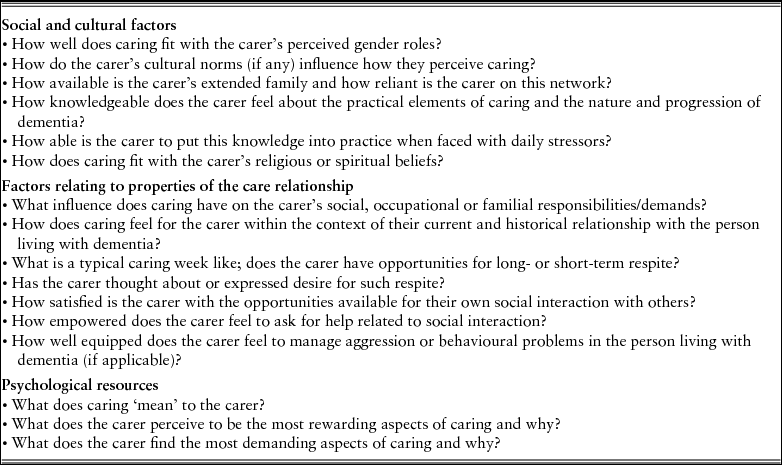
The purpose of this review is to present a narrative synthesis of personal qualities, resources and other factors associated with caregivers’ resilience. However, in order for this review to help practitioners, it is necessary to present the findings in an accessible way. Table 1 summarizes the findings of this review in the form of guide questions for practitioners. These questions should not be interpreted as a list of simple questions for practitioners to ask but, rather, are considerations (or a ‘framework’) for practitioners to use when assessing carers, based on the three themes identified by this review.
Considerations for practitioners
Discussion and recommendations
This review synthesizes and presents empirical data regarding factors that allow carers to build on their natural resources and capacity to provide care for people with dementia. The findings have several implications.
First, and perhaps most important, is the need for practitioners to identify ‘less resilient’ carers in order to be able to enhance the support provided to these caregivers based on both their self-perceived and their actual needs. This is particularly pertinent considering that almost two-thirds of psychosocial and psychoeducational interventions for family carers do not improve outcomes in terms of reduced carer burden, reduced psychological morbidity and increased social support.Reference Cooke, McNally, Mulligan, Harrison and Newman170 Consideration and monitoring of the factors identified in this review and the subsequent considerations for practitioners may therefore help practitioners to understand factors associated with distress, coping and resilience and tailor interventions accordingly, thus maximizing their potential. Furthermore, the framework of factors identified in this review allows practitioners to prospectively identify carers who are less resilient, rather than intervene when psychological distress is already present.
Second, some literature discussed in this review refers to factors that are generally considered to be stable and non-malleable, such as personality traits. Practitioners should bear in mind the influence of such traits on carers’ resilience and consider these when monitoring and interpreting changes in resilience. Whilst providing insight into the role of individual characteristics in facilitating positive adaptation under conditions of risk or adversity, criticism has been levelled at the broader resilience literature because: ‘it places blame on the [individual] for failing to overcome adversity or risk. It also raises questions about the usefulness of prevention efforts because individual trait-like characteristics may not be amenable to change’ (p. 405).Reference Fergus and Zimmerman171 However, despite the importance of traits in shaping individuals’ ability to interpret and deal with caring stresses it is, arguably, environmental influences and their subjective interpretation that create meaning in life and that therefore may be key in determining resilience.
Finally, as outlined above, situational protective factors must also be considered by practitioners. Protective factors include effective formal and familial support, positive relationship with the person living with dementia and a broader positive care context, including extrafamilial support. However, in addition to quantifying carers’ actual use of formal services or reported extent and availability of social networks, it is important for practitioners to consider discussing perceptions of their availability with carers on a regular basis. They should consider the influence of kinship ties and proximity to the person living with dementia on these perceptions and should distinguish between the types of support perceived as required (e.g. instrumental, financial, material or emotional) by caregivers. Furthermore, practitioners must be aware of gender, cultural and ethnic differences in carers’ perceptions and responses to stressors, particularly in terms of perceived adequacy of social and formal support.
The nature of the caring challenge is varied and individuated; evidence-based assessment based on the three domains identified in this review would maximize practitioners’ capacity for accurate and timely identification of carers at risk of lowered resilience and appropriate intervention. Monitoring and discussion of carers’ psychological, social and material obstructions to coping, adapting or growing may enable caregivers to become aware of their influence. Whilst the effectiveness of current practice is well documented, additional consideration of the three domains of resilience within the broader life context, in conjunction with provision of education around the need for social and familial support, may provide carers with a richer set of coping resources to draw from.
Whilst providing an overview of current literature, this review has limitations. As it was non-systematic, decisions were made by the authors regarding the most appropriate material to include. As a result, the evidence presented is an overview of the current state of the literature rather than an exhaustive synthesis. Furthermore, the review adopted a psychological conceptualization of resilience: the ability to maintain normal or enhanced functioning during times of adversity.Reference Hjemdal, Friborg, Stiles, Rosenvinge and Martinussen15, Reference Windle, Bennett and Ungar16 The constructs of self-mastery, self-efficacy, hopefulness, acceptance and stress resistance were therefore also considered as aspects or components of resilience in line with the recommendations of WindleReference Windle14 to allow for the most comprehensive overview, given the tendency of the research literature to adopt a narrow definition of resilience. However, it is possible, although unlikely, that the definition of resilience and its associated constructs adopted by this review may not be the most appropriate and thus the framework outlined may provide only one approach to assessing and enhancing carers’ resilience.
Conclusion
Carers’ resilience depends on social and cultural factors, properties of the caring relationship and carers’ psychological characteristics. Holistic assessment based on this framework can help practitioners to prospectively identify vulnerable carers and to tailor interventions to address factors that help to make them vulnerable but that are amenable to change. The findings of this review are therefore of value to clinical services, given that unmet carer needs influence carers’ psychological well-being and ability to provide appropriate care and support and have implications for the psychological health of both the carer and the person living with dementia.
Financial support
This work was supported by MerseyCare NHS Trust Research and Development Funding Scheme 2008–2009 (grant number 2012.24).
Conflicts of interest
None reported.