Introduction
The species of the family Cribrilinidae Hincks, Reference Hincks1879 are characterized by the possession of a calcified frontal shield formed by the fusion of calcified, hollow, and flattened unjointed spines (costae), collectively called a spinocyst, a term derived from Silén's (Reference Silén1942) taxon Spinocystidea, which was more or less equivalent to Acanthostega (Levinsen, Reference Levinsen1902) and Cribrimorpha (Harmer, Reference Harmer1926) (see also Rosso et al., Reference Rosso, Beuck, Vertino, Sanfilippo and Freiwald2018). Currently, Cribrilinidae is regarded as nonmonophyletic (Gordon, Reference Gordon, Herrera-Cubilla and Jackson2000; Taylor and Waeschenbach, Reference Taylor and Waeschenbach2015). Morphological and fossil evidence of multiple origins of bryozoan frontal shields have also been supported by multi-locus genetic analysis (Knight et al., Reference Knight, Gordon and Lavery2011; Taylor and Waeschenbach, Reference Taylor and Waeschenbach2015). The evolutionary transition from an anascan ancestor to a cribrimorph was reviewed by Gordon (Reference Gordon, Herrera-Cubilla and Jackson2000). While the most spectacular examples of such transitions occur in the Late Cretaceous, Dick et al. (Reference Dick, Lidgard, Gordon and Mawatari2009) demonstrated the evolution of costae in an otherwise anascan genus (Cauloramphus Norman, Reference Norman1903) within the past 12 Myr.
Currently, more than 100 genera and 700 species are assigned to Cribrilinidae (Bock, Reference Bock2020), with only 27 genera and more than 130 species represented by living taxa (Rosso et al., Reference Rosso, Beuck, Vertino, Sanfilippo and Freiwald2018). The group experienced an explosive diversification during the Late Cretaceous, with many of the genera restricted to this period (Lang, Reference Lang1916, Reference Lang1921, Reference Lang1922; Larwood, Reference Larwood1962). In the past 35 years, an unexpected diversity of Recent (Bishop and Househam, Reference Bishop and Househam1987; Reverter and Fernandez, Reference Reverter and Fernandez1996; Harmelin, Reference Harmelin2001, Reference Harmelin2006; Winston, Reference Winston2005, Reference Winston2016; Vieira et al., Reference Vieira, Gordon, Souza and Haddad2010; Winston and Vieira, Reference Winston and Vieira2013; Souto et al., Reference Souto, Berning and Ostrovsky2016; Rosso et al., Reference Rosso, Beuck, Vertino, Sanfilippo and Freiwald2018) and fossil (Di Martino et al., Reference Di Martino, Taylor and Portell2017) cribrilinids from the Atlanto-Mediterranean region has been described.
Jolietina Jullien, Reference Jullien1886 is an exclusively South American genus characterized by having vibracular heterozooids (Moyano, Reference Moyano G.1984) and interzooidal kenozooids that were regarded as homologous with those of Cretaceous pelmatoporines (Gordon and Voigt, Reference Gordon, Voigt, Gordon, Smith and Grant-Mackie1996). It comprises only two Recent species, J. latimarginata (Busk, Reference Busk1884) and J. pulchra Canu and Bassler, Reference Canu and Bassler1928a. Jolietina latimarginata is distributed around southern South America, from the southern Chilean fjord region to the continental shelf and slope off Argentina and Uruguay (Moyano, Reference Moyano G.1984; López Gappa, Reference López Gappa2000). To date, J. pulchra is known only from its type locality, the southern Brazilian continental shelf, at a depth of 128 m (Canu and Bassler, Reference Canu and Bassler1928a).
According to Bock (Reference Bock2020), Figularia Jullien, Reference Jullien1886 includes 33 fossil and extant species, but Rosso et al. (Reference Rosso, di Martino and Ostrovsky2020) recently redefined this genus to contain 18 species, providing a list of 13 species with doubtful assignment to that genus. It is characterized by having a frontal shield of closely fused costae, vicarious avicularia, and ovicells with a pair of large fenestrae (Hayward and Ryland, Reference Hayward and Ryland1998; Rosso et al., Reference Rosso, di Martino and Ostrovsky2020). It is represented in the southwest Atlantic only by F. dimorpha Figuerola, Gordon, and Cristobo, Reference Figuerola, Gordon and Cristobo2018, which was found on the continental slope off the coast of Chubut Province, at depths of 1,148–1,635 m (Figuerola et al., Reference Figuerola, Gordon and Cristobo2018), and an unnamed fossil from the Miocene of Patagonia, reported by Romero et al. (Reference Romero, Brezina, Bremec and Casadío2018).
Parafigularia Moyano, Reference Moyano G.1984 is represented by two extant species: P. magellanica (Calvet, Reference Calvet1904a), inhabiting cold-temperate waters around the southern tip of South America, and the Subantarctic P. darwini Moyano, Reference Moyano G.2011, from the Scotia Arc (Moyano, Reference Moyano G.2011). The genus is characterized by its fertile zooids, whose ovicell is associated with a triangular distal avicularium (Moyano, Reference Moyano G.1984).
Only two fossil cribrilinids are known from the Cenozoic of Argentine Patagonia: Tricephalopora capitata (Canu, Reference Canu1911) (see Lang, Reference Lang1922) and Pelmatopora insignis (Canu, Reference Canu1911) (see Larwood, Reference Larwood1962). Both species were found in the Roca Formation (Paleocene), Río Negro Province.
The aim of this study is to describe the first fossil representatives of the spinocystal genera Jolietina and Parafigularia and a new fossil species of Figularia. We provide a detailed discussion of likely relationships between these genera and other taxa, suggesting these genera may have unrelated ancestors. The studied material comes from the early Miocene of the Monte León and Chenque formations in the provinces of Chubut and Santa Cruz, Argentine Patagonia. In addition, updated descriptions of the Recent South American species J. latimarginata and J. pulchra are included.
Geologic setting
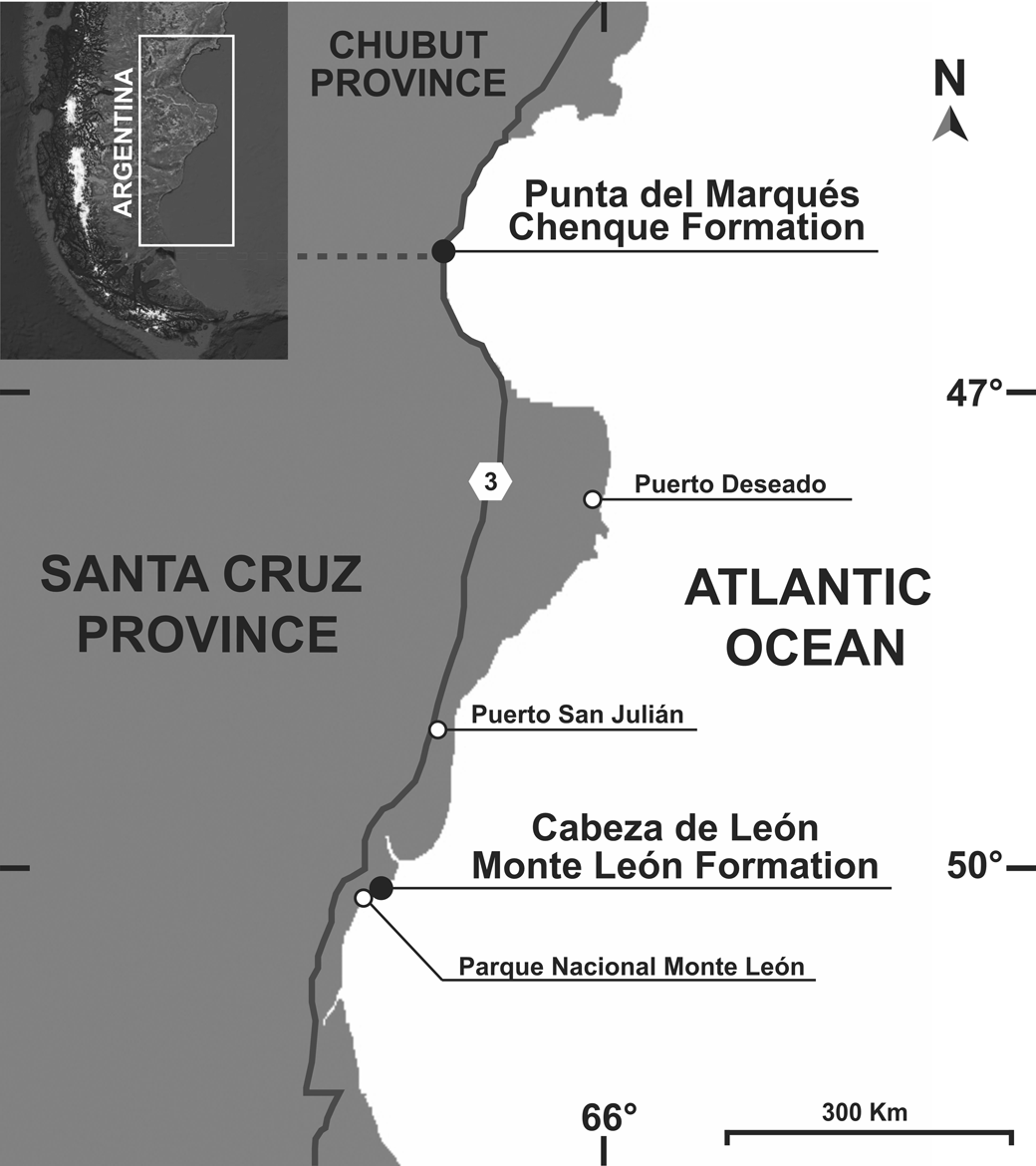
Several sedimentary marine units occur along the Atlantic coast of Argentina. They are exposed from Río Negro to Tierra del Fuego provinces. Among various outcrops, those representing the Miocene time segment are particularly important due to their extensive areal distribution and because they usually contain a great diversity of macroinvertebrates. The Monte León Formation in Santa Cruz Province and the Chenque Formation in Chubut Province are separated by ~500 km and represent two of the most important geologic units of the lower Miocene in Argentine Patagonia (Fig. 1).
Map showing the location of Cabeza de León (Monte León Formation) and Punta del Marqués (Chenque Formation).

In the outcrop section at Cabeza de León, the Monte León Formation is composed of an ~47 m siliciclastic sequence showing bioturbated fine sediments and layers containing abundant macroinvertebrate remains (Parras et al., Reference Parras, Dix and Griffin2012), among which there is a rich association of bryozoans (see Pérez et al., Reference Pérez, López-Gappa and Griffin2015, Reference Pérez, López-Gappa and Griffin2018; López-Gappa et al., Reference López-Gappa, Pérez and Griffin2017; López-Gappa and Pérez, Reference López-Gappa and Pérez2019). The Chenque Formation is characterized by a very bioturbated siliciclastic sequence with alternating sandy and pelitic levels, showing interspersed bioclastic layers with big oysters. This unit is ~300 m thick at the type locality, the city of Comodoro Rivadavia (e.g., Carmona et al., Reference Carmona, Buatois, Mángano and Bromley2008; Cuitiño et al., Reference Cuitiño, Scasso, Ventura Santos and Mancini2015).
Isotopic values of 87Sr/86Sr indicate that the Monte León Formation has an age of 22.12 Ma at the base and 17.91 Ma at the top (Parras et al., Reference Parras, Dix and Griffin2012). This range places the sedimentary sequences of the Monte León Formation in the lower Neogene (Aquitanian–early Burdigalian). The Chenque Formation is correlated with the Monte León Formation, having an isotopic age of 87Sr/86Sr 17.63 Ma (Burdigalian) at the base of the stratigraphic sequence in the Cerro Chenque area (Cuitiño et al., Reference Cuitiño, Scasso, Ventura Santos and Mancini2015). The latter value is very close to 17.92 Ma, the youngest age obtained for Cabeza de León, at the top of the Monte León Formation (Parras et al., Reference Parras, Dix and Griffin2012).
Material and methods
The new species of Jolietina and Parafigularia come from the locality “Cabeza de León” in the Punta Entrada Member of the Monte León Formation (50°21′25.38′′S, 68°53′5.88′′W), which outcrops along the coastal cliffs of the Monte León National Park, Santa Cruz Province, Argentina. The new species of Figularia comes from the locality “Punta del Marqués” of the Chenque Formation (45°56′47.44′′S, 67°33′13.75′′W), in the Chubut Province, Argentina (Fig. 1). Fossil and Recent colonies were coated with gold/palladium, and images were obtained using scanning electron microscopy (SEM Phillips XL-30). Zooidal measurements were obtained from digital scanning electron microscope (SEM) images using ImageJ software.
Repositories and institutional abbreviations
Types and other specimens examined in this study are deposited in the following institutions: Museo Argentino de Ciencias Naturales, Ciudad Autónoma de Buenos Aires, Argentina (MACN); National Collection of Invertebrates at MACN (MACN-In); Museo Egidio Feruglio, Trelew, Chubut (MEF); División Paleozoología Invertebrados, Museo de La Plata, La Plata, Argentina (MLP); Muséum National d'Histoire Naturelle, Paris, France (MNHN); Natural History Museum, London, United Kingdom (NHMUK); National Museum of Natural History, Smithsonian Institution, Washington D.C., United States (USNM).
Systematic paleontology
Phylum Bryozoa Ehrenberg, Reference Ehrenberg1831
Class Gymnolaemata Allman, Reference Allman1856
Order Cheilostomatida Busk, Reference Busk and MacGillivray1852
Family Cribrilinidae sensu lato Hincks, Reference Hincks1879
Genus Jolietina Jullien, Reference Jullien1886
Type species
Cribrilina latimarginata Busk, Reference Busk1884, by monotypy.
Diagnosis
Colony encrusting, multiserial. Autozooids separated by kenozooids. Frontal shield formed by costae, with intercostal pores but without lumen pores. Primary orifice D-shaped; condyle-like processes may be present. Oral spines absent. Secondary orifice may be present. Interzooidal kenozooids with a smooth gymnocyst surrounding a variable developed cryptocyst. Interzooidal vibracular heterozooids present, with elevated cystid and conspicous pivots; vibracular setae long. Adventitious heterozooids absent. Ovicelled zooids dimorphic; ovicell immersed to subimmersed, cleithral, with smooth, imperforate ooecium, sometimes covered by interzooidal kenozooids. Ancestrula similar to autozooids.
Remarks
Jolietina was erected by Jullien, Reference Jullien1886 for Cribrilina latimarginata Busk, Reference Busk1884, from deep water off Montevideo, Uruguay. This little-known genus seems to be restricted to South America, from the Magellanic region (Chile) to Bahia (northeast Brazil); it is characterized by having vibracular heterozooids and elongate interzooidal kenozooids that lie along interzooidal boundaries.
Jolietina latimarginata (Busk, Reference Busk1884)
Figure 2.1, 2.2; Table 1
- Reference Busk1884
Cribrilina latimarginata Busk, p. 131, pl. 22, fig. 10.
- Reference Waters1888
Cribrilina latimarginata; Waters, p. 22, pl .1, figs. 11, 12.
- Reference Moyano G.1984
Jolietina latimarginata; Moyano, p. 56, figs. 16, 17, 33, 34.
- Reference López Gappa and Lichtschein1990
Jolietina latimarginata; López Gappa and Lichtschein, p. 20, pl. 9, figs. 3, 4, pl. 15.
- Reference Cáceres and Moyano1994
Jolietina latimarginata; Cáceres and Moyano, p. 131, pl. 2, figs. E, F.
- Reference Gordon, Voigt, Gordon, Smith and Grant-Mackie1996
Jolietina latimarginata; Gordon and Voigt, p. 91, fig. 2A–D.
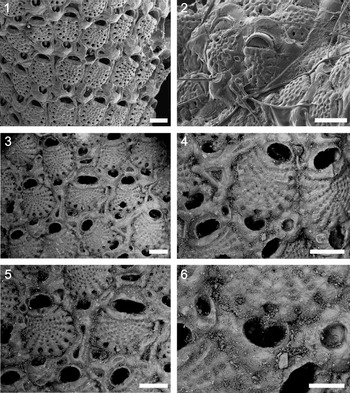
(1, 2) Jolietina latimarginata, MACN-In 43341: (1) general aspect of a colony fragment after treatment with NaOCl; (2) general aspect of an uncleaned specimen, showing its cuticular structures in situ. (3–6) Jolietina pulchra, holotype USNM 8549: (3) general aspect of a colony; (4) autozooids and vibracularia; (5) autozooid and ovicelled zooid; (6) vibracular chamber. (1–5) Scale bars = 200 μm; (6) scale bar = 100 μm.

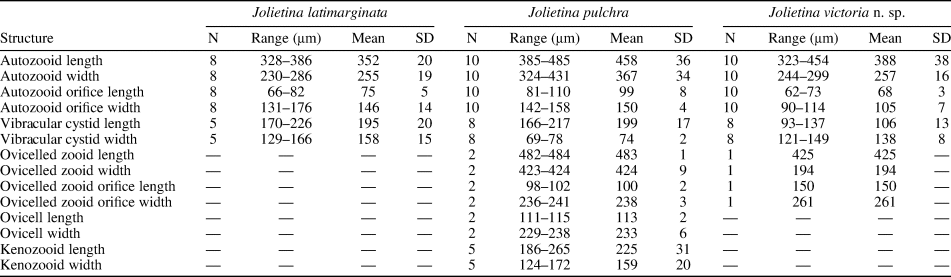
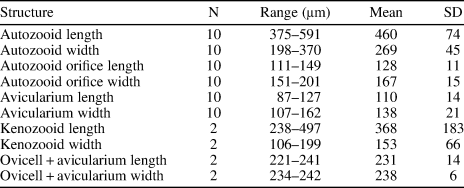
Measurements (in μm) of Jolietina latimarginata (Busk, Reference Busk1884) (MACN-In 43341), Jolietina pulchra Canu and Bassler, Reference Canu and Bassler1928a (USNM 8549), and Jolietina victoria n. sp. (MLP 36402). N = number of measurements; SD = standard deviation.

Holotype
NHMUK 1887.12.9.524, Challenger station 320.
Occurrence
Jolietina latimarginata has a typical Magellanic distribution, ranging from the cold-temperate waters of southern Chile to the continental slope off Argentina and Uruguay (Busk, Reference Busk1884; Waters, Reference Waters1888; Moyano, Reference Moyano G.1984; López Gappa and Lichtschein, Reference López Gappa and Lichtschein1990; Cáceres and Moyano, Reference Cáceres and Moyano1994; López Gappa, Reference López Gappa2000).
Description
Colony encrusting, unilaminar, multiserial. Autozooids sub-ovate, longer than wide, arranged more or less in transverse rows (Fig. 2.1), separated by kenozooids. Primary orifice transversely D-shaped, distinctly wider than long, proximo-lateral corners with two short lateral condyle-like processes; oral spines absent. Secondary orifice developed as a distal raised rim, slightly cucullate, becoming more so with increasing calcification, obscuring the primary orifice. Spinocyst flat, formed by five or six pairs of costae merging in the middle of the frontal shield, the first pair wider and more robust with a distinct median suture; pairs of costae mostly separated by rows of three pores, with about 30–35 rounded intercostal pores overall; costal bases separated by thin slits (Fig. 2.1, 2.2). Kenozooids elongate, occupying interzooidal margins, their opesiae typically narrow in the middle, wider and triangular at each end, with a smooth gymnocyst surrounding a granular cryptocyst. Interzooidal vibracular heterozooids directed laterally, generally located proximal to the autozooids and touching the kenozooidal gymnocyst, with a large, robust, and elevated cystid with gymnocystal calcification, about half autozooidal length; combined opening reniform, with asymmetrical pivots, one stout, one tiny (Fig. 2.1); vibracular setae long and curved (Fig. 2.2). Ovicells and ancestrula not seen in the present material.
Material
MACN-In 43341, Lenga St. ZE13, 53°09.539′S, 67°09.401′W, 76 m (see Liuzzi et al., Reference Liuzzi, López-Gappa and Salgado2018).
Remarks
Jolietina latimarginata is characterized by having a primary orifice distinctly wider than long, with the proximo-lateral corners having condyle-like processes. The vibracular heterozooids have an elevated cystid with asymmetrical pivots.
The ovicell has been figured by Waters (Reference Waters1888) and illustrated with scanning electron microscopy by López Gappa and Lichtschein (Reference López Gappa and Lichtschein1990). It is semi-immersed, longer than wide, mitriform, imperforate, with a central triangular uncalcified area of ectooecium. The ancestrula and early astogeny of J. latimarginata were described by Cáceres and Moyano (Reference Cáceres and Moyano1994).
This species is frequently found on the stems of the erect cyclostome Hornera americana (d'Orbigny, Reference d'Orbigny1847). Gordon and Voigt (Reference Gordon, Voigt, Gordon, Smith and Grant-Mackie1996) provided a figure of the holotype specimen from H.M.S. Challenger Expedition (NHMUK 1887.12.9.524) found on dead coral at station 320 and of a syntype specimen (NHMUK 1887.12.9.525; erroneously stated to be from the Holocene of Argentina) from the same station, found on the bryozoan Foveolaria elliptica Busk, Reference Busk1884 (Gordon, personal observation, 2020).
Jolietina pulchra Canu and Bassler, Reference Canu and Bassler1928a
Figure 2.3–2.6; Table 1
- Reference Canu and Bassler1928a
Jolietina pulchra Canu and Bassler, p. 74, pl. 4, figs. 1, 2.
- Reference Vieira, Migotto and Winston2008
Jolietina pulchra; Vieira, Migotto, and Winston, p. 22.
Holotype
USNM 8549, Jolietina pulchra, F. Canu and R. Bassler det., Rio de Janeiro, Brazil, 21°48′S, 40°03′W, 128 m, collected 1877 by Steamer Norseman.
Occurrence
Recent, Brazil (Bahia, Rio de Janeiro), 49–128 m (Canu and Bassler, Reference Canu and Bassler1928a; present study).
Description
Colony encrusting, unilaminar, multiserial. Autozooids sub-ovate, longer than wide, arranged more or less in transverse rows, separated by kenozooids (Fig. 2.3). Primary orifice transversely D-shaped to oval, wider than long, proximal margin formed by the first pair of smooth and wider costae, these separated by a thin median suture; oral spines absent (Fig. 2.4, 2.5). Secondary orifice developed as a short collar of calcification around the primary orifice, not obscuring it. Spinocyst arched, formed by six to eight pairs of costae merging in the middle of the frontal shield and separated by rows of about five to eight pores, with about 60–85 rounded intercostal pores overall; costal bases separated by thin slits (Fig. 2.5). Elongate kenozooids lying along interzooidal margins, their opesiae constricted in the middle, drop-shaped to triangular at each end, with smooth gymnocyst surrounding a smooth narrow cryptocyst (Fig. 2.4, 2.5). Vibracular heterozooids generally located proximal to the autozooids and touching the kenozooidal gymnocyst, laterally directed, less than half autozooidal length, the cystid smooth, convex; opesia reniform, with a single median pivot (Fig. 2.4, 2.6). Ovicelled zooid larger than non-ovicelled autozooid; orifice dimorphic, transversely oval, secondary orifice formed by a well-developed collar of calcification obscuring the primary orifice distally, distinctly wider than long (Fig. 2.3, 2.5). Ovicell largely immersed, ooecium smooth, imperforate, resembling a small cap (Fig. 2.5). Ancestrula not seen.
Material
USNM 348, Bahia, Brazil, 49 m, collected 1877 by Steamer Norseman.
Remarks
This is the first redescription of the species since its original description based on a specimen from Rio de Janeiro, southeast Brazil (Canu and Bassler, Reference Canu and Bassler1928a). Here we examined the holotype but also found other fragments of J. pulchra (USNM 348) studied by Canu and Bassler (Reference Canu and Bassler1928a) that were not included in their paper. This revealed that J. pulchra also occurs in relatively shallower waters (49 m) in Bahia State, northeast Brazil.
Canu and Bassler (Reference Canu and Bassler1928a) stated that J. pulchra was smaller than J. latimarginata, but we found the opposite. Jolietina pulchra is distinguished from J. latimarginata by having larger zooids (385–485 × 324–431 μm in J. pulchra, 324–341 × 230–286 μm in J. latimarginata), more spinocystal pores (60–85 in J. pulchra, 30–35 in J. latimarginata), narrower vibracular chambers (69–78 μm wide in J. pulchra, 129–166 μm wide in J. latimarginata), and shorter vibracular pivots (larger in J. latimarginata). Canu and Bassler's (Reference Canu and Bassler1928a) original material was found on coral fragments.
Type material
Holotype: MLP 36402, one fragment. Paratypes: MLP 36403, five fragments.
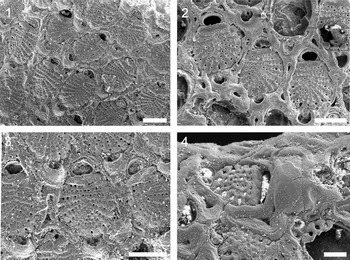
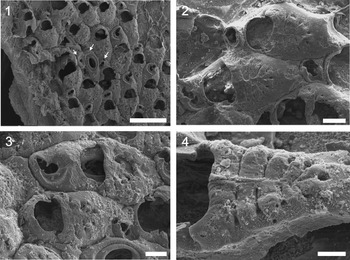
Jolietina victoria n. sp. (1) Holotype, MLP 36402, general aspect; (2) paratype, MLP 36403, detail of three autozooids, vibracularia, and kenozooids; (3) holotype, MLP 36402, autozooids, vibracularia, and kenozooids; (4) paratype, MLP 36403, ovicell. (1–3) Scale bars = 200 μm; (4) scale bar = 100 μm.

Diagnosis
Jolietina with spinocyst formed by eight or nine pairs of costae merging in the middle, separated by rows of about four to six pores, with about 64–96 intercostal pores overall. Vibracular heterozooids with reniform opesia and a robust median pivot.
Occurrence
So far, the species has been found only at the locality “Cabeza de León” (Monte León National Park, Santa Cruz Province, Argentina), in the Punta Entrada Member of the Monte León Formation (early Miocene).
Description
Colony encrusting, unilaminar, multiserial. Autozooids sub-ovate, longer than wide, arranged more or less in transverse or oblique rows, separated by kenozooids (Fig. 3.1–3.3). Primary orifice transversely D-shaped, wider than long, proximal margin formed by the first pair of wider costae, these separated by a thin median suture, proximo-lateral corners of the orifice curved; oral spines absent (Fig. 3.2, 3.3). Secondary orifice developed as a short collar of calcification around the primary orifice, occasionally forming a slightly elevated distal rim but not obscuring the primary orifice. Spinocyst flat, formed by eight or nine pairs of costae merging in the middle of the frontal shield and separated by rows of about four to seven pores, with about 64–96 rounded intercostal pores; costal bases separated by slits (Fig. 3.2, 3.3). Narrow, elongate kenozooids lying along interzooidal margins, their opesiae constricted in the middle, mostly drop-shaped at each end, with smooth gymnocyst surrounding a smooth narrow cryptocyst (Fig. 3.2, 3.3). Vibracular heterozooids generally located proximal to the autozooids and touching the kenozooidal gymnocyst (Fig. 3.2), the cystid smooth, inflated, laterally directed, about one-third of autozooidal length; opesia reniform, with a robust median pivot. Ovicelled zooid with a secondary orifice much wider and shorter than non-ovicelled zooids, formed by a well-developed collar of calcification obscuring the distal part of the primary orifice (Fig. 3.4). Ovicell semi-immersed, with smooth ooecium, imperforate, surmounting the frontal shield of the distal zooid, bordered disto-laterally and partially covered by the interzooidal kenozooids (Fig. 3.4). Ancestrula not seen.
Etymology
Named for the Nao Victoria, the ship that completed the first circumnavigation around the planet, belonging to the Fernão de Magalhães fleet, Portuguese captain of the first European expedition that explored the study area in the sixteenth century. Used as a noun in apposition.
Remarks
Jolietina victoria n. sp. is similar to J. pulchra in having a more-perforated frontal shield (64–96 and 60–85 intercostal pores in J. victoria and J. pulchra, respectively) when compared with J. latimarginata (with 30–35 rounded intercostal pores overall), a similar orifice with rounded proximo-lateral corners but lacking condyle-like processes in the orifice (D-shaped and having proximo-lateral condyles in J. latimarginata). Jolietina victoria differs from both J. latimarginata and J. pulchra mainly in having a spinocyst formed by more costae (five or six pairs in J. latimarginata, six to eight pairs in J. pulchra, but eight or nine pairs in J. victoria).
Jolietina victoria has semi-immersed ovicells partially covered by gymnocystal calcification, which are distinct from immersed ovicells without gymnocyst in J. pulchra.
Genus Figularia Jullien, Reference Jullien1886
Type species
Lepralia figularis Johnston, Reference Johnston1847. By original designation. Recent.
Occurrence
Eocene to Recent.
Remarks
Figularia was erected by Jullien (Reference Jullien1886) for Lepralia figularis Johnston, Reference Johnston1847 from the British Isles, while Rosso et al. (Reference Rosso, di Martino and Ostrovsky2020) very recently provided a redescription of the type species as well as a revised diagnosis of the genus. Gordon (Reference Gordon1984) mentioned the range of morphological variation attributed to the genus, including the presence or absence of lumen pores, variable length of costal field, and the characters of the ectooecium. Figularia and Jullienula Bassler, Reference Bassler and Moore1953 were inexplicably downgraded by Soule et al. (Reference Soule, Soule and Chaney1995) to subgenus rank within Reginella Jullien, Reference Jullien1886. Yang et al. (Reference Yang, Seo, Min, Grischenko and Gordon2018) defended the status of Figularia, Jullienula, and Reginella as distinct genera. According to them, Figularia should include taxa with a well-developed lateral gymnocyst and an ooecium that is typically bifenestrate or with ectooecial pseudopores but suggested that the latter character needs reexamination; species with pseudoporous ooecia might not be congeneric. As redefined by Rosso et al. (Reference Rosso, di Martino and Ostrovsky2020), species of Figularia have only a single lumen pore (pelma) in each costa, the ooecium is bifenestrate (or tetrafenestrate if each fenestra divides in two while forming), and there are vicarious avicularia. Accordingly, Figularia currently comprises 18 species: Figularia arnouldi Buge, Reference Buge1956; Figularia carinata (Waters, Reference Waters1923); Figularia clithridiata (Waters, Reference Waters1887); Figularia dimorpha Figuerola, Gordon, and Cristobo, Reference Figuerola, Gordon and Cristobo2018; Figularia figularis (Johnston, Reference Johnston1847); Figularia fissa (Hincks, Reference Hincks1880); Figularia fissurata Canu and Bassler, Reference Canu and Bassler1929; Figularia haueri (Reuss, Reference Reuss1848); Figularia hilli (Osburn, Reference Osburn1950); Figularia japonica Silén, Reference Silén1941; Figularia mernae Uttley and Bullivant, Reference Uttley and Bullivant1972; Figularia pelmatifera Gordon, Reference Gordon1984; Figularia philomela (Busk, Reference Busk1884); Figularia rhodanica Li, Reference Li1990; Figularia speciosa (Hincks, Reference Hincks1881); Figularia spectabilis Rosso, Di Martino, and Ostrovsky, Reference Rosso, di Martino and Ostrovsky2020; Figularia tenuicosta (MacGillivray, Reference MacGillivray1895); and Figularia triangula Powell, Reference Powell1967. Rosso et al. (Reference Rosso, di Martino and Ostrovsky2020), however, reported smooth ooecia in Figularia planicostulata Canu and Lecointre, Reference Canu and Lecointre1928 (Miocene, France), but this species is characterized by having bifenestrate ooecia (MNHN.F.R53650); thus, it is considered to belong to the genus Figularia.
Di Martino and Taylor (Reference Di Martino and Taylor2018) assigned Emballotheca capitifera Canu and Bassler, Reference Canu and Bassler1929 from the Philippines to Figularia, but this species is morphologically distinguished from other Figularia by having a reduced costal shield surrounded by a pseudoporous gymnocyst (non-pseudoporous in Figularia) and ovicells with multiple ectooecial pseudopores (bifenestrate in Figularia). Two other Indo-Pacific species with pseudopores in the gymnocyst and ectooecium were also previously included in Figularia: Figularia lepida Hayward, Reference Hayward1988 from Mauritius and Figularia gemina Tilbrook, Reference Tilbrook2006 from the Solomon Islands. These now belong to Vitrimurella Winston, Vieira, and Woollacott, Reference Winston, Vieira and Woollacott2014, in its own family Vitrimurellidae Winston, Vieira, and Woollacott, Reference Winston, Vieira and Woollacott2014. Vitrimurella was erected for Gemellipora lata Smitt, Reference Smitt1873 and includes species with a dimorphic orifice, small costal field, pseudoporous gymnocyst, and pseudoporous ectooecium that were previously assigned to both Figularia and Tremoschizodina Duvergier, Reference Duvergier1921. Initially, the genus included five tropical species: Vitrimurella anatina (Canu and Bassler, Reference Canu and Bassler1928b); Vitrimurella fulgens (Marcus, Reference Marcus1955); Vitrimurella gemina Tilbrook, Reference Tilbrook2006; Vitrimurella lata (Smitt, Reference Smitt1873); and Vitrimurella lepida (Hayward, Reference Hayward1988). The type specimen of E. capitifera illustrated by Di Martino and Taylor (Reference Di Martino and Taylor2018, figs 106–109), however, allowed Rosso et al. (Reference Rosso, di Martino and Ostrovsky2020) to also include it in this genus. The Pacific species (i.e., V. capitifera, V. gemina, and V. lepida) are distinguished from the Atlantic species by having hyperstomial ovicells (immersed in Atlantic species) and ooecia with a proximal fissure (absent in Atlantic species). Winston (Reference Winston2016) included Vitrimurellidae in the superfamily Hippothooidea because of the pseudoporous gymnocystal frontal shield, vestigial costae, and pseudoporous ooecia, similar to those in some Trypostegidae. This family may have a pliophloean ancestor (Gordon, Reference Gordon, Herrera-Cubilla and Jackson2000), but the lack of a strictly pliophloean orifice and the absence of an avicularian crossbar in trypostegids suggest that Vitrimurellidae is unrelated to Hippothooidea. However, the morphology of the vicarious avicularia (spatulate with complete crossbar), extent of the gymnocyst, and small suboral costal field in Vitrimurella suggest a relationship with Figularia and with the cribrilinoidean genus Euthyroides Harmer, Reference Harmer1902 (Euthyroididae Levinsen, Reference Levinsen1909). An extant species from the Caribbean, Figularia? [sic] ampla Canu and Bassler, Reference Canu and Bassler1928b (USNM RB 7494), also has pseudoporous ooecia as well as traces of a well-developed costal field like some Figularia species, with pseudopores extending onto costae, hence resembling lumen pores; it is here reassigned as Vitrimurella ampla (Canu and Bassler, Reference Canu and Bassler1928b) n. comb., suggesting this family is better placed in Cribrilinoidea rather than Hippothooidea.
Among other species with multiple ectooecial pseudopores previously attributed to Figularia (considered doubtful by Rosso et al., Reference Rosso, di Martino and Ostrovsky2020), two fossil species—Membraniporella rugosa Maplestone, Reference Maplestone1901 from the Miocene of Australia and Figularia ryukyuensis Kataoka, Reference Kataoka1961 from the Pleistocene of Japan—are better assigned to Reginella or Hayamiellina Grischenko and Gordon in Grischenko et al., Reference Grischenko, Gordon, Nojo, Kawamura, Kaneko and Mawatari2004 rather than Figularia. A final conclusion concerning their placement, however, requires revision of the respective type material. Despite similarities among Figularia and four other cribrilinid taxa—Hayamiellina, Juxtacribrilina Yang et al., Reference Yang, Seo, Min, Grischenko and Gordon2018 (formerly regarded as a subgenus while here elevated to genus rank), Jullienula, and Reginella—these latter genera seem to be mutually more closely related by having a well-developed costal area with two or more costal lumina (pelmatidia), compared with core Euthyroididae and Vitrimurellidae.
At least three species with remarkable costate ooecia, Figularia pulcherrima Tilbrook, Hayward, and Gordon, Reference Tilbrook, Hayward and Gordon2001, Figularia jucunda Canu and Bassler, Reference Canu and Bassler1929, and Figulina tahitiensis Waters, Reference Waters1923, are here assigned to Costafigularia n. gen. (see the following). Figularia contraria Lagaaij, Reference Lagaaij1963, is quite distinct from Figularia (and from Costafigularia and Vitrimurella) in having smaller female zooids; this species requires reexamination and should be reassigned to a distinct genus (currently under review, J.E. Winston, personal communication, 2020).
Five species still require further investigation: Figularia? crassicostulata Canu and Bassler, Reference Canu and Bassler1920 (Priabonian, Florida, USA) and Figularia peltata (Reuss, Reference Reuss1874) (Miocene, Austria) apparently lack pelmata on the costae; Figularia duvergieri Bassler, Reference Bassler1936 (Miocene, France) has an orifice with denticulate anter; Figularia echinoides Brown, Reference Brown1952 (early Oligocene, New Zealand) has mostly two tubular pelmata on each costa and the ovicell was not seen, so it remains unknown if it was bifenestrate; Figularia kenleyi Brown, Reference Brown1958 (Miocene, Australia) has pelmata only on suboral costae.
Figularia elcanoi new species
Figure 4; Table 2
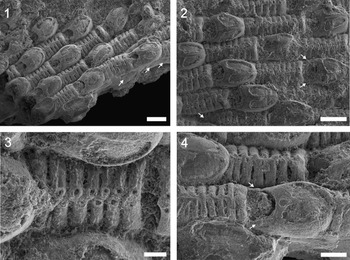
Figularia elcanoi n. sp. (1) Holotype, MEF 6799, group of ovicelled zooids; the arrows show three pore plates on a vertical wall; (2) paratype, MEF 6800, ovicelled zooids; the arrows show the gymnocyst and the pair of processes on the lateral margins of the orifice; (3) holotype, MEF 6799, detail of spinocyst; (4) holotype, MEF 6799, detail of ovicells and frontal shields; the arrows show the pair of orificial processes. (1, 2) Scale bars = 200 μm; (3) scale bar = 50 μm; (4) scale bar = 100 μm.

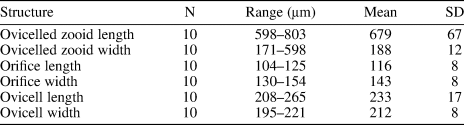
Measurements (in μm) of Figularia elcanoi n. sp. (MEF 6800). N = number of measurements; SD = standard deviation.

Type material
Holotype: MEF 6799, a bilaminar fragment. Paratype: MEF 6800, a bilaminar fragment.
Diagnosis
Colony bilaminar. Zooids rectangular, more than three times longer than wide. Gymnocyst extremely reduced, barely visible proximally. Frontal shield formed by more than 6–12 pairs of alternating costae with a circular lumen pore near the midline. Orifice with a pair of processes on the lateral margins. Ectooecial fenestrae large, separated by a median suture.
Occurrence
This species was found only at its type locality, “Punta del Marqués”, Chubut Province, in the lower layers of Chenque Formation (early Miocene).
Description
Colony erect, bilaminar (Fig. 4.1). Ovicellate zooids rectangular, more than three times longer than wide, ordered quincuncially, separated by deep grooves, lateral margins almost straight (Fig. 4.1, 4.2). Orifice in ovicellate zooids wider than long, proximal margin straight or slightly concave, oral spines not seen, but a pair of blunt processes is constantly present on the lateral margins (Fig. 4.2, 4.4). Gymnocyst smooth, extremely reduced, barely visible proximally in ovicellate zooids (Fig. 4.2). The frontal surface is covered by a shield formed by more than 6–12 pairs of alternating costae separated by slits and fused along the midline; first pair of costae wider and more robust than the others, forming the proximal margin of the orifice; each costa with a small circular lumen pore near the midline (Fig. 4.3). Ovicell hyperstomial, ooecium globose, longer than wide, protruding over the proximal gymnocyst and the most proximal pairs of costae of the distal zooid, with two very large ectooecial fenestrae occupying most of its frontal surface, separated by a median suture (Fig. 4.2, 4.4). Communication between zooids by multiporous septula in the lateral walls (Fig. 4.1). Vicarious avicularia and ancestrula not seen.
Etymology
Honorific for the explorer Juan Sebastián Elcano, who commanded the flagship Victoria from the Philippines to Spain, completing the first circumnavigation of the Earth in 1522.
Remarks
Figularia elcanoi n. sp. is characterized by its bilamellar colonies, the extreme reduction of the gymnocyst, and the pair of large, deep fenestrae in the ovicell. In the two fragments examined, all the zooids seen on both sides of the colony were ovicellate. A gymnocyst not covered by the preceding ovicell can be seen in a zooid at the bottom of Fig. 4.2. The number of costae of each zooid could not be counted precisely because the proximal part of the spinocyst is covered by the ovicell of the preceding zooid.
Bilamellar colonies are not common in the genus Figularia. As far as we know, they occur in F. kenleyi Brown, Reference Brown1958 from the Miocene of southeastern Australia (Brown, Reference Brown1958) and in the recently described species F. spectabilis, from the early Pleistocene deepwater sediments of northeast Sicily, Italy (Rosso et al., Reference Rosso, di Martino and Ostrovsky2020).
Romero et al. (Reference Romero, Brezina, Bremec and Casadío2018) figured an unnamed encrusting Figularia from the Puerto Madryn Formation (early–late Miocene, Patagonia) growing on oyster shells. It is clearly related to F. elcanoi but differs in its narrower costae and shorter zooids and ectooecial fenestrae.
Genus Costafigularia new genus
Type species
Figularia pulcherrima Tilbrook, Hayward, and Gordon, Reference Tilbrook, Hayward and Gordon2001. Recent.
Diagnosis
Colony unilaminar, encrusting. Frontal shield spinocystal, with costal field variable in length, surrounded by marginal gymnocyst; each costa with a single lumen pore; intercostal pores present. Vicarious avicularia often present. Ovicell hyperstomial, with costate ooecium.
Occurrence
Recent, Pacific.
Etymology
Costafigularia n. gen. is derived by combining the Latin costa, rib, with Figularia, alluding to the remarkable costate ooecia of this genus.
Remarks
Figularia pulcherrima Tilbrook, Hayward and Gordon, Reference Tilbrook, Hayward and Gordon2001 from the western Pacific has a well-developed smooth gymnocyst with a costal field like Figularia figularis, but it also has remarkable costate ooecia. Costafigularia n. gen. is here erected for three Indo-Pacific species: Costafigularia pulcherrima (Tilbrook, Hayward, and Gordon, Reference Tilbrook, Hayward and Gordon2001) n. comb. (type species; NHMUK 1998.8.4.71, Recent, Iririki Island, Efate, Vanuatu), Costafigularia jucunda (Canu and Bassler, Reference Canu and Bassler1929) n. comb. (USNM RB 7994, Recent, Phillipines), and Costafigularia tahitiensis (Waters, Reference Waters1923) n. comb. (Recent, Tahiti).
Costafigularia jucunda n. comb. (Canu and Bassler, Reference Canu and Bassler1929, p. 241, pl. 22, fig. 3) and C. tahitiensis n. comb. (Waters, Reference Waters1923, p. 571, pl. 18, fig. 1) are known only from their original publications; thus, a proper review and descriptions of the type material are still required.
Waters (Reference Waters1923, p. 571) characterized Costafigularia tahitiensis n. comb. as having a distinct ovicell “which has at the distal end an area with a number of large prominent papillae at the end of the rays.” His figure suggests a similar ooecial structure as in C. pulcherrima n. comb., with no clear differences in autozooid morphology between these two species. No type specimen of C. tahitiensis n. comb. has been located, but it is supposed that the type material is housed at the Manchester Museum, with other specimens studied by Arthur Waters. Costate ooecia described in both Costafigularia pulcherrima n. comb. and Costafigularia tahitiensis n. comb. are slightly different from ooecia with marginal pseudopores described in Costafigularia jucunda n. comb.
Jullienula is distinguished from Costafigularia n. gen. by having no lateral gymnocyst (gymnocyst well developed in Costafigularia), and its ooecium is reduced in size, possibly derived from one or two costae (ooecium hyperstomial with three or more costae in Costafigularia).
Genus Parafigularia Moyano, Reference Moyano G.1984
Type species
Membraniporella magellanica Calvet, Reference Calvet1904a. Smyth Channel, southern Chile. By monotypy.
Remarks
Parafigularia was erected by Moyano (Reference Moyano G.1984) for Membraniporella magellanica Calvet, Reference Calvet1904a (=Cribrilina patagonica Waters, Reference Waters1905) from the Magellanic region. The genus is characterized by fertile zooids with an ovicell connected with the avicularian chamber and modules composed of an autozooid, a distal avicularium, and a distalmost kenozooid. Two other species are included (Moyano, Reference Moyano G.2011), the subantarctic Parafigularia darwini Moyano, Reference Moyano G.2011 and the Antarctic Parafigularia discors (Hayward and Taylor, Reference Hayward and Taylor1984). Kuklinski and Barnes (Reference Kuklinski and Barnes2009) erected the genus Inferusia, with Inferusia taylori Kuklinski and Barnes, Reference Kuklinski and Barnes2009 from the Scotia Arc as type species. It is characterized, inter alia, by its triangular avicularia associated with ovicells. They compared Inferusia with three genera: Figularia, Filaguria Moyano, Reference Moyano G.1991, and Klugerella Moyano, Reference Moyano G.1991, but neglected to mention Parafigularia while also including Figularia discors in Inferusia (cf. Moyano, Reference Moyano G.2011). The type species of Parafigularia and Inferusia have in common the same kind of ovicell and modules composed of autozooids, avicularia, and kenozooids. They differ, however, in the development of the spinocyst (reduced in P. magellanica, greatly developed in I. taylori) and kenozooids (interspersed between autozooids in I. taylori, distal in P. magellanica). We rather believe that these are differences at the specific level and that Inferusia should be synonymized with Parafigularia due to similarities in their ovicells and modular structure.
Unfortunately, Moyano (Reference Moyano G.2011) inadvertently introduced Parafigularia darwini while being unaware of the existence of Inferusia taylori, described two years earlier (Kuklinski and Barnes, Reference Kuklinski and Barnes2009). The comparison of SEM images and the geographic proximity of the type localities of both nominal species leave no doubt regarding their synonymy, resulting in Parafigularia taylori (Kuklinski and Barnes, Reference Kuklinski and Barnes2009) n. comb.
Species of Parafigularia seem to be distinguishable from other species with a spinocystal frontal shield by having a broad poster with proximal corners with shallow indentations in the gymnocystal calcification. Similar indentations are also known in two genera, Eurystomella Levinsen, Reference Levinsen1909 and Integripelta Gordon, Mawatari, and Kajihara, Reference Gordon, Mawatari and Kajihara2002, currently placed in the catenicelloid family Eurystomellidae Levinsen, Reference Levinsen1909. Despite the morphological similarities between Parafigularia and Eurystomellidae, the relationship between these taxa remains uncertain and requires further studies.
Holotype
MLP 36404, fragment of a colony.
Parafigularia pigafettai n. sp., holotype, MLP 36404. (1) General aspect of the colony; the left and middle arrows show two kenozooids; the right arrow shows the distalmost kenozooid; (2) detail of two zooids; (3) autozooids, ovicell, and avicularia; (4) detail of spinocyst. (1) Scale bar = 500 μm; (2, 3) scale bars = 100 μm; (4) scale bar = 50 μm.

Measurements (in μm) of Parafigularia pigafettai n. sp. (MLP 36404). N = number of measurements; SD = standard deviation.

Diagnosis
Parafigularia with spinocyst covering two-thirds of frontal shield, with 7–10 costae fused in the midline. Interzooidal avicularia distal to each infertile zooid, rostrum triangular, directed disto-laterally, transverse bar incomplete; with an associated distalmost kenozooid.
Occurrence
This species has so far been found only at the locality “Cabeza de León,” Monte León National Park, Santa Cruz Province. The specimens were found in the Punta Entrada Member of the Monte León Formation (early Miocene).
Description
Colony encrusting, unilaminar, multiserial. Autozooids subhexagonal, 370–590 × 200–370 μm, ordered quincuncially, separated by deep grooves (Fig. 5.1). Spinocyst convex, comprising about two-thirds of the frontal shield, formed by 7–10 flattened costae (frequently four or five pairs) separated by narrow intercostal spaces and fused in the midline; first pair of costae more robust and wider than the others (Fig. 5.2). Gymnocyst smooth, restricted to the lateral margins and the proximal third of the frontal shield. Orifice wider than long, bell-shaped, anter separated from the poster by proximolateral indentations, forming a pair of robust lateral condyle-like projections; proximal margin shallow W-shaped (Fig. 5.2, 5.4). Interzooidal avicularia distal to each infertile zooid, wider than long, opesia rounded, cryptocyst well developed, rostrum triangular, directed disto-laterally, transverse bar incomplete; sometimes with an associated distalmost kenozooid (Fig. 5.1). Fertile zooids with ovicell formed by the proximal cystid of the distal avicularium similar to those of infertile zooids; ovicell closed by the operculum, surface of ooecium smooth (Fig. 5.3). Zooids communicating via pore chambers in the disto-lateral walls (Fig. 5.1). Kenozooids consisting of gymnocyst, cryptocyst, and an elliptical opesia may occur between autozooids (Fig. 5.1).
Etymology
Honorific for the Italian scholar and explorer Antonio Alberto Pigafetta, who published the book Relazione del primo viaggio intorno al mondo after completing the first circumnavigation of the world together with Juan Sebastián Elcano.
Remarks
Parafigularia pigafettai n. sp. differs from the remaining species of the genus mainly in the number of costae and the area occupied by the spinocyst (4–7 costae covering a small area in P. magellanica, 9–10 pairs in P. discors, 9–11 pairs covering the whole frontal shield in P. taylori n. comb., 4–5 pairs occupying two-thirds of the frontal shield in P. pigafettai). The only colony examined encrusted the inner surface of a bivalve.
Discussion
Phylogenetic relationships
Morphological traits found in species with a spinocystal frontal shield, here assigned to Jolietina, Figularia, and Parafigularia, indicate that these taxa belong to different spinocystal clades. Gordon (Reference Gordon1989) suggested that the four major frontal-shield types in ascophoran cheilostomes represented four infraorders—e.g., spinocystal (Cribriomorpha), umbonuloid (Umbonulomorpha), gymnocystal (Hippothoomorpha), and lepralioid (Lepraliomorpha). Eleven years later, Gordon (Reference Gordon, Herrera-Cubilla and Jackson2000) argued that these taxa were variably polyphyletic or paraphyletic and could not be sustained, suggesting nine different models for the origin of ascophoran shields. We await the results of comprehensive gene-sequencing studies, currently under way, that will test the various morphological hypotheses. Preliminary results (e.g., Fuchs et al., Reference Fuchs, Obst and Sundberg2009; Knight et al., Reference Knight, Gordon and Lavery2011; Waeschenbach et al., Reference Waeschenbach, Taylor and Littlewood2012; Orr et al., Reference Orr2019) already show that inferred phyletic affinities based solely on morphology do not always align with those indicated by gene trees.
Moyano (Reference Moyano G.1984) and Gordon and Voigt (Reference Gordon, Voigt, Gordon, Smith and Grant-Mackie1996) interpreted the peculiar interzooidal kenozooids of Jolietina latimarginata as homologous to those of Cretaceous pelmatoporines. This cribrilinid group is represented in Paleocene Patagonian deposits of the Roca Formation (Canu, Reference Canu1911) by the poorly known Pelmatopora insignis (see Larwood, Reference Larwood1962). Our study shows that Jolietina was already present in the area since the early Miocene, but there are still no cribrilinid records in southern South America during a period of ca. 46 Myr between the Danian and the early Neogene. Jolietina victoria n. sp. is the first fossil representative of Jolietina, suggesting some trends toward reduction of the number of costae in the frontal shield, immersion of the brooding cavity, and reduction of gymnocystal area with exposition of ooecial surface over time.
The two fossil species from Argentine Patagonia, F. elcanoi n. sp. and P. pigafettai n. sp., differ, inter alia, in their lumen pores, shape of the proximal orificial rim, morphology of heterozooids, and ooecial structure, suggesting two phylogenetic trends in Figularia and Parafigularia.
Figularia is taken here to comprise only those species having costae (pinnate or non-pinnate) with a single lumen pore, smooth lateral and/or proximal gymnocyst, a bi- or tetrafenestrate ectooecium, and vicarious avicularia. Some species previously assigned to this genus belong to other genera, including Costafigularia n. gen., Filaguria, Jullienula, Hayamiellina, Reginella, and Vitrimurella (see also Rosso et al., Reference Rosso, di Martino and Ostrovsky2020). The Patagonian fossil F. elcanoi has the most extensive costal field and more-reduced gymnocystal area compared with other Figularia species. In F. elcanoi, lumen pores are placed near the zooidal midline (distal end of costae), similar to species previously reported from the Southern Hemisphere (F. dimorpha, F. fissa, F. kenleyi, F. mernae, F. pelmatifera, F. speciosa), which are thus different from lumen pores placed near the gymnocystal area (proximal end of costae) characteristic of Figularia figularis (see Hayward and Ryland, Reference Hayward and Ryland1998) and other Northern Hemisphere species, including fossils from Europe (David and Pouyet, Reference David and Pouyet1974; Berning, Reference Berning2006) as well as an unnamed lower Miocene fossil from Florida, USA (Di Martino et al., Reference Di Martino, Taylor and Portell2017). Except for F. elcanoi, which has non-pinnate costae, all fossil species currently assigned to Figularia have pinnate costae. At least three species from the Southern Hemisphere (F. pelmatifera, F. philomela, and F. speciosa) also have pinnate costae. Like in F. elcanoi, the non-pinnate costae were also described in seven other Recent species from the Southern Hemisphere (F. carinata, F. clithridiata, F. dimorpha, F. fissa, F. mernae, and F. triangula) and northeast Pacific (F. hilli).
Harmer (Reference Harmer1902, Reference Harmer1926) first noted morphological similarities between the frontal-shield structure in Euthyroides Harmer, Reference Harmer1902 and that in Figularia. These similarities included an extensive gymnocyst but also the form of the compensation space extending under the costal area and gymnocyst (Gordon, Reference Gordon1989). Both genera included species with costal lumen pores, a variable extent of costal field, smooth gymnocyst, a bifenestrate ectooecium, and large vicarious avicularia with spatulate rostrum, suggesting they could be regarded as sister clades (Gordon, Reference Gordon, Herrera-Cubilla and Jackson2000). Conceivably, Figularia can be transferred to the Euthyroididae Levinsen, Reference Levinsen1909 (presently a separate family of Cribrilinoidea following Gordon, Reference Gordon1989), or the Euthyroididae might itself be included in the Cribrilinidae. We choose, however, to keep Figularia in the Cribrilinidae s.l. until a comprehensive phylogenetic analysis based on both molecular and morphological data is carried out.
It is not only Figularia and Euthyroides that have bi-/tetrafenestrate ovicells. As mentioned by Cook et al. (Reference Cook, Bock, Gordon and Weaver2018), the combined morphological traits of spinocyst, ooecia, and avicularia strongly indicate that Euthyroides evolved from a Figularia-like ancestor. Bilobate ooecia are also reported in other cribrimorphs, such as Corbulipora MacGillivray, Reference MacGillivray1895, Filaguria Moyano, Reference Moyano G.1991, in the calloporid genera Wilbertopora Cheetham, Reference Cheetham1954 and Valdemunitella Canu, Reference Canu1900, and in the putative flustrid genus Klugeflustra Moyano, Reference Moyano G.1972 (Ostrovsky, Reference Ostrovsky2013). Although the New Zealand species Figularia huttoni Brown, Reference Brown1952 and Figularia spinea Brown, Reference Brown1952 have true costae, Gordon (Reference Gordon1986) included them in Valdemunitella, analogous to Membraniporella nitida (Johnston, Reference Johnston1838), formerly Cribrilinidae, which was transferred to Calloporidae (see related comment by Lidgard et al., Reference Lidgard, Carter, Dick, Gordon and Ostrovsky2012, p. 241). Despite the absence of a spinocystal shield in Klugeflustra, Bock and Cook (Reference Bock and Cook2001) suggested that it is morphologically similar to the flustrine phase of some Corbulipora.
When introducing Vitrimurellidae, Winston et al. (Reference Winston, Vieira and Woollacott2014) declined to include it in a specific superfamily, noting similarities with both Trypostegidae (Hippothooidea) and Figularia (Cribrilinoidea), thus leaving the family incertae sedis. Currently, Trypostegidae is regarded as having evolved from a pliophloean ancestor (Voigt and Hillmer, Reference Voigt and Hillmer1983) and is placed within Hippothooidea. Pliophloeans were spinocystal cribrimorphs with numerous gymnocystal pores that also occurred on the costae, and they had avicularian polymorphs that may be ancestral to trypostegid zooeciules (of unknown function) (Gordon, Reference Gordon, Herrera-Cubilla and Jackson2000). Despite the presence of pseudoporous ovicells in Vitrimurella, the morphology of heterozooids (vicarious avicularia with a complete crossbar), and the extensive spinocyst (with the proximal orifice delimited by joined costae, often with lumen pores) suggest this genus is more closely related to Euthyroididae and some cribrilinids (e.g., Figularia and Costafigularia n. gen.) than to Trypostegidae.
Biogeography
The distribution of Parafigularia was previously regarded to comprise Antarctica (Hayward and Taylor, Reference Hayward and Taylor1984), the Scotia Arc (Kuklinski and Barnes, Reference Kuklinski and Barnes2009; Moyano, Reference Moyano G.2011), and Magellanic South America (Calvet, Reference Calvet1904a, Reference Calvetb; Waters, Reference Waters1905; López Gappa, Reference López Gappa1977, Reference López Gappa2000; Moyano, Reference Moyano G.1984) but is now expanded northward to 50°S in the southwest Atlantic with the finding of the Miocene species P. pigafettai n. sp. in Monte León Formation.
Figularia was not known in the southwest Atlantic until the recent finding of a new species on the continental slope off Patagonia, at a depth of more than 1,100 m (Figuerola et al., Reference Figuerola, Gordon and Cristobo2018). In the same year, however, Romero et al. (Reference Romero, Brezina, Bremec and Casadío2018) also figured an unnamed species from the Miocene of Patagonia. Recent species of Figularia are not known in Brazil (Vieira et al., Reference Vieira, Migotto and Winston2008) or Chile (Moyano, Reference Moyano G.1991). The sediments in which F. elcanoi n. sp. was found are characterized by clastic shelf deposits (Paredes and Colombo, Reference Paredes and Colombo2001), associated with a typical ichnofauna of shallow marine environments (Carmona et al., Reference Carmona, Buatois, Mángano and Bromley2008). Figularia has been reported from both the Northern Hemisphere and the Southern Hemisphere, but a range of differences in spinocystal morphology and ooecial structure are found in species attributed to that genus, including some intermediate forms (Gordon, Reference Gordon1984; Yang et al., Reference Yang, Seo, Min, Grischenko and Gordon2018).
A major contribution to the knowledge of the early Miocene Bryozoa of Argentina was the monograph published by Canu (Reference Canu1908). He described material collected by Carlos Ameghino, mainly from the Chenque Formation at “Punta Borja,” presently corresponding to the Comodoro Rivadavia harbor and abrasion platform (see Bellosi, Reference Bellosi1990; Paredes and Colombo, Reference Paredes and Colombo2001; Cuitiño et al., Reference Cuitiño, Scasso, Ventura Santos and Mancini2015; among others). Although the abundant Chenque material examined by Canu (Reference Canu1908) consisted of more than 50 bryozoan species, the Cribrilinidae were not represented in this collection from the early Miocene of Patagonia.
In a paleobiogeographic analysis of late Miocene mollusks from the southwestern Atlantic Ocean, Martínez and del Río (Reference Martínez and del Río2002) proposed that the Miocene biogeographic provinces became locally extinct or moved northward by the end-Miocene and did not give rise to the molluscan faunas present today in the southwest Atlantic. This northward migration caused by cooling of southwest Atlantic waters due to the opening of the Drake Passage (Beu et al., Reference Beu, Griffin and Maxwell1997) might explain why J. victoria seems morphologically more akin to extant Brazilian J. pulchra than to J. latimarginata, a modern species inhabiting the same geographic region as the Miocene fossil. Comparison of modern southwest Atlantic bryozoan faunas (López Gappa, Reference López Gappa2000) with the assemblage that existed in Miocene times, however, does not fully support the hypothesis of local demise or northward migration (Martínez and del Río, Reference Martínez and del Río2002) as some Miocene genera such as Platychelyna Hayward and Thorpe, Reference Hayward and Thorpe1990 (López-Gappa et al., Reference López-Gappa, Pérez and Griffin2018), Aspidostoma (Pérez et al., Reference Pérez, López-Gappa and Griffin2018), Jolietina, and Parafigularia (this study) left living descendants in the area.
Acknowledgments
We are grateful to G. Pastorino (MACN, Buenos Aires, Argentina) and M. Griffin (MLP, La Plata, Argentina) for collecting material from Monte León Formation (Argentina) and to J. Sanner for facilities at the Smithsonian's National Museum of Natural History (USA). F. Tricárico operated the scanning electron microscope at MACN. A. Rosso, E. Di Martino, and B. Berning provided comments and suggestions to improve the text. This article is a tribute to the fifth centenary of the world's first circumnavigation in the sixteenth century, a feat achieved by the fleet of ships commanded by the Portuguese explorer Fernão de Magalhães, which passed through the localities of Punta del Marqués and Cabeza de León in the year 1520. Financial support by CONICET (PIP 2017-2019 no. 0254CO grant to JLG, PIP 2015-2017 no. 1122015-0100523 CO to LMP), Conselho Nacional de Pesquisa (PROTAX-CNPq 440620/2015-5 and Pq-CNPq 308768/2018-3 to LMV, PDJ-CNPq 152608/2018-4 to ACSA) and Programa Refauna (MCTIC/SIBBr/CTFB to ACSA) is acknowledged.