INTRODUCTION
Pseudobulbar affect is caused by multiple central nervous system conditions, including stroke, multiple sclerosis (Feinstein et al., Reference Feinstein, Feinstein and Gray1997), traumatic brain injury (Kaufman, Reference Kaufman2007), amyotrophic lateral sclerosis, central pontine myelinolysis, neurosyphilis, Huntington's disease, neoplasms, and anoxia (van Hilten et al., Reference van Hilten, Buruma and Kessing1988). The symptoms are given several different names in clinical practice, including “emotional incontinence,” “pathological laughter,” “pathological crying,” “pathological laughing and crying,” “excessive emotionality,” “emotionalism,” “forced crying,” and “pseudobulbar affect.” These terms are all descriptive of similar clinical symptoms and are employed interchangeably in clinical practice. “Pseudobulbar affect” and “emotional incontinence” are the most commonly used terms, both of which do not adequately describe the condition. Throughout this report, we use the publishing authors' choice of term for this condition.
Patients with emotional incontinence have an impaired ability to control their emotional reactions. For instance, they might laugh at sad news or cry in response to something visually stimulating (Poeck, Reference Poeck, Vinken and Bruyn1985). “Pathological laughing and crying” is defined as relatively uncontrollable episodes of laughter, crying, or both when they occur without the expected or congruent subjective emotional or cognitive content. Josef Parvizi made the important distinction that the condition is a disorder of emotional expression rather than a primary disturbance of feelings, because the crying or laughing is not related to sadness or happiness but is instead related to a triggering stimulus (Parvizi et al., Reference Parvizi, Anderson and Martin2001).
The term “pseudobulbar affect” originally described a subset of symptoms found in patients with pseudobulbar palsy, a neurological condition distinguished from bulbar palsy. “Bulbar palsy” is characterized by problems with speech and swallowing (dysarthria and dysphagia), and hypoactive jaw and gag reflexes, all stemming from injury to the cranial nerves controlling the tongue and palate (cranial nerves IX–XI, also known as the bulbar nerves). Pseudobulbar palsy describes dysarthria and dysphagia caused by frontal lobe damage involving the corticobulbar tract, with two important distinctions from bulbar palsy—hyperactive jaw and gag reflexes—rather than the hypoactive reflexes found in bulbar palsy and symptoms of emotional labiality and inappropriate affect, which has become known as pseudobulbar affect (Kaufman, Reference Kaufman2007). The term “pseudobulbar affect” has since generalized and is now also applied to the conditions of inappropriate or involuntary outpouring of emotional expression (emotional incontinence) that do not present with pseudobulbar palsy.
CASE REPORT
A 60-year-old woman with multiple sclerosis was referred to an inpatient psychiatry unit with complaints of worsening depression along with hopelessness. She stated that she was depressed and tearful, and her lack of improvement over the previous two years was leading to thoughts of suicide. Her outpatient psychotherapist wanted an evaluation for medical causes of her symptoms. Her multiple sclerosis appeared to be of the relapsing–remitting type. She was diagnosed with multiple sclerosis 10 years previous and had no persistent neurological deficits. She also was not taking any medications for multiple sclerosis because of the cost of the copay required by her insurer.
Upon evaluation, the patient stated that her current depressive episode began about two years before. The patient and her therapist described a history of “uncued panic attacks” that started 2 years before and resolved, followed more recently by episodes of crying for 6 months. The panic attacks appeared to be precipitated by a multiple sclerosis flare that consisted of intense intermittent facial pain, possibly in the distribution of her trigeminal nerve. The patient provided a history of depression and described multiple emotionally traumatic events throughout her childhood and adult life. However, she had previously responded well to a combination of psychotherapy and medications (specifically, escitalopram) and was thought to be free of depression at the time of her multiple sclerosis flare. She obtained no appreciable benefit from psychotherapy and multiple medication trials (escitalopram, aripiprazole, and ziprasidone) in her current depressive episode.
The patient attributed her current distress and “depression” to a culmination of psychological and social stressors over the past 20 years; however, on evaluation, it seemed that she had overcome each of these stressors in the past through psychotherapy and medications, and there was no convincing reason why they would somehow all resurface to produce her current presentation. As we explored her emotional state, it became apparent that she identified herself as “depressed” only because or her crying. She stated that she would find herself crying and sobbing intermittently during the day, and sometimes much of the day. Her crying was at times so severe that it produced emesis. During these times, she had no cognitions of anything sad. She was merely crying, and she interpreted this as feeling depressed. She stated that if she were not crying she would enjoy spending more time with her grandchildren and particularly missed camping in the backyard and cooking with them. Her affect was noted to be appropriately reactive as she described this, even though she was uncontrollably crying throughout most of the formal evaluation. Thus, she lacked the symptoms of anhedonia, restricted affect, and depressive cognitions usually associated with a depressive episode.
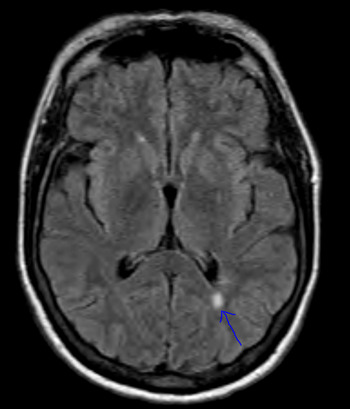
The above history suggested to us that her symptoms may be due to an underlying medical condition. Because of her history of multiple sclerosis, we ordered a brain MRI, which revealed a new plaque lateral to the corpus callosum (see Figure 1). We speculated that this finding on imaging might be responsible for her symptoms and started her on a trial of valproic acid while we embarked on a literature search and conferred with other physicians for treatments of emotional incontinence/pseudobulbar affect. We utilized valproic acid because of a previous success with symptoms of affect and impulse dysregulation in patients with traumatic brain injury. Our current patient responded quite robustly to valproic acid, with a complete resolution of her tearfulness within three days. In the meantime, the literature search showed that Nuedexta (dextromethorphan plus quinidine) is FDA approved for pseudobulbar affect. We discharged the patient home on a cross-taper from valproic acid to Nuedexta; however, she returned six days later with a full recurrence of her crying symptoms. We discontinued Nuedexta, restarted valproic acid, her symptoms again quickly resolved, and she was again discharged with a full resolution of her symptoms.
A 60-year-old woman with a history of multiple sclerosis presented with complaints of depression because she had been uncontrollably crying for several months. Axial FLAIR MRI shows a lesion consistent with a new plaque from multiple sclerosis 2 cm to the left of the corpus callosum. We speculate that this was the cause of her uncontrolled crying.

LITERATURE REVIEW
The first description of pseudobulbar affect is credited to Charles Darwin, who described the symptoms in his text, The Expression of the Emotions in Man and Animals (Darwin, Reference Darwin1872). The earliest comprehensive discussion we identified was by Kinnier Wilson in 1924, who described the syndrome, noting that it is a “sequel to and consequence of a recognizable cerebral lesion or lesions in which attacks of involuntary, irresistible laughing or crying or both, have come into the foreground of the clinical picture” (Wilson, Reference Wilson1924).
Pseudobulbar affect has been documented in patients with multiple sclerosis; however, we found only seven published studies that address or comment on the syndrome in multiple sclerosis, and most were published before 1970 (Feinstein et al., Reference Feinstein, Feinstein and Gray1997). In a study by Anthony Feinstein and colleagues, pseudobulbar affect was said to occur in 1 in 10 patients with multiple sclerosis; however, prevalence estimates have ranged from 6.5 to 95% (Cottrell & Wilson, Reference Cottrell and Wilson1926; Feinstein et al., Reference Feinstein, Feinstein and Gray1997). In our literature search, we could not find any convincing estimates of the incidence or prevalence of this condition.
Ross and Stewart proposed that in some patients a right-sided lesion combined with depression produces loss of cortical control of limbic-associated motor behaviors to produce pathological laughter or pathological crying (Ross & Stewart, Reference Ross and Stewart1987). Robinson speculated that dysfunction of the serotonergic pathways might destabilize input from the basotemporal limbic cortex to the amygdala and lateral limbic circuit, leading to brief outbursts of crying or laughing (Robinson, Reference Robinson1997). Kaufman attributed pseudobulbar affect to cortical damage resulting in loss of the ability to modulate impulses (Kaufman, Reference Kaufman2007).
As for effective treatments for pseudobulbar affect, our literature review found five placebo-controlled double-blind studies, one with amitriptyline in 12 subjects (Schiffer et al., Reference Schiffer, Herndon and Rudick1985) and two with citalopram in 12 and 16 subjects (Andersen et al., Reference Andersen, Vestergaard and Riis1993; Reference Andersen, Ingeman-Nielsen and Vestergaard1994), for a total of 40 patients in three studies investigating serotonergic agents. Nahas cited these studies to support the idea that serotonin (5-HT) plays a pivotal role in the etiology of this condition (Nahas et al., Reference Nahas, Arlinghaus and Kotrla1998). Case reports state that amitriptyline, citalopram, levodopa, nomifensine, methylphenidate, and amantadine have also been helpful (Udaka et al., Reference Udaka, Yamao and Nagata1984; Sandyk & Gillman, Reference Sandyk and Gillman1985; Schiffer et al., Reference Schiffer, Herndon and Rudick1985; Andersen et al., Reference Andersen, Vestergaard and Riis1993; Reference Andersen, Ingeman-Nielsen and Vestergaard1994; Derex et al., Reference Derex, Ostrowsky and Nighoghossian1997). More recently, dextromethorphan has been investigated for pseudobulbar affect and has become the first FDA-approved medication for the condition (Pioro et al., Reference Pioro, Brooks and Cummings2010).
DISCUSSION
Pseudobulbar affect is a disabling condition—emotionally, mentally, and physically. It is caused by multiple central nervous system conditions, has multiple proposed etiologies, and goes by multiple names in clinical practice. This case and the literature review suggest caution before basing treatment on a presumed biochemical model and illustrate the concepts of despair, demoralization, and suicidal ideation in the absence of major depression.
The case reported here provides important additional clinical information in that the patient was already taking an SSRI without appreciable benefit, and her symptoms responded to valproic acid, but not to the FDA-approved dextromethorphan plus quinidine.
This case and the literature review suggest that our current nomenclature for this constellation of symptoms is inadequate and can be misleading. The term “pseudobulbar affect” suggests cooccurring pseudobulbar palsy, which this patient, and many patients with pseudobulbar affect, did not have. The term “emotional incontinence” suggests a primary problem with emotions; however, there is general agreement that the symptoms are a problem with affect rather than emotion. (The DSM–IV glossary of terms defines “affect” as the observable behaviors or expression related to emotion, whereas emotion is a subjectively experienced underlying feeling state [APA, 1994].) The terms “pathological crying” and “pathological laughter” do not suggest a misleading etiology, but lack necessary breadth, as many patients with this syndrome have multiple inappropriate expressions of affect. More recently, involuntary emotional expression disorder (IEED) has been proposed as the label for this syndrome, which appears to be an improvement, though possibly bearing too many syllables to become the preferred term.
The case and literature review suggest that the symptoms labeled “pseudobulbar affect” can have multiple etiologies. It is more of a symptom or syndrome than a specific disease. Our patient's response to valproic acid rather than an SSRI or dextromethorphan supports the idea of a different neurobiological etiology than patients who responded to other medications. The imaging findings in this case support the idea that the patient's symptoms may have been caused by interference with cortical control of primitive affective impulses. Alternatively, the damaged tracts lateral to the corpus callosum may have directly stimulated the motor response of crying.
Finally, this case illustrates important distinctions among the concepts of depression, despair, distress, and demoralization. This patient presented with unrelieved distress and despair leading to suicidal ideation. However, she did not have the constellation of symptoms to meet diagnostic criteria for depression. Contemplating these distinctions provided the impetus to search for the cause of her symptoms and helped bring relief to her suffering.