Introduction
Peritonsillar abscess, commonly called a quinsy, is a collection of pus between the capsule of the palatine tonsil and the superior constrictor muscle. Its anterior and posterior boundaries are formed by the palatoglossus and palatopharyngeus, respectively. It is the most common deep neck space infection, with previous studies showing an estimated incidence of 37 out of 100 000.Reference Risberg, Engfeldt and Hugosson1 Peritonsillar abscess primarily affects young adults during the months of April to May and November to December, when exudative tonsillitis and streptococcal pharyngitis are at their peak.Reference Galioto2 Symptoms of this condition include sore throat and otalgia on the affected side, trismus, malaise, halitosis and fever.Reference Johnson and Kradin3 Clinical signs on examination include swelling and erythema of the soft palate on the affected side, with deviation of the uvula to the contralateral side, trismus and cervical lymphadenopathy. Management of a quinsy involves aspiration of the abscess and administration of antibiotics.Reference Chang, Thamboo, Burton, Diamond and Nunez4
Cultures of the aspirated pus commonly produce polymicrobial growth of Gram-positive and Gram-negative bacteria, including aerobes (e.g. Streptococcus pyogenes) and anaerobes (e.g. Fusobacterium spp.).Reference Klug5–Reference Ehlers Klug, Rusan, Fuursted and Ovesen7 As a result, many institutions prescribe antibiotics such as co-amoxiclav or metronidazole, in addition to the traditional narrower spectrum antibiotics like phenoxymethylpenicillin for fear of undertreating.Reference Ryan, Papanikolaou and Keogh8–Reference Scott-Brown and Gleeson12 The proposed rationale for prescribing these broader-spectrum antibiotics is primarily to prevent complications secondary to the Gram-negative anaerobe Fusobacterium necrophorum, such as Lemierre's syndrome.Reference Ehlers Klug, Rusan, Fuursted and Ovesen7,Reference Ramirez, Hild, Rudolph, Sty, Kehl and Havens13 First described in 1936, Lemierre's syndrome consists of a bacteraemia with thrombophlebitis of the internal jugular vein, which can also result in septic emboli,Reference Lemierre14 but little evidence exists to support the use of penicillin plus additional anaerobic cover in the management of peritonsillar abscess.Reference Wikstén, Pitkäranta and Blomgren15,Reference Kieff, Bhattacharyya, Siegel and Salman16 Furthermore, the prescription of penicillin plus additional anaerobic cover is not without potential complication. Agents with a broader spectrum of activity are known to have increased side effects, and their use increases the incidence and prevalence of antibiotic-resistant organisms.Reference Wiens, Snyder, Finlayson, Mahoney and Celi17,Reference Fair and Tor18
This systematic review aimed to assess penicillin (or allergy alternative) versus penicillin (or allergy alternative) plus anaerobic cover in the management of peritonsillar abscess.
Material and methods
Data sources and literature search
A systematic review was performed in accordance with the Preferred Reporting Items for Systematic reviews and Meta-Analyses (‘PRISMA’) 2020 statement.Reference Page, McKenzie, Bossuyt, Boutron, Hoffmann and Mulrow19 The search was conducted in Ovid Medline, Ovid Embase, PubMed, Web of Science, Cochrane library and ClinicalTrials.gov databases, including papers published from inception until before 26 March 2021. The following search terms and strategy was used: (Peritonsillar Abscess OR Quinsy) AND (Penicillin OR Penicillin V OR Phenoxymethylpenicillin OR Clarithromycin OR Clindamycin OR Erythromycin OR Azithromycin OR Monotherapy OR Dual therapy OR Amoxicillin-Potassium Clavulanate Combination OR Co-amoxiclav OR Augmentin OR Metronidazole OR Anti-Bacterial Agents OR Antibiotics OR Anti-Infective Agents OR Antimicrobial OR Anaerobic Bacteria OR Anaerobic OR Macrolide). The titles and abstracts from the initial search results were screened independently by two authors (KP and CMM).
Study selection
The inclusion criteria were: (1) studies that evaluate the role of penicillin alone (or equivalent penicillin allergic) versus penicillin plus additional anaerobic cover in the management of peritonsillar abscess; (2) randomised, controlled trials (RCTs); and (3) papers published in English language only. Studies that did not compare penicillin alone (or equivalent penicillin allergic) versus penicillin plus additional anaerobic cover were excluded. Duplicate studies, reviews, comments, animal studies, letters to the editor and studies demonstrating a high risk of bias on analysis were also excluded. Data extraction was performed by two authors (KP and CMM) independently.
Type of participants
Adults or children with a clinical diagnosis of peritonsillar abscess.
Type of interventions
Any RCT that involved the administration of antibiotics, specifically where one group was prescribed penicillin (or allergy alternative) and the other group was prescribed penicillin (or allergy alternative) plus additional anaerobic cover.
Outcomes
Measured outcomes were rate of recurrence and resolution of clinical symptoms.
Data extraction and analysis
After the generation of the list of studies meeting the inclusion criteria, two authors (KP and CMM) each performed an in-depth review of studies and extracted all relevant data for comparison (see figure 1).
The Preferred Reporting Items for Systematic Reviews and Meta-Analyses (‘PRISMA’) process.

Results
Search results
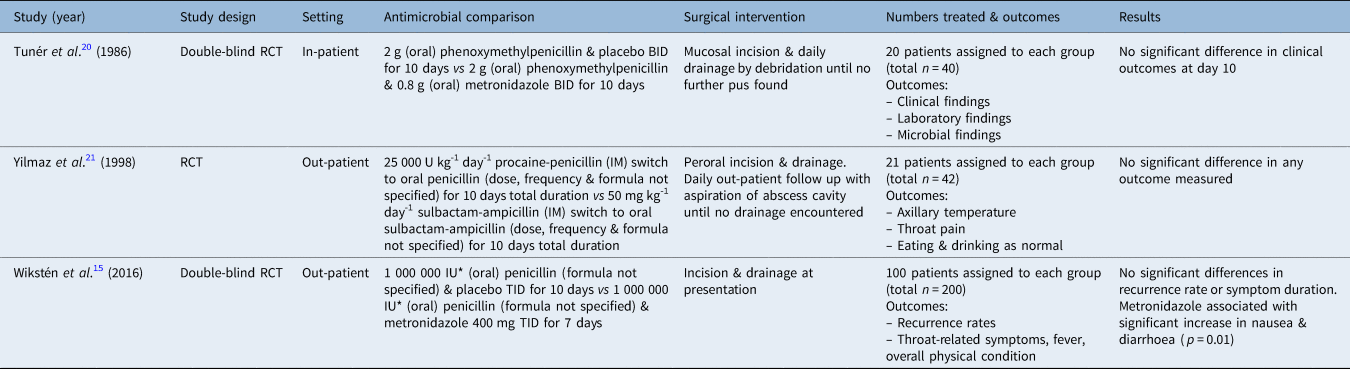
Three studies were included in the review as set by the inclusion criteria; these are summarised in Table 1. The Preferred Reporting Items for Systematic Reviews and Meta-Analyses flow diagram is shown in Figure 1. All studies included were randomised, controlled trials (RCTs). Whilst two RCTs compared penicillin alone to penicillin plus metronidazole, the third looked at penicillin in comparison with a broader-spectrum penicillin (ampicillin) combined with a beta-lactamase inhibitor (sulbactam). All studies assessed the clinical outcomes of these treatments on peritonsillar abscess, including recurrence rate, symptom improvement and the duration of pyrexia. The outcomes were grouped and assessed across the evidence. Table 2 shows the full findings of each study.
Summary of included studies

RCT = randomised, controlled trial
Description of studies analysed

*Note: 1 000 000 IU = 625 mg phenoxymethylpenicillin. RCT = randomised, controlled trial; BID = twice a day; IM = intramuscular; TID = three times a day
Outcomes assessed
Recurrence
Wikstén et al. conducted a double-blind, adequately powered RCT involving 200 patients.Reference Wikstén, Pitkäranta and Blomgren15 The primary outcome measured was recurrence within 56 days of follow up; the authors found no significant difference in the recurrence rates between the two groups (penicillin and placebo vs penicillin and metronidazole). Furthermore, no significant difference was found in the time to recurrence or the baseline characteristics of these patients, including age, gender, smoking status or prior antibiotic use.
Similar findings were identified by Tunér et al., in which all patients in both the penicillin and placebo group, and the penicillin and metronidazole group, were deemed fully recovered after 10 days of treatment.Reference Tunér and Nord20 Every patient was treated with needle aspiration or incision and drainage daily for the 10 days or until no pus was drained. The main conclusion drawn was that daily incision and debridement along with antibiotics is the treatment of choice.
Symptoms
Wikstén et al. assessed symptom duration with patient questionnaires.Reference Wikstén, Pitkäranta and Blomgren15 The number of patients followed up with questionnaires fell well below that required for statistical power, but intention-to-treat analysis was used. The mean duration of throat-related symptoms (difficult mouth opening, sore throat, painful swallowing) was 5.3 days in the penicillin and metronidazole group and 5.6 days in the penicillin and placebo group; this finding was not statistically significant. The patients also reported on their general physical condition and presence of pyrexia, and these findings were not statistically different between the two groups.
Yilmaz et al. conducted a double-blind RCT comparing a 10-day course of procaine-penicillin alone versus sulbactam-ampicillin.Reference Yilmaz, Unal, Figen, Akyol and Ayas21 There were 42 patients in total, randomly assigned, but the co-morbidities or initial clinical symptoms on presentation were not described. Both treatments were given intramuscularly on an out-patient basis. The main resistance mechanism of some anaerobic bacteria to beta-lactams is beta-lactamase production; therefore, the addition of a beta-lactamase inhibitor, sulbactam, to the ampicillin group in this instance broadens the spectrum of antibiotic activity.Reference Wexler, Molitoris and Finegold22 The duration of throat pain and the time to resumption of normal eating in both groups, as measured by patient reports of symptoms, was not significantly different. Axillary temperature also did not differ significantly between the groups. Tunér et al. broadly described the clinical outcomes of penicillin and placebo versus penicillin and metronidazole as very similar between groups.Reference Tunér and Nord20
Wikstén et al. also asked patients to report on symptoms associated with adverse antibiotic effects.Reference Wikstén, Pitkäranta and Blomgren15 Their study found a significant increase in the association of nausea and diarrhoea with the penicillin and metronidazole group compared with the penicillin and placebo group, advocating the use of penicillin alone for the desired clinical outcome with minimal treatment harm. Although many of the other papers included discussion of the harms of unnecessary additional treatment, Wikstén et al. was the only group to formally assess the increased risk of side effects.
Risk of bias
Risk of bias was assessed for each study included in this systematic review. For randomised trials, the revised Cochrane risk-of-bias tool for randomised trials (‘RoB2’) was used, as seen in Table 3.Reference Sterne, Savović, Page, Elbers, Blencowe and Boutron23,24
Risk of bias in randomised trials

Discussion
In the review of the literature to date, no significant clinical harm has been reported using oral formulations of phenoxymethylpenicillin alone as part of peritonsillar abscess incision and drainage interventions in the treatment of peritonsillar abscess. Specifically, the studies focused on the clinical outcomes rather than the microbiology findings. We have not focused on the polymicrobial nature of pus samples from quinsy and antibiotic administration. This is because, ultimately, resolution of symptoms and clinical cure are the priorities in these patients.
All studies advocated the use of either needle aspiration or incision and drainage as the source control measure in addition to the appropriate administration of antibiotics, and this is a well-documented treatment in the literature.Reference Mehanna, Al-Bahnasawi and White25 It is the general consensus that antibiotics alone are not appropriate for the treatment of peritonsillar abscess, and the literature has shown no difference in effectiveness between needle aspiration and incision.Reference Chang, Thamboo, Burton, Diamond and Nunez4 What differed between the studies reviewed was the use of aspiration or incision and drainage. Tunér et al. performed daily aspiration or incision and drainage for up to 10 days or until no more pus was drained.Reference Tunér and Nord20 At the end of the 10 days, patients in both groups were deemed completely treated, and no recurrence was demonstrated. In contrast, Wikstén et al. performed needle aspiration on day 1 and then monitored for signs of recurrence within a 56-day window.Reference Wikstén, Pitkäranta and Blomgren15 One could argue that daily drainage eliminates the risk of any potential recurrence from subtherapeutic antibiotic therapy and therefore it is hard to assess accurately the effect of the antibiotic.
This systematic review is a useful addition to the literature in the context of rationalising antimicrobial choice that provides effective clinical cure, without unnecessarily broadening the antimicrobial spectrum of activity. In the context of increasing the burden of antimicrobial resistance,Reference Smith26 the current evidence (such as it is) suggests that the addition of a second agent specifically targeting anaerobes (metronidazole) and other pathogens (sulbactam-ampicillin) does not provide additional clinical benefit. Further optimisation of therapy to improve clinical efficacy and lessen the impact on resident flora from single-agent oral phenoxymethylpenicillin may be considered in the context of optimising dose, frequency and duration. Furthermore, all three studies used a 10-day treatment duration for which evidence is lacking. In line with other specialties reviewing the use of shorter duration of antimicrobials whilst maintaining clinical efficacy, it would be appropriate to consider shorter courses in the light of improvements in clinical signs and symptoms, and effective surgical drainage.
Antimicrobial resistance is a global challenge. The World Health Organization has endorsed a global action plan on antimicrobial resistance, and studies have predicted that by 2050 antimicrobial resistance will result in 10 million deaths.27 To this end, antibiotic stewardship is a key policy within the National Health Service. In the context of the systematic review findings, ENT surgeons treating patients with peritonsillar abscess must ensure prudent use of the correct antibiotic and not prescribe an unnecessary second agent.
Strengths, limitations and potential bias of evidence
This systematic review, to the best of our knowledge, is the first of its kind to collate the evidence surrounding penicillin versus metronidazole (or broad-spectrum penicillin) for the treatment of peritonsillar abscess, looking specifically at clinical response. Despite the high frequency of presentations with peritonsillar abscess, the optimum antibiotic(s) treatment of choice is still unclear and no consensus has been reached. Given this uncertainty, it is unsurprising that only three studies have been found which assess the clinical effectiveness of penicillin against a combination with metronidazole (or broad-spectrum counterparts), and therefore the main limitation of this review is the small amount of evidence available to present. The potential for concerns over bias in these studies has been identified from the screening tools. Of the three randomised controlled trials (RCTs), all were judged to have some risk of bias. The differing penicillin agents used, route, dose and frequency also limit direct extrapolation to clinical practice. Similar for metronidazole with dosages varying between 400 mg three times a day for 7 days and 800 mg twice a day for 10 days. These schedules will not be applicable to many current practices and understandings of the pharmacokinetics and pharmacodynamics of oral phenoxymethylpenicillin and metronidazole.
Implications for future clinical practice and research
The reviewed evidence suggests that, in the presence of effective drainage of the peritonsillar abscess, single-agent oral phenoxymethylpenicillin is not associated with adverse clinical outcomes. There is no evidence to suggest a benefit of metronidazole administration in the management of quinsy. As such, clinicians should avoid prescribing additional metronidazole in this clinical setting. Some studies have suggested the addition of metronidazole if there is no clinical improvement after 24 hours.Reference Hardingham28 Only three studies were included in this systematic review. We would welcome a well-powered, high-quality RCT to establish the optimum dose and duration schedule of oral phenoxymethylpenicillin, to better inform clinical practice. This would ensure that ENT surgeons are contributing to high-quality research in the global fight against antimicrobial resistance. With the increasing burden of antimicrobial resistance, it would also be prudent to undertake routine microbiological surveillance for susceptibility to penicillin in bacteria isolated from peritonsillar infections. The surveillance data generated would be invaluable in informing rational empiric antimicrobial choices.
Conclusion
Peritonsillar abscess is an extremely common ENT condition, and, as such, appropriate safe and effective management is critical. Current evidence suggests no clinical benefit for the routine administration of additional anaerobic cover (metronidazole) to oral phenoxymethylpenicillin as part of the treatment of peritonsillar abscess. The use of single-agent oral phenoxymethylpenicillin is effective and avoids the use of additional anaerobic cover. Further trials to establish optimum dose and duration schedules of oral phenoxymethylpenicillin would be the next step better to inform clinical practice.
Acknowledgements
The academic activities of C M Douglas are financially supported by a Chief Scientist Office NHS Research Scotland Fellowship and a Medical Research Council Clinical Academic Research Partnership award.
Data availability statement
The data analysed in this study were a re-analysis of existing data which are openly available as per citations in the reference section.
Competing interests
None declared.