Venous thrombosis and pulmonary embolism can induce pulmonary artery stenosis and occlusion in the post-operative period. There is no report on transcatheter intervention involving children in this setting.
We report a case of transcatheter recanalisation of an occluded left pulmonary artery due to an embolic thrombus in a 9-month-old infant after surgical repair of a common atrioventricular canal with tetralogy of Fallot.
Case report
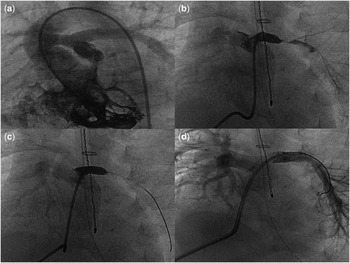
A 4-month-old boy prenatally diagnosed with complete common atrioventricular canal and tetralogy of Fallot was referred for surgical repair. Pre-operative diagnostic catheterisation was performed to assess coronary artery anatomy as this was not reliably assessed by echocardiography and computed tomodensitometry. The pulmonary angiogram revealed well-developed pulmonary artery branches (Fig 1a) and a persistent left superior caval vein connected with the right superior caval vein through an innominate vein. The patient underwent surgical repair with a transannular patch and common atrioventricular canal repair with the single-patch technique. The left atrioventricular valve cleft was not closed. There was no surgical intervention on the branch pulmonary arteries. The early post-operative course was complicated by the presence of low cardiac output syndrome, necessitating inotropic support. Echocardiography revealed severe left atrioventricular valve regurgitation, although intraoperative transoesophageal echocardiography performed after cardiopulmonary bypass showed mild left atrioventricular valve regurgitation. The child was reoperated with closure of the cleft. Post-operatively, he remained in moderate cardiac failure. A thrombosis of the left and right superior caval vein was diagnosed. The coagulation profile was normal. He further suffered from enterocolitis, necessitating emergency surgery with resection anastomosis at the level of the jejunum on post-operative day 17. He was weaned from the ventilator but remained in right cardiac failure. Echocardiography revealed moderate right atrioventricular valve regurgitation with a dilated and hypertrophied right ventricle. The systolic right ventricular pressure was estimated by continuous Doppler to be 50 mmHg. A month after the operation, a computed tomodensitometry demonstrated left pulmonary artery and inferior caval vein occlusion. Left lung perfusion by the lung scan was shown to be 1%. The infant weighing 6 kg was taken to the catheterisation laboratory after written informed consent from the parents. Under general anaesthesia, echo-guided puncture of a superior hepatic vein was performed using a 20-gauge needle with a stylet (Cook, Bloomington, Indiana, United States of America). Under fluoroscopic guidance, a 0.018-inch floppy wire (Terumo Inc., Tokyo, Japan) was introduced through the needle. The needle was removed and a 5 Fr sheath was advanced over the wire to the level of the right atrium. Heparin (100 U/kg) was administered. The right ventricular systolic pressure was 45 mmHg; the cuff systolic blood pressure was 95 mmHg. Pulmonary artery angiography revealed near occlusion of the proximal left pulmonary artery (Fig 1b). Multiple balloon dilations were performed from the distal to the proximal left pulmonary artery with a 4 × 20 mm coronary balloon (ART™ balloon, AMG, Raesfeld-Erle, Germany) advanced over a 0.014 wire. However, a subsequent left pulmonary artery angiogram revealed a complete luminal occlusion (Fig 1c). A 2.5 × 15 mm cutting balloon (Interventional Technologies Inc., San Diego, California, United States of America) was then advanced over a 0.014 BMW wire (Guidant Corporation, Santa Clara, California, United States of America). It was inflated multiple times in the distal and proximal left pulmonary arteries. A subsequent angiogram revealed recanalisation, however, with persistent moderate stenosis in the proximal left pulmonary artery. This was successfully treated with a Palmaz Genesis PG184P stent (Cordis Europa, Roden, The Netherlands) implanted through a 6-Fr long sheath (Cook Medical Inc., Bloomington, Indiana, United States of America). Angiography (Fig 1d) revealed full recanalisation, except in the left superior lobar pulmonary artery, which remained occluded. The right ventricular systolic pressure decreased to 36 mmHg; the cuff systolic blood pressure was 100 mmHg. The transhepatic sheath was removed without coil interposition within the puncture site. The post-catheterisation course was uncomplicated. Coumadin was administered for anticoagulation. The post-catheterisation lung scan demonstrated a 36% perfusion of the left lung. The patient improved clinically and was discharged home 3 weeks later. Left pulmonary artery angioplasty was necessary after 8 months for intra-stent restenosis. As the inferior caval vein became patent after anticoagulation therapy, right femoral vein access was used. Another Palmaz Genesis stent PG184P was successfully implanted over an 8 × 20 mm Z-Med balloon, proximal to the previous stent.
A pre-operative pulmonary angiogram showing a well-developed left PA ( a ) a post-operative main PA angiogram revealing near occlusion of the left PA ( b ); after high-pressure balloon dilation of the left PA, an angiogram showing complete occlusion ( c ). After cutting balloon angioplasty and stent implantation, a left PA angiogram showing complete recanalisation, except in the left upper lobe branch ( d ). PA = pulmonary artery.

Discussion
We report the management of a thrombotic occlusion of pulmonary artery 1 month after surgical repair with cutting balloon angioplasty through a transhepatic approach in an infant weighing 6 kg.
Branch pulmonary artery stenoses resistant to high-pressure balloons have effectively been treated with the cutting balloon technique. The cutting balloon technique involves an incision in the arterial intima and media when the balloon is inflated exposing the microblades.Reference Bergersen, Perry and Lock 1 These incisions allow propagation of intimal tears during angioplasty.Reference Butera, Carminati and Pome 2 The superiority of the cutting balloon technique over standard balloon angioplasty has been well demonstrated, particularly in severe stenosis.Reference Suda, Matsumura, Hayashi and Nishimura 3 In our case, no left pulmonary artery stenosis was detected pre-operatively (Fig 1a). No surgical manipulation of the left pulmonary artery was performed. The left pulmonary artery branch occlusion was due to thrombotic occlusion by a massive pulmonary embolus. We speculate that cutting balloon angioplasty helped incise the organised thrombus and facilitated dissolution of the thrombus in the peripheral pulmonary artery bed. This is confirmed by the dramatic improvement in the left pulmonary artery angiogram (Fig 1d) as well as the improvement in left lung perfusion on the lung scan. Our case describes a new and novel application of the cutting balloon technique. The Palmaz Genesis stent PG184P used in this study can be redilated to a maximum of 11–12 mm diameter.Reference Forbes, Rodriguez-Cruz and Amin 4 , Reference Tomita, Nakanishi, Hamaoka, Kobayashi and Ono 5 Thus, the child has the scope of a normal proximal left pulmonary artery diameter in adulthood (Z-score −1 in 70 kg adult).Reference Sluysmans and Colan 6
Although transcatheter mechanical fragmentation of the thrombi using catheters or aspiration thrombectomy through large sheaths may be successful in the adult population,Reference Fava, Loyola, Flores and Huete 7 such a therapy is only applicable to new thrombi in the first 24–48 hours. In the present case, caval vein thrombosis and pulmonary embolism occurred in the early post-operative period and the thrombus was expected to have existed for 3–4 weeks at the least. We did not consider thrombolytic pharmacotherapy in the present case. There are no clear guidelines on thrombolytic therapy for pulmonary embolism in children. In a recent study, the response to thrombolysis was shown to be poor with only one out of eight patients achieving complete resolution of the thrombus and almost a half failing to respond. In addition, major bleeding occurred in 50% of the cases.Reference Biss, Brandão, Kahr, Chan and Williams 8
Percutaneous transhepatic cardiac catheterisation was used in the present case because of extensive thrombosis of the systemic veins. A number of studies have reported favourable experiences with a variable degree of success and applicability.Reference Shim, Lloyd, Cho, Moorehead and Beekman 9 , Reference Shim, Lloyd and Beekman 10 Transhepatic vein puncture is often performed without ultrasound guidance. We prefer using this technique because it reduces radiation exposure. Moreover, occlusion of the hepatic vein with a coil is recommended at the end of the procedure to avoid intraperitoneal or retroperitoneal haemorrhageReference Shim, Lloyd, Cho, Moorehead and Beekman 9 ; however, we did not perform this in our case. Further, we report that manual compression is successful in establishing haemostasis after sheath withdrawal.
Conclusion
To our knowledge, this is the first reported case of successful transcatheter therapy to relieve thrombotic branch pulmonary artery occlusion in an infant using cutting balloon angioplasty. It is a novel application of the cutting balloon technique not described to date. This technique might be useful when anticoagulation or thrombolysis therapy fails. In this study, we achieved successful transhepatic access in an infant weighing 6 kg.