While officials in China claim that voting rates in rural village committee elections are high, sample survey work by economists has cast doubts on the official figures. According to the White Paper on “Democracy Construction in China,” on average more than 80 per cent of adults of voting age in China voted in the latest round of village committee elections; in some regions the voting rates exceeded 90 per cent.Footnote 1 However, based on a nationally representative data set and statistically rigorous analytic methods, it can be shown that voting rates are in fact much lower than reported.Footnote 2 Moreover, when rigorous definitions are applied to what constitutes actual voting (or, henceforth, actual/reported voting, since in this paper, as in Pang and Rozelle, we rely on self-reporting), the real voting rate drops even further. If “voting” is only counted when each individual marks his or her own ballot (or is consulted about his or her vote if someone else marks the ballot) and physically places it in the ballot box, then the actual/reported voting rate is lower, at only 74 per cent.Footnote 3
Moreover, this lower voting rate is not owing to random gaps in the voting procedures; there is a systematic set of gaps. Some of the largest gaps occur in the cases of women and migrants. Large shares of individuals in these groups are being systematically excluded from truly participating in the process of voting. Evidence suggests that only 60 per cent of women fully exercise their voting rights, and that this rate is even lower for young women and migrant women.Footnote 4 In contrast, nearly 90 per cent of men voted. In other words, there is nearly a 30 percentage point difference between the voting rates of men and women in rural China.
This raises two fundamental questions: why do rural women vote less than men in village elections? Why are women less involved in the civic life of their villages? There are many possible reasons, most of which are founded on basic differences in women versus men. Education levels among rural women are low, and illiteracy rates among women are higher than among men.Footnote 5 Women often do not have their own sources of income and, as a result, may be pressured to vote in a way dictated by their husbands.Footnote 6 Traditional cultural norms are not always supportive of encouraging women to participate in the public affairs of rural communities.Footnote 7
There is an additional factor that may affect the true participation (actual/reported voting rate) of rural women in village elections: their knowledge about their rights to vote. According to Xiang, women often do not realize that the right to participate in village elections is granted by Chinese law.Footnote 8 Many women also lack an understanding of their rights in society and the importance of exercising these rights. Internationally, it has been shown that women in the United States living during or just after the era when women could not vote were less likely to engage in the electoral process between 1952 and 1988.Footnote 9 Organizations, personal discussions and the media differentially impact the voting choices of both genders by shaping the political information they receive.Footnote 10 Do women in China know what their rights are? If they were educated about their rights, would they vote more?
Alternatively, it could be that the problem lies in the understanding of those who run elections: the current leadership of the village (including those, like the Party secretary, who are not running for re-election). How do leaders perceive the way women have been exercising their right to vote? Do village leaders know that women are supposed to be casting their own ballots? Would they be more inclined to consider issues that are of concern to women (such as drinking water, location and quality of schools, and access to child health care) if they knew more women voted? Chattopadhyay and Duflo have shown that when women increase their participation in local governance, the priorities of local leaders change.Footnote 11 Beyond studies like those of Chattopadhyay and DuFlo, there are few, if any, studies that examine how well leaders understand election laws, the importance of participation in the exercise of civil/legal rights, and the ways in which elections are run.
There is one notable exception in China. Gao describes the attempts of her organization, the Shaanxi Research Association for Women and Family, in conjunction with the All-China Women's Federation, to increase the political participation of women.Footnote 12 Although emphasizing a different type of political participation,Footnote 13 Gao's work in Shaanxi sought to increase the participation of women by training women in their rights and presumably trying to convince leaders at village, town, and county levels that there is a benefit to having women more involved in electoral politics at the village level. Thus, while the approach of our study differs from Gao's (we use a social experimentation approach and she uses demonstration villages), and the exact targets of the two programmes are different (ours is seeking to raise the voting rates of women and Gao's is seeking to increase the participation of women in elections and the political process through office-holding), the two studies have many parallels.
The overall goal of this paper is to understand if the knowledge of women and/or local leaders about women's voting rights affects women's voting behaviour. Would more women vote if the various stakeholders (that is, women and local leaders) in village elections were more aware of the problem and of the fundamental right of women to vote? In this paper, we report on the results of a randomized controlled trial (RCT) specifically designed and run by the authors to answer this question.
To meet this goal, we pursue two specific objectives. First, we measure the rate at which women in China's villages report that they are actually exercising their voting rights. Secondly, we seek to understand the reasons why women vote at the rates that they do. In particular, we will try to answer two questions: 1) if women are trained in their voting rights and responsibilities, will their knowledge of their rights improve and will they exercise those rights more fully? and 2) if local leaders are trained in the rights of women to vote, will women in their village exercise their rights to vote more fully?
The RCT involved 700 women from 70 randomly chosen villages in 18 townships across six counties in China's Fujian and Liaoning provinces. The three interventions in the RCT were focused on training sessions designed to improve the knowledge of women and village leaders about women's rights to vote. To our knowledge, this is the first time that social scientists have conducted social experiments in the area of community governance in China. We also supplement this quantitative research with a rich set of qualitative interviews. In this way, we also follow the lead of Gao in using mixed methods, both large-scale surveys and detailed interviews.Footnote 14
The paper is organized as follows. The next section describes the sample, the interventions, the data collection efforts (including a description of our main outcome measures), and our methodological approach. We then describe the results, first looking at the descriptive results, and then turning to the results from the multivariate analysis. The final substantive sections step back and re-examine the quantitative results using the findings of detailed interviews conducted by the authors. The last section of the paper concludes.
Sampling, Data and Methods
Sampling, the process of randomization, and masking
We conducted an RCT on the effect of training for women and village leaders on women's voting rights in rural China in 2009 and 2010. A total of 700 women and more than 200 village leaders from 70 villages in Fujian and Liaoning provinces participated in our study.
Rural village committee elections are typically held every three years, although election years vary owing to different provinces' electoral schedules. Nationwide, there were four provinces in which the timing of the elections allowed us to conduct our intervention in 2009 and our evaluation survey in 2010. In choosing our sample, we randomly chose two provinces, Fujian and Liaoning, from these four qualified provinces. Fujian is located in southern China and held village elections between August and September 2009, while Liaoning is located in northern China and held village elections between April and May 2010. Next, we randomly chose three counties per province: one from the richest tercile of counties, one from the middle tercile, and one from the poorest.
After choosing the sample counties, we then chose the sample towns and villages. To do so, we randomly chose three towns from each county, and four villages from each town. All towns in each county (and all villages in each town) were included in the sampling frame. Using the official household list, we randomly selected ten households from each village, and randomly chose one woman from each household who was over 22 years old and who had permanent rural residency status.Footnote 15
At the time of our baseline survey, our sample included a total of 72 villages and 720 women, but there was some attrition by the end of the study. Elections were not held to schedule in two of the sample villages (by design the elections were supposed to be held after the baseline but before the evaluation survey), and so our final sample only included 70 villages. A total of 46 women were lost to follow-up between the baseline and evaluation surveys, mostly because of off-farm jobs that took them away from the village. A smaller number of respondents were away visiting relatives and were not able to return for the evaluation survey. A total of 654 women participated in the evaluation survey. Total attrition from the baseline survey to the follow-up survey was 6.6 per cent. The rate of attrition of women respondents and the characteristics of the women were balanced across the control group and experimental arms.
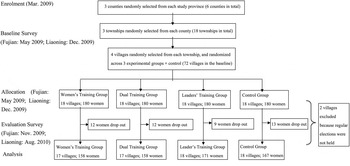
The first step of our study was to conduct a baseline survey to collect household data from the women respondents in the sample. Following the baseline survey, our research team randomly assigned study villages to a control arm or one of three experimental arms (described below). Initially, there were 18 villages assigned to each experimental arm (two provinces × three counties × three towns × one village = 18). Owing to the two villages which dropped out of the study, in the end there were 18 villages in the Control Group, 17 villages in the Women's Training Group, 17 villages in the Dual Training Group, and 18 villages in the Leaders' Training Group. Figure 1 depicts the flow of participants through each phase of the study, as well as the project timeline.
Trial Profile

Our data show that the study villages were largely balanced on observable characteristics at the time of our baseline survey (age; years of education; years married; Party membership; off-farm employment; and baseline score on voting knowledge). Only in the case of ethnic status was there any difference. The percentage of women who reported being Han in the Women's Training Group was slightly lower than in the Control Group (87.1 per cent versus 93.3 per cent). This slight difference is controlled for in our multivariate analysis.
Experiment arms/interventions
In addition to the Control Group which received no intervention, our experiment included three intervention arms:
Women's Training Group
This intervention provided training about voting to women only. There were two trainers from Renmin University, each one of whom was responsible for half of the training courses. Both of the trainers were trained by the project's principal investigators. Most of the training was focused on presenting the training material in a clear and consistent manner so that, to as great a degree as possible, the presentations of the two trainers were identical.
While we were in the village, we also followed a standardized protocol. Shortly after completing the baseline survey (during which time no one had any idea that there would be a training session), the trainer gathered together the women in the Women's Training Group villages in a meeting room or in the home of one of the women. All ten women were trained together. Every woman involved in the training received a letter, written in simple language, introducing the main purpose of the training. Village and township leaders were not allowed in or near the training room, so they were unable to see or hear any part of the training.
The contents of the training included: a) an overview of women's voting behaviour in rural China and the importance of women's votes; b) the basic rights of women and their voting responsibilities; c) a description of the mechanics of correct voting behaviour; and d) encouragement to mark and cast their ballots themselves. The material included in the presentation to the women and village leaders all came from three sources: official policy and legal documents (e.g. women's right to vote according to national law); published academic literature (e.g. how the votes and participation of women in local governance affected outcomes in India; how many women fully exercised their voting rights in China in the past); and instructional material from the Ministry of Civil Affairs. Great care was taken to rewrite the material in such a way that rural women with low levels of literacy could understand the concepts being communicated. At the end of the training session, each woman was given a 2009–2010 wall calendar which summarized the key points of the training programme.
Leaders' Training Group
In the villages participating in the experimental arm, we provided more or less the same training to village leaders as was given to the women in the Women's Training Group, but we did not give any intervention to the women themselves. In carrying out the intervention in the Leaders' Training Group, three of the main leaders in the village were selected to participate in the training: the secretary of the village Party committee (cunshuji 村书记), the village chairman (cunzhuren 村主任), and either the women's director (funü zhuren 妇女主任) or the village accountant (kuaiji 会计). We trained the village leaders in the village meeting room. After the training began, we shut the door and did not allow anybody else to enter the room.
The training material presented to the village leaders was similar to that given to the women, except the focus was on how to enhance effectively the ability of women to participate in village elections (including fully exercising their voting rights) in all stages of the election process, from the campaign through to the actual casting of ballots. Suggestions were also given to the village leaders of ways to encourage women to exercise their voting rights more fully, including the use of various types of media, the mobilization and encouragement of women, and paying extra attention to women who have voting difficulties. The village leader training material all came from official policy and legal documents, published academic literature, and instructional material from the Ministry of Civil Affairs. The trainers also gave village leaders a wall calendar.
Dual Training Group
In this set of villages, our team trained both women and village leaders. The protocols, materials, and approach for training the women were identical to those used in the Women's Training Group. The protocols, materials and approach for training the village leaders were identical to those used in the Leaders' Training Group.
Control Group
No training was given to either women or leaders in the control villages. The control villages were visited the same number of times as the treatment villages.
Data collection
Women's survey
We collected two rounds of data: a baseline survey and an evaluation survey. The same women who completed the baseline survey also completed the evaluation survey. We conducted the baseline survey before the training/village election, and conducted the evaluation survey afterwards. The survey was given to ten randomly chosen women in each village but to no men.
The women's baseline survey included two blocks: the first was designed to collect information about household socio-economic characteristics and basic individual characteristics; and the second collected information about the women's voting experiences during the most recent election. Each woman was asked about: a) whether she participated in the last election, marked the ballot by herself, and/or cast the ballot by herself; b) whether she designated anyone else to mark and cast her ballot; and c) her understanding of the village election. The last part of the second block of the household survey was an 18-question test on voting knowledge, based on the contents of the training course. Enumerators filled out the questionnaires for the women.
During the evaluation survey, enumerators helped the women fill out a questionnaire that was almost identical to that filled out during the baseline survey. In particular, the knowledge test was given again as a way to evaluate what the women had learned from the training programme. Once the survey forms were filled out and filed, qualitative interviews were carried out.
Village leaders' survey
In addition to the women's survey, we also conducted a multiple block survey to collect information about the village and its leaders. During the baseline survey, the chief accountant of the village provided information on the socio-economic status of the village. Information such as the village's population, land area, and infrastructure was also obtained.
The village leaders were interviewed by enumerators during the baseline and evaluation surveys using a three-part questionnaire. The first section of the survey collected basic characteristics of the village leaders, including their age, gender and Party membership. The second section covered village policies related to women during elections. The third and final section was a test of the leaders' knowledge, an exam that was nearly identical to the one administered to women respondents in the Women's Training Group and Dual Training Group, but which contained different questions and emphasized different aspects of the training. If a leader had been replaced by the time of the evaluation survey, we tried to interview both men.
Statistical analysis
To improve estimation efficiency and control for any observable differences which existed between the treatment and control villages during the baseline survey, we ran a series of multivariate double difference models in order to estimate the net effect of the treatments on changes in voting behaviour and test scores before and after the interventions. Several models were used to check the robustness of the findings. In addition to including dummy variables of the treatment arm to which each individual belonged, we also: a) controlled for the individual and household characteristics of the women;Footnote 16 b) used a series of variables to control for the nature of each village in the sample;Footnote 17 and c) used a dummy variable for either the province or township in which the experiments were conducted. The full model is the one that controls for as many factors as possible, including the treatments (the experiment effects), the characteristics of the women-respondents and their families, the characteristics of the village, and a township dummy. We used voting behaviour and scores on our test of voting knowledge as the primary outcome variables.
Quantitative Results
This section describes two distinct findings of our quantitative analysis. First, we analyse the impact of our interventions on the voting knowledge of women (and leaders) in the three experimental arms and control group. Next, we analyse the effect of our interventions on women's voting behaviour. We follow this by interpreting and discussing our findings.
Impact of the experiments on women's knowledge
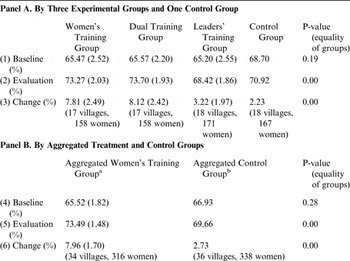
Our descriptive statistics show that when the training programmes included women, women increased their knowledge about their right to vote and the mechanics involved in exercising that right (Table 1). At the baseline, there was no significant difference in average test scores across the intervention and control groups (Panel A, row 1). Women in each of the groups, on average, answered between 65.2 and 68.7 per cent of the questions correctly. At the time of the follow-up testing, however, the percentage of correct answers differs significantly among the groups (Panel A, row 2). The percentages range from a low of 68.4 (among women in the Leaders' Training Group) to 73.7 (among women in the Dual Training Group). The low P-values (0.00 for both indicators) suggest that both the evaluation test scores and the change in test scores from baseline to evaluation differ significantly across the groups (Panel A, rows 2 and 3). The descriptive statistics show that women who received training (in both the Women's Training Group and Dual Training Group) scored over 5 percentage points higher than women who did not receive training (in both the Control Group and the Leaders' Training Group), and that these differences are statistically significant. When we aggregate all women who received training (Aggregated Women's Training Group) and compare their test scores to the test scores of women who did not receive training (Aggregated Control Group), the increase in test scores is statistically larger (8.0 versus 2.7) when women received training (Panel B, row 6).
Women's Voting Knowledge Test Scores and Change from Baseline to Evaluation

Source: Authors' survey.
Note: Per cent correct out of 18 questions. Robust standard errors clustered at the village level are in parentheses; a Aggregated Women's Training Group includes observations from both the Women's Training Group and the Dual Training Group; b Aggregated Control Group includes observations from both the Leaders' Training Group and the Control Group.
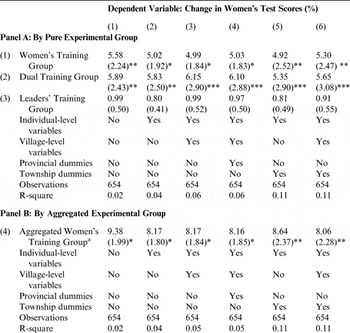
The results of the multivariate analysis are consistent with the descriptive results, showing that the impact on test scores of the experimental interventions that included women's training is positive and significant. These results hold in all models (Table 2). The results of the most basic model in column 1 of Table 2 provide point estimates of the changes in test scores that are identical to those found in the descriptive results (Table 1, row 3, Treatment Group minus the Control Group). The coefficients on the Women's Training Group and the Dual Training Group are also both positive and statistically different from the Control Group. When women received training as part of the intervention in either the Women's Training Group or the Dual Training Group, their test scores increased by 5.6 to 5.9 percentage points. When we control for individual characteristics (Table 2, column 2); individual characteristics and village characteristics (column 3); individual characteristics, village characteristics and provincial dummy variables (column 4); individual characteristics and township dummy variables (column 5); or village characteristics and township dummy variables (column 6), the coefficients on the Women's Training Group and Dual Training Group variables remain both robustly positive and statistically significant. According to both the descriptive and multivariate analyses, these interventions increased the women's knowledge about their right to vote and the mechanics of how to exercise this right.
OLS Regression Analysis of Change in Women's Test Scores

Notes: Robust t-statistics clustered at the village level are in parentheses. *, **, and *** indicate significance at 10%, 5% and 1%, respectively; a Aggregated Women's Training Group includes observations from both the Women's Training Group and the Dual Training Group.
In contrast, the coefficients on the Leaders' Training Group variable demonstrate that the intervention which trained only leaders did not have an effect on the women's knowledge. The point estimates (both in the baseline and evaluation surveys, and the changes between the baseline and evaluation surveys) in the descriptive statistics (Table 1, Panel A, column 3) are largely the same as those in the Control Group (column 4). The coefficients on the Leaders' Training Group variable in all columns of Table 2 are statistically indistinguishable from zero. The implication of this result is that leaders were not willing or able to transmit the content of the training to the women in their village. It is impossible to tell the reason for this failure from Tables 1 and 2.
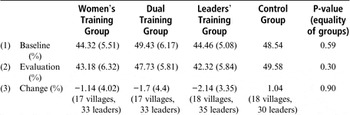
Table 3 suggests that the leaders' failure to increase women's voting knowledge may partly be because of the way in which the leaders absorbed the training material.Footnote 18 The leaders' own scores in the voting knowledge text are slightly lower in the Leaders' Training Group and Women's Training Group than in the Dual Training Group and Control Group (Table 3). The regression results (not shown here for the sake of brevity) support the descriptive statistics: the coefficients on the different intervention groups are all significantly indistinguishable from zero. In other words, even after receiving training, leaders' test scores did not increase from the baseline to the evaluation survey relative to those who did not receive training. There is no difference in the performance of male or female village leaders (results available from authors on request).Footnote 19
Change in Leaders' Test Scores, by Three Experimental Groups and One Control Group

Source: Authors' survey.
Notes: Per cent is correct out of 16 questions. Robust standard errors clustered at the village level are in parentheses.
Impact of the interventions on the way women vote
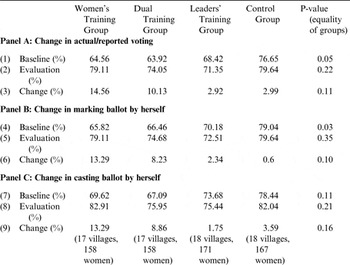
The need for new ways of increasing women's voting rates can best be understood by considering the results of the baseline survey (Table 4, row 1). Fewer than 80 per cent of women who participated in the election fully exercised their voting rights; the exact percentages ranged from 63.9 per cent in the Dual Training Group to 76.7 per cent in the control group. Although just by chance the rate at which women fully exercised their voting rights was higher in the control group, the rate is far from 100 per cent in all groups. These rates are similar to those reported by Pang and Rozelle (Reference Pang and Rozelle2010) who used a separate set of data from an even larger, nationally representative sample. It can also be seen from the results of the baseline survey that the share of women who marked their ballots by themselves (row 4) and the share of women who cast their own ballots (row 7) are also quite low. Clearly, women were not fully exercising their voting rights at the time of the baseline survey.
Change in Voting Behaviour, by Three Experimental Groups and One Control Group

Notes: Percentages are of the total number of women in the experiment arm.
The low voting rates of women set China apart from other countries. NorrisFootnote 20 demonstrates the differences by gender in voting rates in 17 countries. There is a 30 percentage point gap between women and men in China, according to our data (from this study's data and from Pang and Rozelle).Footnote 21 In contrast, Norris found the largest gaps to be 8 percentage points (Romania) and 7.8 percentage points (India), and the average gap to be only 2 percentage points.
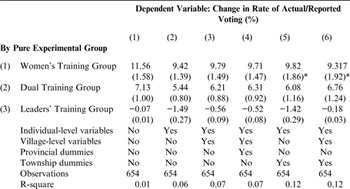
The results from the evaluation survey indicate that the study's interventions (at least those that included training for women) are one way to improve the voting behaviour of women in China.Footnote 22 Specifically, when examining the changes between the baseline and evaluation surveys, the number of women who fully exercised their voting rights in the Women's Training Group and the Dual Training Group increased by 14.6 and 10.1 per cent, respectively (Table 4, columns 1 and 2, row 3). At the same time, the number of women who fully exercised their voting rights in the Leader's Training Group and the Control Group increased by only 2.9 and 3.0 per cent, respectively (columns 3 and 4, row 3). The point estimates show that training women does affect their voting behaviour. However, since the p-value of equivalency among the four groups was 0.11, we cannot draw strong conclusions based on the descriptive statistics. However, the multivariate analysis examining the impact of the interventions on the voting behaviour of sample women is somewhat clearer (Table 5, rows 1 to 2). When we run regressions using our multivariate models (columns 1 to 4), the coefficients on the Women's Training Group variable are positive, but not statistically significant from zero. However, when we run equations 5 and 6, the coefficients on the Women's Training Group variable are positive and statistically significant from zero at the 10 per cent level. The coefficient on the Dual Training Group variable is positive in all models, although not statistically different from zero at standard levels of significance (row 2).Footnote 23
OLS Regression Analysis of Change in Rate of Actual/Reported Voting

Notes: Robust t-statistics clustered at the village level are in parentheses; *, **, and *** indicate significance at 10%, 5% and 1%, respectively.
Unsurprisingly, given the fact that the leaders' training (the Leaders' Training Group) had no effect on the levels of knowledge of either the women or the leaders, we also find that leaders' training did not affect the rate at which women fully exercise their voting rights. In both the descriptive statistics (Table 4, column 3 and 4, row 3) and the multivariate regressions (Table 5, row 3), there is no detectable difference in women's voting behaviour between the women in the Leaders' Training Group and the women in the Control Group.
The rest of Table 4 summarizes the effect of the different experimental arms on women's voting behaviour (rows 4 to 9). Although the p-values of equivalency across all arms of the intervention and control groups range between 0.10 and 0.16 (suggesting some statistical indeterminacy), the point estimates on the increase in voting between the baseline and evaluation surveys indicate that the women who received training (in either the Women's Training Group – column 1 – or the Dual Training Group – column 2) increased their voting more than the women in the intervention groups which did not receive training (the Leaders' Training Group or the Control Group). The higher rates of women fully exercising their voting rights are a function of women both being more vigilant in marking their ballots by themselves and casting their ballots by themselves.
Qualitative Discussion
Although the descriptive and multivariate analysis found statistically significant effects of women's training on women's knowledge about and exercise of their voting rights, qualitative interviews discovered other findings that were not addressed in the survey-based empirical work. First, there were a number of impacts beyond the quantifiable knowledge and voting mechanics. Secondly, while training – and the conveyance of knowledge about voting – did lead to greater exercise of women's voting rights, our interviews made it clear that there were also other obstacles holding back the exercise of voting rights.
In reporting on these results, we recognize that there is a fundamental difference between the nature of the information contained in this section and the material in the previous section. This section presents observations that are based on approximately 50 to 60 interviews. The authors of the paper carried out the interviews during both the baseline and evaluation parts of the survey. In total, we spent almost 20 to 30 days conducting interviews. All interviews were carried out in private in the women's homes or in the village leaders' offices. Each day interview notes were recorded and conversations with both the women and leaders were summarized. Although the authors took detailed notes of the interviews, the names of the respondents were coded in order to conceal their identities.
Although the level of empirical rigour is necessarily lower than that of the results based on the RCT, the use of qualitative/interview-based mixed methods is becoming more accepted by social scientists when conducting impact evaluation studies. For example, in the Journal of Development Effectiveness (the flagship journal of the International Initiative for Impact Evaluation, the leading impact assessment organization in the world today), mixed methods (rigorous RCTs that are supplemented by qualitative interviewing) are encouraged. Others (for example, Gao Reference Gao2010) make regular use of interviews. However, since this is the first RCT conducted in rural China in the area of village governance, it is also the first application of mixed methods. Although we have attempted to present only the information that arose repeatedly during the qualitative interviews and that which we believe to be in most cases more than just a single anecdote, the choice of what interview material to present and what not to present is still under the control of the researcher (unlike the case of the statistical-based analysis).
Other impacts
You don't know what you have given us. Hope. Respect. Confidence! [FJ-C2-T2-V2-R3]Footnote 24
After hearing the talk by our teacher from Beijing, I suddenly realized that voting was important. My vote could mean something. We talk about what is important for us and feel that we are more important now. [FJ-C3-T1-V1-R1]
No one has ever had a meeting just for us. We felt special. I did not understand everything that was said, but I know she was telling us that our vote and our opinion matter. I am not sure they do, but it is nice to think so. [LN-C1-T2-V4-R1]
In our post evaluation interviews, one theme stood out above all others and it was that women believed that, at the very least, the training programme had been special. At first, we were surprised. Our enumerators took less than an hour to fill out the forms for the female respondents. The trainers also spent less than an hour with the women. But, after debriefing the women, it was clear that even though this one short meeting had occurred several months prior to the evaluation, the women felt that it had been convened for them and only them, which made them feel special. It was unique. There are few activities in rural China that are focused solely on women. Even fewer are created and delivered in a way that treats women as equals and tries to make them understand their rights and the value and/or power of those rights.
We also were told that part of the increased respect or confidence was due to the fact that the women actually appeared in public and voted on their own:
I had never marked my own ballot in the past. I certainly had never put the ballot into the ballot box in front of the school. After the training, I did. It made me feel special. [LN-C2-T2-V1-R4]
In the past, my husband voted for the whole family without asking our opinions. This time, after the training, I asked him to let me mark and cast my own ballot. He laughed at me and asked, “What is the difference between my marking and your marking? Aren't we a family?” I responded, “It is my right to express my own opinion.” I was proud of myself. My friends said that I did right. [FJ-C2-T2-V2-R2]
Perhaps this sentiment was best summarized by the following woman, who, when pressed on why the programme made her feel special, responded:
Nobody had ever called women to a meeting except to discuss family planning issues. Nobody ever told us that we … can contribute to the development of the village. We only concerned ourselves with our own families … We women have not had an opportunity to come together to get to know each other even though we have lived in the same village for so many years. If we know a woman, we just call her “so-and-so's wife,” and often do not even know her real name. Women's lives are so boring in the village because we are 100 per cent housewives … We should know, contact and communicate with each other. This programme helped us see that we can be more. I was happy with the programme. [FJ-C1-T1-V2-R1]
In addition to this feeling of being special, a smaller number of women told us that, in fact, they felt empowered enough to take additional action. One respondent from one of the Women's Training Group villages in Liaoning province said that the women in her village took seriously the part of the training that taught them how to ask questions of candidates about their views on issues that involved them. The woman told us that their questioning of one of the candidates (about the competency of the local village clinician) turned into a long discussion about what could be done about health care in the village. They said that they liked the answers they received from the candidate and ended up voting for him. Our interviewee said that the women in the village would make sure that he followed through!
In the most extreme example, one of the women in a Dual Training Group village in Fujian actually decided to run for village leader and won:
After the training, we frequently discussed whether a woman could be the village leader since there had never been a female village leader before. The more we discussed, the more we believed that it could happen. So, with the encouragement of other trainees I made the decision to run for village leader. Although some men spread gossip around the village, most of women supported and voted for me. I won and became the first woman in our village to be village leader. [FJ-C3-T2-V2-R1]
In the villages in our sample, this was the only case in which a woman ran for village leader and won. That means only around 1 to 2 per cent of the villages have women as village leaders. When asked what in the training material was most important in helping her make the decision, she said:
It was something about that if women played a larger role in the village they could do things that affected what women wanted. I want our children to have better schools and better health care, and to improve our village's sanitary conditions. I want someone to rebuild the primary school. I learned that we should think about what is important to us and then make this known to the candidates. [FJ-C3-T2-V2-R1]
When considering the post-evaluation survey interviews, the interviewers noted that many of the women said that they just felt good after the training session. We are not sure exactly why. Was it because this was seen as an activity organized especially for them in an environment (rural villages in China) in which few activities are organized for women? Or was it the message that their votes count, and that they have the same rights given by the government to all citizens in China, and that these rights give them power, or at least a voice? Unfortunately, we cannot quantify empowerment or the level of increased satisfaction. However, what is clear is that at least in the case of some women in some villages, the training programme appeared to have an impact beyond the knowledge they gained and the way they voted.
Constraints and barriers in China's villages
While the statistical analysis and the qualitative interviews demonstrate that the training programmes for women did have an impact, the interviews also clearly show that many barriers remain. This section looks at three areas which were repeatedly raised in the interviews: a) remaining barriers inside the family and fellow villagers; b) resistance from village leaders; and c) indifference towards voting because of the inherent insignificance of the election itself.
By far the most common reaction to questions about why a woman did not fully exercise her vote, even after she had participated in the training, is summed up by the following quotes:
My husband always votes for everyone in the family, because the man is the head of the household especially in these village issues. Therefore, I only get to vote if my husband is not at home. [FJ-C3-T3-V2-R4]
I could not even glance at the ballot because my husband took the ballots for the entire family and marked them by himself without telling us. He thought we did not need to know since even if we had known we would have chosen the same people. [LN-C3-T2-V1-R1]
I was working outside our county when my father-in-law telephoned me telling me the election was being held. After I took the training course, I really wanted to express my own opinion even if I could not put the ballot in the box by myself, so I asked my father-in-law to help me vote for a different candidate than the one he recommended. He was not happy with my choice. “Why are you so headstrong?” In the end, he voted for the candidate he wanted, instead of the one I had chosen. [LN-C3-T2-V2-R1]
In addition to family pressures, there were also more subtle social pressures. For example:
I wanted to vote. I wanted to get the women who were in the meeting with me to try to get the candidates to talk to us, since we did not know the candidates. But in the end a lot of people including my relatives in the village were laughing at us because they thought we were pretending to be concerned with the election, which we had never done before. [FJ-C1-T2-V1-R4]
When I asked the village leader what he was going to do about our village land and irrigation, someone said that I was getting too smart for my own good, and everybody laughed. The village leader ignored me. [LN-C2-T2-V2-R1]
One of the most interesting dynamics that we believed could be happening (but which was difficult to quantify), was the reaction of the village leaders who had received training (both the Leaders' Training Group and the Dual Training Group). Repeatedly during interviews with village leaders, we received cold or angry responses. In several cases they wanted to know why we were trying to “cause trouble” in the village; since most of the village leaders are male they thought we were encouraging women not to re-elect them. One leader told us that they believed that the project would hurt rather than help the village. We asked him if it might damage his own chances for re-election. Laughing, he admitted that it might.
Other emotions and feelings arose during our interviews and interactions with village leaders. One village leader accused us of being naïve students from Beijing who did not understand village life. One of the more thoughtful village leaders told us that he was not going to use the training material. “Why should we? What would I get out of encouraging women to vote?” Another village leader echoed the same sentiment: “Upper levels of government only require that 50 per cent of the village vote – they do not care about whether the voters are men or women. Why should we listen to you when it does not help us?” Finally, and perhaps most basically, some officials complained to us that since they were candidates they were not allowed to be part of the election committee, and were thus excluded from the election planning process altogether. One village leader told us: “In the month prior to the election, I am not allowed to have anything to do with planning the election. I'm not the one responsible for the election, so why should I trouble myself to make women vote?”
Women in some of the Leaders' Training Group villages also picked up on this:
I always voted by myself. But, my family did not know about this last election until it was already over. Is it because the leaders were afraid we would vote against them? [LN-C2-T1-V3-R1]
No one ever paid attention to whether we voted in the past. My husband [who is away at work] has always wanted his father to vote for him and for me. This year, the election committee made a special trip and seemed to make sure that my father voted but not me. [FJ-C1-T3-V3-R1]
However, our interviews also showed us that it is not always unsupportive husbands, fellow villagers or village leaders that keep women from fully exercising their voting rights. In many cases, women did not vote for the same reason that many men did not vote: it was not worth doing. Few scholars inside or outside of China have claimed village elections are always meaningful. Clearly, many of our respondents believed they were not. And, because of this, they did not think the effort to vote was worth it:
The election is important, but my crops are more important, so I won't be waiting at home all day for the ballot box to come around. [LN-C2-T1-V1-R1]
Why did I not fully exercise my voting rights? Because it is a waste of time. The village leaders give me nothing. I don't care who will be the village leader because I just want to live my own life. [LN-C3-T3-V2-R1]
Everyone knows that village elections are meaningless. Just look at the candidates. Nobody is competent and it is also difficult for us to vote for someone other than the candidate standing right in front of us. [FJ-C1-T1-V3-R3]
The government does not let the village decide anything. We are powerless. We know we should vote, but do you think the candidate you choose can really win? And if he wins, will it matter? If you think so, you are definitely wrong! [LN-C3-T3-V4-R3]
In other words, according to our interviews, even effective training programmes may not be able to make women more concerned about exercising their rights to vote. There are many barriers: in the house, in the village, and the system itself. For this reason, it is important to understand the nature of the village before determining if the project was a success or not.
Conclusions
In this paper, we have reported on the results of a randomized controlled trial to assess the effectiveness of teaching women about their voting rights and about some of the mechanisms that will help them to exercise those rights fully. In measuring the effect, we used a set of randomly chosen, randomly assigned villages in which some received the treatment and some did not. Since villages in the experimental arms were more or less identical to those in the control set, and since the treatment was randomly assigned, we are fairly certain that post-intervention differences in the women's knowledge about their rights to vote and any observed differences in the patterns of voting behaviours will be because of the training programme. In an alternative set of experimental arm villages, we trained village leaders.
The results were clear. The voting rate for women is much lower than that for men in China. Our study shows that one of the barriers to higher voting rates is women's lack of knowledge about their rights and the voting process. In post-intervention tests, the women who received training increased their understanding of the rights and processes of voting more than the women in the control groups (and in any village in which women did not get trained). The rate of women who fully exercised their right to vote also rose. However, women's scores on the knowledge test and the rate at which they voted in the elections did not change when we educated the village leaders about women's voting rights.
Interestingly, in the qualitative interviews we found many other possible effects beyond increased scores in a knowledge test and the actual exercising of voting rights. The women appeared to appreciate being told that they matter. There appeared to be a new-found confidence in some women as they realized that they had a civic responsibility to exercise their rights in the village, even beyond voting. Villages can be stifling places for women and we found that giving them attention seemed to mean a great deal. While these results are not based on systematic, survey-based observational data, they do help to inform our quantitative findings by giving a human snapshot of the social context in which the study took place. Moreover, the insights gained during the qualitative interviews seem to suggest that future researchers should take care to include some measure of confidence and self-assurance as outcome measures, in addition to basic knowledge and voting behaviour.
In assessing the importance of our findings, we believe they are the first anywhere that have been able to identify a causal link (using social, in-the-field experimentation) between knowledge of voting rights and the exercising of these rights. However, our findings provide only a partial explanation of the gap in the voting behaviour of men and women. More work is needed, and, as shown in this paper, there are still many barriers to full voting equality. Cultural norms still work against women. Social standards seem to keep women out of the voting booth – especially those women with less education. Perhaps the most important barrier is that women often do not believe in the importance of voting and, because of this, it would be interesting to see if a similar voting training programme would have a larger impact in areas where elections matter more.