


The norm against territorial conquest—that is, the forcible acquisition of territory from another state—serves as a key pillar of the modern international order. An acceptable practice for ages, conquest came to be viewed in the twentieth century as a driver of destructive wars and, therefore, illegitimate. Conquest thus was prohibited in a series of international agreements that required respect for the territorial integrity of states. Among others, these included the 1919 Covenant of the League of Nations, the 1945 United Nations Charter, and the Helsinki Final Act of 1975. The anti-conquest norm enshrined in these agreements has changed state practice dramatically, resulting in a precipitous decline in conquests after World War II (Altman and Lee Reference Altman and Lee2022; Atzili Reference Atzili2011; Fazal Reference Fazal2007; Goertz, Diehl, and Balas Reference Goertz, Diehl, Balas, Goertz, Diehl and Balas2016; Zacher Reference Zacher2001). Today, however, the prohibition on conquest is eroding with Russia’s efforts to conquer Ukraine and China’s growing threat to seize Taiwan (Buckley, Koettl, and Chang Reference Buckley, Koettl and Chang2025). US President Donald Trump’s eyeing of Canada, Greenland, and the Panama Canal also has fueled concern about the norm’s decay (McManus Reference McManus2025). Indeed, the prohibition on conquest has come under such pressure that scholars suggest it is crumbling or in its death throes (Fazal Reference Fazal2025; Poast Reference Poast2025). As a result, the world soon might be facing renewed wars of conquest (Hathaway and Shapiro Reference Hathaway and Shapiro2025).
Whereas scholars have examined how the norm against conquest has affected state behavior, we know little about citizens’ support for this norm. Notably, Lee and Prather (Reference Lee and Prather2020) examined public attitudes toward foreign countries that embark on conquest. This article assesses public attitudes in the conquering state: To what extent do citizens support their own country’s forcible seizure of foreign territory and the assertion of sovereignty over that territory? Indeed, the norm against conquest binds policy makers and militaries, not ordinary citizens. Yet, understanding its impact on public opinion provides an important signal of the norm’s status and health (Carpenter and Montgomery Reference Carpenter and Montgomery2020).
The article examines public attitudes on conquest through a survey experiment based on a real-world event: Israel’s takeover of Syrian territory following the collapse of the Assad regime in December 2024. Our results demonstrate that citizens are willing to support the military occupation of forcibly seized territory—that is, the deployment of their country’s military forces to a foreign territory and their control of it. We found weaker public support for measures that turn military occupation into an illegal conquest—that is, civilian settlement in the territory or the annexation of the territory—policies that express permanent ownership of the foreign territory and its integration into the conquering country. This variation in public support indicates public sensitivity to the norm against conquest. So does respondents’ use of norm-related arguments to justify their opposition to conquest.
Our results demonstrate that citizens are willing to support the military occupation of forcibly seized territory. We found weaker public support for measures that turn military occupation into an illegal conquest.
All of this does not mean that citizens completely reject conquest. In fact, approximately half of the respondents in our experiment indicated their support for annexation. Yet, respondents expressed greater approval of military occupation—a practice recognized by international law. As the world’s territorial order faces increasing pressure (Schultz Reference Schultz2025) and given that public opinion may matter for territorial issues (Rynhold and Waxman Reference Rynhold and Waxman2008), these findings are important for academic and policy debates.
OCCUPATION AND CONQUEST
Assessing the impact of international norms on public opinion presents a significant challenge. Scholars have met this challenge by conducting survey experiments in two different formats. In one format, the experiment explicitly invokes the norm under study: respondents in an experimental condition read that a certain policy violates an international norm; those in a control condition do not receive this information. This format has been applied in the study of human rights and humanitarian norms (Kreps and Wallace Reference Kreps and Geoffrey2016; Kuzushima, McElwain, and Shiraito Reference Kuzushima, McElwain and Shiraito2024).
The second experiment format evaluates the impact of norms without explicitly invoking them. This type of experiment is used in a series of studies assessing how the norm on the nonuse of nuclear weapons shapes public opinion. Participants typically are presented with a scenario that asks them to choose between using conventional or nuclear weapons; however, the norm on nuclear nonuse is not mentioned directly (Sagan and Valentino Reference Sagan and Valentino2017; Smetana and Onderco Reference Smetana and Onderco2023). This experiment format sets a higher bar for detecting the impact of norms. As Carpenter and Montgomery (Reference Carpenter and Montgomery2020, 162) explained, international norms have a stronger impact when they are explicitly invoked as a form of communicative action. Not mentioning norms as a relevant consideration likely blunts their impact and increases measured support for acts that violate the norms. If citizens’ preferences reflect the strictures of norms even when they are not invoked, this indicates that the norms are internalized (Dill, Sagan, and Valentino Reference Dill, Sagan and Valentino2022, 7).
Our examination of the norm against conquest follows the second format and opts for a design that does not mention this norm. Various studies have demonstrated that the public may dismiss international law and norms. Indeed, invoking international norms may elicit a public backlash (Greenhill and Reiter Reference Greenhill and Reiter2022; Terman Reference Terman2023). The current study is situated in Israel, where citizens are particularly skeptical of international norms (Cavari, Efrat, and Yair Reference Cavari, Efrat and Yair2025; Efrat and Yair Reference Efrat and Yair2023; Lupu and Wallace Reference Lupu and Geoffrey2019). In this context, mentioning the norm against conquest likely will fail to decrease Israelis’ support for the seizure of foreign territory. Instead, we sought to identify the impact of the norm by varying the nature of the country’s control of the forcibly seized territory, ranging from military occupation to proscribed conquest.
International law recognizes the state of military occupation, which may arise during or in the aftermath of armed conflicts. Occupation occurs when the armed forces—usually of a state—gain effective control over territory belonging to a foreign country, without the consent of that country. Article 42 of the 1907 Hague Regulations provides the widely accepted definition of occupation: “Territory is considered occupied when it is actually placed under the authority of the hostile army.” Under international law, occupation has two key attributes. First, it does not amount to sovereignty and neither does it confer sovereignty on the occupying power; the occupant possesses fewer powers than the territory’s sovereign. Second, occupation is presumed to be temporary; it is a transitory regime that endures until the return of the territory’s rightful sovereign (Abi-Saab and Kohen Reference Abi-Saab and Kohen2025; Lieblich and Benvenisti 2022).
Unlike occupation, the concept of “conquest” lacks an internationally agreed-upon definition. In this study, we define “conquest” as the taking of foreign territory by military force and assertion of sovereignty over it. Conquest involves a modification of the status quo ante that integrates the foreign territory into the conquering country and erases differences between the territory and the conquering country (Levine-Schnur, Megiddo, and Berda Reference Levine-Schnur, Megiddo and Berda2025). This means that conquest, unlike occupation, involves permanent control of the foreign territory.Footnote 1 Based on these definitions, our research design distinguishes among the following three policies that a territory-seizing country may apply in that territory:
-
1. Military control, wherein the territory-seizing country deploys its armed forces in the foreign territory and controls it, without taking steps that express sovereignty over the territory or integrate it into the country. As such, military control amounts to an occupation of the territory and does not violate the norm against conquest.
-
2. Civilian settlement, wherein citizens of the territory-seizing country move into the territory and settle there. Settlement conveys an intent to exercise permanent control over the territory, and it erases some of the differences between the foreign territory and the country that seized it. This reflects a perception of the foreign territory as part of the sovereign territory. Civilian settlement in a forcibly seized territory thus violates the norm against conquest. Indeed, it is categorically prohibited as a war crime (see Article 49 of the Fourth Geneva Convention and Article 8(2)(b)(viii) of the Statute of the International Criminal Court).
-
3. Annexation, wherein the territory-seizing country formally incorporates the foreign territory and manages it as if it were a part of its own territory. Formal annexation clearly violates the norm against conquest. By formally declaring the forcibly seized territory as its own, the seizing country claims sovereignty over the territory and expresses an intent to control it permanently. Indeed, formal annexation violates the prohibition on the use of force and it breaches additional key principles, including sovereignty, sovereign equality, and self-determination. Under international law, annexation constitutes an act of aggression (Brunk and Hakimi Reference Brunk and Hakimi2024; Levine-Schnur, Megiddo, and Berda Reference Levine-Schnur, Megiddo and Berda2025; United Nations 2018).
These three policies—military control, civilian settlement, and annexation—involve the forcible acquisition of foreign territory. Yet, only civilian settlement and annexation constitute violations of the norm against conquest because they express a claim of permanent ownership and sovereignty over the forcibly seized territory. Based on the threefold typology of policies, we looked for evidence indicating public sensitivity to the norm against conquest.
If citizens are insensitive to the norm against conquest, public support for settlement and annexation should be similar to the support for military control of the forcibly seized territory. Indeed, citizens may approve of annexing the territory or settling there to expand their country’s borders and derive economic and security benefits. We hypothesized, however, that normative thinking constrains this instrumental, interest-based calculation. Citizens likely express less tolerance for settlement and annexation because these policies violate the norm against conquest and the concept of sovereignty. Military control likely would receive stronger public support because occupation is a recognized practice. The deployment of troops in the forcibly seized territory is easily reversible, does not imply sovereignty, and maintains clear differences between the foreign territory and the country that seized it. We therefore hypothesized that:
Citizens will show greater support for military control of a forcibly seized territory than for civilian settlement in or annexation of such territory.
We tested this hypothesis using a preregistered survey experiment in Israel that addressed the Israeli seizure of Syrian territory in December 2024.
ISRAEL’S SEIZURE OF SYRIAN TERRITORY, 2024
The Israeli border with Syria remains a point of ongoing dispute, lacking an internationally recognized demarcation. At the center of the dispute is the Golan Heights—a Syrian territory that Israel seized in the 1967 Six-Day War and annexed in 1981. The current de facto border was established in the 1974 Disengagement Agreement following the 1973 Yom Kippur War. This agreement created a demilitarized buffer zone on the Syrian side of the Golan (hereafter the Syrian Golan), where Syria retains sovereignty but is prohibited from deploying military forces (figure 1). This territory is the focus of our study.
The Syria–Israel Buffer Zone

Figure 1. Long description
A political map showing Israel in yellow, the West Bank in light green, and Gaza in light green. To the North is Lebanon with the city of Tyre. To the Northeast is Syria with the capital Damascus marked by a black square. The Golan Heights is shaded in orange on the Northeast border of Israel. A thin dark brown strip labeled Buffer Zone runs along the eastern edge of the Golan Heights, separating it from the rest of Syria. To the East is Jordan. To the West is the Mediterranean Sea. Major cities marked with black dots or squares include Haifa on the northern coast, Tel Aviv on the central coast, and Jerusalem at the southern edge of the West Bank. Egypt is located to the Southwest. A scale bar at the bottom indicates 0 to 100 kilometers, and a North arrow is in the top left corner.
On October 7, 2023, a war between Israel and Hamas broke out following a surprise attack that Hamas waged in Southern Israel. Hezbollah, based in Lebanon, joined the war the following day. Iran subsequently joined the war by attacking Israel with drones and missiles. The Israeli retaliation weakened Hezbollah and Iran, key allies of the Assad regime in Syria. On November 27, 2024, recognizing that the Assad regime was losing crucial support, Syrian rebels launched an offensive on regime forces. They quickly took control of Syria, and Bashar al-Assad himself fled the country on December 8. That same day, Israeli forces crossed the border into Syria and deployed in the buffer zone. Israel stated that it would hold onto the Syrian Golan for an unlimited time to prevent Syrian forces from approaching Israeli territory and threatening civilians. Reports reveal that Israel had been building military bases in the territory that it seized (Morris, Zakaria, and Kelly Reference Morris, Zakaria and Kelly2025). In April 2025, Israeli citizens were allowed to enter the seized Syrian territory in heavily secured trips to tourist sites (Carmeli Reference Carmeli2025).
This case provides a unique opportunity to examine public views on the seizure and control of foreign territory. By situating our experiment within an ongoing wartime context and focusing on a real-world case of territorial seizure, we mitigated concerns about external validity that typically plague experimental designs (Lupu and Wallace Reference Lupu and Geoffrey2023).
Furthermore, an intense war environment sets a difficult test for the norm against conquest. During this conflict, Israelis experienced an acute sense of insecurity, with many believing that their country was facing an existential threat (Institute for Liberty and Responsibility 2024). In this atmosphere of intense insecurity, citizens are less likely to show respect for the norm against conquest. Conquering foreign territory may seem an attractive remedy for the country’s profound security challenges (Zellman Reference Zellman2015, 494). Israeli citizens also have long experience with the practice of conquest: Israelis reside in the West Bank, seized in 1967, and the part of the Golan Heights captured by Israel that same year. In fact, the territory that is the focus of this study—the Syrian Golan seized in 2024—might be viewed by Israelis as an extension of the already-annexed Golan Heights. All of these circumstances could make Israelis comfortable with the forcible seizure of territory, making it more difficult to find support for our hypothesis of norm-inspired constraints on conquest.
METHODOLOGY
Our experiment was conducted October 16–19, 2025, 10 months after Israel’s seizure of the Syrian Golan,Footnote 2 as news circulated about emerging negotiations between Israel and Syria (Prime Minister’s Office Reference Office2025). Our sample consisted of 1,208 Israelis recruited via iPanel, a company that conducts surveys in Israel. The mean age of respondents was 44.6 (SD=17.4); women constituted 51.4% of the sample; Jewish and Arab respondents constituted 83.4% and 16.6% of the sample, respectively. In terms of ideological self-placement, 49.9% of the sample consisted of rightists, with centrists comprising 25% and leftists 20.0% (the residual “other” category comprised 5.1%) (Cavari, Efrat, and Yair Reference Cavari, Efrat and Yair2026).
Procedure
All respondents read a short text in Hebrew about the Israeli presence in the Syrian Golan. They were told that the Israel Defense Forces (IDF) had been deployed there since December 2024. However, the commencing negotiations between Israel and the new Syrian regime raised the question of whether Israel should withdraw from this territory or continue to hold it. As part of the experimental manipulation, respondents were presented with one of the following three randomly assigned policies that Israel presumably considered implementing in the Syrian Golan:
-
1. Military Control: Israel controls the Syrian Golan and IDF forces remain deployed there.
-
2. Civilian Settlement: Israel controls the Syrian Golan and establishes Israeli settlements there.
-
3. Annexation: Israel controls the Syrian Golan and annexes that territory—that is, declares the Syrian Golan is part of Israel.
The full text of the vignettes is in online appendix section A.
After reading the short vignette, respondents were asked whether they support or oppose the policy mentioned in the text. Responses were recorded using a 5-point scale, from 1=strongly support to 5=strongly oppose.Footnote 3 To ease interpretation, we rescaled responses to vary from 0 to 1, with higher values denoting greater support for each policy.
Respondents then were asked an open-ended question to explain their support or opposition. Open-ended responses provide a more nuanced, detailed insight into respondents’ reasoning and allow a deeper understanding of the considerations underlying policy preferences (Breyer, Palmtag, and Zollinger Reference Breyer, Palmtag and Zollinger2025; Haaland et al. Reference Haaland, Roth, Stantcheva and Wohlfart2024). We focused on respondents who opposed the policies that violate the prohibition on conquest: civilian settlement in or annexation of the Syrian Golan. We sought to determine whether their opposition was motivated by norm-related considerations or by other practical and instrumental concerns unrelated to the norm. We coded responses as norm-related if they expressed one of the following three rationales:
-
1. The Syrian Golan does not belong to Israel. This rationale expresses an internalization of the norm against conquest. It essentially states that Israel cannot acquire foreign territory by seizing it forcibly. Responses along these lines assumed that international borders cannot be altered through force, which is a central tenet of the norm against conquest.
-
2. Concern about an adverse international response to conquest. This rationale recognizes that the forcible seizure of territory deviates from internationally accepted standards, possibly triggering unfavorable international reactions.
-
3. Risk of conflict or obstruction of peace. This rationale shows concern about a possible outcome of violating the norm against conquest: the fueling of conflict. As Goertz, Diehl, and Balas (Reference Goertz, Diehl, Balas, Goertz, Diehl and Balas2016, 104) argued, “International norms about territory are precisely ‘outcome oriented’ in that they are designed to produce peace in the international system.”
Zacher (Reference Zacher2001, 238) similarly suggested that the association of territorial revisionism with major wars was the central driving force that led to a prohibition on the coercive acquisition of territory. By expressing concern about conquest leading to war, respondents conveyed the fundamental rationale behind the norm: preventing conflict. For more information about the collection and analysis of the open-ended data, see online appendix section B.
RESULTS
We expected to observe higher support for military control of the Syrian Golan than for the two policies that contravene the norm against conquest: civilian settlement and annexation. The results support our expectation: among the three policies, Israelis were more supportive of military control (M=0.68; SD=0.31), and they expressed less support for establishing Israeli settlements (M=0.47; SD=0.35) and for annexation (M=0.61; SD=0.34). A one-way ANOVA confirmed that the experimental conditions differed in their level of support (F(2, 1,037)=34.58; p<0.001; η2=0.06). A Scheffé’s post-hoc test showed statistically significant differences between support for military control and support for settlements (p<0.001) and annexation (p=0.033). The settlement–annexation difference also was significant (p<0.001). See online appendix section C for regression models that predicted public support for the different policies.
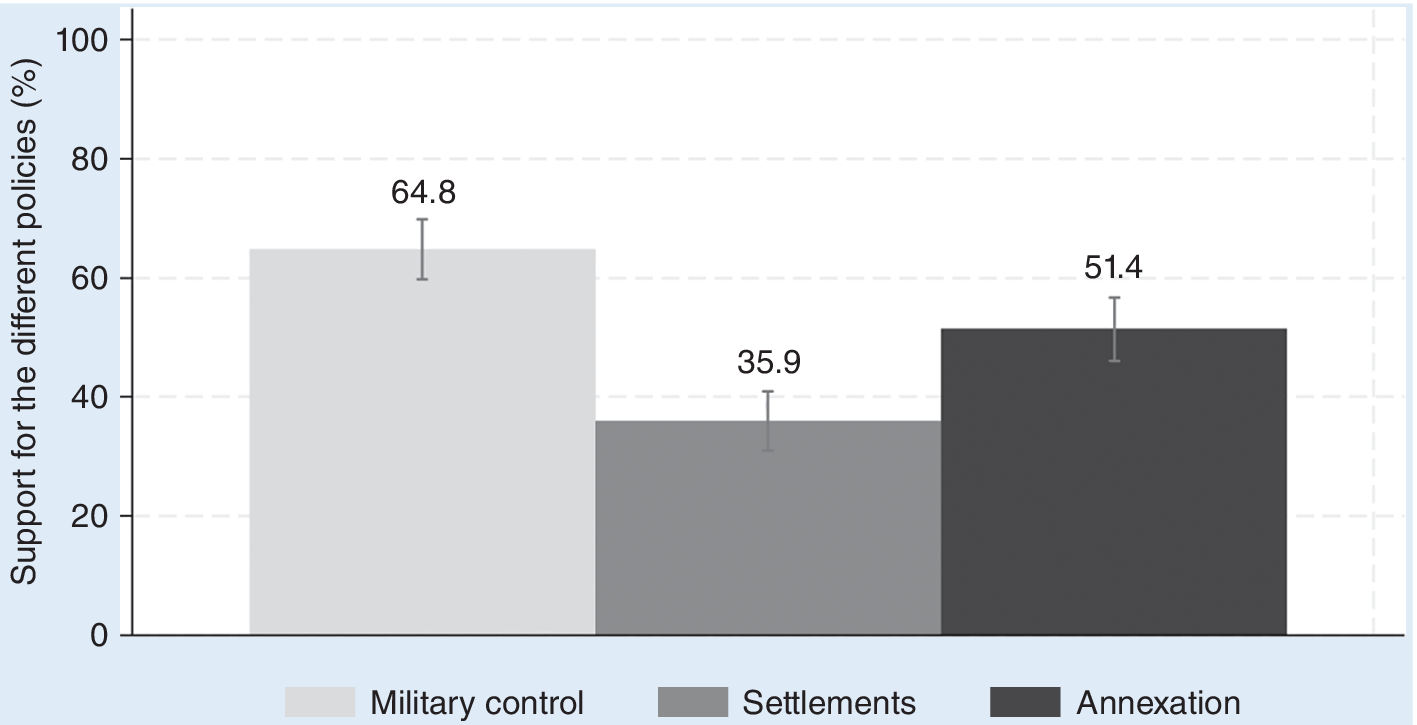
Comparing support (i.e., “support” or “strongly support”) to non-support (i.e., all other options, omitting “don’t know” responses), figure 2 shows that almost two thirds of respondents—64.8% (95% CI: 59.8%, 69.9%)—supported Israeli military control of Syrian territory. In contrast, 35.9% (30.9%, 40.9%) supported establishing Israeli settlements in that territory, and 51.4% (45.9%, 56.8%) supported annexation (χ2=59.47, p<0.001). Clearly, Israelis were more comfortable with a military occupation of Syrian territory than with civilian settlement and annexation—forms of conquest that imply permanence and the assertion of sovereignty over conquered territory. These policies either barely achieve or fail to achieve majority support. It is noteworthy, however, that Israelis seemed more accepting of the annexation of conquered territory than of settlements. A possible explanation is that annexation is a formal, declaratory act that does not necessarily result in a significant change on the ground. Settlement in the conquered territory, by contrast, creates significant, visible changes that are difficult to reverse; therefore, it garners weaker support.
Support for Israeli Policies in the Syrian Golan

Analysis of the open-ended responses revealed the effect of the norm against conquest. Of the 242 explanations by respondents for opposing civilian settlement and annexation, 146 (60%) showed consideration related to the norm against conquest; 89 responses (37%) fell into the first category (i.e., “The Syrian Golan does not belong to Israel”), which suggests that the seized territory does not and cannot belong to Israel. Responses included: “This territory does not belong to the State of Israel, and there is no justification for building Israeli settlements there”; “This territory belongs to Syria, not to Israel”; “Because one shouldn’t settle on conquered territory”; “There is a clear border between the two countries, and it should be respected”; “This is not Israeli territory, this is conquest”; and “Why would you think [this territory] is ours?”
Nine responses (4%) fell into the second category of concern about the international response. Examples included: “This will lead to harsh international sanctions” and “This will just bring us criticism from all countries of the world.” Moreover, 48 responses (20%) cited the norm’s underlying rationale of concern about fueling war. Examples included: “This will lead to war”; “This will hurt the prospects of peace”; “Because the Syrians will hate us and attack us”; and “I’m less into conquest and the creation of new conflicts.”
Other justifications offered by respondents were not related directly to the norm against conquest. They included concerns about unspecified negative outcomes that might follow conquest (e.g., “A recipe for future trouble”); possible risk to Israeli soldiers or civilians in the conquered territory (e.g., “This is dangerous for our soldiers”); and the view of conquest as pointless (e.g., “Unnecessary and wasteful—we have territories inside Israel that should be settled and strengthened”).
Overall, we found echoes of the norm against conquest among a majority of respondents (60%) who opposed settlement and annexation. These respondents rejected the permanent takeover of a territory that is “not ours,” expressed concern about the international implications of an internationally unacceptable conduct, and linked conquest with the fueling of conflict—the norm’s key rationale.
CONCLUSION
Our findings—based on a real-life case study of conquest—present important, timely implications as the norm against conquest erodes, and the forcible seizure of territory—long unthinkable—returns to the array of policy options. In an era in which Canadians perceive their annexation by the United States as a realistic and frightening possibility (Stevis-Gridneff Reference Stevis-Gridneff2025), we should enhance our understanding of the politics of conquest. This study is among the first to examine the domestic politics of conquest—specifically, whether citizens approve of their country’s forcible acquisition of foreign territory. This issue has much importance because the mechanisms undergirding the territorial order exhibit growing signs of weakness (Schultz Reference Schultz2025).
Our study demonstrates that even in the difficult atmosphere of a large-scale, high-stakes military conflict, citizens discern between different types of policies that their government may implement in a forcibly seized territory. Settlement and annexation receive weaker support than military occupation of foreign territory, consistent with the norm against conquest, which prohibits settlement and annexation as violations of territorial integrity and sovereignty. Although citizens do not fully reject the norm-violating practices of settlement and annexation, they favor the legally recognized practice of military occupation. This finding was obtained in a least-likely case of a country with long experience of territorial seizure and acute security concerns; thus, it likely generalizes to other countries.
Settlement and annexation receive weaker support than military occupation of foreign territory, consistent with the norm against conquest.
It is important to note that respondents’ sensitivity to the norm did not result from the information provided in the experiment. Existing scholarship suggests that to influence people’s views, international norms may need to be invoked and activated in real-life political debates and survey experiments (Carpenter and Montgomery Reference Carpenter and Montgomery2020; Chilton Reference Chilton2014; Kuzushima, McElwain, and Shiraito Reference Kuzushima, McElwain and Shiraito2024). Yet, we did not convey to respondents that settlement and annexation differed in legality from military control of the forcibly seized territory. Respondents intuitively sensed the difference and expressed it in the preferences they recorded. The results, therefore, demonstrate that citizens may grasp and give weight to the normative constraints on conquest, even when these constraints are not explicitly mentioned or clarified. Whereas the leaders of the great powers currently demonstrate little concern for the prohibition on conquest, the public seems to recognize the importance of this norm. This finding is welcome news for international stability and peace.
Whereas the leaders of the great powers currently demonstrate little concern for the prohibition on conquest, the public seems to recognize the importance of this norm.
SUPPLEMENTARY MATERIAL
To view supplementary material for this article, please visit http://doi.org/10.1017/S1049096526102340.
ACKNOWLEDGMENTS
We thank three anonymous reviewers for helpful comments and Eliav Lieblich for his advice. This study was supported by the Israel Science Foundation under Grant No. 1479/24.
DATA AVAILABILITY STATEMENT
Research documentation and data that support the findings of this study are openly available at the PS: Political Science & Politics Harvard Dataverse at https://doi.org/10.7910/DVN/FEFVGJ.
CONFLICTS OF INTEREST
The authors declare that there are no ethical issues or conflicts of interest in this research.



 Open access

