Introduction
An increase in the segmentation of markets and in the differentiation of consumption behaviors is a key factor for the future of the world olive oil market, which will lead to a major quality-based product diversification and differentiation of marketing strategies. Increasing consumer demand is anticipated for olive oils that are differentiated on the basis of product and process quality attributes, such as those linked to origin or to alternative production techniques such as organic agricultureReference Anania and D'Andrea 1 . The globalization of the world economy and the expansion of international trade have led to rapid processes of quality internationalization as a crucial element of companies’ competitivenessReference Ruzevicius 2 . Achieving, enhancing and sustaining competitiveness is dependent on delivering superior quality products/services to consumersReference Magd and Curry 3 . The image of quality olive oils is currently taking on increasingly more positive connotations among consumers in developed countries, as well as in the upper middle classes of society in developing countriesReference Sanz-Cañada and Macías-Vázquez 4 . In this context, producing olives and olive oil of differentiated quality can result in a competitive advantage for olive farmers and industries. Given the globalization of markets and the increasing distances between producers and potential consumers, it is difficult for buyers to observe the qualifications of suppliersReference Terlaak and King 5 . Certification through Certified Quality Systems (CQSs) may reduce information asymmetries in supply chains and thereby generate a competitive advantage for certified firmsReference Ruzevicius 2 , Reference Terlaak and King 5 by ensuring the quality of products and services and eliminating technical barriers in tradeReference Ruzevicius 2 . Moreover, it provides further incentives for the seller to provide high-quality goodsReference Albano and Lizzeri 6 to intermediate customers and final consumers. CQSs are voluntary and usually require an organization to demonstrate that it achieves a standard of quality beyond conventional and mandatory levels by employing a specific set of management practices. Usually, these practices must be verified by a third party auditorReference Terlaak and King 5 . CQSs can be seen as institutions in the sense that they are rules that facilitate coordination between people by helping them form expectations that each person can reasonably hold in dealing with othersReference Ruttan 7 . Quality is a multidimensional and complex concept that can be interpreted from diverse perspectivesReference Luning and Marcelis 8 , and the various different CQSs can have different focuses in terms of the quality they guarantee to consumers or customersReference Caracuel-García 9 – Reference Maza, Sepúlveda, Campo and Berga 11 : food security, organoleptic properties, nutritional value, raw material treatment, origin, sustainability, environmental care, health of producers, fair trade, animal welfare, etc. Although certification of quality through the implementation of a CQS is a costly process, its adoption is usually aimed at minimizing the cost in relation to profitReference Kaldis and Gardeli 12 . The set of management practices associated with a CQS may represent a form of technological innovation for farmers, if we understand innovation in a broad sense as an idea, practice or object perceived of as new by an individualReference Rogers and Shoemaker 13 .
Spain is the world-leading olive (Olea europaea, spp.) growing country both in terms of surface area and production: 2.4 million ha and 6.2 million tons of olives per year in the period 2005–2010, which represents 24.9% of the world's olive surface area and 35.8% of world production 14 . Most of the Spanish production (93.0% in 2009) 15 goes to olive mills to produce mainly olive oil and the rest is processed as table olives. Spanish olive oil is mainly destined for exportation: 62.8% was exported in 2009 15 , including both the final bottled product and the bull olive oil to be subsequently processed and bottled. Moreover, olive oil exportation is clearly increasing: while olive oil production increased by 3.2% per year in the period 1996–2009, exportation increased by 14.8% per year in the same period 15 , 16 . The main destinations of Spanish exports, according to the most recent data available (2009), were the rest of the EU-27 countries (74.8% of exports) and emerging markets such as USA and Australia (7.3 and 2.7%, respectively) 15 . The Spanish olive production sector consists primarily of a wide group of small/medium olive growers organized into olive oil cooperatives, which account for more than 70% of the olive oil produced, and a minority of private olive oil mills belonging to large farmersReference Sanz-Cañada and Macías-Vázquez 4 . Andalusia, located in the south of Spain, is by far the country's most important olive-growing region. Andalusian olive cultivation represented 61.9% of the olive surface area and 84.3% of olive production in Spain in 2009 15 . In macroeconomic terms, olive growing provided 27.7% of Andalusian plant production in 2010 17 , and generated 32% of the agricultural employmentReference Gómez-Limón and Arriaza-Balmón 18 , this being the second largest agricultural sector in the region after the production of vegetables 17 . A large share of the olive groves of Andalusia is located in marginal areas and would incur financial losses if the EU subsidies were to disappear: specifically, 58.3% of farms and 61.5% of the olive area 19 . The Andalusian olive-producing sector faces a ‘marketing problem’ with regard to olive oil cooperatives, which draw together most of the olive producers and primary extraction industries and have a weak presence in the bottled olive oil market, thus losing a large share of the added value of the final product in favor of a few bottling industries and big distribution platformsReference Parras-Rosa, Senise-Barrio and Torres-Ruiz 20 . A very small number of firms own the most valuable labels and control most of the olive oil sold in the largest marketsReference Anania and D'Andrea 1 . Therefore, competitiveness through differentiation in the market and consumer value creation is a fundamental strategy for farmers to survive, especially for small/medium farmers, since they cannot compete with large-scale distribution whose marketing strategies are mainly based on priceReference Montegut-Salla, Cristóbal-Fransi and Marimon-Viadiu 21 .
CQSs available for Andalusian olive growers include (1) EU, Spanish, and Andalusian public regulations, such as Protected Designation of Origin (PDO), organic and integrated agriculture; (2) International Standards (ISO) norms, such as 9001, 14001, 19011 and 22000; and (3) retailers’ private protocols, such as GLOBALGAP, International Food Standard (IFS), and Nature's Choice, among others. Despite the wide range of potentially adoptable CQSs and the importance of a strategy of differentiated certified quality for the agents of the olive agrofood system, currently only a few CQSs are adopted. In the past few decades, certification of the product and processes in the Andalusian olive sector in particular and the agrofood system in general has relied almost exclusively on a few CQSs backed by public regulations; the adoption of privately financed quality schemes is token by comparisonReference Silva-Pérez 22 . Two trends in quality certification can be distinguished: (1) certification of alternative production systems associated with more sustainable and environmentally responsible practices that are profitable and fair for farmers and healthy for consumers, such as those promulgated by integrated production (IP) and organic agriculture; and (2) certification of the origin of the product through schemes such as the PDO. Among these relatively widespread CQSs, the one that stands out the most is IP.
IP is an alternative agricultural production system, which arose as a reaction against problems surrounding conventional chemical agriculture, related to the environment, food quality, sustainability and the survival of the rural worldReference Parra-López, Calatrava-Requena and De Haro-Giménez 23 . The origin of the concept of IP goes back to 1977 and was established as a result of a researchers’ meeting in Switzerland, organized by the OILB/IOBC (Organisation Internationale de Lutte Biologique/International Organisation for Biological Control). This organization began its attempt to define the concept of IP in the 1960s, in response to the massive use of synthetic pesticides in agriculture. The scope of IP included and went further than the integrated pest management concept that previously appeared in Europe and the USA in the 1950s. The OILB/IOBC is the organization possessing the greatest experience and authority on the aspects of IP; since 1977, it has run a recognition service for regional plans and a commission on IP 24 . In Spain, as in other countries, the regulation of IP began at the regional level, first in Catalonia in 1993 and then in Andalusia in 1995 (Decree 215/1995) following the OILB/IOBC guidelines. Subsequently, in 2002, the first regulation of IP at the national level was established with Royal Decree 1201/2002. This regulation defines IP as farming systems for vegetable and fruit production, which make the maximum use of resources and production mechanisms and ensure long-term sustainable agriculture, introducing biological and chemical control methods and other techniques that reconcile the demands of society, environmental protection and agricultural productivity, as well as operations for the handling, packaging, processing and labeling of vegetable and fruit products included in the system. The main goal of defining IP principles and rules is to achieve high-quality production by means of an efficient use of production factors, taking into account sustainability criteria and environmental complianceReference Orellana, del Sagrado and del Aguila 25 . This norm also established the general IP rules for farms and processing industries, distinguishing among mandatory, forbidden and recommended practices. In addition, the norm defines some crop-specific technical standards developed by an IP national commission, such as those referring to vegetables, citrus, garlic, cotton and sugar beet. Once the national regulations have been set, Spanish regions had to adapt their own regional regulations to them. IP olive growing in Andalusia is regulated by the Order of 15 April 2008 (BOJA num.83). This norm consists of two fundamental parts: agronomic practices (including mandatory, recommended and forbidden practices) and integrated control strategiesReference Orellana, del Sagrado and del Aguila 25 . Regulated agricultural practices are related to the soil, land preparation, tillage, and management of vegetation cover, planting, fertilizing, irrigation, pruning, integrated control and harvesting. Mandatory practices related to soil management are soil conservation practices to reduce soil erosion; with regard to fertilization, olive farmers have to do at least one foliar test per year, as well as a physical and chemical soil analysis in each farm; in terms of irrigation, they have to carry out a test on water quality every 2 years in an accredited laboratory, and flooding irrigation is forbidden; in pest control, wherever possible, they have to use biological rather than chemical control methods; with respect to harvesting, it is forbidden to mix olives taken from the trees and the ground and to transport them in bags. Otherwise, the control strategy is based on inspection, identification and treatment, mainly conducted through periodical visits from field technicians. At least one onsite check a year is performed on every farm. The specific regulations for agronomic practices and integrated control strategies must be changed when technological advances make it advisableReference Orellana, del Sagrado and del Aguila 25 . IP is an upward trend in Andalusia (Fig. 1), representing 16.7% of the total olive area in 2009 26 , 27 . This is a relatively high adoption rate compared to other CQSs, which are just starting to be recognized by farmers.
Evolution of IP olive surface in Andalusia (2003–2009). Source: CAP, Consejería de Agricultura y Pesca, Junta de Andalucía: http://www.cap.junta-andalucia.es/agriculturaypesca/portal/.

Despite the relative success of the adoption of IP as a form of technological innovation, it is remarkable how few studies in the international literature deal with the diffusion of IP as a quality strategy in the agricultural sector in general and the Andalusian olive-growing sector in particular. In fact, the international literature on CQSs in the olive agrofood system can be classified into the following different categories, which makes the lack of IP studies patent: (1) PDO, as a quality differentiation strategy for olive producersReference Sanz-Cañada and Macías-Vázquez 4 , Reference Marbán-Flores 28 , Reference Marbán-Flores 29 – Reference Baptista and Biswas 33 , its consumer demand/acceptanceReference Bonnet and Simioni 34 – Reference Erraach, Sayadi, Parra-López, Carmona-Torres and Hinojosa-Rodríguez 40 and its marketReference Ruiz-Avilés, Navarro-García, Barea-Barea and Vázquez-Cobo 41 , Reference Ruiz-Castillo 42 ; (2) organic agriculture, its process of diffusion/adoption in the olive sectorReference Chinchilla-Fernández 43 – Reference Parra-López, De Haro-Giménez and Calatrava-Requena 46 and its multifunctional impactsReference Gómez-Limón and Arriaza-Balmón 18 , Reference Parra-López, Calatrava-Requena and De Haro-Giménez 23 , Reference Parra-López, Calatrava-Requena and De Haro-Giménez 47 , Reference Gómez, Amato, Celano and Koubouris 48 (3) ISO 9001, its adoption as a market strategyReference Marbán-Flores 29 and its influence on olive oil qualityReference Vilar-Hernández, Velasco-Gámez and Puentes-Poyatos 49 ; (4) quality, in general, as a market strategy for olive producersReference Marbán-Flores 28 , Reference Montegut-Salla, Cristóbal-Fransi and Marimon-Viadiu 21 , Reference Marbán-Flores 50 and as an output associated with the adoption of certain good practicesReference Moyano-Fuentes, Bruque-Cámara and Sacristán-Díaz 51 ; and (5) consumer demand for quality olive oilReference Krystallis and Ness 52 – Reference Menapace, Colson, Grebitus and Facendola 54 . Among the scarce studies on IP, some indicate that the adoption of IP, similarly to other CQSs, increases the competitiveness of agriculture and allows farmers to access new marketsReference Silva-Pérez 22 . Other authors argue that in the IP framework, quality is understood as a globally oriented concept to increase the sustainability and multifunctionality of agriculture rather than focusing solely on production and profitabilityReference Hinojosa-Rodríguez, Parra-López, Carmona-Torres and Sayadi 55 . Along the same lines, some previous studies compared the multifunctional impacts of IP and conventional olive growing in Andalusia, among other production systems, and demonstrated its better global performance, particularly, not only from an environmental perspective but also in terms of profitabilityReference Gómez-Limón and Arriaza-Balmón 18 , Reference Parra-López, Calatrava-Requena and De Haro-Giménez 23 , Reference Parra-López, Calatrava-Requena and De Haro-Giménez 47 .
With this in mind, this research aims to contribute to filling this gap in the literature on the adoption of IP as a quality innovation in the agricultural sector in general and the olive-growing sector in particular. The specific objectives of this paper are as follows: (1) Describing and updating the general situation regarding the knowledge of, adoption of and intention to adopt a wide range of available CQSs in the olive-growing sector of Andalusia. (2) Comparing the farming practices really implemented by farmers adopting IP, as the most widely diffused CQS, to those of other farmers (non-IP), to check whether the adoption of IP is linked with a real change in farming practices and whether these practices are better from an agronomic, environmental and/or economic perspective. (3) Identifying the adoption factors of IP, i.e., the differential characteristics of farmers and farm structures that may be related with each other and serve to shed light on the adoption of the IP certification scheme. The final aim of the research is to investigate the interconnection between the characteristics of farmers and farms and the adoption of IP, the most widespread CQS in Andalusian olive growing, and between the adoption of IP and quality improvement, defining quality in terms of better farming practices for the environment, food quality and agricultural sustainability. Unveiling these links would help us to better understand the underlying mechanisms that have conditioned the diffusion/adoption process of IP in the region and provide a scientific basis for strengthening the diffusion of IP. This would allow the design of more effective public policies and private strategies to further stimulate the extension of IP and to steer the recognition and adoption of other CQSs in the Andalusian olive-growing sector.
Methodology
The research followed the methodological scheme summarized in Fig. 2. A survey of 400 farmers from the main olive-growing provinces of Andalusia was carried out from May 2010 to February 2011. The main provinces in terms of production and surface area devoted to olive oil are Jaen, Cordoba and Granada 56 , 57 . The stratification of the survey was proportional to the number of olive farmers in five major homogeneous olive-growing zones, previously defined, which include municipalities of similar importance for olive cultivation in terms of olive surface area over the total surface area. The survey was carried out on the basis of face-to-face interviews following a structured questionnaire that basically consists of four parts:
-
I CQSs known of and adopted: The CQSs analyzed include a wide range of available CQSs for olive farmers, including public regulations (PDO, organic, and IP), ISO norms (9001, 14001, 19011 and 22000), and private protocols. CQSs adopted are strictly those for which farmers are officially registered.
-
II Farming practices implemented: Reference is made to the practices of planting, soil management, irrigation, fertilization, phytosanitary treatments, harvesting, transport, pruning and management of by-products. Farming practices are variables, which are potentially related to the adoption of CQSs in general and IP in particular.
-
III Characteristics, attitudes and opinions of the olive farmers: These include agricultural training, sources of information on CQSs, objectives when producing, objectives when innovating, difficulties in innovating, and priorities in R&D, among others. All these are variables that can be related to the adoption of IP.
-
IV Structure of the olive farms: Questions related to farm area distribution, yield, type of labor force, destination of the product and slope of the land, among others. These can also be related to the adoption of IP.
The analyses carried out, which are in accordance with the objectives of the study and the results obtained, are as follows:
-
1. Knowledge and adoption of CQSs and attitudes toward R&D and innovation: A descriptive statistical analysis was carried out of the knowledge and degree of adoption of the CQS currently available to olive farmers. Additionally, some olive farmers’ attitudes and opinions regarding R&D are described.
-
2. Farming practices associated with IP: On the basis of a bivariate statistical analysis of the agricultural practices implemented and the adoption of IP, we aimed to identify those practices that are significantly different due to the implementation of this certification scheme and also those practices that are implemented equally by IP and non-IP adopters. Bivariate statistical correlations are based on (1) corrected Yates χ2 for contingent tables when degree of freedom (d.f.)=1; (2) Pearson χ2 for contingent tables when d.f.>1; and (3) χ2 for bivariate logit when proof for contingent tables is not statistically reliable. The aim is to identify significant differences between farmers and farms, which implement IP and those that do not.
-
3. Adoption factors of IP: A bivariate statistical analysis was conducted of the characteristics of olive farmers and farms and the adoption of IP. Bivariate statistical correlations are based on the same tests as for analysis 2 ‘Farming practices associated with IP’.
Methodological scheme of the research.

Results
Knowledge and adoption of CQSs and attitudes toward R&D and innovation
The most widely adopted quality systems among those studied are IP and PDO, with adoption rates of 16.8 and 16.1%, respectively (Table 1). Organic farming is only adopted by 1.5% of farmers. The remaining quality systems (ISO, GLOBALGAP, IFS and Nature's Choice) are not adopted at all and are known of by less than 6.0% of interviewees, almost none of whom had any intention of adopting them. These data confirm the generally low degree of knowledge and adoption of CQSs in the Andalusian olive-growing sector.
CQS knowledge and adoption rates by Andalusian olive farmers.

Note: Figures are absolute frequencies (number of answers) and percentages (% of answers) for yes/no questions. n.a.=not available.
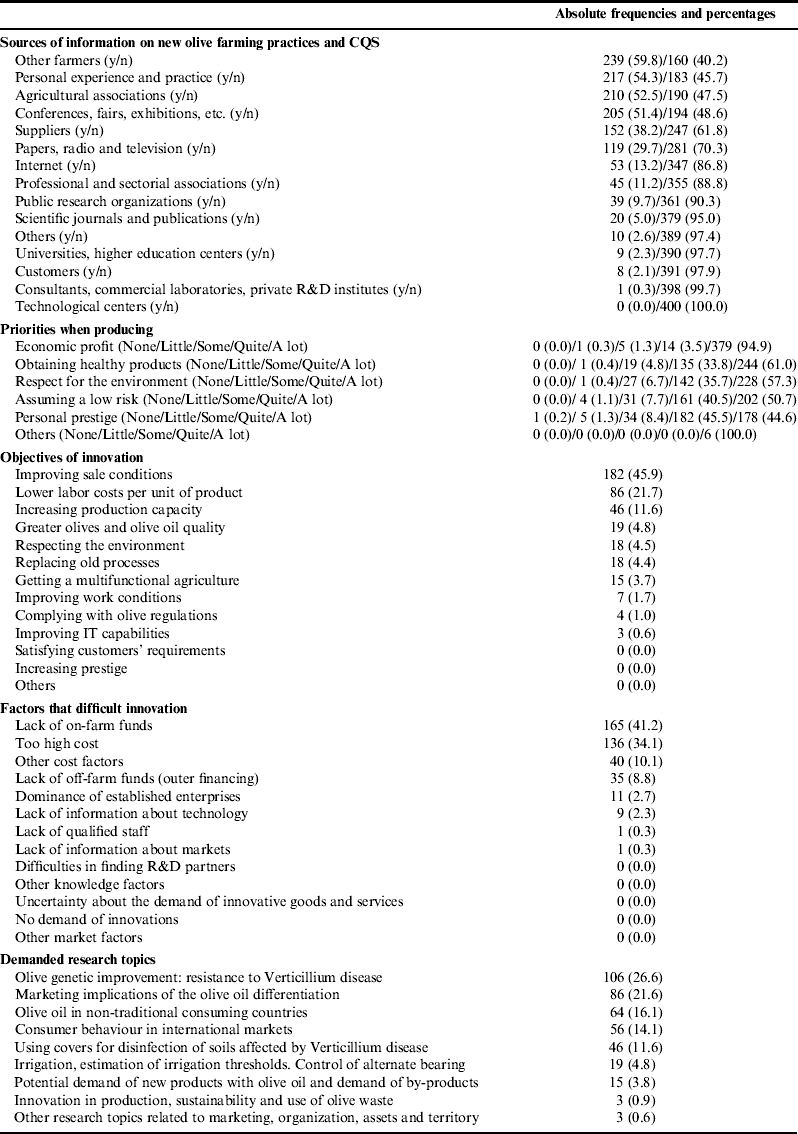
With respect to the attitudes and opinions of olive farmers regarding R&D and innovations (Table 2), on average—without differentiating between IP and non-IP farmers—they find out about new olive farming practices and CQSs mainly through other farmers (59.8% of interviewees), their own personal experience and practice (54.3%), agricultural associations (52.5%) and conferences, fairs, exhibitions, etc. (51.4%). This highlights the importance of personal contact with close sources that are internal to the agricultural system. Other sources of information, which can be considered external, such as customers, consultants, commercial laboratories, private R&D institutes, universities, public research organizations and technological centers are scarcely used; in fact, these are used by less than 10.0% of farmers in all cases. The Internet is cited by 13.2% of interviewees, representing a new means of communication to be exploited in the olive production sector. Otherwise, the main priority of olive farmers as producers is economic profit, since 94.9% of farmers attribute a great deal of importance to this factor. This high consideration for profit seems to determine their opinions on innovation in two ways. First, the objectives that an innovation must pursue, according to farmers (Table 2), mostly refer to the productive function of agriculture, such as improving sale conditions (45.9%), achieving lower labor costs per unit of product (21.7%) and increasing production capacity (11.6%). Second, the factors perceived of as hampering the innovation process are mainly related to financing and costs: lack of funds at the farm (41.2%), high cost (34.1%) and other cost factors (10.1%). Nevertheless, concerns about quality and environment are also important for farmers when producing, such as obtaining healthy products (cited by 61.0%) and respecting the environment (57.3%), as shown in Table 2. Finally, the main research needs identified concern technical questions (genetic improvement for resistance to diseases, 26.6%) and marketing and new markets (olive oil differentiation, 21.6%; non-traditional consuming countries, 16.1%; and international consumer markets, 14.1%).
Attitudes and opinions of Andalusian olive farmers toward innovation.

Note: Figures are absolute frequencies (number of answers) and relative frequencies (% of answers) for (1) yes/no questions; (2) more than two options and single choice questions.
Farming practices associated with IP
The agricultural practices currently implemented in Andalusia under the IP scheme and a comparison with those used by the rest of farmers are summarized in Table 3. Although Picual is the main olive variety used in planting 58 , it is used significantly less by IP farmers than by non-IP ones (62.1 versus 83.7% of farmers, respectively), and conversely Hojiblanca is used more (29.2 versus 4.9%, respectively). Hojiblanca is a milder-flavored variety and has some technical advantages associated with its lesser diffusion in Andalusia, such as less competition for labor at harvest time, fewer fruit set problems and less competition in the market. The Picual variety, on the other hand, presents other important advantages such as higher oil yield, higher rusticity and adaptation to a wider range of conditions, earlier ripening, ease of picking and higher olive stabilityReference Barranco, Barranco, Fernández-Escobar and Rallo 59 . In any case, IP farmers seem to be in a more advantageous position than non-IP farmers to sell to extra-local markets in which a milder flavor could be more appreciated and to explore new consumer niches in the local markets.
Farming practices implemented by IP and non-IP farmers.

1 Corrected Yates χ2 for contingent tables when degree of freedom (d.f.)=1; (2) Pearson χ2 for contingent tables when d.f.>1; (3) χ2 for bivariate logit when proof for contingent tables is not statistically reliable. Significance (sign.): **P≤0.01; * 0.01<P≤ 0.05; n.s.=not significant; y/n=yes/no.
Soil management practices applied by IP farmers are more environmentally friendly since they consist of extending soil cover and reducing bare soil: 75.6% of IP farmers cover the soil compared to 15.4% of non-IP. This could be related, at least in part, to the steeper slope of the areas where IP farms are located, as we will see later, and the fact that soil covering to avoid erosion is a requirement to apply for certain EU agro-environmental subsidies in sloping areas. Irrigation is less widespread among IP farmers (17.3% of IP versus 31.0% of non-IP), which could be related to the presence of IP in more marginal areas. A higher proportion of IP farmers analyzes water quality before irrigation (81.8 versus 26.2% of non-IP), which is highly recommended. Irrigation has some benefits such as increasing production and generating employment because it requires a little more labor. However, it could have some negative environmental impacts associated with water consumption (a limiting production resource in the region), soil erosion and water contamination. Irrigation practices implemented by IP farmers are therefore superior from an environmental point of view, although it is not clear whether they are better overall. Although irrigation is less common among IP farmers, the application of fertilizers through irrigation water is higher (11.7% of the IP versus 4.1% of the non-IP farmers who irrigate) and application to the leaves with a spray is lower (35.3% versus 52.9%). These fertilization practices could have a negative environmental impact, greater in the case of IP farmers. Conversely, the application of phytosanitary treatments is more rational from an agronomic and environmental perspective in the case of IP, since this is done to a greater extent only when the infestation/infection surpasses a determined threshold or in response to expert advice (50.8% of IP versus 21.8% of non-IP farmers). It is worth noting that both types of farmers do implement some recommended practices with no significant differences between them, such as localizing the phytosanitary treatments on the source of infestation (done by less than 4% of both types of farmers).
With regard to harvesting, collecting the fallen olives from the ground through mechanical means is more common among IP farmers (61.2%) than among non-IP ones (35.0%). The use of specific machinery can replace a huge amount of labor and reduce costs for farmers in the long term. In marginal areas, where IP is more common, this could be vital to the survival of olive farms. The separation of the olives picked from ground and trees is also more common for IP farmers (95.3% of IP versus 60.8% of non-IP), which is recommended for obtaining a high-quality olive oil. Management of small pruning offcuts is more rational from an environmental point of view for IP farmers since they shred and incorporate them into the ground more (56.7% of IP versus 21.9% of non-IP) and burn less (41.8 versus 77.5% of non-IP). The remaining practices referring to transport, pruning and management of other by-products are not statistically different for IP and non-IP farmers, with one noteworthy common factor being the scarce use of boxes when transporting the olives, which is recommended to avoid their deterioration and a subsequent decrease in quality.
Adoption factors of IP
Differences between the farmers and farms using IP and the rest can be related to and serve to explain the adoption of IP (Fig. 2). With regard to the characteristics, attitudes and opinions of farmers (Table 4), both types are mainly owner and active farmers (91.0% of IP and 92.4% of non-IP) although there are more IP producers who are tenants (9.0 versus 2.2% of non-IP). IP farmers play more of a dual role on the farm, doing management and physical work simultaneously (91.3 versus 77.2% of non-IP), whereas performing, exclusively, management duties or physical activities is more frequent in the case of non-IP. This indicates that IP farmers are more wholeheartedly dedicated to agriculture. Moreover, IP farmers belong more frequently than the rest to agricultural cooperatives (96.8% of IP versus 77.8% of non-IP), PDO schemes (34.8 versus 12.3%) and, logically, associations of IP farmers (69.0 versus 1.7%) although less to agricultural unions (3.7 versus 14.3%). This indicates that IP farmers are, in general, more connected to professional networks, which are some of the most important sources of information for Andalusian olive farmers, as discussed previously. It must also be highlighted that both types of farmers, with no significant differences, are mainly middle-aged and older (46–65 years), male, with primary level education, experienced in agriculture (11–30 years) and wholly or mainly reliant on agriculture for their income. In line with their greater involvement in professional networks, the sources of information of IP producers are based to a greater extent on agricultural associations (93.3 versus 44.3% of non-IP) and other farmers (80.6 versus 55.7%), that is, to say, sources that are internal to the production system, and less on their personal experience and practice (32.7 versus 58.6%) and external sources such as suppliers (6.0 versus 44.7%), papers, radio and television (13.1 versus 33.0%), and public research organizations (0.0 versus 11.6%). This highlights the importance of personal contact with other farmers and agricultural associations as a source of information for IP farmers, and the relatively low importance of sources outside the production system. Although their priorities as producers and the objectives of innovation for both types of farmers are not different, these mainly being linked to economic and productive aspects as shown previously, they differ on the factors that hamper the innovation and the topics that need to be researched. Thus, high cost is the main factor that hinders the innovation for IP farmers (49.4% compared to 31.1% of non-IP), whereas lack of funds at the farm is the most important factor cited by non-IP farmers (44.1% compared to 26.9% of IP). This could be related to the extra costs that IP implantation and implementation can entail and this is highlighted by those who have already adopted IP and the potentially lower financial solvency of non-IP farmers. With respect to their research demands, IP farms are more interested in market-related topics, such as consumer behavior in international markets and the marketing implications of olive oil differentiation, and less on technical issues, such as genetic improvement, irrigation, etc. This highlights the greater focus of IP farmers on new and international markets.
Characteristics, attitudes and opinions of IP and non-IP farmers.

1 Corrected Yates χ2 for contingent tables when degree of freedom (d.f.)=1; (2) Pearson χ2 for contingent tables when d.f.>1; (3) χ2 for bivariate logit when proof for contingent tables is not statistically reliable. Significance (sign.): **P≤0.01; *0.01<P≤0.05; n.s.=not significant; y/n=yes/no.
With respect to the structural characteristics of farms (Table 5), the most important differences are that IP farms are located to a greater extent than non-IP ones in less favored areas on steeper slopes (mainly medium for IP versus low for non-IP), thus they are less productive on average (mainly 2000–6000 kg olives ha−1 versus 4000–8000 for non-IP), and are more often managed in a traditional non-intensive way (97.6 versus 82.4% of non-IP). In addition, IP farms use ‘family labor supplemented with wage earners’ more (60.4 versus 42.5% of non-IP) and ‘exclusively wage-earner labour’ less. In terms of destination, the olives produced by IP farmers are more frequently destined to cooperative mills (94.9 versus 72.3% of non-IP) and less to independent olive mills (5.1 versus 27.7% of non-IP), which is in accordance with their higher membership to agricultural cooperatives as shown above.
Structural characteristics of IP and non-IP farms.

1 Corrected Yates χ2 for contingent tables when degree of freedom (d.f.)=1; (2) Pearson χ2 for contingent tables when d.f.>1; (3) χ2 for bivariate logit when proof for contingent tables is not statistically reliable. Significance (sign.): **P≤0.01; * 0.01<P≤0.05; n.s.=not significant; y/n=yes/no.
Discussion
Quality differentiation and certification are key issues for the future of the olive agrofood sector. The competitiveness of the olive-growing sector depends heavily on the adaptation capacity of its economic agents to the changing conditions of the markets and the institutional environment. Issues such as food quality, protection of the environment, good farming practices, survival of the rural world and sustainability of agriculture have been incorporated over recent decades into the demands of an increasing number of consumers and citizens in generalReference Parra-López, Calatrava-Requena and De Haro-Giménez 23 . This phenomenon, especially notable in developed countries, the main destination of olive oil, is the result of changes in demographic and socio-cultural variables, consumer attitudes and the development of new lifestylesReference Padilla, Villalobos, Spiller and Henry 60 . In the supply part of the agrofood chain, diverse CQSs have been emerging since the 20th century as institutional innovationsReference Ruttan and Hayami 61 induced, among other factors, by technical changes such as the availability of new production techniques, and alterations in the demand of consumers. A farmer adopting a CQS is the outcome of a complex push and pull process of simultaneously acting forces, consisting of not only final consumers but also intermediate customers and the farmer's own management practicesReference Djekic, Tomasevic and Radovanovic 62 . IP stands out in the Andalusian olive-growing sector as a CQS backed by public regulations, which certifies the quality of the product as a result of the implementation of a set of farming practices intended to be more sustainable, environmentally friendly, profitable, fair for farmers and healthy for consumers. IP allows qualities that are ‘extrinsic to the product’, such as biodiversity conservation, to be introduced into the commodity through monitoring at the point of productionReference Mutersbaugh 63 . IP farming practices may represent a technological innovation for many farmers in the sense that they are techniques that are not commonly known and used.
The results corroborated the higher quality of IP olive products and processes since IP is associated with a wider use of better farming practices from an agronomic, environmental and/or economic perspective, despite IP farms being located in less favored regions. This is in agreement with other previous studiesReference Gómez-Limón and Arriaza-Balmón 18 , Reference Parra-López, Calatrava-Requena and De Haro-Giménez 23 , Reference Parra-López, Calatrava-Requena and De Haro-Giménez 47 which highlight the higher performance of IP both overall and for each of the three dimensions of sustainability: economic, social and environmental (especially the latter of these). However, we cannot conclude that the higher quality of IP olive growing is due to the IP requirements per se, but rather to the manner in which the IP practices are really implemented within the restrictions which the IP norm imposes. Indeed, as previously stated, the IP olive norm is not completely fixed and allows some degree of flexibility, since some practices are only recommended. The majority of IP olive farmers interviewed implement agricultural practices in accordance with IP regulations, as is logical. If some mandatory/forbidden farming practice is not respected by a farmer and this is detected by control measures, the field technician performing the check can take provisional measures, up to and including the withdrawal of IP certification. Our results, however, must be interpreted carefully, since the study was carried out for the main Andalusian olive zone and average conditions. In other scenarios of productivity, climate, etc., the results may change and need to be further investigated in order to fine-tune policy designReference Gómez-Limón and Arriaza-Balmón 18 . Moreover, our methodological approach entails some simplifications and assumptions, as for any model. It does not allow us to determine, for example, the direct effect of adoption factors on the practices implemented, but rather only the indirect effect of adoption factors, through the adoption of IP, on these practices, nor have potential inner relationships among adoption factors, or among practices, been taken into account. All these issues remain as further refinements for future research.
This research also confirms the scarce knowledge of adoption of, and intention to adopt, most of the CQSs by the Andalusian olive farmers. The reason may be the fact that, logically, although they acknowledge the importance of obtaining healthy products and respecting the environment, their main priority is their economic profit as producers, and they perceive the adoption of technological innovations in general as costly processes they cannot afford due to lack of funds. With regard to their information channels, olive farmers seem to be entrenched in a relatively closed information system where ‘contagion’ of information among themselves and close sources is the main diffusion driver. The importance of interpersonal contact and contagion in the diffusion of IP, which was also pointed out in some previous studies on organic olive growing in AndalusiaReference Parra-López, De Haro-Giménez and Calatrava-Requena 46 , highlights the ‘information-intensive’ nature of the process and the practical complexity of this innovation. In the current market conditions, in which consumers are demanding new food products that are safer and more sophisticated, while private businesses and the public sector try to recover credibility and consumer confidence, those most affected are the small-scale producers and processors, since they have had to confront additional costs related to quality assuranceReference Padilla, Villalobos, Spiller and Henry 60 . Special emphasis should therefore be placed on the benefits of adopting CQS in the medium to long term, such as improved competitiveness and higher product qualityReference Jatib 64 . Farmers need to be aware that the quality is in increasing demand in the markets and that the economic benefits of adopting a CQS can exceed the costs of its implementationReference Fotopoulos and Krystallis 35 , Reference Juntunen and Salo 65 , Reference Karipidis, Athanassiadis, Aggelopoulos and Giompliakis 66 . Improved access to credit would probably also increase the adoption of CQS, although this depends on macroeconomic conditions, and expectations regarding the current context of global crisis are not clear. Credit could be channeled through agricultural associations to which Andalusian olive farmers are especially related. Apart from this, a change in mentality is required of farmers, who need to be convinced of the multiple functions of agriculture and the environmental and social benefits of IP insofar as it can condition the legitimacy of public support for agriculture in the near future. The efforts of external R&D institutions, both public and private, to tackle this knowledge transfer to the sector should be encouraged and a greater connection of these institutions with the internal networks of information for farmers is advisable, since the economic success of farmers adopting CQS may depend on them attending training programsReference Kourouxou, Siardos, Iakovidou and Kalburtji 67 . Public institutions in particular should increase their involvement and support in the diffusion of IP due to the greater sustainability of this farming system and the improved welfare of society as a whole. Given the importance of interpersonal contact among farmers for the diffusion of this complex innovation, demonstrations of the experience of those who have already adopted IP could be an effective way of communicating and stimulating other farmers. Furthermore, alternative communication channels should be explored and encouraged, such as the use of IT for educating and training farmers, which is currently hardly used. However, given the socio-demographic characteristics of Andalusian olive farmers (mainly 46–65 years old and with primary level education), the widespread use of alternative channels may be a strategy confined to the medium to long term. This highlights, moreover, the importance of policies for the rejuvenation and formal education of the sector. Some of the factors that can explain the relative success of the diffusion of IP in the Andalusian olive-growing sector are the more complete and professional dedication of IP farmers to agriculture, their stronger links with professional networks, their greater presence in marginal areas where the olive is managed in a family-based, traditional and non-intensive manner and where the adoption of a CQS can represent an important strategy to compete in the market through the certification of quality, and their greater orientation toward new markets.
The demand part also needs important improvement. In effect, despite IP market and demand being one of the research topics most demanded by farmers, the lack of specific studies on this aspect is patent. More information is needed about the acceptance and demand for IP in national and international markets and consumers’ willingness to pay. Although the available data indicate that IP has a moderate share of Andalusian agricultural production, it is not known which part of this production is finally marketed as IP and at what prices. This information, which is available for other CQSs such as organic agriculture and PDO, can be decisive for farmers when considering whether to adopt a quality system. Lack of market acceptance can be a major obstacle for the development of agrofood certificationReference Fan, Ye, Zhao, Tian, Qi and Busch 68 . Research on other CQSs indicates that it is necessary to stimulate ‘quality culture’ among consumers. Indeed, levels of knowledge and perception of quality are very low in the olive marketsReference Baptista and Biswas 33 , Reference Navarro-García, Ruiz-Avilés, Jiménez-Herrera, Barea-Barea, Penco-Valenzuela and Vázquez-Cobo 39 . The act of educating and informing consumers is therefore one of the most important strategies to further boost the consumption and development of CQSs. In the specific case of IP, emphasis should be placed on its overall quality, that is to say, on the environmental and social benefits above and beyond the higher intrinsic quality of the product, which lead to greater sustainability in the production process and the greater welfare of society as a whole.
Conclusions
This paper aims to fill a patent gap in the literature regarding: (1) the underlying factors conditioning the adoption of IP in the Andalusian olive-growing sector, i.e., the most relevant CQS in the most important olive-producing region worldwide; and (2) the comparison of the farming practices really implemented by adopters and non-adopters of IP and their adequacy from an agronomic, environmental and economic perspective. The results confirm the hypothetically higher quality of IP olive agriculture due to the implementation of better farming practices, which are, in general, more sustainable, environment friendly, profitable, fair for farmers and healthy for consumers. The IP practices regarded as especially good are those related to soil management, irrigation, phytosanitation and harvesting. However, certain good practices are scarcely used by IP farmers and there is room for improvement, including the application of fertilizers to the leaves with spray, localizing the phytosanitary treatments on the source of infestation and the use of sacks for transporting the olives.
The results highlight the high impact on farmers’ behavior of sources of information internal to the agricultural system, such as other farmers, self-study, agricultural associations, etc., and the low importance of external sources, such as technological centers, consultants, commercial laboratories, private R&D institutes, customers, universities and public research organizations. Moreover, a lack of orientation of the farmers toward the rest of the agrofood system is patent, since they do not pursue the objective of satisfying customers’ requirements when innovating. Further extending the diffusion of innovations in general and CQS in particular would require bringing information closer to farmers in an accessible manner. The work of R&D institutions should focus more closely on this aspect. Information should meet the R&D needs of the sector, especially those linked to technical and marketing questions, and contribute to clarifying their financial concerns by emphasizing the medium- to long-term improved competitiveness of IP. The environmental and social benefits of IP need to be appreciated by farmers as an added value increasingly demanded by consumers and society in general. The importance of promoting the professionalization and rejuvenation of the sector is also patent. Finally, we should also highlight the need for further research and development in the market and in the demand for IP.
Acknowledgements
The authors acknowledge the Spanish Institute for Agricultural Research and Technology (INIA) and the European Regional Development Fund (FEDER) through the ECOINNOLI project (grant no. RTA2008-00024) and to the Andalusian Ministry of Innovation, Science and Enterprise through the MULTIOLI project (grant no. PAIDI P07-SEJ-03121) for their financial support in this research.