Introduction
Auditory hallucinations are frequently reported by a large proportion of patients with diagnoses in the schizophrenia spectrum (Slade & Bentall, Reference Slade and Bentall1988; Ditman & Kuperberg, Reference Ditman and Kuperberg2005). Numerous studies have shown that they can also affect patients with other psychiatric diagnoses such as bipolar disorder, affective disorders and post-traumatic stress disorder (Aleman & Larøi, Reference Aleman and Larøi2008), and that individuals with no psychiatric or neurological diagnoses also report hallucinations with similar phenomenological characteristics to those observed in clinical samples (e.g. Honig et al. Reference Honig, Romme, Ensink, Escher, Pennings and DeVries1998; Serper et al. Reference Serper, Dill, Chang, Kot and Elliot2005). This has led researchers to view hallucinations as a dimensional phenomenon existing on a continuum with normal functioning (e.g. van Os et al. Reference van Os, Hanssen, Bijl and Ravelli2000, Reference van Os, Linscott, Myin-Germeys, Delespaul and Krabbendam2009). Similarly, numerous studies have shown that the vulnerability to experience hallucinations represents a trait-like disposition that can be reliably measured in non-clinical samples using hallucination-proneness measures (e.g. the revised Launay-Slade Hallucination Scale; Bentall & Slade, Reference Bentall and Slade1985b).
A number of models have been proposed to explain the mechanisms involved in the aetiology of hallucinations (Aleman & Larøi, Reference Aleman and Larøi2008; Waters et al. Reference Waters, Allen, Aleman, Fernyhough, Woodward, Badcock, Barkus, Johns, Varese, Menon, Vercammen and Larøi2012a). Although these accounts often point to the involvement of different cognitive mechanisms, there is general consensus that hallucinations arise from the misattribution of internally generated cognitive events to external agents or sources (Hoffman, Reference Hoffman1986; Bentall, Reference Bentall1990; Frith, Reference Frith1992; Larøi & Woodward, 2007). Amongst the most empirically researched accounts of hallucinatory experiences, self-monitoring theories proposed that hallucinations (as well as other passivity phenomena) arise from disruption in the capacity to monitor the intention to produce certain actions (including acts of inner speech), possibly reflecting defective efference copy-corollary discharge mechanisms (Feinberg, Reference Feinberg1978; Frith & Done, Reference Frith and Done1988; Ford & Mathalon, Reference Ford and Mathalon2005). Such deficits are believed to disrupt the expected association between actions (e.g. inner speech) and the sense that actions are self-initiated, therefore resulting in reduced ability to recognize thoughts and actions as self-generated. Consistently with these accounts, experimental studies have documented associations between self-recognition deficits and auditory hallucinations in patients with diagnoses in the schizophrenia spectrum. A recent meta-analysis of these experimental studies has revealed that psychotic patients are characterized by poorer self-recognition performance compared with healthy controls, and that these deficits appear more pronounced among psychotic patients with auditory verbal hallucinations (Waters et al. Reference Waters, Woodward, Allen, Aleman and Sommer2012b).
It has been argued that self-recognition deficits alone are unable to account for the process of misattribution of internally generated events to external sources that may underlie hallucinatory experiences (Waters et al. Reference Waters, Allen, Aleman, Fernyhough, Woodward, Badcock, Barkus, Johns, Varese, Menon, Vercammen and Larøi2012a, Reference Waters, Woodward, Allen, Aleman and Sommerb). The central role of these attribution processes in the aetiology of hallucinations, and the psychological, emotional and environmental factors that may bias these processes were first considered by Bentall (Reference Bentall1990), who outlined an influential model of hallucinatory experiences within a source-monitoring framework. Source monitoring refers to a set of meta-cognitive processes used to make inferences about the origin of internally and externally generated events (Johnson et al. Reference Johnson, Hashtroudi and Lindsay1993). According to this account, hallucination-prone individuals are not just impaired in their capacity to discriminate between internally and externally generated events, but also present a specific cognitive bias towards the misattribution of internal cognitive events to external sources (Bentall, Reference Bentall1990). Since the introduction of this cognitive model, several studies have examined whether hallucinatory experiences and non-clinical hallucination proneness are associated with this hypothesized externalizing bias using a variety of experimental tasks. Although empirical studies have adapted this model to the study of hallucinations in a variety of sensory modalities (e.g. Brébion et al. Reference Brébion, Ohlsen, Pilowsky and David2008; Arguedas et al. Reference Arguedas, Stevenson and Langdon2012), the majority of the available studies focused on auditory hallucinations and have employed three distinct experimental paradigms: the auditory signal detection paradigm, the verbal self-monitoring paradigm and the source-monitoring paradigm.
Auditory signal detection paradigms are used to investigate the capacity of individuals to detect stimuli in situations of uncertainty, such as detecting specific auditory signals (e.g. voices) against background noise. This experimental procedure generally requires participants to listen to recordings of white noise. A pre-recorded voice is presented in the white noise at different points during the task, and participants are required to indicate the detection of a voice. According to signal detection theory (SDT), the performance in these tasks is influenced by two parameters that can be estimated from a participant's observed pattern of responding: perceptual sensitivity (i.e. the capacity to accurately detect a signal when it is present) and response bias (the individual's willingness to assume that a signal is present under conditions of uncertainty). Studies which employed auditory SDT paradigms have regarded elevated estimates of response bias as a measure of the tendency to misattribute internally generated cognitions to external sources. These studies generally revealed that both non-clinical hallucination-proneness (e.g. Bentall & Slade, Reference Bentall and Slade1985a; Barkus et al. Reference Barkus, Stirling, Hopkins, McKie and Lewis2007; Varese et al. Reference Varese, Barkus and Bentall2011) and psychotic hallucinations (e.g. Bentall & Slade, Reference Bentall and Slade1985a; Varese et al. Reference Varese, Barkus and Bentall2012) are associated with a greater response bias, but not to perceptual sensitivity deficits, a finding that has been interpreted as supporting the involvement of externalizing biases in hallucinatory experiences.
The other two paradigms used to examine the association between externalizing biases and hallucinatory experiences (i.e. verbal self-monitoring and source-monitoring tasks) require participants to make attributions regarding the source of self-generated material. Although these tasks have frequently been used to investigate self-recognition deficits in hallucination-prone samples (as considered in the recent meta-analysis by Waters et al. Reference Waters, Woodward, Allen, Aleman and Sommer2012b), several studies have also examined the participants' observed pattern of responding in these tasks to test whether hallucination-prone individuals present an externalizing bias, i.e. a tendency for misidentifying self-generated material as generated by an external source.
The verbal self-monitoring paradigm is an experimental procedure involving the direct measurement of the on-line monitoring of self-generated speech (Johns et al. Reference Johns, Rossell, Frith, Ahmad, Hemsley, Kuipers and McGuire2001). In a typical experiment, participants are asked to pronounce out loud a list of word stimuli into a microphone. Certain auditory features of the participants' speech, for example pitch, are then distorted, and the speech is played back to the participants. At various points in the experiment, the participants are presented with someone else's pre-recorded voice pronouncing the same stimuli. After each trial, participants are requested to identify the source of the auditory feedback (self or other). Several verbal self-monitoring studies revealed that hallucinating patients attribute their own self-generated speech to external sources more frequently than non-hallucinating clinical controls (e.g. Johns et al. Reference Johns, Rossell, Frith, Ahmad, Hemsley, Kuipers and McGuire2001). Consistent with the notion that the discrimination between internal and external perceptions would be particularly impaired under conditions of perceptual ambiguity (Bentall, Reference Bentall1990), these studies documented stronger effects when auditory feedback was distorted. Despite these consistent findings, a number of published studies have failed to identify significant association between self-to-other misattributions errors and hallucinations (e.g. Versmissen et al. Reference Versmissen, Janssen, Johns, McGuire, Drukker, Campo, Myin-Germeys, Van Os and Krabbendam2007).
The source-monitoring paradigm differs from the signal detection and verbal self-monitoring approaches because participants are asked to distinguish between memories of self-generated material (e.g. words) and memories of externally generated stimuli (Johnson et al. Reference Johnson, Hashtroudi and Lindsay1993). Although several studies have tested for associations between hallucinations and internal source monitoring (i.e. by using ‘say/think’ tasks involving the discrimination of words that participants had previously spoken out loud or just read silently, a process sometimes knows as reality monitoring; Harvey, Reference Harvey1985), only external source-monitoring studies (i.e. tasks involving the discrimination between stimuli that were generated by the subject or externally presented) are informative of externalizing biases that could account for the attribution of self-generated percepts to sources other than the self. In the typical task, participants are provided with a list of externally presented cue words (e.g. words read out loud by the experimenter). For each cue, participants are required to generate a word associate. After a delay, participants are asked to complete a word recognition task including the words generated by the participant, the externally presented cues and new words. Participants are therefore requested to indicate whether the word presented is old or new, and whether it was self-generated or externally provided. With some notable exceptions (e.g. Seal et al. Reference Seal, Crowe and Cheung1997; Bendall et al. Reference Bendall, Jackson and Hulbert2011), several investigations have revealed significant associations between hallucinations and self-to-other misattributions in both clinical (e.g. Bentall et al. Reference Bentall, Baker and Havers1991) and analogue samples (e.g. Larøi et al. Reference Larøi, van der Linden and Marczewski2004), but failed to observe significant associations with other types of misattribution errors (e.g. other-to-self errors).
Despite inconsistent findings, recent narrative reviews (Ditman & Kuperberg, Reference Ditman and Kuperberg2005; Larøi & Woodward, 2007; Aleman & Larøi, Reference Aleman and Larøi2008; Waters et al. Reference Waters, Allen, Aleman, Fernyhough, Woodward, Badcock, Barkus, Johns, Varese, Menon, Vercammen and Larøi2012a) have generally corroborated the link between externalizing biases as assessed by the above-mentioned tasks and clinical and non-clinical hallucination-proneness. However, no quantitative review has yet substantiated such claims. The present research synthesis aims to integrate and examine the consistency of experimental findings from the above-mentioned tasks. In line with findings suggesting that similar processes may underlie both clinical hallucinations and non-clinical hallucination-proneness, the present review included both clinical and non-clinical investigations, and systematically contrasted the effects observed in these two groups of studies. As the three tasks considered in this review present substantial methodological differences, we examined both aggregated and task-specific effects to compare the magnitude of the effects observed in studies that employed different paradigms. Finally, as misattribution errors in several source-monitoring and self-monitoring studies have been reported to be more likely when emotionally valenced rather than neutral stimuli are used (possibly due to the disruptive effect of emotional arousal on the encoding processes required to accurate source identification; Ditman & Kuperberg, Reference Ditman and Kuperberg2005; Aleman & Larøi, Reference Aleman and Larøi2008), we examined these effects separately in studies for which it was possible to decompose the influence of negative, positive and neutral stimuli on misattribution errors.
Method
Literature search and eligibility criteria
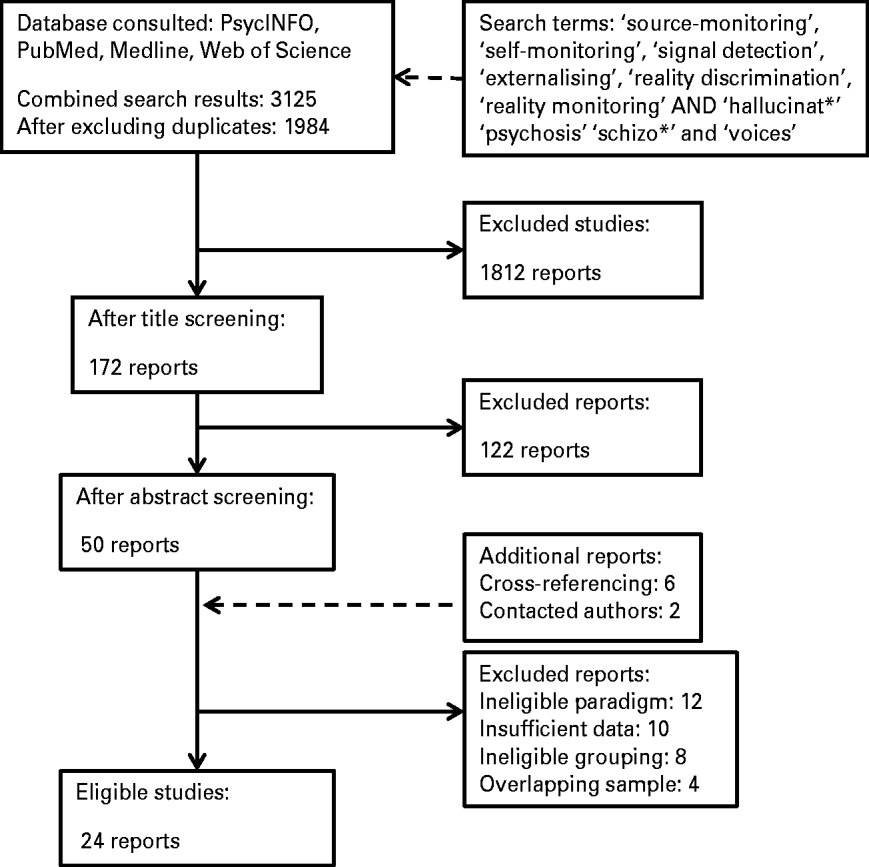
A database search was conducted on Medline, PsycINFO, PubMed and ISI Web of Science for reports available between January 1985 and March 2012. A summary of the database search and the screening process is presented in Fig. 1. The examination of the reference lists of studies deemed eligible for the research synthesis was used to identify any articles that had not been identified through the computerized search. All corresponding authors of the selected studies were also contacted to ascertain whether there was any additional recently published or unpublished report that may be eligible for the analyses. Studies which met the following criteria were considered eligible: (i) the report was in English; (ii) the study examined the relationship between externalizing bias measures (i.e. self-to-other misattribution errors in the case of source-monitoring and self-monitoring studies, and response bias parameters in the case of SDT studies) and hallucinations or hallucination-proneness using auditory SDT, source-monitoring or verbal self-monitoring tasks; (iii) the study employed either a between-group or a correlational design; and (iv) in studies reporting between-group designs, clearly defined comparisons between hallucination-prone and comparable non-prone participant groups (i.e. hallucinating versus non-hallucinating psychotic patients; hallucination-prone versus non-prone non-clinical participants) were required. Clinical studies were considered eligible if they included samples with diagnoses of psychotic disorder (first-episode psychosis, schizophrenia, schizo-affective disorder, delusional disorder or psychotic disorder not otherwise specified). Studies that compared patients with and without Schneiderian or positive symptoms in general rather than hallucinations specifically were excluded. The corresponding authors of articles lacking sufficient statistical information to estimate effect sizes comparable with other reported studies were invited to supply the additional data required to ascertain eligibility and permit the calculation of effect sizes. The authors of studies published more than 15 years prior to the literature search were not contacted as informal inquiries suggested that researchers rarely kept data in an accessible format for such a long period. In cases where the required information was not obtained, the study under scrutiny was excluded from the research synthesis.
Flowchart describing the literature search and screening stages.

Effect size computation and integration method
The effect size calculations and statistical analyses were carried out using Comprehensive Meta-Analysis version 2 (http://www.meta-analysis.com/index.html). Hedges'g (Hedges, Reference Hedges1981) was used as the main effect size metric for the analyses. Hedges'g was computed from the reported group means, standard deviations and sample sizes. When these descriptive statistics were not available, effects of the d-family were estimated from alternative statistics (i.e. p values, t values, correlation coefficients). When no overall effect was available for studies with multiple comparisons of interest (e.g. different emotional valence of stimuli), each group difference was coded individually and then merged prior to inclusion in the main analysis. In the self-monitoring studies as well as source-monitoring studies involving presentations of auditory stimuli presenting different levels of distortion of auditory stimuli (e.g. none, moderate and severe), only the severe distortion results were coded as this was deemed to be the most appropriate comparison for the analysis. For clinical studies, only effects pertaining to the hallucinating versus non-hallucinating patients contrast were estimated. For non-clinical publications where group differences between low, medium and high hallucination-prone samples were reported, only the effect sizes of the low versus high-prone contrast were computed to increase comparability with other reported studies.
Random-effects meta-analysis was used to integrate the extracted effects. First, the summary effect of the association between externalizing bias and hallucination-proneness was estimated irrespective of type of task and type of sample (i.e. clinical versus non-clinical) considered. Second, subgroup analyses were carried out to explore systematic differences between clinical and non-clinical studies, and between studies adopting different experimental paradigms (source-monitoring versus verbal self-monitoring versus auditory SDT). Third and finally, subgroup analyses were carried out on self-monitoring and source-monitoring tasks for which it was possible to examine separately the effect of emotionally valenced and neutral stimuli. For all analyses, heterogeneity statistics (Q test and I 2) were used to examine the amount of statistical inconsistency in the effects considered. Publication bias assessment was carried out using the Egger test for funnel plot asymmetry (Egger et al. Reference Egger, Davey Smith, Schneider and Minder1997). When appropriate, the ‘trim-and-fill’ method (Duval & Tweedie, Reference Duval and Tweedie2000) was employed to correct the results for the potential influence of publication bias or other selection bias. Finally, influence analyses were carried out to determine whether any of the studies included exerted undue influence on these meta-analytic findings.
Results
Literature review results
The database search yielded 3125 studies. A three-step procedure was followed to ascertain eligibility. After eliminating duplicates and examining for relevance of titles (step 1), and screening the remaining abstracts to ascertain potential eligibility (step 2), 50 papers were retained. A total of six records were identified through cross-referencing, and two unpublished reports were made available by the contacted researchers. Examination of the article's full text (step 3) led to the exclusion of 34 papers for the following reasons: insufficient data to calculate effect size (n = 10); unsuitable symptomatic grouping (n = 8); overlapping samples (n = 4); ineligible experimental task (n = 12).
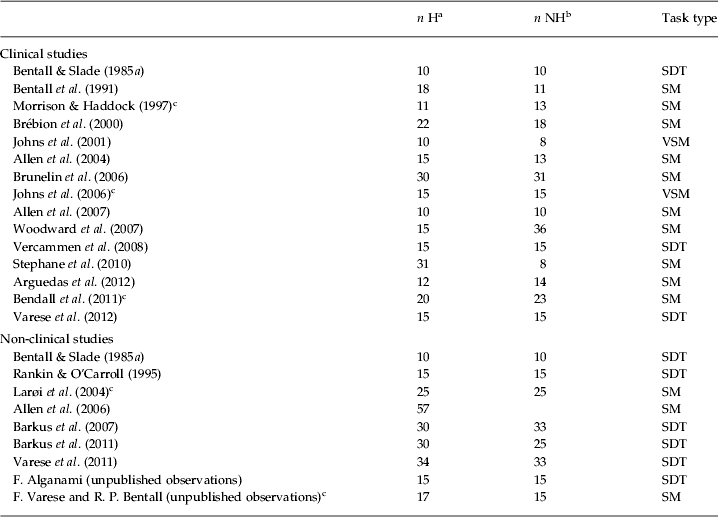
The final sample (Table 1) comprised 15 clinical studies with a total of 489 patients (240 hallucinating patients; 249 non-hallucinating patients), and nine analogue studies with a total of 347 participants (171 hallucination-prone participants; 176 non-prone participants; 57 participants in a correlational study).
Eligible studies included in the meta-analysis
SDT, Auditory signal detection task; SM, source-monitoring task; VSM, verbal self-monitoring task.
a n H is the sample size of the hallucinating patients (in the case of clinical studies) or the hallucination-prone (in the case of non-clinical studies) group.
b n NH is the sample size of the non-hallucinating patients (in the case of clinical studies) or the non-prone (in the case of non-clinical studies) group.
c Report contributing to the comparison of effects of emotional stimuli analysis.
d Study reporting correlational effects only.
Statistical analysis of total sample
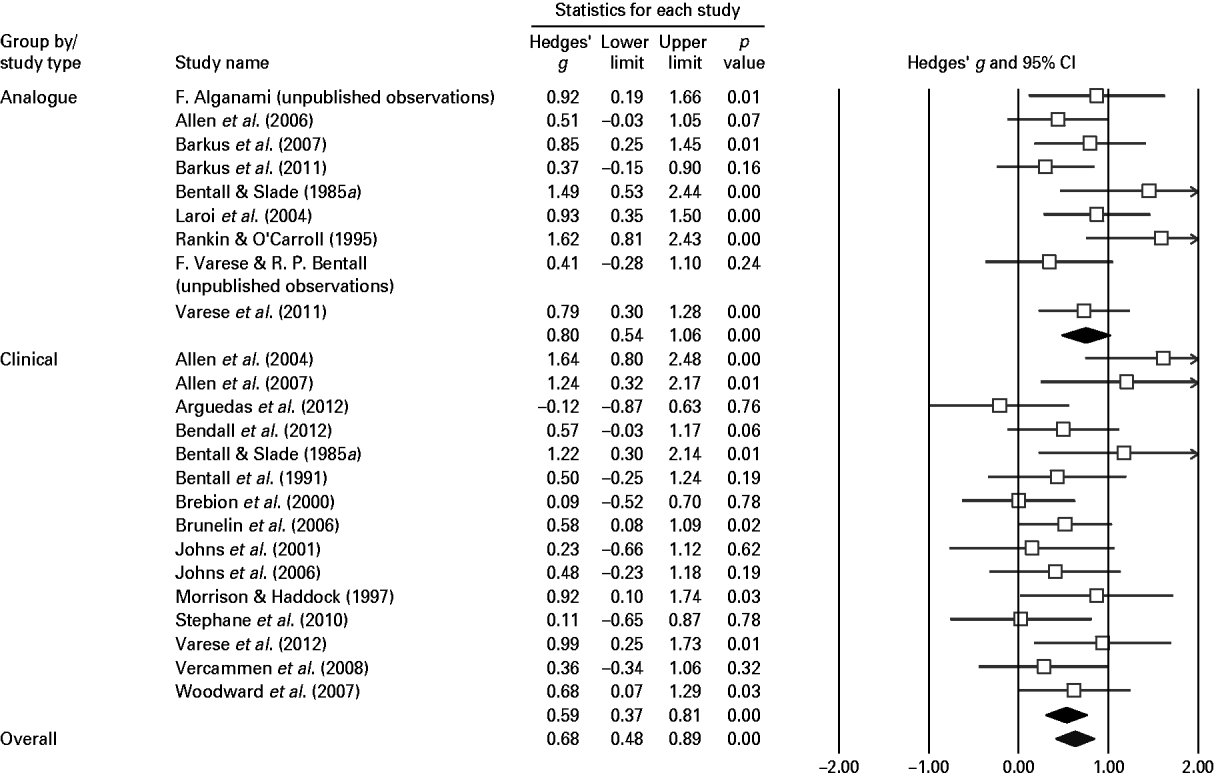
The results of the aggregated analysis (and clinical versus non-clinical subgroup analysis) are displayed in Fig. 2. The analysis revealed a significant association with a summary effect of 0.68 [95% confidence interval (CI) 0.48–0.89, p < 0.001]. Based on Cohen's (Reference Cohen1988) criteria, this indicates a moderate-to-large association between hallucinations and increased externalizing bias. Heterogeneity analyses indicated that the observed inconsistency of the effects could be accounted for by sampling error alone (Q 22 = 33.11, p > 0.05). This was quantified by an I 2 value of 33.56%, which corresponds to a low-to-moderate heterogeneity estimate according to existing conventions (Higgins et al. Reference Higgins, Thompson, Deeks and Altman2003).
Forest plot of the aggregated analysis, stratified by study type (clinical versus non-clinical). CI, Confidence interval.
Subgroup analyses
Subgroup analyses indicated that the association between hallucination-proneness and externalizing bias was robust and significant in both clinical (k = 15, g = 0.59, 95% CI 0.46–0.82, p < 0.001) and analogue studies (k = 9, g = 0.80, 95% CI 0.54–1.06, p < 0.001). The difference between these summary effects was not significant (mean difference = 0.21, p = 0.22). Heterogeneity statistics indicated that the observed effects were homogeneous in both the clinical (Q 13 = 20.29, p = 0.10, I 2 = 31.01%) and the non-clinical subgroup (Q 9 = 10.96, p = 0.12; I 2 = 27.03%).
The results of subgroup analyses that tested for systematic differences due to the use of different types of experimental tasks found robust and significant associations between hallucination-proneness and externalizing bias measures in SDT (k = 9; g = 0.87, 95% CI 0.60–1.14, p < 0.001) and source-monitoring studies (k = 13; g = 0.54, 95% CI 0.31–0.76, p < 0.001). However, the combined effect for verbal self-monitoring was not significant (g = 0.38, 95% CI –0.17 to 0.93, p = 0.17). Due to the small number of verbal self-monitoring studies found to be eligible in the analysis (k = 2), only SDT and source-monitoring studies were included in the analysis testing for significant differences in summary effects. The contrast was not significant (Q 1 = 2.47, p = 0.12). Low heterogeneity was observed in all analyses (SDT: Q 8 = 10.99, p = 0.20, I 2 = 27.26%; source monitoring: Q 8 = 17.89, p = 0.09, I 2 = 28.52%; for verbal self-monitoring tasks heterogeneity statistics were not carried out due to the low number of eligible studies).
Comparison of effects of emotional valence of stimuli
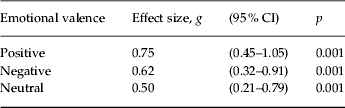
Statistical information to compare the magnitude of the effects observed in source-monitoring and self-monitoring studies that employed neutral and emotionally valenced stimuli was available for five reports. Table 2 summarizes the mean effect sizes corresponding to the three types of stimuli considered (i.e. negative, positive and neutral stimuli). As the samples used to estimate these effects overlapped, it was impossible to directly contrast the effect of emotionally valenced and neutral stimuli. Although the analyses found larger effects for positive and negative stimuli relatively to neutral ones, these summary effects fell within the moderate and large benchmarks of the criteria proposed by Cohen (Reference Cohen1988)
Mean effect sizes for positive, negative and neutral stimuli
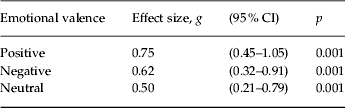
CI, Confidence interval.
Publication bias assessment and sensitivity analyses
For the analyses carried out on the aggregated sample, Egger's test was not significant (p = 0.10), indicating that the results from the aggregated analysis were not influenced by publication bias or other selection bias. However, Egger's test was significant in the analogue subgroup analysis (p = 0.05), and in the analysis of studies that employed auditory SDT tasks (p = 0.04). The application of the trim-and-fill method did not alter the pattern of findings reported in these analyses (i.e. two missing studies were estimated for the analogue subgroup, leading to an adjusted g = 0.67, 95% CI 0.48–0.87, p < 0.001, whereas three hypothetically missing studies where estimated for the synthesis conducted on the SDT studies, leading to an adjusted summary effect of 0.70, 95% CI 0.40–0.99, p < 0.001).
Influence analyses (carried out separately for the aggregated sample and subgroup analyses reported above) indicated that none of the included studies exerted undue influence on the results of this research synthesis. Sensitivity analysis revealed that the inclusion of two unpublished reports did not substantially alter the findings of the aggregated sample or the subgroup analyses. As the subgroup analyses revealed a non-significant summary effect in studies using verbal self-monitoring tasks, the aggregated sample analysis was re-run after excluding self-monitoring studies to determine the impact of their inclusion on the analysis. This did not substantially alter the findings of the aggregated analysis (g = 0.70, 95% CI 0.52–0.88, p < 0.001; Q 21 = 31.97, p > 0.05; I 2 = 34.31%).
Discussion
The findings from the aggregated and subgroup analyses revealed positive associations between hallucination-proneness and biased capacity to discriminate between internally and externally generated events, with both hallucinating patients and non-clinical hallucination-prone individuals displaying increased tendency to misattribute internally generated events compared with non-prone counterparts. Moderate-to-large effects of comparable magnitude were observed across both SDT and source-monitoring studies. Conversely, the summary effect observed in verbal self-monitoring studies was found to be statistically negligible, possibly due to the limited number of self-monitoring studies for which it was possible to extract sufficient statistical information relevant to the current review. The present study provides evidence of a consistent bias in the ability to discriminate between internally and externally generated perceptions in hallucination-prone individuals. The observation of substantial effects in studies comparing hallucinating and non-hallucinating patients suggests that these cognitive biases are not diagnostic-specific, but are accounted for by the presence of hallucinatory experiences. Furthermore, the observation of externalizing biases in non-clinical hallucination-prone participants indicates that these deficits might not be exclusively ascribed to clinical hallucinations. Rather, externalizing biases might represent a trait-like vulnerability to both clinical and non-clinical hallucinatory experiences, and suggest that similar cognitive processes might underlie hallucination-proneness across the psychosis continuum.
The comparable effects observed in source-monitoring and SDT studies, and the low heterogeneity estimates observed in the corresponding aggregated and subgroup analyses, suggest that these paradigms might be assessing biases in a common cognitive domain, and demonstrate similar capacity to measure such bias. However, given the substantial differences existing between these paradigms, it is unlikely that SDT and source-monitoring tasks might be tapping into identical cognitive mechanisms. Rather, performance in both tasks might be affected by common top-down influences that could contribute to the formation of hallucinatory experiences. Further research is required to investigate the relationship between externalizing bias estimates from source-monitoring, self-monitoring and SDT tasks, and determine whether these make independent contributions to hallucination-proneness.
It has been previously argued that externalizing biases might be more readily observable in studies employing experimental tasks involving real-time discrimination between internally and externally generated stimuli (i.e. self-monitoring and SDT tasks) compared with ‘delayed’ tasks (source-monitoring tasks; Ditman & Kuperberg, Reference Ditman and Kuperberg2005). This hypothesis was not fully supported by the present findings. As only two self-monitoring studies were found to be eligible in the present review, it was impossible to contrast this kind of task to the other paradigms considered. Although a large summary effect was observed in the analysis of SDT studies, this was not significantly larger than the moderate summary effect observed in source-monitoring studies. Previous narrative reviews also highlighted that misattribution errors may be more prevalent for emotionally valenced stimuli compared with neutral stimuli, possibly due to disruption of the coding processes necessary for accurate source discrimination (Ditman & Kuperberg, Reference Ditman and Kuperberg2005; Aleman & Larøi, Reference Aleman and Larøi2008). The statistical information necessary to carry out such analysis was available only for one verbal self-monitoring (Johns et al. Reference Johns, Gregg, Allen and McGuire2006) and four source-monitoring studies (Morrison & Haddock, Reference Morrison and Haddock1997; Larøi et al. Reference Larøi, van der Linden and Marczewski2004, Bendall et al. Reference Bendall, Jackson and Hulbert2011; F. Varese and R. P. Bentall, unpublished observations). The present findings revealed effects of similar magnitude for misattribution errors of emotional and neutral stimuli (i.e. negative and positive stimuli led to slightly larger effects compared with neutral stimuli, but all effects fell within the moderate-to-large benchmarks of the criteria proposed by Cohen, Reference Cohen1988). However, these results should be interpreted with caution, as it was impossible to directly contrast these effects.
Although the present findings suggest that externalizing biases are an important cognitive underpinning of hallucinatory experiences, it is yet unclear whether they might be also involved in other symptoms that frequently covary with hallucinations (such as delusional ideation, passivity phenomena and intrusive thinking). It has been argued that the use of appropriate methodological and statistical control is essential to the evaluation of symptom-specific mechanisms underling psychotic symptoms (Bentall, Reference Bentall2003; Varese & Bentall, Reference Varese and Bentall2011). In the only available study which used a factorial design to separate cognitive factors specifically associated with hallucination-proneness from those related to co-morbid symptoms (i.e. intrusive thoughts), the externalizing bias was found to be related to hallucinatory predisposition only (Varese et al. Reference Varese, Barkus and Bentall2011). Further clinical and analogue studies adopting similar designs are required to ascertain whether these cognitive biases can be specifically ascribed to hallucinations or might be alternatively involved in other psychotic complaints.
The results of the present research synthesis clarify previously reported mixed results. It can be argued that mixed findings can be partially accounted for by the clinical heterogeneity of the samples considered in the published literature, which might have overshadowed substantial associations between misattribution biases and hallucination-proneness. A number of studies were excluded from the present meta-analysis as only comparisons between psychotic (but not necessarily hallucinating) patients and healthy controls were considered (e.g. Moritz et al. Reference Moritz, Woodward and Ruff2003; Fisher et al. Reference Fisher, McCoy, Poole and Vinogradov2008). Other excluded studies grouped participants according to presence of positive Schneiderian symptoms rather than hallucinations specifically (e.g. Keefe et al. Reference Keefe, Arnold, Bayen and Harvey1999; Anselmetti et al. Reference Anselmetti, Cavallaro, Bechi, Angelone, Ermoli, Cocchi and Smeraldi2007), or non-clinical psychosis-prone and non-prone groups rather than groups specifically differing on hallucination-proneness measures (e.g. Versmissen et al. Reference Versmissen, Janssen, Johns, McGuire, Drukker, Campo, Myin-Germeys, Van Os and Krabbendam2007). The focus of the present synthesis on effects reflecting differences between hallucination-prone and comparable non-prone samples might have contributed to reducing error stemming from clinical heterogeneity, therefore allowing the observation of substantial effects.
Other potential sources of bias were not fully accounted for in the present study, and will therefore require further scrutiny in future research. The studies included in the present review varied considerably in terms of the symptom characteristics used to define the hallucinating and non-hallucinating groups (e.g. differences in cut-offs used on hallucination scales; different duration criteria for the absence of hallucinations in control groups). It would have been desirable to examine separately the effects from studies that compared hallucinating patients with patients with identical diagnoses and no lifetime history of hallucinatory experiences; however, only two clinical studies were found eligible for such an analysis (Johns et al. Reference Johns, Gregg, Allen and McGuire2006; Varese et al. Reference Varese, Barkus and Bentall2012). Although previous source-monitoring and self-monitoring studies found that hallucinations were specifically associated with self-to-other misattribution errors rather than other misattribution indices (e.g. other-to-self errors), the specificity of this association was not tested in the present meta-analysis. Finally, the estimations of effect size for the source-monitoring tasks included in this review were based on the descriptive statistics for self-to-other misattribution errors as reported in the primary studies. It has been recently argued that the analysis of this source-monitoring errors prevents the discrimination of confounding guessing processes from the externalizing biases believed to underlie hallucinatory experiences, and that more sophisticated statistical methods are required to remove the influence of external-source guessing rates (Woodward & Menon, Reference Woodward and Menon2011). Future studies should corroborate the link between externalizing biases and hallucination-proneness when these confounds are accounted for.
In conclusion, our research synthesis complements previous meta-analytic findings of the cognitive underpinnings of hallucinatory experiences (Waters et al. Reference Waters, Woodward, Allen, Aleman and Sommer2012b), and speaks to the importance of both self-recognition impairments and the cognitive biases towards the misattribution of internally generated events to external sources in the aetiology of hallucinations (Bentall, Reference Bentall1990; Larøi & Woodward, 2007). Although it has been proposed that externalizing biases might be secondary to self-recognition deficits (Waters et al. Reference Waters, Allen, Aleman, Fernyhough, Woodward, Badcock, Barkus, Johns, Varese, Menon, Vercammen and Larøi2012a), the robust effects observed in the present study highlight their importance for a cognitive understanding of hallucinatory phenomena. Future empirical studies should consider the possible interactions between externalizing biases and other cognitive (Waters et al. Reference Waters, Allen, Aleman, Fernyhough, Woodward, Badcock, Barkus, Johns, Varese, Menon, Vercammen and Larøi2012a) and psychological processes (e.g. dissociative processes; Perona-Garcelán et al. Reference Perona-Garcelán, Carrascoso-López, García-Montes, Vallina-Fernández, Pérez-Álvarez, Ductor-Recuerda, Salas-Azcona, Cuevas-Yust and Gómez-Gómez2011; Varese et al. Reference Varese, Barkus and Bentall2012) involved in the aetiology of clinical and non-clinical hallucinatory experiences.
These findings have several clinical implications. Interventions that include techniques to reduce bias in the capacity to discriminate between internal and external percepts could be beneficial to the treatment of auditory hallucinations. Recent studies have evaluated the use of cognitive remediation techniques to compensate for source-monitoring biases (Favrod et al. Reference Favrod, Vianin, Pomini and Mast2006; Subramaniam et al. Reference Subramaniam, Luks, Fisher, Simpson, Nagarajan and Vinogradov2012), although the evidence for the efficacy of these interventions in terms of symptom amelioration is mixed. The findings of the current study call for further convergent evidence to determine the efficacy of these interventions and their applicability to the treatment of hallucinations. The findings of the present study could also inform psychoeducational components included in psychosocial interventions for voices. These components should stress that hallucinations are understandable in terms of normal psychological processes used to discriminate between internal and external perceptions, and may also draw from the growing literature on the factors known to influence source memory and discrimination processes in healthy individuals. This may promote a more normalizing and less distressing understanding of hallucinatory phenomena, and set the basis for the implementation of strategies encouraging an understanding of hallucinations as internally generated cognitive events, as already implemented in existing cognitive–behavioural interventions for distressing voices (Morrison et al. Reference Morrison, Renton, Dunn, Williams and Bentall2003).
Acknowledgements
The authors would like to thank all corresponding authors of the primary studies who kindly provided additional information regarding their published and unpublished studies: Paul Allen, Deborah Arguedas, Emma Barkus, Sarah Bendall, Frank Larøi, Tony Morrison, Louise Johns, Richard Stevenson, Flavie Waters and Todd S. Woodward.
Declaration of Interest
None.