Significant outcomes
∙ The data support the hypothesis that NMDA blockade induces an antidepressant-like effect that requires mTOR but not Trk signalling into the vmPFC-PL. Moreover, the antidepressant-like effect induced by local NOS inhibition seems to be independent on both Trk and mTOR signalling in the vmPFC-PL.
Limitations
∙ Only one behavioural test, the FST was carried out.
No dose-dependent effects were demonstrated.
Introduction
Major depression is the leading cause of debilitation in the world, thus being associated with severe morbidity and an increased risk of mortality (1). Current drug treatments are still suboptimal due to low efficacy and delay in inducing significant clinical effects, what highlights the importance on research aimed at finding new drugs with better antidepressant profile (Reference Hindmarch2,Reference Browne and Lucki3).
The glutamatergic system has been the focus of intense investigation in the search for the development of new antidepressant drugs. It is well documented in the literature that systemic treatment with NMDA antagonists induces antidepressant-like effects in different preclinical animal models (Reference Browne and Lucki3–Reference Zarate and Machado-Vieira5). Moreover, groundbreaking studies showed that a single injection of the NMDA antagonist ketamine induces fast (within 4 h) and long-lasting (up to 7 days) antidepressant effect in humans (Reference Berman, Cappiello, Anand, Oren, Heninger, Charney and Krystal6,Reference Zarate, Singh, Carlson, Brutsche, Ameli, Luckenbaugh, Charney and Manji7) and in animals (Reference Li, Lee, Liu, Banasr, Dwyer, Iwata, Li, Aghajanian and Duman8,Reference Li, Liu, Dwyer, Banasr, Lee, Son, Li, Aghajanian and Duman9), which have been consistently replicated by different research groups (reviewed by Pereira and Hiroaki-Sato (Reference Pereira and Hiroaki-Sato10)).
The fast antidepressant-like effect induced by NMDA receptor antagonists is associated with a rapid increase in brain-derived neurotrophic factor (BDNF) synthesis in the hippocampus (Reference Autry, Adachi, Nosyreva, Na, Los, Cheng, Kavalali and Monteggia11) and in the prefrontal cortex (PFC) (Reference Lepack, Fuchikami, Dwyer, Banasr and Duman12). The main actions of BDNF are mediated by tyrosine kinase B receptor (TrkB) activation, leading to intracellular activation of the mechanistic target of rapamycin (mTOR) (Reference Martinowich and Lu13,Reference Minichiello14). Interestingly, mTOR blockade by rapamycin injection into the medial PFC abrogates ketamine-induced antidepressant-like effects (Reference Li, Lee, Liu, Banasr, Dwyer, Iwata, Li, Aghajanian and Duman8,Reference Lepack, Fuchikami, Dwyer, Banasr and Duman12). Therefore, it has been suggested that the fast antidepressant effect induced by NMDA antagonists is related to increased BDNF-TrkB-mTOR signalling in the PFC and/or Hippocampus (HPC, reviewed by Pereira and Hiroaki-Sato 2018 (Reference Pereira and Hiroaki-Sato10)).
NMDA activation by glutamate can trigger nitric oxide (NO) synthesis in the brain, which is an important neurotransmitter involved in the modulation of behavioural responses to stress (Reference Guix, Uribesalgo, Coma and Munoz15–Reference Calabrese, Mancuso, Calvani, Rizzarelli, Butterfield and Stella18). Similar to NMDA blockade, systemic inhibition of the neuronal NO synthase (nNOS) reduces NO levels in the brain and promotes antidepressant-like effects in rodents exposed to different preclinical models (Reference Harkin, Bruce, Craft and Paul19–Reference Wegener and Volke21). Evidence from our research group suggests that blocking NMDA receptors and NO synthesis within brain regions that are dysfunctional in depression, such as the prelimbic part of the ventromedial prefrontal cortex (vmPFC-PL) (Reference Pereira, Romano, Wegener and Joca22) and the hippocampus (Reference Hiroaki-Sato, Sales, Biojone and Joca23,Reference Diniz, Casarotto and Joca24), also induces antidepressant-like effects. Furthermore, evidence suggests that BDNF may be involved in the antidepressant-like effect induced by nNOS inhibitors since chronic treatment with NOS inhibitors increases BDNF levels in the hippocampus (Reference Yazir, Utkan and Aricioglu25–Reference Stanquini, Biojone, Guimaraes and Joca29). Although it has been recently shown that NO can play a role in ketamine effects (Reference Liebenberg, Joca and Wegener30,Reference Harraz, Tyagi, Cortes and Snyder31), it is not yet known whether the antidepressant-like effects induced by nNOS inhibitors would involve BDNF-TrkB-mTOR signalling in the mPFC-PL.
Therefore, due to the importance of neuroplasticity mechanisms in depression and the role of vmPFC-PL in these conditions (Reference Myers-Schulz and Koenigs32), the aim of the present work was to investigate if TrkB and mTOR signalling in the vmPFC-PL is involved in the antidepressant-like effect induced by local and systemic administration of nNOS inhibitors.
Material and methods
Animals
Male Wistar rats weighing 230–270 g (7–8 weeks old) at the beginning of each experiment were housed in pairs in acrylic cages (570 cm2) in a temperature-controlled room (25±1◦C), under standard laboratory conditions with free access to food and tap water, and at 12 h light/12 h dark cycle (lights on at 06:30 a.m.). All animals were kept in the same room with the aforementioned conditions for at least 1 week before the start of each experiment. Each cage had bedding material made of wooden chips. The animal colony and all experimental facilities were protected from outside noise. The behavioural procedures were carried out in specially equipped rooms in the animal facility between 08:00 a.m. and 12:00 p.m. All animals were randomly assigned to the experimental groups and all behavioural analyses were performed by an evaluator that was blind to the treatment conditions (see supplementary materials for further details).
Ethical standards
The authors assert that all procedures contributing to this work comply with the ethical standards of the relevant national and institutional guides on the care and use of laboratory animals. Procedures were conducted in conformity with the Brazilian Council for Control of Animal Experimentation (COBEA) and the ARRIVE guidelines (Reference Kilkenny, Browne, Cuthill, Emerson and Altman33) for the care and use of laboratory animals, which comply with international laws and politics. Additional information about the experimental procedures accordingly to the ARRIVE guidelines is given in the supplementary material. The protocols described herein have been approved by the local Ethical Committee (CEUA 12.1.235.53.2) and all efforts were made to minimise animal suffering.
Drugs
The following drugs were used: LY 235959 (LY, Tocris), selective ligand binding NMDA receptor antagonist; Ketamine (Cristália – Brazil), NMDA receptor antagonist (channel blocker); 7-nitro-indazole (7-NI, Sigma-Aldrich), nNOS inhibitor; N5-[Amino(propylamine)methyl]-L-ornithine hydrochloride (NPA, Tocris), selective nNOS inhibitor; Rapamycin (LC Laboratories), mTOR inhibitor; K252a (Sigma-Aldrich), Trk receptor antagonist; human recombinant BDNF, rhBDNF (Promega), TrkB receptor agonist. All drugs were diluted in sterile isotonic saline or 50% polyethyleneglycol (50% PEG) immediately before use. Dose range of each drug was based on previous reports or preliminary experiments in the laboratory, where also no behavioural differences between the vehicles (50% PEG vs. saline) was previously shown (see Supplementary Fig. 4.1). Systemic injections were performed at 1 ml/Kg and intra vmPFC-PL injections were performed at a flow rate of 1 µl/min.
Stereotaxic surgery
Stereotaxic surgery was performed as previously described by Pereira et al. (Reference Pereira, Romano, Wegener and Joca22) Briefly, 7 days before the experiment, animals were anaesthetised with 2,2,2-Tribromoethanol (2.5%, 1 ml/100 g) and fixed in a stereotaxic frame. After scalp anesthesia with 3% lidocaine, rat skull was surgically exposed and stainless-steel guide cannulas (26 G) were implanted bilaterally in the PL using a stereotaxic apparatus (Stoelting, Wood Dale, IL, USA) after drilling holes according to the desired coordinates. Further details on the surgery procedure and the coordinates used are provided in the Supplementary Material. The volume of all injections was 0.2 μl/side, administered during 1 min using an infusion pump (Insight, Brazil). After the forced swim test (FST), animals were sacrificed under deep anesthesia (chloral hydrate 5% – 10 ml/Kg), then a trans-cardiac perfusion with saline followed by formaldehyde (10%) was performed. After the trans-cardiac perfusion, a dye was injected (Evans Blue – VETEC) into the cannula to assess placement and rat brains were removed for histological analyses of the injection sites. Animals infused outside the vmPFC-PL were excluded from all statistical analyses. Approximately 15% of the animals were excluded from the experiments given to misplacement of the guide cannulas.
Forced swim test
Animals were evaluated in the FST in a similar protocol based on Ref.(Reference Porsolt, Le Pichon and Jalfre34) with modifications previously described (Reference Pereira, Romano, Wegener and Joca22,Reference Joca and Guimaraes35,Reference Kirkedal, Wegener, Moreira, Joca and Liebenberg36). Animals were initially placed individually to swim in plastic cylinders (30 cm diameter by 70 cm height containing 30 cm of water at 25±1°C) for 15 min (pre-test). Twenty-four hours later, the animals were submitted to a 5 min session of forced swimming (test). The test session was recorded, and an observer who was blind to the treatments measured the time in which animals remained immobile.
Open field test
The open field test (OFT) was carried out in a wooden square arena (72 cm ×72 cm ×40 cm high, divided into 16 squares of 18 cm ×18 cm), in a temperature-controlled room (24±1°C), illuminated with three 40 W fluorescent bulbs placed 3 metres above the apparatus. Rats were videotaped inside the arena for 5 min and the number of total squares crossed was counted as a measure of locomotor activity by an observer who was blind to the treatments (Reference Pereira, Romano, Wegener and Joca22,Reference Scopinho, Scopinho, Lisboa, Correa, Guimaraes and Joca37).
Western-blotting
The expression of TrkB (total and phosphorylated – pTrkB – protein levels) and mTOR (total and phosphorylated – pmTOR – protein levels) was determined by western-blotting (WB) according to previous works (Reference Li, Lee, Liu, Banasr, Dwyer, Iwata, Li, Aghajanian and Duman8,Reference Li, Liu, Dwyer, Banasr, Lee, Son, Li, Aghajanian and Duman9,Reference Autry, Adachi, Nosyreva, Na, Los, Cheng, Kavalali and Monteggia11). After revealing the membranes, the values of optical density to each sample were normalised by the values of the controls and the data are presented as percentage of the control group. Further details on the WB procedure are given in the Supplementary Material.
Experimental design
Effects of K252a or Rapamycin pretreatments on LY 235959 and NPA effects in rat vmPFC.
Experiment 1A: The antidepressant-like effects of LY 235959 or NPA microinjection into the vmPFC-PL of animals exposed to the FST were shown previously (Reference Pereira, Romano, Wegener and Joca22).Thus, the present experiment aimed to investigate if the effects induced by the blockade of NMDA receptors or NO synthesis in the vmPFC-PL would involve TrkB and mTOR signalling. Therefore, an independent group of animals received a bilateral microinjection of K252a or vehicle, 5 min before LY 235959, NPA or vehicle injection into the vmPFC-PL. Five minutes after LY 235959 or NPA microinjection, animals were exposed to the test session. A second independent group of animals received a bilateral microinjection of rapamycin or vehicle 5 min before LY 235959, NPA or vehicle injection into the vmPFC-PL and was exposed to FST 5 min later.
Experiment 1B: To evaluate if BDNF administration would induce the same fast effect (within 5 min), under the same conditions, through TrkB and mTOR activation, an independent group of animals received a bilateral microinjection of K252a; rapamycin or vehicle 5 min before BDNF or vehicle injection. Five minutes after BDNF’s bilateral microinjection, the animals were exposed to the test session of FST.
To exclude the influence of false-positive results, the OFT was conducted as a control experiment to evaluate the possible influence of excessive motor activity of rats treated with the effective dose of BDNF into the vmPFC-PL.
Effects of K252a or Rapamycin pretreatment into the vmPFC-PL on Ketamine and 7-NI induced effects in rats exposed to the FST.
Experiment 2A: Since it was previously shown that the antidepressant-like effect of the NMDA antagonist (ketamine) is dependent on TrkB and mTOR activation in the vmPFC (Li et al., 2010), this experiment was designed to investigate if the same signalling pathway is involved in the antidepressant-like effects induced by systemic nNOS inhibition with 7-NI. Instead of using LY235959 or NPA for systemic experiments, we used ketamine and 7-NI, to compare our data to previous published works.
The first independent group of animals received a bilateral microinjection of K252a, rapamycin or vehicle 5 min before the intraperitoneal (i.p.) injection of ketamine or vehicle. Sixty minutes after ketamine injection, the animals were exposed to the test session. A second independent group of animals received a bilateral microinjection of K252a, rapamycin or vehicle 5 min before the intraperitoneal injection of 7NI or vehicle. Sixty minutes after 7-NI i.p injection, the animals were exposed to the test session of FST. To exclude the influence of false-positive results, the open field test was conducted as a control experiment. Thus, an independent group of animals received an i.p. injection of ketamine, 7-NI or vehicle 1 h before being exposed to the OFT.
Experiment 2B: to investigate if the lack of effect in the previous experiment was due to a long time between drug injection into the mPFC and testing (60 min), we performed a new experiment with administration of BDNF, K252a and rapamycin 60 min before FST. Therefore, animals received an intra-mPFC injection of K252a, rapamycin or vehicle followed, 5 min later, by a second injection of saline or BDNF. Sixty minutes later, all animals were exposed to FST.
Experiment 2C: To investigate ketamine and 7-NI effects on TrkB, pTrkB, mTOR and pmTOR levels. Thus, an independent group of animals was submitted to the pretest and received an i.p. injection of ketamine,7-NI or vehicle, and were killed at the moment of the= test (23 h later). Their mPFC were collected with a punch needle and processed for WB analysis. An experimentally naive group was killed and the samples from the mPFC were collected with a punch needle.
Data analysis
All statistical analyses were performed with GraphPad Prism version 5.01 for Windows (GraphPad software, San Diego, CA, USA). The results were analysed as group means by one-way ANOVA, followed by Dunnett’s post hoc test. Differences with p<0.05 were considered significant. Bartlett’s test for equal variances was applied to verify normality and homogeneity of variances. Grubb’s test was carried out to detect outliers.
Results
Effects of K252a or Rapamycin pretreatments on LY 235959 and NPA effects in rat vmPFC.
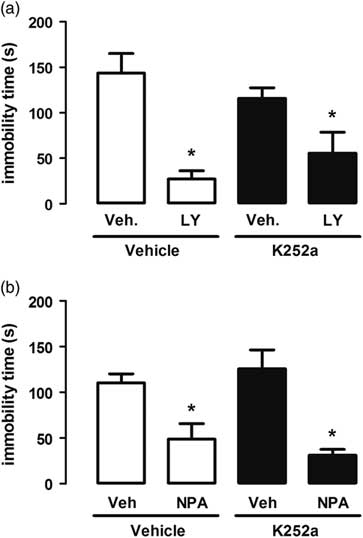
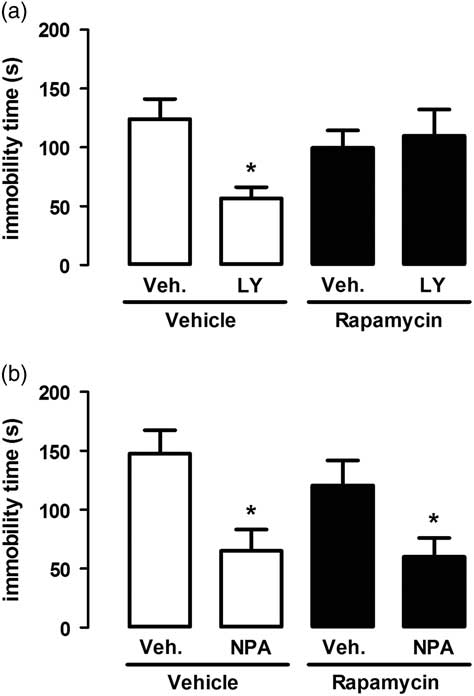
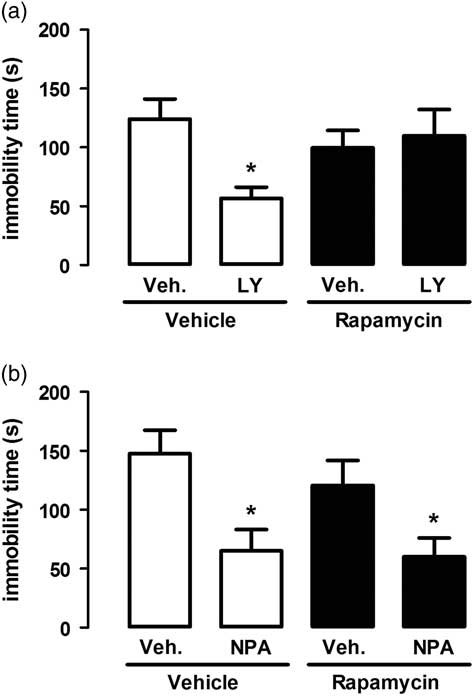
Experiment 1A: The injection of LY 235959 (10nmol/0.2ul/side – (Reference Pereira, Romano, Wegener and Joca22,Reference Benveniste and Mayer38) or NPA (0.01nmol/0.2ul/side – (Reference Pereira, Romano, Wegener and Joca22) reduced the IT in the FST. Pre-treatment with K252a (0.01nmol/0.2ul/side – (Reference Casarotto, Santos, Lucas, Biojone, Pobbe, Vilela-Costa, Joca, Guimaraes and Zangrossi39) did not induce any behavioural changes per se, nor did it change the effects induced by LY 235959 (F(Reference Browne and Lucki3,Reference Harkin, Bruce, Craft and Paul19)=9.241; p<0.05; Dunnett, p<0.05) (Fig. 1a) or by NPA (F(Reference Browne and Lucki3,Reference Calabrese, Mancuso, Calvani, Rizzarelli, Butterfield and Stella18)=11.35; p<0.05; Dunnett, p<0.05) (Fig. 1b). Pre-treatment with rapamycin (0.2nmol/0.2ul/side – (Reference Li, Lee, Liu, Banasr, Dwyer, Iwata, Li, Aghajanian and Duman8)) did not induce any behavioural changes per se, but it was capable of blocking LY 235959 effects (F(Reference Browne and Lucki3,Reference Wegener and Volke21)=3.083; p<0.05; Dunnett) (Fig. 2a). However, rapamycin pretreatment did not change the effect induced by NPA (F(Reference Browne and Lucki3,Reference Pereira, Romano, Wegener and Joca22)=5310; p<0,05; Dunnett) (Fig. 2b). The dose–response experiment used to determine the most effective dose of NPA is shown in the supplementary material (Supplementary Fig.1).
(a) Effects of NMDA antagonist injection (LY 235959) in rats pretreated with a Trk receptor antagonist (K252a) into the vmPFC-PL; n=5–6. (b) Effects of the nNOS inhibitor (NPA) in rats pretreated with a Trk receptor antagonist (K252a) into the vmPFC-PL; n=5–6. The IT was measured 5 min after the injection of LY 235959. *p<0.05; Dunnett’s posttest. Data represent mean±SEM

(a) Effects of NMDA antagonist injection (LY 235959) in rats pretreated with an mTOR inhibitor (rapamycin) into the vmPFC-PL; n=5–7. (b) Effects of the nNOS inhibitor (NPA) in rats pretreated with an mTOR inhibitor (Rapamycin) into the vmPFC-PL; n=6–7. The IT was measured 5 min after the injection of LY 235959. *p<0.05; Dunnett’s posttest. Data represent mean±SEM
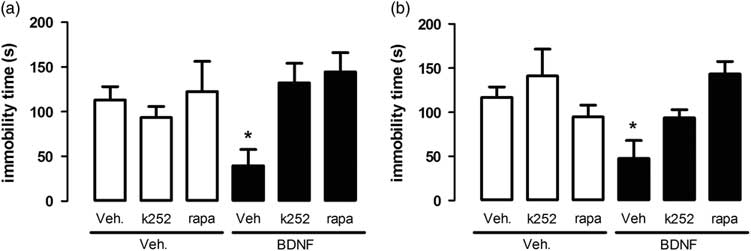
Experiment 1B: Bilateral microinjection of BDNF (0.2 nmol/0.2 µl/side – (Reference Casarotto, Santos, Lucas, Biojone, Pobbe, Vilela-Costa, Joca, Guimaraes and Zangrossi39)) into vmPFC-PL 5 min before the FST significantly reduced the IT of the animals. K252a (0.01nmol/0.2ul/side), injected intra vmPFC-PL, 5 min before BDNF injection, obliterated its effects. Similar results were observed with the intra vmPFC-PL injection of rapamycin (0.2nmol/0.2ul/side) (F(Reference Zarate and Machado-Vieira5,Reference Pereira, Romano, Wegener and Joca22)=4.777; p<0,05; Dunnett; Fig. 3a). The dose–response experiment used to determine the most effective dose of NPA is shown in Supplementary Fig. 2. Bilateral injection of BDNF into the vmPFC-PL did not modify rat exploratory activity in the OFT (Supplementary Fig. 5).
(a) Effects of K252a, rapamycin or vehicle administration, 5 min before BDNF or vehicle microinjection, over the IT of rats exposed to the FST, *p<0.05 compared to vehicle group, Dunnett’s post-test; n=4–6. The IT was measured 5 min after the injection of BDNF. b Effects of K252a, rapamycin or vehicle administration, 5 min before BDNF or vehicle microinjection, over the IT of rats exposed to the FST. *p<0.05 compared to vehicle group, Dunnett’s posttest; n=4-6. The IT was measured 60 min after the injection of BDNF or vehicle. Data represent mean±SEM.

Effects of K252a or Rapamycin pretreatment into the vmPFC-PL on Ketamine or 7-NI intraperitoneal injection effects
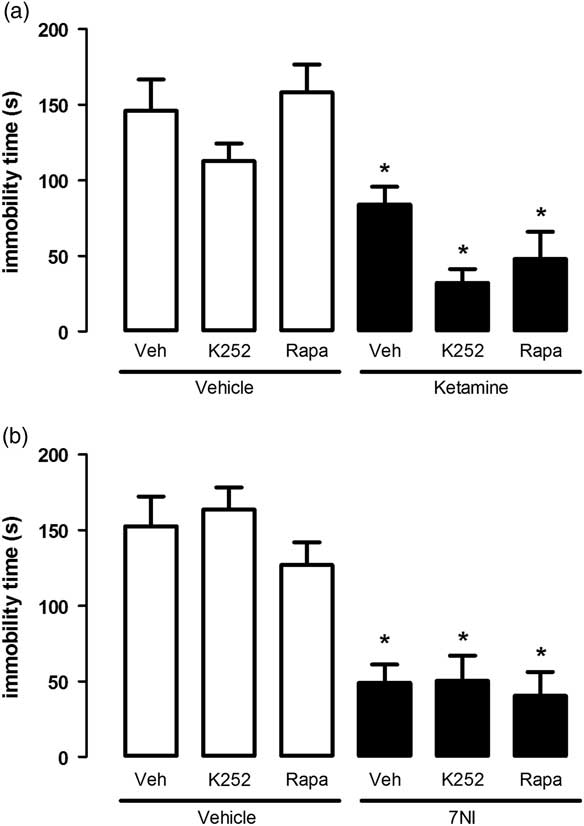
Experiment 2A: Systemic injection of ketamine (10 mg/kg (Reference Li, Lee, Liu, Banasr, Dwyer, Iwata, Li, Aghajanian and Duman8)) reduced the IT on the FST, but pre-treatment with K252a (0.01nmol/0.2ul/side) or rapamycin (0.2nmol/0.2ul/side) did not induce any changes per se, nor did it change the effects induced by ketamine (F(Reference Zarate and Machado-Vieira5,Reference Joca, Ferreira and Guimaraes27)=10.17; p<0.05; Dunnett; Fig. 4a). Systemic injection of 7-NI (30 mg/kg (Reference Yildiz, Erden, Ulak, Utkan and Gacar20,Reference Silva, Aguiar, Diniz, Guimaraes and Joca40) also reduced the IT in the FST, but neither K252a nor rapamycin induced any alterations, nor changed the effects induced by 7-NI (F(Reference Zarate and Machado-Vieira5,Reference Liebenberg, Joca and Wegener30)=13,40; p<0.05; Dunnett; Fig. 4b). The dose–response experiments used to determine the most effective doses of ketamine and 7-NI are shown in the supplementary material (Supplementary Figs 3 and 4, respectively). Systemic injection of ketamine (10 mg/kg) or 7-NI (30 mg/kg) did not modify rat exploratory activity in the OFT (Supplementary Fig.6).
(a) Effects of systemic injection of an NMDA antagonist (Ketamine) in rats pretreated with a mTOR inhibitor (Rapamycin) or with a Trk receptor antagonist (K252a) into the vmPFC-PL; n=5–6. (b) Effects of systemic injection of a selective nNOS inhibitor (7-NI) in rats pretreated with a mTOR inhibitor (Rapamycin) or with a Trk receptor antagonist (K252a) into the vmPFC-PL; n=5–8. The injections into vmPFC-PL were performed 5 min before the systemic injections. The IT was measured 60 min after the systemic injection. *p<0.05; Dunnett’s post-test. Data represent mean±SEM.

Experiment 2B: Bilateral microinjection of BDNF (0.2 nmol/0.2 µl/side) into the vmPFC-PL 60 min before FST significantly reduced rat IT (F(Reference Zarate and Machado-Vieira5,Reference Pereira, Romano, Wegener and Joca22)=4.466; p<0.05; Dunnett). K252a (0.01nmol/0.2ul/side) intra vmPFC-PL injection did not reduce the IT per se, but it attenuated BDNF effects (p>0.05 vs. control) and similar results were observed with the intra vmPFC-PL injection of rapamycin (0.2nmol/0.2ul/side) (Fig. 3b).
Experiment 2C: Systemic injection of ketamine (10 mg/kg), 7-NI (30 mg/kg) or vehicle did not change the expression of total or phosphorylated TrkB in the PFC (Supplementary Fig. 7a). The same treatments did not change the expression of total or phosphorylated mTOR (Supplementary Fig. 7b).
Discussion
The present study demonstrated that the acute antidepressant-like effects of a nNOS inhibitor do not depend on TrkB receptors or mTOR activity in the vmPFC; whereas the acute antidepressant-like effects of the NMDA antagonist are dependent on mTOR activity in the vmPFC. Beyond that, the antidepressant-like effects induced by systemic NMDA antagonist or nNOS inhibitor injection seem not to rely on TrkB receptor or mTOR activity in the vmPFC-PL. In order to confirm the effectiveness of the TrkB and mTOR blockers used (k252a and rapamycin, respectively), we also showed that intra vmPFC-PL injection of these drugs blocked the antidepressant-like effects of BDNF. It is important to note that previous reports showed that the same dose range of the drugs used in the present work does not induce any changes on the locomotor behaviour of the animals (Reference Li, Lee, Liu, Banasr, Dwyer, Iwata, Li, Aghajanian and Duman8,Reference Yildiz, Erden, Ulak, Utkan and Gacar20,Reference Pereira, Romano, Wegener and Joca22,Reference Casarotto, Santos, Lucas, Biojone, Pobbe, Vilela-Costa, Joca, Guimaraes and Zangrossi39), thus reinforcing the obtained OFT results. Such absence of locomotor changes rules out the influence of psychostimulant effects on FST results.
Several studies have demonstrated that BDNF and TrkB receptors have a critical role in the behavioural and cellular efficacy of antidepressants (Reference Shirayama, Chen, Nakagawa, Russell and Duman41–Reference Li, Luikart, Birnbaum, Chen, Kwon, Kernie, Bassel-Duby and Parada44). Our data add important information to this scenario; it shows that BDNF injection into vmPFC is also able to induce antidepressant-like effects, which can be blocked by previous inhibition of TrkB receptors or mTOR. In fact, a large body of evidence implicates mTOR dysregulation in the aetiology of neurological and psychiatric disorders (Reference Hoeffer and Klann45), as it also seems to play an important role on the fast and long-lasting effects of ketamine (Reference Yoon, Seo, Kim, Jeon, Ahn, Kang and Kim46). However, the involvement of plastic mechanisms usually associated to BDNF and mTOR signalling (Reference Zarate and Machado-Vieira5,Reference Rantamaki and Yalcin47) are highly unlikely to play a role in our data since BDNF effects were observed within 5 min after injection.
The fast-acting effects induced by BDNF and mTOR might be related to fast changes in neurotransmitter release or neuronal firing, since protein translation and synthesis are processes that need longer periods than the ones tested herein. In fact, BDNF can induce rapid potentiation of synaptic transmission at hippocampal CA1 synapses and it can rapidly induce and reinforce LTP processes (reviewed by (Reference Lu, Nagappan, Guan, Nathan and Wren48)). Besides, co-expression of different neurotransmitters, including serotonin, is present in BDNF-containing neurons (Reference Yin, Wu, Dong, Zhang, Wang, Zhang, Wei, Lu, Wu, Wang and Li49). Accordingly, BDNF can modulate the release of serotonin, dopamine and GABA (Reference Altar, Boylan, Fritsche, Jackson, Hyman and Lindsay50,Reference Gardier51). Therefore, it is possible that fast effects induced by BDNF administration into the vmPFC could result from rapid changes in local neurotransmitter release, particularly serotonin, which plays an important role in behavioural regulation in the FST (Reference Sartim, Guimaraes and Joca52). This hypothesis, however, remains to be investigated. The involvement of mTOR in regulating neurotransmitter release is unclear. The observed effects on rapamycin blocking the fast effects of BDNF could be caused by unspecific action of the drug. However, there is no data supporting a different mechanism of rapamycin that is not related to mTOR inhibition.
Regarding the involvement of BDNF-TrkB-mTOR pathway in the antidepressant-like effect induced by NMDA blockade in the vmPFC, the results obtained were surprising. The fast antidepressant-like effect induced by local administration of LY235959 was blocked by rapamycin, but not by K252a, thus indicating that it might depend on local mTOR, but not on TrkB activation. Therefore, alternative pathways for mTOR activation may be involved in this effect. One possible alternative is the increased signalling through AMPA receptors, which promotes PI3K/MEK/ERK signalling that leads to mTOR activation (Reference Koike, Iijima and Chaki53,Reference Ignacio, Reus, Arent, Abelaira, Pitcher and Quevedo54). Coherent with this idea, the antidepressant-like effect of NMDA receptor antagonists can be blocked by pretreatment with AMPA antagonists (Reference Li, Lee, Liu, Banasr, Dwyer, Iwata, Li, Aghajanian and Duman8,Reference Pereira, Romano, Wegener and Joca22) and the antidepressant-like effect of AMPAkines can be blocked by rapamycin (Reference Akinfiresoye and Tizabi55). The antidepressant-like effect of LY235959 administration into the vmPFC seems to be dependent on local AMPA receptor activation (Reference Pereira, Romano, Wegener and Joca22). Consequently, as suggested by the literature, we hypothesise that the blockade of NMDA receptors disinhibits local glutamate release, which in turn activates AMPA receptors, leading to mTOR activation, independently of TrkB signalling (Reference Browne and Lucki3,Reference Zarate and Machado-Vieira5,Reference Sanacora and Schatzberg56)).
Contrary to what was expected, the antidepressant-like effect of systemically injected ketamine was not blocked by TrkB or mTOR inhibition into the vmPFC-PL, nor did it change the expression levels of total or phosphorylated TrkB and mTOR in the same brain regions. Since mTOR blockade was performed specifically at the prelimbic area of vmPFC, it is possible that ketamine effects on mTOR would rely on different brain regions. However, LY235959 was injected in the same area as rapamycin, which can explain the inconsistent results. Besides, ketamine is known to generate active metabolites, as the 2 R,6R-hydroxynorketamine, which is capable of inducing antidepressant effects through a pathway that involves direct activation of AMPA receptors and increased BDNF levels into the hippocampus (Reference Zarate and Machado-Vieira5,Reference Zanos, Moaddel, Morris, Georgiou, Fischell, Elmer, Alkondon, Yuan, Pribut, Singh, Dossou, Fang, Huang, Mayo, Wainer, Albuquerque, Thompson, Thomas, Zarate and Gould57).
The production of such metabolites might also justify why we were unable to block the effects of ketamine with local administration of rapamycin in a specific area like the prelimbic vmPFC. This might also help explain differences in the effects induced by LY235959, the selective NMDA antagonist, and ketamine, a drug with multiple mechanisms of action (Reference du Jardin, Liebenberg, Cajina, Muller, Elfving, Sanchez and Wegener58,Reference du Jardin, Muller, Elfving, Dale, Wegener and Sanchez59).
Our data contradict the work published by (Reference Li, Lee, Liu, Banasr, Dwyer, Iwata, Li, Aghajanian and Duman8), who reported that rapamycin injection into the PFC blocked the antidepressant-like effects of an i.p. injection of ketamine, as it also increased pmTOR expression in the same region (Reference Li, Lee, Liu, Banasr, Dwyer, Iwata, Li, Aghajanian and Duman8). Since K252a and rapamycin blocked BDNF effects in the present study, it is unlikely that the doses used were ineffective. Differences in experimental settings between the two studies might explain the contradictory behavioural and molecular results. For instance, we used a smaller volume of injection (0.2 µl/side) since we aimed specifically for the vmPFC-PL and a shorter interval (5 min) between drug injections, whereas the previous study used a much larger volume (1ul/side) to cover the whole mPFC and used a 30-min interval between drug injections. Therefore, other regions of the PFC might have been affected by local rapamycin injection in the work described by Li and colleagues. Additionally, we measured mTOR activation in samples from punched tissue of the mPFC whereas they used the whole PFC, thus including other regions of the PFC. Consequently, while Li et al. provide evidence that mTOR in the PFC might be involved in ketamine´s effect; our data suggest that the medial portion of the PFC is not particularly involved in that. Several research groups have questioned the hypothesis that mTOR activation is essential for the fast antidepressant effects of ketamine. Corroborating our findings, others have shown that systemic injection of rapamycin did not block the antidepressant-like effects of ketamine (Reference Autry, Adachi, Nosyreva, Na, Los, Cheng, Kavalali and Monteggia11,Reference Koike, Iijima and Chaki53). A recent study showed that the administration of ketamine did not increase pmTOR levels in the hippocampus and prefrontal cortex of mice (Reference Zanos, Moaddel, Morris, Georgiou, Fischell, Elmer, Alkondon, Yuan, Pribut, Singh, Dossou, Fang, Huang, Mayo, Wainer, Albuquerque, Thompson, Thomas, Zarate and Gould57). Additionally, a compelling study (including AbbVie, Servier, Pfizer and Alkermes laboratories) showed that mTOR dependent effects of ketamine require specific experimental conditions that might be difficult to replicate (Reference Popp, Behl, Joshi, Lanz, Spedding, Schenker, Jay, Svenningsson, Caudal, Cunningham, Deaver and Bespalov60). Therefore, further investigation is necessary to elucidate how, where and when mTOR can affect the antidepressant-like effects of NMDA receptor antagonists.
Our behavioural and molecular data suggest that the behavioural effects induced by NOS inhibition, whether systemically or locally in the vmPFC-PL, are independent of TrkB receptors or mTOR activity. These observations reinforce the idea that the behavioural effects induced by NMDA receptor blockade and nNOS inhibition, into the vmPFC-PL, occur through independent mechanisms. This is in agreement with our previous report that the antidepressant-like effects of LY 235959 were blocked by pretreatment with an AMPA receptor antagonist, NBQX, into the vmPFC-PL, whereas the antidepressant-like effects of NPA were not affected by the same pre-treatment (Reference Pereira, Romano, Wegener and Joca22).
Nevertheless, the involvement of BDNF and mTOR cannot be ruled out in the effects induced by nNOS inhibitors. Previous reports show that treatment with NO inhibitors can prevent the stress effects on reducing BDNF expression (Reference Yazir, Utkan and Aricioglu25), as they can also increase BDNF expression in different brain regions (Reference Ludka, Zomkowski, Cunha, Dal-Cim, Zeni, Rodrigues and Tasca26). Additionally, NO donor administration to cultured hippocampal cells decrease BDNF release (Reference Canossa, Giordano, Cappello, Guarnieri and Ferri61). Furthermore, the antidepressant effects of ketamine require the reduction in NO synthesis by NMDA receptors (Reference Harraz, Tyagi, Cortes and Snyder31). Such reduction would lead to decreased nitrosylation of GAPDH and Rheb protein, which then disinhibits mTOR activation (Reference Harraz, Tyagi, Cortes and Snyder31). Therefore, we cannot discard the existence of an interaction between NO and BDNF and/or mTOR pathway, but it seems unlikely that this interaction takes place in the vmPFC to modulate behavioural responses elicited by forced swim stress.
The limitations of the present work should be taken into consideration when discussing our data; for instance, we performed only one behavioural test, the FST. It would be interesting to confirm our data in different preclinical tests; however, the association of stereotaxic surgery to other experimental protocols for behaviour evaluation is difficult and leads to extra use of animals. However, it is important to highlight that FST is a widely used behavioural test, highly reproducible, and useful for the screening of drugs with an antidepressant profile, which allows comparison of results with other studies that employed the same test (Reference Pereira, Romano, Wegener and Joca22,Reference Harkin, Connor, Burns and Kelly62,Reference Burgdorf, Zhang, Nicholson, Balster, Leander, Stanton, Gross, Kroes and Moskal63). Finally, we do not show dose-dependent effects, since we based our experiments on the most effective dose of each drug, obtained from previous experiments developed in our group or from the literature.
The evidence presented in the present paper enables us to conclude that BDNF injection into the vmPFC induces antidepressant-like effects through Trk and mTOR activation and the antidepressant-like effect induced by NMDA blockade in the vmPFC requires local mTOR activity, but not TrkB activation. Furthermore, the antidepressant-like effect induced by systemic ketamine and 7-NI treatment does not involve TrkB and mTOR activity in the prelimbic area of the vmPFC, and NMDA receptors and nNOS activation seem to be dissociated within the vmPFC-PL to modulate behavioural immobility in the FST. Altogether, these data highlight the complex interaction between NMDA receptors, nNOS and BDNF signalling in vmPFC in the modulation of behavioural responses to stress. Additionally, our study further corroborates the involvement of glutamatergic and nitrergic mechanisms in the vmPFC for the development of behavioural consequences of stress.
Supplementary material
To view supplementary material for this article, please visit https://doi.org/10.1017/neu.2018.39
Acknowledgements
We are thankful to FAPESP and eMOOD for the funding provided. We are also thankful to Flavia Salata for the technical support provided and to Fernanda Rodella for proofreading the present paper.
Funding
This work was funded by Fundação de Amparo a Pesquisa de São Paulo – FAPESP and CNPq (from Brazil) and Aarhus University Research Foundation – AU-IDEAS initiative (eMOOD).
Statement of interest
Gregers Wegener is Editor-in-Chief of Acta Neuropsychiatrica, but was not involved and actively withdrew during the review and decision process of this manuscript. Gregers Wegener declares having received research support/lecture/consultancy fees from H. Lundbeck A/S, Servier SA, Astra Zeneca AB, Eli Lilly A/S, Sun Pharma Pty Ltd., Pfizer Inc., Shire A/S, HB Pharma A/S, Arla Foods A.m.b.A., Alkermes Inc., Johnson & Johnson Inc. and Mundipharma International Ltd.
Gregers Wegener reported having received lecture/consultancy fees from H. Lundbeck A/S, Servier SA, AstraZeneca AB, Eli Lilly A/S, Sun Pharma Pty Ltd., Pfizer, Inc., Shire A/S, HB Pharma A/S, Arla Foods Amba., Janssen Pharma A/S., and Mundipharma International, Ltd.
All other authors report no potential conflicts of interest.