Introduction
This paper presents an analysis of findings about South African people's views about the necessities in life for an acceptable standard of living within the context of the adaptive preferences literature. The analysis uses the ‘socially perceived necessities’ (SPN) or ‘consensual’ approach to defining and measuring poverty that was pioneered in Britain in the mid-1980s (Mack and Lansley, Reference Mack and Lansley1985). The approach has since been developed (Gordon and Pantazis, Reference Gordon and Pantazis1997; Gordon et al., Reference Gordon, Adelman, Ashworth, Bradshaw, Levitas, Middleton, Pantazis, Patsios, Payne, Townsend and Williams2000; Pantazis et al., Reference Pantazis, Gordon and Levitas2006) and applied internationally including in Australia (e.g. Saunders et al., Reference Saunders, Naidoo and Griffiths2007), Bangladesh (Ahmed, Reference Ahmed2007), Ireland (e.g. Nolan and Whelan, Reference Nolan and Whelan1996), Japan (Abe, Reference Abe2006), Mali (Nteziyaremye and MkNelly, Reference Nteziyaremye and MkNelly2001), Sweden (e.g. Halleröd, Reference Halleröd1994), many other countries within the EU and the EU as a whole (e.g. Eurobarometer, 2007), Vietnam (e.g. Pro Poor Centre, 2007) and Zimbabwe (Mtapuri, Reference Mtapuri2011).
The South African study was the first attempt to explore the socially perceived necessities (SPN) approach in a country with very high levels of poverty and inequality using a nationally representative survey. In 2008, South Africa had a Gini coefficient of 0.7 and high levels of income poverty, with 70 per cent of the population living below a poverty line of R949Footnote 1 per capita per month (Leibbrandt et al., Reference Leibbrandt, Woolard, Finn and Argent2010). It is defined as an upper-middle income country (World Bank, 2011).
In essence, the SPN approach to defining and measuring poverty is based on an assumption that it is possible to obtain a collective view from society on the necessities for an acceptable standard of living. The enforced lack of the necessities due – typically – to lack of resources can be regarded as poverty. The validity of the approach has been questioned on a number of grounds including the argument that people's personal preferences and socio-economic circumstances may influence what they define as a necessity (e.g. Halleröd, Reference Halleröd2006; McKay, Reference McKay2004; Walker, Reference Walker1987). Regarding the latter point, widespread lack of material possessions and poor access to services – as is apparent in South Africa – could result in items being regarded as ‘less necessary’, which in turn could artificially deflate the definition and subsequent measurement of poverty using this approach.
This feeds into the debate about whether a socially perceived necessity has to be possessed by the majority of the population in order for it to be regarded as an ‘essential’ item. The literature is divided on this issue, depending on whether the researcher has selected ‘needs’ or ‘norms’ as the parameters for their concept of poverty. For example, Halleröd et al. (1997: 216) argued that ‘enforced lack of socially perceived necessities must be concentrated on a relatively small part of the population before there can be talk of poverty’.
In contrast, Mack and Lansley (Reference Mack and Lansley1985: 67) argue that ‘it is possible to imagine a society in which the majority of people do not have access to a standard of living that is generally judged to be a minimum’. Veit-Wilson agrees (Reference Veit-Wilson1987: 201; and see Van Den Bosch, Reference Van den Bosch2001), arguing that ‘one can conceive of a society which defines as necessities things which the majority do not have, and of a society with a considerable degree of inequality but in which nobody lacks socially defined necessities and in which there was therefore no poverty’. As will be demonstrated, South African society can be regarded as an example of Veit-Wilson's first type of society as several of the items defined as essential by the majority of the population in South Africa are not possessed by the majority of the population.
Even though Mack and Lansley, Van Den Bosch and Veit-Wilson argue that the approach is theoretically viable in the context of widespread lack, it could be that in practice the approach is undermined in such settings, as people might set their sights particularly low due to their lived experience of poverty. Halleröd (Reference Halleröd2006: 388–9) raises the concern explicitly: ‘In countries with big economic cleavages and segregation. . . the consumption pattern among the better off can appear as more or less unattainable for people in more straitened economic circumstances. In this case poor people might be more inclined to compare themselves with other poor people.’
In this paper, we explore the relationship between people's definitions of items as essential for all South Africans to have in order to enjoy an acceptable standard of living, and their possession of these items. This helps to shed light on the extent to which people's preferences are associated with – and therefore may have been adapted as a result of – their current circumstances, and thus whether widespread lack undermines this approach to defining and measuring poverty.
This paper first reviews the relevance of the adaptive preferences literature for the socially perceived necessities approach to defining poverty and provides details of the survey upon which we draw for the analysis. After examining the extent of agreement between different groups, the relationship between possession, lack and necessity is explored.
Relevance of the adaptive preferences literature to the socially perceived necessities approach to defining poverty
Debates about adaptive preferences have been ongoing for many centuries and straddle – and in some cases pre-existFootnote 2 – a number of different disciplines, including economics and philosophy (e.g. Barr and Clark, Reference Barr and Clark2010; Comim, Reference Comim2005; Harsányi, Reference Harsányi1997; Giovanola, Reference Giovanola2005; Nussbaum, Reference Nussbaum2001; Sen, Reference Sen1999), psychology (e.g. Brandt, Reference Brandt1979; Lalljee et al., Reference Lalljee, Brown and Ginsburg1984), and sociology and social policy (e.g. Bradshaw, Reference Bradshaw and McLachlan1972; Burchardt, Reference Burchardt2003, Reference Burchardt2004; Elster, Reference Elster1983; Le Grand, Reference Le Grand2003; Halleröd, Reference Halleröd2006; Lelkes, Reference Lelkes2005; McKay, Reference McKay2004; Strandh, Reference Strandh, Bihagen, Nyman and Strand1996).
A major reason for the interest in the issue is because of the way in which the notion of adaptive preferences impacts on the quest to determine whether there is an externally determinable ‘good life’ or whether the ‘good life’ can only be determined by individuals using the available (and sometimes limited or flawed) information that they have to hand. Thus, if one accepts that people adapt their preferences due to their circumstances, people's views could be seen as a distortion of how their views might have been if they had not adapted to such circumstances, and therefore might be further removed from an externally determinable definition of the ‘good life’, if such a thing exists.Footnote 3
The approach taken in this paper is along the lines of that articulated by Mack and Lansley (Reference Mack and Lansley1985) and Pantazis et al. (Reference Pantazis, Gordon and Levitas2006: 119) whereby ‘the public's perceptions of necessities reflects the conditions and dependencies of contemporary life – whether these are created by market availability or by developments in social structure and interaction’. Thus, it is argued, people's views about necessities are not undermined by people's individual context but informed by them, and the approach seeks to identify the collective expression of these preferences. However – even though the impact of circumstance is accepted as an important component of decision-making – this does not preclude the relevance of investigating the extent to which there is evidence that people's definitions of necessities may be being influenced by their circumstances (Halleröd, Reference Halleröd2006; McKay, Reference McKay2004).Footnote 4
The adaptive preferences debate is more commonly used in relation to issues of subjective well-being. In such instances, the existence of adaptive preferences is used as armoury to defend the capabilities approach over a welfarist approach (which sees utility as the sole ‘object of value’). This is because, it is argued, subjective well-being (aligned with pleasure, happiness and utility by many economists, and measured using income as a proxy by some) can vary by circumstance and so – because of the resultant adaptive preferences – a sole dependence on utility for measuring people's wellbeing could be misleading (Burchardt, Reference Burchardt2004, Reference Burchardt, Bauld, Clarke and Maltby2006).
It is nevertheless important to explore the role of adaptive preferences in the context of the socially perceived necessities or consensual approach. This is because, as Sen writes (1999: 63): ‘The deprived people tend to come to terms with their deprivation because of the sheer necessity of survival, and they may, as a result, lack the courage to demand any radical change, and may even adjust their desires and expectations to what they unambitiously see as feasible.’
A South African study by Barr and Clark (Reference Barr and Clark2007, Reference Barr and Clark2010) found that the perceptions about the amount of income needed to get by and live well increases with people's income and the income of people nearby.Footnote 5 So too, McKay writes, specifically in relation to the socially perceived necessities approach: ‘Preferences may “adapt” to lived experiences, and so may differ among those with different experiences of poverty and affluence’ (McKay, Reference McKay2004: 203). In particular, ‘Life on a low income can depress aspirations, leading some groups to express that they do not want items that, in other circumstances, they might well desire’ (McKay, Reference McKay2004: 218).
Adaptive preferences are potentially a problem in South Africa because they could result in the socially perceived necessities being artificially deflated (in terms of the proportion of the population defining an item as essential). This is particularly possible in a context where the social, economic and geographical distance between groups was deliberately widened under the apartheid system (Terreblanche, Reference Terreblanche2002).
An important caveat to the analysis presented in this paper is that the notion of adaptive preferences contains within it the need to take time into account. In order for preferences to be ‘adaptive’, this implies that the preferences have changed to take into account a situation which has not always existed. In the South African context, many people's experiences of poverty will have existed for their whole lives. It may be the case that people's expectations have deteriorated with the ongoing experience of abject poverty; it may be that their expectations have always been the same; and it may be that their expectations have risen for a number of reasons (e.g. political climate, change of reference group, change of economic status). Burchardt argues that adaptation can only be demonstrated conclusively with longitudinal data (Burchardt, Reference Burchardt2004: 4).Footnote 6 Even though a longitudinal study would greatly contribute to the understanding of the issue of adaptive preferences in South Africa, it is nevertheless possible to start to explore the issue by identifying situations where it could be that people's circumstances have had an impact on their definitions of socially perceived necessities and therefore where adaptive preferences may exist.
Methodology
The analysis is based on a specially commissioned module in the South African Social Attitudes Survey (SASAS) 2006 (Roberts et al., Reference Roberts, Kivilu and Davids2010). The module was included within Questionnaire 1 of SASAS 2006 which had a sample size of 2,904. SASAS has been run annually by the Human Sciences Research Council (HSRC) since 2002. The sample is nationally representative of adults aged sixteen and over and is based on the HSRC's Master Sample (Pillay et al., Reference Pillay, Roberts and Rule2006; Roberts et al., Reference Roberts, Kivilu and Davids2010). The translation of the module (from English into Afrikaans, isiXhosa, isiZulu, Setswana, Tshivenda and Xitsonga), training of the interviewers, the actual interviews and the inputting, cleaning and weighting of the data were all undertaken by the HSRC, as part of the annual running of the survey.
The SASAS 2006 module contained questions about which of a set of items the respondent would define as essential for all people in South Africa to have, have access to, or be able to do in order to be able to enjoy an acceptable standard of living; items defined as essential by the majority of respondents were treated as ‘socially perceived necessities’.Footnote 7 We label these questions ‘definitional’ questions.
Although some surveys measure ability to afford items, this module (as with the equivalent studies in Ireland, Japan and Vietnam cited above) did not, preferring instead to treat the means by which an item is obtained as a second-order issue.
In addition to the definitional questions, the module contained questions for the respondents about whether they possessed the items. For purchasable items, people who did not possess them were asked whether it was because they did not want the item or could not afford it, in order to explore whether lack of an item was due to choice or lack of resources and thus an ‘enforced lack’ (McKay, Reference McKay2004). There was therefore both a definition component and a measurement component within the same questionnaire.
This 2006 SASAS module was preceded by a pilot module in 2005 which only contained the definition component (Noble et al., Reference Noble, Wright, Magasela and Ratcliffe2007; Wright et al., Reference Wright, Noble, Magasela, Roberts, wa and Davids2010) and this in turn was preceded by forty-eight focus groups across South Africa (Noble et al., Reference Noble, Ratcliffe, Magasela, Wright, Mason, Zichawo and Chigume2004; Noble et al., Reference Noble, Ratcliffe, Magasela, Wright, Mason, Zichawo and Chigume2005).
Socially perceived necessities in South Africa
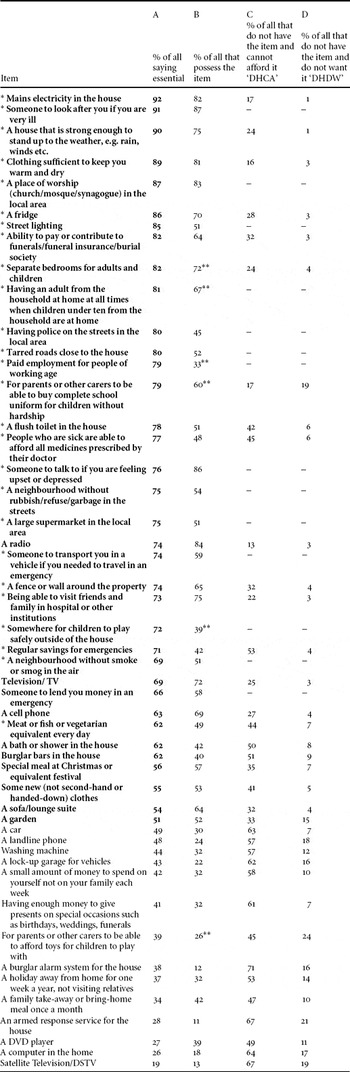
Using the 2006 SASAS module, thirty-six of the fifty items were defined as essential by the majority of the respondents (that is by more than 50 per cent of respondents); these are highlighted in bold in Table 1 and are referred to as ‘socially perceived necessities’ (SPNs). For the thirty-six items that were defined as essential by 50 per cent or more of the population, the scale reliability coefficient (alpha) was calculated to be 0.92 (Cronbach, Reference Cronbach1951). A principal components analysis revealed three main emerging themes: service provision/infrastructure, material possessions and social relations (Wright, Reference Wright2011a).
Percentage of people defining an item as essential (sorted in descending order) and rates of possession/non-possession

Notes: The 36 items that were defined as essential by more than half of the respondents are highlighted in bold.
* These 26 asterisked items are explained below.
** These figures in Column B should be treated with caution as they do not take into account the respondent's age or parental status.
Source: SASAS, 2006.
A striking level of agreement was found between different subgroups in terms of their definitions of necessities. Wright (Reference Wright2011a) analysed the responses – in terms of the extent to which each of the fifty items was defined as essential – for thirty different subgroups, relating to age, sex, population group, area type and socio-economic status, and found that a majority of respondents in each of these thirty subgroups had defined a common subset of twenty-six of the thirty-six SPNs as essential. These are asterisked in Table 1 and comprise twenty-five of the top twenty-six SPNs. The majority of people falling above and below a commonly used South African poverty line (Hoogeveen and Özler, Reference Hoogeveen, Özler, Bhorat and Kanbur2006; Leibbrandt et al., Reference Leibbrandt, Woolard, Finn and Argent2010) of R847 per capita per month in 2006 Rands defined thirty-five of the thirty-six SPNs as essential.
Similarly, correlations (of the percentage of people defining each of the fifty items as essential) were high across subgroups. For example, male and female responses correlated 0.98 (Spearman's rho, p < 0.01), responses from people in rural and urban areas correlated 0.90 (p < 0.01), responses from people who defined themselves as ‘poor’ and ‘not poor’ correlated 0.91 (p < 0.01) and responses from people above and below a poverty line of R847 per capita per month correlated 0.92 (p < 0.01).
The extent of agreement between different groups demonstrated by these high-level findings provide prima facie evidence that the SPN approach can indeed be applied in a country with a high level of inequality and income poverty.
Notwithstanding these findings, there are evidently also differences between groups and these may occur for a number of reasons including reference group, cultural differences and personal circumstances. We now focus specifically on the extent to which people's preferences are associated with their circumstances. In particular, it is possible with this dataset to explore the extent to which patterns of possession or lack are associated with whether an item is defined as essential or not.
Possession and preference
To what extent do people possess the South African SPNs? Column B in Table 1 shows the percentage of people that possess each of the items. Twenty-eight of the thirty-six SPNs are possessed by a smaller percentage of people than the percentage of people defining each item as essential. The two greatest differences were for street lighting (with 85 per cent defining it as essential and 51 per cent possessing it), and police on the streets in the local area (with 80 per cent defining it as essential and 45 per cent possessing it). Overall, for forty of the fifty items in the module a higher percentage of people defined the items as essential than possessed them. Six of the SPNs (having excluded employment and child-related items) are possessed by less than half the respondents: police on streets, ability to afford medicines prescribed by doctor, regular savings for emergencies, bath/shower in house, burglar bars and meat/fish/vegetarian equivalent every day.
In terms of the number of SPNs possessed, on average respondents possessed 21.5 of the thirty-six SPNs. Only 1 per cent of the respondents possessed all thirty-six socially perceived necessities.
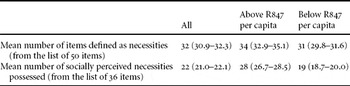
Though the patterns of possession do not differ greatly by sex, they do differ by population group and income (Wright, Reference Wright2011b). For example, Table 2 below shows that on average thirty-four of the fifty items were defined as essential by those falling above the R847 per capita per month poverty line, compared to thirty-one items by those below this poverty line. However the patterns of possession are very different: those above the poverty line possess twenty-eight SPNs on average, compared to only nineteen for those below the poverty line. This suggests that the extent of agreement about the necessities is occurring in spite of widespread discrepancies in terms of possession.
Mean number of SPNs possessed, by monthly per capita income

Notes: 95% Confidence intervals shown in brackets. SPN = Socially Perceived Necessity (50% threshold); R847 represents the upper bound poverty line commonly used in South Africa adjusted to 2006 Rands (Wright. Reference Wright2011a).
Source: SASAS, 2006.
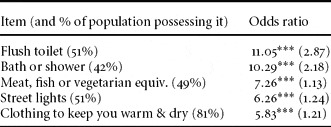
To what extent is there an association between possession of an item and the probability of it being defined as essential? A logistic regression model was fitted using each of the socially perceived necessities in turn as the dependent variable. It was found that for all thirty-six SPNs, the odds of them being defined as essential by those who possess the item are greater relative to those who do not possess the item (all significant at p < 0.001, apart from paid employment which is significant at p < 0.01). The SPNs with the highest odds ratios are shown in Table 3.
SPNs and possession: the five SPNs with the highest odds ratios

Notes: Standard errors shown in brackets.
*** p < 0.001, ** p < 0.01, * p < 0.05.
Source: SASAS, 2006.
Taking the first row as an example, we know from Table 1 that 78 per cent of the population defined a flush toilet as essential. In this table, we see that only 51 per cent of respondents had a flush toilet, and that the odds of a flush toilet being defined as essential are 11.05 times greater for those who possess a flush toilet relative to those who do not. Without wishing to over-interpret this table, it could be argued that these items can help shed light on which of the SPNs – once possessed – are the hardest to imagine being without. Not only that, but they could be seen as the SPNs that – once possessed – are the hardest to imagine anyone being without (as the survey asks whether the item is essential for all South Africans to have). They are, at the very least, the SPNs which – once possessed – are most likely to be defined as essential for the population as a whole, when compared to the views of people who do not possess these items. The SPN with the lowest odds ratio is the television (1.8), but this difference is still significant (p < 0.001).Footnote 8
Individual-level analysis such as this – where definition and possession can be set alongside one another – can only be undertaken if the definition and measurement modules occur within the same survey, whereas a number of the studies that have used this approach to defining poverty have undertaken these steps separately using two surveys, for example the Millennium Survey (Pantazis et al., Reference Pantazis, Gordon and Levitas2006), the EU-wide study (Eurobarometer, 2007) and studies in Japan (Abe, Reference Abe2006) and Northern Ireland (Hillyard et al., Reference Hillyard, Kelly, McLaughlin, Patsios and Tomlinson2003). In those instances, the extent to which the relationship between possession and preference can be examined has mainly been restricted to exploring relationships between aggregate preferences derived from the survey containing the definitional module, and individual patterns of possession based on survey data containing the measurement component (e.g. McKay, Reference McKay2004), although Halleröd (Reference Halleröd2006) has deftly explored the question of adaptive preferences using a Swedish survey containing only the measurement component (that is using questions about possession and reason for lack).Footnote 9
Many of the studies that have combined the definition and measurement steps in a single survey have not explored the relationship between preference and possession in great depth. However, the most extensive analysis on the role of possession status has been undertaken in Belgium where it was found that ‘Whether or not the respondent possesses the item is by far the most important variable influencing his or her perception of its necessity’ (Van den Bosch, Reference Van den Bosch2001: 394).
Could it be that possession is simply a proxy for income, that is whether people could afford the items? The thirty-six regression models were re-run, controlling for income quintile. Quintiles of per capita monthly household income were constructed and the first quintile (that is those with a household per capita income of less than R175 per month which captured about a quarter of all respondents) was treated as the low income reference group. Even having controlled for income quintile, the odds of each item being defined as essential were greater for those who possessed the item relative to those who did not (all significant at p < 0.001, apart from electricity and paid employment which were both significant at p < 0.01).
Enforced lack
It has been recognised that lack of certain items may simply reflect personal choice (e.g. McKay, Reference McKay2004; Piachaud, Reference Piachaud1987). In order to explore this issue, it is possible to look at how people who lacked an item explained that lack in terms of whether it was due to choice or lack of resources (that is an enforced lack). Column C in Table 1 shows the percentage of people who – when asked why they did not possess the item – said that they did not have the item and cannot afford it (‘DHCA’), while Column D shows the percentage of people who did not have the item and said they do not want it (‘DHDW’). Columns C and D are only completed for items that in principle could be purchased.
It is acknowledged that the ‘DHCA’ and ‘DHDW’ categories are rather crude, and – if interviewee fatigue were not an issue – it would be possible to break the categories down into at least the following in order to take into account possession, choice and access to resources in a more nuanced way: ‘don't have, don't want and can't afford’; ‘don't have, don't want but can afford’; ‘don't have, do want but can't afford’ (the classic category relating to an enforced lack of an item); and ‘don't have, do want and can afford’ (a category which resonates with the practice of ‘substitution possibilities’ (Goedhart et al., Reference Goedhart, Halberstadt, Kapteyn and van Praag1977: 516) where people at different stages in their life circumstances or with competing priorities choose certain items over others). Mack and Lansley describe ‘don't have can't afford’ as a ‘useful approximation for those who have an enforced lack of necessities’ (Mack and Lansley, Reference Mack and Lansley1985: 105), but suggest that by selecting this category the extent of deprivation will be underestimated as people may possess only a very poor quality version of the item; people may have converted the enforced lack (due to lack of resources) into a sense of choice, that is may have adapted their preferences (see also Halleröd, Reference Halleröd2006); and people may say that they have the item in order to avoid the stigma of admitting that they do not possess it. Levitas also stresses that the avoidance of shame may play a role in people's responses: ‘The response “don't want” preserves individual dignity above “can't afford”’ (Levitas, Reference Levitas, Pantazis, Gordon and Levitas2006: 150). Two other issues that Levitas raises, which may or may not result in an underestimation of levels of deprivation, are that, by forcing people to choose between ‘don't have don't want’ and ‘don't have can't afford’, alternative constraints are excluded, and objective, experienced and expressed financial constraints are conflated (Levitas, Reference Levitas, Pantazis, Gordon and Levitas2006).
However as can be seen in Table 1, for purchasable SPNs, which apply to the population as a whole (that is excluding child-related items), the percentages are very low for those answering ‘DHDW’. People in South Africa are therefore predominantly explaining their lack of items in terms of enforced lack rather than choice.
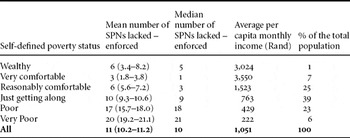
In order to explore this further, Table 4 presents information on enforced lack (that is lack of an item due to lack of resources – the group captured by DHCA in Table 1) by self-defined poverty status.
Mean and median number of socially perceived necessities lacked and average per capita monthly income by self-defined poverty status (using 50% threshold)

Notes: SPN = socially perceived necessity based on 50% threshold. Child-related items and employment are excluded, resulting in a total of 31 SPNs. 95% confidence intervals are shown for the means in brackets. ‘Enforced lack’ for the purposes of this table refers to items that people said they ‘do not have and cannot afford’ for purchasable items, and that they ‘do not have’ for non-purchasable items.
Source: SASAS, 2006.
With the exception of the small group that defined itself as ‘wealthy’, the number of SPNs lacked due to inability to afford the item increases with self-defined poverty status. As the penultimate column demonstrates, the number of SPNs lacked due to lack of resources also increases as average income decreases.
Discussion
In this paper, we have explored the relationship between possession and socially perceived necessities using nationally representative data from South Africa in 2006. The issue of adaptive preferences is explored using the definition and the measurement sections of the survey module.
Using data from the definition section of the module (where people were asked which of the fifty items were essential), it has been demonstrated that there is a high level of agreement between major social cleavages in South African society – including population group, sex, income and area – in terms of the necessities. For example, the responses of people falling above and below a common poverty line displayed a correlation of 0.92 in terms of the extent to which they defined each of the fifty items as ‘essential’. There was also very little difference between the average number of items defined as essential from the list of fifty for those above and below the poverty line (thirty-four and thirty-one items respectively).
Using data from the measurement section of the module in SASAS, we identified that twenty-eight of the thirty-six SPNs are defined as essential by a higher proportion of people than possess them. There is little cause for concern that people are adapting their preferences in terms of saying that they do not want something rather than that they cannot afford it if they do not possess it. For the purchasable SPNs, only a very small proportion of respondents said ‘don't have don't want’, with people instead stating that they do not have the item because they cannot afford it. It was shown that reported enforced lack increases as income decreases and, with the exception of the self-defined ‘wealthy’, there was a linear relationship between enforced lack of SPNs and self-defined poverty status. For example, the median number of SPNs lacked by those who defined themselves as ‘very comfortable’ was one, compared to twenty-one items for those who defined themselves as ‘very poor’.
In the context of these findings, it seems contradictory at first that possession is associated with defining an item as essential. It was found that for all thirty-six SPNs, the odds of an item being defined as essential were higher for people that had the item relative to people that did not have the item. Though possession is positively associated with defining an item as essential, it does not explain the whole picture and it is important to remember Mack and Lansley's (1985: 69) cautionary observation: ‘Just as the extent of ownership in society generally is not a particularly accurate guide to society's overall perception of necessities, neither is an individual's possession or otherwise of an item a particularly good guide to their perception of whether that item is a necessity.’
Other factors need to be taken into account, because otherwise people who lacked items would not regard them as essential and this is clearly not the case and nor has it been the case in South Africa's history where there have been repeated calls for an improved standard of living for all people (e.g. ANC, 1943; ANC, 1955), mainly made by people who did not enjoy the standard of living for which they were calling. There are evidently additional factors that inform people's decisions about an acceptable standard of living, and it is likely that these would include political climate and people's reference groups which – through access to the media – may transcend national borders.
To what extent might these findings apply more generally to developing countries where there is widespread lack? Only a small number of studies in low or middle income countries have used this approach thus far, and there are no other nationally representative studies against which to compare the South African findings with any degree of authority. Some studies are too small or unrepresentative to draw any comparisons, for example Mali (Nteziyaremye and MkNelly, Reference Nteziyaremye and MkNelly2001), and some do not ask about possession, for example Bangladesh (Ahmed, Reference Ahmed2007) and Zimbabwe (Mtapuri, Reference Mtapuri2011). However, a recent Vietnamese study in Ha Tinh Province did find that most of the SPNs were possessed by a smaller percentage of the population than defined them as essential (Pro Poor Centre, 2007).
In the literature on adaptive preferences, reference is made to an ‘hedonic treadmill’ – where the positive impacts of an income increase wears off over time (e.g. Burchardt, Reference Burchardt2005). The analysis in this section is not longitudinal and does not focus on the individual (focusing instead on what people think all South Africans should have). However, we have identified that the odds of a SPN being defined as essential by those who have the item are greater than for those who do not have the items. If in any way this finding about South Africa touches upon the hedonic treadmill debate, it suggests that in the South African context the treadmill (in this instance, of possession leading to necessity) is being projected to the population as a whole. This has a positive message in relation to social solidarity in that the ‘haves’ are treating their more comfortable standard of living as a norm for the population at large.
Debates about adaptive preferences have recently started to highlight their positive role for people, for example lowering of sights can reduce discontent and disaffection (for example Comim, Reference Comim2005; Halleröd, Reference Halleröd2006; Nussbaum, Reference Nussbaum2001; Teschl and Comim, Reference Teschl and Comim2005). However, there is very little evidence of such lowered sights in South Africa, and as such it should come as no surprise that levels of discontent are so high, particularly in relation to service delivery (e.g. Klandermans et al., Reference Klandermans, Roefs and Olivier2001; Von Holdt et al., Reference Von Holdt, Langa, Molapo, Mogapi, Ngubeni, Dlamini and Kirsten2011).
Though the adaptive preferences debate mainly refers to instances when people adapt their preferences to unfavourable conditions, it has also been noted that adaptive preferences can also take place in the direction of an increase of preferences. Indeed, some have argued that poor people set their sights high as a form of survival. In a recent study, which looked at poverty and optimism across Africa, it was argued that ‘given such extreme conditions, optimism among the poor may be a result of selection bias: individuals in such conditions may have to be optimistic to survive. . . Alternatively, our results may reflect these individuals’ realistic assessment that conditions are so bad they can only improve’ (Graham and Hoover, Reference Graham and Hoover2007: 3). In order to explore this issue more comprehensively, it would be necessary to undertake a longitudinal survey to explore the extent to which people's attitudes change over time, and to take into account change in factors such as their reported reference groups and socio-economic status.
Lastly, the application of the SPN approach outside of a high income country context raises an important methodological point in relation to the measurement of poverty. When generating summary measures of lack, it has become common to weight lack by the extent to which an item is defined as essential, sometimes adjusted by subgroup – referred to as the proportional deprivation index (e.g. Halleröd, Reference Halleröd1994; Halleröd et al., Reference Halleröd, Bradshaw, Holmes, Gordon and Pantazis1997). Thus for example in the South African context lack of mains electricity would be given a weight of 0.92, whereas lack of a bath or shower in the house would be given a weight of 0.62. However, a recent study has instead weighted lack according to patterns of possession, with most weight given to items that are lacked by only a small proportion of the population (Halleröd, Reference Halleröd2006).Footnote 10 This latter approach runs the risk of presupposing that there are ‘almost’ acceptable patterns of possession already in existence, that is that an item that is lacked by many is not a very important item. When using the SPN approach in low or middle income countries, it would be advisable to return to the original proportional deprivation index approach whereby lack is weighted by ‘extent of necessity’, rather than by ‘extent of possession’.
There has been debate and speculation about whether the socially perceived necessities approach is viable within a context of a society with high levels of deprivation and inequality. This paper has explored whether there is evidence in South Africa of an association between people's patterns of possession and their definition of items as essential for an acceptable standard of living, with reference to the adaptive preferences literature. We found that possession of an item is strongly associated with people's preferences, even having controlled for income status. However, in spite of this observation and in spite of widespread lack we found a high level of agreement across different groups in terms of identification of items as essential. Furthermore, of those who lacked the socially perceived necessities, most reported that this was because they could not afford them rather than that they did not want them, and thus widespread lack does not seem to undermine the validity of the approach.