INTRODUCTION
This study examines word retention in preschool children who are learning Hmong as a home language (L1) from birth and English as a second language (L2) in preschool settings. Learning a new word involves the learning of the word-form, its referent, and the link between word-form and referent (e.g., Archibald, Gathercole & Joanisse, Reference Archibald, Gathercole and Joanisse2009; Bloom, Reference Bloom2000; Gupta & Tisdale, Reference Gupta and Tisdale2009; Heibeck & Markman, Reference Heibeck and Markman1987; Storkel, Reference Storkel2001). Children's ability to retain the knowledge of newly learned words is fundamental to their vocabulary development. Yet previous research has focused primarily on children's immediate retrieval of words to which they have been newly exposed (e.g., Gray, Reference Gray2003; Kan & Kohnert, Reference Kan and Kohnert2008, Reference Kan and Kohnert2012; see the review in Kan & Windsor, Reference Kan and Windsor2010). By contrast, the retention and long-term retrieval of new words has received less attention. Even less is known about sequential bilingual children who learn a second language during their childhood. The investigation of these children's word retention capabilities contributes to our understanding of the interactions – within a common within-subject cognitive processing system – among maturation, language experience, and word learning in two languages (cf. Marchman, Fernald & Hurtado, Reference Marchman, Fernald and Hurtado2010).
The current study – a follow-up to a study by Kan and Kohnert (Reference Kan and Kohnert2012) – is designed to explore Hmong–English bilingual children's word retention in L1 and in L2 after consistent input of novel words is discontinued. Kan and Kohnert (Reference Kan and Kohnert2012) considered word learning as a complex ongoing process involving multiple exposures across settings and various learning-retrieval opportunities. In a word learning experiment, bilingual preschool children were presented, in each language, with novel words over a four-week word learning program. Novel word comprehension and production probes were administered, for each session, immediately after the presentation of the novel words. The entire word learning process in each language was examined using a two-level hierarchical linear model. Kan and Kohnert (Reference Kan and Kohnert2012) found that there was a linear increase over time in both the comprehension and the production of novel words in each language. Importantly, the growth curves of the bilingual children's novel word production skills were predicted by their existing vocabulary knowledge. The present article explores within-subject factors that are associated with bilingual children's word retention skills in L1 and in L2.
One of the unique characteristics of this group of bilingual participants is the typological difference between their L1 (Hmong) and L2 (English). Hmong and English are highly contrastive languages. Hmong is an isolating Asian language that uses lexical tones to distinguish the meanings of words. Each monosyllabic Hmong word carries a particular meaning. The Roman Popular Alphabet (RPA) is the most popular written form of Hmong (Smalley, Reference Smalley1990). In this system, most monosyllabic Hmong words contain an initial consonant and a vowel or diphthong followed by a tonal marker (e.g., v, b, m). For example, paj ‘flower’ involves an initial consonant p, a vowel a, and a tonal marker j, indicating a high–falling tone (see more information about the Hmong language in Kan and Kohnert, Reference Kan and Kohnert2005, and Kohnert, Kan & Conboy, Reference Kohnert, Kan and Conboy2010). Although Hmong and English share some speech sounds and some general types of permissible word ordering in sentences (e.g., Subject–Verb–Object), there are no shared cognates or other grammatical markers. In contrast to English, in which bounded morphemes are used to express plurality (e.g., -s in dogs) and verb tense (e.g., -ed in walked), Hmong uses quantifiers and temporal adverbs (e.g., Nag hmo ‘yesterday’) to indicate plurality and the time of an event.
Word retention
Several studies have examined long-term word retention skills in monolingual speakers (Markson & Bloom, Reference Markson and Bloom1997; Rice, Oetting, Marquis, Bode & Pae, Reference Rice, Oetting, Marquis, Bode and Pae1994; Wilkinson & Mazzitelli, Reference Wilkinson and Mazzitelli2003; Woodward, Markman & Fitzsimmons, Reference Woodward, Markman and Fitzsimmons1994). In experimental settings, one unique feature of measuring word retention is the longer exposure–retrieval interval (e.g., see Wilkinson & Mazzitelli, Reference Wilkinson and Mazzitelli2003, for review). For example, in one experiment, Carey and Bartlett (Reference Carey and Bartlett1978) studied the word retention skills in a group of three- and four-year-old monolingual English-speaking children. At the beginning of the study, children were briefly exposed to the novel color word chromium. One week later, the children demonstrated retention of the novel word on a comprehension measure. Although evidence shows that children's ability to retrieve fast-mapped words decline over time (e.g., Vlach & Sandhofer, Reference Vlach and Sandhofer2012), evidence also shows that the degree of exposure to the novel words appears to be critical to word retention. For example, Rice and colleagues (Reference Rice, Oetting, Marquis, Bode and Pae1994) directly tested the effects of input on word retention in monolingual children. Using a comprehension measure, they found that children who had more initial exposure to the novel words tended to retain more words after a one- to three-day interval. Similarly, Vlach and Sandhofer (Reference Vlach and Sandhofer2012) found that memory supports (e.g., repetition) during the exposure phase facilitate the long-term retention of new words in three-year-old children. These findings suggest that the investigation of word retention requires us to understand not only how the initial representations are formed but also how the learning system operates across word learning situations over time. For example, it is likely that multiple re-activations during the learning episodes over time accentuate the relevant features of the target words, and thus decrease the forgetting rate of these features over time (Vlach & Sandhofer, Reference Vlach and Sandhofer2012). The current study attempts to control for the input factors by having all bilingual participants receive the same number of exposures to the target novel words in each language (see Kan & Kohnert, Reference Kan and Kohnert2012).
Retaining newly exposed words involves not only external resources such as learning opportunities, reinforcement, and material resources but also resources within the individual word learners such as motivation and lexical processing skills (cf. de Bot, Lowie & Verspoor, Reference de Bot, Lowie and Verspoor2007, Marchman et al., Reference Marchman, Fernald and Hurtado2010). Models of language learning emphasize that language learning is a complex dynamic process in which the current growth level depends on the previous growth level and the interaction with other available internal and external resources (e.g., Borovsky and Elman, Reference Borovsky and Elman2006; de Bot et al., Reference de Bot, Lowie and Verspoor2007; Smith and Thelen, Reference Smith and Thelen2003). Whereas input is, of course, necessary for word learning (e.g., Kan & Kohnert, Reference Kan and Kohnert2012; Li, Farkaš & MacWhinney, Reference Li, Farkas and MacWhinney2004), children's cognitive skills (e.g., processing lexical information in context) are also critical for the success of learning a new word-form and for forming a word–referent association for the new word (e.g., Gathercole, Reference Gathercole2006; Marchman et al., Reference Marchman, Fernald and Hurtado2010). In addition, augmentation both of language knowledge and of organization appears to be related to children's fundamental skills for processing input and for retaining the knowledge of the learned words (e.g., Bialystok, Craik & Luk, Reference Bialystok, Craik and Luk2008; Borovsky & Elman, Reference Borovsky and Elman2006; Gathercole, Reference Gathercole2006; Jarrold, Thorn & Stephens, Reference Jarrold, Thorn and Stephens2009; Neuman, Newman & Dwyer, Reference Neuman, Newman and Dwyer2011; Thorn, Gathercole & Frankish, Reference Thorn, Gathercole and Frankish2002). The present study explores how bilingual children's word retention is related to their fast-mapping skills (i.e., to their forming the initial word–referent links) and to their existing language skills within and across the two languages. Methodologically, there is an advantage to testing bilingual vs. monolingual subjects in the investigation of word retention: namely, the advantage that within-subject factors (e.g., lexical processing skills) in bilinguals can be held constant when the language skills in L1 and in L2 are measured (Marchman et al., Reference Marchman, Fernald and Hurtado2010; Pearson, Fernández, Lewedeg & Oller, Reference Pearson, Fernandez, Lewedeg and Oller1997). In what follows, I review the studies that provide us with evidence regarding the complex relationships among children's fast-mapping performance, existing language system, and their word retention; and I hypothesize about how bilingual children learn and retain new words in both languages.
Fast mapping and word retention
Fast mapping is the initial step of learning the association between word and referent after very limited exposure (e.g., Carey and Bartlett, Reference Carey and Bartlett1978). Previous fast-mapping studies tend to suggest that children who are briefly exposed to a new word can retain the word over long periods of time (e.g., weeks and months; e.g., Carey and Bartlett, Reference Carey and Bartlett1978; Markson & Bloom, Reference Markson and Bloom1997; Woodward et al., Reference Woodward, Markman and Fitzsimmons1994). However, mixed results have been found regarding the relationship between fast mapping and word retention skills in monolingual speakers (e.g., Golinkoff, Hirsh-Pasek, Bailey & Wenger, Reference Golinkoff, Hirsh-Pasek, Bailey and Wenger1992; Horst & Samuelson, Reference Horst and Samuelson2008; Markson & Bloom, Reference Markson and Bloom1997; Woodward et al., Reference Woodward, Markman and Fitzsimmons1994). For example, Markson and Bloom (Reference Markson and Bloom1997) examined long-term word retention in monolingual children (three-year-olds and four-year-olds) and adults who received a brief exposure to a novel word. Without additional exposures, these participants had above-chance performance on a novel word identification task one week and one month later. However, other research has shown that, unlike long-term retained words, the fast-mapped word representations contain only limited linguistic information and may not be fully linked to other words in memory (e.g., Capone & McGregor, Reference Capone and McGregor2005). Consequently, the initial representations may not easily be retrieved. For example, in a recent study by Horst and Samuelson (Reference Horst and Samuelson2008), although monolingual two-year-olds demonstrated some word knowledge when measured immediately after the brief exposure, they did not retain the newly learned novel words after a 5-minute delay.
Although there may be inherent differences between the representations of the fast-mapped words and long-term retained words, there are reasons to expect that there is a link between fast mapping and word retention skills. First, fast mapping can be seen to be a logical and sequential step toward word retention. This logical relationship suggests that the words that are retained in the long-term memory are developed from the fast-mapped word representations and from the re-activated representations through additional learning and mapping opportunities (e.g., Rice et al., Reference Rice, Oetting, Marquis, Bode and Pae1994). Accordingly, we could expect significant within-language relationships between fast mapping and word retention, but not across-language relationships, in bilingual children. Second, children's fast-mapping skills and word retention skills can also be viewed as operating in a common dynamic system within which all components are inter-related (e.g., de Bot et al., Reference de Bot, Lowie and Verspoor2007; van Geert, Reference van Geert2011). This explanation suggests that changes as a result of fast mapping (e.g., learning the initial form–referent link) will have an impact on other variables that lead to storing the word representation in memory. For example, Marchman and Fernald (Reference Marchman and Fernald2008) found that young monolingual children who were more efficient in lexical processing had faster vocabulary growth. The investigation of the within- and across-language relationships between fast mapping and word retention in bilingual children provides new insights into the nature of children's word learning ability. If children's fast-mapping skills and word retention skills are more than a sequential relationship, we would expect significant within-language and across-language relationships between fast mapping and word retention.
Existing language skill and word retention
Children's accumulated language knowledge is a critical consideration with respect to children's word retention. It is well known that greater phonological knowledge facilitates the learning of the word-form of the new word and thus leads to better new word learning performance in monolingual children (e.g., Archibald et al., Reference Archibald, Gathercole and Joanisse2009; Gathercole, Reference Gathercole2006; Jarrold et al., Reference Jarrold, Thorn and Stephens2009). In the same vein, monolingual children who have better semantic organization have stronger early vocabulary (e.g., Borovsky & Elman, Reference Borovsky and Elman2006; Goodman, Dale & Li, Reference Goodman, Dale and Li2008) and learn more new words (Neuman et al., Reference Neuman, Newman and Dwyer2011), whereas those who have limited semantic representations of the words in the lexicon are less efficient in retrieving known words (e.g., McGregor, Newman, Reilly & Capone, Reference McGregor, Newman, Reilly and Capone2002). All these findings suggest a ‘rich-get-richer’ hypothesis: namely, that, given adequate exposure to new words, children who have stronger language skills have an advantage in learning and retaining more words. This hypothesis is also consistent with the dynamic systems theory, which suggests that learning outcomes depend not only on the input but also on the initial conditions of the system (e.g., de Bot et al., Reference de Bot, Lowie and Verspoor2007; Elman, Reference Elman, Port and van Gelder1995; van Geert, Reference van Geert2011).
Similar relationships between existing language skills and word retention are expected in bilingual children. For example, Spanish–English bilingual children's word organization strategies are related to how they retrieve known words in both languages (Peña, Bedore & Zlatic-Giunta, Reference Peña, Bedore and Zlatic-Giunta2002). However, unlike monolingual children, sequential bilingual children learn linguistic skills (e.g., words, grammar) in each of their languages at two different times and in two different cultural contexts (e.g., learning L1 from birth at home and learning L2 in school). Thus, bilingual children tend to exhibit word organization patterns that are different from those of monolinguals (e.g., Peña et al., Reference Peña, Bedore and Zlatic-Giunta2002). Francis (Reference Francis1999) reviewed studies that examined language integration in bilingual linguistic memory and concluded that, at the conceptual–semantic level, bilingual speakers' representations of items that are learned in different languages are likely to pervade a shared conceptual system. The hypothesis of a common system is consistent with findings in studies that examine bilingual children. For example, Persian–Swedish bilingual school-age children's self-rated overall language skills in either language were associated with their performance on generating real words in Persian (L1) and in Swedish (L2) (Kormi-Nouri, Moniri & Nilsson, Reference Kormi-Nouri, Moniri and Nilsson2003). Turkish–Dutch bilingual preschool children's existing vocabulary in both languages was related to their skill in producing new word-forms in a non-word recall experiment in both languages (Messer, Leseman, Boom & Mayo, Reference Messer, Leseman, Boom and Mayo2010). In addition, bilingual children's language experience and proficiency contribute to the magnitude of the effects of language knowledge on long-term word retrieval. For example, Kormi-Nouri et al. (Reference Kormi-Nouri, Moniri and Nilsson2003) found that bilingual children had better performance on word fluency tests in L2 than in L1; and this language effect was greater in children who had more experience with L2. These findings suggest that, analogously to monolingual children, bilingual children's language knowledge and experience in L1 and in L2 is likely to facilitate the retention of new words. Conversely, the relationship between the existing language system and word retention in bilingual children may depend on a combination of within- and between-subject variables such as proficiency in L1 and in L2, language experience, and language use (e.g., Marchman et al., Reference Marchman, Fernald and Hurtado2010; Pearson, Reference Pearson2007).
The current study
As already stated, the purpose of this article was to investigate long-term word retention in sequential bilingual children who learn Hmong as a home language (L1) from birth and who learn English as second language (L2) during the preschool years. In particular, this study explores word retention in relation to existing language skills and to fast mapping within and across language relationships. In a previous study (Kan & Kohnert, Reference Kan and Kohnert2012), this same group of participants (n=32) was systematically exposed to sixteen novel objects and to their corresponding labels in Hmong and in English during an 8-week word-learning program (4 weeks for each language). Children's word retention in each language was examined in this follow-up study. Seventeen of these children were tested after the input was discontinued for 2 months, and the rest of the children after a discontinuance of 4 months. This current study measures children's novel word retention by using both a comprehension task and a production task.
The main research question in this follow-up study was to determine the degree to which sequential bilingual children retain some knowledge of novel words after input is completely discontinued. If, indeed, some novel word knowledge is retained, do children retain more novel words in their stronger language (L1) or in their weaker language (L2)? And to what degree are their existing language skills (in L1 and in L2) associated with their word retention in each language? On the basis of monolingual children's performance (e.g., Markson & Bloom, Reference Markson and Bloom1997; Rice et al., Reference Rice, Oetting, Marquis, Bode and Pae1994), it was expected that sequential bilingual children would retain some novel word knowledge in each language. As discussed earlier, if existing language skills play a facilitative role in overall word learning (e.g., Neuman et al., Reference Neuman, Newman and Dwyer2011), then bilingual children can be expected to retain more words in their stronger language. On the other hand, novel words in a second and weaker language could be more salient and less competitive with the existing language knowledge.
The second research question was to examine whether there are within- and/or across-language relationships between fast mapping and retention. If establishing initial representations of the new words is the initial step toward learning a new word, as has been hypothesized in monolingual children (e.g., Gray, Reference Gray2003), then it is possible that there is only a within-language relationship between fast mapping and word retention. However, it is also possible that there is a within-language and an across-language relationship between fast mapping and retention.
This expectation is based on the hypotheses that children's fast-mapping skills and word retention skills are operating within a common dynamic system (e.g., de Bot et al., Reference de Bot, Lowie and Verspoor2007; van Geert, Reference van Geert2011). The changes of the processes as a result of fast mapping will affect the processes that are related to word retention. In this present study it was also expected that there would be a difference between L1 and L2 in terms of the within-subject link between fast mapping and retention, since children had stronger L1 and weaker L2 skills at the time of testing (cf., Neuman et al., Reference Neuman, Newman and Dwyer2011).
In addition, this study also explored whether temporal exposure–retrieval intervals play a role in children's performance on the long-term retrieval task. In Markson and Bloom (Reference Markson and Bloom1997) there were no significant declines between one week and one month after the initial exposures. This study investigated whether longer exposure–retrieval intervals (i.e., 2 vs. 4 months), as compared to the intervals in Markson and Bloom (Reference Markson and Bloom1997), have stronger influence on children's long-term word retrieval.
METHODS
Participants
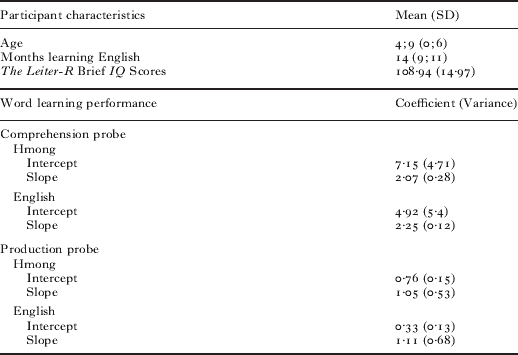
Table 1 summarizes the characteristics of the thirty-two children (16 girls and 16 boys) who participated in this retention study. Ten of these children were born in the US, and the remaining had immigrated to the US between the ages of 0;4 and 2;10. All participants learned Hmong (L1) as a home language from birth and learned English (L2) during their preschool years. According to the parental reports, Hmong was the language spoken at home. In particular, participants tended to use Hmong with their parents, grandparents, and younger siblings, whereas some participants spoke with their older siblings in both Hmong and English. In addition, all participants watched some English TV and videos at home; and 84% of them also watched some videos and local television programming in Hmong. They attended a bilingual Hmong–English preschool program that was developed for Southeast Asian children from low-income families. These participants began attending the preschool program at an average age of 3;2 (SD=0;8, range from 1;6 to 5;1). There was a positive correlation between age and preschool attendance (r=·40, p=·03). In this program, both Hmong and English were used with children at various points during both instructional and transition activities, and during lunch. According to the teachers' reports, at the time of testing, Hmong was the children's stronger language for communication with teachers and for use among themselves. Parent and teacher reports indicated that all participants were typically developing children, without any known behavioral or communication concerns. The participants also passed hearing screenings (American Speech-Language-Hearing Association, 1997). In addition, the Leiter International Performance Scale – Revised (Leiter-R; Roid & Miller, Reference Roid, Miller, Roid and Miller1997) was used as an index of the participants' cognitive skills. As shown in Table 1, these children scored within one standard deviation of the mean, although in formulating the original norm, Hmong children were not taken into consideration.
Participant characteristics and word learning performance in Kan and Kohnert (Reference Kan and Kohnert2012)
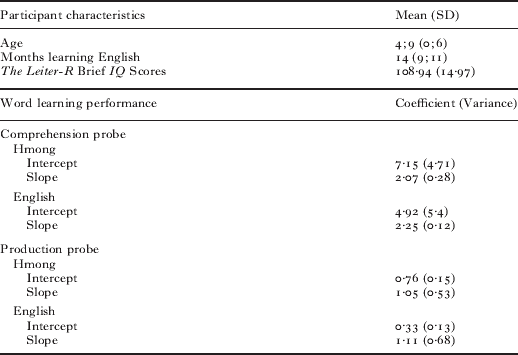
note: The maximum score possible for the word learning measures in each language is 16.
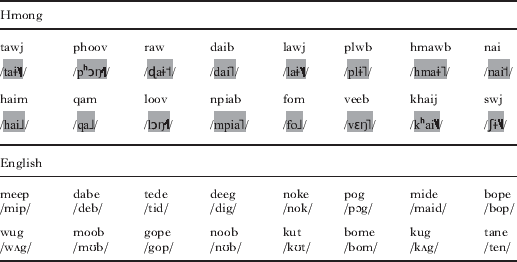
In Kan and Kohnert (Reference Kan and Kohnert2012), these participants had been presented with sixteen novel objects together with labels in Hmong (e.g., haim /hai⌋/; ‘m’ is a tone marker for a low-level tone) and in English (e.g., meep /mip/) during play in eight different sessions (4 consecutive sessions for each language) over a period of 8 to 10 weeks. That is, input of novel words in both languages was held constant. The novel words in Hmong and in English are one-syllable words (see ‘Appendix’). Table 1 summarizes the participants' word learning performance in both languages. As previously indicated, children's word learning skills were stronger in L1 than in L2. After one brief presentation of each novel word, children were able, on average, to identify the referents of 7·15 words in Hmong and 4·92 words in English; they were able to name 0·76 objects in Hmong and 0·33 objects in English. For each language, the participants were then exposed to the novel words over the next 3 weeks. Their novel word identification skills and production skills were measured immediately after the exposures. On average, with regard to comprehension, there was an increase of 2·07 words each week for Hmong and 2·25 words for English; with regard to production, there was an increase of 1·05 words each week for Hmong and 1·11 for English.
For the current study, seventeen participants (9 boys and 8 girls; mean age=4;8, SD=0;5) were tested 2 months after the discontinuation of the novel word input; and fifteen participants (7 boys and 8 girls; mean age=4;9, SD=0;7) were tested 4 months after the discontinuation of the novel word input. There were no significant differences between these two retention interval groups in age (t=·7, p>·05, d=·25), in the length of studying in the preschool (t=·92, p>·05, d=·33), and in the Leiter score (t=·48, p>·05, d=·17). In addition, two-level hierarchical linear models indicated that these two groups of children did not differ in terms of their fast-mapping scores, in either modality, in Hmong and in English. And no group differences were found for the slopes of word learning in Hmong and in English.
Novel word retention measures in L1 and in L2
Stimuli were the same sixteen object labels in Hmong and in English that were used in the word learning task in Kan and Kohnert (Reference Kan and Kohnert2012). The retention of the novel words for each language was measured using the comprehension and production tasks after the input had been completely discontinued. In contrast to the word learning task, the retention task did not include an exposure phase. As in the previous novel word learning study, the sixteen novel words were arranged in eight blocks (i.e., 2 novel words in each block). In each block two novel objects, together with two common objects, were presented to each child. Word retention tasks in Hmong and in English were implemented in two different language contexts in two different sessions. In the novel word retention production task, each child was presented with each object in each block (i.e., 2 novel objects and 2 common objects) and was asked, first, to name each item. For the novel word retention comprehension task, two additional novel objects were added to the original array of four items (2 novel objects and 2 common objects) for each block. The probability of a child's responding correctly by chance on the comprehension measures was 1/6 (·17).
The task was implemented in a quiet room in the preschool. The order of the language used was counterbalanced. There were no language order effects for production (F(1, 30)=2·74, p>·05, η2=·01) or for comprehension (F(1, 30)=3·42, p>·05, η2=·02). No feedback or additional cues were given during the retention task. The retention tasks were administered by two trained research assistants – a native speaker of English for the retention task in English and a Hmong–English bilingual speaker for the retention task in Hmong. Children's performance was scored online by another trained research assistant and was videotaped for a reliability check. Ten percent of the children's word retention performance on the videotape was randomly selected and scored by another trained research assistant. The inter-rater reliability analysis indicated that there was a high consistency between the raters (·98).
Existing linguistic skills in L1 and in L2
Children's existing language skills were measured using a story retelling task. The picture book Frog, Where Are You? (Mayer, Reference Mayer1969) was used as the basis for story retells. In order to ensure the consistency of the story across participants, scripts were developed in Hmong and in English (see Kohnert et al., Reference Kohnert, Kan and Conboy2010 for details). This sample of participants was independent of the sample for Kohnert et al. (Reference Kohnert, Kan and Conboy2010). All participants were tested in both languages in two sessions. Half of the participants completed the task in Hmong first and half in English first. There was an average of one to two weeks between the two language sessions. The task was administered by trained research assistants proficient in the target language.
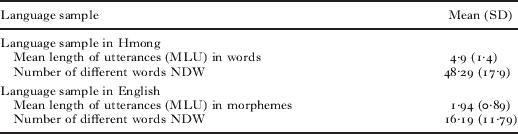
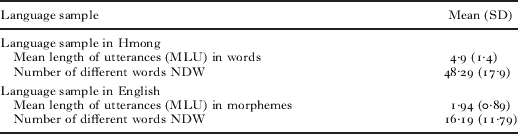
The story retell samples were transcribed and coded by trained research assistants who were native speakers of either Hmong or English. Systematic Analysis of Language Transcripts (SALT) Software Version 9 (SALT V9; Miller & Iglesias, Reference Miller and Iglesias2006) was used to analyze the transcriptions in English. SALT was also adapted for the analysis of samples in Hmong (see Kohnert et al., Reference Kohnert, Kan and Conboy2010 for details). For each child's story retell, the mean length of utterance (MLU) and the number of different words (NDW) were used to represent the child's grammatical skills and lexical diversity in each language. For English, MLU was calculated in morphemes because MLU-M is considered to be a sensitive index of grammatical development for toddlers and preschool children (e.g., Miller & Chapman, Reference Miller and Chapman1981). For Hmong, MLU was determined by counting the number of words in an utterance, because there are no bound morphemes in Hmong (Smalley, Reference Smalley1990). Table 2 summarizes participants' story retell performance. Consistent with the findings in Kan and Kohnert (Reference Kan and Kohnert2012), there was a strong within-language correlation between NDW and MLU in each language (Hmong: r=·55, p<·05; English: r=·8, p<·001). Ten percent of the samples in each language were randomly selected to be re-transcribed, coded, and analyzed using SALT. The inter-rater reliability was ·97 for Hmong and ·95 for English.
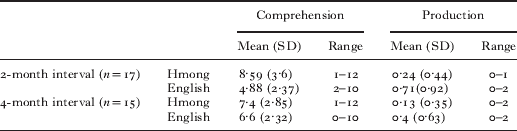
Word retention in Hmong (L1) and in (L2)
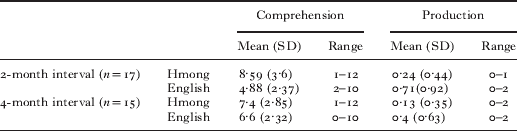
note: The maximum score possible for each measure in each language is 16.
RESULTS
Retention of novel words in L1 and in L2
Table 3 summarizes children's performance on the novel word retention task in L1 and in L2. The performance for both groups was significantly above chance for comprehension in Hmong (2-month interval: t(16)=9·62, p<·001, d=4·8; 4-month interval: t(14)=9·83, p<·001, d=5·25) and in English (2-month interval: t(16)=8·2, p<·001, d=4·1; 4-month interval: t(14)=10·72, p<·001, d=5·13). For novel word production, on average they named no more than one novel word for either language for both interval groups (see Table 3). Of thirty-two participants, only six children named one novel object in Hmong, and twelve children named one or two novel objects in English, whereas the rest of the participants were not able to name any objects correctly in either language. The floor performance suggests that it is challenging for these children to produce the retained words in their stronger language (L1) and in their weaker language (L2).
Language sample analysis in Hmong and in English
A multivariate analysis of variance (MANOVA) was used to examine the production and the comprehension scores with retention interval (2 intervals) as a between-subject variable and language (2 languages) as a within-subject variable. Significant main effects of language were found for production (F(1, 30)=6·14, p=·02, η2=·16) and comprehension (F(1, 30)=12·78, p=·001, η2=·26). However, there were no significant main effects of retention interval (F(1, 30)=·36, p>·05, η2=·01) and no significant interaction between language and retention interval either on the production scores (F(1, 30)=·47, p>·05, η2=·00) or on the comprehension scores (F(1, 30)=3·99, p>·05, η2=·01). The language effect on the comprehension probe indicated that children had significantly better performance in Hmong than in English, suggesting that such sequential bilingual children retain more words in Hmong than in English. By contrast, children named more words in English than in Hmong, although children's average production scores in both languages were close to zero. The non-significant results of retention interval indicate that, for both measures, there were no differences between the children who were tested 2 months after input was discontinued and those who were tested 4 months after input was discontinued.
Fast mapping and word retention
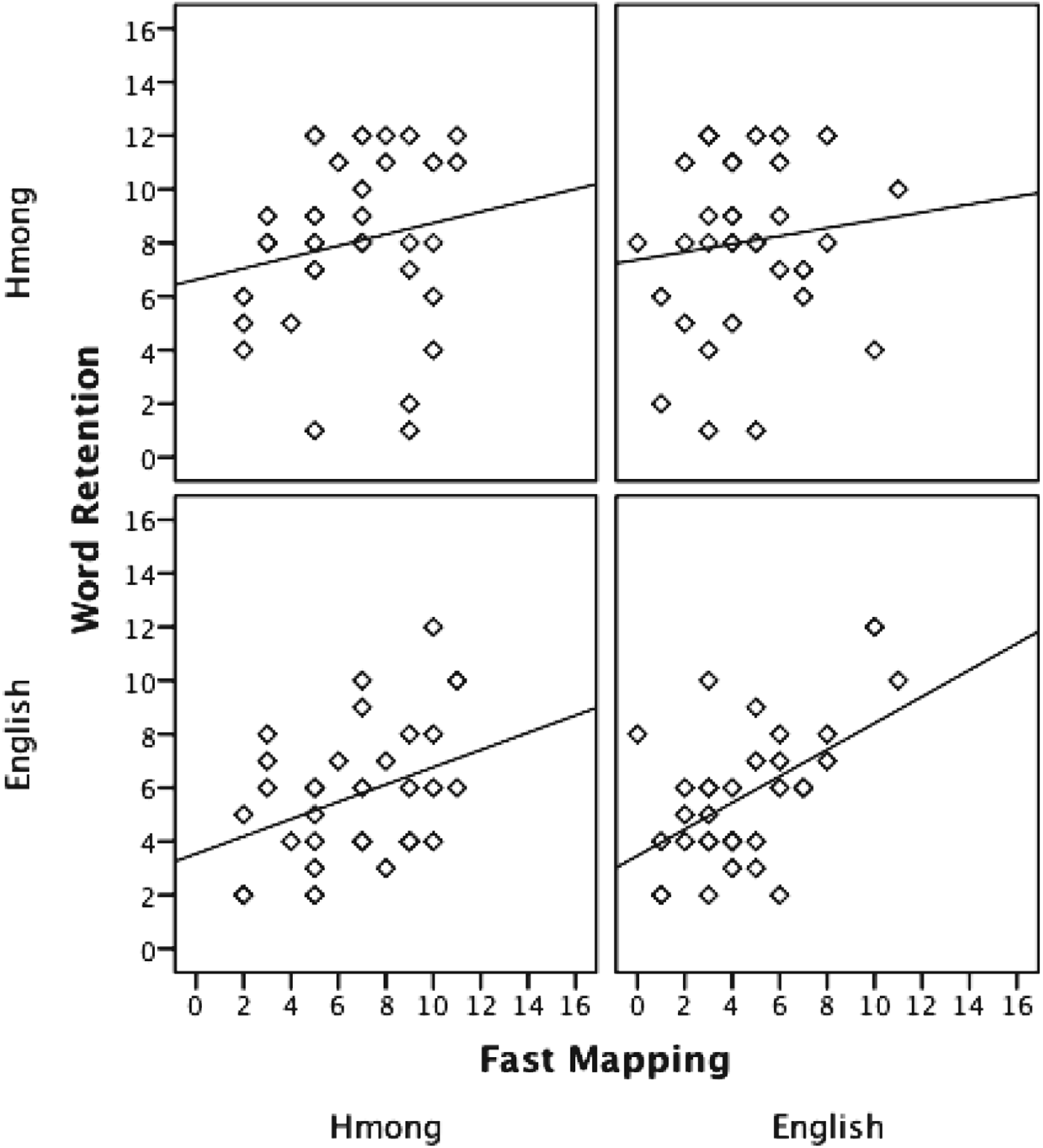
Because of children's floor performance on the production probe, only comprehension scores were examined in the analyses of the correlations between fast mapping and word retention in L1 and in L2. The correlation analysis showed there to be significant relationships between word retention and fast mapping on the comprehension measures but not on the production measures. Children's word retention (comprehension) in English was significantly correlated with their fast mapping (comprehension) in English (r=·51, p=·003) and with their fast mapping (comprehension) in Hmong (r=·37, p=·04). As shown in Figure 1, children who fast mapped more words both in Hmong and in English tended to retain more words in English. However, the relationship between retention in Hmong and fast mapping (comprehension) in either language was not significant (fast mapping in Hmong: r=·18, p>·05; fast mapping in English: r=·11, p>·05).
Relationships between word retention (comprehension scores) and fast mapping (comprehension scores) in Hmong (L1) and in English (L2). Children's word retention in English was significantly correlated with their fast mapping in English (r=·51, p<·01) and with their fast mapping in Hmong (r=·37, p<·05). No such relationships were found in Hmong (p>·05).

Novel word retention and existing language skills
Again, only comprehension scores in L1 and in L2 were examined in the analyses, because of the low production scores. The patterns of correlations between word retention and existing language skills appear to be different in L1 and in L2. There were within-language correlations in L2; but there were no such correlations in L1. For L2, children's novel word retention, as measured on the comprehension probe, was significantly correlated with their MLU in English (r=·5, p=·01) and their NDW in English (r=·51, p=·01). By contrast, no correlations were found between children's novel word retention in L1 and their existing L1 skills (MLU: r=·26, p>·05; NDW: r=·33, p>·05). These findings suggest that children's lexical diversity and grammatical complexity did not directly link to word retention in children's stronger language (L1). There were no cross-language correlations between word retention and existing language skills in L1 or in L2.
DISCUSSION
The present study is a first step in attempting to explore long-term word retention skills in three- to five-year-old sequential bilingual children with varying L1–L2 proficiency. Participants were more proficient in L1 than in L2 at the time of testing. On average, participants had had just 14 months of English (L2) experience in the preschool setting. In a previous word learning study (Kan & Kohnert, Reference Kan and Kohnert2012), these children had systematically received the input of sixteen novel words in L1 and in L2. Each child's word retention skills – novel word production and comprehension – in each language were measured 2 months or 4 months after the input was discontinued. For the production task, the average score for children's novel word retention was close to zero for both L1 and L2 for both interval groups, and there were no differences in the retention scores between the two interval groups. For the comprehension task, the children had above-chance performance on the novel word identification measure in both languages. The findings suggest that the children retained some novel word knowledge in both languages. There was no significant difference between the findings for the 2-month interval and the 4-month interval on either measure for either language. This outcome is consistent with the results in Markson and Bloom (Reference Markson and Bloom1997), in which no significant differences were found between 1-week and 1-month retention intervals. Such evidence for word retention on the comprehension measure is consistent with other studies of similar-aged monolingual children (Markson & Bloom, Reference Markson and Bloom1997; Rice et al., Reference Rice, Oetting, Marquis, Bode and Pae1994; Wilkinson & Mazzitelli, Reference Wilkinson and Mazzitelli2003) as well as with studies of adult word learners (e.g., Markson & Bloom, Reference Markson and Bloom1997).
At the group level for both interval conditions, children identified more novel words in Hmong (8·59 and 7·4 respectively) than in English (4·88 and 6·6 respectively). In studies with monolingual children, it is difficult to rule out the possibility that stronger word retention is attributed to their cognitive skills. In the investigation of bilingual children's word retention skills, within-child factors (e.g., lexical processing skills) are held constant, while other language factors such as existing language skills in the two languages are free to vary (Marchman et al., Reference Marchman, Fernald and Hurtado2010). Thus, the within-subject differences in word retention in L1 and in L2 cannot be attributed to the cognitive skills of the bilingual child. In this study, novel word exposures in L1 and in L2 are controlled for. The different degrees of word retention in L1 and in L2 can only be explained by other variables (e.g., existing language skills). One important finding in this study – a finding that concerns the complex within- and across-language relationships between children's fast- mapping skills, their existing language skills, and their word retention – might shed some light on the factors that are central to children's word retention. In what follows, I discuss the roles of bilingual children's fast-mapping skills and their existing language skills in word retention.
How does fast mapping relate to word retention?
Different patterns of associations were found in L1 and in L2 in this study. Children who had stronger fast-mapping performance in L1 and in L2 had better word retention in their non-dominant language (L2). By contrast, children who had better fast-mapping performance in L1 or L2 do not necessarily retain more words in their dominant language (L1). As discussed earlier, fast mapping can be seen as a logical and a sequential first step of word retention. This explanation suggests that the initial word–referent association in memory serves as a template for learning when additional exposures are available. Thus, a weak fast-mapped representation might lead to poor word retention. Yet the processes that are involved in fast mapping and word retention can also be seen as operating in a dynamic system. That is, the change of the processes for fast mapping may lead to the change of the processes for word retention. Importantly, these two explanations are not mutually exclusive, since an initial template representation can be established within a dynamic system. Within and across language, linkages between word retention in L2 and fast mapping in L1 and in L2 suggest that fast mapping and word retention skills constitute more than a logical and a sequential relationship. Methodologically, the counterbalanced order of the two testing languages ruled out the effect of language order on the word retention in L2. The cross-language link for word retention in L2 suggests that the processes for fast mapping and word retention might be operating within a common dynamic system, at least at the beginning stage of L2 learning. Future studies that compare sequential bilingual preschoolers with a sample of children who began learning their L2 at an older age will allow us to further examine this hypothesis.
Interestingly, children who had better fast-mapping performance in L1 or L2 do not necessarily retain more words in their dominant language (L1) although, as a group, children retained more words in L1. It is possible that children who have a stronger knowledge in a language do not necessarily rely on the initial template for the mappings during the additional learning contexts. Rather, the initial representation from fast mapping might be stored, to a certain extent, in the well-connected system in L1. The absence of within-language relationships suggests that factors other than the initial word–referent templates in memory in L1 (e.g., L1–L2 interference) might affect their fast mapping and word retention performance in L1 (cf. Kan & Kohnert, Reference Kan and Kohnert2008). In addition, at the time of testing, children had better overall social and linguistic skills in L1. The lack of cross-language relationship suggests that, for the stronger language, children might rely not only on a common cognitive system for lexical processing but also on their social and linguistic knowledge in L1 for fast mapping and for word retention. Further studies that involve longitudinal investigations of the effect of fast mapping on word retention will provide us with more evidence regarding the modifications in this relationship over time.
How do existing language skills relate to word retention?
Similar to the relationships between fast mapping and retention, the degrees of the relationships between existing language and word retention turned out to be different in bilingual children's dominant language (L1) and in their non-dominant language (L2). Children's greater word retention in their non-dominant language (L2) was associated with higher MLU and greater NDW in L2. The associations were significant even when chronological age and L2 experience (as indexed by the length of study in the bilingual preschool) were controlled for. The within-language associations are consistent with the within-language correlations between existing vocabulary and word learning slopes in sequential bilingual children, as evidenced in Kan and Kohnert (Reference Kan and Kohnert2012). These findings suggest that neither chronological age nor L2 experience can be the only driving forces behind the lexical learning and the grammatical relationships. Robust findings of within-language links between existing language skills and word retention in children's new and weaker language (L2) are consistent with the findings in previous studies of younger monolingual children (e.g., Borovsky & Elman, Reference Borovsky and Elman2006; Goodman et al., Reference Goodman, Dale and Li2008; Jarrold et al., Reference Jarrold, Thorn and Stephens2009). These findings support the ‘rich-get-richer’ hypothesis that when all other external factors are equal, children who have stronger language skills have an advantage in learning and retaining more words, and are in line with the role of children's existing language (i.e., initial conditions) in word learning in the dynamic systems theories (e.g., Borovsky & Elman, Reference Borovsky and Elman2006; de Bot et al., Reference de Bot, Lowie and Verspoor2007).
In contrast to the L2, there was no significant within-language relationship in L1 between children's existing language skills (MLU or NDW) and their word retention. These findings indicate a clear difference between how new words are retained in L1 and in L2. Several methodological issues could potentially contribute to the difference between word retention in L1 and in L2, so that the interpretation of the difference needs to be done with caution. For example, the non-significant relationship between MLU and word retention might be related to the typological differences in morphology between Hmong and English (e.g., there is no bound morphology in Hmong). Thus, the results might be affected by the methods for measuring sentence complexity in Hmong (Kohnert et al., Reference Kohnert, Kan and Conboy2010).
Although children's performance on the production probe was not included in the correlation analysis, there was a hint of a negative relationship between L1 word production (a more demanding retrieval condition) and L2 existing language skills. Specifically, the scores of six participants who correctly named one item in L1 had relatively lower lexical diversity in L2 (Mean NDW=1·3; SD=·9), than the rest of the participants (Mean NDW=2·1; SD=·8). One might interpret the negative cross-language association as resulting from competition between existing vocabulary in one language (L1 or L2) and the retention of new vocabulary in the other language. If word retention requires skills for the integrating of newly learned words into the existing language system (see Frances, Reference Francis1999, for review), then the findings may suggest a temporary L1–L2 interference in organizing newly learned words in children who begin to learn L2 in preschool settings. Future studies that focus on the effects of supports (e.g., prompts and feedback) on the production of the retained words will contribute to our understanding of the complex relationships between children's existing language skills and their word retention skills under a demanding condition.
Word retention: differences in L1 and in L2
Overall, Hmong–English bilingual children retained more words in their stronger language (L1) than their weaker language (L2). Yet there are differences in terms of the patterns of word retention in relation to existing language and fast-mapping skills in L1 and in L2. There are two plausible explanations for the different patterns of association between existing language skills and word retention in L1 (children's stronger language) as compared with L2 (children's weaker language). Learning two languages involves data-driven learning for each language (e.g., Gathercole, Reference Gathercole2007). Multiple exposures to two very different sets of cues seem to be even more important for bilingual children who learn two typologically distinct languages at two different times. At the early stages of language development, children rely on the data to develop various strategies (e.g., word organization) which contribute to their skills in figuring out the meaning of the new words (e.g., Neuman et al., Reference Neuman, Newman and Dwyer2011). If greater existing language skills simply serve as an index of children's conceptual development, then it is reasonable that, at the beginning stage of L2 learning, children who have strong MLU in L2 would retain more words in L2. However, with children's increasing language skills, different language domains are established, and they influence children's strategies in learning new words (cf. Bates & Goodman, Reference Bates, Goodman and Altmann1997; Capone & McGregor, Reference Capone and McGregor2005). In this study, children had much stronger L1 skills and, presumably, had developed various strategies across domains for learning and storing words in L1. That is to say, MLU alone might not be able to represent children's complex learning strategies for retaining new words. Therefore, less robust links between MLU and word retention in the stronger language (L1) would be expected, versus in the newer and relatively weaker language (L2). Similarly, strong links between lexical diversity and word retention in a newer language (L2) might reflect one of the strategies that children develop as they start to learn L2. These links, perhaps, will change when children have stronger L2 skills and more L2 experience. These explanations can be further investigated in future longitudinal studies focusing on the change in children's strategies for learning new words within each language.
A second possible explanation has to do with the methods for measuring bilingual children's existing language skills (e.g., syntactic and semantic skills) in each language and the procedures for measuring word learning and retention skills. First, a variety of measures (e.g., MLU and NDW in language sample analysis) have been widely used to examine children's existing language skills across languages. As mentioned earlier, the adaptation of these measures for a typologically different language (e.g., Hmong) have been done on the basis of inflectional languages (e.g., English). It is likely that the measures that are developed for a minority language are biased and do not fully capture children's knowledge of that language (e.g., Kohnert et al., Reference Kohnert, Kan and Conboy2010; Peña, Reference Peña2007). Second, for the word learning tasks, children were presented with the target novel words in a scripted play context in each language (see the methods in Kan & Kohnert, Reference Kan and Kohnert2012). It may also be the case that this highly scripted context in L2 facilitates word learning in children with relatively higher syntactic skills in L2 and thus leads to better retention, whereas the scripts in L1 might not be as important for the same children who are more proficient in L1. Future studies are needed to focus on the agreement between the theoretical concept of language knowledge and a specific measuring tool or procedure for younger children learning languages that have different typological characteristics (e.g., classifiers; free-standing aspectual markers).
In summary, this study contributes to our understanding of word retention in bilingual children who learn two languages at two different times. Evidence in this present study indicates that there are differences in word retention as it occurs in children's stronger language (L1) and as it occurs in children's weaker language (L2). Overall, bilingual children retain more words in their stronger language. Children's word retention is linked to their existing language skills and fast-mapping skills. Such relationships appear to be more robust in L2 than in L1. As regards L2, better word retention was associated with stronger existing language skills in L2 and with better fast-mapping performance in both languages. By contrast, no such relationships were found in L1. Along with some evidence (in Kan and Kohnert, Reference Kan and Kohnert2012) of cross-language interactions, the evidence in this present study supports an interdependent relationship between existing language knowledge and word retention.
LIMITATIONS AND FUTURE DIRECTIONS
To measure children's word learning and word retention skills for both languages, we developed novel word learning tasks in Hmong and in English (see also Kan & Kohnert, Reference Kan and Kohnert2012). We view word learning as a continuum involving the process of word learning (Kan & Kohnert, Reference Kan and Kohnert2012) and word retention. Accordingly, we examined the growth curves of children's knowledge of novel words in L1 and in L2 during the word learning experiment; and we measured their word retention skills after exposures were discontinued. The method did have some limitations. First, the group assignment of the two interval groups (2 months and 4 months) was based on the children's availability for testing at the beginning of the word learning study (Kan & Kohnert, Reference Kan and Kohnert2012). Those who were available to be tested and were tested first were the children who were in the 4-month-interval group. Although the participant characteristics of both groups (e.g., age, L1 and L2 experience, non-verbal cognitive skills) were not significantly different from one another, we cannot rule out all other hidden variables that might have affected the results. Perhaps, for future studies, random group assignment is recommended in order to overcome such limitation. Second, this study measured word retention at one point in time. This snapshot does not provide us with information about how word knowledge decays over time. Future studies looking at the decaying rate over a longer period of time would give us a better picture of word retention. Third, following other word learning studies (e.g., Kan & Windsor, Reference Kan and Windsor2010), we focused on the words that were learned during the word learning task in Kan and Kohnert (Reference Kan and Kohnert2012) and on the words that were retrieved in the current study. However, word learning and retention involve a succession of non-linear events including learning, forgetting, and relearning (e.g., Vlach & Sandhofer, Reference Vlach and Sandhofer2012). Future investigations should employ a non-linear statistical model (e.g., Molenaar, Sinclair, Rovine, Ram & Corneal, Reference Molenaar, Sinclair, Rovine, Ram and Corneal2009) for examining the non-linear nature of the entire learning process in each language.
Appendix A: Novel Words in Hmong and in English