In 2015 through early 2016, Canada received a large cohort of Syrian refugees. In a matter of 4 months, the country received over 26,000 Syrian refugees. Of this cohort of refugees, 50% were children and youth under the age of 18 (Immigration, Refugees and Citizenship Canada, 2016, p. 5). This was the largest Canadian refugee operation since the resettlement of Indo-Chinese refugees from Vietnam and Cambodia in the 1970s and 1980s. In addition to these cohorts of refugees, Canada has continued to welcome those fleeing persecution from other countries as well. An increasing proportion of Canada’s population are child and youth refugees. Many speculate about their acculturation processes, assuming they are distinct from other newcomer children and youth. This raises questions over how well they adapt to Canadian society and what affects their integration outcomes.
Although there is ample research on the integration of immigrants and their children, there are far fewer studies that systematically examine the integration of refugee children, particularly taking a longitudinal approach (Pritchard, Maehler, Pötzschke, & Ramos, Reference Pritchard, Maehler, Pötzschke and Ramos2019). For these reasons, using the Longitudinal Immigration Database (IMDB), this paper examines patterns of adulthood transitions among refugee children in Canada, focusing on the timing of their entrance into the labour market and formation of family through marriage (or common law union) and childbirth, which are markers of their acculturation to their new host society. The paper assesses the impact of knowledge of official languages, age at arrival, and country of origin on these transitions. By doing so, we aim to shed light on the characteristics specific to refugees apart from those commonly associated with “newcomers” in general.
The Canadian immigration context
In Canada, the immigrant population includes both refugees and nonrefugee newcomers. In the country’s immigration policy framework, refugees are admitted with permanent residency, save for refugee claimants, who seek asylum and remain as asylum seekers until they are granted refugee status. Immigrants are individuals who were born outside of Canada and obtained permanent residency (Statistics Canada, 2016a). Because refugees and successful asylum seekers are granted permanent residence they are in essence part of the immigrant population, though they are distinguished from other immigrants because of the unique admission criteria and selection process for permanent residency. In general, refugees are admitted to the country based on humanitarian considerations, whereas other immigrants tend to be admitted through pathways that prioritize their economic contributions to Canada or for family reunification purposes.
In recent years, both refugee and other immigrant populations have increased in Canada and so too has the number of children who accompany them. According to the 2016 census, more than one in five Canadians (21.9%) are foreign-born and 37.5% of Canadian children are either immigrants, including those who come as refugees, or have at least one newcomer parent (Statistics Canada, 2017a, 2017b). Estimates from the 2016 Canadian census also show that 7% of newcomer children, between the ages of 0 and 14, are refugees, which translates to 1% of Canadian children in this age group. About 14% of immigrant youth are refugees, between the ages of 15 and 24, accounting for 2.4% of Canadians in that age group (Statistics Canada, 2016b).
The growing share of refugee and other immigrant children and youth in Canada and other industrialized nations has raised interest in their integration outcomes. Research for adults shows that landing or admission categories, which we will elaborate upon below, have important effects on immigrants’ integration and their experiences (Aydemir, Reference Aydemir2011; Hou & Bonikowska, Reference Hou and Bonikowska2017; Kaida, Hou, & Stick, Reference Kaida, Hou and Stick2019). Research also shows that landing categories affect the acculturation outcomes of newcomer children and youth. For example, disruption of schooling and separation from family for refugee children distinguish them from other immigrant children and present challenges for their adaptation to a new country (Beiser, Reference Beiser1999; Nakhaie, Reference Nakhaie2019; Victorian Foundation for Survivors of Torture, 1998; Wilkinson, Reference Wilkinson2002, Reference Wilkinson2008). Such disruptions may also affect their long term labour market outcomes (Bonikowska & Hou, Reference Bonikowska and Hou2010; Kyle, Macdonald, Doughney, & Pyke, Reference Kyle, Macdonald, Doughney and Pyke2004). Less work has, however, been done on noneconomic forms of integration as well as the life-course transitions of newcomer children and youth.
Adulthood transition: normative order and children of newcomers
Researchers have recently started to investigate the complexities of integration and adulthood transitions among immigrants vis-à-vis the native-born youth, looking at indicators that reflect their economic independence, such as transitioning from school to the labour market as well as their social independence characterized by forming romantic relationships and starting a family through marriage/common law union and childbearing (Beaujot & Kerr, Reference Beaujot and Kerr2007; Gonzales, Reference Gonzales2011; Gonzales & Roth, Reference Gonzales, Roth, Scott and Kosslyn2015; Hofferth & Moon, Reference Hofferth and Moon2016; Impicciatore, Reference Impicciatore2015; Rumbaut, Reference Rumbaut2005; Rumbaut & Komaie, Reference Rumbaut and Komaie2010; Utomo, Reimond, Utomo, McDonald, & Hull, Reference Utomo, Reimondos, Utomo, McDonald and Hull2013). However, these studies do not disaggregate across landing categories to distinguish refugee children and youth from other immigrants. The few exceptional studies that look at refugee children and youth and compare their outcomes to their immigrant counterparts admitted through other landing categories tend to focus on educational (Hou & Bonikowska, Reference Hou and Bonicowska2016, Reference Hou and Bonikowska2017; Nakhaie, Reference Nakhaie2019) and economic outcomes (Hou & Bonikowska, Reference Hou and Bonicowska2016; Hou, Reference Hou2017) and treat these outcomes as static. They fail to account for when these transitions occur. Accounting for life-course transitions is important because it is a better proxy of acculturation and because a life event has compounding effects on subsequent life events. Moreover, accounting for transitions offers a better portrait of whether or not refugee children or youth face different acculturation processes and outcomes than other newcomer children and youth.
Traditionally, there are normative orders associated with adulthood transitions in North America and other developed countries. For instance, the completion of schooling is often followed by entrance into the labour market, which is further followed by family formation (Beaujot & Kerr, Reference Beaujot and Kerr2007; Berlin, Furstenberg, & Waters, Reference Berlin, Furstenberg and Waters2010; Rumbaut, Reference Rumbaut2005; Utomo et al., Reference Utomo, Reimondos, Utomo, McDonald and Hull2013). It is considered “normative” because deviations from the sequence signal conditions that are associated with socially less desirable living conditions. For example, entrance into the labour market without finishing secondary education or postsecondary education leads to lower earnings potential (Ferrer & Riddell, Reference Ferrer and Riddell2003) and more precarious work conditions (Noack & Vosko, Reference Noack and Vosko2011). Likewise, entering into marriage before finishing schooling has negative economic and social or cultural impacts (Hogan, Reference Hogan1978; Kaplan, Reference Kaplan, Wachter and Finch1997; Marini, Reference Marini1984; Ramos, Reference Ramos2018). Childbirth outside of a recognized spousal union or during the school-age years, moreover, has implications for the economic conditions of households and limits the life chances of young parents themselves. A delay in one transition thus affects other transitions or outcomes. The “normative order” of adulthood transitions for the general population tends to go from completion of schooling, entry into the labour market, entry into spousal union, and then parenthood.
As a general pattern, studies find that younger adults in recent years are taking longer to reach economic and social maturation than their counterparts decades ago (see Berlin et al., Reference Berlin, Furstenberg and Waters2010, for comprehensive review for the United States). With respect to refugee and immigrant children, this then begs the question of whether their transitions to adulthood will follow the “normative” pattern and if there are differences between refugee and other immigrant children. To unpack these questions, it is important to consider the structural factors that shape their experiences, such as admission category, as well as characteristics that shape adulthood transitions for children more generally.
What affects transitions to adulthood?
Research shows that immigrant landing categories affect a number of integration outcomes for adults because of structural differences associated with different administrative landing categories. Portes and Böröcz (Reference Portes and Böröcz1989) offer a conceptual framework that illustrates how contextual elements matter in terms of integration. They identify three factors in the country of origin, as well as the receiving society, that influence the integration outcomes of newcomers, including conditions of exit, class origin, and context of reception.
Conditions of exit refer to the political circumstances that surround emigration. Refugees, compared to other immigrants, for instance, are forced to emigrate due to persecution and hardships, and as such are precluded from the option of returning to their country of origin for an extensive period of time (Beiser, Reference Beiser1999; Portes & Böröcz, Reference Portes and Böröcz1989). These conditions can affect the integration process of immigrants. Portes and Böröcz (Reference Portes and Böröcz1989) argue that class origins, such as occupation status, skill levels, employability, and adaptability to jobs, also affect immigrants’ level of economic transition to a new country. Low-skilled migrant workers, for example, are more susceptible to local labour market conditions than high-skilled workers and professional immigrants. They caution, however, that class background does not necessarily lead to better “life chances” and that successful transition largely depends on the context of reception of the host society. Governmental policy, public opinion, labour market demand, and the existence of preexisting ethnic communities also play a crucial role in the integration process of the newcomers.
Immigrants admitted as permanent residents to Canada are mainly selected to enhance economic development (economic class immigrants), reunite with family (family class immigrants) or in fulfillment of the country’s international obligation to protect vulnerable people (refugee class; Statistics Canada, 2017a). Among these three broad categories there are over 50 subcategories, which are too numerous to summarize for the purpose of this paper; however, it is worth unpacking the refugee categories. Refugee status can be granted overseas, as in the case of government-assisted refugees (GARs) and private-sponsored refugees (PSRs) or in Canada after a person has successfully made asylum claims upon arrival and thus referred to as refugees landed in Canada (RLCs; Immigration, Refugees and Citizenship Canada, 2016). These differences in the admission process generally signal immigrants’ socioeconomic background, their language abilities, and education which all impact their integration outcomes.
Research on adult economic immigrants shows that they have an advantage in terms of human capital, including better knowledge of official languages and higher levels of education, compared to refugees and family class immigrants (DeVoretz, Pivnenko, & Beiser, Reference DeVoretz, Pivnenko and Beiser2004; Hou & Bonikowska, Reference Hou and Bonicowska2016, Reference Hou and Bonikowska2017; Wilkinson & Garcea, Reference Wilkinson and Garcea2017; Yoshida & Amoyaw, Reference Yoshida, Amoyaw, Korntheuer, Maehler, Pritchard and Wilkinson2020). Among refugee groups, research shows that PSRs have better language skills and higher levels of education and skill sets than GARs (Immigration, Refugees and Citizenship Canada, 2016) and their higher human capital endowments and social networks in the host community are tied to higher wages (Kaida et al., Reference Kaida, Hou and Stick2019). Relative to GARs and PSRs, RLCs who go through the asylum claims process within Canada have limited access to social support services and their settlement experiences are more precarious (Goldring, Berinstein, & Bernhard, Reference Goldring, Berinstein and Bernhard2009). Research by Hou and Bonikowska (Reference Hou and Bonikowska2017) shows that immigrant landing categories also affect the educational outcomes of refugee and immigrant children. They found that the children of economic immigrants have higher rates of university completion than children of other landing categories. For these reasons, we expect that admission category will also influence the timing of transitions to adulthood with refugee children experiencing earlier transitions than the children of economic immigrants.
We expect this because research on adulthood transitions shows that higher education is linked to delays in both economic and noneconomic adulthood transitions. More than ever, education has become essential for entry into the labour market and more people are now pursuing postsecondary education into their 20s (Berlin et al., Reference Berlin, Furstenberg and Waters2010). An obvious consequence of prolonged education is delayed entry into full-time employment. Delayed entry into the labour market also means deferral of forming a marital or common law union because men and women tend to get married when they have achieved higher economic status (Oppenheimer, Reference Oppenheimer1988). In Canada, for instance, in 1941 the median age at first marriage among women was 23 years old, which declined to 21 in the early 1970s, but increased to 28.2 by 2001 (Beaujot & Kerr, Reference Beaujot and Kerr2004, Reference Beaujot and Kerr2007). Similarly, the average age of women at first birth was about 23 years old in 1976, but this increased to 28 years by 2003 (see Beaujot & Kerr, Reference Beaujot and Kerr2007). Because of disruptions in education in their home country, measuring the level of education of refugee children at the time of landing in a new host country is difficult (Pritchard, Maehler, Pötzschke, & Ramos, Reference Pritchard, Maehler, Pötzschke and Ramos2019). However, given the importance of English as an international language, which is commonly taught in educational systems around the world and linked to upper class economic status, it can be a proxy of education. In Canada, it is one of the country’s two official languages. Having knowledge of an official language thus offers newcomer children an advantage in the country’s educational system. For these reasons, we expect that children who arrive with skills in an official language at the time of landing will be more likely to have later adulthood transition, deferring their entrance into the labour market and family formation.
Age at the time of immigration is also shown to affect levels of acculturation to a new country and has a significant influence on the timing of transition to adulthood (Rumbaut & Komaie, Reference Rumbaut and Komaie2010). Canadian research shows that younger immigrant children have different integration patterns than first-generation immigrants and the children of immigrants born in Canada (Boyd, Reference Boyd2009; Boyd & Tian, Reference Boyd and Tian2016). Wu, Schimmele, and Hou (Reference Wu, Schimmele and Hou2012) report that 1.5-generation immigrants’ self-perceived integration level was similar to that of native-born Canadians. The notion of 1.5 signals that immigrant children were born outside of the country, but migrated at an early age (typically defined at 12 years or younger), and have different socialization experiences compared to 1.0-generation immigrants, who migrated at an older age. They are also different from children of immigrants born in a host country. For these reasons, we expect that the younger an immigrant or refugee child is at the time of landing in Canada, the slower their adulthood transitions and the more consistent their transitions will reflect the “normative” order of adulthood transitions.
The present study
Based on the literature reviewed on immigrant landing categories as well as the literature on adulthood transitions, we will explore three hypotheses using the IMDB. Portes and Böröcz’s (Reference Portes and Böröcz1989) work offers theoretical grounds to expect that refugees’ integration process in the host society will be quite distinct from nonrefugee newcomers. Our first hypothesis is that refugee children and youths’ adulthood transitions will be different from those of other immigrants. Furthermore, empirical findings in the Canadian literature indicate that refugees in Canada have lower human capital and economic outcomes than economic immigrants. Thus, we expect that refugee children and youth will have earlier economic and noneconomic transitions than other immigrant children and youth. Among refugees, we expect those with the most vulnerability, GARs, to also have earlier transitions than other refugee children and youth. Education is a key factor in delaying transitions. However, measuring education at the time of landing for refugee children and youth is difficult, thus we use knowledge of official language as a proxy for it and our second hypothesis is that knowledge of an official language leads to delayed adulthood transitions. Age at the time of arrival is an important predictor of integration outcomes and for this reason we also expect that it will influence adulthood transitions and our third and last hypothesis is that younger refugee and immigrant children will have later adulthood transitions, following the “normative order.”
Method
Data
Our analysis uses data from the 2015 IMDB. It combines two sets of administrative records: the Immigrant Landing File and T1FF tax files. The Immigrant Landing File is collected by Immigration, Refugees, and Citizenship Canada and holds the information of individual immigrants who become permanent residents of Canada. The file includes detailed data on demographic and socioeconomic information, such as admission category, sex, age, country of birth, highest education, and knowledge of official language at the time of application for permanent residency. The T1FF tax file comes from the Canada Revenue Agency and contains detailed information on economic indicators, such as income and the amount of taxes paid, as well as household information, such as marital status and number of children. The IMDB 2015 holds the records of immigrants admitted as permanent residents from 1980 who filed a tax return at least once between 1982 and 2015.
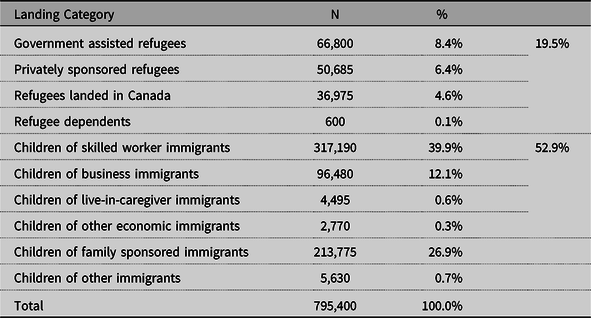
In our analysis, the focus is on individuals who became permanent residents between 1980 and 2000 at 0 to 17 years of age. The number of refugee and immigrant youth that fall in these criteria was 795,400 (Table 1).
Distribution of refugee and immigrant children and youth in IMDB 2015 landing category

Refugee children and youth are 19.5% of the sample, within which GARs are 8.4%, PSRs 6.4%, and RLCs 4.6% of the sample. A little more than half of the sample (52.9%) were dependents of economic immigrants, with 40% of the sample as dependents of skilled workers (SW) and 12.1% as dependents of business immigrants. Children and youth landing through the family sponsored category account for 26.9% of the sample. Our analysis will not report on children and youth who landed as “refugee dependents,” and children of “live-in-caregiver immigrants,” “other economic immigrants,” and “other immigrants,” who are, together, less than 2% of the sample.
Measures
The analyses examined the timing of three life-course events, including labour market activity (Y1), marriage or common law status (Y2), and parenthood (Y3). To analyze the patterns of transition into these adulthood statuses, we focused on the age at which each of the outcomes (Y1–Y3) was first observed in the tax records. Because the T1FF tax records do not include indicators for full- or part-time work conditions, we generated an earnings threshold, which captures extensive labour market activity. The threshold for extensive labour market activity (Y1) is defined as the full-time full-year (35 hours per week 52 weeks per year) equivalent earnings at the national average of minimum wages for each tax year. The values are adjusted for inflation, and the constant value is set at the 2015 level. If someone had earnings equal to or higher than $18,900, which is the full-time full-year equivalent of the national average of minimum wages in 2014, then they are considered to have transitioned into “extensive labour market” activity. For marriage or common law status, and parenthood, we used indicators that identify the marital status and number of children in the household found in the T1FF tax records.
To identify the age of each adulthood transition, we first generated a dummy indicator (Dit) to show the status of outcomes for each year of the tax records from 1982 to 2015, where i = 1, 2, or 3, indicating the three adulthood outcomes (Y1–Y3), and the t = 1, 2, …, 34, indicating each tax year. Then for each individual, we concatenated the 34 sets of dummy indicators in order to identify the tax year (t), in which the digit of 0 or 1 appears. That is, if 1 appears in the fifth digit out of the concatenated variable (e.g., “00001111111111….”), then the person’s outcome was positive in the fifth tax year (t = 5) of the analysis, which is 1986. Then, the age at which Yi was first observed for this person is their age in the 1986 tax return. If none of the 34 digits registered the value 1 (e.g.,“0000000000000000000 …”), that person is deemed to have not experienced the adulthood status (Yi) during the study period between 1982 and 2015 and as such is considered “censored.” To account for the systematic selection bias of the censored cases, the Heckman selection model was applied.
To analyze our first hypothesis, we focused on immigrants’ landing category. We looked at four subgroups of refugees (GARs, PSRs, RLC, and Refugee dependents (or R-Dep)) and four categories of economic immigrants (skilled workers, business class, live-in-care givers, and other economic immigrants), as well as family class immigrants. Immigrant categories that fall outside the main admission streams are categorized as “other.” All categories were included in the analyses; however, we only report those that consist of more than 1% of the entire cases in order to ensure the robustness of the estimate.
In addition to landing category, and to explore our second and third hypotheses, we looked at the impact of knowledge of official languages and the age at landing in Canada. Knowledge of the official languages was measured with the knowledge of English, French, English and French, or neither reported in the landing records. Age at arrival was grouped into three categories: 0–5 years, 6–12 years, and 13–17 years, which correspond to preschool, elementary school, and early teen ages. This variable captures different degrees of the impact of socialization in the host and home countries. It also corresponds to the developmental stage of language learning. In order to examine variations in the impact of knowledge of an official language prior to migration, we included an interaction between official language and age at landing in our analyses.
Related to the effect of knowledge of an official language and age at landing, the literature addresses how the political and economic context of the country of origin and destination influence the settlement outcomes of newcomers (Portes & Böröcz, Reference Portes and Böröcz1989; Portes & Rumbaut, Reference Portes and Rumbaut2001; Luthra, Waldinger, & Soehl, Reference Luthra, Waldinger and Soehl2018; Zhou, Reference Zhou1997). The development level of the country of origin is also reported to influence the educational outcomes of refugee and immigrant children (Hou & Bonikowska, Reference Hou and Bonikowska2017). Furthermore, languages of the home country could also overlap with the knowledge of English and French. To account for the potential effect of source country, we included dummy variables for the top 20 countries of birth as a control variable. Further, the economic conditions and political context surrounding refugee and immigrant children in the host society tend to affect the settlement process of refugees and immigrants (Portes & Böröcz, Reference Portes and Böröcz1989; Luthra et al., Reference Luthra, Waldinger and Soehl2018). We control for these contexts by including landing year in our models. Landing year is categorized into four cohorts: 1980–84; 1985–89; 1990–94; and 1995–2000.
Analytic approach
Our analysis first examines whether and to what extent adulthood transitions vary between children who migrate to Canada as refugees and those who arrive as children of other immigrants. We first present the descriptive characteristics of our analytic sample and test our hypothesis using bivariate analysis. The second part of the analysis examines whether the patterns of adulthood transition vary between refugee children and children of nonrefugee immigrants, and how knowledge of official language and age at landing affect those patterns. In doing so, we estimate Heckman selection models (Heckman, Reference Heckman1976) to account for bias caused by the nonrandom event of censorship. In Heckman’s formulation, dependent variable Y for the jth person is estimated with an ordinary least squares regression equation with a set of predictors X and the random error u 1;
 $${Y_j} = X\beta + {u_{1j}},$$
except that a selection equation, which uses another set of predictors (Z), is estimated to examine the probability of observing (or not observing) the outcome Y.
 $$z\gamma + {u_{2j}} \gt 0,{\rm{ where}}$$
 $${u_1}\,\~\,\,N(0,\sigma )$$
 $${u_2}\,\~\,\,N(0,1)$$
 $$corr({u_1},{u_{2j}}) = \rho .$$
Thus, the selection equation accounts for the systematic bias from “censored” cases, who never experienced the adulthood status during the 1982–2015 tax years. In instances where there is a significant correlation in the two-error terms (ρ), excluding the selection equation leads to biased estimates in the regression equation. In the results section, we report the conditional marginal effects of predictors; the effects, which take into account the probabilities of censored cases.
Using this estimation method, four models are compared. We test our first hypothesis in Model 1. It only includes the landing category dummy variables along with a set of dummy variables for landing year cohorts. We include the landing cohort controls because the effects of the landing categories are already established in the bivariate analysis. The first model establishes baseline differences in the timing of transition into substantial labour market activity, forming conjugal union, and parenthood across refugees and other immigrant groups. We test our second and third hypotheses in Models 2 through 4. Model 2 adds knowledge of official language at landing. The results from this model assess the importance of language in adulthood transition. Model 3 accounts for the interaction between language and age at landing analyzing how they jointly account for gaps in the timing of transition between refugees and nonrefugee children. Model 4 adds a set of dummy variables to control for country of birth. Results from this model examine whether the effects of refugee status, and language and age at landing, remain above and beyond the country-specific effect.
Because labour market activities, spousal union, and parenthood are highly gendered phenomena, we conduct our analysis separately for men and women. Throughout the analyses, significance test results are offered. However, the large volume of data (n = 410,975 and 380,885 for men and women, respectively) means a very high risk of Type I error, falsely rejecting the null hypothesis. To avoid the risk for erroneous conclusions, the results are interpreted with more emphasis on the substantial differences across the point estimates, rather than the statistical test results.
Results
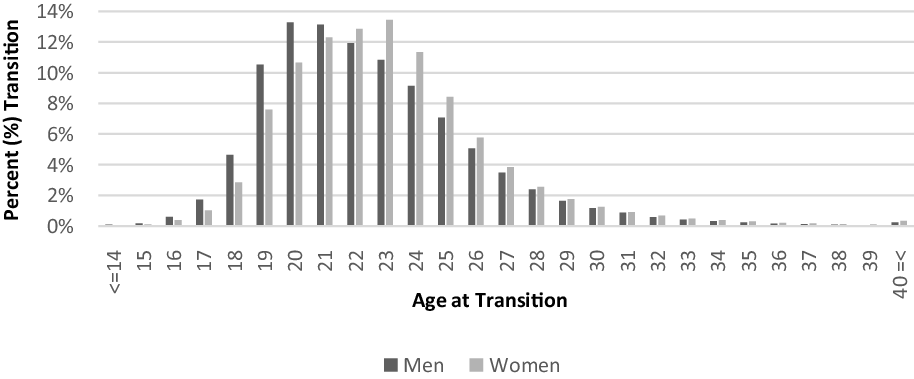
We begin our analysis by first looking at the overall timing of adulthood transitions. Figures 1 to 3 show the distributions of age at adulthood transitions for men and women. The charts show that men enter into substantial labour market activity at a younger age than women. The average age of reporting first substantive earnings is 22.5 years for men and 23.1 years for women. Although the mean difference is about 0.6 years, the chart shows distinct patterns for men and women. Transition to this outcome peaks at the age of 20 or 21 years old for men but is 23 years of age for women.
Distribution of age at transition into substantial labour market activity (Y1) by gender.

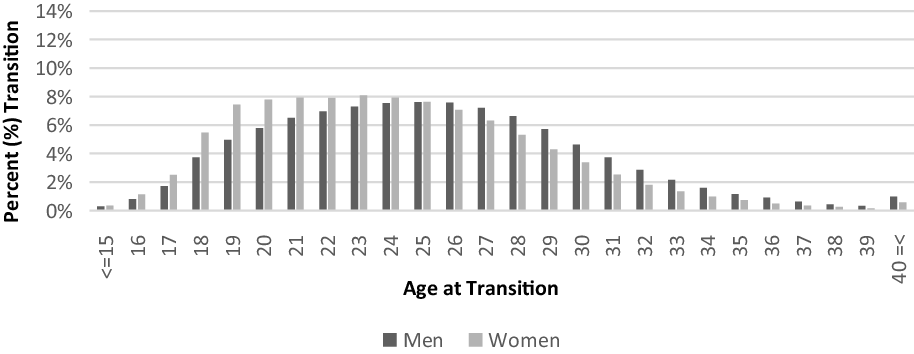
Distribution of age at transition into marriage/common law union (Y2) by gender.

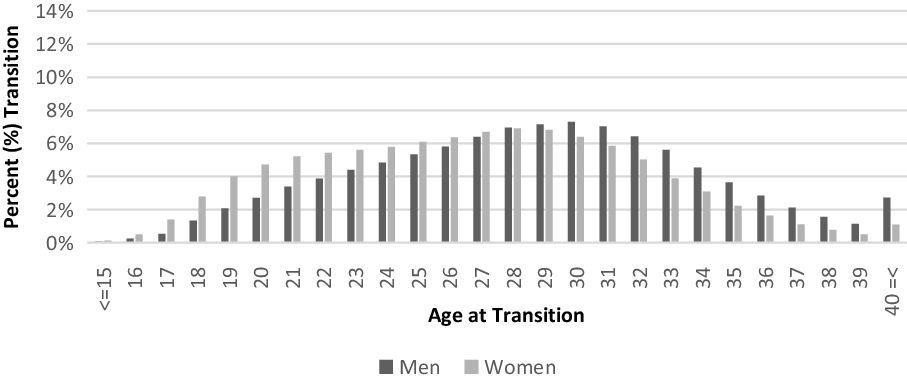
Distribution of age at transition into parenthood (Y3) by gender.

With regard to spousal union and claiming a child, women transition at an earlier age than men. Of those who formed a conjugal relationship, the average age was 25 years for men and 24 years for women. The much flatter distribution relative to entry into the labour force (Y1) signals substantial variability in the timing of entering into spousal union. For women, there is a steady entrance into forming a union even before 20 years of age, but for men, it starts in their 20s and peaks in their middle 20s. Similar to the distribution for spousal union, women begin parenthood at a younger age than men. Among those who claimed a child by 2015, the average age of first reporting a child was 26.8 for women and 28.7 years for men. For women, entrance into parenthood is steady throughout their 20s while men are more concentrated in their late 20s.
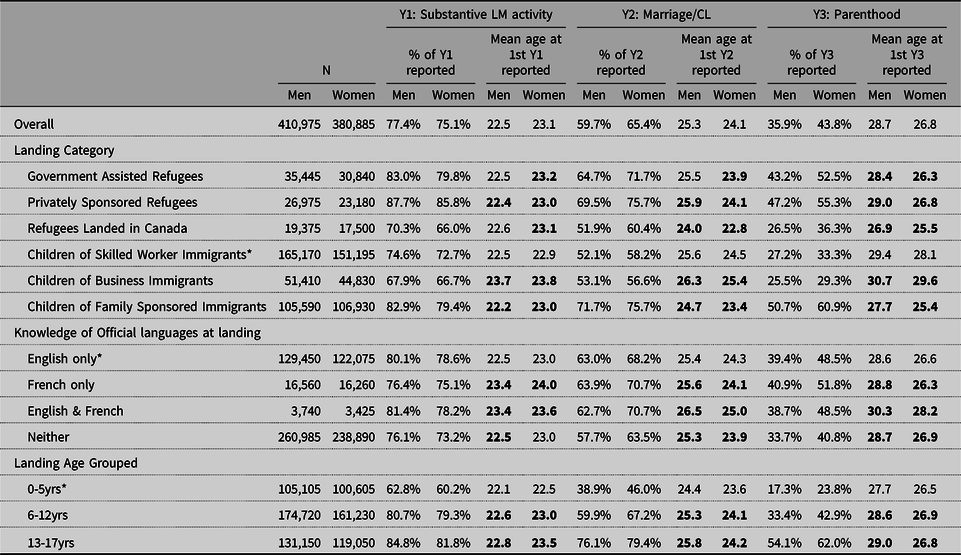
Table 2 reports summary statistics for the three adulthood transitions by the landing category of immigrant and refugee children and youth as well as their knowledge of official languages and age at the time of landing in Canada. For transition into substantial labour market activity (Y1), there is not a large difference between children and youth of different refugee groups and dependents of SW immigrants (reference category for mean comparisons). The mean differences between the refugee categories and SWs are less than 0.3 years for the most part. The gap within the economic class categories is much greater, where children of business immigrants transition into substantial labour market activity at an older age than the children of SWs. There is no discernable difference between refugee categories and family class immigrant children. Likewise, there are no substantial differences among the three refugee groups.
Summary of Adulthood Status Outcomes by Landing Category and Other Predictors

* The category is used as the reference category for the mean comparisons.
Note: The bold values in the mean age indicate the difference from the reference category was statistically significant at 0.01 alpha level.
For family formation indicators (Y2 and Y3), there are large differences between refugee children and the children of economic immigrants compared to what was observed for labour market activity. The children of refugees tend to enter spousal union (Y2) and parenthood (Y3) at younger ages than the children of economic immigrants. The mean ages at first marriage for the refugee categories tend to be lower than that of the SW category; particularly between RLCs and SWs. Compared to the children of family class immigrants, GARs and PSRs make transitions later, while RLCs make transitions at a younger age. The initial descriptive results indicate partial support for our first hypothesis. Relative to children of economic immigrants, refugee children tend to have an earlier transition in terms of forming families, but not entrance into substantial labour market activities. Within the refugee groups, RLCs made the earliest transition into forming families.
Focusing on knowledge of official language at landing, the results show no consistent trends. Our second hypothesis specifies that knowledge of Canada’s official languages would signal better success in schooling, which would lead to delayed transition into adulthood. Looking at entry into labour market activity (Y1), Table 2 shows that children and youth with knowledge of “English only” and those with “neither English nor French” language proficiency have similar mean age values. For spousal union (Y2), the “neither” language group has slightly earlier transitions than those who arrive with English knowledge among women, but for men the pattern is not clear. The mean ages at transitioning to parenthood (Y3) for the “neither” language group for both men and women are slightly higher than the “English only” group, which contradicts our second hypothesis. However, the effect of language may be confounded by other factors, such as age at landing and country of origin. Those who arrived at a very young age, for example, may not have knowledge in any of the official languages at the time of landing. Likewise, knowledge of English or French is correlated with the language of immigrants’ source country.
When we examine age at the time of landing, Table 2 shows that those who arrive at younger ages make earlier transitions to all three outcomes. The mean age at transitioning to substantial labour market activity for men who arrived as teenagers (13–17 years old) is 0.7 years higher than those who arrived as children between ages 0 to 5 years, while for women, the gap is 1 year. For family formation, too, the mean age at transition increases with age at landing. These results do not support our third hypothesis since those who arrived at younger ages have earlier transitions instead of delayed transitions. These findings signal a need for exploring alternative meanings of adulthood transition among newcomer children and youth.
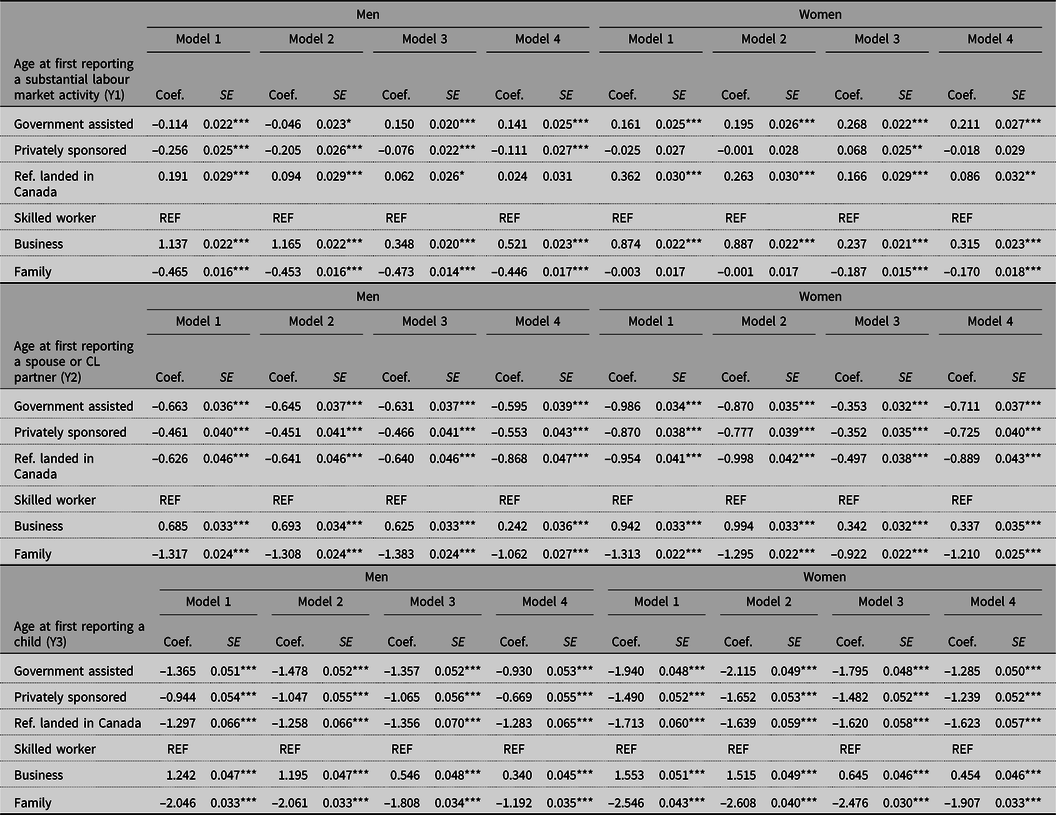
We explore our hypotheses even further by running multivariate models in Tables 3 and 4. To offer an easier interpretation, we highlight only the effects of landing category, official language at the time of landing, age at the time of landing, and the interaction between language and age in isolation from other variables. Models 3 and 4 in both tables come from the same models, but the tables differ in the presentations of the effects of terms in the models. Full models with all variables are included in Appendixes 1a–1c. In Table 3, we present the marginal effects of immigration category on the three measures of adulthood transition. The results from Model 1, which controls for the effect of landing year, are quite similar to what was reported earlier. Refugee children’s transition into adulthood takes place at an earlier age than the children of economic immigrants, but later than the children of family class immigrants. These findings are more robust for family-related adulthood transitions (Y2 and Y3) compared to the transition into substantial labour market activity (Y1). Within refugees, the marginal effects of the PSRs are generally smaller than the GARs and RLCs, indicating that the latter two groups make transitions earlier than the PSRs.
Conditional marginal effect of immigration category on three indicators of adulthood transitions (Heckman selection model)

*p < .05. **p < .01. ***p < .001.
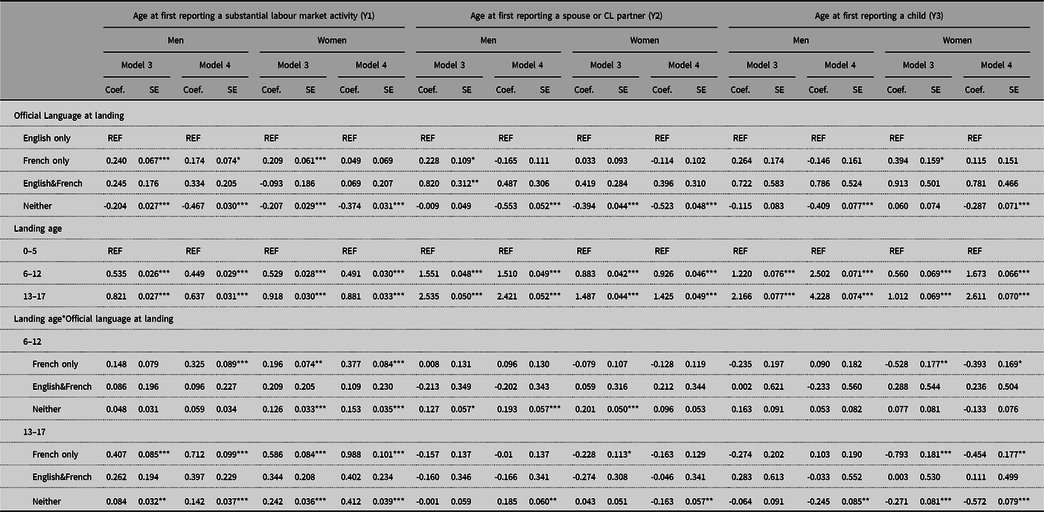
Conditional marginal interaction effect of official languages at landing and landing age on three indicators of adulthood transitions (Heckman selection model)

*p < .05. **p < .01. ***p < .001.
Models 2, 3, and 4 add controls for knowledge of official language, age at landing, and source country. In these models, the coefficients of the immigration categories change slightly, but the overall patterns do not change. Sizable reductions in the coefficients are observed between Models 2 and 3, and between Models 3 and 4 for the family formation outcomes (Y2 and Y3), while there is no consistent pattern across the models for the economic transition outcome (Y1). Specifically, for women’s transition to spousal union (Y2), the coefficients for GARs, PSRS, and RLCs in Model 3 are reduced to less than half the coefficients in Model 2. For transition into parenthood (Y3), there is a substantial reduction in their coefficients in Model 4 for both men and women. These results indicate that entrance category impacts the timing of transitions to adulthood. Some of the gaps are confounded by individual and structural factors, such as age at landing and source country, but not official language at landing. Even when they are controlled for, there are sizable differences in the timing of transition into adulthood, particularly for family formation. Generally, the effects presented in Table 3 confirm our first hypothesis.
The impact of language, however, may be sensitive to age at the time of landing, and it is also highly confounded by the source country refugees and immigrants arrive from. There may also be an interaction effect between knowledge of official language and landing age. In Table 4, we focus on these interaction effects without and with source country adjustments in Models 3 and 4, respectively.
When we focus on age at transition into substantial labour market activity (Y1), the results show slight negative effects of not having knowledge in English or French at landing for both men and women. In Model 3, the estimated marginal effects were –0.204 and –0.207 for men and women, respectively. They are greater than the effects reported in the model without the control of landing age (see Appendix 1a). The effect of official language at landing only becomes apparent when age at landing is controlled for. Once this is done, arriving with no official language is associated with early entry into a substantial labour market activity. When the interaction effect between knowledge of an official language and age at landing is estimated, the results are mixed for men and women. For men, there are small positive values for the “neither” language categories for the 6–12 years old at landing (0.048) and for the 13–17 years old (0.084), which indicate that the language effect does not have a substantial interaction effect. Regardless of the landing age, men who arrived without any official languages tend to enter into labour market activity at an earlier age. For women, the positive interaction effects for older landing age groups (0.126 for ages 6–12 years at landing and 0.242 for ages 13–17 years at landing) serve to cancel out the negative main effect for the “neither” category. For women, no official language skills prior to landing leads to early entry into the labour market only for those who came to Canada at a younger age. In Model 4, which includes additional controls for source country, these general patterns did not change but the size of the effects associated with the “neither” language group increased. Knowledge of English and French is confounded by source country.
For family-related transition measures (Y2 and Y3), the effect of the knowledge of official language at landing is again confounding with age at landing and source country. For transition into spousal union, the effect for the “neither” language group among men did not have a discernable effect until source country is introduced in Model 4. For women, the effect size also increased in Model 4. The “neither” language skill group shows a negative effect, indicating that their transitions occur earlier than the English group. There are also sizable interaction effects between language and age at the time of landing. For conjugal relationship (Y2), the interaction terms are gendered. For men, the positive interaction effects of the “neither” category for 6–12 and 13–17 landing age groups mean that when they arrive at an older age, the negative effect associated with no official language is not as substantial as the 0–5 age group. For women, the negative interaction effect for the 13–17 landing age group means that no prior knowledge in English or French leads to even earlier entrance into spousal union. For transition into parenthood, the interaction effects of “neither” language category group among the 13–17 landing age group are both substantial and negative in Model 4. No knowledge of an official language at the time of landing is associated with early parenthood transitions. The effect is greater among those who arrive as adolescents (13–17 years of landing) compared to those who arrive as children (12 years or younger), except for men’s transition into marriage.
While the impacts of knowledge of an official language have varying effects on transition outcomes, and highly confounded by landing age and source country, the effect of landing age is substantial and robust. For all outcomes, arriving at a later stage of childhood/adolescence is associated with delayed transitions. This offered mixed support for our second hypothesis, but contradicted our third hypothesis.
Overall, the analyses show that refugee children and youths’ transitions into adulthood take place at an earlier age than children of economic immigrants, but later than children of family class immigrants. Refugee status has a more salient and robust impact on adulthood transition into family formation than transition to economic activity. We also found that differences among immigrant and refugee children and youth from different landing categories are partially confounded by age at landing and source country, but knowledge of official languages did not account for the gap. Instead, the effect of knowledge of English or French is highly confounded by age at landing and the source country of immigrant and refugee children and youth.
Discussion
The results offer a number of avenues to better understand the life experiences of refugee and immigrant children and their transitions into adulthood. Consistent with our first hypothesis, children of refugee and other immigrants differ in their timing of adulthood transitions, where refugee children generally tend to have earlier transitions than those who are dependents of economic immigrants, but transition later than dependents of family class immigrants. The pattern is evident for transitions to family formation, but not economic transition. This could be explained by the high postsecondary completion rates of refugee children found by other researchers (Hou & Boniowska, Reference Hou and Bonikowska2017, p. 1442). However, another plausible explanation is economic struggles among recent immigrants, which makes their experiences more similar to refugees than commonly thought.
The literature shows that immigrants in Canada during the 1980s and 1990s did not fare well in the labour market (Baker & Benjamin, Reference Baker, Benjamin, Abbott, Beach and Chaykowski1997; Banerjee, Reference Banerjee2009; Hum & Simpson, Reference Hum and Simpson1999; Li, Reference Li2003; Reitz, Reference Reitz2001), yet their offspring do well in attaining higher education as mentioned above. This suggests that many immigrant youths start working while they are in school in order to pursue a postsecondary degree and offset student debt or help their families. Our data show that the average ages of earning substantial wages for male and female children of SW immigrants are 22.5 and 22.9, respectively. These figures indicate that a sizable number of immigrant children start working early. As a result, the timing of labour market transition between refugees and children of SW immigrants may not be as stark as other transition indicators. Gonzales and Roth (Reference Gonzales, Roth, Scott and Kosslyn2015), for instance, note that newcomer children make earlier economic transitions than others as they take on more economic responsibilities to contribute to their households.
Previous studies indicate that among refugees, GARs and RLCs tend to face greater economic struggles than PSRs. This is because PSRs tend to have better social capital upon arrival through their sponsors and in turn they have better economic outcomes than the GARs (Kaida et al., Reference Kaida, Hou and Stick2019; Picot, Zhang, & Hou Reference Picot, Zhang and Hou2019). Furthermore, RLCs often go through a lengthy period of uncertainty and precariousness, with limited access to state-funded settlement services (Goldring et al., Reference Goldring, Berinstein and Bernhard2009). Despite these differences, GAR refugee children and youth enter the labour market around the same time as PSRs. This may indicate that, like the negligible differences between refugees and immigrants, the life-course experiences of different newcomer children and youth are more similar than commonly expected in the dominant literature.
Knowledge of official language at the time of landing signals an advantage in transitioning to the host society, and for refugee and immigrant children and youth it also signals advantages in schooling. As a result, it was hypothesized that those without such language skills may make earlier transitions. Our results show that absence of prior knowledge does not have direct impacts on adulthood transition. The effect is, however, sensitive to age at landing and source country. Once these factors are controlled for, those without prior skills in English and French tend to make earlier transitions into the labour market and family formation.
The literature on immigrant children and youth also suggests a socioeconomic advantage and social adaptation for those who arrive at younger ages. However, our findings show the opposite trend. That is, those who arrive at an earlier age tend to make earlier transitions. This was the case across all indicators that we examined for both genders. The literature suggests that the life experiences of newcomer children hold unique meaning, relative to their native-born counterparts. In addition to providing economic support to the household at an early age, it is also reported that forming families in the new country may provide a sense of rootedness (Rumbaut & Komaie, Reference Rumbaut and Komaie2010). This could account for the early transitions among those who arrived at a younger age.
Conclusion
The growing proportion of refugees and immigrants among young people in Canada inspires the probing of their acculturation to the country and their life-course transitions. Research that focuses on their long-term adaptation process is, however, scarce. Against this backdrop, using the Canadian longitudinal data, we examined patterns of transition to adulthood among refugee and immigrant children. More specifically, we assessed how refugee and nonrefugee status affect patterns of transition into adulthood and how knowledge of host language, age at landing, and source country account for differences in these transitions.
We found that compared to the dependents of economic immigrants, refugees have earlier transitions into forming families. However, we found that refugee children and youth enter into labour market activity around the same time as those who are dependents of skilled worker immigrants, which suggests that the economic struggles of refugee and nonrefugee immigrant children and youth may be more similar than many assume. Both trends remain after controlling for knowledge of the host country’s official languages, age at landing, and source countries. We also found that immigrant and refugee children and youth who arrive without knowledge of official languages have earlier adulthood transitions, but its effect is small and highly contingent on age at the time of arrival.
Overall, our paper shows the value of focusing on life-course processes over static outcomes of integration. By doing so, our findings signal that admission categories and language ability are not as salient in affecting acculturation as assumed by many. Our results show the need to further explore whether or not early life-course transitions to adulthood necessarily have cascading negative consequences on other aspects of refugee children and youth’s lives. The meaning and effect of their early transition may be different from the “normative order” of transition to adulthood.
Acknowledgments
The authors would like to express special thanks to Dr. Martha Crago for her promotion of research on refugee children and youth. We would also like to thank Dr. Joanne Paradis for her valuable comments, as well as the team of guest editors and reviewers who provided insightful feedback on the manuscript. This research was supported by the Child and Youth Refugee Research Coalition, which is funded by the Social Sciences and Humanities Research Council of Canada.
Appendix 1a. Conditional marginal effects on age at first reporting a substantial labour market activity

*p < .05. **p < .01. ***p < .001.
Note: The results specific to the ordinary least squares regression and selection models are available upon request.
Appendix 1b. Conditional marginal effects on age at first reporting a spouse or CL-partner

*p < .05. **p < .01. ***p < .001.
Note: The results specific to the ordinary least squares regression and selection models are available upon request.
Appendix 1c. Conditional marginal effects on age at first reporting a child

*p < .05. **p < .01. ***p < .001.
Note: The results specific to the OLS regression and selection models are available upon request.