INTRODUCTION
The Lusitanian toadfish, Halobatrachus didactylus (Bloch & Schneider, 1801) is a benthic and solitary marine teleost of the family Batrachoididae (Roux, Reference Roux, Whitehead, Bauchot, Hureau, Nielsen and Tortonese1986). It inhabits coastal waters from the Gulf of Guinea to the centre of the Iberian Peninsula (Bauchot, Reference Bauchot, Fischer, Schneider and Bauchot1987), where important populations of the species occur almost exclusively in estuaries (Costa & Costa, Reference Costa and Costa2002). This confinement in estuaries is mainly due to the relatively low temperature and strong hydrodynamics of this coastal region in contrast to that observed in estuarine systems, where specimens find more suitable conditions to reproduce (Costa & Costa, Reference Costa and Costa2002; Costa et al., Reference Costa, Almeida and Costa2003). Being on the northern boundary of its distribution, the Tagus estuary population is relatively unstable and vulnerable. In fact, the species disappeared from this ecosystem in the 1960s, with a slight decrease in temperature, and reappeared in the 1990s, after a gradual temperature increase (Cabral et al., Reference Cabral, Costa and Salgado2001). Despite being relatively sedentary, Costa (Reference Costa2004) observed that H. didactylus may undertake more extensive movements, and Campos et al. (Reference Campos, Costa, Quintella and Almeida2008) determined that such movements may be relatively frequent. Being a voracious predator (Cárdenas, Reference Cárdenas1977; Costa et al., Reference Costa, Silva, Almeida and Costa2000), H. didactylus may play an important ecological role in regulating the populations of its prey (Costa, Reference Costa2004). In small and relatively enclosed ecosystems it may even be responsible for the displacement of competing species (Costa, Reference Costa2004; Costa et al., Reference Costa, Domingos, Almeida, Feunteun and Costa2008). Like other Batrachoididae, this species exhibits two male morphotypes: type I, with its characteristic nest and offspring guarding; and type II, the alternative morphotype (Modesto & Canário, Reference Modesto and Canário2003).
The distribution, abundance and population structure of H. didactylus was studied in detail for the Mira estuary (Costa, Reference Costa2004), a small linear system (~2 km2) on the south-west coast of Portugal. That work demonstrated that, due to thermohaline constraints, higher densities of H. didactylus occurred in the middle section of the estuary, where the population preferably reproduces, and that individuals tended to displace to lower sections of the system as they grew. Regarding the sex-ratio, data from the Bay of Cadiz (Palazón-Fernández et al., Reference Palazón-Fernández, Arias and Sarasquete2001) and the Mira estuary (Costa, Reference Costa2004) indicate an initial balance between the sexes that becomes favourable to females with age, resulting from the more demanding role of males in reproduction (Costa, Reference Costa2004). Studies from Costa et al. (Reference Costa, Silva, Almeida and Costa2000) and Pereira et al. (Reference Pereira, Silva, Costa and Costa2011) also suggest that this pattern may occur in the Tagus estuary. The proportion of male morphotypes was previously determined in the Ria Formosa (Modesto & Canário, Reference Modesto and Canário2003), on the south coast of Portugal, and Mira estuary (Costa, Reference Costa2004), and the percentage of type II males was much higher in the latter location. According to Costa (Reference Costa2004), this feature was caused by the differences in species density in the two systems, since the percentage of type II males seems to increase with density, presumably because of greater competition for reproductive resources.
Adult H. didactylus increase their feeding activity in spring in order to be able to reproduce (Cárdenas, Reference Cárdenas1977; Costa et al., Reference Costa, Silva, Almeida and Costa2000; Costa, Reference Costa2004). In contrast, H. didactylus decrease in activity during the winter as a result of the decreased water temperature (Costa et al., Reference Costa, Silva, Almeida and Costa2000; Costa, Reference Costa2004), a situation that seems to be less intense in the lower regions of estuaries (Costa, Reference Costa2004) and does not occur at sea (Cárdenas, Reference Cárdenas1977). It is, therefore, interesting to study and understand the activity of the species in a large brackish water system and to evaluate if that activity is more similar to that observed in the Mira estuary or observed at sea.
The aim of this work was to study and to determine if and how the geomorphology of the system and environmental factors influenced the distribution, abundance, structure and activity of the H. didactylus population in the Tagus estuary and to investigate if these features are similar to those of different estuaries, namely smaller and linear ecosystems, such as the Mira estuary, where this species was previously subject to detailed study. Also, this work will contribute to understand the colonization of this ecosystem by H. didactylus, in order to better evaluate its role in the biological community.
MATERIALS AND METHODS
Study area
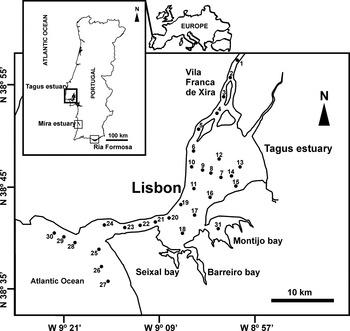
This study was carried out in the Tagus estuary, a large water system (~320 km2) located on the central western coast of Portugal, and adjacent coastal areas (Figure 1). Morphologically, the estuary has a linear structure in the initial and final stretches, although the main central water body is very broad, with several large bays (Montijo, Barreiro and Seixal Bays) along the southern bank (Figure 1). The Tagus estuary runs along a geological fracture in its central section, which emphasizes the asymmetry in its margins (Bettencourt et al., Reference Bettencourt, Gomes, Dias, Ferreira, Silva and Costa2003). A significant part of the northern margin is straight, relatively high and regular, due to human intervention. Greater depths in the estuary are usually observed along this stretch, not only because of the geological fault, but also because of dredging for navigation channels. The southern margin is generally lower and irregular, presenting a wide range of intertidal mud-banks, which are exposed at low tide.
Location of the Tagus estuary and adjacent coastal area and sampling stations (•).

Salinity gradually decreases from the lower to the upper zone of the estuary, reaching 0 under normal hydrological conditions at Vila Franca de Xira (Costa et al., Reference Costa, Vasconcelos, Costa and Cabral2007). The water temperature varies seasonally, reaching significantly higher values than that observed for seawater in the summer, and considerably cooler than seawater during winter (Costa & Costa, Reference Costa and Costa2002; Bettencourt et al., Reference Bettencourt, Gomes, Dias, Ferreira, Silva and Costa2003). Due to its size and high diversity of habitats, the Tagus estuary has a very important role as a nursery area for many fish, including commercial species (Cabral & Costa, Reference Cabral and Costa1999). The number of resident species in the Tagus estuary is relatively small, with H. didactylus assuming a key ecological role in the system due to its high longevity and the body size of the specimens (Pereira et al., Reference Pereira, Silva, Costa and Costa2011).
Sampling and laboratory procedure
In order to determine the species distribution in the Tagus estuary and adjacent waters, 31 sampling stations covering the entire system (Stations 1–24 and 31) and neighbouring coast (Stations 25–30) were established (Figure 1). Sampling surveys were carried out every two months between November 2000 and May 2002 (9 sampling surveys) using an otter trawl (14.2 m headline, 21.5 m footrope, 50 mm body stretched mesh, 18 mm cod-end stretched mesh, and with a tickler-chain) aboard a 7 m long professional fishing vessel. All trawl hauls lasted for 15 minutes and were conducted during the day at neap tides at a constant speed of 2.5 knots. Each sample swept an average area of approximately 9500 m2. Immediately before and after each trawl, depth, water temperature and salinity were measured near the bottom (0.5 m) with a multi-parameter probe YSI® 600 XLM. Sediment samples were obtained at the same points with a van Veen grab for granulometric composition according to Silva et al. (Reference Silva, Costa, Almeida and Costa2006). Captured H. didactylus were counted and measured and a subsample of 432 specimens was selected for dissection, and determination of sex and male morphotype. These operations were carried out according to the methodology used by Pereira et al. (Reference Pereira, Silva, Costa and Costa2011).
Statistical analysis
The distribution of H. didactylus in the Tagus estuary and adjacent coastal area was established from a presence/absence matrix for the various sampling stations considering all surveys. Species density in each trawl haul was calculated as total captured H. didactylus specimens per trawled area (in hectares (ha)). Average density per site was estimated averaging density values of the H. didactylus in different sampling seasons. The Kruskal–Wallis test (Siegel & Castellán, Reference Siegel and Castellan1988) was used to compare the species density among the various stations. The sampling stations that presented absence or trace densities (<1 ind.ha−1) of the species were excluded from further analysis. Conversely, where the density of H. didactylus was relevant (≥1 ind.ha−1), the population structure and activity of the specimens throughout the year was analysed.
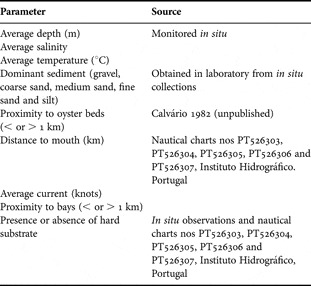
In order to examine the population size-structure by location, considering all seasons together, the captured individuals were divided into six length-classes, which, according to Pereira et al. (Reference Pereira, Silva, Costa and Costa2011), corresponded to the following age-classes: TL1: specimens < 15 cm (up to 1 year of age); TL2: 15 ≤ specimens < 20 cm (up to 2 years of age); TL3: 20 ≤ specimens < 25 cm (up to 3 years of age); TL4: 25 ≤ specimens < 30 cm (up to 4 years of age); TL5: 30 ≤ specimens < 35 cm (up to 5 years of age); and TL6: specimens ≥ 35 cm (over 5 years of age). Subsequently, a matrix of densities by sampling station was calculated according to the different size-classes and used to group the sampling stations with greater similarity in size-classes' densities through a hierarchical cluster analysis, using the Ward's cluster-analysis method with squared Euclidean distance (Hair et al., Reference Hair, Anderson, Tatham and Black1998). This analysis also allowed the determination of the dominant size-classes in the various locations in the estuary, as well as the identification of the areas of high recruitment (i.e. where most individuals of size-class TL1 were observed). To determine which environmental parameters were more influential in the distribution of the various size-classes of the species, the multivariate technique canonical correspondence analysis was used, since the characteristics of the data require the use of a unimodal method (ter Braak & Šmilauer, Reference ter Braak and Šmilauer2002). To perform this statistical procedure, the size-class density by location matrix was related to the corresponding environmental data matrix (Table 1), incorporating in the final model the significant parameters after a forward selection using the Monte Carlo permutation test. This statistical procedure was also used to determine the significance of the first and all canonical axes of the analysis (ter Braak & Šmilauer, Reference ter Braak and Šmilauer2002).
Environmental parameters used in the canonical correspondence analysis to determine which abiotic determinants influence the distribution of the various size-classes of Halobatrachus didactylus, and respective sources of information.

In order to analyse the H. didactylus population sex-structure in the Tagus estuary, the overall sex-ratio was determined and analysed to evaluate if this parameter was uniform throughout the system. For this purpose, two separate analyses were performed, targeting the relevant sampling stations in two ways. Firstly by upper (sampling Stations 6–16), intermediate (sampling Stations 17–20 and 31), and lower estuarine zones (sampling Stations 21 to 24); and secondly by zones near settled margins (sampling Stations 6, 9–11 and 19–24) and zones further from settled margins (sampling Stations 7, 8, 12–18 and 31). To investigate if the sex-ratio in the H. didactylus population of the Tagus estuary significantly differed from the theoretical ratio 1:1 (Nikolsky, Reference Nikolsky1963), a ‘goodness-of-fit’ G-test was used (Sokal & Rohlf, Reference Sokal and Rohlf1995). To complete the analysis, the proportion of both male morphotypes in the whole system was also determined.
When inactive, H. didactylus specimens bury themselves in the sediment or find shelter on the bottom. In these circumstances, capturing fish can be very difficult (Costa, Reference Costa2004). Thus, outside of the recruitment period, temporal changes in specimen captures reflect, in particular, fluctuations in the activity of the individuals. Therefore, in order to detect variations in the activity of the species throughout the year in this system, an analysis of specimen captures in the different sampling seasons was performed. This approach was applied to the whole estuary and also separately for three different areas. In the last case, sampling stations were allocated to the following zones: upper, lower and intermediate estuary (as described above for the analysis of sex-structure). In these four analyses, density values of each sampling survey were compared using a Kruskal–Wallis test.
Kruskal–Wallis tests and the hierarchical cluster analysis were performed with SPSS software (version 16.0). The ‘goodness-of-fit’ G-tests were performed with BIOMstat software (version 3.0). The canonical correspondence analysis was performed with CANOCO software (version 4.5).
RESULTS
Distribution and abundance
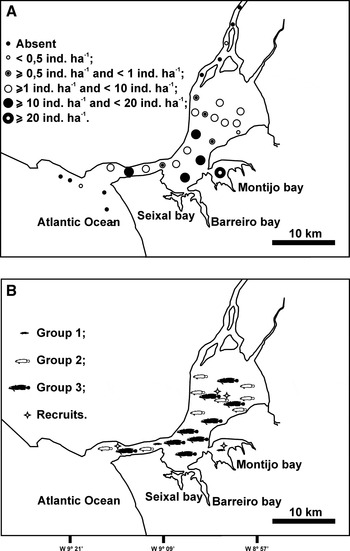
Halobatrachus didactylus density along the Tagus estuary and adjacent coastal area varied significantly (Haj = 137.13; df = 30; P < 0.001). This population showed a preferential distribution in the intermediate and lower estuarine stretches, with only few specimens found in the other sampled areas (Figure 2A). In the upper estuary (salinity less than 19) and in the marine environment only at sampling Stations 3, 27 and 28 were some isolated specimens captured. The site where this species was more abundant was Montijo Bay (sampling Station 31), immediately followed by the adjacent areas of Montijo and Barreiro/Seixal Bays (sampling Stations 17 and 18) and the sampling Stations 11 and 23, near the right bank.
(A) Distribution and abundance of Halobatrachus didactylus along the Tagus estuary and adjacent coastal area (mean values); (B) spatial distribution of the dominant size-classes of H. didactylus and the presence of its recruits along the Tagus estuary.

Length-structure of the population
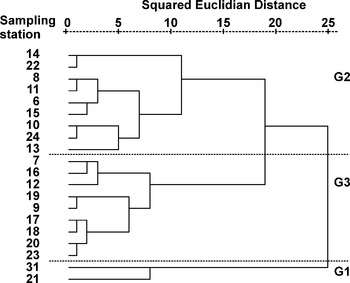
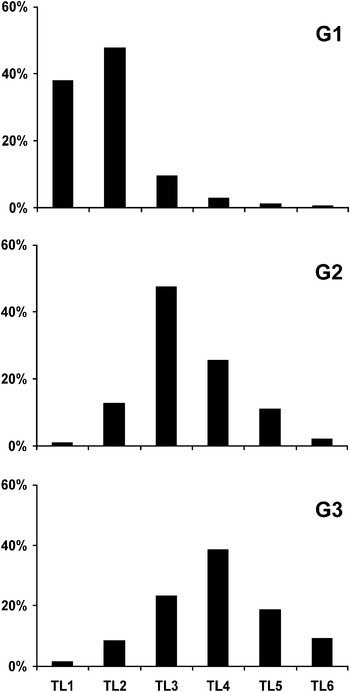
As the abundance of H. didactylus differed throughout the study area, its population size-structure clearly varied among the sites. The hierarchical classification analysis identified three distinct groups of sampling stations in terms of the size-structure of H. didactylus (Figure 3). In group G1, there was a predominance of small individuals, including recruits (Figure 4), group G2 had a preponderance of medium sized specimens (TL3 class, when most of the specimens reach the adult stage), and group G3 was dominated by large individuals, the majority corresponding to the TL4 class (breeding males and most from morphotype I). Figure 2B illustrates the spatial distribution of the three groups, highlighting the occurrence of recruits (TL1). These were found in three distinct regions: upper middle estuary (sampling Stations 7 and 8); bays (high abundance in sampling Station 31) and adjacent areas (sampling Stations 17 and 18); and also near the sea (sampling Station 23).
Dendrogram of hierarchical classification analysis performed to identify homogeneous groups of sampling stations in terms of size-structure of the Halobatrachus didactylus Tagus estuary population.

Length–frequencies of Halobatrachus didactylus specimens in each group of sampling stations with homogeneous size-structure population (G1, G2 and G3), where total length (TL) TL1: specimens < 15 cm; TL2: 15 ≤ specimens < 20 cm; TL3: 20 ≤ specimens < 25 cm (up to 3 years of age); TL4: 25 ≤ specimens < 30 cm (up to 4 years of age); TL5: 30 ≤ specimens < 35 cm (up to 5 years of age) and TL6: specimens ≥ 35 cm (over 5 years of age).

Influence of environmental parameters in the distribution of size-classes
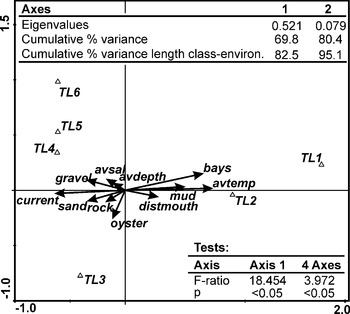
The canonical correspondence analysis revealed that the conditions responsible for higher densities of small individuals (TL1 and TL2), including recruits, were mainly (in descending order of importance): (i) high water temperature; (ii) presence of bays; (iii) low water flow; and (iv) predominance of muddy substrate (Figure 5). Medium sized individuals (TL3) were found in greater concentration in rocky areas (natural or artificial) or with a predominance of oyster beds. Larger specimens (TL4, TL5 and TL6) were more abundant in areas of coarser sediment and higher water currents (as TL3 individuals), depth and salinity.
Canonical correspondence analysis diagram relating the influence of environmental variables to the size-structure of the Halobatrachus didactylus population of the Tagus estuary. The length-classes (from TL1 to TL6) are represented by triangles. The explanatory environmental variables are indicated by arrows (bays, proximity to bays; mud, % of mud in the sediment; avtemp, average temperature; distmouth, distance to estuary mouth; oyster, proximity to oyster beds; rock, proximity to rocky substrate; sand, % of sand in the sediment; current, water velocity current; gravel, % of gravel in the sediment; avsal, average salinity; avdepth, average depth). Eigenvalues, percentage of variance explained by the first two axes, and results of the statistical tests performed to determine the significance of the first axis and of all canonical axes are also presented.

Sex-ratio
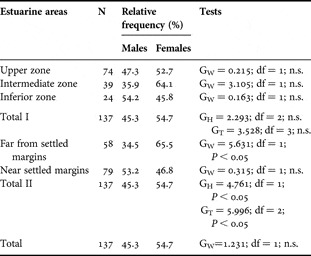
Although the sex-ratio of the Tagus estuary H. didactylus population was slightly favourable to females, it was not significantly different from the theoretical 1:1 ratio (Table 2). Similar results were observed when the sampling stations were grouped in upper, intermediate and lower estuarine areas (Table 2). However, when considering sampling stations by areas near and far from settled margins, significant differences were obtained (GT), showing that these areas are heterogeneous (GH) with regard to sex-ratio (Table 2). In this case, while in zones near settled margins there was a balance between the percentage of males and females, females were clearly dominant at sites further from settled margins.
Percentage of Halobatrachus didactylus males and females in several zones of the Tagus estuary, showing also the results of the statistical procedures performed to determine if the sex-ratio in each case differ from the expected ratio 1:1.

N, number; n.s., non-significant.
Proportion of male morphotypes
The analysis of the male specimens showed that the incidence of type II individuals was low in the Tagus estuary. In fact, only 3.2% of the examined sexually mature males (N = 62) belonged to this group.
Temporal variability in captures
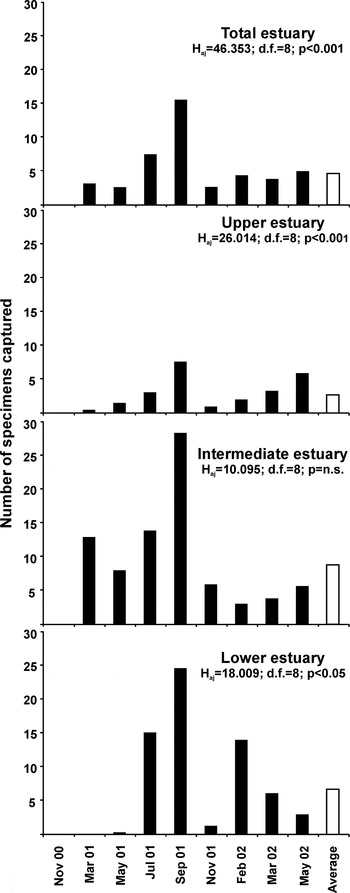
When considering all sampling stations, there were highly significant differences in Lusitanian toadfish captures during the various seasons of the year (Figure 6). There was an increase in species density in spring, whereas late summer showed a peak of high abundance followed by a sudden drop, with remaining captures at low abundance during the winter months. This pattern of variation was less marked in the lower areas of the system, where the density of the species seemed to have less seasonal variations (even in the intermediate zone, no significant differences were observed among the captures in the different seasons). In this case, only the peak of abundance in late summer appeared to be clearer and the main differences seemed to occur between years, rather than within the same year.
Variation in abundance captures of Halobatrachus didactylus throughout the year in the Tagus estuary, taking into account the entire system and its upper, intermediate and lower zones separately.

DISCUSSION
This work confirmed the observations of Costa & Costa (Reference Costa and Costa2002) that, in estuaries, this species only has significant populations in its intermediate and lower areas. The near absence in the upper region of the Tagus estuary is similar to that observed in other brackish systems and is mainly due to the lower salinity (Costa, Reference Costa2004). Moreover, the reduced number of specimens captured in coastal areas adjacent to the Tagus estuary was probably caused by both the high hydrodynamics and low water temperature in this area during the breeding season, which rarely reaches the necessary 17–18°C for the survival of the offspring (Costa & Costa, Reference Costa and Costa2002). Still, on the Tagus estuary adjacent coast, the amount of captured individuals was higher than that observed in upstream areas and in the vicinity of other western Portuguese brackish systems, including the Mira estuary (Beja, Reference Beja1995). This is probably due to the protection provided by Lisbon's Peninsula from the frequent north/north-east swell, thus allowing the establishment of more significant local populations of H. didactylus than those usually observed in similar situations, confirming the data obtained by Costa & Costa (Reference Costa and Costa2002). Since the marine areas adjacent to the Tagus and Sado estuaries are both protected from north/north-east swells, the lower abundance of H. didactylus in the latter system (Henriques et al., Reference Henriques, Gonçalves, Almada, Almada, Oliveira and Gonçalves1999) could be related to the reduced flow of the Sado River, since along the Portuguese coast H. didactylus seem to prefer areas with high freshwater influence, possibly in relation to a high productivity (Costa & Costa, Reference Costa and Costa2002).
Halobatrachus didactylus abundance and distribution in the Tagus estuary differed slightly from that observed for the Mira estuary. In this latter system, there was a higher density of individuals in its central area, decreasing upstream and downstream (Costa et al., Reference Costa, Domingos, Almeida, Feunteun and Costa2008). This was mainly due to an upstream decrease in salinity and downstream decrease in temperature (Costa & Costa, Reference Costa and Costa2002). In the case of the Tagus estuary, although a similar tendency was detected, a distinct pattern was observed. Thus, there was clearly an area of high H. didactylus abundance in Montijo Bay and its surroundings, as well as in the nearby Barreiro and Seixal Bays. There were also two minor peaks of density, one in the central region of the estuary and the other almost at the river mouth.
The differences between the Tagus and Mira estuaries were mainly related to the characteristics of each system. In fact, the latter is a small estuary with a linear structure. As such, it has lower habitat diversity and fewer potential nesting sites, which are concentrated in the centre of the system where temperature and salinity are also more suitable for spawning. The Tagus estuarine system is considerably different, with its size and shape allowing larger extents and wider varieties of habitats, enhancing the occurrence of several suitable sites for reproduction and, consequently, different population peaks throughout the estuary.
The most important place of reproduction of H. didactylus in the Tagus estuary appeared to be located along the southern margin of the system (high species density, dominance of small specimens and presence of recruits) in the regions of the Montijo Bay, and probably Barreiro and Seixal Bays, as indicated by the species high abundance, presence of recruits in their vicinity and also some recent observations in the Seixal Bay (unpublished data). The importance of the Montijo Bay to the population is also evident from the high reproductive success of in situ experiments carried out in artificial nests by Amorim & Vasconcelos (Reference Amorim and Vasconcelos2008) and Amorim et al. (Reference Amorim, Simões and Fonseca2008). The relatively closed and shallow nature of these areas provide an increase of water temperature in late spring and early summer, producing favourable conditions for reproduction. In addition, the low velocity water currents observed in these bays favours the juvenile specimens, which are not as strong swimmers. The predominance of muddy sediments in these areas also facilitates burrowing by smaller individuals (Costa, Reference Costa2004). These bays seem to work as repositories of the local surrounding areas, where the species abundance is also significant.
This situation is similar to that found along the Portuguese coast in marine regions close to estuarine areas, especially in the Algarve and on parts of the western coast protected against the north/north-east swell, as observed at the mouth of the Tagus and Sado Rivers (Costa & Costa, Reference Costa and Costa2002). As individuals grow, habitat requirements change, particularly in terms of food and space (Costa, Reference Costa2004). As a consequence, medium and large specimens tended to occur in areas of greater depth in the Tagus estuary, despite the stronger currents and coarser substrates. Animals of intermediate size occurred preferentially along the oyster beds and in areas with greater abundance of hard substrate, where they can easily find shelter (Costa, Reference Costa2004). Larger specimens seemed to be less dependent on shelter, appearing to be associated mainly with greater depth and at the river mouth, probably because larger prey items can easily be found in these areas.
The other two peaks of abundance of the species in the Tagus estuary are also related to good conditions for recruitment in these areas or their vicinity. Sampling Station 11 seemed to be a good receptacle of individuals that were born upstream, especially in the vicinity of the oyster beds (sampling Stations 7 and 8), where there is a secondary recruitment peak. The area near the mouth (sampling Station 23) had rocky substrates and, despite its lower average temperatures, also seemed to be an appropriate place for the species. It should be noted that this area is dominated by larger specimens while surrounding zones were dominated by smaller specimens, which could reflect its importance for reproduction, with the displacement of subdominant individuals of smaller size to less favourable areas, a very common phenomenon at both interspecific and intraspecific level (e.g. Archer, Reference Archer1988; Robertson, Reference Robertson1998; Costa et al., Reference Costa, Domingos, Almeida, Feunteun and Costa2008).
The maximum density of the species in the Tagus estuary (41.4 ind.ha−1) was much lower than in Mira estuary (153.4 ind.ha−1) (Costa, Reference Costa2004). Contrary to what happens in systems of larger dimensions, such as the Tagus estuary, the small size of the Mira estuary means that larger prey and predators are scarce and even low intensity climatic events, including small fluctuations in air or water temperature or the occurrence of rainfall, can result in large changes in the estuarine water body (Costa, Reference Costa2004). This may induce dramatic consequences for the species recruitment and, in extreme and prolonged situations, can even lead to its localized disappearance (Costa, Reference Costa2004). So, the success of the species in that estuary depends on a high fecundity, fast growth rate and early maturity of individuals, thus maximizing the largest possible number of breeding seasons and descendants, and a small average size of the specimens (the maximum length is just over 30 cm, which is well adapted to the sizes of prey and predators in the system), that allows the existence of a larger population (Costa, Reference Costa2004). The Tagus estuary is larger and therefore expected to have fewer sudden environmental changes, and also to be able to support larger predators and prey, which could result in the survival of larger individuals (maximum total length of about 50 cm (Pereira et al., Reference Pereira, Silva, Costa and Costa2011)) with a reduced population density in this system.
This study also confirmed the results of the earlier work by Pereira et al. (Reference Pereira, Silva, Costa and Costa2011), that the occurrence of type II males is very low in the Tagus estuary (≤5%). The percentage of opportunistic males seems to increase with population density, with a high proportion of type II males in the Mira estuary (about 30%) (Costa, Reference Costa2004). In Ria Formosa, which occupies a surface area of ~100 km2 (compared to the ~2 km2 and 320 km2 of the Mira and Tagus estuaries, respectively), the percentage of opportunistic males was intermediate (14%) (Modesto & Canário, Reference Modesto and Canário2003). The existence of higher habitat diversity in the Tagus estuary may provide a greater availability of suitable nesting sites (and so potentially less competition between males), which would result in a reduction of type II males.
As with the population of the Mira estuary, the Tagus estuary subpopulation of females tended to be higher than the subpopulation of males. This may be a result from sexual segregation or an increased mortality rate of adult males due to the greater physical demands of their reproductive strategy (Costa, Reference Costa2004). However, the lower proportion of alternative males in the Tagus estuary may indicate a reduction of reproductive competition between males in this system and explain the near-equal sex-ratio observed. The proportion of males and females varied throughout the estuary. The need to establish appropriate nesting sites during the breeding season caused the males to distribute mainly through estuarine areas near settled margins, which are also usually deeper. These are most abundant on the northern margin of the Tagus estuary and potentially offer greater availability of shelter, as opposed to the southern margin, which is generally shallower and with a predominance of softer substrates. This results in males being as abundant as females in areas near settled margins, but less abundant elsewhere.
Regarding the fluctuation in H. didactylus captures in the Tagus estuary throughout the year, it was possible to observe that, in the upper zone, abundance increased throughout spring, due to the increase of individuals' activity in search for food in order to breed in late spring and early summer, when temperatures are more appropriate (Costa et al., Reference Costa, Silva, Almeida and Costa2000), and peaked at the end of the summer, caused by the recruitment phase after reproduction. In winter, when average water temperature drops to significantly lower levels (above 14°C), activity may have decreased, and fish practically disappeared from the surveys. In areas closer to the estuary mouth, due to greater influence of seawater, the temperature amplitude was smaller (in the adjacent coastal area the observed minimum temperature was 15.6°C) and, although the recruitment peak was still clear, the maximum activity in spring and minimum activity in winter were less obvious. This pattern was very similar to that observed in the Mira estuary (Costa, Reference Costa2004).
The H. didactylus population from the Tagus estuary displays important differences from the one from the Mira estuary, despite presenting the same tendencies observed in the population of this system. These differences are thought to be related to the differences in the geomorphology of this system and the relatively recentness of this population. The distribution of H. didactylus in the Tagus estuary was less marked and linear, with the species presenting low densities, in opposition to what happens in the Mira estuary population. In the Tagus estuary the sex-ratio is more balanced and the proportion of type II males is much reduced (3.2%) in comparison to the Mira estuary population (about 30%). However, activity patterns of the populations of these two systems are very similar.
The evolution of the biological communities of the Tagus estuary, in general, and of the H. didactylus population, in particular, should be closely monitored, given its recent reappearance, as the species returned to the system in the 1990s after an absence of nearly 30 years (Cabral et al., Reference Cabral, Costa and Salgado2001). In fact, there is a strong probability that this population is still expanding within the ecosystem, which could generate significant impacts on other resources of the Tagus estuary, such as Anguilla anguilla (Linnaeus, 1758), as it occurs in the Mira estuary (Costa et al., Reference Costa, Domingos, Almeida, Feunteun and Costa2008). The situation may also be influenced by recent increases in water temperature, which may benefit this sub-tropical species.