INTRODUCTION
The Gobiidae are typically small fish which occur abundantly in inshore marine waters and estuaries with 19 species listed for the British Isles and surrounding seas (Howson & Picton, Reference Howson and Picton1997). Swaby & Potts (Reference Swaby and Potts1990) included nine gobies in their list of ‘uncommon British marine fishes’; six of these nine species are covered by the present report. It is generally accepted that gobies as a group are difficult to identify accurately (Wheeler, Reference Wheeler1978) but it is important that field researchers are aware of the likely range of species in samples. Hence a considerable amount of time has been invested in building up a database of accurately identified images during the course of obtaining the records.
Information on species distributions is of value in support of obligations faced by regulatory authorities and those promoting conservation and biodiversity. Tasks include the routine monitoring of coastal waters under the Marine Strategy Framework Directive (MSFD); monitoring species distribution for climate change; tracking potentially invasive species and the collection of baseline data on ecology and distribution leading to effective conservation. Swaby & Potts (Reference Swaby and Potts1990) strongly advocated obtaining data on the ecology and distribution of rare fish species in support of these activities.
MATERIALS AND METHODS
The six goby species for which new distribution records have been obtained and reported here are: Jeffreys' goby (Buenia jeffreysii (Günther, 1867)); Couch's goby (Gobius couchi Miller & El-Tawil, Reference Miller and El-Tawil1974); Red-mouthed goby (Gobius cruentatus Gmelin, 1789); Steven's goby (Gobius gasteveni Miller, Reference Miller1974); diminutive goby (Lebetus scorpioides (Collett, 1874)); and Guillet's goby (Lebetus guilleti (Le Danois, Reference Le Danois1913)).
The records detailed in this paper were made over a number of years by amateur and professional divers using self-contained underwater breathing apparatus (SCUBA), the majority of sightings being supported by digital photographs of individual fish. Kay & Dipper (Reference Kay and Dipper2009) recommend the use of digital photography for accurately identifying small fish species and have demonstrated that it is an invaluable tool for this purpose.
Photographs were taken using a variety of digital cameras in underwater housings and were frequently opportunistic reports acquired during either recreational dives or commissioned surveys with objectives other than obtaining records of gobies. In the case of G. couchi digital photographs were used to compare images from geographically widely dispersed populations of the species. Images were also sent to international experts for confirmation of identification and comment (G. couchi, G. gasteveni and L. guilleti).
Observations on habitat were made by divers using recording terminology developed for the Marine Nature Conservation Review (MNCR) (Hiscock, Reference Hiscock1996). Water depths were obtained from dive computers and recorded as approximate depth below sea level.
Licences to photograph G. couchi in English waters issued by Natural England were held by one of the authors (L.B.) as required by the inclusion of this species in Schedule 5 of the Wildlife and Countryside Act 1981.
Visits were made to the Lough Hyne National Marine Reserve in south-west Ireland, by the authors for the express purpose of obtaining a wide range of digital images of G. couchi. The survey work in the lough was carried out under licences issued by the Department of Environment, Heritage and Local Government Environment Infrastructure & Services (National Parks and Wildlife). Lough Hyne harbours a large population of G. couchi (Wilkins & Myers, Reference Wilkins and Myers1992) and over 300 images of different individuals obtained here were then compared with images of suspected G. couchi from other localities in order to confirm the identity of fish from other sites.
RESULTS
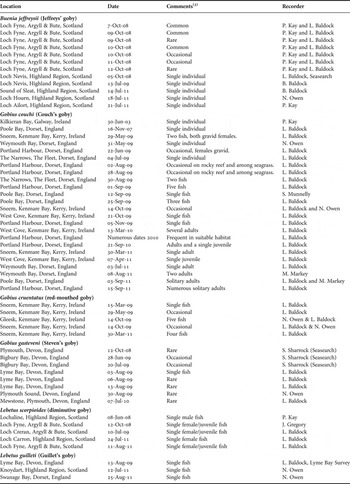
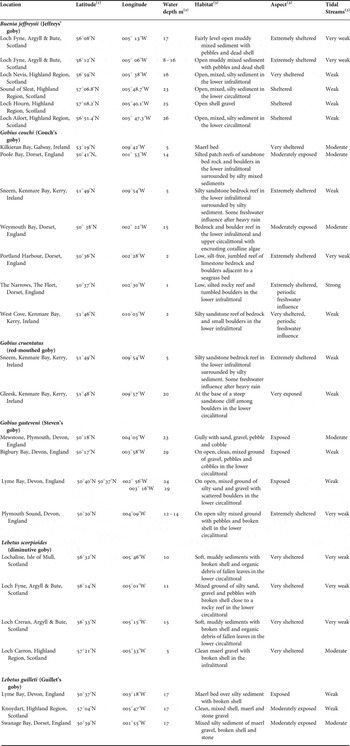
Records of recent sightings of six goby species from relatively shallow (<30 m), nearshore marine habitats in Britain and Ireland are summarized in Table 1. Habitat details for each location where records were obtained are provided in Table 2. These goby species have been rarely reported, if at all either by divers or any other means in these nearshore habitats.
New records of six rare goby species from Britain and Ireland.

(1)Terminology follows Hiscock (Reference Hiscock1996).
Locations and habitat details relating to records of six rare goby species in Britain and Ireland.

(1), all positions are WGS84 datum; (2), water depths are below sea level, derived from dive computers; (3), terminology follows Hiscock (Reference Hiscock1996).
Jeffreys' goby—Buenia jeffreysii
Observations made during the present work indicated that B. jeffreysii occurred frequently in extremely sheltered and relatively shallow (8–20 m) sites with very weak tidal streams on mixed, muddy, circalittoral sediments in Scottish sea lochs. Adults were sometimes observed hidden under shells or in the absence of suitable shelters burrowing directly in the soft sediment. Juveniles of this species (length about 20 mm) were noted in October in Loch Fyne.
Couch's goby—Gobius couchi
Gobius couchi was recorded from extremely sheltered to moderately exposed localities in southern England and south-west Ireland. Tidal streams varied from very weak to strong and water depths ranged from 1–15 m. The species appeared to tolerate some temporary freshwater influence, especially during ebb tide after heavy rain. The lower infralittoral habitats were often silty but crucially included suitable shelters for the gobies under boulders and cobbles or in fissured bedrock.
A visit to the type locality of the species in the Helford River, Cornwall in April 2009 failed to find any G. couchi. This may have been because it was too early in the year, or the site characteristics may have changed since the goby was first recorded there in 1972 (Miller & El-Tawil, Reference Miller and El-Tawil1974).
Numerous juveniles of G. couchi were observed on open mixed, muddy sediments together with small individuals of the painted goby (Pomatoschistus pictus (Malm, 1865)) in Lough Hyne in October. Juveniles were recorded in Portland Harbour in September. At all sites the adult gobies co-occurred with both black gobies (Gobius niger Linnaeus, 1758) and rock gobies (Gobius paganellus Linnaeus, 1758); both these species could be confused with G. couchi.
Red-mouthed goby—Gobius cruentatus
Gobius cruentatus occurred with G. couchi in the same shallow, silty infralittoral habitat at Sneem in Kenmare Bay, south-west Ireland. By contrast the site at Gleesk in Kenmare Bay is on a very exposed, open coast facing the prevailing south-westerly winds with a water depth of 20 m. Gobius cruentatus occurred here with the leopard-spotted goby (Thorogobius ephippiatus (Lowe, 1839)).
Juveniles of G. cruentatus, which have been reported to be hyperbenthic (Kovacic, Reference Kovacic2004), were not recorded at any sites.
Steven's goby—Gobius gasteveni
Records for G. gasteveni were from sites on exposed open coasts in southern England on relatively level seabed with scattered small to medium boulders on mixed, muddy ground in the lower circalittoral. Observations on behaviour suggested that the fish did not have lairs into which they retreated; when disturbed they would dart away a short distance soon to return. There were generally several fish of different sizes together and G. niger was often present as well.
Diminutive goby—Lebetus scorpioides
The records for L. scorpioides a small goby species were all from Scottish sea lochs at extremely sheltered locations either on mixed, muddy sediments with broken shell or on maerl gravel in an area exposed to tidal currents. Recorded water depths were 5–17 m. The cryptically coloured females/juveniles were about the size of the prawn Hippolyte varians Leach, 1814 which occurred in the same habitat and the fish only gave themselves away when they darted a short distance to lie stock still until disturbed again.
Guillet's goby—Lebetus guilleti
This is the smallest goby on the British and Irish list with a maximum recorded length of about 24 mm (Miller, Reference Miller1971). This species was reported from two localities on the south coast of England in Lyme Bay and Swanage Bay on slightly silty sediment composed of a mix of sparse live and dead maerl with dead shell and stone in a water depth of 17 m. A record from Scotland was from a similar depth and habitat.
DISCUSSION
The sightings of six rare goby species detailed here demonstrate the value of diver reports supported by digital images of live fish from habitats some of which cannot be adequately sampled by remote methods. Swaby & Potts (Reference Swaby and Potts1990) noted that Gobius couchi and Gobius gasteveni were restricted to single populations in the United Kingdom. The records provided here and others reported since 1990 show these two species are now more widely distributed. Can this be attributed to climate change or is it a result of better informed ‘surveyors’, better methods for reporting incidental observations and more wide ranging surveys driven by the requirements of national and international legislation? All these factors are likely to contribute in various ways to the overall picture of the distribution of a species at any moment in time.
There have been a number of initiatives over the last 20 years to promote biological recording in the marine environment. The increasing popularity of SCUBA diving in recent years and the development of relatively inexpensive underwater digital photographic techniques have contributed to a proliferation of records of species from nearshore subtidal habitats. There are now more accessible ways of identifying specimens and photographs and participants are more aware of the threats to the marine environment and the value of recording biodiversity.
The importance of records of small cryptic species of fish provided by divers was demonstrated some time ago by the discovery of the leopard-spotted goby (Thorogobius ephippiatus) as a member of the British fauna by G.R. Forster (Corbin, Reference Corbin1958). The distribution of this goby was subsequently described in detail by Miller (Reference Miller1969) supported to a great extent by divers' sightings. Similarly, the red blenny (Parablennius ruber (Valenciennes, 1836)) an inhabitant of exposed, subtidal rocky cliffs was not recognized as a member of the British and Irish fauna until Goodwin & Picton (Reference Goodwin and Picton2007) re-evaluated and collated widely dispersed reports by divers supported by photographs.
Jeffreys' goby—Buenia jeffreysii
Buenia jeffreysii has long been considered a deepwater, offshore species (Holt & Byrne, Reference Holt and Byrne1903; Howson & Picton, Reference Howson and Picton1997) generally occurring in water depths greater than 30 m. Records available on the National Biodiversity Network (NBN) show a wide offshore distribution in the Celtic Sea and the south-western approaches to the English Channel in addition to nearshore records from Scottish sea lochs: Loch Linnhe, Loch Eil (Joint Nature Conservation Committee, Marine Nature Conservation Review team) and Loch Nevis (Marine Conservation Society, Seasearch Marine Surveys)); and the Isle of Man (Port Erin Marine Laboratory, University of Liverpool). The new records presented here from Loch Fyne, Loch Ailort, Loch Hourn and the Sound of Sleat indicate that Jeffreys' goby is widely distributed in Scottish sea lochs in water depths as shallow as 8 m.
Lebour (Reference Lebour1919) recorded juveniles of Jeffreys' goby (as Gobius jeffreysii) in the ichthyo-plankton offshore Plymouth ‘in the deeper water beyond Rame Head and the Eddystone’, while Allen (Reference Allen1899) reported adults as abundant among bryozoan turf in water depths of 50–60 m on the Eddystone grounds. The present authors are not aware of any recent nearshore diver records of this species from the English Channel coast. Jeffreys' goby has been confused with the much more common painted goby (Pomatoschistus pictus Malm, 1865) which occurs in very similar habitats.
Miller (Reference Miller, Whitehead, Bauchot, Hureau, Nielsen and Tortonese1986) shows B. jeffreysii distributed from Norway and the Faroe Islands, the south-western English Channel to the southern edge of its range in the deep waters of the Bay of Biscay (Ainsworth et al., Reference Ainsworth, Ferriss, Leblond, Guénette, Guénette, Christensen and Pauly2001).
Couch's goby—Gobius couchi
Gobius couchi was first described by Miller & El-Tawil (Reference Miller and El-Tawil1974) from specimens collected intertidally in the Helford River, Cornwall, south-west England. Other records for this species in England are from the River Fal in Cornwall including a report of the capture of more than 20 individuals by the Environment Agency in the autumn of 2008 (Environment Agency press release) and the Fleet in Dorset (Dyrynda & Farnham, Reference Dyrynda and Farnham1985). In Ireland the species has been reported from two widely spaced localities on the south-west and north-west coasts: Lough Hyne, County Cork where there is a thriving population at present (Miller & El-Tawil, Reference Miller and El-Tawil1974; Minchin, Reference Minchin1987; Wilkins & Myers, Reference Wilkins and Myers1992; authors' personal observations); and Mulroy Bay, County Donegal (Minchin, Reference Minchin1988).
The records provided in the present report extend the range of G. couchi to localities outside the extremely sheltered situations in which it has previously been found. It is possible that inexperienced observers have overlooked this species in other types of habitat in the past through confusion with either Gobius niger or Gobius paganellus.
Since its description G. couchi has been recorded widely from the Mediterranean: near Naples, Italy (Stefanni & Mazzoldi, Reference Steffanni and Mazzoldi1999); from the Adriatic coast of Croatia (Kovacic, Reference Kovacic2001); the Levant (Kovacic & Golani, Reference Kovacic and Golani2007); and the Ligurian Sea (Liu et al., Reference Liu, Ahnelt, Balma and Delmastro2009).
Red-mouthed goby—Gobius cruentatus
Gobius cruentatus appears to be at the northern edge of its range in south-west Ireland with records to date from three localities in situations sheltered from the prevailing south-westerly winds: Lough Hyne where there is a large population (Wheeler, Reference Wheeler1970; Minchin, Reference Minchin1987; Wilkins & Myers, Reference Wilkins and Myers1992); and Bantry Bay and Kenmare Bay (Minchin, Reference Minchin1995). The present new records are from two more localities in Kenmare Bay: one a sheltered inlet with some freshwater input resembling the sites of earlier records. By contrast the second record is from a site on the open coast exposed to the prevailing south-west wind and swell.
Gobius cruentatus is otherwise widely distributed in European waters from the Bay of Biscay (Wheeler, Reference Wheeler1970) south to Morocco, throughout the Mediterranean (Miller, Reference Miller, Whitehead, Bauchot, Hureau, Nielsen and Tortonese1986) and into the Black Sea (Engin et al., Reference Engin, Turan and Kovacic2007; Boltachev et al., Reference Boltachev, Karpova and Danilyuk2009).
Steven's goby—Gobius gasteveni
Gobius gasteveni was first described by Miller (Reference Miller1974) from material collected from the English Channel, Brittany and Madeira in water depths in the range 36–74 m. There are now numerous records for the British Isles and Ireland available from the NBN indicating an offshore distribution extending from south-west Ireland, the Celtic Sea, St George's Channel, the central Irish Sea and the English Channel east to North Foreland in Kent. Miller (Reference Miller1974) considered that the severe winter of 1962–1963 resulted in this species disappearing from its former grounds off Plymouth. Does the re-discovery of G. gasteveni at these sites near Plymouth in relatively shallow water and further east along the Devon coast indicate recent range extension or a return to the pre-1962 situation for this species?
Miller (Reference Miller, Whitehead, Bauchot, Hureau, Nielsen and Tortonese1986) indicated the range for G. gasteveni to be the English Channel, Madeira and the Canaries. Alberto et al. (Reference Alberto, Nieto and Rodriguez Solorzano1999) recorded a substantial population of G. gasteveni in north-west Spain and the species has been reported to breed in the Arrábida National Park in Portugal (Beldade et al., Reference Beldade, Pedro and Gonçalves2007; Monteiro et al., Reference Monteiro, Borges, Robalo, Almada, Henriques and Gonçalves2008). Recent records for this species indicate that it can occur in shallower habitats than previously reported.
It is likely that this species may be confused by inexperienced observers with G. niger which has been seen to co-occur with G. gasteveni (L.B., personal observation).
Lebetus spp.
The two species of Lebetus have been confused in the past, their taxonomic position having been clarified by Miller (Reference Miller1971). Males and females of the diminutive goby had been identified as separate species (Lebetus orca (Collett, 1874) and Lebetus scorpioides respectively) but Miller (Reference Miller1963) demonstrated that these represented males and females of a single species: Lebetus scorpioides. Demir & Russell (Reference Demir and Russell1971) recognized two forms of postlarvae of the genus Lebetus from material collected around Plymouth: the Petersen form and the Fage form with the latter being more common. Miller (Reference Miller1971) subsequently demonstrated that these two forms represented two species in the genus Lebetus: Lebetus guilleti and L. scorpioides respectively.
On the basis of museum specimens Miller (Reference Miller1971) recorded the distribution of L. guilleti extending from the Kattegat, the Irish Sea, the western English Channel, the west coast of Ireland and south to Portugal. The species, which is the smallest goby on the British and Irish list, has rarely been recorded since. Wilkins (Reference Wilkins1998) reported L. scorpioides from maerl grounds from western Ireland (Galway), but was not aware at the time of the distribution of L. guilleti nor of the correct identity of the Lebetus species collected by Holt & Byrne (Reference Holt and Byrne1903) from Ballynakill Harbour, Galway (Miller, Reference Miller1971) to which record Wilkins referred. A breeding population of L guilleti was discovered in the Shetland Islands recently (Hope & Shucksmith, Reference Hope and Shucksmith2010).
There are records of L. guilleti from Roscoff, Brittany where Le Danois (Reference Le Danois1913) collected it from maerl grounds in the area (together with B. jeffreysii). It has also been recorded from the Mediterranean: Banyuls sur Mer in southern France (Zander in Herler & Kovacic, Reference Herler and Kovacic2002); and the Adriatic (Herler & Kovacic, Reference Herler and Kovacic2002).
Most recent records for Lebetus species are as larvae from surveys of the ichthyoplankton: in the Irish Sea Nichols et al. (Reference Nichols, Haynes, Fox, Milligan, Brander and Chapman1993) recorded larval L. scorpioides in very low numbers; Dransfeld et al. (Reference Dransfeld, Dwane, McCarney, Kelly, Danilowicz and Fives2000) reported both species as larvae from waters around Ireland with L. scorpioides occurring in over 20% of the samples and L. guilleti in less than 1%. Further afield Ré (Reference Ré1981) found both species present as postlarvae in samples from the Portuguese coast while Garrido et al. (Reference Garrido, Santos, dos Santos and Ré2009) described larval Lebetus as being one of the most abundant taxa in samples collected off central Portugal occurring at 25% of stations but without distinguishing the two species. Moyano & Hernández-León (Reference Moyano and Hernández-León2009) recorded L. guilleti composing 0.2–0.6% of the catch in February and May respectively off Gran Canaria in deep water (100 m).
Records reported in the present study, though they fall within the geographical boundaries for the known distribution of the two Lebetus species, provide an indication of the ecological preferences of adult fish in relatively shallow, nearshore habitats. The lack of recent records of adults reflects the small size (<2 cm) and cryptic behaviour of these fish.
In conclusion this list of new records for six rare goby species in coastal waters demonstrates that photographs collected by diving marine biologists can be used to confirm sightings of these fish which are judged difficult to identify in the field. The records have also extended the known range of goby species classified by Swaby & Potts (Reference Swaby and Potts1990) as rare. The records will assist in the evaluation of biodiversity and contribute to the interpretation of fish communities in coastal waters as part of the MSFD status assessments for which Defra is the competent authority.
ACKNOWLEDGEMENTS
The authors acknowledge the help of their various dive buddies without whom none of this would have been possible and especially Sally Sharrock who first drew our attention to ‘unusual’ gobies. We are also grateful for permission to quote records provided to us by other divers: Jason Gregory, Mike Markey, Suzanne Munnelly and Nick Owen. Marcelo Kovacic, Bernard Picton and Peter Wirtz helped by responding swiftly to confirm the identification of various images of fish. Work in Loch Fyne in 2008 was supported by a grant from the Porcupine Marine Natural History Society awarded to P.K. under the ‘Small Marine Projects’ scheme. The four records from Lyme Bay, Devon in 2009 were obtained during work carried out under contract No. MB0101: ‘Lyme Bay—a case-study: measuring recovery of benthic species; assessing potential “spillover” effects and socio-economic changes’ funded by Defra and Natural England and managed by Dr T. Stevens and Dr E. Sheehan, Plymouth University. Apart from these two sources this research received no specific grant from any funding agency, commercial or not-for-profit sectors.