Introduction
This article explores the construct of a ‘good life’ in Croatia by applying cultural consensus model analysis. The study is part of a holistic anthropological project conceptualized in the tradition of the Croatian School of Anthropology (e.g. Rudan, Reference Rudan1972; Rudan et al., Reference Rudan, Sujoldžić, Šimić, Bennett, Roberts, Roberts, Fujiki and Torizuka1992, Reference Rudan, Janićijević, Jovanović, Miličić, Smolej-Narančić and Sujoldžić2004). The project is focused on studying the subjective and objective manifestations of psychosocial stress in youth as a response to cultural changes associated with modernity in the transitional (post-socialist and post-conflict), and more recently (since 1st July 2013) the European Union context. The research framework takes into account the double transitional challenge of youth maturation and identity formation in the post-socialist society, which itself is undergoing drastic and multiple transformations, key cultural transmission agents and their influence on adolescence, as well as major methodological and theoretical developments in the study of culture and health.
For youth, successful transition to independent adulthood requires competences in dealing with age-specific developmental tasks (e.g. constructing and maintaining more mature relationships with peers and romantic partners as well as setting educational goals and planning future careers), each of which might represent a specific stressor (Kelley, Reference Kelley2004). Earlier studies have shown that typical adolescent fears revolve around three major themes: being unemployed, failing in school and experiencing a romantic break-up, whereas more recent studies have pointed out that future-related stressors such as anxiety about job security and environmental destruction cause uncertainty among European youth (Nurmi, Reference Nurmi1991; Gelhaar et al., Reference Gelhaar, Seiffge-Krenke, Borge, Cicognani, Cunha and Lončarić2007). Adolescents' expectations for their futures are dependent upon the socio-cultural and environmental conditions they live in. For example, studies by Larson (Reference Larson2002) and Blossfeld & Hofmmeister (Reference Blossfeld and Hofmeister2005) confirmed that various forms of culture changes (e.g. globalization, information technology, economic disparities, changes in family structure) are exposing young people to high levels of precariousness. Youth maturation and social integration are even more uncertain and stressful in the transitional context than previously in the socialist era, or nowadays in more developed democratic societies (Ilišin et al., Reference Ilišin, Bouillet, Gvozdanović and Potočnik2013). Today, youth socialization takes place in the unstable transitional context in which institutions, social norms and cultural values are being radically changed. In transitional countries youth face specific challenges, including growing social inequality, unequal educational opportunities, a competitive work market, growth in unemployment, increased rate of crime, corruption and various forms of risk behaviour, decreased quality of health care, disintegration of previous and slow introduction of new and different social and cultural values, as well as the influence of the global economic crisis and recession (e.g. Ule et al., Reference Ule, Rener, Mencin Čeplak and Tivadar2000; Roberts, Reference Roberts2003). Croatia represents an example of a transitional country with specific characteristics, such as the war in the 1990s (displacement and exile during the conflicts, post-conflict return, co-existence, reconciliation and reintegration), slow democratization, an unsatisfactory privatization process and restructuring of economic potentials, as well as the recent judicial, administrative, economic and other reforms necessary for the country to meet the conditions for joining the European Union.
In maturation youth are also exposed to strong and diverse cultural transmission agents. In Croatian society the most prominent and influential agents are the family and school (e.g. Sujoldžić et al., Reference Sujoldžić, Peternel, Kulenović and Terzić2006). Parents, as the core figures in an individual's family life, are the principal holders of culture of origin. On the other hand, school is the agent that exposes youth to various kinds of socio-cultural influences and communication with age-mate culture holders and teachers. Peers in school are the main holders of the dominant values in particular cultural and social settings, although the dominant values in one local cultural setting cannot be regarded as dominant in another, even within the same community. Lastly, teachers represent holders of institutionalized knowledge and values. Youth development is based on two psychological processes that take place simultaneously: one related to the individual developmental aspect of separation from dependence and identifications while achieving an autonomous, individual identity, and the other related to adaptation to a new culture, which is the fluid outcome of current social movements and changes.
The interplay of biology and culture in human development, and the commitment to holism in empiric research and theory, remain challenging issues in anthropology. Early research exploring the stress and culture change hypothesis indicated that cultural changes associated with modernization, urbanization and migration could be understood as stressors contributing to the increased disease risk of communities (e.g. Donnison, Reference Donnison1929; Cassel, Reference Cassel1976; Cassel et al., Reference Cassel, Patrick and Jenkins1960; McGarvey & Baker, Reference McGarvey and Baker1979; McGarvey, Reference McGarvey, Panter-Brick and Worthman1999). Developments in cultural theory and ethnography have allowed more direct investigations of the association between culture and individual behaviour and health outcomes (e.g. Dressler, Reference Dressler1991, Reference Dressler1995; Dressler et al., Reference Dressler, Balieiro and Dos Santos1997, Reference Dressler, Balieiro and Dos Santos1998, Reference Dressler, Balieiro and Dos Santos1999; McDade et al., Reference McDade, Stallings and Worthman2000; McDade, Reference McDade2001; McDade & Wortman, Reference McDade and Worthman2004). A very productive avenue in bio-cultural synthesis is evident in the work of William Dressler and colleagues. Dressler (Reference Dressler1995) developed the concept of ‘lifestyle incongruity’ (inconsistency between an individual's real and desired lifestyle in such a way that the individual's lifestyle aspirations are higher than that individual's education and occupation can maintain) and found that higher levels of lifestyle incongruity are associated with poor health, and that poor health associated with lifestyle incongruity may be attenuated by social support. Namely, Dressler and colleagues employed a cognitive theory of culture to study the relationship between culture and health by analysing cultural consensus (a test for shared cultural models) and cultural consonance (a test of the degree to which individual behaviour is consistent with cultural models). The issues of applying an integrative anthropological approach in youth research have been addressed in detail by McDade et al. (Reference McDade, Stallings and Worthman2000), who proposed the concept of ‘socialization ambiguity’ to capture the tensions and inconsistencies of culture change in Samoa and developed new assays to measure the immune function as a part of the reaction to psychosocial stress.
The specific aim of the present study was to elicit ‘locally meaningful indicators of relevant variables’ (Dressler et al., Reference Dressler, Borges, Balieiro and Dos Santos2005) and to report the results of the analysis of cultural consensus regarding the knowledge of three population groups (upper secondary school seniors and their parents and teachers) about two good-life sub-domains: ‘health & well-being’ and ‘migration & socioeconomic milieu’. In meeting the specific aim of the study the following have been analysed: agreement with the cultural consensus model in studied groups and sub-groups; the content of cultural knowledge in groups and sub-groups that comply with the cultural consensus model; and the patterns of inter-generational transmission of cultural knowledge. The general aim of this study was to show how cultural changes associated with modernity in the transitional context may be studied at individual and group levels and operationalized for holistic anthropological research of culture and health.
Methods
Sample
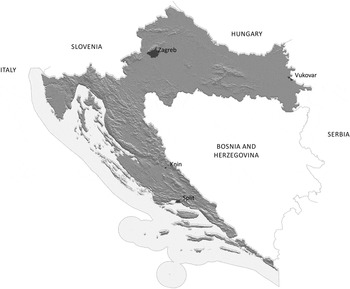
The cultural consensus model was analysed in the sample of 469 upper secondary school seniors, 474 parents and 158 teachers. To ensure diversity in the sample these three groups were recruited from four cities (Zagreb, Split, Knin and Vukovar; see Fig. 1) and two major types of upper secondary schools in Croatia (grammar schools and technical and related schools). Zagreb is a capital of Croatia, with the most developed economic, social, cultural and educational infrastructure. Split is a central city and sea port in Dalmatia, a relatively prosperous Croatian region oriented towards tourism, maritime, fishery and agriculture. Vukovar and Knin are smaller cities in the proximity of the state borders with Serbia and Bosnia and Herzegovina, with direct experience of the war and destruction in the 1990s, massive population displacement and exile, the post-conflict return and reintegration.
Geographical map of Croatia, with location of the sampled cities.

At the end of the 2011/2012 school year (Croatian Bureau of Statistics, 2013) there were 181,110 students in upper secondary schools in Croatia (90,837 female students), of which 98.4% were in the age group 14–18, the age for upper secondary education. There were in total 437 active upper secondary schools, which included 720 school units of various kinds, depending on the educational plan and programme (177 grammar schools, 259 technical and related schools, 50 art schools, 196 industrial and craft schools and 38 schools for disabled youth). There were 664 state, 38 private and eighteen religious upper education schools. Upper secondary education in Croatia lasts from one to five years, is not compulsory and provides education and skills that are necessary either to enter the labour market or to continue with higher education. At the end of 2011/2012 in Zagreb there were 39,905 students (19,925 females) in 1517 class units in 34 grammar schools, 39 technical and related schools, eleven art schools, sixteen industrial and craft schools and four schools for disabled youth. In Split there were 13,610 students (6928 females) in 546 class units in twelve grammar schools, sixteen technical and related schools, three art schools, eight industrial and craft schools and three schools for disabled youth. In Vukovar there were 1871 students (females) in 115 class units in one grammar school, three technical and related schools and two industrial and craft schools. In Knin there were 836 students (426 females) in 39 class units in one grammar school, two technical and related schools and two industrial and craft schools.
Schools were randomly chosen in each city with the exception of Knin: one grammar school and three technical and related schools in Zagreb, one grammar school and three technical and related schools in Split, one grammar school and two technical and related schools in Vukovar. In Knin the only grammar school unit was included in the study, along with one technical school.
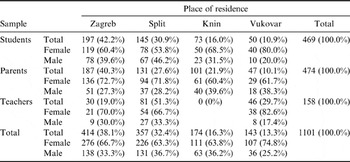
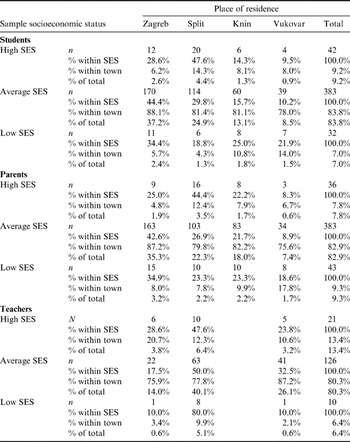
The distribution of three groups of study participants according to gender and the place of residence is shown in Table 1, and the distribution according to self-assessed socioeconomic status and place of residence is shown in Table 2. Demographic changes in Croatia have had cultural, social and economic effects, causing specific and local differentiations (e.g. Peternel, Reference Peternel2013). The sample in this study is characterized by differences in demographic characteristics and migratory trends in various sampled cities, especially in the case of Knin. As is evident from Table 1, teachers from Knin did not participate in the second phase of the study (the survey involving the self-administered questionnaires). However, teachers actively participated in the interviews during the first phase of the study, which took more time and effort for the participants than the second phase. It is important to note that the working population of Knin, and especially teachers, are mostly commuters. The authors were fully aware of this comparative disadvantage, which results from the complex demographic, economic and migratory realities in Knin.
Distribution of study participants according to the sample group, gender and the place of residence, Croatia 2011/2012

Distribution of study participants according to sample group, self-estimated socioeconomic status (SES) and the place of residence
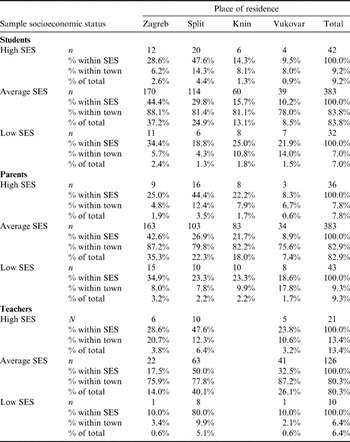
The majority of participants in all three groups report an average socioeconomic status (84% of students, 83% of parents and 80% of teachers). Split has the highest percentage of students and parents reporting high socioeconomic status, and Vukovar has the highest percentage of students and parents reporting low socioeconomic status. A different pattern can be noted among teachers. The highest percentage of teachers reporting high socioeconomic status live in Zagreb and the highest percentage reporting low socioeconomic status live in Split. There is a statistically significant difference among students according to their socioeconomic status and place of residence (Pearson's χ2=13.737, df=6, p=0.33). Furthermore, the chi-squared test does not show statistically significant differences in distribution among parents and teachers according to their socioeconomic status and place of residence.
Cultural consensus theory
Cultural consensus theory (Romney et al., Reference Romney, Weller and Batchelder1986) is a collection of analytical techniques and models for assessing cultural beliefs and the degree to which individuals know or report these beliefs (i.e. the culturally correct answers to a series of questions and each informant's knowledge or degree of sharing of the answers – individual cultural knowledge or competency) (Weller, Reference Weller2007). Competency is estimated from the degree of agreement between each pair of informants and culturally correct answers are estimated by weighting each informant's response by his or her competency and aggregating responses across all sampled people. It is important to note that culturally correct answers do not simply reflect the average of individual beliefs and understandings because higher weight is given to informants who are more culturally competent. Cultural consensus theory enables the investigator to determine if the level of sharing in responses is sufficient to conclude that all informants are drawing on the same cultural model of the tested domain. Cognitive anthropologists argue that culture consists of a set of cultural models that apply to different cultural domains of life. Cultural models are understood as schematized outlines of all elements of the domain, processes within the domain and the relations between that and other domains. Although individuals vary in their knowledge encoded in cultural models (as well as their motivation and ability to act in accordance to the cultural model), this knowledge is widely shared by members of the same group. The most frequently shared aspects of knowledge or belief may be considered the culture of a group (D'Andrade, Reference D'Andrade1987).
Two-phase data collection
The purpose of the first phase of data collection was to elicit emic knowledge about the studied sub-domains through interviewing. Data collected in the first phase were analysed and used to create a set of structured questions to be tested during the second phase by using the cultural consensus model.
In the first phase of the study (during the autumn of 2011) individual semi-structured interviews were carried out in each sampled city. The following topics were discussed: social interactions, family and intimate relationships, material goods, leisure time, future professional and private life goals, attitudes towards present socioeconomic and political circumstances in the country, health and well-being. During interviews participants were also asked to free-list elements of the good-life domain. The free-listing routine was carried out until no new elements of a good life were mentioned. Based on analysis of the collected materials an inventory of 124 items associated with a good life was selected and organized into seven sub-domains: 1) education and professional life; 2) intimate and family relations; 3) health and well-being; 4) leisure time and social participation; 5) material goods, 6) migration and socioeconomic milieu; and 7) religion and identity. In this paper the focus is on the results of the consensus analysis of the two good-life sub-domains: ‘health & well-being’ and ‘migration & socioeconomic milieu’. Since the items of these two sub-domains do not show inner correlations, it might be presumed that they are driven by different patterns of cultural logics. Therefore, the choice of ‘health & well-being’ and ‘migration & socioeconomic milieu’ as the first good-life sub-domains to be analysed is justified by their potential capacities to reflect different patterns of changes in cultural knowledge influenced by the current social and political transformation in Croatian society.
The second phase of the study (conducted in the spring of 2012) consisted of the survey in which upper secondary school seniors, parents and teachers from the same schools from four cities were given the self-administered questionnaires. The questionnaires were structured based on the first phase inventory of items associated with a good life and organized in the form of the 5-point rating Likert scale. Respondents were asked to think about the entire population of Croatian youth and to answer the question: ‘What is important for youth to have good life in Croatia?’ Respondents were asked to rate the importance of each good-life item as ‘not important’ (1), ‘slightly important’ (2), ‘moderately important’ (3), ‘very important’ (4) and ‘extremely important’ (5). To assess how each respondent is positioned in the social structure, the questionnaire also contained a set of questions pertaining to demographic and socioeconomic status.
Data analyses
Cultural consensus model analysis was used to estimate the consistency of respondents' answers to questions. There are two cultural consensus models – formal and informal. The formal model, described by Romney et al. (Reference Romney, Weller and Batchelder1986), is suited to short, open-ended, multiple choice (including dichotomous) answers, whereas the informal model was worked out by the same authors to accommodate ordinal, interval and ratio-scaled answers (Romney et al., Reference Romney, Batchelder and Weller1987). The informal cultural consensus model was used for the data analyses in this study. In brief, the informal model is oriented to estimating differences between respondents and not variables and therefore does not require correcting for guessing. The model does not test how questions are asked and answered, hence competence scores do not indicate the proportion of answers that a respondent knows, but how well the responses of each respondent correspond with those of the group (Weller, Reference Weller2007). The informal model allows the estimation of answers to a series of questions and respondent accuracy in answering those questions. Here, an agreement matrix is factored with the minimum residual factoring method without rotation and the competence scores are used to weight the responses of each respondent (Weller, Reference Weller2007). The cultural consensus method was originally devised for small samples, but it also works for larger samples (Trosset & Caulkins, Reference Trosset, Caulkins and Rapport2002).
In this study ANTHROPAC 4.92 (Borgatti, Reference Borgatti1996) software (the ‘interval’ option) was used to perform the cultural consensus analysis. The software provides three basic outputs: the competence score of each informant (factor loadings on the first factor), the estimated answer key showing the culturally correct answers of the group to the items under inquiry and the similarity matrix (correlations for all pairs of informants). In addition to the cultural consensus analyses, SPSS version 16.0 software was used to perform descriptive and additional statistical procedures.
Ethical issues
Informed consent was sought according to the necessary requirements set by the European Union for the specific recommendation for research involving ‘emancipated minors’ (adolescents between 16 and 18 years of age) (ftp://ftp.cordis.europa.eu/pub/fp7/docs/informed-consent_en.pdf). The informed consent forms were signed on two separate occasions: prior to the first and the second phases of the field research, by participating adolescents, and by their parents/legal representatives. The consent forms were also signed prior to the second phase of the field research by participating teachers and parents.
Results
The specificities of the ‘health & well-being’ and ‘migration & socioeconomic milieu’ sub-domains among the three studied population groups in Croatia, based on the cultural consensus model analysis, are as follows.
Health and well-being
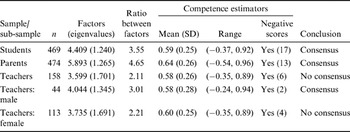
The cultural consensus model analysis in the ‘health & well-being’ sub-domain meets the statistical criteria for satisfying the assumptions of the model and the threshold of knowledge sharing in coherent domains in the case of students and parents but not in teachers (Table 3). Additional cultural consensus analyses were run for two sub-groups of teachers based on gender. A high level of sharing of responses is noted in male teachers and a low level in female teachers. The highest ratio between the eigenvalues for the first to second factors is noted for parents (4.65:1), followed by students (3.55:1) and male teachers (3.01:1). The observed ratios in the population of all and female teachers (2.11:1 and 2.21:1, respectively) fall within the range of eigenvalue ratios between the two first factors of 2.0:1 to 2.9:1, characteristic of weak agreement or ‘proto-cultural’ domains (Caulkins, Reference Caulkins2004).
Results of consensus analysis in the ‘health & well-being’ sub-domain in different samples (students, parents, teachers) and sub-samples of teachers (male, female), Croatia 2011/2012

The ratio of the first to second eigenvalues determines if there is only a single dimension present in the analysed data. The actual value of the ratio is not directly related to the level of agreement in the data, whereas the average competence score provides this information directly since the square of the average competency of the group is equal to the Pearson correlation coefficient between all pairs of respondents (Weller, Reference Weller2007). Therefore, the higher the average competence score, the higher the agreement between respondents (i.e. consensus). The average competence score is highest among parents (0.64), followed by students (0.59) and male teachers (0.58) (Table 3). Respondents with negative estimated competences are found among all tested groups and sub-groups of respondents (Tables 3).
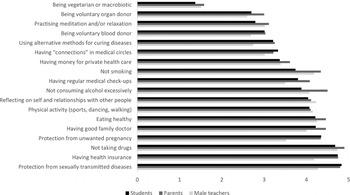
Cultural consensus model analysis also determines the content of cultural knowledge, in other words, the model's answer-key or culturally correct answers. The culturally correct answers are Bayesian posterior estimates of the answer to each question, using each respondent's answer weighted by his or her competency. We chose to arbitrarily interpret culturally correct answers as those of high (above 4), medium (from 3 to 4) and low importance (below 3). The analysis of the content of cultural knowledge among students, parents and male teachers (Fig. 2) produces evidence for the importance of four themes in the ‘health & well-being’ domain: healthy habits, socio-cultural dimensions of health, helping behaviour or altruism and alternative health lifestyle. Low cultural importance is mostly related to alternative health lifestyle (‘being vegetarian or macrobiotic’, ‘practising relaxation and/or meditation’) and helping behaviour or altruism (‘being a voluntary organ donor’ and ‘being a voluntary blood donor’) in all three groups and one additional alternative health lifestyle (‘using alternative methods for curing diseases’) in male teachers. Scores slightly higher than 3 are noted in two items reflecting alternative health lifestyle, among parents for the item ‘practising relaxation and/or meditation’ and among parents and students in the item ‘using alternative methods for curing diseases’. Two items of socio-cultural dimensions of health reach the level of medium cultural importance in all three groups: one pointing to social aspects of health-criticizing phenomena characteristic of a transition society such as clientelizm and corruption in obtaining satisfactory health care (‘having “connections” in medical circles’) and the other pointing to differences in quality of health care service between public and privately own sectors (‘having money for private health care’). Medium cultural importance is also associated with healthy habits: the items ‘not smoking’ and ‘not consuming alcohol excessively’ in students and ‘having regular medical check-ups’ in students and male teachers. High level of cultural importance among all three groups of respondents is related to two social health items (‘having a good family doctor’ and ‘having health insurance’) and to as many as seven healthy habits items reflecting at the same time social and cultural dimensions of health (‘reflecting on self and relationships with other people’, ‘physical activity (sports, dancing, walking)’, ‘eating healthy’, ‘not taking drugs’ and ‘protection form sexually transmitted diseases’). High cultural importance is also associated with the item ‘not consuming alcohol excessively’ by parents and male teachers (not by students) and the item ‘protection from unwanted pregnancy’ by students and parents (not by male teachers).
Answer-key for the ‘health & well-being’ sub-domain for students, parents and male teachers.

Migration and socioeconomic milieu
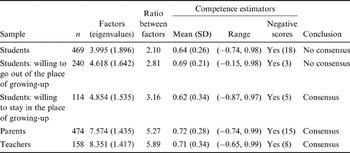
The single-factor solution and the assumption of the cultural consensus model in the ‘migration & socioeconomic milieu’ sub-domain is confirmed in the case of parents and teachers (Table 4). Further cultural consensus model analyses were run for different sub-groups of students based on gender, place of residence, self-assessed socioeconomic status, type of school and pre-migratory mood. The 3:1 threshold for cultural consensus is met only in the group of students willing to continue living in the place of growing-up (Table 4). Teachers show the highest ratio between factors (5.89:1), followed by parents (5.27:1) and students willing to stay in the place of growing-up (3.16:1). The ratios between factors in students (2.10:1) and students willing to go out of the place of growing-up (2.81:1) imply that in these instances the ‘migration and socioeconomic milieu’ may be considered the weak-agreement or ‘proto-cultural’ sub-domains. The average competence score is slightly higher among parents (0.72) than among teachers (0.71), whereas in students willing to stay in the place of growing-up it is lower (0.62). The number of people with negative competence score is lowest among students willing to stay in the place of growing-up (3), followed by teachers (8) and parents (15).
Results of consensus analysis in ‘migration & socio-economic milieu’ sub-domain in different samples (students, parents, professors), Croatia 2011/2012
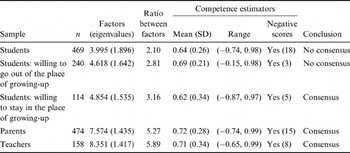
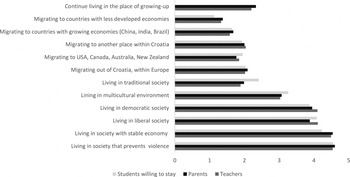
The analysis of the content of cultural knowledge for one sub-group and two groups reaching consensus in the ‘migration & socioeconomic milieu’ sub-domain (students willing to stay in the place of growing-up, teachers and parents) is shown in Fig. 3. Two major themes appear: pre-migratory mood and preferred socioeconomic conditions. Low cultural importance is almost exclusively related to pre-migratory mood (‘migrating to countries with less developed economies’, ‘migrating to countries with growing economies (China, India, Brazil)’, ‘migrating to USA, Canada, Australia and New Zealand’, ‘migrating out of Croatia, within Europe’, ‘migrating to another place within Croatia’) and only one aspect of socioeconomic milieu (‘living in traditional and conservative society’) in all three tested (sub)groups. Living in the traditional environment reaches low cultural importance in all three (sub)groups, but students willing to stay in the place of growing-up appreciate it more than their parents and teachers. Medium cultural importance relates to the items ‘living in multicultural environment’ in all three (sub)groups, ‘living in democratic society’ in students willing to stay in the place of growing-up and parents and ‘living in liberal society’ in parents. The items ‘living in the society that prevents violence’ and ‘living in society with stable economy’ reach high cultural value in all three sub-groups. High cultural importance is also associated with the item ‘living in liberal society’ among students willing to stay in the place of growing-up and teachers, and the item ‘living in democratic society’ in teachers.
Answer-key for the ‘migration & socio-economic milieu’ sub-domain for parents, teachers and students willing to stay in the place of growing-up. The item ‘continue living in the place of growing-up’ is used as a discriminatory variable for two groups of students.

Staying versus going out of the place of growing-up
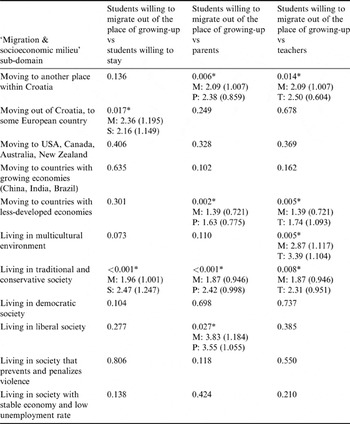
Comparisons of the sub-group of students not reaching consensus with other sub-groups or groups of respondents was done using ANOVA (Table 5). The ANOVA was run based on the raw data scores as recorded by each respondent before the cultural consensus model analysis. Students willing to go out of the place of growing-up and those willing to stay differ from each other significantly in their ratings of two items: ‘moving out of Croatia, to some European country’ (mean item score of students willing to migrate is higher than the mean item score of students not willing to migrate) and ‘living in traditional and conservative society’ (mean item score of students willing to migrate is lower than the mean item score of students not willing to migrate). Students willing to go out of the place of growing-up differ significantly from their parents, with lower ratings of the items ‘moving to another place within Croatia’, ‘moving to countries with less developed economies’ and ‘living in traditional and conservative society’ and higher rating of the item ‘living in liberal society’. Students willing to go out of the place of growing-up differ significantly from teachers, with lower ratings of the same items as in the case of parents, but with one additional item, ‘living in multicultural environment’.
Results of ANOVA test among different samples and sub-samples, Croatia 2011/2012

Mean item scores and standard deviation values (in parentheses) are given in the cases of statistically significant differences.
M=students willing to migrate; S=students not willing to migrate; P=parents; T=teachers.
* p<0.05.
Discussion
In this study ‘health & well-being’ and ‘migration & socioeconomic milieu’ were clearly articulated as important aspects of the good-life construct by respondents during the first phase of data collection. These subjects are frequent and important parts of the private and public discourse, especially in the media and political sphere, very likely in relation to the economic crisis in the country coupled with the more liberal migration regime for Croatian citizens within the EU and consequently the increased emigration rate. Apart from the importance of these two good-life sub-domains among study participants and members of Croatian society, health, well-being, socioeconomic circumstances and migration represent crucial research topics important for anthropology (medical and applied) and the development of global health care programmes and policies. The consensus analysis carried out in this study points to at least three important phenomena for anthropological research: heterogeneity of studied sample groups, incomplete inter-generational transmission of cultural values and two exceptions to the ‘competence-as-sharing’ paradigm.
Heterogeneity of the studied sample groups
Based on the results of this study it is evident that neither upper secondary school seniors nor their teachers represent homogenous groups, whereas parents do. Students do not draw on the same cultural model in the ‘migration & socioeconomic milieu’ and teachers in the ‘health & well-being’ sub-domains.
Different sub-groups of students were tested for agreement with the cultural consensus model (based on gender, place of residence, self-assessed socioeconomic status, type of school and pre-migratory mood). Apart from those students willing to stay in the place of growing-up, other sub-groups of students have very heterogeneous notions of what potential migratory destinations and preferred socioeconomic conditions might be associated with a good life. In fact, the question of staying or going away from the place of growing-up might signify contours of two concepts of good life among Croatian youth. The first concept of a good life in terms of migration and socioeconomic conditions is coherent, shared by a smaller and culturally homogenous group of students and imagined in the local and familiar space, perhaps within the existing networks of social support. The second concept is non-coherent and vague, is characteristic of a larger and culturally heterogeneous group of students and is imagined in distance from the local and familiar. It illuminates the uncertainty and the unpredictability of the transitional project in Croatia, but also the uncertainty and socioeconomic anxieties in potential migratory destinations.
Teachers do not adhere to the same cultural model in the ‘health & well-being’ sub-domain (male teachers do and female do not). This sub-domain reflects not only contemporary healthy habits, but also attitudes and critical social orientations towards public health problems and altruistic behaviour. In fact, the ‘health & well-being’ sub-domain reflects not only the view on health as ‘a complete state of physical, mental and social well-being’ and ‘the absence of disease or infirmity’ (WHO, 1946), but also social problems characteristic of health care in the transitional society such as clientelizm and corruption in obtaining satisfactory health care and differences in the quality of health care service between public and privately own sectors. It has been confirmed that low trust in the health care system is associated with poor self-related health and poorer health outcomes (Mohseni & Lindstrom, Reference Mohseni and Lindstrom2007). Similarly, corruption in the health care system has negative effects on the economic cost and efficiency of the health care sector (Vian, Reference Vian, Heggenhougen and Quah2008), health indicators of life expectancy, child and maternal mortality (Holmberg & Rothstein, Reference Holmberg and Rothstein2010) and patient trust in the health care system (Paredes-Solis et al., Reference Paredes-Solis, Andersson, Ledogar and Cockcroft2011). In Croatia, Radin (Reference Radin2013) reported a significant link between corruption and public vs private care sector preferences in a representative sample of the population in 2007 but not in 2009. Taken together, these results indicate that in Croatia, citizens’ context and experience with corruption transfer to their perceptions about the integrity of the health care system. Older citizens are inclined to the existing health care infrastructure, very likely because of their low income and the fact that they helped to create the existing public health care system during the socialist period, whereas wealthier and better educated citizens are more likely to use private care (Radin, Reference Radin2013). Health and well-being are hot political issues in the already polarized Croatian society, as seen recently in fierce public debates on the issues of health care reform (Škaričić, Reference Škaričić2011) and inclusion of health and sex education in basic and upper secondary schools (Bijelić, Reference Bijelić2008). The reason for heterogeneity in cultural valuing of the ‘health & well-being’ sub-domain in the population of Croatian upper secondary school teachers observed in this study might be considered in relation to their specific position in contemporary society. This is an example of an educated segment of the population that became under-paid and stripped of social recognition in the period of transition, but with a vast variety of personal, family, cultural, demographic and socioeconomic trajectories. Particular sub-groups of Croatian upper secondary school teachers have very distinct cultural knowledge about health and well-being, as in the case of affluent female teachers (data not shown) who differ from other groups because they agree that alternative lifestyles, alcohol consumption and smoking have high cultural importance, whereas, for example, having health insurance does not.
The observed examples of cultural heterogeneity of the studied groups should also be considered in the light of the complexity of various political, economic and cultural changes during the period of transition. The Croatian transition is influenced, at least partially, by the state of ‘semi-modernity’, a term proposed by the Croatian sociologist Županov (Reference Županov, Čengić and Rogić2001) to describe the co-existence of modern and traditional elements in Croatian society and differing capacity for social change in various population strata.
Incomplete inter-generational transmission of cultural values
Ilišin et al. (Reference Ilišin, Bouillet, Gvozdanović and Potočnik2013, p. 12) argued that the transitional period in Croatia has been more risky than promising for youth and sluggish in adopting new cultural values: ‘Despite radical changes in the social and political order, young people, with rare exceptions, turned out to be very similar to older generations, which indicated that inter-generational transmission of values in Croatia had been going on without a significant interruption’.
In the present study, evidence of inter-generational cultural transmission is traced among students, parents and male teachers in the ‘health & well-being’ sub-domain in the majority of the tested items. Inter-generational differences may be observed in the culturally correct answers related to a few items associated with risk behaviour, for alcohol consumption and smoking between students and their parents (and to a slightly smaller degree between students and male teachers). In Croatia, alcohol consumption is customary on many social occasions, whereas smoking was recently banned in public by law and its harmful side-effects have been heavily advertised in the media and in public health anti-smoking campaigns. Interestingly, inter-generational differences are not noted for using drugs, and abstaining from drugs may be considered a cultural norm shared by students, parents and male teachers. Despite the medium cultural importance of not smoking and not consuming alcohol excessively in students (and high cultural importance for parents and male teachers) and high cultural significance of avoiding drugs among students, parents and male teachers, the number of Croatian youth abusing alcohol, tobacco and drugs is alarmingly high. According to the European School Survey Project on Alcohol and Other Drugs (ESPAD; Hibell et al., Reference Hibell, Guttormsson, Ahlström, Balakireva, Bjarnason, Kokkevi and Kraus2012) on 15- to 16-year-old students from 36 countries, cigarette smoking was reported by 41% of respondents from Croatia, alcohol use by 66%, whereas 54% respondents reported heavy episodic drinking in the period of the past month. Smoking and alcohol consumption in Croatian youth were higher than the ESPAD average. Among Croatian study participants, 18% claimed life-time use of cannabis, 5% of illicit drugs other than cannabis, 5% of tranquillizers without prescription and as many as 28% of inhalants. Use of illicit drugs in Croatian youth was similar to the ESPAD average, with the exception of inhalants, which were significantly more used in Croatia.
The transmission of cultural knowledge in the ‘migration & socioeconomic milieu’ sub-domain is traced between students willing to stay in the place of growing-up, parents and teachers. These three groups attach low cultural value to migrations within Croatia and abroad and tradition. However, students willing to stay in the place of growing-up appreciate traditionally organized society slightly more than older generations. Furthermore, students willing to stay in the place of growing-up, like their parents and teachers, attach medium and high cultural importance to multiculturalism, democracy, liberal orientations, a stable economy and prevention of violence. The majority of students are willing to go out of the place of growing-up but they do not have concordant cultural knowledge about desired migratory destinations within Croatia and abroad or preferred socioeconomic conditions. Students willing to go out of the place of growing-up differ significantly from parents and teachers in their lower readiness to move within Croatia and to countries with less-developed economies, as well as in their lower appreciation of multiculturalism than teachers, tradition than parents and teachers and liberalism than parents. In the case of the upper secondary school seniors included in this study, the question of staying or going away from the place of growing-up signifies potential tensions of adhering or not adhering to cultural norms shared by older generations.
The data based on the cultural consensus model analysis indicate two groups of students with different cultural characteristics. A smaller group of upper secondary school seniors (32%) is more similar to older generations, is culturally homogenous and agrees that remaining in the place of growing-up is of high cultural importance. On the other side, a larger group of students (68%) holds heterogeneous motives for spatial mobility in Croatia and/or abroad and heterogeneous decisive orientations about desirable socio-political and economic circumstances.
The results of the quantitative and qualitative studies conducted from the mid-1990s until the mid-2000s, mostly sociological and psychological (e.g. Golub, Reference Golub2002; Šverko, Reference Šverko2005), on the extent, reasons and determinants of migration of the well-educated young Croatian population (so called ‘brain drain’), indicate that more than 75% of university students were motivated to move abroad after finishing their studies. In the period from the mid-1990s to mid-2000s the intention to move abroad was mostly defined by university students' perception of value achievement probability: students who wanted to leave the country assumed that they could achieve their utilitarian values better abroad (Šverko, Reference Šverko2005). These studies indicated that the main pull factors for moving abroad were primarily of economic nature, including also factors such as the possibilities for professional development, education and overall personal improvement (Golub, Reference Golub2002; Šverko, 2004). A similar migration trend of the educated youth was confirmed in studies conducted from 2010 to 2013, although these indicated a move from the brain-drain concept to the one of ‘brain circulation’ involving re-migration (Horstein & Jurčević, 2012; Horstein & Pleše, Reference Hornstein, Pleše, Varzari, Tejada and Porcescu2014).
Migratory trends in the general Croatian young population are different from those of university students. Mendeš (Reference Mendeš and Ilišin2006) found that Croatian youth generally have a low tendency towards both internal and external migration. The most recently published nationally representative sociological survey of Croatian youth (14–27 years of age, including upper secondary school and university students, employed and unemployed youth) indicates that about 70% of youth do not consider changing residence within Croatia (Ilišin et al., Reference Ilišin, Bouillet, Gvozdanović and Potočnik2013). The same study indicates similar trends about intended migration abroad – 70% of sampled youth do not want to move abroad. One quarter of the sampled youth who want to emigrate prefer developed European countries, followed by North America and Australia (Ilišin et al., Reference Ilišin, Bouillet, Gvozdanović and Potočnik2013). Ilišin et al. (Reference Ilišin, Bouillet, Gvozdanović and Potočnik2013) found that tendencies towards both internal and external migration in general Croatian youth are motivated by two key economic factors (improvement of living standard and easier employment) and less significant factors (better education, higher cultural diversity, escape from the unfavourable situation in Croatia). Higher living standard is a more important potential migratory motive to unemployed youth than to upper secondary school and university students. On the other hand, students choose mobility to obtain better education more than unemployed and employed youth. Cultural consensus data reported on the upper secondary school seniors in this study show different trends in comparison to the sociological profile of general Croatian youth described by Ilišin et al. (Reference Ilišin, Bouillet, Gvozdanović and Potočnik2013) and more similar trends to those characteristic for the educated youth (Golub, Reference Golub2002; Šverko, Reference Šverko2005) and those advocated in the media and the opinion polls suggesting that up to 85% of Croatian youth are prepared to leave the country (Hornstein & Pleše, Reference Hornstein, Pleše, Varzari, Tejada and Porcescu2014).
The observed trend for imagining a better life either in a more prosperous place in Croatia or abroad in the larger and culturally heterogeneous group of upper secondary school students is connected to the specificities of Croatian transition. If various cultural, socio-demographic and economic trends are considered, it is evident that transition in Croatia is a complex, contradictory and ambiguous process characterized by uncertain and unpredictable outcomes (Prica & Škokić, Reference Prica and Škokić2011). For example, life expectancy at birth, as a measure of the overall quality of life in a country (estimated as the average number of years to be lived by a group of people born in the same year, if mortality at each age remains constant in the future) has shown a steady increase in Croatia since the 1990s (CIA, 2012). In 2012 the life expectancy at birth in Croatia was estimated at 76 years, similarly to Poland and Slovakia, but lower than in Slovenia, Bosnia and Herzegovina, Albania and Czech Republic. According to the gross national income (GNI) per capita, Croatia is a middle-wealth country, with US$13,540 per capita in 2011 (World Bank, 2009–2011). Croatian GNI per capita fluctuated between 1997 and 2000, increased from 2001 to 2008 and has decreased from 2009 onwards. Gross national income per capita in Croatia is significantly lower than in Slovenia and lower than in Slovakia and Czech Republic. The Gini index (which measures the extent to which the distribution of income among individuals or households within an economy deviates from a perfectly equal distribution; index of 0 represents perfect equality, while an index of 100 implies perfect inequality) shows a steady increase from 1988 to 1999, a decrease from 2000 and 2004 and an increase from 2004 onwards, with the peak in 2008 of 33.7 (the last year for which data are available; CIA, 2012). More equality in income distribution than in Croatia is recorded in Hungary, Slovenia, Romania, Montenegro, Bulgaria, Serbia, Slovakia and Czech Republic. Croatia is also characterized by a disturbingly high unemployment rate (18.8% in January 2014; http://epp.eurostat.ec.europa.eu), which is the third highest among the 28 EU member states and the highest among transitional countries, and a high youth unemployment rate (49.2% in December 2013: http://ycharts.com/indicators), which is also among the highest in Europe and among transitional countries. The above summarized data contextualize the uncertainty and dissatisfaction with the quality of life in the country and offer an explanation of why a large group of Croatian upper secondary school seniors are motivated by spatial mobility, but do not share a single cultural model about desirable migratory destinations and socio-political and economic conditions.
Non-conformity to cultural norms
The majority of the tested sample groups described in this article may be discussed within the ‘competence-as-sharing’ paradigm dominant in cognitive anthropology and cultural consensus theory (i.e. students and parents in the ‘health & well-being’ sub-domain as well as parents and teachers in the ‘migration & socioeconomic milieu’ sub-domain). However, cultural beliefs about health and well-being among female teachers and cultural beliefs about intended migrations and preferred socioeconomic circumstances among upper secondary school seniors willing to migrate out of the place of growing-up are examples of two sub-groups that resist cultural norms. The ‘competence-as-sharing’ paradigm has been challenged by an alternative view that creative transformation of cultural knowledge and non-conformity to broad cultural norms may be advantageous in meeting particular personal goals or specific requirements in local settings (Hruschka, Reference Hruschka2009) and that competence should be evaluated in relation to specific ecological circumstances and cultural domains of activity (Ogbu, Reference Ogbu1981). In the transitional context where one might trace the evidence of the ‘confusion of cultural values’ (Leighton & Leighton, Reference Leighton, Leighton, Freedman and Kaplan1967, p. 1532) or the state in which the cultural system is not in a stable equilibrium, these two sub-groups might be adopting cultural norms useful in particular cultural settings and socioeconomic milieus. In the case of female teachers it is found that those claiming high socioeconomic status have very distinct cultural knowledge about health and well-being (data not shown). This sub-group of female teachers attach high cultural value to alternative lifestyles and tolerate deviant social behaviours (alcohol consumption and smoking). These attitudes do not reflect the image of a good life in the middle-class population of teachers in Croatia, but they do reflect appropriate and acceptable behaviour among a small group of affluent female teachers. The attitudes of female teachers could be further explored in future to observe if this finding might be associated with changes in cultural knowledge among different socioeconomic strata in contemporary Croatian society. The second example of non-conformity to cultural norms is that of students willing to migrate out of the place of growing-up. These students have heterogeneous notions of where and in what socio-political and economic circumstances a good life should be searched for, possibly due to their perception of insecurity and unpredictability both in the local and the distant.
Conclusion
The specific aim of this study was to elicit ‘locally meaningful indicators of relevant variables’ (Dressler et al., Reference Dressler, Borges, Balieiro and Dos Santos2005) and to report the results of the analysis of cultural consensus regarding the knowledge of Croatian upper secondary school seniors and their parents and teachers about two good-life sub-domains: ‘health & well-being’ and ‘migration & socioeconomic milieu’. The general aim of the study was to show how cultural changes associated with modernity in the transitional context may be studied at individual and group levels and operationalized for holistic anthropological research of culture and health, while keeping sensitivity to the local meaning and context.
The results of the study indicate the following specificities of the ‘health & well-being’ and ‘migration & socioeconomic milieu’ sub-domains in the contemporary Croatian transitional context. The cultural consensus model analysis meets the statistical criteria for satisfying the assumptions of the model and the threshold of knowledge sharing in coherent domains in students and parents in the ‘health & well-being’ sub-domain and in parents and teachers in the ‘migration & socioeconomic milieu’ sub-domain. In additional testing of various sub-groups, the single-factor solution in the cultural consensus model is confirmed in male teachers in the ‘health & well-being’ sub-domain and in students willing to go out of the place of growing-up in the ‘migration & socioeconomic milieu’ sub-domain. Cultural beliefs about health and well-being among female teachers and cultural beliefs about intended migrations and preferred socioeconomic circumstances among upper secondary school seniors willing to go out of the place of growing-up are examples of two sub-groups that resist cultural norms and do not comply to the ‘competence-as-sharing’ paradigm dominant in cognitive anthropology and cultural consensus theory.
The analysis of the content of cultural knowledge among students, parents and male teachers produces evidence for the importance of four themes in the ‘health & well-being’ domain: healthy habits, helping behaviour or altruism, alternative health lifestyle and socio-cultural dimensions of health reflecting social problems characteristic for health care in the transitional society such as clientelizm and corruption in obtaining satisfactory health care and differences in the quality of health care service between public and privately own sectors. The evidence of inter-generational cultural transmission is traced in the majority of the tested items and inter-generational differences are observed in the culturally correct answers related to alcohol consumption and smoking, which have higher cultural value among students than in the older generation.
In the ‘migration & socioeconomic milieu’ sub-domain the analysis of the content of cultural knowledge in students willing to stay in the place of growing-up, teachers and parents reveals two major themes: pre-migratory mood and preferred socioeconomic conditions. In the case of upper secondary school seniors included in this study, the question of staying or going away from the place of growing-up signifies potential tensions of adhering or not adhering to cultural norms shared by older generations and two concepts of a good life. The transmission of cultural knowledge is evident in the majority of the tested items among students willing to stay in the place of growing-up and their parents and teachers, although it is noticed that students willing to stay in the place of growing-up appreciate tradition slightly more than the older generation. When the image of a good life in terms of migration and socioeconomic conditions is analysed between two groups of students with different pre-migratory attitudes, contours of two concepts are noticed. One is coherent, shared by a smaller and homogenous group of students and imagined in the local and familiar space, perhaps within the existing networks of social support. The second is non-coherent and vague, is characteristic of a large and heterogeneous group of students and is imagined in distance from the local and familiar. It illuminates the uncertainty and the unpredictability of the transitional project in Croatia, but also the uncertainty and socioeconomic anxieties in potential migratory destinations.
Apart from pointing to the above summarized characteristics of cultural knowledge and its inter-generational transmission in contemporary Croatian society, the study also demonstrates the value of testing the cultural consensus model in holistic anthropological research of culture and health by using the emic perspective and locally significant phenomena for understanding individual cultural competences and sharing of cultural values in the studied groups and sub-groups. For studying individual subjective and objective outcomes of stress in response to challenges of youth maturation, identity formation and socialization in the transitional context it is useful to understand the extent of sharing and the content of cultural knowledge within and among tested groups and sub-groups (i.e. to understand cultural norms within the student population and concordance in culturally correct answers among students and their parents and teachers).
Acknowledgments
This study was conducted as a pilot study for the project ‘Modernity Stress, Youth and Migrations’ (09.01/408) of the Croatian Science Foundation awarded to Dr Irena Martinović Klarić. The authors acknowledge the editor and the anonymous reviewer whose constructive suggestions helped to improve this paper. The authors also thank all the study participants for their time and willingness to contribute to this research.