INTRODUCTION
The management of marine resources is moving away from traditional top-down and single-stock strategies and towards bottom–up and ecosystem-based management (Olsson et al. Reference Olsson, Folke and Berkes2004; Pikitch et al. Reference Pikitch, Santora, Babcock, Bakun, Bonfil, Conover, Dayton, Doukakis, Fluharty, Heneman, Houde, Link, Livingston, Mangel, McAllister, Pope and Sainsbury2004). This shift towards bottom-up governance of resources can be enhanced through the use of co-management policy frameworks (Botsford et al. Reference Botsford, Castilla and Peterson1997; Castilla & Defeo Reference Castilla and Defeo2001, Reference Castilla and Defeo2005; McConney et al. Reference McConney, Pomeroy and Mahon2003). Co-management is particularly well suited to application in artisanal fisheries where it can integrate government concern for efficient resource use with local concern for self-determination and self-control (Fanning Reference Fanning, Mann, Chircop, McConnell and Morgan2000). A fundamental characteristic of such a strategy is that governments provide the general legal framework for the user organization, which in turn must have the means to regulate the actions of its members (Sen & Neilsen Reference Sen and Neilsen1996; Pomeroy & Berkes Reference Pomeroy and Berkes1997). Thus, co-management is expected to increase the efficiency of fisheries management, as compliance and self-regulation are assumed to be better in bottom-up than in top-down management systems (Jentoft Reference Jentoft1989).
The recent adoption by national governments of co-management tools as an integral part of their fisheries policies is providing informative case studies that have broadened the development of the theory and empirical research regarding co-management (Nielsen et al. Reference Nielsen, Degnbol, Viswanathan, Ahmed, Hara and Raja2004; McClanahan & Castilla Reference McClanahan and Castilla2007). Despite the effort devoted to the generation and implementation of these management policies, their impacts on fishers' environmental perceptions and behaviour have not received significant attention (but see McClanahan et al. Reference McClanahan, Davies and Maina2005; Napier et al. Reference Napier, Branch and Harris2005; Richardson et al. Reference Richardson, Kaiser and Edwards-Jones2005; Gelcich et al. Reference Gelcich, Edwards-Jones and Kaiser2007). This is an important knowledge gap, because effective marine conservation increasingly depends upon the resultant actions of different stakeholder groups (Gelcich et al. Reference Gelcich, Edwards-Jones, Kaiser and Watson2005a, Reference Gelcich, Edwards-Jones and Kaiserb). As for a range of interventions (such as aid or development funds), a new co-management policy may change fishers' short-term behaviour. However, if the policy is not accompanied by a change in fishers' perceptions, there is a risk that fishers might revert to less desirable (unsustainable) behavioural patterns upon withdrawal of the policy (Hauck & Hector Reference Hauck, Hector, Hauck and Sowman2003) or in the event of price crashes (Folke et al. Reference Folke, Hahn, Olsson and Norberg2005). The absence of changes in perception would reduce the potential for long-term environmental conservation (Pretty Reference Pretty2003).
The relevance of seeking to change perceptions within a policy context is evident from public health campaigns initiated by governments (for example reduction in smoking, drinking and driving). These aim to change the public perceptions and subsequently behaviour. However, there is also some evidence that through changing peoples’ actual behaviour (i.e. their habits), their perceptions of these behaviours will change and these new behaviours may become more commonly expressed in the future (for example see Honkanen et al. Reference Honkanen, Olsen and Verplanken2005; Verplanken et al. Reference Verplanken, Hofstee and Janssen1998). Indeed the potential role that government can have on the behaviour of its citizens has been long recognized: ‘For legislators make the citizens good by forming habits in them, and this is the wish for every legislator, and those who do not effect it miss their mark, and it is in this that a good constitution differs from a bad one’ (Aristotle, Nicomachean Ethics, Book II, Part 1).
If Aristotle's belief is correct, then within an environmental context it could be argued that by ‘forcing’ fishers and other resource users to engage with a sustainable use policy, then over time their perceptions will change. If for some reason the policy and/or natural environment should change then the existence of these new perceptions will reinforce the sustainable behaviours encouraged by the original policy. However, to date these ideas have remained untested in any field related to environment and resource management (but see Wilson & Hart Reference Wilson and Hart2001). Against this background the aims of this paper are twofold, namely to define fishers' concerns regarding coastal environmental issues in order to establish distinct environmental domains and to understand fishers' determinants of environmental perceptions, putting special emphasis on whether the act of engaging with a sustainable use oriented co-management policy affects their environmental perceptions.
POLICY CONTEXT: CHILEAN CO-MANAGEMENT POLICY
In 1991, the Chilean Fisheries and Aquaculture Law (FAL) enabled the development of co-management with artisanal fishers. The basis of this co-management is the Management and Exploitation Areas for Benthic Resources (MEABR) policy, where territorial user rights for fishers (TURFs) are assigned to small-scale fisher unions in well-defined coastal areas (Castilla Reference Castilla1994). These TURFs are based on a common property approach, which proposes that user rights will create institutional arrangements among fishers that then promulgate sustainable resource use (Ostrom Reference Ostrom1990; Gelcich et al. Reference Gelcich, Edwards-Jones, Kaiser and Castilla2006).
The MEABR co-management policy was introduced because of overexploitation of benthic resources, which resulted from neoliberal policies adopted in Chile in the mid-1970s and an aggressive exchange-rate policy in 1974/1975 that substantially improved fishing export earnings to the extent that Chile became the leading exporter of fish and shellfish in South America (Thorpe et al. Reference Thorpe, Ibarra and Reid1999). The gastropod Concholepas concholepas (known locally as loco) was one of the most important species to be overexploited because of its high value in Asian markets (Castilla et al. Reference Castilla, Gelcich, Defeo, McClanahan and Castilla2007), and management of the loco fishery was one of the main drivers for the establishment of the MEABR policy (for a detailed history see Castilla Reference Castilla1994; Gelcich et al. Reference Castilla and Defeo2005b; Castilla et al. Reference Castilla, Gelcich, Defeo, McClanahan and Castilla2007; Castilla & Gelcich Reference Castilla and Gelcich2008).
The MEABR policy enabled fishers to form registered groups, here called ‘unions’, and to acquire user rights over a subtidal area of seabed. Under MEABR policy regulations, unions must identify an area of seabed over which they wish to make a claim and then co-finance a baseline study of this area, from which resource catch quotas and a management plan are established. Unions are also required to contract external consultants to undertake annual follow up assessments of stock in the management area, and to determine changes in the total allowable catches. MEABR policy was originally designed to manage the harvest of loco (Gelcich et al. Reference Gelcich, Edwards-Jones and Kaiser2005a), but is now felt to have wider social and biological benefits (Castilla et al. Reference Castilla, Gelcich, Defeo, McClanahan and Castilla2007; Castilla & Gelcich Reference Castilla and Gelcich2008; Gelcich et al. Reference Gelcich, Godoy, Prado and Castilla2008). Since policy inception, 547 management areas have been officially designated across Chile; 301 have resource management plans approved and are therefore currently able to harvest their resources (Sernapesca 2005).
The MEABR policy was not initiated across Chile in a single event, but commenced in some administrative regions earlier than others. Once the MEABR policy was enacted, it became impossible to sell Concholepas concholepas harvested from open access areas of seabed, and so if fishers wanted to continue to harvest and sell this profitable species they had to form an official union and apply for a management area. In order to help fishers make the transition from an open access areas regime to a common property regime, substantial fiscal subsidies were available and were felt to be crucial to the adoption of the policy (Meltzoft et al. Reference Meltzoft, Lichtensztajn and Stotz2002; Gelcich et al. 2005a; World Bank 2006). By 2000, over US$ 1 000 000 had been spent in co-financing MEABR studies (in different regions and throughout different years).
Knowledge of fishers' perceptions prior to co-management implementation are lacking in Chile, however the manner in which the MEABR policy was established offers the opportunity to explore whether or not engagement with the policy has changed fishers' perceptions. Crucial to this is the acceptance of the proposition that fishers' environmental perceptions were not important in determining initial adoption of MEABR policy. This is likely to be the case for two reasons. Firstly, the policy was effectively compulsory. In other words, in order to continue to harvest C. concholepas it was necessary to adopt the policy. Secondly, as the policy was implemented in different regions at different times, even the most environmentally aware fishers in some regions were prevented from adopting the policy in the early years as it was simply not available within their region. Additionally, empirical evidence has demonstrated that small-scale fishers with distinctly different attitudes adopted the MEABR policy at similar time periods on the basis of government support (Gelcich et al. 2005b).
METHODS
Research sites
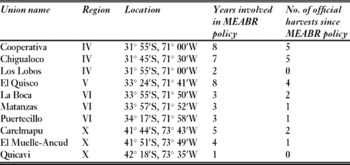
We surveyed fishers from 10 different unions in Chile, as between them they represented the full range of time-scales over which fishers could have been formally involved in co-management (Table 1). Unions in regions IV and V were the first to receive government support for co-management and most unions in these regions piloted MEABR policy implementation in Chile (Table 1). Regions VI and X are the latest regions in Chile to introduce the MEABR policy. Unions in these regions typically range from those in the initial application phases to those undertaking a third official harvest (at the time of the study; Table 1). Region X had its first management plans approved in 2001, but since then there have been a large number of applications, accounting for 79% of the applications across Chile in 2005 (Sernapesca 2005).
Locations of fishing unions who participated in the study, and the length of time they had been involved in co-management.

Field methods
Fieldwork was conducted between October 2003 and July 2004, and comprised two main stages. The first included 15 group sessions with artisanal fishers from the unions. Approximately 10 fishers participated per session. Meeting themes were moderated by Stefan Gelcich using a topic guide to increase confidence and avoid confusion. The primary objective of the group meetings was to understand how fishers related to environmental issues. However these meetings also provided information which enabled qualitative identification of specific environmental themes that informed fishers’ overall view of conservation and environmental management.
The information gathered at the group meetings informed the second fieldwork stage, which involved the development of questionnaires that were subsequently used to collect data both on fishers’ perceptions of environmental issues and the determinants of these perceptions. Stefan Gelcich administered questionnaires in Spanish at fishing ports (termed caletas in Chile) through direct interception of fishers who were members of the local fishing union. This technique was used to minimize sampling bias associated with snowballing (Richardson et al. Reference Richardson, Kaiser and Edwards-Jones2005). Questionnaires included sections seeking information on respondent socio-demographic and livelihood variables (hereafter contextual variables) and respondent environmental perceptions. The section on environmental perceptions included 20 Likert-type statements with anchor points, 1 = strongly disagree and 5 = strongly agree. We used a sample of 15 fishers to pre-test questionnaires for clarity, which resulted in changes and question rewording. In total, we surveyed 226 fishers and obtained 217 complete questionnaire responses for analysis.
Fishers’ environmental perception domains
We used factor analysis of the 20 Likert-type statements about environmental perceptions to test for the existence of specific environmental perception domains. We expected that questionnaire items related to similar environmental themes would load heavily on the same factor. These items (statements) loading on different factors would determine the existence of specific environmental domains (Zenetell & Knuth, Reference Zenetell and Knuth2004). We performed factor analysis of the attitudinal responses of the questionnaire by principal component analysis and Oblim rotation (Pallant Reference Pallant2004). We selected the number of factors included by analysing the screenplot of eigenvalues against the number of components (Pallant Reference Pallant2004). We grouped statements that loaded on the same factor to form distinct environmental perception domains, which we tested for reliability by using Cronbachs’ alpha (Zenetell & Knuth Reference Zenetell and Knuth2004; Schaaf et al. Reference Schaaf, Ross-Davis and Broussard2006). Cronbachs’ alpha equals zero if there is no true score, but only error between the items, and therefore statements are uncorrelated across subjects. If all items are perfectly reliable and measure the same thing (true score) then Cronbachs’ alpha equals one (Pallant Reference Pallant2004). We only grouped statements that loaded on the same factor to form distinct environmental domains if they had a Cronbachs’ alpha coefficient above the 0.7 benchmark (as proposed by Nunnally & Bernstein in Schaaf et al. Reference Schaaf, Ross-Davis and Broussard2006).
Fishers’ environmental perception responses
We calculated fishers’ environmental perceptions for each domain of concern by averaging individual responses (Likert scores) after reverse coding of some questions. As a result of reverse coding, high values (closer to 5) represented pro-environmental perceptions. We then analysed comparisons between fishing unions using Kruskal-Wallis and Dunn's pairwise tests.
Determinants of fishers' environmental perceptions
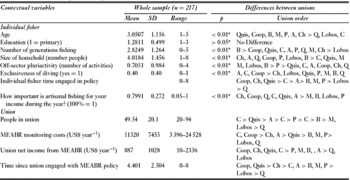
Determinants of fishers' environmental perceptions involve contextual variables which can be individual (such as education, individual income and individual time engaged in the MEABR policy) or associated with the union (for example number of boats in the union or time the union has officially been designated the management area), therefore in order to explore the determinants of fishers' environmental perceptions, we performed independent analyses at a union level and at an individual fisher level. We tested contextual variables for multicollinearity; when variables exhibited correlation coefficients above 0.6, we selected only one (the most significant for the study) using our knowledge of the study theme (final list of contextual variables in Table 2).
Conceptual variables used to test determinants of fishers environmental perceptions. Age: 1 = 18–27 years old; 2 = 28–37 years old; 3 = 38–47 years old; 4 = 48–57 years old; 5 > 57 years old. Unions: Cooperativa Los Vilos (Coop); El Quisco (Quis); Carelmapu (C); Chigualocco (Ch); Ancud (A); La Boca (B); Matanzas (M); Puertecillo (P); Los Lobos (Lobos); Quicavi (Q). *Indicates difference using Kruskal-Wallis and Dunns pairwise comparisons.

Determinants of unions’ environmental perceptions
To study the determinants of fishers' perceptions at a union level, we averaged Likert scores of each environmental domain of concern (after reverse coding for some questions), resulting in an overall score for each individual fisher that was then averaged to obtain one score for each union. Perception scores for each domain were used as dependent variables to perform a backstep multiple regression. We used union contextual variables (Table 2) as independent variables and tested data for normality assumptions using Kolmogrov-Smirnov analysis.
Determinants of individual fisher's environmental perceptions
To identify determinants of the perceptions of individual fishers, we averaged Likert scores of each environmental domain of concern (after reverse coding for some questions), resulting in an overall score for each individual fisher. We transformed these individual fisher scores for each domain into binary scores (those above and below a mean value of 3), which we used as dependent variables to perform a logistic binary backstep regression. We used individual fisher contextual variables (Table 2) as independent variables.
RESULTS
Group meetings took place at the fishing coves and provided evidence on the way that fishers talk about marine environmental issues. At the beginning of the group meetings, fishers normally stated the environmental issues that were important for their livelihoods. Environmental concerns could be divided into two main themes: (1) conservation of resource stocks, which was related to the sustainable use of benthic and pelagic species of commercial value and (2) fishers' concerns about pollution in coastal zones and the effects this might have upon marine resources and their subsequent market value. Once discussion commenced, fishers began building on the responses of other group members and new themes emerged, such as the importance and costs of conserving non-target species. Follow-up questions enabled the exploration of deeper levels of meaning and the identification of new themes. In this way, findings from group meetings enabled the identification of four distinct environmental themes: (1) the importance of benthic resource stock conservation, (2) concern about increasing water pollution, (3) the trade-offs between conservation and income from fisheries and (4) conservation of charismatic species.
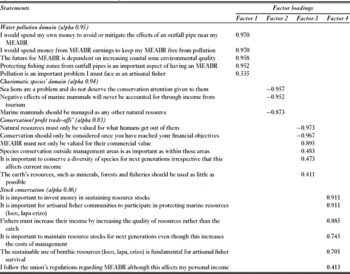
The four environmental themes identified in the group meetings allowed us to design questionnaires using Likert-type statements. Factor analysis performed on the questionnaire statement responses loaded within four factors (Table 3). From the types of statements included within each of these four factors, we named these factors: ‘water pollution’, ‘stock conservation’, ‘conservation/profit trade-offs’ and ‘charismatic species’, each a domain of environmental concern. Cronbachs’ alpha values indicated the different responses to specific statements within each of the domains were reliable (Table 3). All these domains had values above the 0.7 benchmark.
Results of factor analysis which represent four distinct environmental domains of concern. Values in parenthesis represent Cronbach's alpha values. MEABR refers to the actual management areas.

fishers' environmental perception responses
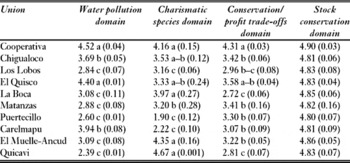
When statements in each theme were averaged, resulting in an overall score for each respondent, Kruskal-Wallis analysis revealed significant differences between unions for the conservation/profit trade-off domain (H = 63.08, df = 9, p < 0.001), the water pollution domain (H = 188.47, df = 9, p < 0.001) and the charismatic species domain (H = 63.08, df = 9, p < 0.001). However, there were no significant differences in perceptions of the stock conservation domain (H = 12.59, df = 9, p = 0.18). In general, union Cooperativa had the most positive perceptions towards every set of environmental domain. No single union consistently appeared to be the least concerned with environmental issues (Table 4). It is important to highlight that the stock conservation domain showed positive perceptions with average values above 4.8 (strongly agree) in all unions studied. Perceptions of the water pollution domain showed unions Cooperativa and El Quisco presented a strong position towards the need for unpolluted environments and unions Los Lobos, Puertecillo and Quicavi exhibited significantly lower scores (Table 4). Positive perceptions about the charismatic species domain were held mainly by fishers from Quicavi. In contrast, fishers from Puertecillo and Carelmapu presented negative perceptions about the conservation of charismatic species (Table 4).
Mean scores (± SE) of different unions regarding different environmental perception domains. Likert scale anchor points are 1 = strongly disagree to 5 = strongly agree. Differences between unions were tested with Kruskal-Wallis tests and pairwise differences were tested using Dunn's test; those unions that are not significantly different share the same letter.

Determinants of union environmental perceptions
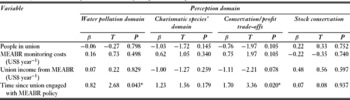
When a backward stepwise multiple regression was used to relate contextual variables and the conservation/profit trade-offs domain scores, time engaged in MEABR policy was selected as the only variable which produced a significant model (F = 6.06, p < 0.05; adjusted r 2 = 0.36). In addition, results of the backward stepwise multiple regression showed that time engaged with MEABR policy was the variable that best explained unions’ average perceptions of the water pollution domain. This model was also significant (F = 64.87, p<0.0001; adjusted r 2 = 0.87). No contextual variable or set of variables significantly explained the charismatic species and stock conservation domain average scores (Table 5).
Multiple regression results which show the relationship between contextual variables and mean environmental domain scores of each union. β = standarized slope, T = statistic and p = significance. *Significant at 5%.

Determinants of individual environmental perceptions
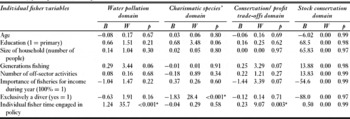
When testing for individual fisher determinants of environmental perceptions through backward stepwise binary logistic regressions (Table 6), the time each individual fisher had been engaged in the MEABR policy proved the best single variable explaining their perceptions of water pollution (Nagelkerke R 2 = 0.58). The backstep binary logistic regression between individual fisher contextual variables and the conservation/profit trade-offs domain scores, showed that the individual time a fisher had been engaged in MEABR policy and the importance of fisheries for income during the year (negative slope) produced a significant model (Nagelkerke R 2 = 0.1). In addition, the binary logistic regression showed exclusiveness of diving as the variable that best explained individual fishers perceptions of the charismatic species domain (Nagelkerke R 2 = 0.24). No contextual variable or set of variables significantly explained the stock conservation domain (Table 6).
Logistic regression showing the relationship between contextual variables and fishers individual environmental domain scores (responses for individual fishers' domain scores, where n = 217). B = logistic regression coefficient, W = Wald statistic (has a χ2 distribution and df = 1), p = significance, * = significant.

DISCUSSION
Authors writing about different natural resource domains have suggested that involvement in specific regulatory practices, which focus on greater stakeholder participation, could be linked with greater concern for the environment (Morris & Potter Reference Morris and Potter1995; Leach et al. Reference Leach, Pelkey and Sabatier2002; Agrawal Reference Agrawal2005). This is an extremely complex and poorly understood relationship that becomes critical if we are to guide governance-society interactions along sustainable trajectories in coastal zones through co-management. This study has revealed that the environmental perceptions of Chilean artisanal fishers are composed of four distinct domains of concern, and that fishers' perceptions of each of these appear to be associated with different determinants. Importantly, time engaged with MEABR policy at an individual and at a union level proved to be a significant determinant of fishers' environmental perceptions regarding the water pollution and the conservation/profit trade-offs environmental domains. The existence of these significant relationships between time engaged in MEABR policy and positive environmental perceptions is encouraging for managers and policy makers. Such a relationship establishes the potential for co-management to change fishers' perceptions and suggests artisanal fishers may demonstrate more sustainable behaviours in the future.
The relationship between time of engagement with the policy and pro-environment perceptions was strongest for the environmental domain of water pollution, which showed significant relationships in the individual fisher and union levels of analysis (58% and 87% of the variance, respectively). Accordingly, fishers that had experienced longer engagement with marine co-management were more likely to agree with statements such as: ‘I would spend my own money to avoid or mitigate the effects of an outfall pipe near my MEABR’ and ‘I would spend money from MEABR earnings to keep my MEABR free from pollution’ (Table 3). The reasons for this are unclear, but perceptions of environmental quality could be related to the fact that C. concholepas (the main product of the management areas) is exported to Asian and other international markets (Castilla et al. Reference Castilla, Gelcich, Defeo, McClanahan and Castilla2007). Union members have increasing communication with representatives of these markets and are more actively involved in understanding the needs of the export market; international market forces have raised local awareness of the issue of water quality and the need to reduce pollution. This type of interaction has important implications for developing countries, where environmental standards of some sectors may be below those expected by developed country consumers. While it might be expected that in the long-term this market pressure would serve to improve water quality in developing countries, in the short-term it may lead to conflict between small-scale fishers and large commercial enterprises (i.e. mining, salmon aquaculture and sewage treatment plants).
There is a significant relationship between time engaged in co-management and a more conservation-oriented perception. When considering unions, time engaged with MEABR policy explained 36% of the variance, even though strong conservation ethics may conflict with achieving financial returns from fishing. Therefore, through engagement with the MEABR policy, fishers have increased their appreciation of the value of species and ecosystems. This outcome may be expected from a policy that provided user rights over a historically overharvested seabed to a group of fishers who harvested their target species by diving, an act which allows fishers a direct view of their fishing grounds. This is important, as species diversity has been shown to be greater inside the management areas than outside (Gelcich et al. Reference Gelcich, Godoy, Prado and Castilla2008) and there is a greater C. concholepas catch per unit effort within the areas (Castilla et al. Reference Castilla, Manríquez, Alvarado, Rosson, Pino, Espóz, Soto, Oliva, Defeo, Jamieson and Campbell1998), thus fishers potentially experience a direct visual correlation between species diversity and a greater density of harvestable species. Harvesting by diving would make fishers more aware of the impacts of their actions on the habitat and appreciative of their environment while at the same time seeking to make a profit from production (Burton Reference Burton2004; Michel-Guillou & Moser Reference Michel-Guillou and Moser2006). When analyses are performed at an individual fisher level, time of engagement with MEABR policy is a significant factor that explains 10% of fishers' perceptions of the conservation/profit trade-offs domain. We suggest perceptions of this domain are influenced greatly by fishers' personality traits and social norms (Gelcich et al. 2005b; Edwards-Jones Reference Edwards-Jones2006).
Fishers showed the strongest positive perceptions about the stock conservation domain. Statistical analysis suggested that positive perceptions were common across fisher unions and did not appear to be significantly related to any contextual variable. However, given that many fisheries, including some Chilean ones, have historically been overfished (Castilla Reference Castilla1994; McClanahan & Castilla Reference McClanahan and Castilla2007) it could be argued that these perceptions were the product of the opportunistic sampling design in which fishers might be trying to please the interviewer with pro-environmental attitudes. They might even have been representing an environmentally friendly discourse that did not necessarily reflect genuine stewardship of resource stocks; for example fishers could have been answering the questions strategically, offering responses which reflected a worldview developed in a social environment favouring environmentally responsible fishers. This could occur where fishers who communicate the politically acceptable worldview preferentially qualify for development funds and other benefits (Gelcich et al. 2005a; Morris & Potter Reference Morris and Potter1995). There is some evidence for the latter case from Los Vilos in Chile, where memories of intervention from a period when MEABR was in a developmental phase, taught some unions that volunteering for conservation projects brings status (in the eyes of conservation agencies) and wealth (Gelcich et al. 2005a). However, in the areas studied here, external funds related to stock conservation are now limited and do not appear to provide a real alternative to managing stocks in a sustainable way, and fishers are not consistently positive in their attitudes towards environmental domains of concern. Therefore, fishers' positive perceptions about the sustainable use of stocks are almost certainly genuine.
fishers' perceptions of the charismatic species domain varied between unions, however of all the contextual variables used in this study (at a union or individual level) the only significant determinant of this perception was exclusiveness of diving, which exhibited a negative relationship with the variable. This could be because the most common charismatic species in the research sites was the sea lion, which is primarily piscivorous. Sea lions seem to have a disproportionately negative effect on the livelihoods of fishers dependent on finfish, as opposed to those dependent on diving to harvest benthic shellfish. Sixty per cent of fishers (mainly finfishers) agreed with the statement ‘sea lions are a problem and do not deserve the conservation attention given to them’.
Overall, the results suggest that length of time spent participating in the MEABR policy influenced fishers' perceptions of the water pollution and conservation/profit trade-offs domains in an environmentally positive manner. Time of engagement with co-management has also been reported to affect the perceived success of co-management programmes in South Africa (Napier et al. Reference Napier, Branch and Harris2005). Time is essential for co-management to succeed as a policy. However, time is not an isolated factor, and it is associated with learning-by-doing and participatory processes associated with policy implementation. Artisanal fishers in the mussel fisheries in Sokhulu, South Africa (Harris et al. Reference Harris, Branch, Sibiya, Bill, Hauck and Sowman2003) and loco fisheries in Chile (Castilla et al. Reference Castilla, Manríquez, Alvarado, Rosson, Pino, Espóz, Soto, Oliva, Defeo, Jamieson and Campbell1998) have come to understand why harvesting has to be controlled. If this understanding is to include other environmental domains of concern, then it will be important to educate fishers about the impacts of co-management policies on ecosystems and habitats in a local context. Actively encouraging fishers to engage in participatory research may be useful (Olsson et al. Reference Olsson, Folke and Berkes2004; Wiber et al. Reference Wiber, Berkes, Charles and Kearney2004; Folke et al. Reference Folke, Hahn, Olsson and Norberg2005).
It can be argued that one of the most important, although least tangible, objectives of resource management policies should be to bring about a shift in perceptions of resource users (fishers, farmers and others) with respect to resource use, which should outlast the original scheme (Morris & Potter Reference Morris and Potter1995). Few policies are constructed with this in mind, and it is heartening that the Chilean fishery MEABR co-management policy appears to have initially accomplished this. We are unable to state which particular aspects of the policy have been responsible for the perception changes observed amongst the fishers, but such changes would seem likely to arise from increased familiarity with the policy (Hutton & Pitcher Reference Hutton and Pitcher1998), its inclusion of formal common property user rights (Harris et al. Reference Harris, Branch, Clark, Sibiya, McClanahan and Castilla2007; Castilla et al. Reference Castilla, Gelcich, Defeo, McClanahan and Castilla2007) and its reliance on market forces. If this were true, then we would expect perceptions of resource users to change more rapidly in a co-management situation, where there is a closer, more dialogue-based relationship between resource users and policy administrators (Pinkerton Reference Pinkerton1994), than in situations where resource management rules are made by distant administrators and upheld by official regulators who do not engage in significant dialogue. Given that the length of time fishers are engaged with co-management affects environmental perceptions of domains of concern differentially, public officials and funding agencies should take care to avoid prematurely judging early stage co-management partnerships. Premature withdrawal of funding or support may lead to failure (Hauck & Hector Reference Hauck, Hector, Hauck and Sowman2003). It takes time to educate participants, overcome distrust and reach agreements. Thus, understanding the incentives for resource users to comply, or not, with resource management policy remains a rich area for future work that may represent a bridging strategy between sustainable management of coastal resources and marine conservation.
ACKNOWLEDGEMENTS
We thank fishers who took part in this study for patience and support. Stefan Gelcich acknowledges the financial support of FONDECYT 3060085 and Juan Carlos Castilla acknowledges the support of the Centro de Estudios Avanzados en Ecología & Biodiversidad, Facultad de Ciencias Biológicas, Pontificia Universidad Católica de Chile, project 1501-0001. We sincerely thank Dr Evelyn Pinkerton and N. Godoy for helpful comments on the manuscript.