Implications
This experiment characterized the negative impacts of excitable temperament on growth and puberty attainment of Bos indicus beef females. Heifers were initially classified by temperament according to exit velocity and resultant exit score, which successfully predicted their temperament responses during subsequent handling events. Heifers with excitable temperament gained less weight and experienced delayed puberty compared to heifers with adequate temperament. The underlying reasons for these outcomes warrant investigation, including genetic relationships between temperament with growth and reproductive systems. Nonetheless, temperament should be considered as selection criteria for replacements heifers to optimize productivity in cow-calf systems based on B. indicus females.
Introduction
Development of replacement heifers is a critical component of cow-calf production systems (Bagley, Reference Bagley1993), and heifers that calve as 2-year-old wean more and heavier calves during their productive lives (Lesmeister et al., Reference Lesmeister, Burfening and Blackwell1973). Hence, management to maximize the number of heifers able to conceive by 15 months of age improves profitability of cow-calf operations. However, B. indicus-influenced heifers typically reach puberty after 15 months of age (Rodrigues et al., Reference Rodrigues, Kinder and Fitzpatrick2002). Moreover, excitable temperament is commonly observed in B. indicus cattle (Hearnshaw and Morris, Reference Hearnshaw and Morris1984; Fordyce et al., Reference Fordyce, Dodt and Wythes1988), which impacts reproductive function in beef females and likely contributes to delayed puberty in B. indicus heifers (Cooke, Reference Cooke2014).
Temperament is defined as the fear-related behavioral responses of cattle when exposed to human handling (Fordyce et al., Reference Fordyce, Dodt and Wythes1988). Cattle with excitable temperament have reduced growth rates compared to cohorts with adequate temperament (Francisco et al., Reference Francisco, Resende, Benatti, Castilhos, Cooke and Jorge2015), whereas post-weaning BW gain is negatively associated with age at puberty in heifers (Schillo et al., Reference Schillo, Hall and Hileman1992). Excitable temperament is also associated with increased synthesis and circulating concentrations of ACTH and cortisol during handling, which can disrupt key physiological events required for puberty attainment including first ovulatory LH surge (Dobson and Smith, Reference Dobson and Smith2000; Cooke, Reference Cooke2014). However, no research has directly investigated the impacts of temperament on growth and puberty attainment in B. indicus females, such as Nelore heifers. Based on this rationale, we hypothesized that Nelore heifers with excitable temperament will have reduced BW gain, altered adrenocortical physiology and delayed puberty attainment compared to cohorts with adequate temperament. Therefore, this experiment investigated the impacts of temperament on post-weaning growth rates, plasma cortisol concentrations and puberty attainment by 15 months of age in Nelore heifers.
Material and methods
Animals and temperament evaluation
This experiment was conducted in a commercial cow-calf operation located in São Manuel, SP, Brazil. A total of 170 Nelore heifers (mean ± SE; initial BW=238±2 kg, initial age=369±1 days) were assigned to this experiment. Heifers were weaned 4 months before the beginning of experimental procedures, and managed in two groups of 82 and 88 heifers each according to the general management of the operation. This arrangement was maintained throughout the experimental period (days 0 to 91), which was completed when heifers achieved 15 months of age to address the main hypothesis and objectives of this experiment. Groups were maintained in individual Brachiaria brizantha pastures with ad libitum access to water and a commercial mineral–vitamin mix (Bovipac Plus; MCassab, São Paulo, SP, Brazil). Moreover, groups also received a total mixed ration (TMR) offered at 2.4% of heifer BW/day. The TMR consisted of (DM basis) 69% corn silage and 31% soybean meal.
Heifer temperament was assessed on day 0 via exit velocity (Cooke, Reference Cooke2014), which was determined as the speed of the heifer exiting the squeeze chute by measuring rate of travel over a 1.8-m distance with an IR sensor (FarmTek Inc., North Wylie, TX, USA). Heifers were divided into quintiles within each group according to their exit velocity (in m/s), and assigned a score from 1 to 5 (exit score; 1=heifers within the slowest quintile; 2=heifers within the second slowest quintile; 3=heifers within the intermediary quintile; 4=heifers within the second fastest quintile; and 5=heifers within the fastest quintile). Moreover, heifers were classified according to exit score as adequate temperament (ADQ; exit score⩽3) or excitable temperament (EXC; exit score>3). Chute score was not utilized herein for temperament evaluation (Cooke, Reference Cooke2014) due to the physical characteristics of the squeeze chute, which completely immobilized the heifer and prevented proper assessment of heifer behavior during chute restraining. Overall, 74 heifers were classified as EXC (group 1, n=35; group 2, n=39) and 96 heifers classified as ADQ (group 1, n=47; group 2, n=49).
Sampling
Samples of pasture and TMR were collected every 30 days, pooled and analyzed for nutrient content by a commercial laboratory (3R LAB; Lavras, Minas Gerais, Brazil). Samples were analyzed by wet chemistry procedures for concentrations of CP, ADF and NDF, whereas net energy for maintenance and gain were calculated as in Reis et al. (Reference Reis, Cooke, Cappellozza, Marques, Guarnieri Filho, Rodrigues, Bradley, Mueller, Keisler, Johnson and Bohnert2015). Nutritional profile of pasture and TMR were, respectively (DM basis), 60% and 70% total digestible nutrients, 57% and 37% NDF, 29% and 23% ADF, 1.38 and 1.69 Mcal/kg of net energy for maintenance, 0.80 and 1.08 Mcal/kg of net energy for gain, and 15.8% and 20.8% CP.
Heifer BW and body condition score (BCS; according to Wagner et al., Reference Wagner, Lusby, Oltjen, Rakestraw, Wettemann and Walters1988) were obtained on days 0, 31, 60 and 91 of the experiment. Growth rate of each heifer was modeled by linear regression of BW against sampling days, and each regression coefficient was used as heifer average daily gain (ADG). Heifer exit velocity was assessed again on days 31, 60 and 91, and exit score calculated as described for day 0. Heifer puberty was assessed via trans-rectal ultrasonography (7.5 MHz transducer, Aloka Prosound 2; Corimetrics Medical Systems Inc., Wallingford, CT, USA) to verify ovarian activity on days 0 and 10 (interval A), days 31 and 41 (interval B), days 60 and 70 (interval C), days 81 and 91 (interval D). Puberty was declared during the 10-day interval period when a corpus luteum was detected (Cooke et al., Reference Cooke, Arthington, Austin and Yelich2009a). This criterion was based on a cyclic luteal pattern suggestive of normal estrous cycles (Day et al., Reference Day, Imakawa, Garcia-Winder, Zalesky, Schanbacher, Kittok and Kinder1984; Reis et al., Reference Reis, Cooke, Cappellozza, Marques, Guarnieri Filho, Rodrigues, Bradley, Mueller, Keisler, Johnson and Bohnert2015). Heifer age and BW at puberty were calculated based on heifer age and BW within the 10-day interval sampling in which puberty was declared.
Blood samples were collected on days 0, 31, 60 and 91, beginning at 0800 h, from a subgroup of heifers randomly selected from group 2 (EXC, n=23; ADQ, n=34). Samples were collected from the same subgroup of heifers across all sampling days. Blood was collected via jugular venipuncture into commercial blood collection tubes (Vacutainer, 10 ml; Becton Dickinson, Franklin Lakes, NJ, USA) containing freeze-dried sodium heparin. After collection, all blood samples were placed immediately on ice, centrifuged (2500×g for 30 min; 4°C) for plasma harvest, and stored at −20°C on the same day of collection. Samples were analyzed for cortisol (Immulite 1000; Siemens Medical Solutions Diagnostics, Los Angeles, CA, USA) as previously described (Cooke et al., Reference Cooke, Schubach, Marques, Peres, Silva, Carvalho, Cipriano, Bohnert, Pires and Vasconcelos2017) due to 100% cross-reactivity between bovine and human cortisol, and accomplished within a single assay with an intra-assay CV of 5.4%.
Statistical analysis
All data were analyzed using heifer as experimental unit, with the MIXED or GLIMMIX procedure of SAS (SAS Institute Inc., Cary, NC, USA) for quantitative and binary data, respectively. Satterthwaite approximation was used to determine the denominator df for the tests of fixed effects, and heifer(temperament × group) and group were included as random effects. The model statements used to compare initial age, heifer ADG, age and BW at puberty contained the effect of heifer temperament (ADQ or EXC). The model statements used to compare temperament variables, BW, BCS, puberty attainment and plasma cortisol contained the effects heifer temperament (ADQ or EXC), time (10-day interval for puberty and day for all remaining variables) and the temperament × time interaction. Puberty attainment was also analyzed with the aforementioned model, with heifer mean BW and ADG included as independent covariates. The specified term used for repeated statement was day, the subject was heifer(temperament × group) and the covariance structure utilized was autoregressive, which provided the best fit for these analyses according to the Akaike information criterion. Results are reported as least square means, according to temperament type if no interactions were significant, or according to the highest order interaction detected. Pearson correlations were calculated among individual temperament measurements across days, with the CORR procedure of SAS. For all analyses, significance was set at P⩽0.05 and tendencies were determined if P>0.05 and P⩽0.10.
Results
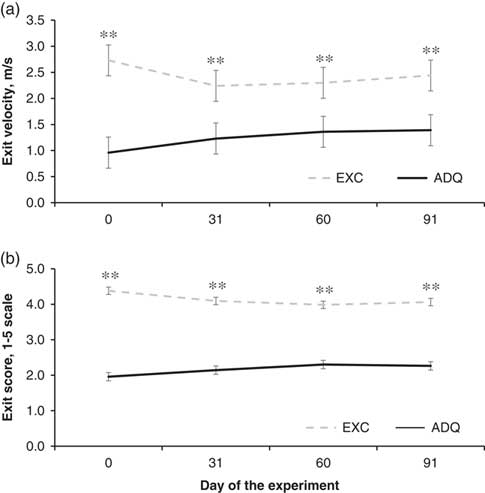
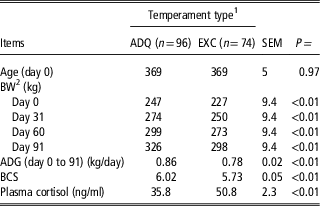
Exit velocity obtained on day 0 was positively correlated (P<0.01; r⩾0.64) with subsequent evaluations on days 31, 60 and 91 of the experimental period (Table 1). Positive correlations were also detected among exit velocities obtained on days 31, 60 and 91 (P<0.01; r⩾0.76). Similar outcomes (Table 1) were detected for exit score (P<0.01; r⩾0.63). Moreover, temperament × time interactions were detected for exit velocity and exit scores, which were greater (P<0.01) in EXC v. ADQ heifers on day 0 and throughout the experimental period (Figure 1). Mean plasma cortisol concentration during the experiment was also greater (P<0.01) in EXC v. ADQ heifers (Table 2).
Exit velocity (a) and score (b) in replacement Nelore (Bos indicus) heifers according to temperament. Heifer temperament was evaluated via exit velocity on day 0. Individual exit score was calculated by dividing exit velocity into quintiles and assigning heifers with a score from 1 to 5 (1=slowest; 5=fastest heifer). Heifers were classified according to exit score as adequate (ADQ, n=96; exit score⩽3) or excitable temperament (EXC, n=74; exit score>3). Temperament × time interactions were detected (P<0.01) for both responses. Temperament comparison within days; **P<0.01.

Pearson correlation coefficients among initial (day 0) exit velocity and score with and across subsequent evaluations (days 31, 60 and 91; n=170) in replacement Nelore beef heifersFootnote 1

1 Within cells, values outside parentheses are correlation coefficients, whereas values within parentheses are P-values.
Age at the beginning of the experiment, BW and average daily gain (ADG), body condition score (BCS) and plasma cortisol concentrations in replacement Nelore (Bos indicus) beef heifers according to temperament

1 Heifer temperament was evaluated via exit velocity on day 0. Individual exit score was calculated by dividing exit velocity into quintiles and assigning heifers with a score from 1 to 5 (1=slowest; 5=fastest heifer). Heifers were classified according to exit score as adequate (ADQ, n=96; exit score⩽3) or excitable temperament (EXC, n=74; exit score>3).
2 A temperament × time interaction was detected for BW (P<0.01); hence, BW values are reported within collection days.
Age at the beginning of the experiment was similar (P=0.97) between ADQ and EXC heifers (Table 2). A temperament × time interaction was detected (P<0.01) for heifer BW, which was always greater (P<0.01) in ADQ v. EXC heifers. Mean BCS and ADG during the experiment were also greater (P<0.01) in ADQ v. EXC heifers (Table 2).
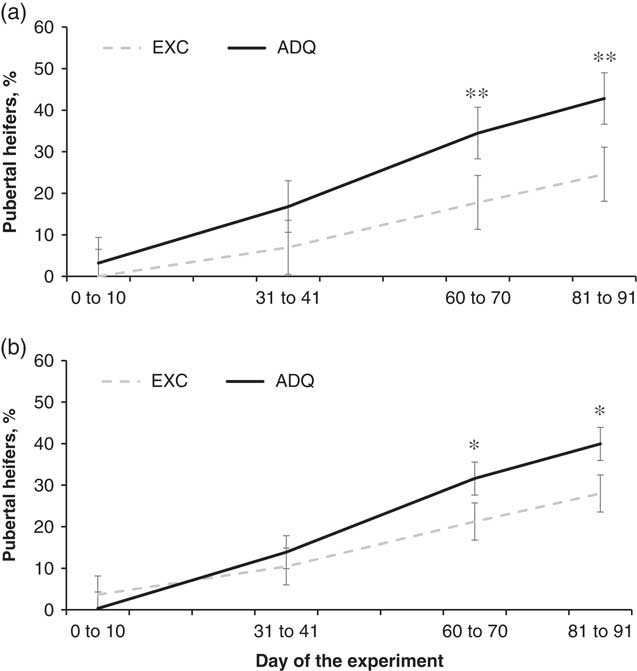
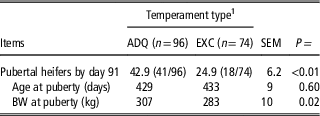
A temperament×time interaction was detected (P=0.03) for puberty attainment, which was delayed in EXC compared with ADQ heifers (Figure 2a). At the end of the experimental period, a greater (P<0.01) proportion of ADQ heifers were pubertal compared to EXC heifers (Figure 2a; Table 3). Heifer ADG and mean BW during the experiment were significant covariates (P⩽0.02) when included in the puberty model, although puberty attainment was still delayed in EXC heifers (temperament × time interaction, P=0.04; Figure 2b). Within heifers that reached puberty during the experiment, ADQ were heavier (P=0.02) but had similar age at puberty attainment (P=0.60) compared with EXC heifers (Table 3).
Puberty attainment in replacement Nelore (Bos indicus) heifers according to temperament. Heifer temperament was evaluated via exit velocity on day 0. Individual exit score was calculated by dividing exit velocity into quintiles and assigning heifers with a score from 1 to 5 (1=slowest; 5=fastest heifer). Heifers were classified according to exit score as adequate (ADQ, n=96; exit score⩽3) or excitable temperament (EXC, n=74; exit score>3). (a) reports original results, whereas (b) reports puberty attainment covariately adjusted to heifer mean BW and average daily gain (P⩽0.02 for covariates) during the experiment. Temperament×time interactions were detected (P⩽0.04). Temperament comparison within days; **P<0.01, *P⩽0.05.

Puberty parameters in replacement Nelore (Bos indicus) beef heifers according to temperament

1 Heifer temperament was evaluated via exit velocity on day 0. Individual exit score was calculated by dividing exit velocity into quintiles and assigning heifers with a score from 1 to 5 (1=slowest; 5=fastest heifer). Heifers were classified according to exit score as adequate (ADQ, n=96; exit score⩽3) or excitable temperament (EXC, n=74; exit score>3).
Discussion
Based on the temperament evaluation criteria adopted herein, nearly 40% of heifers from both groups were classified as EXC heifers. Matsunaga et al. (Reference Matsunaga, Silva, Toledo, Paranhos da Costa, Eler and Ferraz2002) estimated that the incidence of excitable Nelore cattle in Brazilian beef operations is at 10%, which differs from the current outcomes. This discrepancy can be attributed to several factors, including number of cattle evaluated, parity, differences in cattle population and production systems, as well as temperament evaluation criteria (Cooke et al., Reference Cooke, Bohnert, Meneghetti, Losi and Vasconcelos2011). Nevertheless, the goal of this experiment was to investigate the impacts of temperament on growth and puberty attainment in B. indicus beef heifers, and not to define the incidence of excitable females in B. indicus herds. The method used herein to evaluate temperament of cattle was based on research with B. indicus cattle (Cooke et al., Reference Cooke, Bohnert, Meneghetti, Losi and Vasconcelos2011; Francisco et al., Reference Francisco, Resende, Benatti, Castilhos, Cooke and Jorge2015; Cooke et al., Reference Cooke, Schubach, Marques, Peres, Silva, Carvalho, Cipriano, Bohnert, Pires and Vasconcelos2017), and had the purpose of classifying heifers according to temperament by using techniques that can be feasibly completed during cattle processing (Cooke et al., 2014). As previously mentioned, chute score was not utilized herein due to the physical characteristics of the squeeze chute. Yet, exit velocity and corresponding exit score have been widely used to assess temperament of beef cattle (Curley et al., Reference Curley, Paschal, Welsh and Randel2006; Burdick et al., Reference Burdick, Agado, White, Matheney, Neuendorff, Riley, Vann, Welsh and Randel2011; Vetters et al., Reference Vetters, Engle, Ahola and Grandin2013).
Across EXC and ADQ heifers, exit velocity and exit score obtained on day 0 were positively correlated, at least moderately, with subsequent evaluations during the experimental period (Table 1). As a result, exit velocity and exit score were always greater in EXC v. ADQ heifers (Figure 1) despite a slight decrease in this difference as the experiment progressed, which can be associated to acclimation of EXC heifers to handling events (Curley et al., Reference Curley, Paschal, Welsh and Randel2006; Burdick et al., Reference Burdick, Agado, White, Matheney, Neuendorff, Riley, Vann, Welsh and Randel2011). Vetters et al. (Reference Vetters, Engle, Ahola and Grandin2013) also reported Pearson correlation coefficients ranging from 0.43 to 0.64 between exit velocity and exit scores in beef steers during a 105-day period, with temperament evaluated at approximately 35-day intervals. Curley et al. (Reference Curley, Paschal, Welsh and Randel2006) evaluated exit velocity in yearling Brahman bulls, and reported Pearson correlation coefficients between 0.30 and 0.47 with assessments obtained 60 and 120 days later. Moreover, Curley et al. (Reference Curley, Paschal, Welsh and Randel2006) ranked animals according to initial exit velocity, being 1 with slowest animals and 3 with fastest animals, and reported that exit velocity was greater in bulls ranked 2 and 3 compared with bulls ranked as 1 throughout the 120-day evaluation period. Collectively, these outcomes indicate that exit velocity and exit score are reliable instruments for temperament assessment, repeatable across days, and can be used to select heifers for temperament by predicting their exit velocity and score during future handling events.
Heifers classified as EXC were lighter at the beginning of the experiment compared with ADQ heifers, despite similar age (Table 2) and post-weaning overall management. Francisco et al. (Reference Francisco, Cooke, Marques, Mills and Bohnert2012) reported similar results in BW at weaning and upon feedlot entry in Bos taurus steers and heifers originated from the same cowherd. Moreover, EXC heifers had less ADG during the experiment, which increased BW differences between EXC and ADQ heifers by 8 kg during the experimental period (Table 2). Reduced ADG in cattle with excitable temperament has been reported by others (Cafe et al., Reference Cafe, Robinson, Ferguson, McIntyre, Geesink and Greenwood2011; Turner et al., Reference Turner, Navajas, Hyslop, Ross, Richardson, Prieto and Bell2011; Francisco et al., Reference Francisco, Resende, Benatti, Castilhos, Cooke and Jorge2015) and attributed to reduced dry matter intake (Nkrumah et al., Reference Nkrumah, Crews, Basarab, Price, Okine, Wang, Li and Moore2007) and feed efficiency (Petherick et al., Reference Petherick, Holroyd, Doogan and Venus2002; Francisco et al. Reference Francisco, Resende, Benatti, Castilhos, Cooke and Jorge2015) compared to cattle with adequate temperament, which were not evaluated herein due to experimental design. Yet, differences detected for heifer BCS during the experiment (Table 2) indicate that nutritional status was indeed reduced in EXC v. ADQ heifers (León et al., Reference León, Hernández-Cerón, Keisler and Gutierrez2004), suggesting less DM intake and/or feed efficiency in EXC heifers. Hence, this experiment provides further evidence that temperament directly impacts BW development in growing beef cattle, including Nelore replacement heifers.
Age at puberty is highly determined by BW and growth rate (Schillo et al., Reference Schillo, Hall and Hileman1992), corroborating with the reduced incidence of puberty attainment in EXC v. ADQ heifers (Figure 2a). It should be noted that EXC heifers that reached puberty during the experiment were lighter at the 10-day interval in which puberty was declared compared with ADQ heifers, suggesting that temperament effects on puberty is not totally due to BW effects (Table 3). Indeed, when heifer mean BW and ADG during the experiment were included as covariates into the puberty attainment model, the EXC heifers still experienced delayed puberty compared to ADQ heifers (Figure 2b). Accordingly, temperament has been shown to impair reproductive function in beef females by other mechanisms than BW and growth, including heightened adrenocortical reactions in cattle with excitable temperament (Cooke, Reference Cooke2014).
Several research studies from others (Stahringer et al., Reference Stahringer, Randel and Neuendorff1990; Fell et al., Reference Fell, Colditz, Walker and Watson1999; Curley et al., Reference Curley, Paschal, Welsh and Randel2006) and our research group (Cooke et al., Reference Cooke, Arthington, Araujo and Lamb2009b; Cooke et al., Reference Cooke, Bohnert, Cappellozza, Mueller and DelCurto2012; Cooke et al., Reference Cooke, Schubach, Marques, Peres, Silva, Carvalho, Cipriano, Bohnert, Pires and Vasconcelos2017) support the greater plasma cortisol concentrations detected in EXC v. ADQ heifers (Table 3) herein. Excitable temperament has been positively associated with plasma cortisol during handling independently of breed type, age category and production system, including Nelore cattle (Cooke, Reference Cooke2014). The hormones produced during the adrenocortical stress reaction influence several production traits, such as growth and reproductive function (Fell et al., Reference Fell, Colditz, Walker and Watson1999; Dobson et al., Reference Dobson, Tebble, Smith and Ward2001). More specifically, heightened plasma cortisol concentrations impair nutrient availability by stimulating body tissue catabolism and diverting nutrients from growth (Nelson and Cox, Reference Nelson and Cox2005), and disrupt key physiological events required for puberty attainment including gonadotropin synthesis and first ovulatory LH surge (Dobson and Smith Reference Dobson and Smith2000). Yet, differences in BW development and puberty attainment reported herein should not be fully attributed to increased plasma cortisol concentrations in EXC heifers, given that such response was only assessed and typically stimulated by handling events (Cooke et al., Reference Cooke, Schubach, Marques, Peres, Silva, Carvalho, Cipriano, Bohnert, Pires and Vasconcelos2017). In turn, additional mechanisms associating temperament and productive function of beef females warrant investigation, including genetic and innate deficiencies within developmental and reproductive system in excitable females (Cooke, Reference Cooke2014). Several genes that may be responsible for cattle temperament have been identified (Schmutz et al., Reference Schmutz, Stookey, Winkelman-Sim, Waltz, Plante and Buchanan2001; Riley et al., Reference Riley, Gill, Boldt, Funkhouser, Herring, Riggs, Sawyer, Lunt and Sanders2016), whereas genetic correlations between temperament and reproductive traits were already reported in Nelore cattle (Barrozo et al., Reference Barrozo, Buzanskas, Oliveira, Munari, Neves and Queiroz2012). Therefore, research is required to fully characterize the impacts of excitable temperament, beyond reduced BW development and increased adrenocortical reactions during handling, on reproductive development and function of beef females.
Conclusions
Collectively, this experiment provides novel information regarding the negative impacts of excitable temperament on growth and puberty attainment in B. indicus beef females. Heifers were classified by temperament according to initial exit velocity and resultant exit score, which effectively characterized heifer temperament by predicting their behavioral responses during succeeding handling events. Heifers classified as EXC gained less BW and experienced delayed puberty compared with ADQ heifers. The exact biological reason for these outcomes still warrant investigation, given that plasma cortisol was only assessed and is transiently increased in EXC cattle upon handling events. These include, but are not limited to, genetic relationships between excitable temperament with growth and reproductive function. Nonetheless, this experiment demonstrated that cattle temperament has direct implications on heifer development in cow-calf system based on B. indicus females.
Acknowledgements
R. F. C. is also affiliated as permanent professor to the Programa de Pós-Graduação em Zootecnia/São Paulo State University (UNESP), School of Veterinary Medicine and Animal Science, Botucatu 18168-000, Brazil. Correspondence about this article can also be directed to R. F. C. at reinaldocooke@tamu.edu.
Declaration of interest
No conflicts of interest to report.
Ethics statement
All animals were cared for in accordance with the practices outlined in the Guide for the Care and Use of Agricultural Animals in Agricultural Research and Teaching (Federation of Animal Science Societies, 2010).
Software and data repository resources
No software, data or models were deposited in official repositories.