Introduction
In addition to the Teloschistes-type asci, most species of the lichen family Teloschistaceae are characterized by the presence of anthraquinones, which impart a yellowish orange colour to the thallus and/or apothecia. The widespread and well-delimited family currently comprises c. 110 genera and is estimated to contain over 1500 species (Arup et al. Reference Arup, Søchting and Frödén2013; Kondratyuk et al. Reference Kondratyuk, Jeong, Yu, Kärnefelt, Thell, Elix, Kim, Kondratyuk and Hur2013, Reference Kondratyuk, Jeong, Yu, Kärnefelt, Thell, Elix, Kim, Kondratiuk and Hur2014, Reference Kondratyuk, Kärnefelt, Thell, Elix, Kim, Kondratiuk and Hur2015a, Reference Kondratyuk, Lőkös, Farkas, Oh and Hurb, Reference Kondratyuk, Lőkös, Kim, Kondratiuk, Jeong, Jang, Oh and Hurc, Reference Kondratyuk, Kärnefelt, Thell, Elix, Kim, Kondratiuk and Hurd, Reference Kondratyuk, Lőkös, Halda, Upreti, Mishra, Haji Moniri, Farkas, Park, Lee and Liu2016, Reference Kondratyuk, Lőkös, Halda, Roux, Upreti, Schumm, Mishra, Nayaka, Farkas and Park2017a; Søchting et al. Reference Søchting, Søgaard, Elix, Arup, Elvebakk and Sancho2014a, Reference Søchting, Garrido-Benavent, Seppelt, Castello, Pérez-Ortega, De Los Ríos Murillo, Sancho, Frödén and Arupb; Wilk et al. Reference Wilk, Pabijan, Saługa, Gaya and Lücking2021). The family is divided into three subfamilies, Caloplacoideae, Teloschistoideae and Xanthorioideae (Gaya et al. Reference Gaya, Högnabba, Holguin, Molnár, Fernández-Brime, Stenroos, Arup, Søchting, van den Boom and Lücking2012; Arup et al. Reference Arup, Søchting and Frödén2013) or four subfamilies (Kondratyuk et al. Reference Kondratyuk, Lőkös, Kim, Kondratiuk, Jeong, Jang, Oh and Hur2015d). The genus Squamulea is most similar to Huriella and is characterized by small, squamulose or areolate thalli containing anthraquinones, a saxicolous habit, and by producing apothecia with a paraplectenchymatous proper margin and hypothecium (Wilk Reference Wilk2020). From Pakistan, only one species of the genus Squamulea (namely Squamulea subsoluta (Nyl.) Arup et al. as Caloplaca irrubescens (Nyl. ex Arnold) Zahlbr. in Aptroot & Iqbal (Reference Aptroot and Iqbal2012)) has been previously identified.
During our exploration of the lichen diversity of Pakistan, collections of the genus Squamulea were made from Khyber Pakhtunkhwa Province and various sites in Azad Jammu and Kashmir, Pakistan. Using molecular analyses, as well as morphological and chemical characters, we were able to confirm the presence of one new species and one new record of the genus Squamulea in Pakistan, which are presented here.
Materials and Methods
Morphological and chemical studies
Collections were made during a lichen survey of Azad Jammu and Kashmir, Kaghan Valley and Khanspur in 2021. The specimens were examined macro and micromorphologically using a stereomicroscope (EMZ-5TR, Meiji Techno, Japan) and compound microscope (SWIFT M4000-D) with a 9MP camera system, respectively. For anatomical investigation, sections of apothecia were made by hand and mounted in water and 10% KOH (K). A minimum of 20 measurements in water were made for each diagnostic feature from five specimens. The collected specimens were deposited in the herbarium of the Institute of Botany, University of the Punjab, Lahore (LAH). Secondary chemistry was analyzed using spot tests which were performed using 10% KOH and sodium hypochlorite solution (C). Thin-layer chromatography was carried out using solvent system C, following standard methods (Orange et al. Reference Orange, James and White2010).
DNA extraction, PCR amplification and sequencing
Genomic DNA was extracted directly from a portion of thallus with apothecia from each specimen using a modified 2% CTAB method (Gardes & Bruns Reference Gardes and Bruns1993). The primer pair ITS1F (Gardes & Bruns Reference Gardes and Bruns1993) and ITS4 (White et al. Reference White, Bruns, Lee, Taylor, Innis, Gelfand, Sninsky and White1990) was used to amplify the internal transcribed spacer (ITS) regions, following the amplification protocol of Khan et al. (Reference Khan, Khalid and Lumbsch2018). PCR products were sent to BGI (Beijing Genomics Institute), China, where both strands were sequenced.
Sequences were assembled using BioEdit (Hall Reference Hall1999). BLAST analyses (https://blast.ncbi.nlm.nih.gov/Blast.cg) were used for initial verification of their identities and to retrieve highly similar ITS sequences. The newly generated sequences and additional sequences retrieved from GenBank were used in an initial alignment, which was then trimmed and realigned using webPRANK with default settings (Löytynoja & Goldman Reference Löytynoja and Goldman2010). On the CIPRES Web Portal (Miller et al. Reference Miller, Pfeiffer and Schwartz2010), the HYK + G + I model was selected using jModelTest (Posada Reference Posada2008). A maximum likelihood analysis (ML) was also implemented using RAxML-HPC2 v. 8.1.11 (Stamatakis Reference Stamatakis2014) on CIPRES, with 1000 bootstraps for rapid bootstrapping. Parvoplaca nigroblastidiata Arup et al. (KT161982) was used as outgroup. A tree displaying the phylogeny reconstruction from the ML analysis was generated in FigTree v. 1.4.3 (Rambaut et al. Reference Rambaut, Suchard, Xie and Drummond2014).
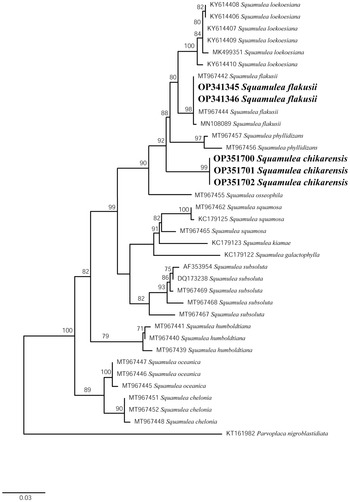
Phylogenetic relationships within Squamulea based on a maximum likelihood (ML) analysis of the ITS region. The ML bootstrap values ≥70 obtained from a RaxML analysis are shown above internal branches. New sequences generated in this study are in bold. Parvoplaca nigroblastidiata was used as outgroup.

Results
Phylogenetic analyses
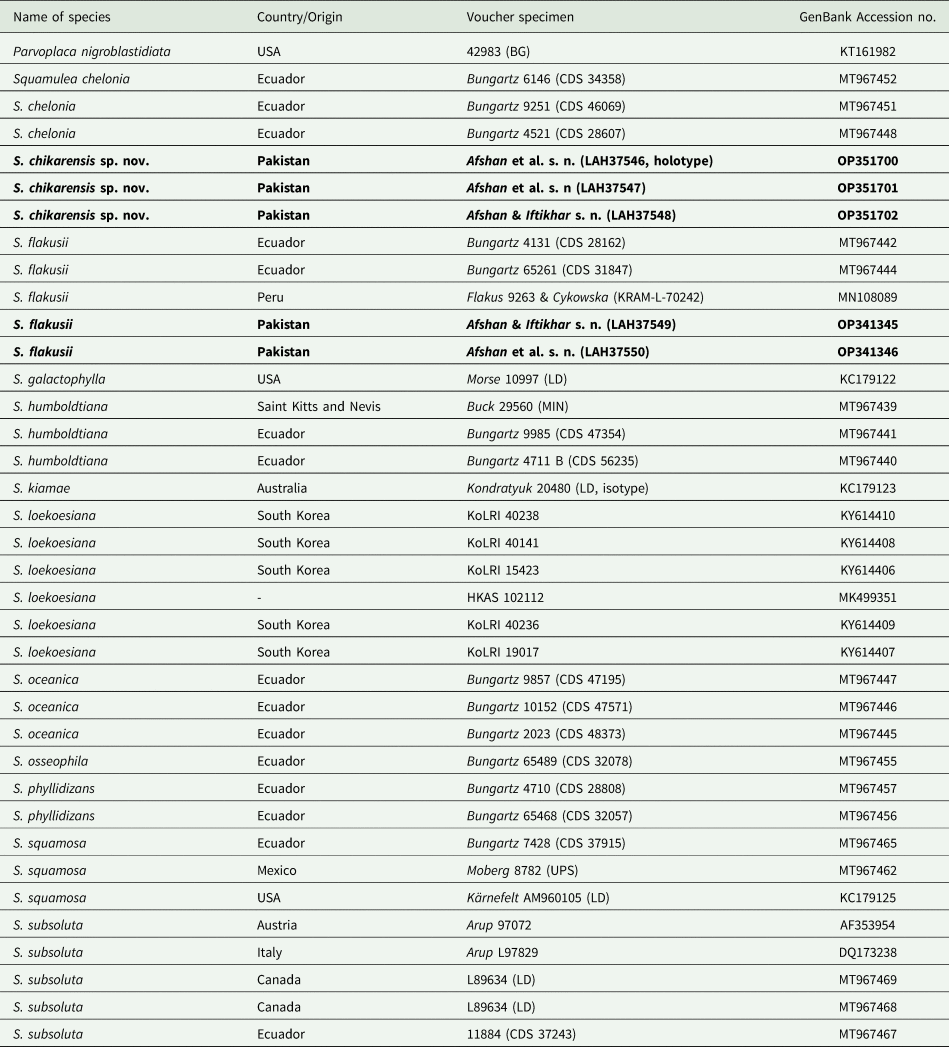
The final ITS dataset consisted of 35 sequences, representing 12 species of Squamulea and Parvoplaca nigroblastidiata (see Table 1 for voucher details). The aligned ITS1-5.8S-ITS2 region comprised 565 sites, of which 282 were conserved and 155 variable; 128 sites were parsimony-informative. Our phylogeny recovers S. chikarensis in a clade together with S. loekoesiana (S.Y. Kondr. & Upreti) Arup et al., (KY614406, KY614407, KY614408, KY614409, KY614410, MK499351), S. flakusii (Wilk) Arup et al., (MT967442, MT967444, MN108089, OP341345, OP341346), S. phyllidizans (Wetmore) Søchting & Bungartz (MT967456, MT967457) and in a basal position in the clade, S. osseophila Søchting & Bungartz (MT967455). This clade contains species from a wide geographical range and diverse substrata, including species with blastidia, microsquamules and no asexual propagules. Molecular methods are often required in Squamulea to distinguish species reliably. The ITS sequence of the holotype of S. chikarensis is identical to the sequences of additionally studied specimens (i.e. OP351701, OP351702). Two further newly generated sequences nested within the clade of S. flakusii previously known from Ecuador (Galapagos Islands) and Peru. We therefore report S. flakusii for the first time from Pakistan and Eurasia.
Sequences used in the ITS phylogenetic analysis of Squamulea species, with GenBank Accession numbers and voucher information. New sequences generated in this study are in bold.

Taxonomy
Squamulea chikarensis Afshan, Fayyaz, Iftikhar & Khalid sp. nov.
MycoBank No.: MB 845620
The taxon is characterized by a pale green to yellow thallus, large apothecia up to 0.8–1.8 mm wide, pale yellow to yellow-orange apothecial discs, hymenium 70–110 μm high, large ascospores (12–20 × 5–11 μm) and a narrow ascospore septum (1.5–3 μm).
Type: Pakistan, Azad Jammu and Kashmir, Chikar, moist temperate forest, 36 $^\circ $23′N, 75
 $^\circ $47′E, 3850 m alt., on rock, 2 October 2020, N. S. Afshan, I. Fayyaz & F. Iftikhar (MK-11) (holotype—LAH37546).
(Fig. 2)
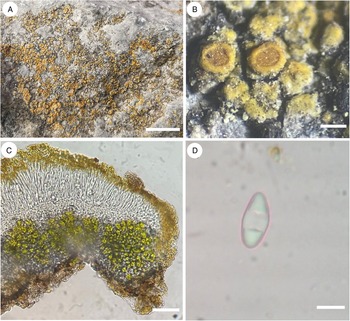
Squamulea chikarensis (holotype-LAH37546). A, squamulose thallus in natural habitat. B, apothecia. C, transverse section of apothecium showing paraplectenchymatous proper margin and hypothecium. D, ascospore. Scales: A = 1 cm; B = 1.5 mm; C = 100 μm; D = 10 μm. In colour online.
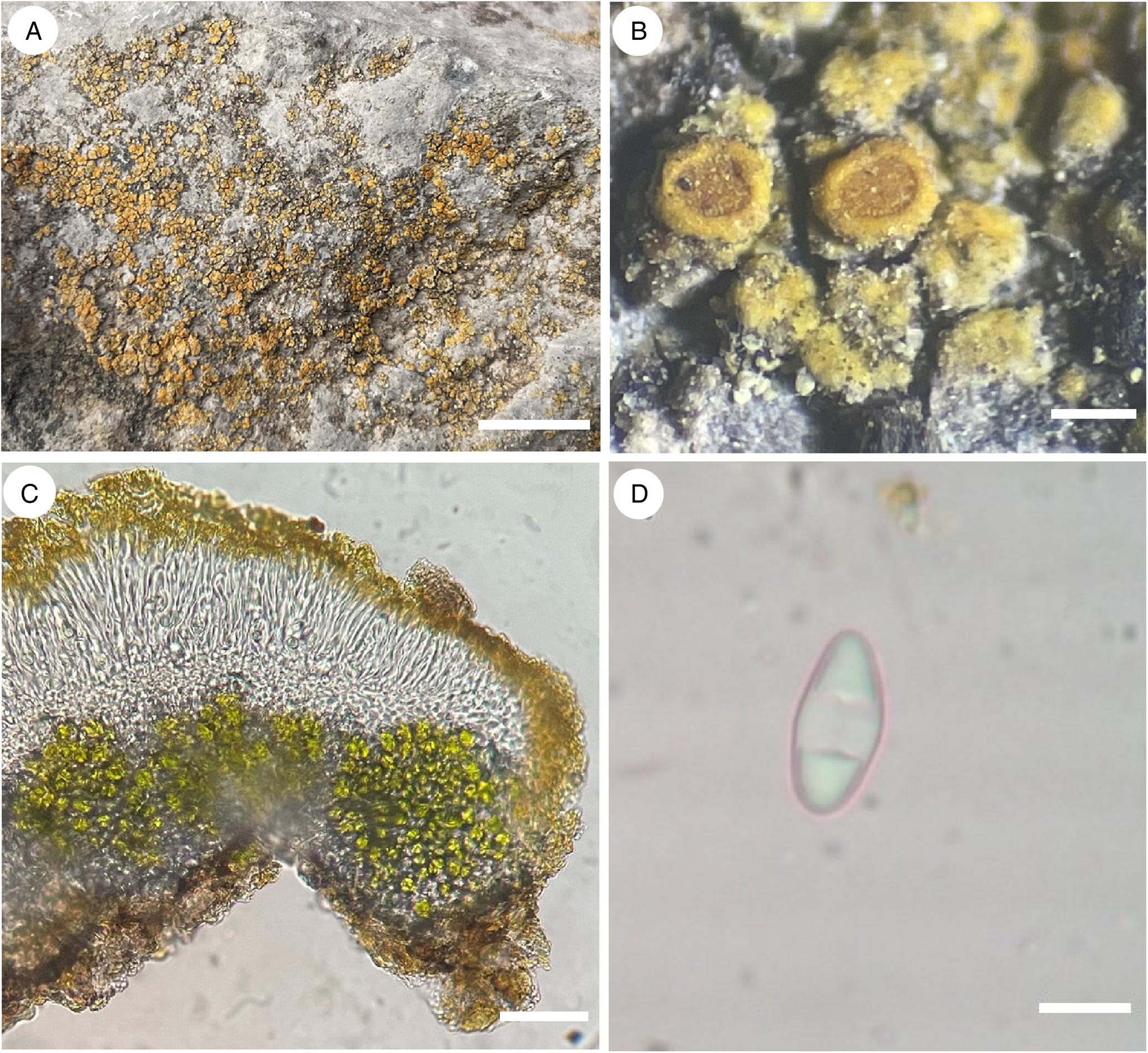
Thallus areolate to subsquamulose, areoles/squamules are scattered to crowded, flat to concave, pale green to yellow, slightly pruinose thallus irregular in outline, up to 2–4 cm diam., not delimited by a prothallus. Cortex paraplectenchymatous, even, 14–22 μm thick. Algal layer continuous, 53–65 μm thick. Photobiont cells more or less globose, trebouxioid, 9–15 μm. Medulla white, 60–75 μm thick.
Apothecia mostly sparse, erumpent to sessile, circular, (0.8–)1.0–1.4–1.6(–1.8) mm diam., zeorine. Disc concave to flat, pale yellow to yellow-orange, slightly contrasting against thallus, pruinose. Margin paler than disc, slightly prominent in young apothecia, then level with disc. Proper exciple thin, paraplectenchymatous. Thalline exciple thick, slightly/partly reduced, algae abundant, in a continuous layer. Epihymenium brownish orange, granular inspersed, K+ purple, 13–18 μm thick. Hymenium hyaline, 70–110 μm high. Paraphyses simple, septate, 2–3 μm wide, tips up to 5 μm. Hypothecium hyaline, not inspersed, paraplectenchymatous. Asci 8-spored, clavate, Teloschistes-type, 58–65 × 13–17 μm. Ascospores polarilocular, oblong to broadly ellipsoid, (12.0–)13.5–15.7–18.3(–20.0) × (5.0–)6.2–7.3–9.6(–11.0) μm, septa (1.5–)1.9–2.2–2.7(–3.0) μm wide.
Pycnidia not seen.
Spot test
Thallus and apothecia: K+ reddish brown, C−, KC+ dark red.
Chemistry
Thallus and apothecia with a large proportion of parietin and smaller proportions of teloschistin, fallacinal, parietinic acid and emodin (chemosyndrome A sensu Søchting (Reference Søchting1997)).
Etymology
The specific epithet ‘chikarensis’ (Latin) refers to the type locality Chikar, where the specimen was collected.
Habitat and distribution
The new species was collected in the Himalayas of Pakistan, on siliceous rocks in moist temperate forests, dominated mainly by Pinus roxburghii, Pyrus pashia, Quercus oblongata and Q. glauca. The maximum daily temperature of the region varies from 20–30 °C during the summer and averages 4 °C during the winter, with moderate rainfall.
Additional specimens examined
Pakistan: Khyber Pakhtunkhwa: Kaghan Valley, moist temperate forest, 34°30ʹN, 73°18ʹE, 2500–3000 m alt., on rock, 2021, N. S. Afshan & F. Iftikhar (SG-20) (LAH37548). Azad Jammu and Kashmir: Chikar, moist temperate forest, 36 $^\circ $23′N, 75
 $^\circ $47′E, 3850 m alt., on rock, 2021, N. S. Afshan, I. Fayyaz & F. Iftikhar (CKT-39) (LAH37547).
Squamulea flakusii (Wilk) Arup, Søchting & Bungartz
In Bungartz, Søchting & Arup, Plant and Fungal Systematics 65, 564 (2020).
(Fig. 3)
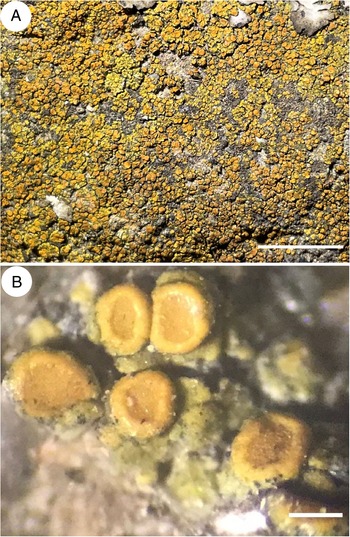
Squamulea flakusii (LAH37549). A, squamulose thallus in natural habitat. B, apothecia. Scales: A = 1 cm; B = 1 mm. In colour online.
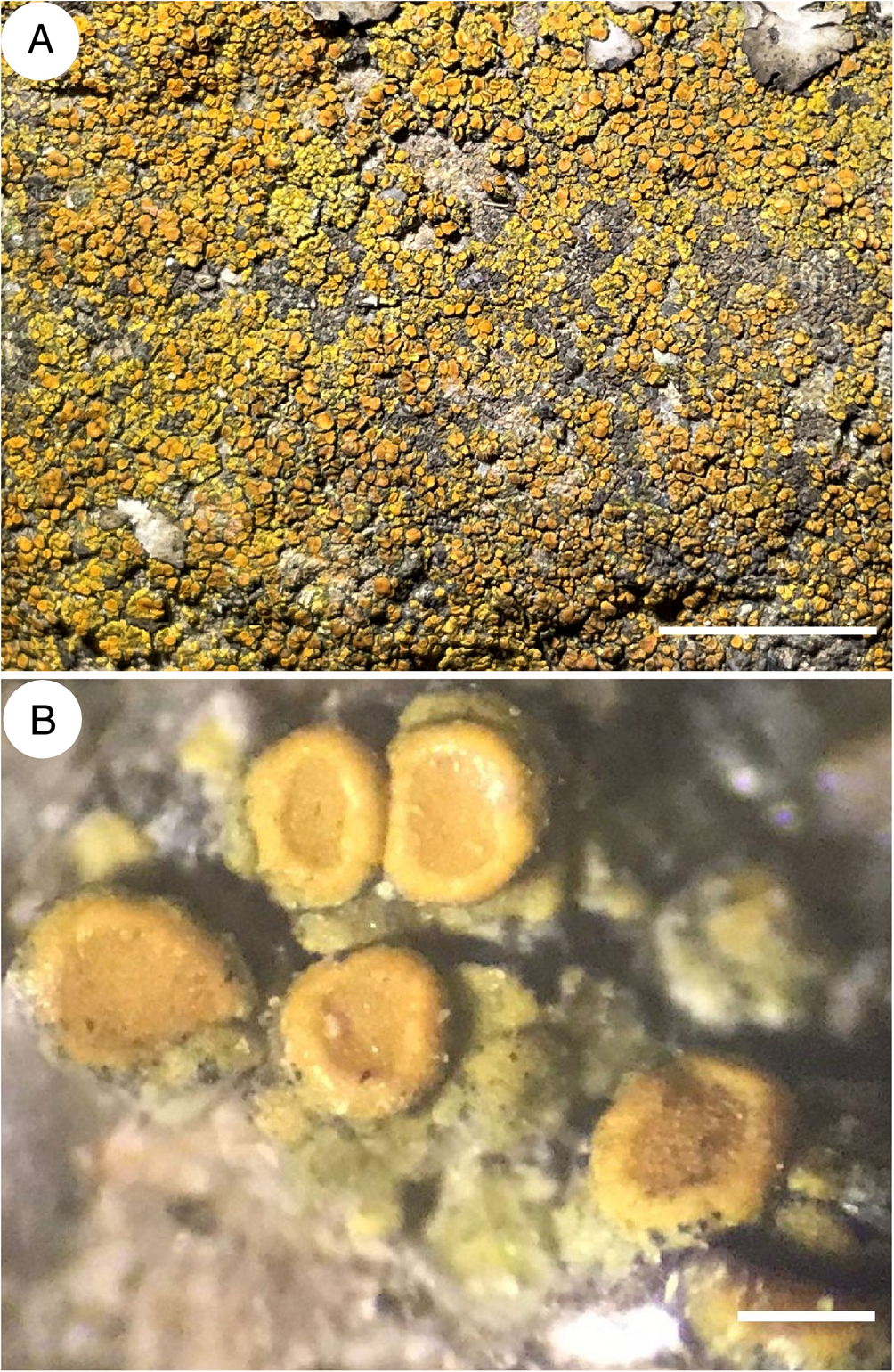
Thallus squamulose or strongly reduced and almost invisible, 2‒3 cm diam., orbicular to irregular in outline, pale yellow to dark yellow, pruinose, squamules flat to convex. Prothallus absent. Cortex thin to thick (in well-developed thallus), 27‒50 μm thick, paraplectenchymatous. Algal layer continuous. Photobiont cells trebouxioid, more or less globose, 9‒14 μm diam.
Apothecia abundant, somewhat crowded and aggregated, rounded, angular, old apothecia distinctly undulate, adnate, zeorine, (0.5–)0.8–1.0–1.2(–1.4) mm wide. Disc plane to strongly convex, yellow-orange to pale orange, pruinose, often cracked (especially in old apothecia). Proper margin thin, slightly prominent in young apothecia, then level with disc, slightly paler than disc. Thalline margin 65‒90 μm thick, conspicuous, much reduced, algal cells abundant, forming a continuous layer. Epihymenium light brown, 25‒38 um thick. Hymenium 60‒78 μm thick. Paraphyses simple to slightly branched, 2‒3 μm broad at base, with upper cells slightly thickened, up to 4 μm. Hypothecium 80‒140 μm thick, paraplectenchymatous, hyaline. Asci 8-spored, clavate, 50–63 × 12–22 μm. Ascospores polarilocular, usually broadly ellipsoid, 12–18 × 7–11 μm, septum (1.0–)1.3–2.0–2.6(–3.0) μm wide.
Pycnidia not seen.
Spot test
Thallus and apothecia: K+ purple, C−, KC+ purple.
Specimens examined
Pakistan: Khyber Pakhtunkhwa: Kaghan Valley, moist temperate forest, 34°30ʹN, 73°18ʹE, 2500–3000 m alt., on rock, 2021, N. S. Afshan & F. Iftikhar (SG-45) (LAH37549). Azad Jammu and Kashmir: Garhi Dupatta, moist temperate forest, 34°36ʹN, 73°35′E, 817 m alt., on rock, 2021, N. S. Afshan, I. Fayyaz & F. Iftikhar (CKR-07) (LAH37550).
Discussion
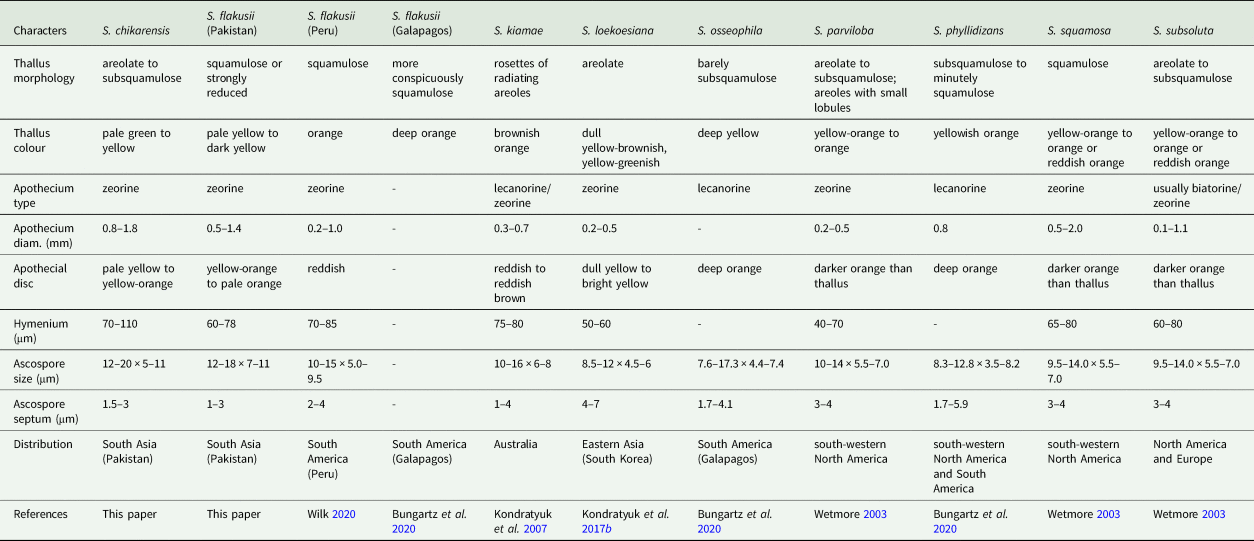
The species Squamulea chikarensis is characterized by minute squamules, usually scattered, large apothecia and large ascospores with rather thin septa. The comparison of the new species with its close relatives is presented in Table 2. Morphologically the new species resembles S. subsoluta, a widespread species also occurring in Pakistan (under the name Caloplaca irrubescens; Aptroot & Iqbal Reference Aptroot and Iqbal2012). However, S. subsoluta differs from the new species in having a yellow-orange to orange or reddish orange thallus, a blackish prothallus, a darker orange apothecial disc and smaller ascospores, 9.5‒14.0 × 5.5‒7.0 μm (Wetmore Reference Wetmore2003). Squamulea flakusii, newly recognized in the lichen biota of Pakistan, differs from S. chikarensis by having a pale yellow to dark yellow thallus, apothecia that are 0.5‒1.4 mm wide, a hymenium 60‒78 μm high and smaller ascospores, 12‒18 × 7‒11 μm.
A comparison of morphological and anatomical features of Squamulea chikarensis sp. nov. with selected Squamulea species.
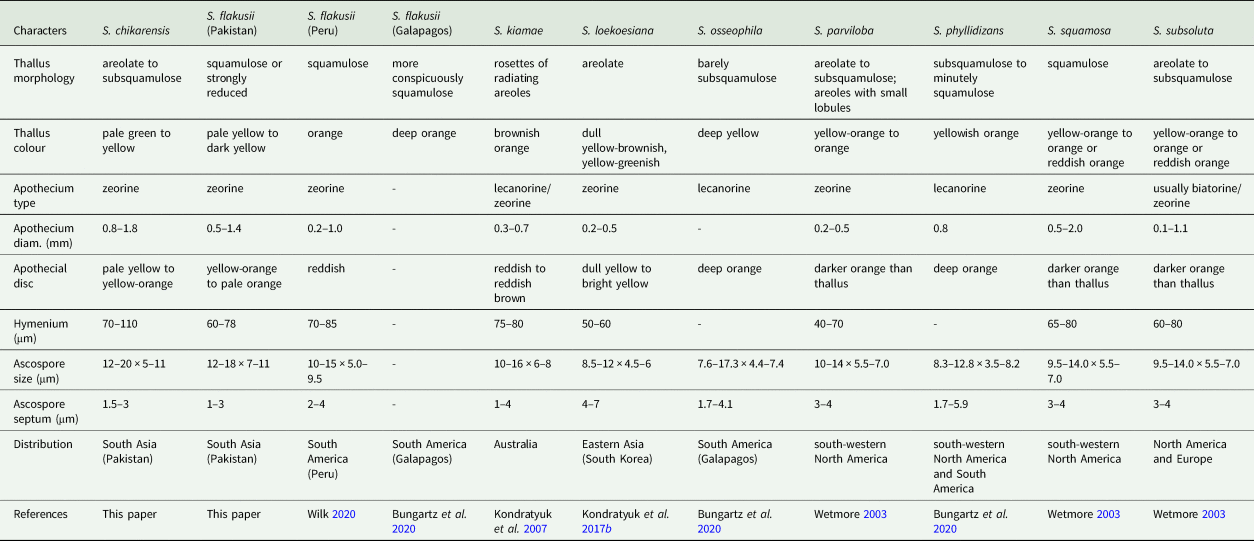
In the present study, Squamulea flakusii is morpho-anatomically and molecularly characterized, and confirmed as a new record for Pakistan. The morphological features of the Pakistani collections agree with the published description of S. flakusii (from South America, Peru) (Wilk Reference Wilk2020), with the exception of the following (features in brackets refer to the Peru collections): less reduced thallus (vs more reduced thallus), pale yellow to dark yellow thallus (vs orange thallus), less crowded and aggregated apothecia (vs more crowded and aggregated apothecia), larger apothecia up to 0.5‒1.4 mm wide (vs 0.2‒1.0 mm), yellow-orange to pale orange apothecial discs (vs reddish apothecial discs), larger ascospores, 12‒18 × 7‒11 μm (vs 10–15 × 5.0–9.5 μm) and a narrower ascospore septum, 1–3 μm (vs 2–4 μm). The morphology of Pakistani specimens of S. flakusii is, however, quite different to specimens from the Galapagos. Pakistani specimens have a pale yellow to dark yellow thallus (vs deep orange thallus) and are collected at an elevation of 817–3000 m alt. (vs above 1000 m alt. for Galapagos specimens). For a comparison of S. flakusii with S. chikarensis and other taxa, see Table 2 and the discussion under S. chikarensis.
Although Squamulea flakusii has been described from South America (Peru) and was then recorded only from the Galapagos Islands (Bungartz et al. Reference Bungartz, Søchting and Arup2020; Wilk Reference Wilk2020), its distribution in the Northern Hemisphere is possible. This could indicate that the species may be a widespread taxon, as in the case of S. subsoluta known also from Austria. To date, due to the uncertainty regarding phenotypic characters, phylogenetic analysis of DNA sequences is almost the only reliable way to distinguish species and to study the geographical distribution of Squamulea species (Bungartz et al. Reference Bungartz, Søchting and Arup2020). Therefore, our knowledge of those species should increase in the future with sampling and analysis of further Squamulea species. In Pakistan, S. flakusii was collected in the high mountain area, at 817–3000 m alt., in humid forest habitat, on siliceous rock, which more or less corresponds with the previous reports from South America. One Pakistani specimen sequenced (OP341346), however, was collected at c. 817 m alt., in moist temperate forest. The genus is probably more abundantly represented in Pakistan's lichen biota than is currently known.
Acknowledgements
We are very grateful to Dr Ulf Arup (Biological Museum, Lund University, Sweden) for his guidance and to Dr Karina Wilk (IB PAS, Krakow) for her useful comments, both helping to improve the manuscript considerably. We also thank Jason Hollinger (The Edgewood Institute, USA) for reviewing the English and helping us overcome grammatical mistakes. We are indebted to anonymous reviewers whose comments greatly improved the manuscript.
Author ORCIDs
Najam-ul-Sehar Afshan, 0000-0003-4538-3626; Iram Fayyaz, 0000-0001-6193-1069; Fatima Iftikhar, 0000-0003-4440-3787; Maria Jabeen, 0000-0001-9045-9293; Abdul Nasir Khalid, 0000-0002-5635-8031.